 The first night I
slept in my beach house, the ocean sounded like a promise.
Not a dramatic promise. Not the kind people post under filtered sunset photos so strangers can type jealous little hearts. Just the low, steady breathing of the Atlantic beyond my balcony, rolling toward shore and dragging itself back again, as if the water were reminding me of something simple and ancient: you made it here. You are allowed to rest. You are allowed to take up space.
Sullivan’s Island was warm in that soft Lowcountry way that makes the air feel almost lit from within. Porch lights floated through humidity. The smell of salt, jasmine, and fresh paint drifted through the open windows. Somewhere down the street a screen door slapped shut, then laughter carried briefly and disappeared into the dark. Inside, my new house was quiet. Too quiet at first, because I had spent so much of my life surrounded by other people’s demands that silence felt almost suspicious.
I stood barefoot in my kitchen and let my palm rest on the cool quartz counter I had picked myself, paid for myself, installed without anyone else’s opinion involved. A half-unpacked box labeled LINENS sat near the front door in my careful block handwriting. Another box marked BOOKS leaned under the console table. My bedroom still smelled faintly like cedar from the new dresser. The blue shutters outside the front windows cast pale moon-cut shadows across the floor, and every few minutes the wind moved through the palms in the yard with a hush that sounded like a hand smoothing wrinkled fabric.
It was mine. Mine in the cleanest, most miraculous sense. My name alone on the deed. My mortgage paid from my account. My keys in the ceramic bowl by the door. No second signature. No compromise. No one telling me that I did not need much space anyway.
I had spent twelve years earning that silence.
Twelve years turning bonuses into savings instead of trips. Twelve years eating leftovers at my desk in Charleston while coworkers flew to Cabo and posted rooftop cocktails from Miami. Twelve years saying, maybe next year, maybe later, maybe when the numbers are better, while I quietly moved money from one column to another and built my future in private. I had said no to furniture I wanted, apartments I could have stretched for, clothes that would have made my life look prettier in photographs. I had said yes to overtime, yes to clients who always needed one more revision, yes to being dependable in ways that exhausted me. Because someday I wanted a door that opened to my own key.
And that morning, at forty-three years old, I had signed my name at the bottom of the closing packet while the attorney smiled and slid the deed across the table and said, “Congratulations, Ms. Beckett.”
No one had ever handed me a future before. I had only ever built them.
At 11:20 p.m., my phone rang.
Victoria Hail.
My stepmother.
I stared at the name until it buzzed twice and something old and childish tightened in the center of my chest. I should have let it go to voicemail. Any sane woman would have let it go. But old training has roots. Deep ones. Roots that spread through the body long after the mind knows better. My hand moved before my dignity fully caught up.
“Hello?” I said.
“Bonnie.” Victoria said my name the way clerks call ticket numbers. No hello. No warmth. No congratulations on the house she had probably heard about from some distant family acquaintance and immediately decided should also belong to her. “We’re moving in tomorrow.”
For a second I thought I had misheard her. The waves continued outside, slow and regular. The refrigerator hummed. Somewhere above the sink, a cabinet door I had not shut tightly enough clicked open half an inch.
“I’m sorry?” I said.
“Your father says it’s fine,” she replied. Her tone was calm, bored, mildly inconvenienced by my need to be told things twice. “Paige wants the upstairs room with the balcony. Your father and I will take the primary suite. You can use one of the smaller rooms downstairs. You don’t need much space anyway.”
I sat up so fast the duvet slid off my legs and fell in a whispering heap to the floor.
“Victoria,” I said, and each syllable came out thin with disbelief, “this is my house.”
She gave a little dry laugh. “It is a house, Bonnie. Family shares. We will be there around ten. Make sure there is coffee.”
That last sentence landed clean and cold, like a slap wearing pearls.
Then she added, with the careless confidence of someone who had never once been seriously stopped in her life, “And if you don’t like it, you can find somewhere else to live.”
The line went dead.
I kept the phone against my ear long after the call ended, listening to the silence as if the silence itself might correct what I had just heard. Then I lowered it slowly and looked out across the dark water. My hands were trembling in my lap. Not dramatically. Not the sort of trembling that sends glasses crashing to the floor. Just a deep, involuntary tremor, the body remembering old threats before the mind can rename them.
Then, strangely, my mouth curved.
Not into a warm smile. Not into forgiveness. Into something stiller. Sharper. The kind of smile that rises from a place where fear has finally fermented into clarity.
Because I did not cry.
I did not call my father begging him to fix her.
I did not pace the house or scream into the phone or collapse on the new hardwood floors in gratitude to the old family script.
I remembered a hallway from seventeen years earlier. Cardboard boxes. Gum snapping between Paige’s teeth. Victoria in my doorway holding a clipboard like a queen taking inventory after conquest. I remembered the precise sensation of learning that people who steal from you count on your shock to keep you polite.
They count on good girls freezing.
I was not seventeen anymore.
When I was seventeen, my mother died in five months.
Ovarian cancer took her so quickly that memory still struggles to arrange the timeline into something logical. One month she was standing at the kitchen island in our Mount Pleasant house, reading a college brochure and telling me I was allowed to leave South Carolina if that was what my life required. The next month she was sitting down to fold laundry because standing for long made her dizzy. After that came the tests, the soft-faced doctors, the casseroles from people who suddenly spoke too gently, the smell of antiseptic and hand lotion and flowers turning sweet in water before anyone could throw them away. Then pain. Then exhaustion. Then the terrible speed of decline, the body giving up room by room while the mind remained painfully awake to it.
People love saying someone fought cancer. As if courage makes a disease negotiate. My mother had courage. What she also had was agony she tried very hard to hide from me until hiding became impossible. She still insisted on asking about my homework from bed. Still made lists. Still tried to remember whether we had enough eggs in the fridge. She was trying to mother me right up to the edge of disappearing.
The day she died, the house felt as if someone had turned off the heat from the inside.
I remember standing in the living room after the funeral, wearing a black dress I already hated, staring at the framed photograph on the mantle where she was laughing at something outside the frame and nobody had ever bothered to tell me what it was. The refrigerator hummed. A delivery truck groaned past on the street. Traffic moved over the Ravenel Bridge. A bird landed on the back fence and flew off again. I was furious at the world for continuing to behave as though the center had not just dropped out of mine.
My father, Gerald Beckett, was already a respected Charleston attorney by then. His name opened doors. Men at charity events clapped him on the back with visible eagerness. Judges nodded to him in grocery stores. Clients lowered their voices when he entered conference rooms because his reputation had weight. After my mother died, he worked more. I told myself, because I was seventeen and wanted to preserve some shape of him I could still trust, that work was how he survived grief. Courtrooms had rules. Loss did not.
He left early, came home late, and spoke in efficient fragments about deadlines, depositions, and appellate filings. The house became somewhere I haunted instead of lived. I ate dinner alone more often than not. I kept my mother’s lemon cake recipe taped inside a kitchen cabinet because it felt like proof that if I held on to enough of her small handwriting, some part of her might remain anchored.
Two years later, Victoria arrived.
At first she came wrapped in softness.
She brought casseroles in pretty glass dishes and stood in my father’s kitchen like she already knew where things belonged. She asked about my classes. She touched my shoulder in the exact way women do when they know they are being watched and would like credit for tenderness. She paused in front of my mother’s photographs and said, “She was beautiful,” in a voice tuned carefully enough that I hated myself for wanting to believe her.
I wanted to hate her from the start. I wanted that. It would have been easier. Cleaner. But grief makes you hungry in embarrassing ways. It makes warmth look like medicine. And Victoria understood performance better than anyone I had met in my young life. She knew when to sigh. When to lower her eyes. When to let a sentence trail off into apparent compassion. She knew how to stand in church foyers and receive pity as if she had earned it merely by being willing to love a widower.
When she married my father, I tried to be generous. I really did.
I told myself she was not replacing my mother. I told myself grown-ups were complicated and lonely and maybe marriage after grief was not betrayal but survival. I told myself I was nearly an adult and therefore should not make things harder than they already were.
That illusion lasted until she unpacked.
The first thing she took from me was not money.
It was my room.
I came home from a weekend study trip at a friend’s house and found movers carrying boxes labeled BONNIE’S THINGS down the hallway. My posters had been ripped from the walls and rolled into cardboard tubes. My books were stacked crookedly in laundry baskets. My bed frame leaned disassembled against the banister. Paige, Victoria’s daughter, stood inside my room with her gum snapping and her head tilted slightly, already imagining where her vanity would go.
Victoria stood in the doorway holding a clipboard.
“What is this?” I asked.
She did not even turn fully toward me. “Paige needs a brighter room. Yours gets the morning sun. You will be more comfortable downstairs.”
Paige was fourteen then, blonde, sharp-faced, and already possessed of the kind of smug cruelty that only flourishes in children who know an adult will protect them from consequences. She looked at me like I was a former tenant lingering too long after an eviction notice.
“This is my room,” I whispered.
Victoria finally looked at me and smiled in a way that showed every tooth without revealing a single human feeling. “Bonnie, your father and I discussed it. Don’t make this awkward.”
My father stood at the end of the hallway with his tie loosened and his briefcase still in hand. I looked at him, waiting. Waiting for him to say my name in the tone fathers use when they are still fathers first. Waiting for him to tell the movers to stop. Waiting for him to choose me once.
He only said, “It’s just a room, sweetheart.”
That was the day I learned a home can be taken while you are still standing inside it.
After that came the smaller thefts, the ones people dismiss because each one on its own sounds too petty to explain why it matters. My mother’s china went into storage because Victoria said the pattern looked old-fashioned and depressing. My college fund was “temporarily reallocated” to cover a private academy deposit for Paige because she “needed the better environment.” My mother’s necklace vanished from my jewelry box and reappeared on Paige during Christmas brunch, the emerald stone bright against her white sweater while Victoria said, “Oh, that old thing? Gerald said it should stay in the family.”
Every protest I made was turned back on me. Victoria called me dramatic. My father called me sensitive. Paige called me pathetic when no one else could hear.
So I learned silence.
I learned how to smile without showing my actual thoughts. I learned to keep copies of anything that could later matter. I learned that people who steal most effectively often begin by telling you that you are rude for noticing. And because I was not stupid, however much they preferred to act as though I were merely difficult, I also learned to build every serious dream in secret.
That beach house was the biggest secret I had ever kept.
No one in my family knew I had spent three years watching listings. No one knew I had opened a separate savings account twelve years earlier and nicknamed it TIDE in my banking app so no one glancing at my phone would guess what it meant. No one knew that each annual bonus from the medical consulting firm where I eventually became a partner went into that account before I let myself pay for anything indulgent. No one knew that I had made myself skip weddings, girls’ trips, spa weekends, and a dozen little luxuries because every time I pictured salt light on white walls, it steadied me more than any temporary pleasure could.
And when I finally found the house—white exterior, blue shutters, slightly crooked palms in the front yard, a balcony facing the water—it was as if some private version of my mother had been waiting there, not haunting it exactly, but blessing it from a distance.
That was what Victoria had tried to enter by phone. Not just real estate. Not just square footage. The first place that had ever felt like my own life spoken aloud.
I went downstairs, turned on the kitchen light, and laid the closing folder on the counter. The deed. The mortgage note. The title insurance documents. My name. Only my name. I checked the security system app I had installed that morning. Cameras active. Smart lock active. Motion alerts on. I walked through the house once in the dark, looking at every window, every door, every bolt. Then I poured myself a glass of water and did something I had not done in years.
I called my father first.
He answered on the fourth ring, voice thick with sleep and irritation. “Bonnie? What is wrong?”
The simplicity of that question almost made me laugh.
“Did you tell Victoria she could move into my house tomorrow?”
Silence.
Not the silence of confusion. The silence of a man trying to decide how much truth he can get away with.
Then he sighed. “She said you had plenty of room. It would only be until we figure things out.”
I stood very still in my moonlit kitchen. “Figure what out?”
More silence.
“We sold the Mount Pleasant house,” he said at last.
The air changed.
That house. My mother’s house. The one he had promised, more than once, would remain in the family. The one with the cabinet where her lemon cake recipe still lived taped inside the left door because I had not been able to remove it even after all these years. The one where my childhood was buried under every floorboard, for better and worse. The one place I had assumed, stupidly, at least held some line he would not cross.
“You sold Mom’s house?”
“Victoria thought it was time,” he said, sounding defensive already. “The market was very strong. Paige has had financial setbacks, and we needed flexibility.”
I gripped the phone harder. “What does Paige’s life have to do with my mother’s house?”
“Bonnie, don’t start this.”
Start this.
As if he were not the one calling me after midnight to tell me his wife had announced a takeover of my new home. As if history were some hobby I had chosen.
“Did you promise her my house?” I asked.
“I told Victoria family would take care of family.”
I closed my eyes.
No more fear now. No more grief. Just a cold, clean clarity spreading through me like seawater.
“So Victoria sold my mother’s house,” I said slowly, “helped Paige, and assumed she could move into mine.”
“Don’t say it like that,” he snapped, but there was no force behind it. He sounded tired. Cornered. Embarrassed.
I looked past the glass doors toward the black line of the ocean.
“No,” I said softly. “I think I’m finally saying it exactly right.”
He started to say my name, perhaps for sympathy, perhaps for authority, perhaps because somewhere inside himself he still believed those two things were interchangeable. But I had already ended the call.
Then I called a lawyer.
Not my closing attorney. A probate litigator named Josephine Greer whose number I still had from years earlier when a friend at work told me, after some unrelated family headache, that if I ever needed someone who could untangle inheritance disputes without blinking, Josephine was the woman to call. It was a wild thing to do at nearly midnight, but money buys access and long careers buy instincts. Her answering service patched me through. When she heard the name Gerald Beckett, her tone sharpened.
“I know who he is,” she said. “What happened?”
So I told her. The beach house. Victoria. The phone call. The sale of Mount Pleasant. The fact that my father was an attorney, my mother had died when I was seventeen, and I had never been shown the full probate file because back then he had said, with offended dignity, that he was handling everything.
Josephine asked three quick questions. Had the Mount Pleasant property originally belonged to my mother’s side of the family? Yes—my maternal grandmother had left it to my mother five years before she died. Had I ever received any formal notice of sale or distribution? No. Did I know whether my mother had a will? Yes. I had seen one years ago, briefly, after the funeral, before my father said not to worry about “adult paperwork.”
“Email me every name, date, and document you have,” Josephine said. “And send me a photograph of the old tax bill if you’ve ever kept one.”
I actually had. Because I kept everything.
By 1:10 a.m. I had sent her copies of old Christmas cards with the Mount Pleasant return address, a photo of my mother standing on the front porch the year before she died, a scanned county tax statement I had once needed for some sentimental reason and never deleted, and the only probate-related paper I still had—a polite letter from my father’s firm sixteen years earlier saying the estate had been “administered in accordance with the decedent’s wishes.”
At 2:03 a.m., Josephine called back.
“Do not let them through the door tomorrow,” she said.
I sat down at the kitchen island. “Why?”
“Because your father may have just created the worst kind of problem for himself.”
She had pulled the probate file electronically and found the will.
My mother, whose maiden name was Annalise Mercer, had inherited the Mount Pleasant house as separate property from my grandmother. In her will, she had granted my father a limited right to live in the home while acting as executor, with one condition so important it had been repeated twice. If he remarried or attempted to transfer, encumber, or sell the property, all rights terminated immediately and the house—or its proceeds if sold with proper authorization—passed to me.
I could not speak.
Josephine continued, voice calm and precise. “Your father remarried two years after your mother died. Which means the occupancy right terminated then. If he continued representing himself as sole lawful owner after that, especially in connection with a sale, we have grounds to challenge everything from authority to disbursement.”
My heart was beating so hard it made the skin at my throat flutter.
“He’s an attorney,” I whispered.
“Yes,” Josephine said dryly. “That is part of what makes this so professionally stupid.”
The room around me seemed to sharpen. The cabinet edges. The grain in the wood floor. The pale reflection of the pendant lights in the window glass.
“What happens now?” I asked.
“What happens now is that I file emergency notice before anyone spends a dollar. Title company. closing attorney. listing broker. If the proceeds have not fully cleared, we freeze them. If they have, we trace. I also want copies of your security footage if they show up tomorrow, because if your stepmother threatens access to your home based on funds tied to a contested estate, I want the whole pattern.”
A laugh rose in me then, half disbelief, half relief so intense it bordered on nausea.
“Coffee,” I said aloud without meaning to.
“What?”
“She told me to make sure there was coffee.”
Josephine was silent for half a beat.
“Then make coffee,” she said. “But not for them.”
I barely slept. I sat on my balcony until almost dawn with a blanket around my shoulders and a legal pad on my lap, writing down every detail I could remember from the past twenty years. The room theft. The necklace. The college fund. The way Victoria always spoke about my mother’s things as though they had simply been waiting for her better taste. The time Paige bragged drunk at Christmas that she would get “the big pieces” one day because Bonnie was “too plain to fight.” The date of my father’s remarriage. The year the Mount Pleasant deed changed tax mailing addresses. The promise he had made at least twice in front of witnesses that my mother’s house would stay in the family.
By sunrise I had three pages of notes and a steadiness I had not felt in years.
At 8:15 a.m., Josephine texted: Funds frozen pending review. Do not engage beyond what is necessary. Deputy may attend if needed.
At 8:26, another text: Also, Bonnie—you were right to call.
I took a shower, dressed carefully in white linen pants and a pale blue blouse, twisted my hair into a low knot, and put on my mother’s tiny gold stud earrings—the only piece of hers I had left that Victoria had never managed to touch. Then I made coffee.
Not because Victoria had told me to. Because I wanted the house to smell like my terms when the morning began.
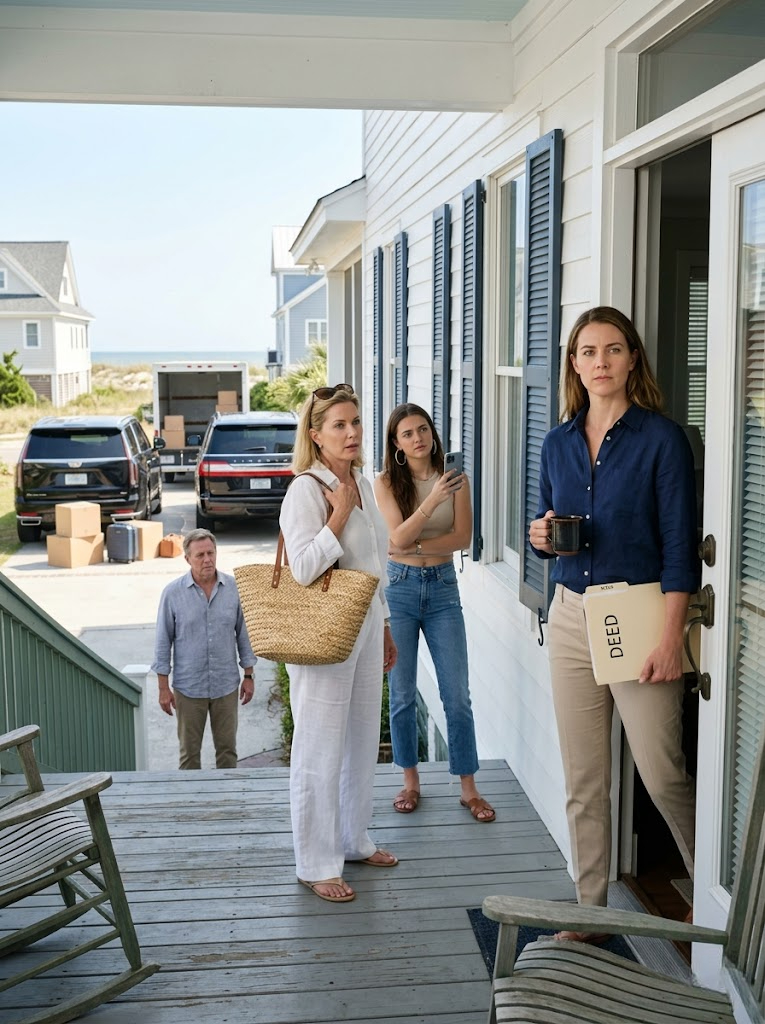
At 9:57 a.m., two black SUVs turned into my driveway.
The timing was so exact it would have been funny if it had not been so insulting. Victoria stepped out first wearing white linen, oversized sunglasses, and the expression of a woman arriving at a property she already considered beneath her management. She carried a woven tote bag on one arm and wore lipstick too dark for daytime. Paige came next, all long tanned legs and expensive athleisure, filming the front of the house on her phone as if documenting an upgrade for social media.
My father got out last.
He looked older than he had on the phone. Not merely tired. Smaller somehow. His hair, once thick and carefully silver at the temples, seemed flatter. The skin around his mouth had taken on the downward pull of a man whose decisions had begun returning home to roost. Behind the SUVs, lumbering into the driveway with comic obscenity, came a moving truck.
Victoria walked up the porch steps and smiled when she saw me through the glass.
Then she reached for the handle.
The smart lock held.
Her smile slipped.
I stood inside with my coffee in one hand and my mother’s will folder in the other. She knocked once. Then harder. Then hard enough to make the glass rattle in the frame.
I opened the door three inches.
Victoria leaned forward. “Honestly, Bonnie, don’t be childish. We have movers waiting.”
I looked at her calmly. “The coffee isn’t for you.”
Her mouth tightened.
“It’s for my attorney,” I said, “and the deputy who just froze the money from the house you never had the right to sell.”
For the first time in my life, Victoria Hail had no immediate expression ready.
She blinked. Once. Then twice. Behind her, Paige lowered her phone. My father went still in the exact way guilty men do when the floor shifts under them a second time in less than twelve hours.
Victoria recovered first, of course. Women like her survive as long as they do by treating panic like a private skin condition.
“What nonsense has Gerald been filling your head with now?”
“My father didn’t tell me,” I said. “My mother did. In her will.”
My father’s face drained.
There is a quality to some silences that feels almost ceremonial, as if the world pauses to acknowledge that a lie has finally run out of room. Even the movers behind the truck seemed to sense something was wrong. One of them stepped down from the cab and glanced toward the porch with open curiosity.
Victoria laughed, but the sound came out too high. “Bonnie, you are embarrassing yourself.”
“No,” I said. “I’m embarrassing you. There’s a difference.”
She took a step toward the doorway, and I moved just enough to show that the gap would not widen.
“Move,” she snapped, her voice dropping into the tone she used when no audience she cared about was present. “We are not doing one of your emotional scenes.”
Paige rolled her eyes. “Mom, seriously, can we just get inside? It’s already hot.”
Then my father said my name. Softly. Carefully.
“Bonnie.”
I looked past Victoria at him.
He had removed his sunglasses and held them uselessly in one hand. There was something in his face I had spent half my life wanting—fear, yes, but also recognition. Not of my pain. Of my seriousness. Men like my father often do not believe in consequences until the paperwork has their own name on it.
“Josephine Greer contacted Halsey Title at eight-oh-five this morning,” I said. “She also contacted the broker, the closing attorney on the Mount Pleasant property, and the probate clerk. If you spent any sale proceeds already, they’re traceable. If you signed that sale affidavit after your rights under Mom’s will terminated, you didn’t just lie to me. You lied on record.”
Victoria turned toward him. “What is she talking about?”
He did not answer.
That was answer enough.
Paige lowered her phone completely now. “Wait. What?”
Victoria’s head snapped back toward me. “This is absurd. Gerald owned that house.”
“No,” I said. “He occupied it. Until he remarried. Which terminated his right. That’s in the will too.”
Her face changed.
It was not dramatic. I wish it had been. I wish her composure had shattered beautifully, glass all over the porch. But people like Victoria rarely break in ways satisfying to spectators. What happened instead was subtler and somehow uglier. Her features rearranged themselves around calculation. She looked at Gerald, then at me, then at the moving truck, then back at Gerald as if trying to determine how much of the new disaster belonged to him and how quickly she could step away from it if needed.
“You told me the house was yours,” she said.
My father swallowed. “I believed—”
“No.” My voice cut across his. “You knew.”
He stared at me.
I held up the folder and felt no tremor at all now. “Mom’s will was explicit. Separate property. Conditional occupancy. Transfer to me upon remarriage or attempted sale. You are a lawyer. You read it.”
His mouth opened, then closed.
Victoria’s tote slid slowly off her shoulder and landed against her leg. “Gerald.”
He still did not look at her.
Down the street a gull screamed. The palms ticked softly in the wind. Somewhere inside my house the coffee maker clicked into its warming cycle.
Then another car turned into the driveway.
A dark sedan. Josephine Greer at the wheel, sunglasses on, expression unreadable through the windshield. Behind her, a county deputy in an SUV.
Victoria actually took a step back.
Josephine got out carrying a slim leather portfolio and climbed the porch with the calm grace of a woman who had spent twenty years walking into other people’s disasters with better shoes and more authority than anyone present. She was in her late fifties, silver hair in a smooth chignon, white blouse, navy trousers, no wasted motion anywhere in her body.
“Good morning,” she said.
The deputy remained near the base of the steps, not aggressive, just present in a way that made the moving men suddenly very interested in checking straps on the truck.
Victoria found her voice first. “Who exactly are you?”
Josephine handed her a packet of papers. “Josephine Greer. Counsel for Ms. Bonnie Beckett. You have been provided notice that any attempt to enter this property without her permission constitutes trespass. You have also been notified of a probate and title dispute concerning the recent sale of the Mount Pleasant residence formerly belonging to Annalise Mercer Beckett.”
Paige stared. “Oh my God.”
My father looked as though he had been struck.
Victoria glanced down at the top page and went white. “Restraining notice?”
“Preservation and non-dissipation demand,” Josephine corrected. “Among other things.”
The deputy, a broad-shouldered woman with a kind, impassive face, addressed the moving crew. “Gentlemen, you’ll need to hold here until the property owner instructs otherwise.”
One of them pointed uncertainly at Victoria. “She booked us.”
The deputy nodded. “And this lady”—she indicated me—“owns the house you are currently planning to unload into. So until she says yes, the answer is no.”
There are moments when revenge tastes less like victory than oxygen. That was one of them.
Victoria tried once more to regain altitude. “Bonnie, this is unnecessary. We are family.”
I laughed then. I could not help it. A real laugh this time. Light. Brief. Almost cheerful.
“You only say family when you want access to something locked,” I said.
Paige looked from me to Josephine to my father. “Mom, what is happening?”
Victoria rounded on Gerald with a violence she usually reserved for private settings. “You told me everything was handled.”
Josephine adjusted her glasses. “Mr. Beckett, I strongly recommend that from this moment forward you stop speaking unless through counsel.”
My father finally found enough of himself to say, “Bonnie, please. Let’s discuss this privately.”
I looked at him, at the lines around his eyes, at the familiar face that had once carried me asleep from the car to bed after late school plays, that had taught me to ride a bike, that had once cried at my mother’s funeral and made me believe we were the same species of grieving animal. Then I looked at Victoria, at Paige, at the moving truck they had ordered to my home as if I were still the girl they could push downstairs.
“No,” I said. “Public is where you like making your decisions.”
Victoria’s composure cracked first.
It happened when Paige, in that astonishingly selfish way of entitled daughters everywhere, said, “So where are we supposed to go?”
Not Are we in trouble. Not Did you lie. Not What did we do.
Where are we supposed to go?
Victoria turned to her and snapped, “Be quiet.”
Paige’s face twisted. “Don’t tell me to be quiet. You said this was handled.”
My father rubbed one hand across his mouth. The deputy looked politely away. Josephine stood like a monument.
The moving men began quietly re-securing the truck.
It would have been easy then to humiliate them further. To list every theft. The room. The college fund. The necklace. The years of gaslighting. The beach house itself. I could have stood there and finally read my family aloud to themselves. But power does not always require performance, and I had already spent too much of my life reacting to people who mistook noise for control.
So I stepped fully onto my porch, closed the door behind me, and said the only things that mattered.
“You are not moving into my house. You are not touching my property. And if any one of you steps through this door without permission, I will have you removed.”
My father said my name again, but it sounded weaker this time. Less like authority. More like memory.
I kept going.
“As for Mount Pleasant, the money is frozen. Josephine will be in touch with your counsel. If there is anything left of my mother’s things, you will return them.”
Victoria actually recoiled at that last sentence, which told me more than I wanted to know.
“What things?” Paige asked.
I looked at the emerald pendant resting against her throat.
My mother’s necklace.
I had not even noticed it at first. Perhaps because the rest of the morning had already exceeded my capacity for insult. The stone flashed green in the sun as Paige turned toward me, one hand reflexively touching it.
“That necklace,” I said.
Paige’s hand dropped.
Victoria stepped between us instinctively. “Now see here—”
“No,” I said, and for the first time in my entire life Victoria Hail stopped mid-sentence because of me. “You’ve spent twenty years teaching me that anything not protected will be taken. I listened.”
Josephine cleared her throat very gently. “Ms. Hail, if items belonging to Annalise Mercer Beckett’s estate were distributed inconsistently with testamentary instructions, now would be an excellent time to begin inventory.”
Victoria stared at her.
The deputy shifted slightly and said to no one in particular, “I’d recommend everybody keep this civil.”
Gerald closed his eyes.
When he opened them again, he looked at me with the exhausted recognition of a man who has finally run out of excuses that flatter him.
“I was trying to keep everyone housed,” he said quietly.
The sentence was so miserably small that for a second I did not know whether to laugh or cry.
“Then you should have started by not selling my mother’s house to finance Paige’s failures,” I said.
Paige gasped like I had struck her.
“You don’t know anything about my life.”
“No,” I said. “Because every time your life falls apart, someone else pays for it.”
Victoria spun on me. “How dare you judge my daughter.”
I met her stare without blinking. “You judged me at seventeen and billed me rent in humiliation for twenty years. We’re finally using the same currency.”
The deputy coughed once into her fist, perhaps to hide a reaction.
What ended the scene, strangely, was not law or fury but logistics. One of the moving men, red-faced and increasingly impatient, walked halfway up the drive and said, “Ma’am, if we’re not unloading, we need a new destination or we start storage charges.”
Victoria rounded on him as if he had insulted royalty. “Can you not see we are in the middle of something?”
He looked at the deputy, then at Josephine, then at me. “Yes, ma’am,” he said. “That’s why I’m asking.”
I smiled.
It was not kind.
That was when Victoria lost whatever remained of her morning. She snapped at the movers, snapped at Paige, snapped at Gerald, then pulled off her sunglasses with enough force to bend one arm. “This is your fault,” she hissed at my father. “All of it.”
Paige started crying, not from remorse but inconvenience. Gerald looked ten years older than he had the night before.
And I, standing on my own porch with the ocean at my back, realized something I should have understood years earlier. The opposite of powerlessness is not rage. It is steadiness.
I let them leave without another word.
The moving truck reversed first, tires crunching over oyster-shell gravel. The SUVs followed. Victoria never looked back at me. Paige did once, red-eyed and furious, her mother’s necklace still flashing at her throat like stolen light. My father paused at the passenger door of his car and turned slightly, as if he wanted to say something final, salvaging, paternal. Then Josephine moved one paper in her hands and whatever impulse had risen in him died on the spot.
By 10:19 a.m., my driveway was empty again.
The silence afterward was so complete I could hear the distant shudder of the tide against the pilings at the end of the street.
Josephine stayed for coffee.
We sat at my kitchen table with the windows open and the house still smelling faintly of confrontation and dark roast. She explained the next steps with the same calm precision she had used on the porch. Because the sale of Mount Pleasant had closed only the previous afternoon, most of the proceeds were still within the banking system’s active transfer window and had been frozen before full disbursement. The buyer, once informed of the title dispute and conditional will language, was already speaking to their own counsel. My father’s role as executor and attorney made the situation far worse for him because a court would not look kindly on “misunderstanding” from someone trained to understand precisely these documents.
“Do you want the house back?” Josephine asked.
I looked out toward the ocean and thought of Mount Pleasant.
The front walk lined with camellias. The crack in the third kitchen tile my mother used to joke gave the room character. The cabinet door with the lemon cake recipe taped inside in faded tape. The upstairs room that had once been mine until it wasn’t. The staircase where I had stood with boxes of my own clothes while Victoria directed movers around me as if I were furniture. Every version of myself still trapped in those walls, some beloved, some unbearable.
“I want what was hers protected,” I said. “I want what was mine returned. But I don’t know if I want to live inside that history again.”
Josephine nodded. “That is often the healthiest answer.”
I laughed softly. “Healthiest is not usually the family specialty.”
“No,” she said dryly. “I gathered.”
After she left, I walked through my house slowly, touching things. The banister at the stairs. The cool glass of the balcony door. The pale linen curtains in the guest room. My own bed, still unmade. Ownership feels abstract until someone tries to override it. Then every hinge becomes intimate.
That afternoon I received six missed calls from my father, three from an unknown number that later turned out to be Victoria’s friend Celeste, and one voicemail from Paige in which she cried for thirty seconds and then said, “I hope you’re happy,” before hanging up. I saved it. Not because I planned to use it. Because I had long ago learned the value of letting entitled people narrate themselves.
Two days later, the first formal tremor hit Charleston legal circles.
My father’s firm, Beckett & Harrow, placed him on administrative leave pending internal review. That was the sanitized language. The actual meaning was simpler: someone at the firm had realized a senior partner might have signed false estate authority documents in a real estate sale involving a conditional testamentary transfer. Lawyers are many things, but they are rarely sentimental when liability begins sniffing around the curtains.
By the end of the week, the buyer of Mount Pleasant had withdrawn and filed a claim against the title insurer. The sale had effectively collapsed. My father’s brokerage agent stopped returning Victoria’s calls. Paige posted a cryptic Instagram story about “toxic people weaponizing paperwork,” which remained online for fifty-three minutes before disappearing under what I imagine was legal pressure or maternal hysteria.
Then came the inventory.
That was Josephine’s idea, and in retrospect it may have been the cruelest possible form of justice, which is precisely why it worked so well. Because my mother’s will had transferred certain personal effects with the house, and because ownership of the house itself was now under dispute, every significant item removed from Mount Pleasant needed to be accounted for.
Victoria hated this.
She hated lists. She hated evidence. She hated anything that reduced her reign of taste and entitlement to numbered lines and signatures. But the court order was clear. Until title and estate matters were resolved, nothing could be sold, gifted, hidden, or “misplaced.”
So a week later I stood in the foyer of the Mount Pleasant house with Josephine, a court-appointed estate examiner, and two boxes of inventory tags while Victoria hovered in the living room like a disgraced empress denied the right to rearrange cushions.
The smell hit me first.
Not my mother’s perfume. That had faded years ago. Something else. Lemon polish. Old wood. Faint mildew from Charleston humidity working quietly at the baseboards. It was my childhood in scent form, and for one destabilizing second I was seventeen again, coming in from school, hearing my mother in the kitchen.
Then I saw the walls.
Victoria had redecorated them in shades of expensive blandness. My mother’s deep blue hallway runner was gone. The watercolor of marsh grass she loved had been replaced with abstract gray lines. The china cabinet held modern sculptural bowls instead of the dishes my grandmother passed down. But underneath all that, the structure remained. Same banister curve. Same narrow scratch by the coat closet where I once dragged a suitcase too hard after a college trip. Same cabinet. Same door.
The lemon cake recipe was gone.
That hurt more than I expected.
I walked straight into the kitchen and opened the cabinet myself. Clean wood. New contact paper. No taped card. No handwriting.
“Where is it?” I asked.
Victoria, standing five feet away, said coolly, “Where is what?”
“The recipe that was taped inside this door.”
She shrugged. “It was old paper, Bonnie. The kitchen needed updating.”
I turned slowly toward her.
“There are people,” I said, “who leave rooms better than they found them. And then there are people like you, who mistake erasure for improvement.”
Her face sharpened. “Don’t be sanctimonious in my house.”
Josephine did not look up from her notepad. “For present purposes, Ms. Hail, that remains very much in dispute.”
Paige was not there that day. She had apparently gone to stay with a friend rather than witness the humiliation of itemized accountability. Gerald arrived halfway through and looked as if he had not slept. He watched the examiner tag silver, photographs, old correspondence boxes, jewelry cases, and art with a kind of slow horror, as though only now realizing that the story he had told himself for years—that history can be managed by silence—was being dismantled one object at a time.
I found my mother’s necklace in Victoria’s dressing room.
Of course I did. Where else would a thief with taste issues keep something she had never deserved? It lay in a velvet tray beside two newer pieces Gerald must have bought her over the years to reward loyalty or soothe whatever performance of injury she currently specialized in.
When the examiner lifted the necklace with gloved hands and read the appraisal note attached from the old estate file, Victoria actually said, “Paige has worn that for years.”
“And my mother wore it for thirty before that,” I replied.
Gerald flinched.
The college fund records were harder to untangle but not impossible. My father had indeed “temporarily reallocated” a portion of the account intended for my education. Only temporary turned into permanent the way it so often does when the victim is the dependable child and the beneficiary is the favored one. Under ordinary circumstances I might have let that old theft stand as one more scar. But something about the porch at Sullivan’s Island had changed my standards. I was no longer interested in preserving family myths at my own expense.
So I included the fund misappropriation in the broader settlement negotiations.
That phrase—settlement negotiations—sounds so bloodless compared to what it really means when family is involved. It means sitting across conference tables from people who know your childhood nickname while their attorneys argue over percentages. It means hearing your father’s counsel refer to your mother’s kitchen table as “the disputed property environment.” It means watching Victoria dab her eyes with a tissue at strategic moments, discovering with private satisfaction that no one outside your immediate bloodline is fooled by it, and then going home exhausted in a way neither grief nor work ever quite produced.
For three months it went on.
I stayed in my beach house and worked during the week, driving to Charleston when hearings or meetings required it. The rhythm of the ocean began knitting something inside me back together. I learned which board on my upstairs balcony creaked if I stood near the rail. I learned that the jasmine by the side fence smelled strongest after rain. I learned the names of my neighbors—the retired couple next door who brought over shrimp and grits the second weekend I lived there, the young teacher across the street who ran at dawn and waved with unembarrassed warmth, the widowed woman three houses down who kept wind chimes and once said, after hearing the faintest outline of my family mess, “Honey, just because people are older than you doesn’t mean they’re wiser. Sometimes it just means they’ve had more years to practice nonsense.”
I painted the downstairs guest room a muted sage green. I bought linen curtains with my own money and hung them crooked the first time because no man was standing over me offering unnecessary corrections. I hosted my first dinner party for two colleagues from Charleston and my neighbor Lila, and the entire evening I kept catching myself thinking, No one here is waiting to take anything.
Meanwhile, Mount Pleasant became a battlefield of facts.
The will was valid. The remarriage clause was explicit. Gerald’s sale authority had lapsed years earlier. His attempt to leverage the property for Victoria and Paige’s benefit, whether through sale proceeds or occupancy assumption, was indefensible. His counsel tried two or three avenues anyway—executor discretion, equitable reliance, estoppel by family conduct—but none held. Josephine dismantled each argument with elegant brutality.
Victoria’s own position worsened when we uncovered emails.
Those were not supposed to exist. People like Victoria always imagine that because they operate through tone and implication, the record remains clean. But she had written enough over the years—in forwarding notes to realtors, in messages to Paige, in one particularly stupid email to a decorator where she described Mount Pleasant as “the old Mercer property Gerald still controls until Bonnie stops being sentimental”—that her knowledge of the underlying ownership complications became difficult to deny.
The beach house surfaced in those emails too.
In one message to Paige, sent the night before she called me, Victoria wrote, Once Bonnie is in the island house, she will fold. She always folds when challenged directly. Make sure you call dibs on the balcony room before she starts crying.
I read that line at my kitchen counter and felt nothing at all.
That was when I knew I was truly changing.
Not because it stopped hurting. Because it no longer had the power to define me.
The first real crack in their household came from Paige, not Gerald or Victoria. That surprised me less than it might once have. Entitled children are often the first to revolt when the machinery feeding them stops working. She had expected her mother to conjure stability from command the way she always had. Instead she found herself in a short-term furnished rental outside West Ashley, sharing thin walls and low-quality lighting with the consequences of adult dishonesty.
She called me one evening, drunk.
I almost didn’t answer. But curiosity remains one of my more fatal traits.
“You ruined everything,” she said before I could speak.
I leaned against my balcony rail and watched the last strip of pink over the water. “Hello to you too.”
“You always do this,” she snapped. “You act quiet and then destroy people.”
It was such a revealing sentence that I smiled despite myself.
“No, Paige. I act quiet and then defend myself. It only feels like destruction because you’re used to people handing you my space.”
She made a choking little sound, half laugh, half sob. “Mom says you’re cruel.”
“Your mother thinks boundaries are cruelty because she has never survived without trespassing.”
Silence.
Then, more softly, and perhaps for the first time in her life speaking without an audience, Paige asked, “Were you really that unhappy with us?”
I stared at the ocean.
What a question. Not Did we hurt you? Not Was it wrong? Were you really that unhappy? As if my pain had existed mainly as an inconvenience in their atmosphere.
“Yes,” I said. “I was.”
She hung up.
Weeks passed. Paper moved. Lawyers billed. My father’s leave from the firm became a quiet retirement “by mutual agreement.” Victoria stopped coming to meetings in person and began appearing on video instead, perhaps because the physical weight of public rooms had become too much once she lost the advantage of furniture and familiarity. Gerald looked grayer every time I saw him. Sometimes he would watch me across a table as if trying to locate the exact point in my life where I ceased being a daughter and became someone outside his jurisdiction.
One afternoon, during a settlement session that had already gone on too long, he asked for a private conversation.
Josephine looked at me. I surprised myself by nodding.
We stood in an empty conference room at the back of her office. Through the frosted glass I could see shadows moving in the hallway. Gerald remained standing instead of sitting, which was unusual for him. He had always preferred the visible authority of being planted behind a desk or table.
“I did not know how to parent grief,” he said.
For a second I thought I had misheard him.
He went on, staring not at me but at the legal books lining the shelf opposite. “After your mother died, I knew how to keep working. I knew how to sign things, appear in court, keep money moving, answer clients, manage logistics. I did not know how to come home to that house with you looking so much like her.”
My throat tightened despite myself.
“That is not an explanation,” I said quietly.
“I know.”
He rubbed one hand over his face. “Victoria made things easier at first.”
“Yes,” I said. “For you.”
He nodded once, almost imperceptibly. “I let ease become authority. Then habit. Then damage.”
There are apologies that seek absolution and apologies that merely place truth in the room where it should have been years earlier. His was the second kind. Late. Incomplete. But real.
“You sold Mom’s house,” I said.
His eyes closed briefly. “I told myself I was solving a financial problem.”
“For Paige.”
“Yes.”
“And then you let Victoria tell me I could move out of my own home if I didn’t like it.”
He opened his eyes. “That was unforgivable.”
I looked at him for a long time. My father, who had once seemed towering. My father, who had failed me in increments so small I spent years doubting my own measurement of them. My father, who had finally been reduced to saying the one thing I never thought I would hear from him without qualification.
“You’re right,” I said.
When we returned to the larger room, nothing in the legal posture changed. Nor should it have. Personal insight is not settlement currency. But some part of the atmosphere shifted. Not warmer. Truer.
The final agreement came in late autumn.
Mount Pleasant would not revert to my father, nor to Victoria, nor be sold for their benefit. Because the prior sale had been invalidated and title restored under my mother’s will, the property itself passed to me. My father retained no remaining claim beyond certain personal items clearly his. I received restitution tied to the college fund misappropriation, the necklace, and several other estate assets improperly distributed over the years. The beach house, of course, remained entirely mine with formal trespass provisions filed in case Victoria ever again mistook audacity for authority. Gerald agreed to resign from all executor roles tied to Mercer family matters and accepted a formal censure from the state bar that, while not disbarment, ensured the end of his public image as the man who handled everyone else’s legacies flawlessly.
Victoria signed because she had to.
Paige signed because no one asked what she wanted.
I signed last.
The pen felt oddly light in my hand.
When it was over, Josephine gathered the documents into her leather folder and looked at me over the table. “What would you like to do with Mount Pleasant?”
Everyone else in the room watched me. Even Victoria, though she tried to hide it.
I had thought about the answer for weeks.
“I’m not moving back there,” I said.
Victoria let out a tiny breath of relief before realizing how transparent it made her.
“But I’m not keeping it for ghosts either,” I continued. “The house will be sold properly, on my terms. A portion will fund an ovarian cancer research grant in my mother’s name. Another portion will go into a scholarship for girls leaving unstable homes. And before the house closes, I am removing the kitchen cabinet door.”
Silence.
Then Josephine smiled. Not broadly. Just enough.
“That,” she said, “is excellent.”
Victoria blinked. “The cabinet door?”
I turned to her. “That recipe belonged to my mother. You tore it out. I’m taking the door.”
Perhaps to her, perhaps to many people, that sounded absurd. But anyone who has ever had a life dismantled by inches understands that recovery is rarely made of grand gestures. Sometimes it is made of hinges and handwriting and refusing to let the smallest sacred thing be treated as disposable again.
The new owners of Mount Pleasant were a young couple from Savannah with two children and the open, hopeful faces of people who still believed homes were where love settled instead of where power arranged itself. I met them only once. I walked them through the house after the papers were signed and showed them the magnolia out back, the drafty upstairs hallway, the window in the breakfast nook that stuck a little in summer. When we reached the kitchen, the cabinet door was already off its hinges, wrapped carefully in quilted packing cloth, waiting in my car.
“There used to be a recipe taped here,” I said.
The woman smiled. “Family recipe?”
“Yes.”
“You should definitely take it.”
I looked at her then, at the ease with which she recognized something my stepmother had never believed in, and I felt an old tightness in my chest loosen a little more.
“I am,” I said.
The ovarian cancer grant was established the following spring through MUSC in my mother’s name. The scholarship fund came two months later. I attended the first award breakfast in a pale green dress and sat through speeches about resilience while trying not to think about how often resilience is simply what people rename necessity after the fact. Still, when the first recipient—a seventeen-year-old girl with a trembling voice and eyes too old for her face—stood at the podium and said she wanted to study architecture because she dreamed of designing homes where nobody felt afraid, I had to look down at my hands for a moment and breathe carefully.
My life at Sullivan’s Island deepened.
That is the best word for it. Not improved, though it did. Not healed, though there was healing. Deepened. The house became mine not just legally but rhythmically. I learned where morning light landed first in the upstairs hall. I learned that if I left the balcony doors open on certain nights, the ocean would breathe against my dreams so steadily I woke feeling less alone in the world. I planted herbs outside the kitchen window and let myself buy the expensive linen duvet I once would have postponed another year out of habit. I took up the absurd luxury of reading on weekday evenings. I began inviting people over without apologizing for the size of the table or the mismatched wine glasses. The house stopped feeling like a hard-won object and became what I had wanted all along: an ordinary daily sanctuary.
My father wrote me a letter six months after the settlement.
Handwritten. No legal language. No defense. No requests.
He wrote that there are some forms of cowardice people call compromise because they are ashamed to name them properly. He wrote that he had loved me but too often preferred the child who required less moral courage from him. He wrote that he understood if I never trusted him again and that he was grateful I had at least forced the truth into daylight before he died pretending to himself.
I read the letter once on my balcony and then tucked it into the same drawer where I kept my mother’s earrings, the beach house deed, and the old lemon cake cabinet door.
I see him now twice a year.
Lunch in public. Ninety minutes. No Victoria. No Paige. No money. No mythology. We talk about neutral things first. The weather. His blood pressure. Books. The way Charleston traffic keeps getting worse. Eventually the conversation usually drifts closer to truth. Not all the way. Perhaps it never will. But close enough to be real. He looks older every time. Less certain. More human.
Victoria sent exactly one communication after the settlement that was not routed through counsel. A Christmas card with no return address, only the printed line wishing me peace in the new year. No note. No apology. No request. I threw it away unread after the front.
Paige, unexpectedly, changed first.
A year after the porch incident she called and asked if I would meet her. Not at my house. Not even on Sullivan’s Island. At a crowded café in Charleston on a Saturday morning when every table was full of strollers, laptops, and women who had somewhere to be after coffee. She arrived without makeup and without my mother’s necklace, which of course was already back in my possession by then, resting in a velvet box in my bedroom drawer.
She looked nervous.
We ordered coffee. Sat. Waited.
Then she said, “I used to think you were weak.”
I raised one eyebrow. “That seems like a strange opening line.”
A short, embarrassed laugh escaped her. “I know. I’m trying not to sound rehearsed.”
“What do you want, Paige?”
She wrapped both hands around her paper cup. “I wanted to say I understand now.”
I almost stopped her. Understanding is one of those words people use when they want credit for arriving late to someone else’s pain. But something in her face made me listen.
“When Mom lost the apartment last fall,” she said, “and expected me to fix it, I realized I didn’t know how to do anything that didn’t involve asking someone else for money or making them feel guilty. That was… unpleasant.”
I said nothing.
“She raised me to think taking was the same as belonging,” Paige said quietly. “And I let her. Because it was easier.”
There it was. Not full redemption. Not transformation under heavenly light. Just a clean sentence. An accurate one.
“What are you doing now?” I asked.
“I’m working.” She almost smiled at the word, as if it still surprised her. “A real job. Event logistics. Junior-level, terrible hours, unreasonable clients.”
“And?”
“And apparently it is possible to be tired without being persecuted.”
I took a sip of coffee so she would not see the reluctant amusement in my face.
She looked down. “I was cruel to you. For years. I knew it.”
“Yes,” I said.
“I’m sorry.”
That was all.
No tears. No explanations. No, but you have to understand Mom. Just sorry.
Forgiveness is not always a speech. Sometimes it is a very small internal door unlatching one millimeter because someone finally told the truth without trying to dress it.
We are not close now. Perhaps we never will be. But she sends a birthday text each year, and once in a while a photo of some disastrous event setup with the caption adult life is humiliating. I reply more often than not.
As for me, I stopped thinking of my beach house as a reward for surviving my family and started thinking of it as the first structure I ever inhabited without flinching.
That changed everything.
It changed the way I walked into rooms. It changed the men I declined politely but firmly instead of trying to seem less demanding for. It changed the friends I kept. It changed how I spent money and what I no longer apologized for wanting. It changed the volume of my own voice. There is something radical about living inside walls no one can emotionally evict you from. It alters your posture. Your breathing. Your threshold for nonsense.
Two years after I moved in, on a spring evening heavy with orange light, I hosted a dinner on my back deck.
Not a big one. Just seven people. Josephine. My neighbor Lila and her husband. Two women from work I genuinely loved. My friend Mara from college who had known me before grief made me efficient. The table was set with mismatched linens and white plates and three small glass vases of jasmine from the side yard. I made shrimp and grits, roasted okra, cornbread, and my mother’s lemon cake from memory because the recipe on the cabinet door was faded in one corner and I wanted to prove to myself that even if ink vanished, taste could still travel.
The sun dropped slowly behind the palms. Someone lit candles. Lila told a scandalous story about her second husband and nearly choked Josephine with laughter. The ocean kept breathing beyond the dunes. At one point I looked around the table and realized no one there wanted anything from me except my company. No one was scanning the house for what might be theirs later. No one was measuring rooms. No one was asking whether I really needed so much space.
I excused myself for a moment and stood alone at the railing.
The air smelled like salt and sugar and lemons. Laughter floated out behind me. My house glowed at the windows. The little white beach house with blue shutters and crooked palms and a balcony facing the Atlantic. Mine.
For years I thought home was something people gave each other if they loved you enough.
That was not true.
Home, I learned, is something you build in layers and defend in plain language. It is paperwork. Locks. Boundaries. It is choosing not to answer midnight calls unless you want to. It is knowing that family can be real without being rightful. It is taking back the cabinet door. It is making coffee for your attorney instead of your stepmother. It is the refusal to let the people who minimized you narrate your future just because they knew you when you were too young to stop them.
Sometimes, late at night, I still think of the porch.
Victoria in white linen, hand on my locked door. Paige filming because she thought her life was still a performance with guaranteed edits. My father older than I wanted him to be, standing behind the woman he chose because she made things easy until she didn’t. And me, coffee in one hand, deed in the other, finally speaking from the center of my own life instead of the edges of theirs.
I used to imagine revenge as something louder.
What it turned out to be was much better.
It was calm.
It was paperwork.
It was the moment they realized I was no longer the girl in the hallway watching my room disappear around her.
It was the moment I opened my own door only three inches and understood that three inches of protected space is sometimes more powerful than an entire life lived asking permission.
The ocean still sounds like a promise at night.
But now I understand what promise it is making.
Not that life will stop hurting. Not that family will become fair because you finally deserve fairness. Not that every theft can be reversed.
Only this:
What is yours can remain yours if you stop handing thieves the key.
THE END