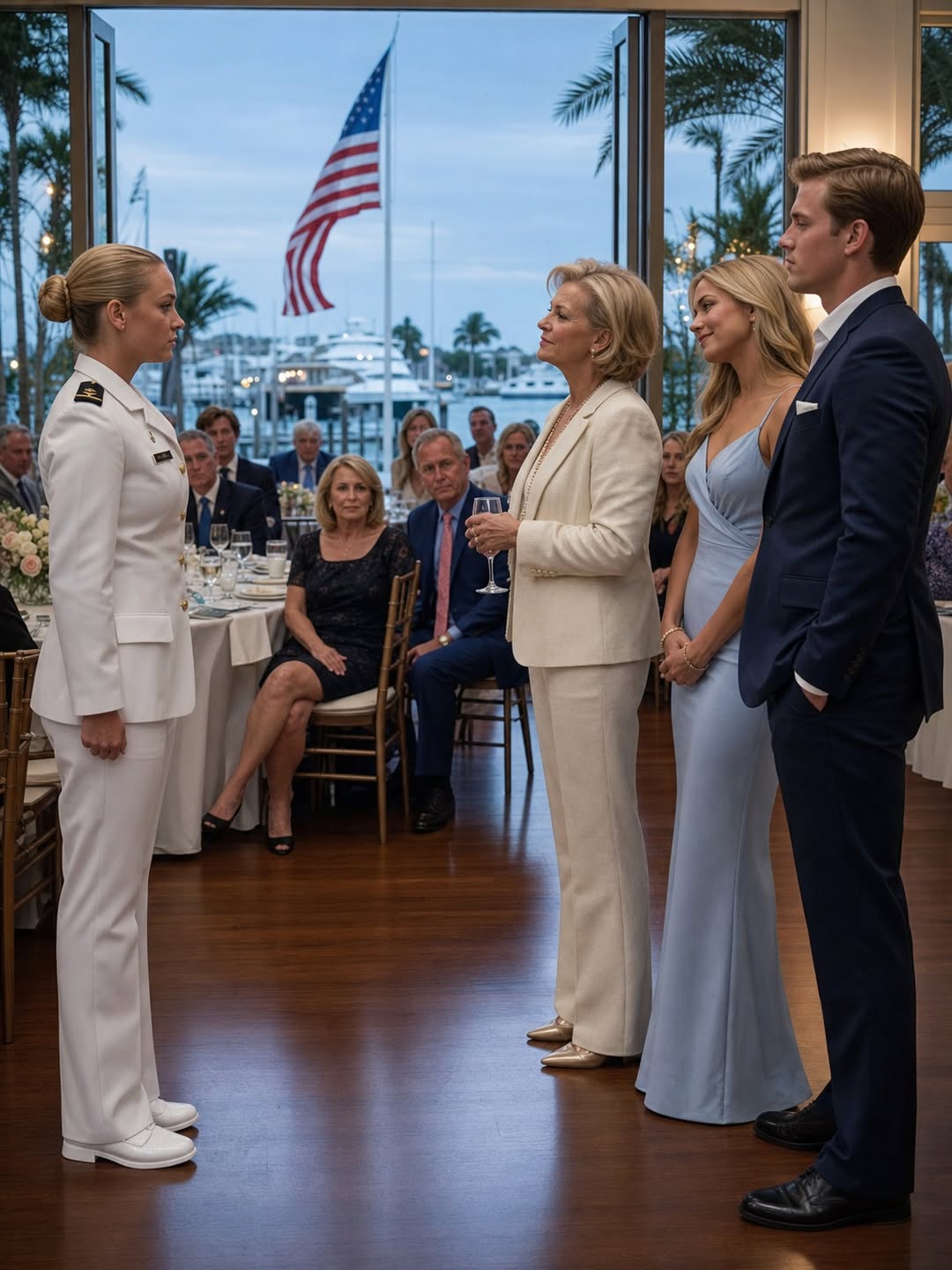
At My Sister’s Engagement to a SEAL Captain, They Introduced Me as “The Failure”—Until He Saluted Me.
For years, I was the overlooked daughter—the one who funded family emergencies, showed up to every event, and kept quiet while they laughed at my career. But when my mother introduced me at my sister’s engagement dinner as “the failure,” and her SEAL fiancé stood to salute me as Admiral Kent, everything changed.
This isn’t a story about revenge—it’s about respect, and what happens when you finally stop shrinking to fit someone else’s version of you.
If you’ve ever been underestimated, dismissed, or made to feel small by the people who should’ve been proud, this one’s for you.
Because sometimes the most powerful thing you can do—
I’m Sonia Kent, 47, and I worked my way up from a chief’s daughter in Navy housing to a rear admiral commanding thousands across the Pacific. For years, I funded my family’s emergencies, showed up to every event, and let the jokes about being the lonely career one roll off. But when at my sister’s engagement, my own mother introduced me to her seal fiancé as the failure, and he ended up saluting me in front of everyone, I made a choice that changed everything.
Have you ever been underestimated or humiliated by people who were supposed to be proud of you? If so, you’ll understand what comes next. Before I tell you how it all unfolded, let me know where you’re tuning in from. And if you’ve ever had to reclaim your worth after being written off, hit that like button and subscribe. What happened after that salute might surprise you.
I’d been stationed overseas when my sister Claire announced her engagement. The message came through the official Navy email system. First, a formal notification that my leave request had been approved for family event. Then, Mom called. Not to ask if I could make it, but to issue instructions. “Make sure you dress appropriately,” she said, her voice carrying that particular edge I’d learned to recognize over decades. “We don’t want another uniform scene.”
I was standing in my office at the time, overlooking the harbor where three destroyers sat in formation, their gray holes cutting precise lines against the blue water. Outside my door, junior officers moved with purpose, their salutes crisp and immediate. Inside this room, I commanded respect that had been earned through years of difficult decisions and flawless execution. But to my mother, I was still the daughter who’d made the wrong choices.
“I’ll be there,” I said simply.
“Clare’s so excited,” Mom continued as if I hadn’t spoken. “He’s a real catch. A SEAL captain. Not like those desk officers you work with.”
I let that one pass. I’d learned years ago that correcting her only led to circular arguments where she’d forget the facts and remember only that I’d been difficult. The truth was I spent most of my time at sea or in strategic planning sessions that determined the movement of entire carrier groups. But to her, if you weren’t kicking down doors with a rifle, you weren’t really military.
“What’s his name?” I asked.
“Ryan Hail. Captain Ryan Hail.” She said it with the kind of reverence usually reserved for celebrities. “He’s been deployed six times. Six times, Sonia. And he still makes time for family.”
The implication hung in the air between us. I’d missed Clare’s first wedding because I’d been in the Gulf managing a crisis that had kept three ships and 4,000 sailors safe. She’d never forgiven me for that. Never mind that I’d sent a gift worth three months of my salary. Never mind that I’d called from a secure line the moment I had 30 minutes of downtime. I hadn’t been there. And in Mom’s calculus, that was the only thing that mattered.
“I’m looking forward to meeting him,” I said.
“Just try to be normal,” she replied. “Claire’s been through so much with her divorces. She deserves this.”
After we hung up, I sat at my desk and watched the ocean. A group text notification lit up my phone. The family thread. I opened it to find 17 messages about engagement, party planning, venue selections, and menu choices. I scrolled up. The conversation had started three weeks ago. No one had thought to include me until today, and even now it was only because my father had apparently noticed my absence and added me himself.
I set the phone down and returned to the report in front of me. Pacific Fleet Readiness Inspection Results. Eighteen ships evaluated, twelve commenations issued, three captains who needed additional oversight—precise, clear, consequential work. The kind of thing that kept sailors alive and missions successful.
My phone buzzed again. Claire, in a private message: “Mom said you’re coming. Please don’t make this about you.”
I read it twice, trying to decode what she meant. Then I understood. She was asking me not to mention my career, not to correct anyone’s assumptions, to play small so she could feel big on her special day. I typed and deleted three responses before settling on: “Congratulations. I’m happy for you.”
She sent back a heart emoji. Nothing else.
A junior officer knocked and entered. Lieutenant Ramirez, my aide. “Ma’am, the briefing’s ready when you are.”
“Thank you.” I stood, smoothed my uniform, and followed him to the conference room. The next two hours were spent discussing logistics for an upcoming joint operation. I barely thought about the engagement dinner. This was where my mind belonged—problems that could be solved, decisions that mattered, conversations with people who valued competence over performance.
But that evening, alone in my quarters, I pulled out the dress whites I’d need for the dinner. I pressed them myself despite having access to services that could have done it for me. There was something meditative about the process—the heat of the iron, the sharp creases forming under pressure, the transformation of rumpled fabric into something crisp and professional.
A younger officer had joked earlier that day after I’d mentioned the family dinner. “Ma’am, that’s what reunions are for—to remind them who you really are.”
I hadn’t laughed. I just nodded and changed the subject because the truth was I’d been reminding them for years. Every promotion, every commendation, every article in the Navy Times, and it never seemed to matter. They’d built a story about me, the career spinster who’d chosen ambition over family, and they were committed to it regardless of evidence.
The night before I flew out, I had dinner with Commander Jules Tanner, my executive officer. We’d served together for three years, and she’d become something close to a friend, as much as the chain of command allowed.
“You seem tense,” she observed over mediocre Thai food from the only restaurant near base that delivered after 2200 hours.
“Family thing,” I said.
She nodded. She’d met her share of families who didn’t understand what we did. “Want to talk about it?”
“My sister’s marrying a SEAL captain. My mother thinks he’s more military than I am.”
Jules nearly choked on her pad tie. “You’re joking.”
“I wish I was. Sonia, you coordinate operations across seven time zones. You’ve got 4,000 sailors under your command. You brief senators.” She shook her head. “What does she think you do all day?”
“Paperwork, apparently.”
“Are you going to tell them?”
I considered it. The idea of walking into that country club and announcing my rank felt both satisfying and exhausting. “I’m going to show up and be respectful. What they do with that is up to them.”
Jules studied me for a moment. “That’s very diplomatic of you.”
“I’m tired of fighting for space in my own family.”
“Then why go at all?”
It was a fair question. I’d asked it myself a dozen times while packing. But the answer was simple. Even if it didn’t make sense, they were still my family. My mother had raised me. My sister had been my best friend once before diverging paths and different priorities had carved a canyon between us. I kept showing up because some part of me still hoped that one day they’d see me clearly.
“Because I’m not ready to give up yet,” I said finally.
Jules raised her beer. “To family. May they eventually get a clue.”
I clinked my glass against hers and smiled.
The flight to Florida was smooth. I spent most of it reviewing personnel files and trying not to think about the dinner. When I landed, I rented a car and drove straight to the country club, my dress whites hanging in the back seat. The parking lot was full of expensive cars. I found a spot in the back away from the entrance and sat for a moment in silence. Through the windows, I could see people gathering—my sister’s friends, my mother’s social circle, men in suits and women in cocktail dresses. And somewhere inside, Captain Ryan Hail, who my mother thought represented real military.
I checked my ribbons one final time, made sure my cover was positioned correctly, and stepped out into the humid evening air. It was time to remind them who I really was, whether they were ready to see it or not.
The country club smelled like expensive perfume and fresh flowers. I walked through the entrance alone, my heels clicking against marble floors that probably cost more than my annual salary. A hostess with a practiced smile directed me toward the private dining room where my family had gathered. I could hear them before I saw them—laughter, the clink of glasses, my mother’s voice rising above the others with that particular theatrical quality she reserved for audiences.
When I entered, the conversation didn’t stop. No one turned. I stood in the doorway for a moment, taking in the scene. Roundts covered in white linens, centerpieces of roses and hydrangeas, and at the head table, my sister Clare in a pale blue dress that matched her eyes, looking radiant and confident.
My mother saw me first. Her smile hardened. “Oh, you actually came,” she said loud enough that several people turned. “Everyone, this is my disappointment of a daughter.”
The words landed like a slap, but I kept my expression neutral. I’d learned that reaction was what she wanted—some visible wound she could either ignore or apologize for, depending on her mood and her audience. Laughter rippled through the room. Not cruel laughter, exactly. More like the nervous sound people make when someone says something uncomfortable and they’re not sure how to respond.
Clare looked down at her plate. Not embarrassed for me, I realized. Embarrassed of me?
Mom continued, emboldened by the response. “This is the one who never gave me grandchildren. Too busy playing sailor.”
More laughter, lighter this time.
I walked toward the head table, my stride measured and calm.
“Sonia,” Clare stood, came around the table. Her hug was brief and stiff. “I’m so glad you could make it.” The words were right, but her tone suggested otherwise.
“Congratulations,” I said. “I’m happy for you.”
“This is Captain Ryan Hail,” Mom interjected, gesturing to the man beside Clare. “Real military, not office military like you.”
He stood and I got my first clear look at him. Tall, fit, probably early forties. The kind of weathered handsomeness that came from years of outdoor operations. His eyes were sharp, assessing. He extended his hand.
“Ma’am,” he said politely, his grip firm but not aggressive. “It’s nice to meet you.”
His gaze traveled over my uniform, lingering on my ribbons. I watched his expression—polite disinterest, the kind of look senior officers gave to junior personnel at mandatory social functions. He was being courteous, nothing more. Then his eyes caught on my shoulder boards. The silver star pinned there.
I watched the moment of recognition hit him. His eyes widened. The color drained from his face. He released my hand and took a step back, his body responding before his mind had fully processed what he was seeing. His heels came together sharply. His right hand snapped up in a salute so crisp it could have been used in a training video.
“Admir Kent, ma’am,” he said, his voice carrying across the suddenly silent room. “I apologize, ma’am. I didn’t recognize you out of context.”
The laughter died midbreath. Forks froze halfway to mouths. Someone’s wine glass made a small clink as it was set down too hard.
I returned the salute slowly, holding eye contact. “At ease, Captain.”
He dropped his hand but didn’t relax. His face had gone from confident to mortified in the span of three seconds. Behind him, I could see his sealed teammates, three other men in suits, all staring at me with wide eyes.
My mother’s mouth had fallen open. She looked from me to Ryan and back again, trying to reconcile what she just witnessed with the narrative she’d built.
“She outranks you,” someone whispered from a nearby table.
Ryan didn’t answer. He pulled out the chair beside Clare. “Please, ma’am, sit.”
“Thank you, Captain.” I sat, placing my cover on the table beside my plate. The silence stretched. I could feel everyone’s eyes on me, could sense the recalculation happening in real time. My sister’s face had gone pale. My mother looked like she’d been struck.
One of Ryan’s teammates leaned forward. “Admiral Kent, Pacific Fleet, Strike Group 7?”
“I confirmed.”
“Holy—” he breathed, then caught himself. “I mean, excuse me, ma’am. We studied one of your operations at Coronado, the straight passage last year.”
“That was a team effort,” I said. “Good sailors, good planning.”
“That was brilliant,” he countered. “You got four ships through a contested area with zero incidents. The briefing made it required reading.”
Ryan had recovered slightly. He sat down beside Clare, who still hadn’t said anything. “Ma’am, I apologize again. Your mother said—” He stopped himself, realizing the trap he was walking into.
“It’s fine, Captain.” I unfolded my napkin, placed it in my lap. “It happens.”
But it wasn’t fine, and everyone at that table knew it.
Mom finally found her voice. “You never told us you were an admiral.”
I looked at her directly. “I’ve been a rear admiral for eighteen months. It was in the Navy Times. I sent you the article.”
“I thought that was a different Sonia Kent,” she said weakly.
“It wasn’t.”
Clare reached for her wine glass, her hand shaking slightly. Ryan put his hand over hers, steadying it. He was staring at me with something between awe and horror.
“How long have you been in?” one of the other seals asked.
“Twenty-nine years.”
“Academy?”
“Yes.”
“What’s your specialty?”
“Surface warfare. Strategic operations.”
The questions continued, and I answered them simply, without elaboration. But each answer was another nail in the coffin of my mother’s narrative. Each response revealed the gap between who she decided I was and who I actually was.
Dinner was served, but no one was really eating. The conversation had fractured into small pockets of whispered discussion. I caught fragments. “I didn’t know.” “She never said.” “How did we not know?” My mother was silent now, pushing food around her plate. Clare kept looking at me like I was a stranger.
Ryan, to his credit, tried to salvage the evening. “Ma’am, if you’re comfortable discussing it, what’s your command like?”
“Busy,” I said. “We’re responsible for a fairly large operational area. Keeps everyone sharp.”
“I bet.” He paused. “I served under Admiral Richardson two years ago. Do you know him?”
“We’ve worked together. Good officer.”
“He spoke highly of you. Actually, I didn’t make the connection until now.”
Another nail.
By the time dessert arrived, the atmosphere had shifted completely. People were asking me questions, showing respect, treating me like someone important. My mother sat at the head of the table, diminished, her power in this space suddenly revealed as the shallow thing it had always been. I didn’t gloat. I didn’t make pointed comments or enjoy her discomfort. I just existed, fully visible for the first time in their presence.
When I excused myself to leave early, but not rudely so, Ryan stood immediately. “Ma’am, it was an honor. Truly.”
“Congratulations on your engagement, Captain. Take care of my sister.”
“I will, ma’am.”
I hugged Clare briefly. She whispered, “Why didn’t you tell us?”
“I tried,” I said simply. “You didn’t listen.”
I walked out of that country club with my head high and my shoulder straight. The humid air hit me like a wall, but I didn’t care. I drove back to base housing, let myself into the small apartment the Navy provided, and sat in the dark for a long time. I didn’t feel triumphant. I just felt tired. Tired of being underestimated. Tired of fighting for respect in spaces where it should have been freely given. Tired of being the punchline to my mother’s jokes. But also, for the first time in years, I felt something else. Clarity. The mask had fallen away. They’d seen me. Really seen me. And now I had to decide what to do with that.
Claire and I grew up in Pensacola, where the Navy was less a career path and more a fact of life. Aircraft noise punctuated every outdoor conversation. Housing units stretched in identical rows, each one occupied by a family that understood deployment cycles and the particular anxiety of waiting for a ship to return. Dad was a chief petty officer—E7, the backbone of the Navy. He worked on aircraft engines, came home with grease under his fingernails, and spoke about the service with quiet pride. He never pushed us toward military life, but he never discouraged it either. He just showed us what it looked like to serve with dignity.
Mom had different aspirations. She wanted daughters who would marry well, have children, host dinner parties. She’d grown up poor, and the Navy had given her stability, but she viewed it as a stepping stone to something better, something more respectable in her mind—something that didn’t involve moving every three years or saying goodbye at piers.
Claire was born beautiful. That’s not subjective. It was simply true. Even as a child, people stopped Mom in grocery stores to comment on her features. By high school, she’d learned to weaponize it. She dated the quarterback, got elected homecoming queen, and filled photo albums with images of herself surrounded by friends.
I was born curious. I took apart radios to understand how they worked. I read Dad’s technical manuals for fun. In middle school, I started attending Navy events with him—change of command ceremonies, retirement parties. I liked the order of it, the way everyone knew their place and their purpose.
When I told Mom I wanted to go to the Naval Academy, she laughed—not cruelly, but dismissively. “Honey, you don’t have to do that. You’re smart. You could marry someone successful.”
“I want my own success,” I said.
“That’s not how the world works for women.”
But I applied anyway. Dad helped me with the physical fitness requirements, running beside me at 0500 hours before school. He didn’t say much, but his presence was support enough. I got in. Top test scores, strong recommendations, a congressional nomination. When the acceptance letter arrived, Dad put it on the refrigerator. Mom took it down the next day. Said it made the kitchen look cluttered.
Clare went to cosmetology school. She was good at it—had a talent for making people feel beautiful. She opened her own salon by twenty-two, married a real estate developer at twenty-three. The wedding was enormous, expensive, exactly what Mom had always wanted. I missed it because I was deployed in the Gulf. I tried to explain. The mission was critical. I couldn’t get leave. My absence wasn’t personal. But to Claire, it was the ultimate betrayal. Her sister hadn’t shown up for the most important day of her life.
The marriage lasted three years. When it ended, I flew home on emergency leave. Clare was devastated, crying in Mom’s kitchen about how she’d wasted her youth. I sat with her, brought her tissues, listened to every detail.
“At least you were there for this,” she said.
“Of course, I was.”
“You’re never there.”
It stung because it was partially true. I missed birthdays, holidays, ordinary Tuesdays. But I was building something—a career that mattered, a life of purpose.
Through my twenties and thirties, I became the family ATM. Claire needed rent money after her divorce. I sent it. Mom’s car broke down. I paid for repairs. Dad needed surgery. I covered the co-ay. Every crisis that required cash flowed through me. I didn’t mind. Exactly. I made good money and lived simply. But the gratitude was always thin, always provisional. It came with comments like, “Must be nice to have all that disposable income.” Or, “If you had a family, you’d understand expenses.”
When I made Lieutenant Commander at thirty-two, I called to share the news. Mom answered and I heard her tell someone, “Sonia got another promotion. I guess that’s nice.” Another promotion—like I was collecting stamps.
My second deployment was to the South China Sea. I was executive officer on a destroyer responsible for 1,200 sailors and a weapon system worth billions. We tracked submarines, intercepted drug runners, showed force in contested waters. I slept four hours a night and loved every minute of it.
Clare got married again while I was gone—this time to a dentist. The wedding was smaller and I wasn’t invited. “We kept it intimate,” she explained when I called. “Immediate family only.” I was immediate family, but apparently not the right kind.
That marriage lasted five years. When it ended, Clare moved back in with Mom. I was stationed in Norphick by then, close enough to visit on weekends. I drove down once a month, helped with yard work, took them to dinner. They complained about me the whole time—how I never visited enough, how I worked too much, how I’d never understand real love because I’d chosen career over family. I stopped correcting them. Let them believe what they needed to believe.
When I made commander at thirty-six, the Navy Times ran a small piece. I sent it to Mom. She texted back, “Nice. We’re proud.” But she never mentioned it to her friends. Never brought it up at family gatherings. It was like that part of my life existed in a separate dimension that didn’t count.
I made captain at forty-one—O6, a rank most officers never reach. It came with responsibility for an entire ship and the crew that ran it. I stood on the bridge and made decisions that affected hundreds of lives. I testified before Congress about readiness and strategy. I was invited to speak at the war college.
Mom asked when I was going to settle down.
Dad was different. He never said much, but sometimes I’d catch him reading articles about my ship or my command. Once at a family barbecue, one of his old Navy buddies asked about me. Dad’s face lit up. “She’s commanding a destroyer now. First woman in her cohort to get that assignment.”
Mom interrupted. “Let’s not talk about work. Clare just got her salon certified organic.”
The pattern was clear. Any success I achieved was minimized, redirected, or ignored. Any struggle Clare faced was elevated to crisis status.
I paid for Claire’s salon renovation—$12,000. She thanked me by saying, “Must be nice to not have real expenses.” I funded Mom’s kitchen remodel—$15,000. She showed it off to her friends and mentioned that her successful daughter, the one with the salon, had helped make it possible.
When I made rear admiral at forty-five, it was a significant moment—O7, flag rank. The ceremony was formal, attended by senior leadership from across the fleet. Dad flew up for it, stood in the back in his retired chief’s dress blues, tears in his eyes. Mom didn’t come. She had a hair appointment. I sent her photos. She responded, “Looks cold up there.” Clare texted, “Cool, I guess.”
I stopped expecting more. I built my life around the people who valued me—the sailors I mentored, the officers I worked with, the mission I served. But I never stopped showing up for family events, never stopped calling on birthdays, never stopped being present in whatever way they’d allow. Because somewhere deep down, I still believed that family meant something. That blood created obligations that transcended fairness or logic. That eventually they’d see me clearly.
The engagement dinner shattered that belief. Not because of the insult—I’d weathered worse—but because of the certainty in my mother’s voice when she called me a disappointment. She believed it fully. Despite everything I’d accomplished, everything I’d given, every way I’d tried to be enough, I would never be enough because I’d failed the only test that mattered to her. I hadn’t become the daughter she wanted.
And that night, with Ryan’s salute still hanging in the air, I realized something crucial. I didn’t need to be. I’d spent three decades trying to earn respect from people who were determined not to give it. I’d funded their lives, attended their events, swallowed their insults. I’d contorted myself into shapes that felt unnatural, hoping that if I just tried hard enough, they’d love the real me. But the real me was never what they wanted. They wanted someone smaller, someone who needed them, someone whose success didn’t challenge their narrative about what women should be. I wasn’t that person. I’d never been that person. And finally, blessedly, I was tired of pretending I could be.
The drive back to base that night was quiet. I didn’t cry. I didn’t rage. I just drove, watching the familiar Florida landscape pass by, feeling something inside me settle into place. When I got to my quarters, I pulled out my phone and looked at the family group chat. Seventeen new messages, none of them addressed to me, none of them acknowledging what had happened at dinner. I opened a new text to Clare. “I’m glad you’re happy. I hope Ryan treats you well.” Then I deleted the family group chat from my phone. Not in anger, not in revenge—just acceptance. Some doors close because we slam them. Others close because we finally quietly stopped holding them open.
After the salute, conversation stumbled forward like a wounded animal trying to look healthy. People asked polite questions about my command, but their voices carried the hollow quality of people who’d just witnessed something they couldn’t quite process. Ryan kept apologizing with his eyes. Every time I glanced his direction, he looked like a man who’d just realized he’d insulted a superior officer in front of witnesses, which technically he had. Clare picked at her salmon and said nothing. Mom tried to recover by pivoting to wedding planning, but her voice lacked its usual confidence. She kept glancing at me like I was a stranger who’d taken her daughter’s seat.
I excused myself before coffee was served. “Early flight tomorrow,” I said, which was true enough.
Ryan stood immediately. “Ma’am, thank you for coming.”
“Congratulations again, Captain Sinclair.” I used my sister’s future rank as a gentle joke, but she didn’t smile.
Dad walked me to my car. He’d been quiet all evening, watching everything with those careful eyes that missed nothing.
“You handled that well,” he said as we reached my rental.
“Did I have a choice?”
“You always have a choice. You chose dignity.” He paused. “I’m proud of you, Sonia. I always have been.”
I hugged him and for a moment I was eight years old again, standing on his shoulders at an air show, watching the Blue Angels trace patterns across the sky.
“Thanks, Dad.”
“Your mother—” He started, then stopped. “She doesn’t know how to be wrong. Never has.”
“I know.”
“Give her time.”
I nodded, but I wasn’t sure time would change anything. Some people revised their opinions when presented with new evidence. Others just dug in deeper, protecting their worldview against reality.
The drive back to base housing took forty minutes. I spent most of it replaying the evening—not the humiliation, that had barely registered, but the moment after. The silence, the recalibration, the sudden awareness that their narrative had been wrong all along. I’d wanted them to see me, and now they had. The question was, what came next?
Back in my quarters, I changed out of my dress whites and into civilian clothes—jeans and a navy sweatshirt Dad had given me years ago. I made tea and sat on the small balcony overlooking the base. Below, I could see the night shift changing, sailors moving between buildings, vehicles passing through security gates, the machinery of the Navy continuing its endless operation. This was my world. These were my people.
In the quiet, I replayed every year I’d funded their lives. Every apology I’d made for being too ambitious. Every time I’d minimized my accomplishments to make them comfortable. The word failure echoed differently now—almost comical. I thought of the women I’d mentored. The young nsigns who’d come to my office confused about their career paths, who left with clarity and purpose. The lieutenant who’d been considering leaving the service until we’d talked about what leadership really meant. The commander who’d recently taken her own ship, who sent me a message that said simply, “You showed me this was possible.” I thought of the operations I’d planned, the decisions that had kept sailors safe, the strategies that had worked, the moments when everything hung in the balance, and I’d made the call that needed to be made.
My family had never seen any of it because they’d never wanted to. They’d built a story. The ambitious daughter who’d sacrificed family for career. And they’d committed to it regardless of evidence.
I stopped feeling hurt. Just tired. Tired of swimming against a current that would never change direction. Tired of fighting for space in a family that had already decided how much room I deserved.
My phone buzzed. A message from Clare. “You embarrassed Mom. Couldn’t you just play along?”
I read it three times, feeling something shift inside me. Play along. Pretend to be small. Accept the insult with grace. Be the punchline so Mom could have her moment.
I typed and deleted five different responses. Finally, I settled on nothing. I just stared at the message, watching the cursor blink. Then I deleted the text without responding.
The next morning, I skipped the family brunch I’d been expected to attend. I was supposed to sit through another meal of comparison and criticism, another round of jokes at my expense. Instead, I went for a run on the base, showered, and caught my flight six hours early.
My phone started buzzing before I even reached the airport. Mom calling. I declined. She called again. I declined again. Then a voicemail. “So, you think you’re too good for us now? Is that it? You show up for one dinner, embarrass everyone, and leave. That’s very typical of you, Sonia. Very selfish.”
I saved the voicemail—not to replay it, but as evidence, a record of who we really were to each other.
On the flight back to Norphick, I drafted an email. It took me three hours and seven attempts to get the tone right. Not angry, not wounded—just clear.
“Mom and Claire,
I love you both, but I need to step back from family events for a while. The dynamic isn’t healthy for me, and I don’t think my presence adds anything positive for you. I wish you both well. I’ll be focusing on my command responsibilities. Take care, Sonia.”
I read it twenty times before sending it. Then I hit send and put my phone in airplane mode. When I landed, I had thirty-seven messages. I deleted them all unread and blocked the family group chat—not in anger, in self-preservation.
The next few weeks passed in a blur of work—fleet exercises, readiness evaluations, strategic planning sessions. I fell into the rhythm of command, finding comfort in problems that had solutions and people who valued competence.
Jules noticed the change. “You seem lighter,” she said one evening over paperwork in my office.
“I cut some weight,” I said.
She understood without asking.
A month later, the Navy Times ran a profile piece: “Rear Admiral Sonia Kentum’s command of Strike Group 7.” It was a full page with photos and quotes from senior leadership. They mentioned my academy record, my operational experience, my reputation for precision and calm under pressure. I didn’t send it to my family, but apparently someone else did.
My sister texted a single word: “Wow.” Nothing else. Just that. I didn’t respond.
Mom called. I didn’t answer. She left a voicemail. “I saw the article. It’s very impressive. I didn’t realize you’d done so well.” I deleted it.
Dad called. I answered that one.
“Congratulations, kiddo,” he said. “Strike Group Seven. That’s a big deal.”
“Thanks, Dad.”
“Your mother’s been talking about the article to everyone.”
“Good for her.”
“She wants to apologize. I think she just doesn’t know how.”
“She knows how, Dad. She just doesn’t want to enough.”
He sighed. “That’s probably true.”
“I love you,” I said. “But I can’t keep doing this. The dynamic doesn’t work anymore.”
“I understand.” He paused. “For what it’s worth, I always knew who you were.”
“That means everything.”
After we hung up, I sat at my desk and stared at the photo on the wall. My change of command ceremony. Hundreds of sailors in formation, flags snapping in the wind, the weight of responsibility settling onto my shoulders like a familiar coat. I hadn’t sought revenge—just distance. But distance was enough to make the truth obvious. I was not a failure. I was not a disappointment. I was a flag officer in the United States Navy, and I’d earned every single star on my collar. My family’s inability to see that was their limitation, not mine. And finally, mercifully, I was ready to stop making their problem my burden.
Command life consumed me in the way only those who’ve lived it can understand. 0500 briefs became my morning coffee. Flight deck inspections, my meditation. The endless rhythm of operational tempo—planning cycles, maintenance schedules, training evolutions—created a framework that felt cleaner than anything in my personal life. No backhanded compliments here. No subtle diminishment. Just clear hierarchies, defined responsibilities, and the kind of respect that came from proven competence.
Strike Group 7 was mine now. For ships, twenty-three aircraft, for thousands sailors. We operated across a theater that stretched from Hawaii to the Philippine Sea, maintaining readiness for any contingency the Pacific might throw at us. The weight of it should have been crushing. Instead, it felt like relief.
My days started in darkness and ended the same way. Briefs at 0500, operations meetings at 0700, ship visits throughout the morning, tactical planning in the afternoon. By the time I made it back to my quarters, I barely had energy to shower before sleeping.
Jules worried about me. “Ma’am, you’re running yourself into the ground.”
“I’m fine.”
“You’re working sixteen-hour days.”
“So are you.”
“I’m not the one whose family just imploded.”
I looked up from the readiness report I’d been reviewing. “My family didn’t implode. It just finally showed its real structure.”
She sat down across from my desk. “Have you talked to them at all?”
“My father once, and he understands. The others—” I shrugged. “They’re adjusting to a new reality.”
What I didn’t tell her was that the silence from my mother and sister felt less like punishment and more like freedom. Every day that passed without a guilt-laden phone call or a request for money was a day I could breathe easier.
Six weeks after the engagement dinner, Clare called. I stared at her name on my screen for three rings before answering.
“Sonia.” Her voice was small, uncertain.
“Claire.”
“Can we talk?”
“We’re talking now.”
“I mean, really talk. Not— I don’t know. Not like this.”
I waited. On the other end, I could hear her breathing, gathering courage for something.
“Ryan’s been deployed for three weeks,” she said finally. “I thought I understood what that meant. You know, because you’d been deployed. But I didn’t. I didn’t understand at all.”
“It’s hard,” I said neutrally. “He can’t tell me where he is or what he’s doing. I don’t know if he’s safe. I don’t even know when I’ll hear from him next.” She paused. “Is that what it was always like for you?”
“Yes.”
“And we never asked. We just— we made jokes about you running away.”
I said nothing. What was there to say?
“I’m sorry,” she whispered. “I’m so sorry, Sonia. I didn’t understand. I didn’t even try to understand.”
The apology landed in the space between us and I examined it carefully. Was it real? Was it performative? Did it matter?
“I appreciate you saying that,” I said finally.
“Mom’s been—” she trailed off. “She’s been different since the dinner, since the article.”
“Different how?”
“Defensive. She tells everyone about you now, but it’s like she’s trying to convince them she always knew, always supported you.” Clare laughed, but it was bitter.
“It’s weird to watch people rewrite their own histories,” I said. “It’s easier than admitting they were wrong.”
“Were we really that bad?” The question hung in the air. I could lie, smooth it over, make it easier for both of us, but I was done with that version of kindness.
“Yes,” I said simply. “You were.”
She was quiet for a long moment. “I don’t know how to fix it.”
“I’m not sure it can be fixed, Clare. Not quickly. Maybe not at all.”
“But we’re sisters.”
“That’s biology, not relationship. Those are different things.”
I heard her breath catch like she might cry. Part of me wanted to comfort her, to fall back into old patterns. But a larger part—the part that had been built over three decades of service—stayed firm.
“I have to go,” I said. “I have a brief in ten minutes.”
“Okay.” She sounded defeated. “Sonia?”
“Yeah.”
“For what it’s worth, I’m really proud of you. I should have said that years ago.”
“Thank you.”
After we hung up, I sat in my office and stared at the harbor. A destroyer was pulling out, its wake cutting white lines through the blue water. Sailors lined the rails in formation, the ship’s bell ringing out departure notes that carried across the water. I’d been that sailor once, young, eager, standing at attention while the world expanded beyond the horizon. Now I sent those sailors out. Now I made the decisions that determined where they went and what they did. The responsibility was immense, but so was the trust.
These people—4,000 sailors across my strike group—they counted on me to make good calls, to be clear-headed and decisive, to put mission and safety above ego or emotion. I couldn’t do that if I was constantly fighting for validation from people who’d proven they wouldn’t give it. So, I’d stopped fighting. And in the space that created, I’d found something unexpected: peace.
That evening, I had dinner with Ensen Maya Rios, one of the junior officers in my mentorship program. She was twenty-four, Filipino American, brilliant with logistics and terrified she wasn’t good enough.
“I don’t know if I belong here,” she said over mediocre pad thai from the restaurant near base. “Everyone else seems so confident.”
“They’re not,” I said. “They’re just better at faking it.”
“You always seem confident.”
“That’s practice and rank. The higher you go, the less you can show doubt, even when you feel it.”
She picked at her food. “My family doesn’t understand why I joined. They wanted me to be a doctor or a lawyer. Something respectable.”
I smiled. “Let me guess. They think military service is for people who couldn’t do anything else.”
“Exactly.” Her eyes widened. “How did you know?”
“Because some families can’t imagine that someone would choose this—that we’d see serving as an honor, not a fallback.”
“Do they ever come around?”
I considered the question carefully. “Sometimes. Sometimes not. Either way, you can’t make your career choices based on their approval.”
“That’s easier said than done.”
“It is. But here’s what I learned. The people who can’t see your value aren’t qualified to assess it.” I leaned forward. “You graduated top 10% of your class. You’ve gotten excellent evaluations. Your division officer says you’re the best NS sign she’s worked with. Those are facts. Your family’s disappointment is opinion. Don’t confuse the two.”
Maya’s eyes filled with tears. “Thank you, ma’am.”
“You’re going to be fine, Ensign—better than fine.”
Watching her leave, I thought about all the young women I’d mentored over the years—the ones who doubted themselves because someone had planted that doubt, the ones who’d needed permission to be excellent. I couldn’t fix my own family, but I could help build a different kind of family here. One based on mutual respect and shared purpose. One where excellence was recognized, not resented.
That night, alone in my quarters, I pulled out a notebook and wrote down everything I was grateful for. It wasn’t a long list, but every item was real: Dad’s pride, Jules’s friendship, Maya’s potential, the destroyer cutting through blue water, the mission that gave my life meaning, and at the bottom, my own strength—hard won and real.
My phone buzzed. A message from Claire. “Ryan says you’re a legend in SEAL community. They teach your operations at Coronado.” I stared at the text for a long moment. Then I typed back, “Tell him thank you and good luck with his deployment.” She sent back a heart emoji. It wasn’t reconciliation, but it was something. A small step toward honesty. I’d take it, but I wouldn’t chase it. Wouldn’t build my sense of self around whether that step led to more steps or stopped completely. Because I’d finally learned what I should have known all along: my worth wasn’t up for debate. It was established fact, and anyone who couldn’t see it simply wasn’t paying attention.
The wedding invitation arrived three months later, forwarded through official channels because Clare didn’t have my current address. Cream card stock, elegant script, my name spelled correctly for once: Rear Admiral Sonia Kent. I held it for a long time, feeling its weight.
Jules found me in my office staring at it. “You going?”
“I don’t know.”
“What’s holding you back?”
“I don’t want to be a statement. I don’t want to be the admiral sister who shows up and makes it about her rank.”
“So, don’t make it about your rank. Just be her sister.”
“I’m not sure I know how to do that anymore.”
Jules sat down. “Ma’am—Sonia—you’ve spent your whole life trying to be enough for them. Maybe it’s time to just be yourself and let them deal with it.”
She was right, but the thought of walking back into that world made my chest tight—not from fear, from exhaustion at the prospect of performing again. I set the invitation on my desk.
“I’ll think about it.”
But thinking turned into weeks of avoidance. We deployed for exercises in the South China Sea. I spent eighteen-hour days coordinating movements across four ships, managing aircraft operations, running readiness drills that pushed every sailor to their limits. It was easier to focus on the mission than on the decision.
Two weeks before the wedding, my father called. “You coming?”
“I sent flowers.”
“That’s not what I asked.”
I sighed. “Dad, I don’t know if I can sit through that. The questions, the attention, the explanations.”
“No one’s asking you to explain anything.”
“Mom will want me to.”
“Your mother’s learning to be quiet.” His voice carried an edge I rarely heard. “We had a conversation after the engagement dinner. A real one.”
“What kind of conversation?”
“The kind where I reminded her that she’s got two daughters and she’s about to lose one of them permanently if she doesn’t wake up.”
I closed my eyes. “You didn’t have to do that.”
“Yes, I did. Should have done it years ago.” He paused. “Come to the wedding, kiddo. Not for them. For yourself. Show up on your terms. Leave when you want, but don’t miss it because you’re tired of fighting. You already won. This is just the victory lap.”
After we hung up, I sat in my stateroom and stared at the ocean through the porthole. The water was gray today, choppy with weather moving in from the west. I’d spent three decades proving myself to the academy, to my commanders, to the sailors under my command. I’d earned every promotion, every responsibility, every star on my collar. Why did I still feel like I had something to prove to my family?
The answer came quietly. I didn’t. Not anymore. If I went to the wedding, it would be because I chose to. Because Clare was still my sister despite everything. Because some part of me, small but stubborn, still believed in the possibility of family. But I’d go as myself—completely. Without apology.
I sent a message to Clare. “I’ll be there. Congratulations.”
She responded immediately. “Really? Thank you. It means everything.”
I didn’t tell her I’d be in dress whites. Didn’t ask if that was appropriate. Just decided that if I was going to show up, I’d show up honestly. The Navy had taught me many things, but one lesson had proven most valuable: you can’t control how people see you. You can only control who you choose to be. I chose to be exactly who I’d become.
The week before the wedding, I got a message through official channels from Captain Ryan Hail using proper military format. “Ma’am, I wanted to apologize again for my conduct at the engagement dinner. I had made assumptions based on incomplete information. It was unprofessional and disrespectful. I’ve since educated myself on your operational history and am honored that you’ll be at our wedding. Respectfully, Captain Ryan Hail, USN.” I appreciated the formality, the recognition that he’d screwed up and owned it.
I wrote back, “Captain Hail, your apology is accepted. I look forward to celebrating with you and my sister. Fair winds and following seas. RADM Kent.”
Jules helped me press my dress whites the night before I flew out.
“You nervous?”
“No, just ready to get it over with.”
“That’s the spirit.” She grinned. “I mean it though. I’m not going to fix anything. I’m not going to force a reconciliation. I’m just going to show up, be polite, and leave.”
“Sounds healthy.”
“Sounds exhausting.” She laughed. “Most family things are.”
The flight to Florida was smooth. I rented a car, drove to a hotel near the venue—not staying with family this time—and laid out my uniform with military precision. The morning of the wedding, I stood in front of the hotel mirror in full dress whites, every ribbon in place, every crease sharp, my cover positioned exactly right. I looked like what I was, a flag officer in the United States Navy. Let them deal with it.
The church was beautiful. White roses everywhere, soft music playing, guests filing in wearing their best clothes. I arrived alone twenty minutes before the ceremony started. People turned when I walked in—not just looked, turned. The uniform commanded attention whether I wanted it or not. I found a seat toward the back on the bride’s side, far enough away to not be in family photos, but present enough to count.
An older woman beside me leaned over. “Are you military?”
“Yes, ma’am.”
“What rank?”
“Rear admiral.”
Her eyes widened. “My goodness. Are you with the groom’s unit?”
“I’m the bride’s sister.”
She looked stunned, then delighted. “How wonderful. You must be so proud.”
“I am,” I said, and meant it.
Clare looked happy in the photos displayed around the church. Whatever else was true, that mattered.
The ceremony started. Clare walked down the aisle on Dad’s arm, looking radiant in white lace. When she passed my row, our eyes met. She smiled—genuinely smiled—and I nodded back. The vows were traditional. Ryan’s voice was steady, confident. Clare cried happy tears. Dad stood in the front row in his retired chief’s dress blues, and I saw him wipe his eyes during the kiss. Mom sat beside him in a pale pink suit, her posture perfect, her face unreadable.
At the reception, I was seated at a table with some of Ryan’s SEAL teammates and their wives. They asked intelligent questions about my career, about life at sea, about leading a strike group. The conversation was easy, professional, respectful.
Clare and Ryan made their rounds. When they reached my table, Clare hugged me tightly. “Thank you for coming. Really.”
“You look beautiful,” I said. “I’m happy for you.”
Ryan shook my hand properly this time. “Thank you for being here, ma’am. It means a lot to both of us.”
“Take care of her, Captain.”
“I will. You have my word.”
They moved on to the next table, and I felt something release in my chest. This was enough. This was closure of a sort.
Mom approached as I was finishing dinner. She looked older than she had at the engagement party, more uncertain.
“Sonia.” She stood beside my chair, hands clasped. “Can we talk?”
“Of course.”
We walked outside to a garden area, away from the noise and music. The Florida evening was warm, humid, the air thick with the smell of jasmine.
“I’ve been thinking a lot,” she started, “about what I said at the engagement dinner.”
“Mom, we don’t have to—”
“No, we do. I do.” She took a breath. “I called you a disappointment in front of everyone. And I was wrong.”
I waited. Years of apologies had taught me to let people finish before responding.
– Part 2
“Your father explained to me what you’ve accomplished. Not just the rank, but everything else. The operations, the leadership, the sailors who respect you.” Her voice cracked slightly. “I didn’t know because I didn’t want to know. I wanted you to fit into a specific box. And when you didn’t, I decided that meant you’d failed.”
“You weren’t alone in that,” I said quietly.
“I know. Claire and I both did it. We made you small so we could feel bigger.” She looked at me directly. “I’m sorry. I’m so deeply sorry.”
The apology hung in the air between us. I examined it, turned it over, felt its weight.
“I appreciate you saying that,” I said finally. “I do. But, Mom, I need you to understand something. I can’t go back to how things were. Where I’m constantly proving myself or minimizing my life to make you comfortable. That version of our relationship is over.”
“I know. I don’t know what comes next. I don’t know if we can build something different. I’d like to try.” Her eyes were wet. “If you’re willing.”
I thought about it. Really thought about it. Not as a daughter desperate for approval, but as an officer assessing a situation objectively. Could my mother change? Maybe—people could surprise you. Did I want to invest in that possibility? That was harder to answer.
“I’m willing to try,” I said slowly. “But it has to be real. No backhanded comments. No minimizing. No comparing me to Clare or anyone else. If you can’t do that, I’d rather have distance.”
“I can do that. I will do that.”
“Then okay. We’ll try.”
She stepped forward, hesitant, and I let her hug me. It was brief, awkward, but real. When we walked back inside, Dad caught my eye from across the room. He nodded just once—understanding and approval in a single gesture.
I stayed for another hour, watched Clare dance with Ryan, talked with several guests, posed for a few photos. When I left, the party was still going strong, but I’d done what I came to do.
On the drive back to the hotel, I felt lighter. Not fixed, not healed—just lighter.
My phone buzzed. A text from Claire. “Thank you for coming. Thank you for everything. I love you.”
I pulled over, wrote back, “Love you, too. Be happy.” It was a start. Maybe just a start. Maybe nothing more. But it was something.
The next morning, I flew back to Norfick. By the time I landed, the wedding felt like something that had happened to someone else—not in a bad way, just distant, separate from my real life. My real life was waiting on base. A stack of operational plans that needed review. A personnel issue that required my attention. Three meetings scheduled for Monday morning.
I unpacked my dress whites, sent them to be cleaned, and changed into my working uniform. The transformation was physical and mental. Admiral to officer to person. All the same, but different depending on the context.
Jules stopped by my quarters that evening. “How was it?”
“Better than expected.”
“Did your mom apologize?”
“She did. And meant it, I think.”
“Think you’ll rebuild?”
I considered the question. “Maybe on different terms. We’ll see.”
“That’s progress.”
“It’s something.” I paused. “You know what the strangest part was? The whole time I was there, I kept thinking about getting back here. Not because I was miserable, but because this is home now. This is where I belong.”
Jules smiled. “Took you long enough to figure that out.”
“Better late than never.”
Over the following weeks, my relationship with my family shifted into something new. Not warm exactly, but honest. Mom called occasionally with actual questions about my work. Clare sent updates about married life without complaints about my absence. Dad and I talked every Sunday the way we always had. It wasn’t perfect. Old patterns occasionally surfaced—a comment that felt pointed, a comparison that stung slightly. But when those moments happened, I addressed them directly instead of swallowing them.
“Mom, that felt dismissive.” “Claire, I need you to not minimize my work.” And they adjusted—slowly, imperfectly, but genuinely.
Meanwhile, my command responsibilities intensified. We conducted a major exercise in the Philippine C4 nations—twelve ships, three weeks of coordinated operations that tested every system and every sailor. I stood on the bridge of my flagship at 0300 one morning, watching destroyers maneuver in formation under starlight. Commander Tanner stood beside me reviewing communications traffic.
“Ma’am, you ever miss the simple days?” she asked. “When you just had to worry about your own watch station?”
“Sometimes. But this is better.”
“How so? Bigger impact, more meaning?”
I gestured at the formation. “For a thousand people executing a complex operation flawlessly—that doesn’t happen by accident. It happens because everyone from the most junior seaman to the senior officers knows their job and does it excellently.”
“You make it look easy.”
“It’s not, but it’s worth it.”
A message came through. One of our aircraft had a maintenance issue and needed to divert to an alternate landing site. Jules and I worked through the problem, coordinated the response, ensured the pilots landed safely. Just another night at sea. Just another problem solved. By the time the sun rose, we’d executed seventeen separate evolutions without incident—the kind of success that never made headlines because it was simply expected. That was the nature of command. You are remembered for your failures, not your thousand quiet successes. But I knew and my sailors knew. And that was enough.
Three months after the wedding, the Navy Times ran another profile. This one was longer, deeper—an interview about leadership philosophy, career choices, the challenge of being a woman in a male-dominated field. They asked about work-life balance. I gave them an honest answer. “I don’t believe in balance. I believe in integration. My work isn’t separate from my life. It is my life. And I’m proud of that.”
The article was well received. I got messages from officers across the fleet, from mens I’d worked with years ago, from women at the academy who were just starting their careers. One message stood out—from Nsign Rios. “Ma’am, I showed my family the article. My mom finally understands why I joined. Thank you for being visible.”
That night, I read the article again, paying attention to the photo they’d chosen—me on the bridge of my flagship, binoculars in hand, scanning the horizon. The image of someone who knew exactly who she was and what she was doing. I sent the article to my family—not to prove anything, just to share.
Mom responded, “I’m so proud of you. I hope you know that now.” Claire: “My badass sister.” Dad: “Always knew you were special, kiddo.”
I saved those messages—not because I needed the validation anymore, but because they represented something important. The truth finally acknowledged. The title I’d earned, Rear Admiral, had become armor. Not vanity, but protection against revisionist memory. No one could rewrite my story now. It was documented, published, real.
For the first time in my life, I felt complete peace in the silence—not the silence of being ignored, but the silence of being secure, of knowing who I was regardless of who was watching.
Six months after the wedding, I received orders that I’d been expecting but hadn’t quite believed would come: promotion to vice admiral and assignment as deputy commander of Pacific Fleet. O9. Three stars.
Jules found me staring at the official notification. “Ma’am, you okay?”
“I made vice admiral.”
She grabbed the paper from my hands, read it, and let out a whoop that was decidedly unmilitary. “Holy— Ma’am, congratulations!”
“Thank you.”
“You don’t seem excited.”
“I’m processing.”
The truth was more complicated. I was excited, honored, proud. But I was also thinking about all the people who hadn’t believed I’d get here. All the times I’d been underestimated, overlooked, or dismissed. And now I was one of the highest ranking women in the United States Navy.
The promotion ceremony was scheduled for three months out. Large, formal, attended by senior leadership from across the service. I could invite guests—family, friends, colleagues. I thought about who I wanted there. Dad, obviously. Jules. Several mens who’d become friends. The officers who’d served under my command and taught me as much as I’d taught them. And my mother and sister. Because despite everything, they were family. And this moment was big enough to be shared.
I called Dad first. “I’m getting promoted to vice admiral.”
Silence on the other end. Then, “Sonia. Three stars.”
“Three stars.”
I heard him take a shaky breath. “Your mother needs to hear this.”
“Hold on, Dad. I can call her—” but he was already calling for her. I heard their muffled conversation. Then Mom’s voice.
“Sonia.”
“Hi, Mom.”
“Your father says you’re getting promoted. Vice Admiral. In three months.”
Another silence. Then quietly, “I don’t even know what to say.”
“You don’t have to say anything. I just wanted you to know.”
“Can we come to the ceremony?”
“I’d like that.”
After we hung up, I sat in my office and let myself feel it. Really feel it. Not the accomplishment—that was professional satisfaction—but the personal victory. I’d done it. Not for them, but despite them, and now they were finally here to witness it.
The next three months were a blur of transition, planning, briefings, and preparation. I was moving from operational command to strategic leadership—different responsibilities, broader scope, higher stakes. Ensign Rios, now Lieutenant Rios after her promotion, stopped by my office a week before the ceremony.
“Ma’am, I wanted to thank you before you moved to your new assignment.”
“For what?”
“For showing me this was possible. When I was struggling at the academy, I looked at the senior women officers and tried to imagine myself in their place. You were the one who made it seem real.”
“You did the work, Lieutenant. I just didn’t get in your way.”
“You did more than that. You gave me permission to be ambitious.” She paused. “My family came to my commissioning. My mom cried. She told me she was proud.”
“That must have felt good.”
“It did. But you know what felt better? Realizing I didn’t need it anymore. That I was proud of myself regardless.”
I smiled. “That’s the real accomplishment.”
After she left, I thought about all the women I’d mentored over the years—the ones who’d stayed in, the ones who’d gotten out, the ones who’d found their own paths. Each one had taught me something about leadership, about resilience, about the cost and reward of choosing this life.
The ceremony took place on a Friday morning in October. Clear skies, warm sun, a light breeze carrying the smell of saltwater. The venue was a hanger on Naval Base San Diego, transformed with flags and formal seating. Four hundred people attended—officers from across the fleet, civilian leadership, my entire chain of command. And in the third row, my family. Dad in his retired chief’s dress blues. Mom in a navy dress. Clare with Ryan beside her.
The ceremony followed traditional protocol—opening remarks, citation reading, the formal pinning of my third star. The admiral conducting the promotion said words I barely heard—something about exemplary service and distinguished leadership. What I noticed was the weight of the third star as it was pinned to my collar—the physical manifestation of responsibility.
Dad came up for the pinning. His hands shook slightly as he attached the star, but his face was steady. Proud. When he stepped back and saluted, I returned it crisply. Then, because protocol allowed it, I hugged him.
“Proud of you, kiddo,” he whispered. “Always have been.”
The ceremony concluded with remarks from the Pacific Fleet Commander about my new role, my operational history, my reputation for precision and calm decision-making. Then reception—handshakes, congratulations, photos with everyone who’d helped me get here.
Mom approached carefully. “Sonia, this is extraordinary.”
“Thank you.”
“I mean it. I had no idea—no concept of what this meant.”
“Most people don’t.”
“It’s not okay. I should have known. Should have asked.” She paused. “But I’m here now, learning.”
“That’s all I can ask.”
Clare hugged me tightly. “My sister, the vice admiral. Wait until I tell everyone at the salon.”
I laughed. “Feel free.”
Ryan shook my hand formally. “Ma’am, it’s an honor. Truly. I’ll be telling this story for years—the time I accidentally insulted a future three-star admiral.”
“Let’s just say you helped clarify some things, Captain.”
Throughout the reception, I found myself watching the crowd—sailors I’d served with, officers I’d mentored, leaders who’d taken chances on me. This was my family, too. Chosen, earned, built through shared purpose.
Jules found me near the end. “How does it feel?”
“Surreal. Real. Both.”
“You’ve earned this twenty times over.”
“We’ve earned it. None of this happens without good people around you.”
“Spoken like a true flag officer.” She grinned. “So what now?”
“You save the world.”
“Something like that. Probably just a lot of meetings.”
“Boring meetings that determine the future of naval operations across the Pacific.”
“Exactly. Boring.”
We laughed. And in that moment, I felt the fullness of it. Not just the promotion, but everything it represented. The journey from academy midshipman to vice admiral. The sacrifices, the victories, the slow building of a life that mattered.
That evening, after everyone had left, I stood alone on the pier and watched the sun set over the Pacific. The water turned gold, then orange, then deep purple as darkness settled. Somewhere out there, ships under my operational oversight were conducting missions. Sailors were standing watch, executing orders, keeping the seal lane safe. I was responsible for them now. Not just their operations, but their well-being, their training, their futures. The weight of it was immense. But so was the honor.
I thought about the young woman I’d been at the academy—ambitious, driven, desperate to prove herself. What would she think if she could see me now? She’d probably be relieved, proud, maybe a little surprised.
I pulled out my phone and sent a message to the family group chat, the one I deleted years ago but had cautiously rejoined months earlier. “Thank you for being there today. It meant everything. Love you all.”
Responses came quickly. Dad: “Love you, kiddo.” Mom: “We’re so proud. So incredibly proud.” Claire: “Best sister ever. No contest.”
I smiled and pocketed the phone. Then I turned and walked back toward base, my three stars catching the last light of day, my stride confident and sure.
I didn’t need applause—just respect. And finally, mercifully, I had both. The family who’d raised me and the family I’d chosen. The life I’d built and the purpose I served. All of it together—complete. Not perfect, but real. And that was enough.
Here’s where I’ll leave it. I drew a line, kept my dignity, and kept moving. If this hit home, drop your story below. Share this with someone who needs a backbone today and subscribe for more cleareyed boundary wins. Questions for you. When family minimizes you, what boundary actually worked? Would you have stayed for the dinner or left earlier? What, if anything, would you have said to my mother in that moment? If you’re military or support someone who is, how do you balance duty with family pressure? What does respect look like to you? Words, actions, or distance.