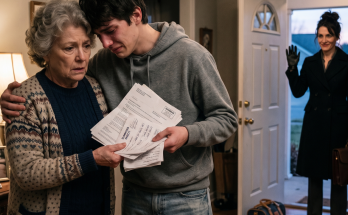
“She’s Not Well, Your Honor,” My Brother-In-Law Testified. I Stayed Silent. The Judge Removed His Glasses And Asked: “Doctor, When Exactly Did You Examine Her?” His Face Went White. My Sister Gasped: “Oh No.”
Part 1
I counted the grain lines in the defense table because if I looked at my sister, I might have stood up and said something that would ruin everything.
Seventeen lines ran through the wood, thin and dark, like somebody had dragged a needle across honey. I counted them once, then again, while my brother-in-law sat across the aisle dabbing the corners of his eyes with a white handkerchief that looked too square, too clean, too ready.
Dr. Preston Keen was good at looking devastated. He had the posture for it. Shoulders slightly bent, chin lowered, wedding ring visible when he touched his face. Beside him, my older sister Colette kept one hand on his back, moving it slowly in circles, like she was comforting a man who had lost everything instead of sitting next to the man who had helped her try to take everything from me.
The courtroom smelled like varnish, old paper, and somebody’s bitter coffee. The air-conditioning clicked on and off above us with a metallic cough. Judge Eamon Fitzwilliam sat high behind the bench, silver hair neat, face unreadable, glasses low on his nose.
Preston’s attorney was speaking.
“Your Honor, this is not simply about money. This is about a vulnerable woman in the final months of her life, isolated from one daughter and placed under the emotional control of another.”
I almost smiled at the phrase emotional control. My mother, Margaret Holloway, had once chased a raccoon off our back porch with a broom while wearing pink slippers and yelling, “Not today, you little bandit.” Nobody controlled that woman. Not when she was healthy, not when cancer had eaten her down to bones and stubbornness.
But nobody in that courtroom wanted to hear about the raccoon.
They wanted a story.
Preston was giving them one.
I was the unstable younger daughter. The lonely one. The one who never married, never had children, never moved into a house with columns and a security gate. I was the one who slept on my mother’s couch during chemo, who labeled her pills in tiny plastic boxes, who learned the exact sound of her breathing when pain medication had finally worked.
That, apparently, made me dangerous.
My name is Adeline Holloway. I was thirty-one years old when my brother-in-law swore under oath that I had lost my mind.
Six months before that hearing, I buried my mother in a cemetery outside Warwick, Rhode Island. It was a cold March morning, the kind that made everyone’s breath look like smoke. I chose her navy suit because she said black made her look like a disappointed nun. I chose white roses because she loved how they browned at the edges before they died, like old letters.
Colette arrived late to the funeral, wearing dark sunglasses even though the sky was gray. Preston parked their black Mercedes crooked across two spaces and shook hands with the funeral director like they were meeting at a charity luncheon.
During the eulogy, Colette cried loudly enough for the first three rows to hear. I stood beside her and stared at the casket, trying to remember the exact temperature of my mother’s hand the last time she squeezed mine.
Afterward, while people ate ham sandwiches in the church basement, Colette found me near the coffee urn.
“Addie,” she whispered, eyes red but dry now. “Did Mom say anything at the end?”
I thought she meant something tender. A final message. A blessing.
“She said my name,” I told her.
Colette pressed her lips together. Her perfume was sharp and expensive, cutting through the smell of coffee and plastic tablecloths.
“No,” she said. “I mean… about paperwork.”
I looked at her then. Really looked.
Her earrings were pearl drops, the ones Mom gave her for her nursing school graduation. I remembered Mom saving three months to buy them. I remembered Colette hugging her, laughing, saying she would wear them forever.
At my mother’s funeral, my sister’s first real question was whether there was paperwork.
That was when something inside me went quiet.
Not broken. Not angry. Quiet.
Nine days later, in Attorney Harold Briggs’s office, I learned why.
The will was fair at first. The Warwick house split between us. The life insurance split between us. Mom’s retirement account split between us. Colette nodded through all of that, her tissue folded in her lap.
Then Harold cleared his throat and opened a second folder.
“There is also the Holloway Medical Settlement Trust.”
Preston looked up.
I noticed because he had been pretending to read emails under the table until that exact second.
The trust came from a malpractice settlement Mom received in 1994 after a hospital misdiagnosed an infection that nearly killed her. She invested it and never touched it. Harold said it was worth approximately 3.6 million dollars.
Then he read the beneficiary line.
Me.
Only me.
The room changed. Even the dust in the window light seemed to stop moving.
Colette turned so pale I thought she might faint. Preston’s face went red in slow patches, starting at his neck.
Harold began reading Mom’s attached letter, but I barely heard it over the blood pulsing in my ears.
My mother had left me the trust because, in her words, I had stayed. Because Colette had Preston’s money, Preston’s family, Preston’s houses, Preston’s safety net. Because Mom worried I would spend my whole life taking care of other people and never build a life of my own.
When Harold finished, Preston folded his hands on the table.
“That’s impossible,” he said softly.
Harold blinked. “I assure you, Dr. Keen, the documents are valid.”
Preston smiled then. Not wide. Just enough.
“We’ll see.”
Three weeks later, I was served with papers accusing me of manipulating my dying mother, forging trust documents, isolating her from my sister, and showing signs of serious mental instability.
At the bottom of the petition was Exhibit C.
A letter on hospital stationery.
Signed by Dr. Preston Keen.
I read the first paragraph, and my fingers went cold because Preston had not just called me greedy. He had called me insane, and he had done it like a doctor.
Then I saw the date on his letter, and my grief turned into something sharper: why had he written it two days before my mother died?
Part 2
The day I got served, rain crawled down my kitchen window in crooked lines while I sat at my little oak table and read Preston’s letter until the words stopped looking like English.
“Flat affect.”
“Emotional lability.”
“Possible hypomanic presentation.”
“Unreliable narrator of the decedent’s wishes.”
Preston was an orthopedic surgeon. He replaced knees and shoulders. He once spent fifteen minutes at Thanksgiving explaining cartilage to my mother using a dinner roll as a prop. He had no psychiatric practice, no training beyond a rotation decades ago, and no right to diagnose me from across a holiday table.
But the letter looked official. Hospital letterhead. His title under his name. The kind of thing judges and lawyers treated carefully because it wore a white coat even on paper.
I took a sip of tea that had gone cold.
My cat, Beatrice, sat on the chair opposite me, old and sour-faced, her tortoiseshell fur sticking up along her spine. She had been my mother’s cat before becoming mine by inheritance, attitude included. She watched me the way Mom used to watch me when she knew I was about to do something stubborn.
“I know,” I told her. “I’m not calling Colette.”
Beatrice blinked.
I didn’t call my sister. I called Priya Mehta.
Priya was a probate litigator with a voice so calm it made other people realize too late that she had already taken their house apart brick by brick. I knew her from a fraud case where my firm traced stolen nonprofit funds through six bank accounts and a fake landscaping business.
She listened while I explained the petition.
Then she said, “Adeline, I need you to breathe before I answer.”
“I am breathing.”
“You’re making spreadsheet breathing.”
That was fair. I work as a forensic auditor. When other people panic, I build columns. Date, source, amount, description, discrepancy. Grief had made me messy for a while, but Preston’s letter organized me.
I hired Priya the next morning.
Her office smelled like lemon polish and printer toner. She had a tiny jade plant on her desk and a framed photo of her wife and daughter at Narragansett Beach. I handed her a folder with the petition, Mom’s will, the trust documents, and copies of every email Colette had sent during Mom’s illness.
There were not many.
Priya read in silence, only lifting her eyebrows once at Exhibit C.
“Did he examine you?” she asked.
“No.”
“Were you ever his patient?”
“No.”
“Did he speak to you during your mother’s final month?”
“He texted me once to ask whether the hospital had valet parking.”
Priya removed her glasses and rubbed the bridge of her nose.
“That letter is ugly,” she said. “But ugly is not always illegal. We need to beat the petition first.”
I nodded, but my attention had caught on something else.
In the petition, Colette claimed Mom had been “increasingly dependent” on me because I had “assumed control over finances, medications, communications, and visitors.” That was a lie braided with truth. I controlled medications because somebody had to. I controlled visitors because Mom got exhausted after ten minutes. But finances?
Colette had power of attorney.
Mom signed it eleven months before she died, at the kitchen table in Warwick. I remembered the yellow folder, Mom’s chipped mug, the smell of cinnamon toast. Colette said it was practical. She was a nurse. Preston knew the medical world. They could help if bills got complicated.
I had objected.
Mom had patted my hand. “Your sister understands these things, Addie.”
I looked at Priya. “Can I pull Mom’s bank records?”
“As executor, yes. Carefully. Legally. No shortcuts.”
“I don’t take shortcuts.”
“I know. That’s what worries me.”
She told me the court process would take months. Petitions, responses, discovery, depositions, hearings. Preston and Colette would try to paint me as unstable, and every emotional reaction I had would become evidence.
“So don’t give them any,” Priya said. “No angry texts. No confrontations. No midnight emails. Nothing.”
“What do I do instead?”
“Let me handle court.”
I looked down at Preston’s letter, at the smooth arrogance of his signature.
“And outside court?”
Priya studied me for a long second. “Outside court, you follow the rules.”
I did.
Mostly.
The first bank envelope arrived two weeks later, thick and white, with Mom’s name printed in the little address window. I set it on my kitchen table and made myself wait until I had coffee, a legal pad, and a red pen.
Rain tapped the glass again. Beatrice slept on Mom’s old cardigan, which I had not washed because it still smelled faintly like lavender soap and hospital lotion.
I opened the statements.
At first, everything looked ordinary. Pharmacy charges. Grocery stores. Electric bill. Small checks to St. Agnes Church. Then, in June, there was a cash withdrawal for $9,800.
I circled it.
Two weeks later, another.
Then another.
Not ten thousand. Never ten thousand. Always just under.
By midnight, my coffee was cold and my shoulders ached. I had circled $142,000 in withdrawals and transfers from Mom’s checking account in eleven months.
The memos were bland.
Home repair.
Medical supplies.
Caregiver support.
I was the caregiver. I had never been paid a cent.
I pulled the money market statements next. Three wires stood out immediately. Two went to a Delaware LLC called Nantucket Legacy Holdings. One went to a Boston concierge medical practice called Keen Family Wellness.
I whispered the name aloud.
Keen.
My brother-in-law’s name sat there in black ink, attached to my dying mother’s money.
Then I saw the amount.
$38,000.
For “integrative oncology support.”
On the date listed, my mother had been in hospice, barely able to swallow water.
I felt the room tilt, but I did not cry.
I wrote the company name on my legal pad and underlined it twice, because the question had changed. This was no longer about why Preston wanted the trust.
It was about what he had already stolen.
Part 3
I did not tell Priya everything right away.
That sounds reckless, and maybe it was, but evidence has a smell to me. Not literally, not like smoke or spoiled milk. More like pressure in the air before a storm. If you show one piece too early, guilty people stop moving. They freeze, lawyer up, clean files, forget passwords, lose phones.
I needed Preston moving.
So I gave Priya enough to guide discovery, not enough to make her slam both hands on her desk and tell me to stop doing her job.
I asked for bank subpoenas. I asked for business records. I asked for the court to compel disclosure of communications about Mom’s estate, Mom’s capacity, and any financial transfers involving Mom’s accounts.
On paper, we looked cautious.
At my kitchen table, I became something else.
Every night after work, I changed into sweatpants, fed Beatrice, heated soup I did not taste, and opened my laptop. The blue glow made the rest of my apartment disappear. Outside, buses hissed along the wet Providence streets. Upstairs, my neighbor’s toddler ran back and forth like a tiny drunk horse.
I built a master file.
Checking account.
Money market.
Power of attorney activity.
Medical invoices.
Calendar dates.
Texts.
Emails.
Hospital records.
I gave every transaction a row. I gave every lie a column.
The first red herring came from a man named Luis Ortega.
He had done actual repairs on Mom’s house two years earlier after a pipe burst under the downstairs bathroom. His company appeared again in the statements during Mom’s illness: $6,400 for “urgent home repair.”
For half a day, I thought Luis was part of it.
I drove to Warwick after work, parked outside Mom’s empty house, and sat in the driveway with the engine running. The maple tree had dropped red leaves all over the lawn. The porch light flickered because I still had not replaced the bulb. The house looked smaller than it had when Mom lived there, like her absence had taken square footage with it.
Luis answered my call on the third ring.
“Miss Holloway? Everything okay with the bathroom?”
His voice was warm, confused.
I asked about the $6,400.
He went quiet.
Then he said, “I never billed your mother this year.”
He emailed me every invoice he had ever sent her. The last one was twenty-one months old. Whoever used his company name had copied the memo from an old check.
That made my neck prickle.
A lazy thief steals money. A careful thief builds explanations before anyone asks.
The second red herring was my sister.
I wanted Colette to be innocent. I also wanted her to be guilty enough that I could stop missing her. Both feelings sat in me like two dogs growling over the same bone.
She had power of attorney. Her signature appeared on some transfers. Her email had approved a “caregiver reimbursement” form. But when I looked closer, things blurred. The digital approvals came from her account at odd hours, often when she was on shift at the hospital. Some signatures looked like hers but with too much pressure at the start of the C, too clean on the final e.
Colette’s real handwriting always leaned forward, impatient.
These signatures stood straight.
Preston’s handwriting stood straight.
I pulled old Christmas cards from a shoebox in my closet. Mom kept everything, and after she died, I had taken the box because I couldn’t bear to throw away envelopes with her name on them. Preston’s cards were all polished and brief.
Warmest wishes, Preston.
Straight letters. Controlled loops. Hard stops.
The forged Colette signatures had the same stiffness.
I photographed them side by side, then hated myself for hoping.
Because even if Preston had forged some signatures, Colette had still sat in court documents and called me unstable. She had still said I isolated Mom. She had still let him use a doctor’s title to turn my grief into a diagnosis.
A week later, discovery gave me the first real crack.
Preston’s attorney produced a set of text messages between Colette and Mom. They were supposed to show Mom had been confused, needy, dependent on me.
One message from Mom read: “Addie won’t let me talk. She says I’m too tired. I don’t know what I signed.”
My hands went numb when I saw it.
Not because it hurt, though it did.
Because my mother never called me Addie in texts.
She used “A.” Always. Even when texting full sentences, even when annoyed.
A, can you pick up milk?
A, bring my blue sweater.
A, don’t fuss.
I scrolled through the produced messages and found three more “Addie” texts, all sent from Mom’s phone after 10 p.m., all on nights when I knew Mom had been sedated.
I checked my own messages from those nights. Photos of her pill tracker. Notes to myself. One video, twelve seconds long, of Beatrice curled against Mom’s hip while Mom slept under a yellow blanket.
At 10:14 p.m. on July 8, someone texted Colette from Mom’s phone: “Addie is scaring me.”
At 10:12 p.m., I had taken a photo of Mom asleep with her oxygen tube slipping loose, because the hospice nurse wanted to see how she was positioning her head.
In the photo, on the nightstand beside Mom, her phone was not there.
I zoomed in until the image broke into pixels.
The charging cord hung empty.
Someone had taken my dying mother’s phone from her bedroom, sent messages pretending to be her, and returned it before morning.
I sat there with my pulse banging in my throat, because for the first time I understood the plan had started long before the will was read.
Then my phone buzzed with a new email from an address I did not recognize, and the subject line said: You don’t know what he did in Nantucket.
Part 4
The email had no greeting.
Just one sentence and an attachment.
Ask your brother-in-law why the cottage has a panic room.
I stared at it while my refrigerator hummed and Beatrice scratched at the edge of Mom’s cardigan like she was trying to dig a hole through time.
The attachment was a grainy photo taken at night. A gray-shingled cottage stood behind dune grass, moonlight silvering the windows. Construction lights glowed inside. A white truck was parked near the porch, its company logo half visible.
I zoomed in.
Brant & Sons Coastal Renovation.
There was also a man on the porch, one hand lifted to block the camera.
Preston.
Not clear enough for court maybe, but clear enough for my stomach.
Nantucket had always been Preston’s magic word. His family “summered” there. He said it without irony, as if summer were something people performed. Colette used to laugh at that when they were dating. After twenty years, she said it too.
I searched property records. Nothing under Preston Keen. Nothing under Colette. Nothing under Keen Family Wellness.
Then I searched Nantucket Legacy Holdings.
There it was.
A cottage purchased seven months before Mom died for $1.2 million. Not beachfront, but close enough to smell salt and money. The registered mailing address traced to a Delaware agent. The mortgage documents were thin. A renovation permit had been filed two months later.
Owner representative: P. Keen.
My coffee turned sour in my mouth.
The permit listed structural reinforcement, interior storage modification, and “secure lower-level room.”
Panic room.
I leaned back in my chair, listening to rain tick against the fire escape. I should have felt excited. Instead, I felt invaded. Preston had stolen from my mother while she shrank under blankets, and he had hidden it inside cedar shingles and ocean air.
I forwarded the email to Priya with only one line: We need to talk.
She called eight minutes later.
“Where did this come from?”
“No idea.”
“Do not respond.”
“I wasn’t going to.”
“Adeline.”
“I said I wasn’t.”
She exhaled. “This could be bait.”
“I know.”
“Or it could be a contractor, neighbor, affair partner, angry investor, anyone. Anonymous evidence is tricky.”
“I know.”
“What do you want to do?”
I looked at the photo again. Preston’s raised hand. The lit window. The cottage built out of my mother’s pain.
“I want records that don’t care who sent it.”
So we went after permits, contractor invoices, LLC filings, property tax payments, insurance documents. Public records first. Subpoenas second. I did not touch the anonymous email again.
Two weeks passed.
In those two weeks, Colette gave her deposition.
Priya advised me not to attend, but I insisted. I wore a gray suit and kept my hands folded. Colette sat across the conference table with a paper cup of water in front of her, looking smaller than I remembered. Her hair was pulled back too tightly. Her wedding ring flashed every time she reached for a tissue.
Preston sat beside her for the first hour.
That mattered.
When Priya asked whether she believed I had isolated Mom, Colette looked down.
“Yes,” she said.
“What specific steps did Adeline take to isolate your mother?”
“She controlled visits.”
“How?”
“She said Mom was tired.”
“Was your mother tired?”
Colette’s mouth trembled. “She had cancer.”
“Did you ask to visit and get refused?”
“Not exactly.”
“Did Adeline ever tell you that you could not come?”
Colette swallowed. Preston shifted beside her.
“She made it uncomfortable.”
“How?”
“She always knew more. About the medications, the appointments, the doctors. She made me feel like a stranger in my own mother’s house.”
For one second, I almost felt sorry for her.
Then Priya asked, “Did Adeline prevent you from calling your mother?”
Colette’s eyes filled. “Mom didn’t always answer.”
“Did Adeline have your mother’s phone?”
“No.”
“Who did?”
Colette looked confused.
Priya slid one of the fake texts across the table. “Do you recognize this?”
“It’s from Mom.”
“Did you personally see your mother type it?”
“No.”
“Could someone else have had her phone?”
Preston’s chair creaked.
Colette looked at him.
He smiled softly at her, a husband’s smile, a warning dressed as comfort.
“I suppose,” she said. “But why would anyone do that?”
I wrote the question down.
Why would anyone do that?
Because fake confusion supported a will challenge. Fake fear made me look dangerous. Fake isolation covered real theft. That was my working theory, but theories are not proof.
The emotional reversal came near the end.
Priya asked Colette whether she knew about Keen Family Wellness.
Colette blinked. “Preston’s consulting project?”
“What kind of consulting?”
“Medical wellness. Private clients. I don’t know details.”
“Was your mother a client?”
“No.” Colette sounded offended. “Of course not.”
Priya placed the $38,000 invoice on the table.
Colette read it.
The room went so quiet I heard the fluorescent light buzzing overhead.
“That’s not right,” she whispered.
Preston reached toward the paper, but Priya put her hand over it first.
Colette turned to him, face open and frightened. “Preston?”
He said, “Not now.”
Not “that’s false.”
Not “I can explain.”
Not “I’ve never seen that.”
Not now.
I walked out of that deposition with my legs unsteady, because I had discovered my sister might not know the whole truth, and I hated that it mattered to me.
That night, another anonymous email arrived with no attachment, only nine words: The panic room isn’t for safety. It’s for files.
Part 5
By November, my life had narrowed to work, court, bank records, and the cemetery.
Every Sunday morning, I drove to Mom’s grave with flowers on the passenger seat and coffee cooling in the cup holder. The cemetery outside Warwick sat behind a low stone wall, with oaks that dropped leaves onto the headstones like old copper. In warm weather it smelled like cut grass. In cold weather, like wet earth and exhaust from the road beyond the fence.
I brought peonies when I could find them, white roses when I couldn’t.
I never believed the dead could hear us, not exactly. Mom had believed in practical things: clean sheets, antibiotics, emergency cash in a coffee can. But sitting beside her headstone made the noise in my head line up into sentences.
“I found the cottage,” I told her one Sunday.
A crow landed on a nearby marker and shook rain from its feathers.
“I found fake texts too. I don’t know if Colette knew. I don’t know if that makes it better or worse.”
The stone said Margaret Rose Holloway, 1952-2025. Beloved Mother. Fierce Heart.
I had picked Fierce Heart because everything else sounded too soft.
A car door closed behind me.
I turned.
Colette stood ten yards away, holding a bouquet of grocery-store lilies still wrapped in plastic. She wore jeans, no makeup, and a camel coat that looked too thin for the wind. For a moment she was eighteen again, home from nursing school, rolling her eyes because I had stolen her sweater.
“What are you doing here?” I asked.
Her face flinched. “Visiting Mom.”
“You usually send flowers through an app.”
She looked down at the lilies. “I deserved that.”
“No. You deserved worse. I’m tired.”
She came closer, stopping beside the foot of the grave. The plastic around the flowers crackled in her hands.
“Addie—”
“Don’t call me that.”
Her eyes lifted.
It was a small cruelty, but it landed. Addie had been hers once. She used to call me that when she braided my hair before school, when she smuggled me candy after Dad left, when she promised nothing bad would happen to us as long as we stuck together.
Then she let her husband write me into a psychiatric ghost story.
“Adeline,” she said carefully. “I didn’t know about the invoice.”
“Which one?”
The color drained from her cheeks.
“How many are there?”
I almost answered. I wanted to. I wanted to throw every number at her until she staggered under the weight of them. $142,000. $81,000. $38,000. $1.2 million. I wanted her to know the exact price of her trust.
Instead, I remembered Priya’s warning.
No confrontations.
“No,” I said.
Colette hugged the lilies to her chest. “Preston says you’re twisting things.”
“Of course he does.”
“He says Mom agreed to some financial planning. That she was worried about taxes. That you misunderstood because you were under stress.”
I laughed once. It sounded ugly in the quiet cemetery.
“And you believe him?”
“I don’t know what I believe.”
That hurt more than yes.
Wind moved through the oaks, and leaves scraped across the grass. Colette stared at Mom’s headstone like it might give her instructions.
“I was jealous,” she said.
I looked at her.
She wiped her nose with the back of her hand, not elegantly, not like in court documents. “You were there. You knew what she needed. The nurses called you. The doctors called you. Mom asked for you. Every time I came, I felt useless.”
“So you decided I was controlling her.”
“I decided it was easier to believe that than to admit I had stayed away.”
The honesty arrived too late to be generous.
I picked up my empty coffee cup. “You signed the petition.”
“I was angry.”
“You said I scared Mom.”
“Preston showed me the texts.”
“You didn’t ask me.”
“I thought you’d lie.”
There it was.
Not Preston. Not confusion. Not grief.
My sister had chosen the story that made me the villain because it made her absence survivable.
I stepped around her and placed my roses in the metal vase by Mom’s stone. The stems were cold and slick.
“Adeline,” she whispered. “What if I made a mistake?”
I turned back.
Her eyes were red now, but I did not move to comfort her.
“Then you made it under oath.”
I left her standing there with the lilies still wrapped in plastic.
For three days after that, nothing happened. Then the contractor subpoena came back.
Brant & Sons Coastal Renovation produced invoices, permits, delivery receipts, and one scanned packet labeled Client Secure Storage Specifications. Most of it was boring: reinforced door, climate control, shelving, independent power.
But tucked in the middle was a delivery log for twelve fireproof document cabinets shipped to the Nantucket cottage.
Signed for by P. Keen.
The delivery date was March 19.
Two days after my mother died.
I stared at the signature until my eyes blurred. The cottage was not just a place Preston bought with stolen money.
It was where he moved something right after Mom died, and suddenly I had to know what had been so dangerous it needed a locked room on an island.
Part 6
I learned the name of the anonymous sender by accident.
Not because they slipped. Because Preston did.
During supplemental discovery, his attorney produced a chain of emails about the Nantucket renovation. Most names were redacted. One was not.
Maren Voss.
She appeared only once, in a forwarded message from Brant & Sons: “Maren flagged concern about basement modifications and client document storage.”
I searched her name.
Maren Voss was an architect based in New Bedford. Small firm. Historic restorations. Coastal properties. No obvious connection to Preston beyond the cottage.
I did not email her. I did not call her. Priya did.
Two days later, we met Maren in a diner off Route 6 where the coffee was burnt and the vinyl seats stuck to the backs of my thighs. She was in her forties, with cropped black hair, a wool coat, and the exhausted eyes of someone who had been carrying a secret too long.
Priya began with the legal warnings. Maren could choose not to talk. She could get her own attorney. Nothing informal was guaranteed safe.
Maren nodded. “I know.”
Her hands were wrapped around a mug she had not touched.
“I sent the emails,” she said.
Priya’s expression did not change. Mine probably did.
Maren looked at me. “I’m sorry for doing it anonymously. I didn’t know who to trust.”
“Why send them at all?” I asked.
She glanced toward the diner window, where trucks hissed by on wet pavement.
“Because Dr. Keen scared one of my employees.”
The story came out slowly.
Maren’s firm had been hired to consult on the cottage renovation because Nantucket rules were complicated and the property had old structural quirks. Preston wanted a secure room in the lower level. That alone was not illegal. Rich people built wine rooms, gun rooms, panic rooms, archive rooms. Maren had seen stranger.
But then Preston became controlling.
No photos. No subcontractor notes. No digital plans labeled with his name. Pay through the LLC. Deliveries scheduled when neighbors were away. Cabinets moved at night.
“One of my junior designers saw him arguing with a woman outside the cottage,” Maren said.
“What woman?” Priya asked.
“I don’t know. Blond. Late thirties maybe. Not his wife.”
My mind immediately went to affair partner. Clean, simple, wrong enough to distract from worse things.
Red herring.
“What were they arguing about?” I asked.
“She was crying. He said, ‘You got paid to keep quiet.’ Then he saw my employee watching and lost it.”
Maren’s jaw tightened.
“He threatened to ruin our permits. Then he said if anyone talked, he had friends who could make professional licenses disappear.”
Priya wrote something down.
Maren opened her bag and removed a folder. “I kept copies.”
Inside were printed emails, delivery logs, photos, and one handwritten note on Brant & Sons letterhead.
Client insisted cabinets be installed before 3/21. Client brought sealed banker boxes himself. Estimated 18-22 boxes. Refused inventory.
Eighteen to twenty-two banker boxes.
My mother’s entire life fit into six.
“What was in them?” I asked.
Maren shook her head. “I don’t know. But one box broke.”
The diner noise seemed to drop away.
“A corner split when they carried it down. Papers slid out. My employee saw hospital letterhead. Patient names. Billing forms. Copies of driver’s licenses.”
Priya went still.
Patient names meant privacy violations. Billing forms meant fraud. Driver’s licenses meant identity theft, maybe.
Preston had not built a panic room for money.
He had built it for records.
Maren continued. “A week later, that employee got a letter from an attorney accusing her of violating an NDA. She quit. I should have reported it then, but…” Her mouth twisted. “People like him make you calculate your mortgage before your conscience.”
I understood that more than I wanted to.
Priya asked if Maren would sign an affidavit. Maren hesitated, then nodded.
“I’ll sign.”
On the drive back, Priya was quiet. The sky had turned pewter over the highway. Bare trees blurred past my window.
Finally she said, “This is bigger than probate.”
“I know.”
“Financial exploitation, possible insurance fraud, medical identity theft, HIPAA violations, wire fraud. Maybe more.”
I watched raindrops chase each other across the glass. “Can we use it in the hearing?”
“Some. Carefully. We need enough to impeach him without turning probate court into a federal trial.”
“Preston accused me of being mentally unstable so nobody would believe me.”
“Yes.”
“He knew what he was hiding.”
“Yes.”
The yes settled between us like a weight.
A week later, Priya received the bank production from Nantucket Legacy Holdings. It was incomplete, but it gave us one new name.
A payment of $25,000 had gone from the LLC to a woman named Erin Vale.
Memo: consulting.
I searched the name and felt my stomach twist.
Erin Vale was a hospice nurse.
She had been assigned to my mother for the last three weeks of her life.
And suddenly the fake texts from my mother’s phone had a possible hand behind them.
Part 7
Erin Vale smelled like peppermint gum and cigarette smoke.
That was the first thing I remembered about her from hospice. She always arrived with a neat bun, soft shoes, and a canvas bag full of supplies. She called my mother “honey” in a way that sounded practiced but not cruel. I had been grateful for her because gratitude is easy when you are exhausted and someone else knows how to adjust oxygen tubing.
Now I sat in Priya’s office with Erin’s name on a bank transfer and felt the memory curdle.
“She had access to Mom’s phone,” I said.
Priya did not answer immediately. She was reading the LLC record again, lips pressed together.
“She had access to medication schedules too,” I added. “She knew when Mom was sedated.”
“Adeline.”
“She could have sent the texts.”
“Adeline.”
I stopped.
Priya looked up. “We do not know that yet.”
“No. But we know Preston paid her.”
“We know an LLC tied to Preston paid her. We do not yet know why.”
I hated lawyers when they were right.
Priya subpoenaed Erin’s records. Payroll, communications, invoices, anything related to Preston, Colette, Mom, or the LLC. Erin fought it through her own attorney, which told me more than cooperation would have.
While we waited, Preston escalated.
His team filed a supplemental affidavit claiming my “obsessive fixation” on financial records proved his concerns. He described me as “paranoid,” “rigid,” and “unable to process grief.” He said I had harassed contractors, intimidated witnesses, and constructed “elaborate conspiracy theories.”
The man had stolen from a dying woman and then called evidence a symptom.
I read the filing at my desk during lunch. The office around me smelled like microwaved noodles and dry-erase markers. My coworker Miles leaned over the cubicle wall.
“You okay?”
I looked up too fast. “Fine.”
He squinted. “That’s the face you make when a spreadsheet owes you money.”
Miles was a senior analyst, thirty-six, divorced, funny in a dry way that never demanded laughter. He had sandy hair, a crooked front tooth, and a habit of leaving granola bars on my desk when I forgot to eat.
He knew some of what was happening. Not all.
I handed him the affidavit.
He read two pages, then lowered it slowly. “This guy is a doctor?”
“Technically.”
“He writes like a villain with malpractice insurance.”
Despite everything, I laughed.
The laugh startled me. It broke something loose in my chest, and for one second the office lights seemed warmer.
Miles handed the paper back. “You need another set of eyes on anything?”
“No.”
“You always say no.”
“Because it’s usually the correct answer.”
He nodded, then placed a peanut butter granola bar beside my keyboard. “Then here’s my formal objection.”
That evening, I found myself thinking about his crooked tooth while sorting hospice logs, which annoyed me. Attraction felt like a luxury item, something displayed behind glass for people whose mothers had not died and whose sisters were not suing them.
But life has rude timing.
Erin’s production arrived on a Thursday.
Priya called me in after work. Her office window reflected the city lights behind us, making the room look doubled. She had printed only a few pages, which was never a good sign.
“There are texts,” she said.
Between Erin and Preston.
Most were logistical. Arrival times. Medication questions. Billing. Then, near the end of Mom’s life, the tone shifted.
Preston: Need confirmation she remains confused in evenings.
Erin: She is tired, not confused.
Preston: Chart should reflect cognitive decline.
Erin: I chart what I see.
Two days later.
Preston: Additional compensation available for private documentation support.
Erin: I’m not falsifying records.
My breath caught. “She refused.”
“At first,” Priya said.
She turned the page.
Three days before Mom died, Erin texted Preston: I sent what you asked. Don’t contact me again after payment.
Preston: Use exact wording?
Erin: Yes.
Preston: From patient phone?
Erin: Yes. I hate this.
The room tilted. I gripped the edge of Priya’s desk.
Fake texts. From my mother’s phone. Sent by her hospice nurse. Paid by Preston.
Anger came so hot and clean that for a second I could not see.
Priya slid a glass of water toward me.
“There is more,” she said carefully.
I shook my head. “Of course there is.”
Erin had also produced one voicemail. She claimed she kept it because Preston frightened her.
Priya played it.
Preston’s voice filled the office, low and smooth.
“If Adeline ever questions you, remember that grief can look unstable. You’re a nurse. You know how to say that without lying.”
My hands started shaking.
Not because he had trapped me.
Because he had rehearsed my destruction with the people I trusted beside my mother’s bed.
Then the voicemail continued, and Preston said one more sentence that made Priya stop the recording and stare at me.
“Besides, once Margaret is gone, no one will be able to prove when she stopped understanding.”
Part 8
I did not sleep that night.
Every time I closed my eyes, I saw Erin standing in Mom’s bedroom, phone in hand, while my mother slept under the yellow blanket. I imagined the blue light on Erin’s face. The oxygen machine humming. Mom’s breath catching softly, unaware that someone was borrowing her voice to frame her daughter.
At 4:12 a.m., I got up and scrubbed the kitchen sink.
At 5:03, I fed Beatrice.
At 6:20, I drove to work because numbers were easier than walls.
Miles found me in the break room pouring coffee into a mug that already had coffee in it.
He gently took the pot from my hand. “Okay. That’s enough caffeine crimes.”
I stared at him and, to my horror, almost cried.
He didn’t ask. He just stood there, blocking the doorway with his body, giving me privacy from people walking by.
“Bad news?” he said.
“Proof,” I answered.
“Sometimes that’s worse.”
I looked at him. “Yes.”
He nodded like he understood, and maybe he did. His divorce had been quiet office gossip the year before: a wife, a business partner, a shared bank account emptied in July. He never talked about it unless someone else made betrayal sound simple.
After work, he walked me to my car. The parking garage smelled like oil and damp concrete. A fluorescent light flickered above us.
“You don’t have to tell me,” he said. “But don’t sit alone in the dark with it every night.”
“I have a cat.”
“I said what I said.”
That was how friendship shifted. Not dramatically. Not with violins. Just a man standing beside my dented Subaru, making a joke gentle enough to leave room for fear.
The hearing was set for early January. Preston’s side wanted the trust frozen and a full capacity review of Mom’s final amendment. Priya wanted the petition dismissed. The judge wanted no theatrics.
I wanted Preston on the stand.
Priya warned me that judges dislike surprises. We could not dump every discovery document like confetti. Evidence needed structure. Motive. Opportunity. Pattern. Credibility.
So we built the hearing like a bridge.
First: Mom’s capacity. Her oncologist would testify that she was lucid in January when she updated the trust. Harold Briggs would testify that he met privately with her, without me present, and confirmed her wishes. The notary would testify that Mom joked about hating blue ink.
Second: Preston’s lack of psychiatric authority. His affidavit would be attacked as improper, biased, and unsupported.
Third: financial motive. We would show suspicious transfers, not the whole federal spiderweb unless necessary.
Fourth: witness manipulation. Erin’s texts if the judge allowed them.
Fifth: the cottage records if Preston denied knowledge.
I practiced answering questions until my own name sounded fake.
Priya asked, “Did you ever prevent your sister from visiting your mother?”
“No.”
“Did you benefit from the trust amendment?”
“Yes.”
“Did you ask your mother to amend the trust?”
“No.”
“Did you know she had done so?”
“Not until the reading.”
“Did you consider your mother competent in January?”
“Yes.”
“Why?”
“Because she beat me at Scrabble by seventy-two points and called Harold Briggs a windbag after he left.”
Priya paused. “We may phrase that differently.”
But Harold testified to almost exactly that.
In his deposition, he described Mom sitting upright in her recliner, wearing a purple cardigan, with a legal pad on her knees. He said she explained the trust change clearly. She knew her assets. She knew her daughters. She knew Colette might object.
“She told me,” Harold said, “‘Colette will be hurt, but hurt is not the same as hungry.’”
I had to leave the room when I read that transcript.
Mom had known.
Not everything, maybe not Preston’s theft, but she had known the shape of us. Colette cushioned by wealth and resentment. Me trying not to need anything. She had made a choice, and Preston could not bear a choice that did not pass through him.
The weekend before the hearing, I went to Mom’s house one last time before listing it for sale.
Snow had fallen overnight. The driveway glittered under weak sun. Inside, the house smelled stale, with a faint undercurrent of her lavender soap trapped in closets.
I walked room to room.
Kitchen with the chipped tile by the sink. Living room where I slept on the couch. Bedroom where she died. The yellow blanket was folded on a chair. I pressed it to my face and inhaled dust, cotton, and the ghost of her.
In the hall closet, I found a shoebox I had missed.
Inside were old photos, warranty papers, birthday cards, and a small envelope with my name on it.
A.
My heart slammed once.
I opened it with shaking fingers.
Inside was a note in my mother’s handwriting.
If anything happens and they make you doubt yourself, remember the blue folder behind the boiler.
I stood in that cold hallway with snow light on the floor, feeling the house hold its breath.
Behind the boiler, I found the blue folder taped to the wall.
Inside were copies of bank statements, handwritten notes, and one page that made my knees weaken: Mom had noticed the missing money before I did.
And at the bottom of her final note, she had written seven words: Preston is not what Colette thinks.
Part 9
The blue folder changed everything and nothing.
It did not magically solve the case. It did not hand Preston to the judge wrapped in ribbon. But it gave my mother back her voice, and after months of people speaking over her, diagnosing her, pitying her, using her illness like fog, her voice felt like a match struck in a dark room.
Priya scanned every page.
Mom’s notes were careful but shaky. Dates. Amounts. Questions.
June 14: $9,800 cash withdrawal. C says home safety railings. No railings installed.
July 3: Called bank. They said authorized by POA.
July 20: P asked about trust. Why?
August 2: Could not find phone after Erin visit.
September 11: Cried after Colette left. She believes him too easily.
That line broke me.
Not because Mom blamed Colette, but because she still loved her while seeing her clearly. I sat in Priya’s office and cried into one of her stiff legal napkins until my face hurt.
Priya let me. Then she said, “This note may come in as evidence of state of mind. The financial observations help. The direct statement about Preston may be challenged, but it matters.”
“Mom knew.”
“She suspected.”
“She hid it from me.”
“Maybe she was protecting you.”
I almost laughed. “From what? The truth?”
Priya’s face softened. “From having to fight while she was still alive.”
That was exactly something Mom would do. Patch the roof herself in a storm so nobody else got wet.
The January hearing began on a Thursday morning.
Providence was icy, the sidewalks salted white. I wore a navy suit and low heels. Priya wore black. Preston wore charcoal and a tie the color of expensive wine. Colette wore cream, which annoyed me because it made her look innocent.
Judge Fitzwilliam entered at 9:02.
Everyone stood.
My stomach dropped, then steadied.
The first hour belonged to Preston’s attorney, Martin Bell. He had silver cuffs, a courtroom voice, and the polished sadness of a man billing by the hour to mourn someone he never met.
He painted me as lonely and possessive. He said I had “embedded” myself in Mom’s home. He said Colette had been “pushed to the margins.” He said the trust amendment was “unnatural,” because a mother does not leave millions to one child unless something has gone wrong.
I looked at Colette then.
She was staring at the table.
Good, I thought. Look down.
Harold Briggs testified first.
He walked slowly, using a cane, but his voice was steady. He described knowing Mom for decades, drafting her will, meeting with her privately, asking capacity questions. He remembered the purple cardigan. He remembered her saying she wanted me to take the Kyoto trip.
Martin Bell tried to make him seem old, sentimental, sloppy.
“Mr. Briggs, you cared for Margaret Holloway personally, did you not?”
“I respected her.”
“Perhaps enough to see what you wanted to see?”
Harold looked over his glasses. “Counselor, I have been a probate attorney for forty-one years. If affection destroyed judgment, this courthouse would have collapsed before you were born.”
The judge’s mouth twitched.
The oncologist came next. Dr. Amelia Grant, crisp and direct, testified that Mom had pain, fatigue, and medication side effects, but no clinical dementia. In January, when the amendment was signed, she was alert and oriented.
Martin Bell asked whether cancer patients could have good days and bad days.
“Of course,” Dr. Grant said.
“Could Mrs. Holloway have been confused at times?”
“Yes.”
“Could Adeline have taken advantage of those confused times?”
Dr. Grant looked at me, then back at him. “Anything is possible. I saw no evidence of that.”
Possible. No evidence.
That was the rhythm of court. People could suggest poison without proving the bottle existed.
Then Colette testified.
She cried less than I expected.
Maybe because Preston was watching.
She said she loved Mom. She said she wanted to visit more. She said I made her feel unwelcome. She said Mom seemed afraid of upsetting me.
Priya’s cross was gentle at first.
“Did Adeline ever bar you from the home?”
“No.”
“Did Adeline ever block your number?”
“No.”
“Did you attend your mother’s oncology appointments?”
“I had work.”
“How many?”
Colette’s lips parted.
Priya waited.
“One,” Colette whispered.
“How many hospice visits did you attend?”
“I don’t remember.”
“Would reviewing the hospice log refresh your memory?”
Colette’s face tightened. “Two.”
I stared at the table grain and counted.
Then Priya asked about the texts.
Colette said she believed they came from Mom. Priya showed her Mom’s note about the missing phone. Colette’s eyes moved across the handwriting, and her expression cracked.
“That’s Mom’s writing,” she said.
Preston leaned toward his lawyer.
The emotional reversal hit the room like cold air. Colette had arrived as Preston’s witness. Now she looked like someone realizing she might have helped bury the wrong body.
Then Priya asked, “Mrs. Keen, did you know your husband paid Erin Vale twenty-five thousand dollars through Nantucket Legacy Holdings?”
Colette went still.
“No,” she said.
Preston’s attorney shot up. “Objection.”
The judge leaned forward. “Counsel, approach.”
They argued at the bench in low voices. I watched Preston for the first time that day.
His hand rested on the table beside a legal pad.
He was tapping his pen once, twice, three times.
Not nervous.
Calculating.
The judge allowed limited questioning, and Priya repeated the question.
Colette looked at Preston. He did not look back.
“No,” she said again, but this time her voice shook.
And I realized with a sick little turn of my stomach that my sister was not the mastermind.
She was the shield.
Part 10
Preston took the stand after lunch.
He walked like a man entering his own hospital wing. Calm. Upright. A little tired, as if the rest of us were unfortunate but necessary. He swore to tell the truth with one hand raised, wedding ring bright under the courtroom lights.
I had watched him perform warmth for years.
At family dinners, he asked questions that were not questions. “Still at that auditing job, Adeline?” “No boyfriend yet?” “You’re very devoted to your mother, aren’t you?” He always made ordinary facts sound like symptoms.
On direct examination, he became Dr. Keen.
Harvard Medical School. Massachusetts General residency. Board-certified orthopedic surgeon. Two decades of practice. Hospital committees. Charity surgery trips. Awards with long names.
Martin Bell asked about Mom.
Preston lowered his voice. “Margaret was a proud woman. I cared for her deeply.”
I almost choked.
He described visiting when he could, advising Colette, worrying about my “intensity.” He said my caregiving went beyond devotion into “control.” He said I snapped at nurses, restricted visitors, and seemed “detached from ordinary emotional response.”
Detached.
I remembered holding Mom’s hair while she vomited. Remembered sleeping in jeans because hospice might call. Remembered pressing morphine under her tongue with hands so gentle they cramped.
Preston continued.
“In my clinical opinion, Adeline was under severe psychological strain. I believed then, and believe now, that her judgment was impaired.”
He looked at me with soft pity.
That was the moment I stopped being angry.
Anger still has heat. This was colder. Cleaner.
Priya rose for cross-examination.
She carried one folder to the lectern. Just one. Preston’s eyes flicked to it.
“Dr. Keen,” she said, “you are an orthopedic surgeon.”
“Yes.”
“You repair bones and joints.”
“That is a simplification, but yes.”
“You are not a psychiatrist.”
“No.”
“You are not a psychologist.”
“No.”
“You have never treated Adeline Holloway as a patient.”
“No.”
“You have never conducted a psychiatric evaluation of her.”
“I observed her over many years in a family context.”
“Not my question. Have you ever conducted a psychiatric evaluation of her?”
“No.”
“You did not review her medical records before submitting your affidavit.”
“No.”
“You did not speak with her therapist, because to your knowledge she does not have one.”
“I would not know.”
“You did not refer her for treatment.”
“I encouraged Colette to encourage her.”
Priya tilted her head. “So the answer is no.”
Preston’s jaw tightened. “No.”
Priya lifted his affidavit.
“You wrote, ‘In my clinical opinion, Adeline Holloway exhibits symptoms consistent with a bipolar or cyclothymic disturbance.’”
Martin Bell shifted in his chair.
Priya continued, “That is a clinical opinion, correct?”
“It is an observation.”
“You used the phrase clinical opinion.”
“Yes, but not as a formal diagnosis.”
“You submitted it to a court on hospital letterhead.”
“I used available stationery.”
A tiny sound moved through the gallery. The judge looked up, and silence returned.
Priya’s voice stayed soft. “Are you aware of ethical limitations on diagnosing individuals you have not examined?”
Preston smiled faintly. “Again, I did not diagnose.”
“You merely used your medical title, hospital letterhead, psychiatric terminology, and the phrase clinical opinion to tell a judge my client was mentally impaired.”
His smile disappeared.
Priya let the silence sit.
Then she changed lanes.
“Dr. Keen, what is Keen Family Wellness?”
“A private consulting entity.”
“What services does it provide?”
“Wellness strategy.”
“To whom?”
“Private clients.”
“Was Margaret Holloway a client?”
“I would have to review records.”
Priya opened the folder.
“You invoiced her money market account for $38,000.”
“I don’t recall the specifics.”
“For integrative oncology consultation services.”
“That may have been a family planning matter.”
“Family planning?”
“Medical advocacy, care coordination, nutritional—”
“On March 10, Margaret Holloway was in inpatient hospice.”
Preston blinked once.
“Were you aware of that?”
“I may have been.”
“On March 10, according to travel records produced in discovery, you were in Aruba.”
His face changed.
Not much. A quarter inch of the mask slipping.
Priya handed the exhibit to the clerk. “So what integrative oncology consultation did you provide from Aruba to a hospice patient who died one week later?”
Martin Bell stood. “Objection. Argumentative.”
Judge Fitzwilliam said, “Overruled.”
Preston cleared his throat. “The invoice may have been misdated.”
“By whom?”
“I don’t know.”
“You signed it.”
“I sign many documents.”
“Do you often sign $38,000 invoices to your dying mother-in-law by accident?”
The judge looked down at his notes. I saw the corner of his mouth flatten.
Priya moved to Nantucket Legacy Holdings. Preston denied control at first. Then Priya produced LLC records. He called himself an advisor. She produced bank signature cards. He said administrative convenience. She produced contractor invoices. He said property investment.
Then she showed him Mom’s note.
Not the line about him. Just the financial observations.
“Did Margaret Holloway ask you about missing withdrawals?”
“I don’t recall.”
“Did she ask why money was sent to an LLC tied to you?”
“No.”
“Did she know about Nantucket Legacy Holdings?”
“I don’t know.”
Priya looked at him for a long moment. “Dr. Keen, did you move Margaret Holloway’s money through entities you controlled while later accusing her daughter of exploiting her?”
Preston leaned back.
“I reject the premise.”
That was when Judge Fitzwilliam removed his glasses for the first time.
He set them on the bench and looked at Preston not like a judge hearing testimony, but like a man who had just smelled smoke behind a wall.
Priya lifted one last document.
“Your Honor, with the court’s permission, I’d like to address the payment to hospice nurse Erin Vale.”
Preston’s face finally lost all color.
And I knew before anyone spoke that whatever came next was the part he had feared most.
Part 11
Erin Vale did not appear in person.
Her attorney had negotiated that much. Instead, Priya entered authenticated text messages and a sworn affidavit, while Martin Bell objected so often the judge finally told him to sit down unless he had a new word to use.
The courtroom had changed by then.
At the beginning, people watched me like I might unravel. Now they watched Preston.
Priya read the texts aloud, each word landing with a small, hard sound.
Need confirmation she remains confused in evenings.
She is tired, not confused.
Chart should reflect cognitive decline.
I chart what I see.
Additional compensation available for private documentation support.
I’m not falsifying records.
Then the later text.
I sent what you asked. Don’t contact me again after payment.
Use exact wording?
Yes.
From patient phone?
Yes. I hate this.
Colette made a sound beside Preston, not quite a sob, not quite a gasp. He did not touch her. That told me everything about their marriage in one second.
Priya played the voicemail next.
Preston’s recorded voice filled the room.
“If Adeline ever questions you, remember that grief can look unstable. You’re a nurse. You know how to say that without lying.”
The judge leaned back.
Then the final sentence came.
“Besides, once Margaret is gone, no one will be able to prove when she stopped understanding.”
Nobody moved.
The air-conditioning clicked on with a dull rattle.
I stared at Preston and waited for triumph.
It did not come.
Instead, I felt sick. My mother had been reduced to timing. To documentation. To whether her mind could still defend itself after her body could not.
Martin Bell stood slowly. “Your Honor, these communications are being taken out of context.”
Judge Fitzwilliam picked up his glasses, then set them down again without putting them on.
“What context improves them, counsel?”
Bell’s mouth opened. Closed.
Preston finally spoke, though no question had been asked. “Erin misunderstood.”
The judge turned toward him. “Dr. Keen, you will answer only when questioned.”
For the first time since I had known him, Preston obeyed immediately.
Priya was not finished.
She introduced the Nantucket renovation records, not all of them, just enough. Secure room. Fireproof cabinets. Delivery date two days after Mom died. Payment from the LLC funded partly by transfers from Mom’s accounts.
Then Maren Voss’s affidavit.
Client insisted cabinets be installed before March 21.
Client brought sealed banker boxes himself.
Estimated 18-22 boxes.
Refused inventory.
Preston’s lawyer objected again. Relevance. Prejudice. Scope.
Priya answered calmly. “Your Honor, Dr. Keen has testified under oath that my client is paranoid for tracing financial misconduct. These records establish a good-faith basis for her concerns and a motive for Dr. Keen to discredit her.”
Judge Fitzwilliam nodded once.
“Allowed for that limited purpose.”
Priya turned back to Preston.
“Did you transport banker boxes to the Nantucket cottage on March 19?”
“I don’t recall.”
“Did those boxes contain medical billing records?”
“No.”
“Patient identification documents?”
“No.”
“Records from Keen Family Wellness?”
“No.”
“You are certain?”
“Yes.”
Priya paused.
That pause was the sound of a door opening.
She reached into her folder and withdrew a photo I had not seen before. My pulse kicked.
“Do you recognize this?”
Preston looked.
His face hardened. “No.”
Priya handed copies to the judge and opposing counsel. “This photograph was produced yesterday evening by Maren Voss’s former employee after service of subpoena. It shows the interior of the secure storage room before the cabinets were fully installed.”
Martin Bell shot up. “Your Honor—”
“Sit down, Mr. Bell.”
He sat.
Priya faced Preston. “Is that your handwriting on the box labels?”
The photo was grainy, but the labels were visible.
KFW Billing 2022.
M. Holloway POA.
Vale.
Trust.
My mouth went dry.
Trust.
Preston stared at the image.
“I can’t authenticate that.”
“Not my question.”
“I don’t know.”
“You don’t know whether those are your boxes in your secure room on property owned by your LLC?”
“I reject the characterization.”
The judge’s voice cut in. “Dr. Keen.”
Preston looked toward the bench.
Judge Fitzwilliam’s glasses remained folded on the blotter. Without them, his eyes looked sharper, less patient.
“You came into this courtroom and offered a medical opinion that Ms. Holloway was mentally unfit,” he said. “You did so while failing to disclose payments to a hospice nurse, invoices to the decedent’s accounts, and entities under your control receiving funds from those accounts.”
Preston said nothing.
The judge continued. “Do you wish to revise any of your testimony?”
For a moment, I thought Preston might confess.
His shoulders lowered. His mouth softened. He looked suddenly older, not humbled, but cornered.
Then he said, “Adeline has always been unstable. She is very good with documents. That does not mean she understands reality.”
There it was.
Even with the walls burning around him, he tried to hand me the match.
Something inside me settled forever.
I would never forgive him.
Not in court. Not in sickness. Not for Colette. Not because time passed and people got tired of anger. He had stood over my mother’s last days and weaponized her dying breath.
Priya’s voice became almost tender.
“No further questions.”
Judge Fitzwilliam looked at the exhibits. Then at Preston. Then at Colette, whose face had gone gray. Then at me.
He put his glasses back on, took them off again, and folded them carefully.
“Dr. Keen,” he said, “I have heard enough.”
The courtroom went so still I could hear my own heartbeat, because the judge had not yet ruled, and Preston was still smiling like a man who believed consequences were for other families.
Part 12
Judge Fitzwilliam did not raise his voice.
That made it worse for Preston.
A shouting judge gives a guilty man something to resist. A quiet judge gives him nothing but the facts, laid flat and sharp.
“This court is not making findings today on every possible criminal issue suggested by the evidence,” the judge said. “That is not the function of this proceeding. But this court can and will determine whether the petition before it has merit.”
He looked at Martin Bell.
“The petition alleges undue influence by Adeline Holloway, lack of capacity by Margaret Holloway, and concerns regarding Ms. Holloway’s mental fitness. The evidence presented does not support those allegations.”
Colette lowered her head.
Preston kept staring forward.
“The evidence does support something else,” the judge continued. “A pattern of financial transactions involving entities connected to Dr. Preston Keen. Efforts to manufacture evidence of cognitive confusion. Improper medical representations made about Ms. Holloway without examination. And a motive to discredit the person most likely to discover irregularities.”
He turned to Preston.
“Dr. Keen, you used your professional title in a private family dispute to lend medical authority to speculation about a woman you never examined. You submitted that speculation under oath. You then offered testimony in this courtroom that is, at best, evasive.”
Preston’s jaw worked once.
The judge’s voice remained steady.
“The petition is denied.”
For half a second, I did not understand.
Denied.
The word passed through me slowly, like warmth returning to fingers after cold.
“The trust amendment stands,” Judge Fitzwilliam said. “The Holloway Medical Settlement Trust shall be administered according to the decedent’s documented instructions, with Adeline Holloway as sole beneficiary.”
Priya touched my elbow lightly.
I still did not move.
Judge Fitzwilliam was not finished.
“I am directing that the transcript of this proceeding, Dr. Keen’s affidavit, and the financial exhibits admitted today be forwarded to the Rhode Island Attorney General’s office. I am further directing that materials related to Dr. Keen’s medical representations be forwarded to the Rhode Island Board of Medical Licensure and Discipline. Given evidence of interstate transfers and entities organized outside Rhode Island, federal authorities may also find review appropriate.”
Preston finally reacted.
His face did not collapse. It emptied.
Colette turned toward him with an expression I had never seen on her before. Not anger. Not grief. Recognition.
Like she had lived in a house for twenty years and only now noticed the walls were painted over mold.
“Court is adjourned,” the judge said.
The gavel sounded smaller than I expected.
People stood. Papers shuffled. The spell broke.
Preston leaned toward Martin Bell, whispering fast. Bell shook his head once, sharply. Colette remained seated. Her hands rested in her lap, palms up, as if she had dropped something invisible.
Priya gathered our files.
“You did it,” she said.
“No,” I answered. “Mom did.”
She nodded.
In the hallway, reporters were not waiting. This was not television. No microphones, no flashbulbs, no dramatic courthouse steps. Just a vending machine humming near the elevator and a janitor pushing a yellow bucket past a family arguing about parking validation.
That almost made it worse.
Life continued, indifferent to revelation.
Colette caught up to me near the exit.
“Adeline.”
I stopped because my mother had raised me with manners, and because part of me still turned when my sister called.
Her face was blotchy. Preston was nowhere behind her.
“I didn’t know,” she said.
The words came out too quickly, like she had been holding them in her mouth since Erin’s texts.
I looked at her cream coat, her pearl earrings, the trembling line of her lipstick.
“You knew enough.”
She flinched.
“I didn’t know about the money.”
“You knew you lied about me.”
Her eyes filled. “I thought—”
“No.” My voice sounded calm to me, almost gentle. “You chose.”
She shook her head. “He manipulated me.”
“Yes,” I said. “He did.”
For a second, hope moved across her face.
Then I finished.
“And you let him because blaming me was easier than facing yourself.”
Her tears spilled over. Once, I would have stepped forward. Once, I would have hugged her out of reflex, because she was my sister and because when Dad left, she had held me in the hallway and promised we were still a family.
But I was not ten anymore.
“I’m sorry,” she whispered.
“I believe you.”
Her shoulders sagged.
“But I don’t forgive you.”
The words stood between us, clean and final.
Outside, the January air hit my face so hard my eyes watered. I walked to my car alone. The parking lot was crusted with dirty snow. My breath came out white. My hands shook when I tried to unlock the door, and for one wild second I thought I might fall apart right there between two SUVs.
Then my phone buzzed.
A text from Miles.
No pressure to answer. Just wanted you to know I’m outside the courthouse with coffee if you want quiet company.
I looked across the lot.
He stood near a pickup truck, holding two paper cups, his coat collar turned up against the wind. He did not wave. He did not hurry toward me. He simply waited where I could choose him or not.
After months of people grabbing, accusing, diagnosing, and deciding for me, that small patience nearly broke me.
I walked over and took the coffee.
Miles looked at my face and asked only one question.
“Home or cemetery?”
I looked back at the courthouse doors as Colette came out alone, and I knew the trial had ended, but the life after it was just beginning.
Part 13
The Attorney General opened an investigation within three weeks.
Preston was indicted in September on wire fraud, elder financial exploitation, insurance fraud, and charges tied to patient records found in the Nantucket cottage. By then, federal agents had already searched the property. The secure room was real. So were the cabinets. So were the boxes.
Keen Family Wellness had not been wellness.
It had been a machine.
Preston billed wealthy clients for private medical navigation, billed insurers for services never provided, used patient information to create false consulting records, and moved money through shell companies with names meant to sound like old family trusts. My mother’s accounts had been convenient because she was ill, because Colette had power of attorney, and because Preston thought grief would make me sloppy.
He was wrong.
His medical license was suspended first, then revoked. The hospital scrubbed his name from its website within days. The Nantucket cottage was seized. The yacht never materialized. The jeweler returned a diamond bracelet purchased with money traceable to Mom’s account.
Colette filed for divorce after the indictment, not before.
That mattered to me.
People praised her for being strong. Mutual acquaintances used phrases like “starting over” and “survivor.” I did not correct them, but I did not join them either. My sister had suffered, yes. She had also helped load the gun pointed at me, even if Preston pulled the trigger.
Both things could be true.
She called me eleven months after the hearing.
I was in my new kitchen in East Greenwich, painting the window trim a soft green Mom would have called “brave for resale.” Beatrice slept in a patch of sun on the floor, ancient and dramatic. Outside, the yard was mostly weeds, but I had planted rosemary near the back steps and white roses along the fence.
My phone lit up with Colette’s name.
I let it ring three times before answering.
She was crying in her car. I could tell by the hollow sound, the turn signal clicking faintly in the background.
“I need to say it without him in my head,” she said.
I sat down at the kitchen table, paintbrush still in my hand.
“Then say it.”
She apologized.
Not the courtroom hallway version. Not quick, not defensive. She said she had envied me. She said she had resented how Mom trusted me. She said when Preston showed her the fake texts, she felt relieved because they gave her permission to believe what she already wanted to believe. She said she signed the petition because she wanted the money and because she wanted proof that Mom had not chosen me.
That honesty cost her something. I heard it.
It did not buy forgiveness.
“I’m glad you said that,” I told her.
“Can we try?” she asked.
I looked at the green paint drying unevenly on the trim. Through the window, the roses bent in wind.
“No.”
The silence after that was long.
“Never?” she whispered.
“I don’t know what time will do,” I said. “But I know what I’m choosing now. I’m not rebuilding a relationship just because you finally named the damage.”
She cried harder, but quietly.
I did not comfort her.
“I loved you,” I said. “I probably still do in some old part of me. But I don’t trust you. And I’m not handing you my peace so you can feel less guilty.”
She said she understood.
Maybe she did. Maybe she only understood that understanding was the last decent thing left to perform.
We agreed to communicate through attorneys about the remaining estate matters. We did not meet for coffee. We did not go together to Mom’s grave. I went alone the following Sunday with white roses and told Mom the truth.
“I’m not forgiving her,” I said.
The cemetery was bright that morning. Sunlight slipped through the oak branches and flashed on the polished stone. A lawn mower buzzed somewhere far off. The roses smelled faintly sweet, the kind of sweetness that disappears if you chase it.
“I know you wanted us to stay sisters,” I said. “But you also taught me not to keep touching a hot stove just because it used to cook dinner.”
A breeze moved over the grass.
I chose to take that as approval.
The trust remained mostly untouched. I paid off my small Cape-style house. I built a garden. I took the Kyoto trip the next spring, carrying Mom’s reading glasses in a hard case in my bag. In Gion, I sat in a teahouse while rain tapped the paper screens, and I drank matcha so bitter it made my eyes water.
“I made it,” I whispered.
Not to the glasses exactly. Not to a ghost.
To the part of me that had spent years waiting for permission to live.
Miles and I took things slowly.
Painfully slowly, according to him, though he never pushed. He helped me build raised garden beds and pretended not to notice when I cried over Mom’s old recipe cards. On our first real date, he took me to a diner instead of somewhere elegant because he said betrayal had made both of us allergic to performance. I liked him for that.
A year after the hearing, Preston pleaded guilty to several counts in a deal that still sent him to prison. At sentencing, he spoke about stress, pressure, reputation, complicated family dynamics. He did not say my mother’s name until the judge asked him directly whom he had harmed.
Even then, he said, “Mrs. Holloway.”
Not Margaret.
Not my mother.
Just a woman on paper.
I gave a victim impact statement. My hands did not shake.
I told the court that Preston had stolen money, yes, but worse, he had tried to steal reality. He had taken ordinary grief and called it madness. He had taken caregiving and called it control. He had taken a dying woman’s silence and tried to fill it with lies.
When I finished, I did not look at him.
I walked out into clear afternoon light and felt nothing dramatic. No thunder. No music. Just air moving in and out of my lungs.
That was enough.
People like Preston expect forgiveness to arrive eventually because they confuse exhaustion with mercy. People like Colette expect blood to become a bridge no matter how many times they burn it. I learned better.
Love that arrives after betrayal with empty hands is not love. It is cleanup.
And I am not a cleanup crew for people who destroyed my life and then missed my kindness.
My name is Adeline Holloway. I am thirty-two now. I have a house with green trim, a stubborn old cat, white roses by the fence, and a red pen in my desk drawer that I keep for no practical reason except that it reminds me who I became when everyone thought I was breaking.
In court, my brother-in-law swore I had lost my mind.
But I had not lost my mind.
I had been counting.
THE END!