 The sound of
the bone snapping was smaller than Elena expected.
Not explosive.
Not cinematic.
Not the kind of crack that freezes a room and turns everyone into witnesses.
It was quick and dry, like a brittle twig giving way under winter ice.
For one blank second, Elena didn’t understand what had happened.
She only stared.
Her left wrist bent at an angle that made her stomach turn.
Her hand seemed detached from her body, hanging wrong, as if it belonged to a mannequin someone had twisted carelessly and forgotten to fix.
The pain didn’t come first.
Shock did.
Cold rushed through her chest.
Her hearing narrowed.
The bright kitchen around her—the marble counters, the pendant lights, the gleaming stainless steel appliances Garrett had insisted on importing from Italy—seemed to drift a few inches away from reality.
Then Garrett spoke.
“Look what you made me do.”
His voice was smooth, controlled, offended on his own behalf.
That was Garrett Hartford’s real gift.
Not rage.
Rage was simple.
Anybody could rage.
His gift was making cruelty look reasonable.
He stood only a step away in a crisp white shirt with the sleeves rolled just enough to seem relaxed.
Nothing on him suggested violence.
No flushed face.
No sweat.
No wildness.
He looked like a man in an ad for luxury watches, not a husband who had just seized his pregnant wife’s arm and twisted until the bone gave out.
Elena clutched her broken wrist against the curve of her eight-month belly and stumbled backward until her hip hit the counter.
The baby kicked.
Hard.
That terrified her more than the fracture.
She pressed her palm to her stomach.
“Please,” she whispered, though she didn’t know whether she was speaking to the baby, to God, or to herself.
Garrett’s expression shifted almost instantly.
The fury drained away.
Regret filled the space it left.
Then concern.
Then that softer thing he wore in public, the mask that made women at charity luncheons tell Elena how lucky she was.
“Honey,” he said, reaching toward her.
“I didn’t mean that.”
She flinched so violently he stopped.
And the pain hit.
White-hot lightning streaked from her wrist to her shoulder.
Her knees almost buckled.
She grabbed the edge of the counter with her good hand and swallowed the cry rising in her throat, because crying made Garrett furious, and fury made him careless.
“I was at the doctor’s,” she whispered.
He didn’t answer that part.
It was true, though.
That was where the night had gone wrong.
Her prenatal appointment had been delayed because the baby was measuring large, and her obstetrician wanted another ultrasound and extra monitoring.
Elena had texted Garrett from the waiting room.
She had called once from the parking lot and again from the car when traffic slowed near the train station.
He hadn’t answered.
When she got home twenty-two minutes later than expected, dinner wasn’t ready.
That was enough.
With Garrett, ordinary things could become crimes if they inconvenienced him.
“You could have called,” he said.
“I did.”
His jaw hardened.
He hated resistance even when it came in a whisper.
“I was in a meeting.”
Another wave of pain ripped through her arm.
She inhaled sharply.
He glanced at her wrist, then at her stomach, and something in his gaze
turned cold and efficient.
Calculation.
That was always the moment Elena feared most.
Not the strike.
Not the shove.
Not the bruises hidden under expensive cashmere sleeves.
The calculation.
Because the second Garrett started thinking, the violence became a plan.
“We need to go to the hospital,” he said.
He picked up his keys, his wallet, both their phones.
Then he returned and laid his hand on the small of her back with a tenderness so practiced it made her skin crawl.
“Come on,” he murmured.
“Let me take care of you.”
She hated him most when he was gentle.
During the screaming, at least the truth was visible.
Afterward, his softness was a trapdoor covered with velvet.
He guided her into the passenger seat of the black Range Rover and tucked the small pregnancy pillow beneath her arm.
Every bump in the road sent a pulse of agony through her body.
Westchester drifted past in stately silence.
Stone walls.
Wide lawns.
Perfect hedges.
Warm yellow windows glowing behind old trees.
The neighborhood looked like security made permanent.
Inside the SUV, Elena tried not to breathe too deeply.
Garrett drove with one hand on the wheel, calm and upright, as if he were taking her to dinner instead of the emergency room.
“You tripped on the stairs,” he said after a long silence.
She stared out the window.
“You were carrying laundry,” he continued.
“You lost your footing.
You fell.”
The baby shifted under her ribs.
“Can you hear me?”
Elena nodded once.
Years ago, before she married Garrett, before she moved into the stone house with the manicured lawn, before she learned how much a smile could hide, she had believed that surviving abuse was about courage.
She knew better now.
Surviving was often about timing.
At St.
Matthew’s, Garrett became flawless.
He parked at the emergency entrance, hurried around to open her door, and called for help before she had both feet on the ground.
“My wife fell,” he told the triage nurse, panic roughening his voice by exactly the right amount.
“She’s thirty-three weeks pregnant.
I think she broke her arm.”
The nurse looked at Elena.
Elena opened her mouth.
Garrett’s fingertips landed in the center of her back.
Not hard enough for anyone to notice.
Just enough.
“Stairs,” Elena whispered.
They put her in a wheelchair.
A fetal monitor came first.
Then blood pressure, questions, lab work, pain scale, medications, fetal movement, contractions, bleeding.
Garrett answered half the questions before she could.
He smiled apologetically.
He touched her hair once.
He let his voice crack in all the right places.
“They’ve been telling her to take it easy for weeks,” he said.
“She hates sitting still.”
One nurse held Elena’s gaze a fraction too long, but then someone else called her away.
A doctor ordered X-rays of Elena’s wrist and forearm while obstetrics continued monitoring the baby.
Garrett insisted on coming with her.
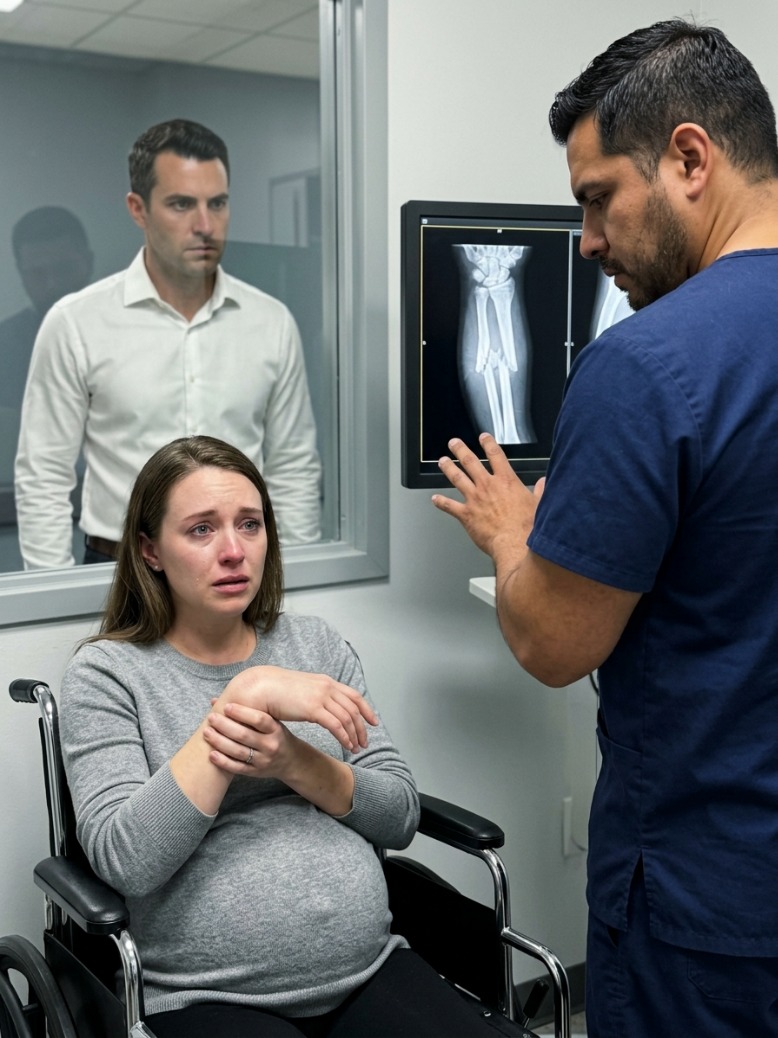
The radiology room was colder than the rest of the hospital, bright in a way that made everything seem exposed.
Elena sat in the chair, shaking from pain and adrenaline, while a broad-shouldered technician in navy scrubs entered with a tablet in hand.
His badge read M.
Ruiz.
He looked tired, solid, kind in the way some people are kind without advertising it.
His eyes moved from Garrett to Elena’s swollen arm.
“Her husband can wait behind the protective glass,” he said.
Garrett smiled.
“She gets anxious without me.”
“Hospital policy,” Ruiz replied.
Garrett’s mouth tightened for the briefest moment before he stepped behind the partition.
Ruiz moved carefully as he positioned Elena’s arm.
“I’m sorry,” he said.
“I know,” Elena whispered.
“It’s okay.”
It wasn’t okay, but that was the language she had learned.
He adjusted the plate, glanced at the monitor beside the machine—and froze.
Not dramatically.
Just stillness.
His eyes scanned the screen again.
Then he looked at Elena’s face.
Then the bruises shadowing her wrist.
Then back to the screen.
Something in him changed.
“Mrs.
Hartford,” he said quietly, his voice measured now, almost cautious.
“Has anyone asked if you’re safe going home tonight?”
The question slammed into her harder than the pain.
Behind the glass, Garrett straightened.
Ruiz tapped the screen once more as if confirming a detail.
Then he looked at Elena with unmistakable recognition.
Not recognition of her face.
Recognition of her file.
He finished the images, set the plate aside, and stepped into the hallway.
Elena couldn’t hear his exact words, but she saw him check the chart again, pull out his phone, and speak fast and low.
Six minutes later, the elevator doors opened.
Two FBI agents stepped out with hospital security.
Garrett’s smile vanished.
The woman leading them was in a dark blazer, her badge visible at her waist.
She walked straight toward him as if she had known for years that this moment would eventually come.
“Mr.
Hartford,” she said, “step away from your wife.”
Garrett let out a disbelieving laugh.
“There has to be some mistake.
My wife fell down the stairs.
She’s pregnant.”
The second agent, older and heavyset, had a worn manila file under his arm.
Elena’s heart stopped when she saw the name on the tab.
Not Elena Hartford.
Elena Vale.
The name Garrett had forbidden her to speak.
The name he had told her belonged to a dead life.
The female agent turned to Elena.
Her voice softened.
“Elena Vale, my name is Special Agent Naomi Keller.
Before you say anything, you need to understand something.
We have been looking for you for almost three years.”
Garrett moved, just one sharp step, but the security guard caught his arm.
Elena stared at the file, then at the agent, then at Ruiz standing near the nurses’ station with his phone still in hand.
Naomi Keller followed her gaze.
“Mr.
Ruiz attended a federal training two years ago,” she said.
“Certain hospitals were asked to watch for specific names tied to an active financial crimes and witness coercion investigation.
He saw yours in a sealed note attached to your prior imaging records.
The system flagged it when your chart opened tonight.”
Elena’s mouth went dry.
“My records?”
Naomi nodded.
“Before your marriage, you gave a deposition to federal investigators regarding Marston Capital Development.
You were an accounting assistant.
You identified a shell company used to move bribe money through real estate purchases.
Two weeks before your follow-up testimony, you disappeared.”
Elena looked at Garrett.
He had told her a different story.
He had told her the FBI wanted to pin crimes on him because he refused to play politics.
He had told her people from her old job were dangerous.
He had told her changing her number, leaving her apartment, moving into one of his properties, and keeping quiet were the only ways to stay safe.
He had told her marriage would protect her.
He had told her everyone else was lying.
At the beginning, Elena had believed him because believing him was easier than admitting how fast her life had narrowed.
Then the isolation began.
Her phone changed.
Her friends disappeared one excuse at a time.
He managed her schedule.
He corrected what she wore.
He read her emails.
He persuaded, explained, charmed, and then punished whenever she resisted.
By the time she understood what had happened, she was already surrounded.
Naomi Keller stepped closer.
“We never stopped looking for you.
But every lead died.
Your bank records ended.
Your old number disappeared.
The apartment lease was terminated.
Then Garrett Hartford married you six months later under a different legal filing structure that sealed the address through one of his subsidiaries.”
Garrett lifted his chin.
The fear on his face hardened into contempt.
“This is absurd.
She’s my wife.
Ask her.”
Everyone looked at Elena.
The room seemed to shrink around her.
For years, this had been the most dangerous moment—being asked to tell the truth while he was still close enough to punish it.
Naomi seemed to sense that.
She nodded to security.
“Take Mr.
Hartford to interview room three.
He is not under arrest yet, but he is not to leave this floor.”
“You can’t do this,” Garrett snapped.
The softness was gone now.
So was the polished charm.
His eyes locked on Elena with naked fury.
And there it was.
The real man.
Not hidden.
Not edited.
“Elena,” he said, low and vicious, “don’t be stupid.”
She felt the baby move again.
Something in her shifted with it.
Not courage exactly.
Exhaustion, maybe.
Or clarity.
The kind that arrives only when the thing you fear most is already happening.
She looked at Naomi Keller and spoke the first true sentence she had allowed herself in years.
“He broke my arm.”
Garrett lunged so suddenly that two security guards had to pin him against the wall.
People shouted.
A monitor alarmed somewhere down the corridor.
He cursed, struggled, and then started yelling that Elena was unstable, medicated, hysterical, pregnant, confused.
He threw out titles and board memberships and donor names.
He demanded lawyers.
He threatened the hospital.
He called Naomi incompetent and Ruiz a liar.
No one looked impressed.
Once Garrett was taken away, the silence that followed felt unreal.
Naomi Keller crouched beside Elena’s chair.
“Can you tell me when this started?”
Elena tried.
At first the words came in broken pieces.
The first shove.
The first apology.
The first time he threw a glass near her head and called it an accident.
The first time he took away her phone “for a weekend” after she mentioned calling her sister.
The first time he told her her old life had been compromised and that only he knew how to keep her safe.
The time he locked her in the wine cellar for three hours because she embarrassed him at dinner.
The bruises hidden under silk sleeves at charity events.
The miscarriage before this pregnancy, after
he pushed her into a bathroom vanity and then cried harder than she did.
Naomi didn’t interrupt.
Neither did the obstetrics nurse who had quietly entered halfway through and now stood with tears in her eyes.
Ruiz remained in the doorway, arms folded, not intruding, just there.
By dawn, the statements were recorded, the fracture splinted, and Elena was admitted for observation because of abdominal tightening that doctors now believed were stress-induced contractions.
Garrett Hartford was no longer in interview room three.
He was in federal custody.
The deeper investigation unfolded fast once Elena began talking.
The shell companies from her old deposition were real.
So were the bribes.
So were the retaliatory threats against witnesses.
Garrett hadn’t merely manipulated Elena into disappearing; federal prosecutors believed he had targeted her precisely because she knew enough to damage him.
He had approached her when she was frightened and overwhelmed after her first interview with investigators.
He offered protection, then romance, then marriage.
What looked like seduction was, in the government’s words, witness tampering wrapped in domestic coercion.
He was eventually charged with wire fraud, conspiracy, witness intimidation, unlawful surveillance, assault, and multiple counts related to financial corruption.
Elena’s hidden life became part of the case.
So did the hospital visit.
So did the X-rays showing the fresh fracture layered over older injuries in different stages of healing.
When the grand jury indictment was unsealed, his photograph was suddenly everywhere.
The same magazines that once called him one of Westchester’s most admired philanthropists now ran headlines about the polished predator behind the charity galas and ribbon cuttings.
People came out of the woodwork.
A former assistant described screaming behind office doors.
An ex-girlfriend admitted he had followed her for months after she tried to leave.
A contractor testified about cash payments, falsified invoices, and threats.
Garrett’s empire, so carefully built on confidence and intimidation, began collapsing under the weight of its own records.
Elena gave birth two weeks later.
Labor started in the middle of the night with rain tapping the hospital windows and one hand still trapped in a brace.
Naomi Keller came by before dawn, not as an agent that time, but simply as a woman bringing coffee and asking if Elena wanted someone in the room.
Elena said yes before she could overthink it.
Her daughter arrived red-faced and furious at the world, with a full head of dark hair and a cry so strong that Elena started crying too.
She named her Mara.
Not after anyone.
Just because the name sounded like something that could survive.
The months that followed were not cinematic either.
Freedom wasn’t one clean moment.
It was paperwork.
Therapy.
Night terrors.
Depositions.
Learning how to buy groceries without checking over her shoulder.
Learning that a slammed cabinet in the apartment upstairs did not mean anyone was coming.
Learning that kindness offered without conditions could exist.
Ruiz sent a card after the baby was born.
It had no dramatic message inside.
Only: You were believed.
That matters.
Elena kept it in the kitchen drawer of her small rental apartment, the first place she had ever chosen for herself.
A year later, she testified in federal court.
Garrett sat at the defense table in a dark suit, looking older and somehow smaller without the power of
surprise on his side.
He still tried to meet her eyes.
He still seemed to believe there was a version of the room he could control if he wanted it badly enough.
There wasn’t.
Elena told the truth in a clear voice.
About the lies.
About the fracture.
About the name he buried.
About the way he made her doubt every instinct until fear felt like love and silence felt like safety.
The jury returned guilty verdicts on nearly every count.
When the foreperson read them aloud, Garrett’s expression didn’t crack all at once.
It wore down, piece by piece, as if the verdict were sandpaper against a mask he had trusted too long.
He was sentenced to twenty-seven years in federal prison.
Reporters later called Elena brave.
Survivors wrote letters saying her testimony sounded like their own lives.
Commentators argued over whether his financial crimes or his abuse revealed his true nature more clearly.
People asked how someone so polished could hide something so rotten in plain sight.
Elena never found that question difficult.
He had hidden because people preferred the beautiful version.
The expensive version.
The version with the white shirt and the charitable smile.
That was the part that haunted her longest.
Not that Garrett had lied.
That he had lied in a language the world was eager to understand.
Sometimes, late at night, while Mara slept in the next room, Elena still thought about the radiology suite.
The bright light.
The cold air.
Mateo Ruiz pausing at the monitor.
The tiny stillness before everything changed.
A life can collapse from one violent moment.
It can also reopen from one person deciding that what they see on a screen, on a face, in a bruise, matters enough to act.
The break in her arm healed crooked at first and ached when rain rolled in.
The deeper fractures took longer.
Some of them, she suspected, would always ache.
But when Mara was old enough to ask why her mother had a faint white line near her wrist from the surgery, Elena knew exactly what she would say.
Not the whole story.
Not at first.
Only this:
There was a night when someone thought he had ended everything.
And instead, it was the night the truth finally found the right room.
Even now, Elena sometimes wondered which red flag had been the first real one.
The way Garrett knew too much too soon? The way he called control protection? The way every apology somehow made her responsible for his behavior? She no longer asked whether he ever loved her.
That question belonged to the old life, the one built on confusion.
The one that mattered now was simpler, sharper, and far more useful: when charm arrives carrying silence behind its back, how quickly do we dare call it what it is?