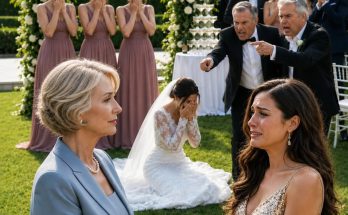
The morning my husband’s new wife showed up at my door, I was kneeling in my father’s rose garden with my gloves damp from dew and my skirt hem darkened by the soil, trimming the white blooms he had planted for my wedding day. The irony was not subtle enough to miss. My marriage to Holden Blake had ended in the kind of public humiliation people pretend to handle with grace and actually survive by breaking privately in better-dressed rooms. He had been gone from my life a year before he married Haley West, the secretary he swore was just “good at keeping his calendar straight” while he was still wearing my ring. And now here she was, striding up the stone garden path in bright red Louboutins pointed enough to wound a conscience, wearing sunglasses at ten in the morning and a smile greedy enough to make a vulture blush.
I heard her before I looked at her. Some people have footsteps. Haley had an entrance. Heels on stone, the faint metallic jangle of bracelets, perfume arriving half a second ahead of her body, and then that voice—sweet in the way overripe fruit is sweet, one hour from rot.
“Melanie,” she said, drawing my name out like we were old friends sharing a joke I had somehow forgotten. “We’re here for our rightful share of your father’s estate. Move out immediately.”
I didn’t stand. I didn’t even look up at first. I just clipped another rose, turning the stem neatly between my fingers so the bloom would sit properly in the basket already half-filled beside me. The roses were white because my father had insisted white was the only honest flower for a wedding. “Red is for performance,” he’d said when he planted these bushes twelve years earlier, his trouser knees soaked through because he refused to let anyone else dig the holes. “White is for vows you actually mean.”
My father had a habit of saying things that took years to finish being true.
“There is no ‘we,’ Haley,” I said calmly. “And you have no claim here.”
“Oh, we’ll see about that.” She stepped closer, close enough that her shadow stretched over the roses. “The will reading is tomorrow. Holden and I have already spoken to your brother. Isaiah agrees it’s only fair we take our share.”
That made me look up.
It wasn’t the mention of the will reading. I had expected some version of greed before that day arrived. Greed always gets impatient around paperwork. It was Isaiah’s name. My brother and I had not spoken properly since my father’s funeral six weeks earlier, and that silence had become its own living thing, heavy and ugly, settling into every room where our father should have been. At the funeral Isaiah had spent more time comforting Holden than speaking to me, which at the time had felt like betrayal too sharp to forgive. I had not yet learned that grief and strategy can wear the same face if you’re being lied to skillfully enough.
Before I could answer, Haley crouched slightly—not enough to help with the roses, only enough to put her face closer to mine as if intimacy could sharpen cruelty.
“This house is worth at least a million dollars, Melanie,” she said. “Do you honestly think you get to keep all of it? Daddy’s princess playing gardener while the rest of us get nothing.” She gave a little laugh, one designed for witnesses even when there were none. “Start packing. We’ll need a month to renovate after we move in.”
I rose slowly, peeling one glove off finger by finger because I refused to give her anything hurried. The morning smelled like wet earth and cut stems. Somewhere beyond the side hedge a sprinkler clicked on. The old brick of my father’s house held the early sun in its joints. Haley’s shoes were already sinking slightly into the damp edge of the path, which gave me a brief, petty pleasure.
“Get off my property,” I said, “before I forget my manners.”
Her laugh sounded like a champagne flute shattering on tile. “You can’t keep us out. Holden was like a son to your father.”
My jaw tightened. “The same Holden who cheated on me?”
May you like
“Ancient history,” she said breezily, flipping her hair over one shoulder. “Besides, your father loved us. And tomorrow the will proves it.”
Us.
That word again, spoken with the entitlement of someone who mistakes proximity for inheritance. Haley had a particular talent for turning theft into belonging through grammar alone.
She turned then, satisfied she had landed her poison, and began picking her way back toward the gate with exaggerated care, one heel after another, as though my garden were a stage and the exit mattered as much as the scene. I watched her go because anger kept me still and because if I had followed her I’m not entirely certain I would have remained the sort of woman judges find sympathetic.
At the gate, she paused and glanced back over her shoulder. “Tomorrow will be fun,” she said. “You always were terrible at losing.”
Then she slipped through the wrought iron and disappeared toward the driveway, the sound of her heels fading under the low growl of the car idling beyond the hedge.
I stood motionless until the car door slammed and the engine carried her back down the long drive. Only then did I let out the breath I had been holding. It came out through my nose, sharp and hot, and for a second the whole morning seemed to tremble around me—the roses, the brick, the stillness of the house behind me, the knowledge that my father was dead and people like Haley considered death merely a scheduling opportunity.
I bent to pick up the basket.
That was when I saw the envelope.
It had slipped half beneath the base of the oldest rosebush, the one nearest the stone birdbath, its corner damp with morning dew and one edge darkened by soil. At first I thought Haley had dropped something. Then I saw the handwriting.
My father’s.
I knew his hand the way people know prayers they no longer believe in but could still recite under pressure. Miles Harrison wrote in deep blue-black ink with a fountain pen older than I was, each letter confident, slightly slanted, nothing tentative in it even near the end when his body had begun betraying him. My breath stalled in my throat.
The envelope was addressed simply: Mel.
Not Melanie, which everyone else used when they wanted to sound serious. Not Miss Harrison, which annoyed him enough that he once corrected a bank manager in my presence and then made the man apologize to me as if names were moral territory. Mel was his private name for me. The one he used when I was small and muddy and had climbed the maple tree even after being told not to. The one he used the day I signed the lease on my first flower shop and he arrived with lunch and a ladder because he thought all women deserved someone to hang the first thing on their walls.
My hands were suddenly unsteady.
For one foolish heartbeat I looked around as if he might emerge from the greenhouse grinning, delighted at the trick. But the greenhouse stood quiet, the panes flashing with pale light. My father had been buried six weeks earlier beneath a sky so blue it felt rude. Men do not step out of greenhouses after that.
I knelt again, more slowly this time, set the basket aside, and lifted the envelope from the soil. The paper was thick, expensive. He had always preferred stationery that made an impression under your fingertips. There was no wax seal or dramatic flourish, just the deliberate practicality of a man who knew the world often became ugly and believed a good pen and a locked drawer could outlast more things than sentiment ever would.
I carried the envelope into the house with dirty hands.
The front hall still smelled faintly of lemon polish and old wood, the way it had all my life. Harrison House had once belonged to my great-grandparents and had the kind of beauty that requires constant, expensive maintenance and gives nothing back but atmosphere if you do not love it. My father loved it. I had returned after his death partly because Aaliyah, his attorney and my best friend, told me the estate would need someone here until probate and partly because leaving it empty had felt like abandoning him a second time. The staff had long since been reduced to a weekly housekeeper and grounds service, and I had insisted on taking over the roses myself because no one else cut them the way he did, leaving just enough stem for next bloom, never too low, never careless.
I crossed the front hall, passed the staircase where I had once sat in my wedding dress holding my shoes in one hand while Dad fixed Holden with that long appraising stare he reserved for men he wanted to trust but hadn’t fully decided about, and went straight to his study.
The room still felt occupied. Not haunted exactly. More like the furniture retained memory in a practical way. The leather chair dented slightly on one side where he always favored it. The brass lamp with the green shade angled toward the blotter on his desk. Books in rows that made sense only to him. The faint ghost of pipe tobacco embedded in the curtains, though he had stopped smoking indoors years before I graduated college. The walls were paneled in dark walnut, and morning light filtered through the tall windows in broad gold bars that made dust look ceremonial.
I shut the door behind me and sat in his chair.
Then I called Aaliyah.
She answered on the first ring. “Tell me Haley didn’t come to the house.”
“She came to the house,” I said.
There was a beat of silence, then the unmistakable sound of her grabbing keys. “I’m on my way.”
“She said she and Holden have already spoken to Isaiah.”
Another pause, shorter this time, but sharper. “Don’t do anything until I get there.”
“There’s more.” I looked down at the envelope in my hand. “I found a letter. In the rose garden.”
“What kind of letter?”
“One in my father’s handwriting.”
Aaliyah exhaled slowly. “Open nothing. Touch nothing else in the study. I’ll be there in ten.”
If you have never had an attorney as a best friend, you may not understand the strange comfort of being ordered around by someone who loves you and bills most people for what they are receiving for free. I obeyed. Mostly because I wanted a witness, but also because the sight of my father’s hand on that envelope had unsettled me in a way I could not yet name. Grief rearranges time. For six weeks I had been moving through rooms that still contained his things, answering condolence calls, reviewing inventory from Harrison Industries, choosing ties for burial photographs, and trying not to think too hard about the fact that the only thing louder than a powerful man dying is the sound of other people approaching what he left behind. I had not yet learned how to separate fresh grief from practical danger.
So I sat in his chair and waited while the envelope rested on the desk blotter in front of me like a pulse. My eyes drifted around the study in the involuntary inventory of memory. The framed black-and-white photo of me at nine in rain boots holding a fistful of peonies bigger than my head. Isaiah at seventeen in a baseball uniform, all elbows and defiance. Holden at our wedding, smiling for the camera with his hand on my back and my father behind us looking proud, amused, and, I now thought, not fully fooled.
That photograph was the cruelest object in the room.
I had met Holden when I was twenty-four and had mistaken confidence for steadiness because at that age many women are still being trained to admire the performance of certainty in men who have never been forced to earn any. He was handsome in the clean, polished way corporate men know how to be handsome without seeming vain. He had ambition, excellent manners, the kind of laugh that made waitresses turn their heads, and a talent for studying what mattered to the people around him and mirroring it back at them just brightly enough to feel like understanding. My father liked him immediately, which should have made me more suspicious, not less. Dad had spent his life building Harrison Industries from a regional supply company into something large enough to matter and private enough to breed envy. Holden started in a junior business development role two months after the wedding and was in an executive office within four years, which should have been another clue. The truly gifted almost never rise that quickly without a witness willing to bend the ladder.
Still, for eight years I loved him sincerely. We built routines. We collected dishes and art and arguments about paint colors. We took vacations that looked prettier in photographs than they ever felt in my body. He learned exactly how I took my coffee and exactly when to call my father for advice instead of asking me directly, a habit that felt like reverence until I saw the calculation beneath it. The affair with Haley had not begun, as people later assumed, after our marriage had somehow naturally “run its course.” It had begun while Holden was still telling me he wanted to start trying for children “once things settle down at work.” Men who are lying often use the future as a storage unit for sincerity. He and Haley had made a sport of humiliating me retroactively. By the time the divorce papers were signed, she had already been leaving earrings in his car like breadcrumbs, as if she needed me to understand not only that he had cheated, but that my pain amused her.
My father had never said I told you so. He was too disciplined for that. What he said, the night I moved my last box out of the apartment Holden and I had shared, was, “Some people think charm is collateral. It isn’t. Sooner or later the bank comes looking.”
At the time I thought he meant Holden’s moral debt as a husband.
I did not yet know he also meant the company.
Aaliyah arrived in nine minutes wearing a camel coat over a navy sheath dress and the expression of a woman who had already decided exactly how much nonsense she was willing to tolerate from the day. She let herself in without knocking, crossed the study in three purposeful strides, hugged me once, hard, and then held me by the shoulders to assess whether I was angry enough to be useful or hurt enough to be dangerous.
“Did you open it?”
I shook my head.
“Good.” She took off her coat, draped it over the chair by the window, and sat opposite me. “Tell me exactly what Haley said.”
I repeated the conversation as closely as I could, down to the mention of Isaiah and the promise of renovation. Aaliyah’s face did not change much while I spoke, which is how I knew she was worried. The sharper her mind got, the more still her body became.
When I finished, she nodded toward the envelope. “Open it.”
My hands trembled only once, when I slid my finger beneath the flap. Inside was a single sheet of cream paper folded in thirds and a small brass key taped to the lower corner. I unfolded the page.
My dearest Mel,
If you’re reading this, someone has made a move against the estate. Likely Haley. She reminds me of a shark—teeth and no soul. The key opens the bottom drawer of my desk. Everything you need to protect what’s yours is inside. Remember: in chess, sometimes you sacrifice a pawn to protect the queen.
Love,
Dad
For a moment I couldn’t see the words because my eyes had filled too fast. The room blurred—the books, the lamp, Aaliyah’s careful stillness—and all I could think was that even dying had not prevented my father from anticipating the exact shape of other people’s greed. That he had known Haley well enough to compare her to a predator on paper and tuck the comparison under my roses because he trusted the roses more than the people in his house.
Aaliyah handed me the glass of wine she must have poured while I was reading without my noticing. “Your father was preparing for this,” she said.
I looked down at the brass key in my palm. It was old-fashioned, heavy for its size, the sort of key that implies secrets with discipline behind them. My father hated electronic locks. “If something matters,” he used to say, “it should require metal.”
The bottom drawer of his desk had always been locked. As a child I had assumed it held the kind of adult mysteries all children imagine—war letters, diamonds, divorce papers, maps to buried money. Later I assumed it held contracts and confidential company files. I had never asked. Harrison men were not sentimental about privacy, but they were absolute about it.
I knelt beside the desk, slid the key into the lock, and turned it.
The drawer opened with a low, reluctant sound, as if it had been waiting longer than I had known.
Inside was a thick manila envelope, a USB drive, and a sealed folder marked in my father’s handwriting: If Haley smiles, open this first.
Despite everything, I laughed. A raw, incredulous sound. Of course he had labeled the order of emergency by facial expression.
Aaliyah exhaled through her nose. “That sounds like Miles.”
I handed her the folder, and she slid out the contents onto the desk blotter one by one. Photographs. Bank statements. Printed emails. Timelines. A legal memorandum with yellow tabs. Pages of notes in my father’s tight, controlled hand. The room seemed to grow colder the longer we looked.
“This…” I said, picking up the first photograph. “This is surveillance.”
Aaliyah nodded. “Your father hired private investigators three months before he died.”
The photograph showed Haley in a dark parking lot near Easton, handing an envelope to a man in a gray coat whose face had been partially obscured by angle and distance. Another showed Holden leaving a law office that was not Aaliyah’s, not the company’s, not anyone I recognized. Another showed him passing a slim document case to a man standing outside a glass tower downtown that I knew, with a sickness that bloomed instantly in my gut, belonged to one of Harrison Industries’ largest competitors.
My father had trusted Holden with company access.
I picked up one of the bank statements, my finger tracing a highlighted outgoing transfer from a corporate account to a shell consulting firm with no obvious employees. “What is this?”
“Embezzlement,” Aaliyah said simply. “Or the start of it. Holden was diverting funds through side contracts and feeding proprietary data to a competitor. Your father discovered irregularities during a routine internal review. He didn’t confront Holden immediately because he wanted the whole structure.”
I looked up at her. “Why didn’t he tell me?”
Something passed over her face—frustration, affection, maybe both. “Because he knew exactly what you would do, Melanie. You would confront Holden out of hurt, not strategy. Haley would cry. Holden would deny. They’d destroy evidence. Your father was dying and trying to leave you something stronger than anger.”
There is a particular humiliation in realizing the dead have been protecting you from truths you were living inside. I turned the next page. It was an email printout from Haley to someone saved as M.P. Consulting, discussing “timing around will access” and “medical intel.” Another tabbed section held receipts for cash withdrawals, a burner phone, and what appeared to be payments to someone in a private nursing registry.
Aaliyah pointed to the USB drive. “That contains audio and video of Haley attempting to bribe your father’s nurse for information about the will two days before he passed.”
I stared at her. “She bribed a nurse?”
“She tried.”
“She thought he was dying and she was already shopping for floor plans.”
Aaliyah didn’t answer. She didn’t need to.
The room filled with the sound of my own breathing. Outside, somewhere in the back garden, a wood pigeon called once and stopped. My father had been ill for eight months. Pancreatic cancer. Swift, ugly, and precise in its cruelty. He had handled it the way he handled everything—by making lists, asking direct questions, putting his affairs in order, and refusing pity from people who mistook illness for spiritual enlightenment. In the final weeks he had become thinner but not softer. He still wore pressed shirts. Still reviewed company reports from bed. Still corrected me when I said if instead of when. I had spent those months trying to be his daughter and his caretaker at once, and perhaps because of that I missed how much else he was still doing beneath the visible grief. He had been dying and laying traps. He had been choosing flowers for his own funeral and building a prosecution package in the same week.
Aaliyah rested her palms on the desk. “Before you look at the drive,” she said quietly, “there’s something else.”
I swallowed. “What?”
“Your father added a codicil to his will three days before he died.”
My head lifted. “What kind of codicil?”
“The kind that changes tomorrow.”
There are moments when a room seems to draw its own breath before speaking. This was one of them. Aaliyah reached into her briefcase and withdrew a sealed copy of the will, then slid to the relevant page. The codicil was several pages long, heavily witnessed, notarized, and written in the kind of dense, precise legal language that transforms emotion into architecture. She summarized as I read.
In the original will, the estate had been divided in a way that already reflected my father’s complicated loyalties. Sixty percent to me, including the house, the rose garden, and the controlling family interest in Harrison Industries. Forty percent in divided bequests and discretionary trusts to Isaiah, certain philanthropic commitments, and, controversially, Holden—on the basis of what my father once called “past service and presumed fidelity.” Holden’s share had outraged me even in draft months earlier, though Dad refused to discuss specifics while ill and I had been too proud to beg. I had assumed, bitterly, that some paternal affection survived stupidity. I had not known it was bait.
The codicil stated that any bequest to Holden Blake or Haley West was provisional and contingent upon the absence of prior misconduct against the testator, the estate, or Harrison Industries. It further provided that acceptance or attempted enforcement of the bequest by either party would trigger the immediate disclosure of evidence collected by my father regarding fraud, coercion, financial misconduct, interference with medical personnel, and attempted manipulation of testamentary capacity. Copies were to be delivered simultaneously to law enforcement, the court, the company board, and all counsel of record. In short, Dad had left them just enough rope to demand their share publicly and hang themselves with it under perfect lighting.
I sat back slowly. “He built the will into a trap.”
“The perfect one,” Aaliyah said. “Because Haley is greedy enough to step into it with a camera crew.”
I blinked. “A camera crew?”
Aaliyah’s mouth tightened with something close to disgust. “She called this morning. She requested permission to document the reading for ‘personal archival reasons.’”
I barked out a laugh. “Of course she did.”
“She wants a victory reel.”
“Then let her film one.”
For the first time that morning, something steadier than shock began to gather in me. Not relief. Relief would have required safety. This was something more useful. Alignment. The ugly pieces fit now. Haley’s smugness. Holden’s pale silence at the funeral. Isaiah’s distance. The way my father had looked at me in the hospice room three days before he died and said, almost casually, “When people show up smiling around money, let them.” I had thought he meant investors. He had meant vultures.
Headlights swept briefly across the study windows.
Aaliyah glanced toward the driveway. “That’ll be Isaiah.”
My whole body tightened.
Isaiah Harrison was thirty-four, two years older than I was, and had inherited our father’s height, his dark eyes, and his maddening ability to look as if he understood more than he cared to say. As children we had been close in the loose, combative way siblings are before adulthood teaches them different kinds of hunger. He taught me to throw a baseball and once pushed a boy off the bleachers for calling me horse-faced in middle school. I broke his nose with a board game box when I was thirteen after he read my diary aloud to his friends. We recovered from both incidents. Adulthood scattered us. He went into the operations side of Harrison Industries while I, to my father’s mild disappointment and eventual deep pride, opened a flower shop instead of entering the company. We loved each other, but after our mother died when I was seventeen, the house hardened around unspoken loyalties. Dad talked business to Isaiah and beauty to me, and though neither role was lesser, the split did damage anyway.
At the funeral, Isaiah had stood with Holden for too long. That was the fact my grief could not get past. He had one arm around my ex-husband’s shoulder while I received casseroles and condolences alone, and all I could think was that whatever father-son mythology Holden had sold the men in my family had lasted past the grave.
The study door opened without a knock. Isaiah stepped in wearing yesterday’s suit and exhaustion like a stain. His tie was loose, his jaw shadowed, his hair not quite combed. He looked at the spread of evidence across the desk, then at me.
“So,” he said quietly, “you found Dad’s insurance policy.”
I stood before I knew I was doing it. “Insurance policy? Is that what we’re calling this now?”
He winced. “Mel.”
“No, don’t ‘Mel’ me. Not after the funeral. Not after spending six weeks acting like Holden was the bereaved spouse and I was some problem to be managed.”
Aaliyah folded her arms but said nothing. She knew when family required the knife to reach the bone.
Isaiah exhaled hard and pulled a chair away from the wall but didn’t sit. “I wasn’t betraying you,” he said. “I was acting as a double agent.”
The silence that followed was so sharp I could hear the radiator click.
I laughed once, short and mean. “You’re going to have to do better than that.”
He set a folder on the desk and opened it. Inside was a cashier’s check for five hundred thousand dollars payable to him and never deposited.
“Haley offered me half a million to testify that Dad wasn’t mentally competent when he signed the codicil,” he said.
All the blood seemed to drain from my hands. “What?”
“I took it straight to Dad.”
He reached into the folder again and pulled out his phone, then placed it on the desk between us like a weapon he was tired of carrying. “He told me everything after that. About Holden feeding company information out. About Haley trying to get to the will. About the investigators. He needed someone close enough to them that they’d keep talking. I already hated Holden, so apparently I was ideal.”
I stared at him. “And you couldn’t tell me?”
His mouth tightened. “Dad made me swear not to. He said if you knew, you’d go straight for Haley’s throat. Which, for the record, I still think would’ve been fair, but not helpful.”
He unlocked the phone and opened an audio file. “Listen.”
At first there was only clinking glass and restaurant noise. Then Haley’s voice came through, unmistakable even distorted by speakers.
“Once the old man dies,” she said, low and amused, “you testify he wasn’t of sound mind. Holden and I take control. Melanie won’t know what hit her.”
The hair on my arms rose.
The recording shifted. Isaiah’s voice, flatter than I had ever heard it: “And my share?”
Haley laughed. “You’ll get more than your sister deserves.”
Another file. This time Holden.
“We sell the house,” he said. “Liquidate what we can. Melanie can go back to her little apartment. She never deserved this place anyway.”
The room seemed to narrow around me. I remembered Holden walking through this house when we were still married, one hand in his pocket, admiring the crown molding and saying to my father, “Places like this disappear when families get sentimental.” At the time I thought it was admiration. It was inventory.
I pressed a hand to the desk. “Why?” The word came out smaller than I wanted. “Why do they hate me so much?”
Isaiah looked away first. Not because he couldn’t answer. Because he could.
“Haley blames you for making Holden feel guilty about the affair,” he said. “Which is insane, obviously, but she builds her world out of grievance. And she thinks Dad loved you too much.”
Aaliyah’s mouth twitched. “She’s not entirely wrong about that last part.”
I closed my eyes. My father had loved me openly, which in our family was a dangerous kind of blessing. He loved Isaiah too, deeply, but in a language made of responsibility and competence. With me, he had allowed softness. He brought me cuttings from estate sales because he knew I’d coax them back to life. He sat in the back row at my first floral design competition and cried harder than I did when I won. When Holden left, Dad arrived at my apartment with soup, a locksmith, and a new deed box before I had even changed the sheets. Perhaps if you are the person visibly loved in a family full of ambitious people, someone will eventually decide you have been overpaid.
“He knew,” I said, mostly to myself. “He knew she was dangerous.”
“That’s why he set the codicil,” Aaliyah said. “The moment Haley and Holden try to accept anything, every piece of evidence becomes public record. Law enforcement gets copies immediately. So does the board. So does the court.”
I opened my eyes and looked at the desk again—the photographs, the notes, the USB, Isaiah’s recordings, the whole architecture of consequence my dying father had built while the rest of us were trying not to say the word death aloud in front of him. A strange sound escaped me, half laugh, half disbelief.
“Haley hired a camera crew for the will reading,” I said.
Isaiah’s mouth curved for the first time that day. “Good,” he said. “Then the cameras will catch the whole thing.”
We spent the next several hours planning not like grieving children but like a legal team preparing a public execution with documentation standards. Aaliyah outlined the sequence. She would begin with the original bequests exactly as written. Holden and Haley would hear the provisional inheritance before the codicil. If Haley did what she always did—celebrate first, think later—there would be no room afterward for claims of confusion. Detective Mallory had already arranged for two officers in plain clothes to remain within response distance once Aaliyah triggered the evidentiary release. The company board had been quietly notified to expect emergency materials. Isaiah would remain outwardly neutral until the right moment because Haley still believed him compromised. I would say as little as possible until the evidence spoke.
“Can you do that?” Aaliyah asked me finally.
I understood the real question. Could I sit in a room with the man who betrayed my marriage, the woman who weaponized my humiliation, a camera crew waiting for spectacle, and all the legal proof of my father’s final distrust, and not set the house on fire myself?
“Yes,” I said.
Isaiah looked at me for a long moment, something like remorse in his face. “I should have told you sooner.”
“No,” Aaliyah said before I could answer. “Miles was right. If she had known, Haley would have smelled it.”
“That isn’t what I meant,” Isaiah said quietly.
I looked at him then and saw, behind the exhaustion, the brother I had nearly lost to my own assumptions. He had been carrying this alone too. Not as heavily as me, not with the same injuries, but carrying it. Sitting across from Haley and Holden while they laid plans for my erasure. Listening. Recording. Pretending. The funeral memory shifted in my mind. Him with his arm around Holden, yes—but perhaps not comforting. Containing.
“You still could’ve looked at me,” I said.
He took that without defense. “I know.”
The house changed after that. Not physically. The walls were the same, the study still smelled of tobacco and books, the kitchen still opened onto the back terrace where the roses climbed. But I no longer felt cornered inside my own grief. Danger named is easier to stand in than danger felt and denied. We reviewed the USB that afternoon, and if I had not already hated Haley with a disciplined adult hatred by then, the footage would have done it for me. She had cornered my father’s night nurse in the hospice suite two days before he died, smiling as if they were discussing centerpieces, and offered cash for “peace of mind” about the final will. The nurse, God bless her, had been wearing the recording button my father’s investigator provided after he warned the medical team someone might try something. Haley asked whether my father was lucid when he signed “the newer paperwork.” She asked whether he had mentioned me. She asked whether medication had made him “confused enough that documents could be challenged.” At one point she laughed and said, “It’s not like he’ll be around to argue.” Hearing that line in her voice while my father was still warm in the next room made my hands go numb.
I slept badly that night in the bedroom where I had spent the final week listening to my father breathe. Dreams came in fragments—roses, camera flashes, Holden’s hand on my waist from a marriage already rotting, Haley’s heels on the garden path, my father smiling from the study and then coughing blood into a linen handkerchief. I woke before dawn and went outside barefoot into the chill just to feel something simple and physical under me. The roses were gray-blue in the early light. I stood among them and thought of the note: sometimes you sacrifice a pawn to protect the queen.
My father had loved chess because it turned sentiment into structure. When I was small, he taught me openings by comparing pieces to people at family dinners. “The knight is charming and dangerous because he doesn’t move how anyone expects,” he’d say. “The bishop seems holy until you realize he only ever travels on one color.” He always called the queen power mistaken for decoration. “Men think they can predict a queen because they’ve spent years underestimating her,” he told me when I was eleven and angry that Isaiah beat me three games in a row. “That lasts right up until the board closes.”
Standing in the cold garden before sunrise, I heard his voice as clearly as if he were beside me. Not ghostly. Memory is often more exact than haunting.
By ten the next morning, the house had become a stage.
Haley’s camera crew arrived first, which told me everything I needed to know about her priorities. They unloaded tripods, lighting panels, and a rolling case of equipment while pretending not to stare at the portrait of my great-grandmother in the front hall. One young cameraman looked barely old enough to rent a car. He asked where the best angle would be for “reaction shots,” and Aaliyah, with a face carved from etiquette, told him the best angle was whichever one kept him silent.
Haley came in fifteen minutes later wearing a fitted black dress and the kind of careful mourning makeup women use when they want to look tragically luminous rather than bereaved. Her hair fell in soft controlled curls over one shoulder. Diamond earrings. Neutral lip. She had rehearsed herself for victory. Holden followed in charcoal, already looking slightly unwell, as if some primal part of him understood that returning to this house for money carried the scent of a mistake. He avoided my eyes. Good. Let him feel small.
Isaiah arrived separately and took a place near the bookshelves, expression unreadable. Detective Mallory’s officers were not visible, but I trusted they were close. Aaliyah sat behind my father’s desk with the will, codicil, and evidence folders arranged with surgical neatness. I stood by the fireplace beneath the painting of the house in winter, my hands clasped behind me so no one could see whether they trembled.
Haley glanced around the room and smiled at the cameras. “This is going to be historic,” she whispered loudly enough for everyone to hear.
“Yes,” I said. “It is.”
If she noticed the tone, she didn’t show it.
Aaliyah cleared her throat. “As counsel to the estate of Miles Harrison, I will begin the formal reading of the will.”
Haley clasped Holden’s arm with theatrical affection and angled her body toward the nearest camera. I had spent enough years in rooms with floral clients to recognize performance when I saw it. She was already planning which clip to use. Holden’s pale profile against old wood. Her poised patience under imagined injustice. Maybe a slow zoom when my face allegedly fell. She had no idea my father had designed this moment like a mousetrap and she had arrived with professional lighting.
Aaliyah began with the standard provisions—debts, taxes, charitable commitments, a bequest to the children’s oncology wing my father supported anonymously for fifteen years, maintenance funds for the house, voting instructions for the company shares. Her voice was calm, controlled, and slightly bored, which somehow made everything more severe. My father had always said true power never rushed.
Then came the line Haley had been waiting for.
“The remainder of my estate,” Aaliyah read, “shall be divided as follows: sixty percent to my daughter, Melanie Harrison Blake—”
“Just Harrison,” I said lightly.
A flicker went through Holden’s face. Worth it.
Aaliyah didn’t miss a beat. “—Melanie Harrison, including but not limited to title to Harrison House, the rose garden, my personal effects as designated in Schedule A, and controlling interest in Harrison Industries.”
Haley’s smile thinned but held. Sixty percent wasn’t all of it. Not yet.
“Forty percent,” Aaliyah continued, “shall be provisionally allocated in equal parts to Holden Blake and Haley West—”
Haley made a delighted sound, small but piercing. “See?” she said, turning toward the cameras. “I told you. Miles loved us.”
Holden looked less thrilled than stunned. I think, in that second, he believed he had gotten away with every version of himself at once. Unfaithful husband. Opportunistic executive. Favored protégé. He had always wanted life to let him keep all the masks.
Aaliyah closed the initial page and opened the codicil.
“However,” she said, “Mr. Harrison added a codicil three days before his passing.”
Haley blinked. “A what?”
“A legal modification,” Aaliyah said, though the ice in her voice made the word sound like a diagnosis. “This codicil states that any acceptance or attempted enforcement of the provisional bequests made to Mr. Blake or Ms. West constitutes consent to immediate evidentiary disclosure regarding financial irregularities, corporate disloyalty, coercion of medical personnel, attempted manipulation of testamentary capacity, and interference with estate administration discovered before Mr. Harrison’s death.”
The room held still.
Holden’s hand slipped from Haley’s grasp.
I watched confusion strike her first, then disbelief, then the first glimmer of fear. “What are you talking about?”
Aaliyah reached for a folder on the desk. “These photographs document meetings between Ms. West and an unlicensed intermediary later identified as connected to fraudulent estate schemes in two states. These bank records show unauthorized transfers and embezzlement tied to Harrison Industries while Mr. Blake was in a fiduciary role. This USB contains recorded attempts to bribe medical staff for information regarding the will.”
Holden went white. Not pale. White. The kind of color people turn when the body understands consequence before the mind can.
“Where did you get that?” he asked, voice cracking.
“Your father,” Isaiah said from the corner, finally stepping into the light. “He hired investigators after you started selling company secrets.”
Haley turned on him so fast the cameraman nearly tripped backing up. “You lying—”
Isaiah cut her off. “I recorded every conversation you ever had with me about the will, Haley. Every bribe. Every threat. Every plan to throw Melanie out of her own home.”
Her face changed then in a way no makeup could conceal. The polished widow-adjacent performance vanished and something rawer showed underneath—not innocence, never that, but the frantic rage of a predator realizing the trap is already closed.
“Turn those cameras off!” she shouted at the crew.
“No,” I said, stepping forward at last. “You wanted them here.”
Aaliyah pressed a button on the monitor beside the desk.
My father appeared on the screen.
The video had been recorded in the hospice sitting room. He was thinner than any version of him I wanted preserved, the skin at his temples pulled close, the blue veins in his hands too visible even resting on the arm of the chair. But his eyes were clear. Terribly clear. He wore a charcoal cardigan over one of his white shirts because he hated looking “medical,” and behind him I could see the edge of the lamp I had brought from home because he said hospital lighting made everyone look like they were already being embalmed.
He looked straight into the camera.
“If you are watching this,” he said, voice weaker than in life but still unmistakably his, “it means the people I suspected have shown their true colors.” He paused to breathe, then continued. “To my daughter, Melanie—if this is difficult, remember that truth is difficult only to those who expect lies to protect them. To Holden Blake: I welcomed you into my family and my company. You repaid trust with theft. To Haley West: consequences always arrive, no matter how expensive the shoes.”
Even through her panic, Haley made a strangled noise of outrage.
On the screen, my father gave the smallest hint of a smile. “As set forth in the attached codicil and evidence packet, any attempt by either party to accept, enforce, or manipulate the bequests herein shall trigger immediate notice to law enforcement, the board of Harrison Industries, and the probate court. In the event my daughter is watching this, let me relieve her of any final uncertainty: protect yourself first. I did.”
The screen went dark.
For half a second no one moved.
Then Haley screamed, “This is illegal!”
Aaliyah’s answer was almost gentle. “No. But bribery, embezzlement, fraud, and conspiracy are.”
The study door opened.
Two officers stepped inside, uniforms visible now, badges catching the lamp light. Detective Mallory followed them, face expressionless in the way of women who have seen too many rich people confuse disbelief with immunity.
“Ms. West, Mr. Blake,” she said, “please come with us.”
Chaos entered the room all at once and from different directions. Haley surged toward the camera crew first, shrieking for them to stop filming, then spun back toward Holden as if he might have an escape route hidden in his tie. Holden looked at me once. I will never forget that look. Not because it moved me. Because it didn’t. There was apology in it, yes, and fear, and the dawning realization that he had been less clever than he believed. But there was also the old selfishness, the plea for me to feel something that would comfort him. “I’m sorry,” he whispered.
It was almost offensive how small the words sounded compared to the damage.
The officers moved in. Haley thrashed once, then twice, then began crying in large ugly gasps that smeared mascara down both cheeks. “Holden!” she screamed. “Do something!”
Holden did not. Men like Holden rarely become brave on the day courage would no longer benefit them. He allowed the cuffs. He lowered his head. He went where he was directed.
Haley was louder. “This is her fault!” she shouted, jerking her chin toward me. “She’s vindictive! She’s obsessed! Miles hated being manipulated—she manipulated him!”
Detective Mallory raised an eyebrow. “Save it for counsel.”
As they led Haley past me, she lunged half a step in my direction. “This should have been mine,” she hissed. “He loved you too much. None of this would have happened if you knew how to let a man go.”
There are insults that stick and insults that expose. That one did the latter. It revealed, in one breath, the whole shriveled theology of her life: love as competition, inheritance as justice, men as territory, women as obstacles to be removed.
I leaned close enough for only her to hear me over the commotion. “He did let a man go,” I said. “The wrong one.”
Her face twisted. Then the officer took her by the arm and she was out in the hall, still shouting, still performing, though now for deputies instead of cameras.
The study fell abruptly silent after they were gone. The camera crew stood frozen, unsure whether they were still employed. One of them slowly lowered his lens. The youngest looked like he might throw up.
Isaiah exhaled shakily from across the room. “Dad would have loved that.”
That got me. Not the arrest. Not the video. Not Holden’s face. That sentence. Because my father would have loved it, not out of cruelty, though he had a sharp appetite for justice when betrayed, but because he believed the world should occasionally align itself neatly enough for fools to fall into the exact holes they had dug.
I laughed then, once, through tears I had not approved.
Aaliyah closed the folder. “We’re not done,” she said quietly.
She was right.
The week that followed turned my private grief into something with court dates and federal interest. Detectives informed us Haley West was not, in any meaningful sense, Haley West. Her legal name was Margaret Phillips, though that had not been the name on two prior marriage licenses in other states or the one attached to an elder-exploitation probe in Florida. She was part of a multi-state fraud network that specialized in insinuating itself into the lives of wealthy older men through assistants, caregivers, romantic partners, or “consultants,” then siphoning assets through coercion, false claims of incapacity, forged documents, and medical manipulation. My father had suspected some version of this before he died, which was why the evidence packet went far beyond company theft. He wasn’t simply punishing the woman who helped destroy my marriage. He was exposing a professional predator who had mistaken his illness for opportunity.
Once law enforcement cracked open Haley’s devices, everything widened. There were messages with aliases, contact lists, shell accounts, photographs of other properties, notes on vulnerable targets. There was enough there that the local charges became the smallest branch of a larger tree. Holden, to his eventual ruin, had not merely slept with a dangerous woman. He had partnered with one. The corporate documents he fed outside the company tied him to trade-secret theft, wire fraud, and conspiracy beyond the estate issues. Men like Holden always imagine their wrongdoing can be compartmentalized: affair here, money there, small betrayal, large career. But rot spreads.
The preliminary hearing a month later was the first time I saw Haley without costume. Jail had not made her humble. It had stripped away her audience control. She entered in county khaki with her hair scraped back too tight and her eyes bright with the kind of rage that burns through sleep. She represented herself for the first ten minutes by trying to instruct her attorney in stage whispers until the judge warned her twice. When the prosecution laid out the initial evidence, she laughed. When Isaiah’s recordings were admitted, she went pale. When the nurse’s testimony came in, precise and devastating, Haley lost control entirely.
She stood up in the middle of the courtroom and pointed at me. “This is because of her,” she shouted. “Everything got complicated because that smug little garden saint couldn’t stop making Holden feel guilty.” Her attorney tried to pull her down. She jerked away. “He didn’t even want her! He stayed because the old man funded everything! She had her father and his money and that ridiculous house and everybody feeling sorry for her like she was some wounded princess—”
The judge banged his gavel so hard people jumped.
Haley kept going.
“There was nothing special about you,” she screamed at me. “He loved you too much for no reason!”
There are moments when the truth becomes visible because a liar stops decorating it. Her outburst did more damage to her case than any cross-examination could have. By the end of the hearing, additional bail arguments were moot. She was remanded without discussion.
Holden’s path was quieter and somehow sadder. He took a plea eventually, not out of remorse but because the evidence was dense enough to make trial a suicide pact. Fifteen years, with financial penalties, forfeitures, and the kind of permanent professional ruin no amount of “potential” survives. I visited him once before sentencing because Aaliyah thought I might regret not seeing him clearly one final time. He looked older by a decade in county blues. Thinner. Softer around the jaw. The confidence that once seemed to animate him had gone out like electricity in a building.
He apologized for many things and none of them mattered. He said Haley had pushed, that he had made “terrible compromises,” that he had never stopped caring for me, that he didn’t know how everything had gotten so far away from who he thought he was. I listened because closure sometimes requires hearing a person fail at explanation until you are fully cured of waiting for one.
When he finished, I asked, “Did you ever love me?”
He looked at his hands for so long I understood the answer before he spoke.
“I think I loved what being with you meant,” he said.
There are sentences that wound and sentences that disinfect. That one did both.
I stood, thanked him for his honesty as if we were in a business meeting, and left. I did not cry. I stopped carrying him in my body that day.
Life imprisonment sounds dramatic when you say it quickly, and in Haley’s case it did not arrive from my father’s estate alone. It arrived from what the larger investigation uncovered—elder fraud across state lines, racketeering, identity theft rings, witness intimidation, and a chain of coercion in at least one prior case involving medical manipulation so serious federal prosecutors pursued it as more than white-collar theft. The courtroom outburst did not create the life sentence. It destroyed the last chance anyone had of imagining her as merely greedy rather than structurally dangerous. When the final federal judgment came down, I was in my shop arranging winter branches in a front display, and Aaliyah called to tell me.
“You okay?” she asked after she said the sentence.
I looked around the shop. Buckets of eucalyptus near the sink. Dahlias fading on the back table. The chalkboard sign out front advertising Saturday wreath classes. My own hands, stained faintly green from stems. “I don’t know,” I said. “I think I’m quiet.”
“Quiet’s allowed.”
It was.
Because once the legal storm closed, what remained was not triumph. It was space. And grief, like floodwater, finally had room to show where it had been pushed aside.
My father was still dead.
That sounds obvious, but crises have a way of making death feel procedural rather than irreversible. For months I had been moving between attorneys, police, board meetings, recordings, evidence, hearings, and the sheer theater of exposure. Once the case settled, once Holden disappeared into a sentence and Haley into a larger machine of consequences, the silence in Harrison House returned in a different key. There was no more danger coming toward me. There was only absence.
Isaiah came by more often after that. At first we circled each other carefully, two people who had lost the same father in different languages and then mistrusted each other while thieves worked the margins. He moved back into the guest suite for a while to help with estate logistics and the company transition, and I found, to my surprise, that sharing the house with him did not feel like regression. He made coffee too strong, left files in untidy stacks, and hummed under his breath when reading contracts, a habit that used to drive me insane and now felt like continuity. One evening, late, while we sat in the kitchen eating soup from mismatched bowls, he said, without looking up, “I’m sorry about the funeral.”
I set down my spoon. “I know.”
“No,” he said. “I don’t think you do. I hated that I had to stand next to him. I hated that you saw it.” He rubbed a hand over his face. “Dad thought if we pushed too soon, Haley would vanish and Holden would bury the rest. He told me to stay close. But I should’ve found a way to tell you something.”
I thought about the months before our father died, about all the things he had been managing at once, about the unbearable arrogance of people who exploit the dying and the impossible calculations of those trying to stop them. Then I reached across the table and took Isaiah’s wrist for one brief moment. “You came back,” I said.
It wasn’t forgiveness exactly. It was truer. Recognition.
A month after the final case closed, Isaiah found the second key.
Of course it was in the greenhouse. My father had always treated the greenhouse as both laboratory and confessional, a warm glass kingdom of cuttings, rare orchids, and practical solitude. As a child I called it his second office. He called it the only room in the house where no one expected him to answer a phone. After his death I hadn’t gone inside much. The humid air and the smell of soil and fertilizer held too much of him. But Isaiah had started inventorying old tools and nursery records there, partly because my father never threw away a ledger and partly because grief gives grown children bizarre appetites for organization.
He called me out one Saturday morning. “Mel,” he shouted through the back door. “Get out here.”
I found him standing near the potting bench holding a small iron key and looking amused. “Taped under the seed shelf,” he said. “Only Dad would treat a greenhouse like a safety deposit box.”
There was a tag tied to the key with my name on it.
We found the box half an hour later in the narrow storage loft above the east side shelving, tucked behind old terracotta pots and a crate of irrigation parts. It was cedar, the lid fitted so well it barely seemed separate from the body. Inside was a deed, another letter, and trust documents Aaliyah had to sit down before reading.
The deed was to the vacant lot next to my flower shop.
My flower shop—Harrison Blooms, though I had named it years earlier only after a fight with my father in which I insisted I was not going to hide my last name just because flowers seemed less serious than manufacturing. He had laughed and written the first month’s rent check before I finished arguing. The shop sat on a corner two miles from the river, with a brick front, wide display windows, and a narrow side alley that opened onto an empty parcel long used for nothing but weeds and illicit parking. I had dreamed more than once of expanding into that lot someday, maybe with an outdoor event space or a greenhouse classroom. But dreaming and affording are different professions.
The letter was in the same blue-black ink as the first.
Mel,
You’ve weathered the frost. Now it’s time to bloom again.
If events have unfolded as I feared, then you know by now that some people confuse proximity with love and access with entitlement. Let them. They are always loudest right before they lose.
I purchased the lot beside your shop eighteen months ago under the trust structure Aaliyah will explain. The trademark for Harrison Gardens is registered. Funding has been placed in reserve for expansion, staffing, and the greenhouse concept you once sketched for me on a napkin and then forgot. I did not.
You have my house because it is yours in spirit. You have the business because you have steadier hands than any of us. Now take the lot too and build something living where others expected only inheritance.
Your brother will pretend not to need this, but use him anyway. He’s better with steel than roses and softer than he admits.
Love,
Dad
I cried hard enough that I had to sit on an overturned fertilizer bucket with my face in both hands while Isaiah looked pointedly at the ferns and pretended men in our family had not been trained to witness tears only by standing guard outside them. When I could finally breathe again, he crouched in front of me and said, “So. Ready to grow something new?”
I looked around the greenhouse—the fogged glass, the old bench scarred by decades of work, the vines my father had coaxed up the east wall, the little tags in his handwriting still tucked into soil beds long gone dormant. Beyond the panes I could see the rose garden and the bright line of late sun on the house. Grief remained. It would remain. But for the first time since his death, peace did not feel like betrayal of that grief. It felt like obedience to it.
“Yes,” I whispered. “For Dad. For us. For me.”
Harrison Gardens took a year to build and two years to fully understand.
The vacant lot became a glass-and-brick extension of my flower shop: greenhouse classrooms, a small event courtyard, work tables for design workshops, and a cutting garden built from divisions I transplanted from my father’s estate. White roses, of course. Peonies. Hellebores. Old English lavender. We saved the best of the greenhouse benches and installed them under the new windows. I kept one cracked terracotta pot on a shelf by the register because not every beautiful thing needs to be repaired to be kept. Isaiah handled contractors like a man born to terrify them and occasionally surprised me by knowing exactly which corner would catch the best afternoon light for potted citrus. Aaliyah negotiated permits as if zoning officials were misbehaving toddlers. Hannah, though not officially part of the project, showed up every other Saturday with takeout and ruthless opinions about restroom tile.
The opening day of Harrison Gardens drew more people than I expected and fewer than my father would have predicted, which I considered a private victory. The mayor sent flowers. The company board sent a check. Marisol from the ER came straight from shift in scrubs and work boots, hugged me with one arm, and announced loudly to a customer that this was what happened when you underestimated night-shift women. Isaiah gave a toast so short and sincere it nearly undid me. Aaliyah made everyone sign the guest book because “history likes documentation.” And at the edge of the courtyard, planted near the entrance where they could catch the morning light, bloomed cuttings from the original wedding roses, white and impossible and still, somehow, mine.
Sometimes people still asked about Holden. Or Haley, in lowered voices, because scandal ages more slowly than character. I learned to answer cleanly. Holden was sentenced. Haley was convicted. My father knew more than people understood. Then I would redirect them toward the ranunculus or the workshop schedule or whatever arrangement waited half-finished on my table. I no longer felt obligated to turn my own catastrophe into someone else’s cautionary entertainment.
What stayed with me most, in the end, was not the courtroom or the arrests or even the video of my father speaking from the brink of death with all that dry precision still intact. It was the garden. The morning Haley came strutting up the path in shoes too expensive for wet soil, convinced inheritance was something she could seize by performance and appetite. The envelope under the rosebush. My father’s hand on the paper. The line about chess and queens. People like Haley imagine themselves hunters, but they are really scavengers. They move toward what already exists. They do not know how to build. My father knew that. I know it now too.
There are many things I lost in those years. A marriage, obviously. Illusion. A version of sibling trust that had to be burned down and rebuilt properly. The habit of assuming family and safety belong in the same sentence without conditions. But there were things I gained too, and they are harder to explain because they sound less dramatic. I gained the ability to hear greed early. I gained the discipline to let a liar keep speaking. I gained a sharper understanding of what love does not require—silence, confusion, self-erasure, gratitude for crumbs. I gained a brother back. I gained a business that feels like inheritance transformed rather than merely received. And I gained the kind of peace that comes only after you stop bargaining with people who have mistaken your decency for weakness.
Some evenings, after the shop closes and the greenhouse lights go soft gold against the dark, I walk the side path between the original store and the garden expansion and think about the women I used to be. The bride among the white roses believing vows could sanctify character. The daughter in the hospice room still hoping her father would outwit death one more time. The ex-wife standing in a study full of evidence trying to hold grief and fury without dropping either. The woman in the courtyard now, hands smelling of eucalyptus and clean dirt, keys in her pocket, her own name on the deed, her father’s name above the door because this time it means what it should.
I no longer live at Harrison House full-time. I kept it, restored it, and moved back into the smaller carriage apartment on the estate grounds because the main house felt too large for only one life and too full of memory to become merely practical. The roses remain. I still trim them myself. Every spring when the white blooms begin again, I carry the first cut stems to the study and set them in the blue glass vase my mother once bought at an estate sale before she died. The room still smells faintly of tobacco and books. The desk drawer still opens with that reluctant old sound. Sometimes I sit there with coffee before the shop opens and read one of my father’s letters again, not because I need instruction now but because love spoken plainly by the dead can still steady the living.
Isaiah comes for Sunday dinner more often than not. We argue about mulch. He insists on using spreadsheets for everything and still cannot arrange flowers without making them look like a witness protection program. He married late, to a woman who laughs with her whole face and once told me, after hearing the broad outline of the estate mess, “Your family really knows how to raise the stakes.” She was right. But families also know how to survive themselves if even two people in them finally decide truth is worth the inconvenience.
As for Haley, the last thing I heard before the appeals process swallowed her into its own long machinery was that she had tried to change her name again. That information reached me through Aaliyah over lunch one day, and I remember feeling not satisfaction but the weary comprehension that some people never become accountable; they only become bored with the name attached to what they did. Holden wrote once from prison. A real letter, not through counsel, in small careful handwriting I barely recognized as his. I did not open it for three days. When I finally did, it contained apologies, memory, excuses, and one line that made me smile despite myself: I understand now what your father meant about banks coming for charm. I burned the letter afterward in the firepit behind the greenhouse. Not vindictively. Just because ash was a more honest ending than filing.
The morning my husband’s new wife came to the rose garden and told me to start packing, she thought she was standing at the threshold of her victory. She saw an inherited house, a grieving daughter, an estranged brother, a dead man’s paperwork, and a future she imagined could be grabbed hard enough to become hers. What she did not see—what people like Haley never see—is how much labor, intelligence, and devotion had already gone into protecting what they called theirs. She did not see my father recording from a hospice chair. She did not see Aaliyah building legal tripwires. She did not see Isaiah sitting through meetings with a voice recorder in his pocket and bile in his throat. She did not see me, not really. She saw a gardener, a daughter, a woman she thought had already lost the important man. She mistook softness for access. She mistook grief for weakness. She mistook white roses for surrender.
She was wrong.
The white roses still bloom.