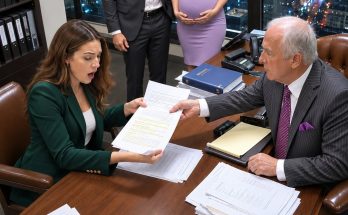
MY FATHER ABANDONED ME WHEN I WAS THREE. TWENTY-EIGHT YEARS LATER, HE RETURNED WITH A TERMINAL ILLNESS, AN OLD SUITCASE, AND NOWHERE TO GO. I TOOK HIM IN, PAID HIS MEDICAL BILLS, AND GAVE UP MY ENTIRE LIFE TO CARE FOR HIM. THEN ONE NIGHT, I OVERHEARD HIM WHISPERING, “SHE WON’T CHECK UNTIL I’M GONE.” WHAT I FOUND INSIDE THE ENVELOPE HIDDEN IN HIS COAT REVEALED A SECRET THAT CHANGED EVERYTHING I THOUGHT I KNEW ABOUT MY FATHER.
PART 1: THE MAN AT MY DOOR
My father left when I was three years old.
I don’t remember the sound of the front door closing.
I don’t remember him packing his suitcase.
I don’t remember the last time he kissed my forehead or promised to come back.
But I remember the stories my mother told me.
His name was Richard Mitchell.
He was thirty-one when he walked out of our lives.
He left my mother, Margaret, with a three-year-old daughter, a small apartment, and almost no money.
For years, my mother worked two jobs.
During the day, she cleaned offices. At night, she worked at a grocery store.
Sometimes she came home so tired that she fell asleep sitting at the kitchen table.
But she never complained.
Whenever I asked about my father, she gave me the same answer.
“Your father made a choice, Caroline. But his choice doesn’t determine your worth.”
I grew up believing that.
I stopped asking questions.
I graduated from college, found a steady job, and eventually bought a modest house of my own.
My mother was there when I signed the paperwork.
She cried more than I did.
“Your father should have been here to see this,” she whispered.
I didn’t know what to say.
My mother passed away when I was twenty-six.
She had battled a long illness, and I spent her final months beside her.
Before she died, she held my hand and made me promise something.
“Don’t let bitterness take your whole life, Caroline.”
I promised.
Two years later, when I was thirty-one, someone knocked on my front door.
I opened it.
And there he was.
My father.
He looked much older than the photographs I remembered.
His hair had turned almost completely gray. His face was thin, and he leaned heavily on a walking stick.
Beside him stood an old suitcase.
“Hello, Caroline.”
I couldn’t speak.
He looked at me for several seconds.
Then he said:
“I know I don’t deserve this, but I don’t have anywhere else to go.”
I stared at the stranger who had once been my entire world.
“What happened to you?”
He lowered his eyes.
“I’m sick, sweetheart. The doctors say there’s not much time.”
For twenty-eight years, I had imagined what I would say if he ever returned.
I had imagined anger.
Questions.
Maybe even the satisfaction of closing the door in his face.
But standing there, looking at an elderly man who could barely remain upright, I couldn’t do it.
I stepped aside.
“Come inside.”
And just like that, my father returned to my life.
I had no idea what he had brought with him.
PART 2: THE SECOND CHANCE
The doctors confirmed that my father had an advanced illness.
His treatment would be complicated.
He needed regular appointments, medication, and someone to help him with everyday activities.
He had no insurance that covered all his expenses.
He had very little savings.
And according to him, he had nobody else.
I asked where he had been living.
“Different places,” he answered.
“What about your friends?”
He shook his head.
“Most are gone.”
“What about your family?”
He looked at me.
“You’re my family.”
I didn’t know how to respond.
The following week, I arranged a spare bedroom for him.
I bought a comfortable mattress, fresh clothes, and the things he needed.
I started driving him to medical appointments.
I paid for medication.
I adjusted my work schedule.
My life changed almost overnight.
At first, our conversations were awkward.
He would sit at the kitchen table while I prepared dinner.
Sometimes he tried to ask about my childhood.
“Did you like school?”
“Yes.”
“Did you have many friends?”
“A few.”
“Did you ever play sports?”
“Sometimes.”
Our conversations felt like two strangers trying to pretend they had known each other for years.
One evening, he asked about my mother.
“Was Margaret happy?”
I stopped chopping vegetables.
“She worked very hard.”
He nodded.
“She always did.”
I looked at him.
“You remember her?”
His eyes filled.
“Every day.”
I didn’t know what to believe.
If he remembered her every day, why had he stayed away for twenty-eight years?
I wanted to ask.
But whenever I came close, he changed the subject.
Still, I continued caring for him.
I told myself that perhaps this was our opportunity to make peace.
Perhaps I could finally have a father.
Perhaps he had made terrible mistakes but genuinely wanted to make things right.
I wanted to believe that.
More than I wanted to admit.
PART 3: THE OLD SUITCASE
My father never unpacked his suitcase.
It remained beside his bed.
Whenever I offered to put his clothes into the closet, he refused.
“Please leave it alone.”
“Why?”
“It’s just personal things.”
I respected his privacy.
But I noticed something strange.
Every evening, he checked the suitcase before going to sleep.
Sometimes he opened it, moved a few things around, and locked it again.
One afternoon, I found him sitting on the edge of the bed, holding a photograph.
It showed a younger version of my mother.
She was standing beside a tree, smiling.
I recognized it immediately.
It had been taken before I was born.
“Where did you get that?” I asked.
He looked startled.
“Your mother gave it to me.”
“Why do you have it?”
He gently placed it back inside the suitcase.
“Because I never stopped loving her.”
I stared at him.
“Then why did you leave?”
His face changed.
For a moment, I thought he might finally answer.
Instead, he whispered:
“I made a terrible mistake.”
I felt frustration rising.
“That’s not an explanation.”
“I know.”
“Did you ever try to find us?”
He looked away.
“More than you know.”
I waited.
But he said nothing else.
That night, I called my aunt Susan.
She was my mother’s younger sister and the only person who knew most of the details about my parents’ marriage.
I told her my father had returned.
There was a long silence.
Then she said something unexpected.
“Caroline, be careful.”
“Why?”
“Your father was never honest about why he left.”
“What do you mean?”
She sighed.
“Your mother spent years protecting you from things you were too young to understand.”
I sat down.
“What things?”
“I can’t explain everything over the phone.”
Before hanging up, she said:
“Look after yourself, sweetheart. And don’t assume that someone coming home means they’ve changed.”
I couldn’t sleep that night.
PART 4: THE WHISPERED PHONE CALL
Three weeks passed.
My father became increasingly dependent on me.
He needed help getting to appointments.
He sometimes forgot where he had placed things.
Some days he was cheerful.
Other days he barely spoke.
I arranged for a home-care nurse to visit twice a week.
I also reduced my working hours.
My savings were shrinking.
But I kept telling myself that I could manage.
Then one evening, I returned home earlier than expected.
My father was in his bedroom.
The door was slightly open.
I heard him talking on the phone.
At first, I wasn’t paying attention.
Then I heard my name.
“Caroline?”
I stopped in the hallway.
My father continued speaking in a low voice.
“She’s taking care of everything.”
A pause.
Then:
“No, she hasn’t asked about the documents.”
Another pause.
My stomach tightened.
Then he whispered:
“She won’t check until I’m gone.”
I felt cold.
He continued:
“Everything is still exactly where I left it.”
I stood completely still.
Then he said:
“Once the time comes, you’ll understand why I had to do it this way.”
The call ended.
I walked into the kitchen before he could see me.
My hands were shaking.
What documents?
What was I supposed to check?
And what did he mean by “until I’m gone”?
For the first time since he arrived, I wondered whether my father had returned because he wanted a relationship with me.
Or whether he needed something from me.
I decided not to confront him immediately.
Instead, I waited.
The following morning, while helping him organize his coat before a medical appointment, I noticed something unusual.
There was a small envelope hidden inside the inner lining.
It had my name written on it.
CAROLINE MITCHELL.
I froze.
I looked toward the hallway.
My father was in the bathroom.
I carefully removed the envelope.
It was sealed.
And beneath my name, in smaller handwriting, were four words.
“Open after my death.”
I put it back exactly where I had found it.
But I knew I couldn’t ignore it anymore.
PART 5: THE ENVELOPE
That evening, I called Aunt Susan again.
I told her about the phone conversation.
I told her about the envelope.
She went silent.
Then she asked:
“Did you open it?”
“No.”
“Good.”
“Why? What is going on?”
She took a deep breath.
“Caroline, your father left because of something that happened before you were born.”
“What?”
“He was involved in a financial arrangement with someone. Your mother discovered it. Things became complicated.”
“Was he in trouble?”
“Yes. But it wasn’t only about money.”
I felt my heart beating faster.
“Then why did Mom never tell me?”
“Because she wanted you to grow up without carrying his mistakes.”
I looked toward my father’s bedroom.
“Did he come back because he wants money?”
“I don’t know.”
“Do you know what is in that envelope?”
She hesitated.
“No. But I remember your mother saying that one day you might receive something that would explain everything.”
I stared at the wall.
“What exactly did Mom say?”
My aunt answered quietly.
“She said, ‘When Richard finally tells Caroline the truth, she will understand why I waited so long.'”
I couldn’t sleep.
The next morning, I went to my father’s room.
He was awake, sitting near the window.
“Dad, I need to ask you something.”
He looked at me.
“Of course.”
“Why did you really leave when I was three?”
His expression changed.
He looked toward the window.
“I was afraid.”
“Of what?”
“Of losing everything.”
I waited.
He continued.
“I had made financial decisions that I couldn’t undo. People were depending on me. I thought leaving would protect you and your mother.”
“Protect us from what?”
He closed his eyes.
“From the consequences of my mistakes.”
I felt anger rising.
“So you left us to deal with everything alone?”
He nodded.
“I was wrong.”
“Did you ever try to come back?”
He looked at me.
“Yes.”
“When?”
“Many times.”
“Then why didn’t you?”
He couldn’t answer.
I left the room.
But before closing the door, I heard him whisper:
“Because I didn’t know how to face the person I had hurt most.”
PART 6: THE SECRET IN THE SUITCASE
Two days later, my father had a difficult medical appointment.
The doctor explained that his condition was progressing.
He would need more support.
My father listened quietly.
When we returned home, he asked me to bring his suitcase into the living room.
“I need to show you something.”
I placed it beside him.
He unlocked it.
Inside were old clothes, photographs, medical papers, and several folders.
He removed a blue folder and placed it on the table.
“Your mother gave me this before I left.”
I stared at him.
“What?”
He opened it.
Inside was a collection of documents.
There were bank statements.
Letters.
A property agreement.
And a photograph of a small house.
I recognized it.
It was the first house my mother and father had lived in together.
“Why do you have these?”
He looked at me.
“Because your mother never stopped trying to protect you.”
He handed me a document.
It showed that a property had been placed into a trust many years earlier.
The beneficiary was listed as:
Caroline Margaret Mitchell.
I looked at him.
“What is this?”
“Your mother established it before she died.”
I turned the page.
There were records of monthly deposits.
Small amounts at first.
Then larger ones.
The account had been maintained for years.
“Where did this money come from?”
My father lowered his eyes.
“From a property your mother inherited.”
I stared at him.
“Why didn’t I know about this?”
“Because she didn’t want you to feel that you had to depend on it.”
I turned another page.
There was a note from my mother.
For Caroline, when she is old enough to understand that security is not the same as happiness.
I felt tears in my eyes.
But there was something else.
The documents showed that the trust had been changed several times.
And my father’s name appeared beside one of the changes.
I looked up.
“Why is your name here?”
He took a slow breath.
“Because I was the person responsible for keeping the original documents safe.”
“Then why did you say I wouldn’t check until you were gone?”
He looked at me for a long time.
Finally, he answered.
“Because there is another envelope.”
PART 7: WHAT MY MOTHER REALLY LEFT
My father reached into the suitcase and removed a second envelope.
It was older than the first.
The paper was slightly damaged.
My mother’s handwriting was on the front.
To my daughter, Caroline.
My father handed it to me.
“She asked me to give you this when I returned.”
I stared at him.
“Why didn’t you give it to me immediately?”
“Because I was afraid you would hate me before you understood.”
I opened the envelope.
Inside was a letter.
My darling Caroline,
If you are reading this, then your father has finally found his way back into your life.
I don’t know what he has told you.
I don’t know whether he has explained why he left.
But I want you to understand something.
Your father did love you.
That doesn’t excuse what he did.
Love is not simply a feeling. It is a responsibility.
When you were three, your father made a decision that changed our lives. He believed he could fix a financial problem by leaving us behind.
He was wrong.
I spent years raising you, working, saving, and trying to give you a childhood that wasn’t defined by his absence.
I never wanted you to hate him.
But I never wanted you to believe that you owed him forgiveness.
I stopped reading.
My hands were trembling.
The letter continued.
There is money in the trust because I wanted you to have choices.
Not because I expected you to become wealthy.
Not because I wanted you to rescue anyone.
I wanted you to have the freedom to build a life that belonged to you.
Then came the final paragraph.
If your father returns when he is ill, please remember that compassion is your choice.
You can care for him without sacrificing yourself.
You can forgive him without pretending the past never happened.
And you can love someone while still protecting your future.
I lowered the letter.
My father was crying quietly.
“I should have given it to you sooner,” he said.
I looked at him.
“Why did you really come back?”
He didn’t answer immediately.
Then he reached for my hand.
“Because I wanted to tell you the truth before I died.”
PART 8: THE REAL REASON HE LEFT
My father finally explained everything.
Twenty-eight years earlier, he had invested in a business with a man he trusted.
The business failed.
But instead of accepting the loss, he made several desperate decisions.
He borrowed money.
He signed agreements he didn’t fully understand.
He used family savings to cover expenses.
When my mother discovered what had happened, she demanded that he stop.
They argued.
My father became frightened.
He believed creditors would come after the family.
He convinced himself that leaving would protect my mother and me.
But there was another part of the story.
My mother had offered him a chance to stay and face the consequences together.
He refused.
He left because he was ashamed.
For years, he lived with the consequences.
He moved between jobs and temporary homes.
He tried to rebuild his finances.
He wrote letters to my mother but never sent them.
He watched from a distance as I grew up.
And every year, he promised himself he would return.
But each year, he found another excuse.
Until his diagnosis.
“Why didn’t you come when Mom was alive?” I asked.
His eyes filled.
“Because I was afraid she wouldn’t forgive me.”
“She might have.”
“I know.”
“Then you took that choice away from her.”
He nodded.
That was the truth he couldn’t escape.
He had spent twenty-eight years protecting himself from the consequences of his actions.
And now, when he finally faced the past, there was very little time left.
I sat beside him.
For the first time, I understood his shame.
But understanding did not erase the years he had missed.
PART 9: THE ENVELOPE HE DIDN’T WANT ME TO OPEN
I returned to the first envelope.
The one hidden in his coat.
I placed it on the table.
“There’s still something you haven’t explained.”
He looked at it.
“Yes.”
“Why did you say I wouldn’t check until you were gone?”
He took a deep breath.
“Because I didn’t want you to discover the last document without understanding why it existed.”
I opened it.
Inside was a legal document and a handwritten note.
The document concerned the old family house.
It showed that my mother had transferred her interest in the property into the trust before she died.
But the note was what caught my attention.
It read:
Richard,
I know you are afraid.
I know you believe Caroline will never forgive you.
But I don’t want her to inherit your shame.
The money is hers.
The house is hers.
And the truth is hers.
If you return, tell her everything.
Do not ask her to pay for your mistakes.
I looked at my father.
“Did you intend to take something from me?”
He shook his head.
“No.”
“Then what were you hiding?”
He pointed to the final page.
There was a list of payments.
For years, he had been quietly sending money into the trust.
Not enough to make him wealthy.
But enough to maintain the account.
The payments had started shortly after my mother died.
I stared at the dates.
“You were contributing to this?”
He nodded.
“I couldn’t be there for you. I couldn’t undo what I had done. But I could make sure your mother’s wishes were protected.”
I looked at the total.
It was substantial.
“Why didn’t you tell me?”
He looked down.
“Because I didn’t know whether you would accept anything from me.”
Then he whispered:
“I wasn’t trying to take your money, Caroline. I was trying to make sure I didn’t leave you with nothing.”
For a long time, I couldn’t speak.
The envelope had not revealed a plan to steal my inheritance.
It had revealed a secret attempt to repair something that had been broken for almost three decades.
But it also revealed that my father had waited until he was dying to tell me.
And that hurt more than I expected.
PART 10: THE WOMAN WHO RAISED ME
The next morning, I visited my mother’s grave.
I brought fresh flowers.
I sat beside her name and read her letter again.
I thought about all the mornings she had gone to work before sunrise.
All the nights she had returned exhausted.
All the school events she attended alone.
All the times I had asked why other children had fathers who came to their performances.
She never spoke badly about him.
She never made me feel responsible for his absence.
And she never allowed her disappointment to become my burden.
I realized something.
My father had returned with a suitcase full of documents.
But my mother had spent twenty-eight years building the life those documents were meant to protect.
I whispered:
“Mom, I understand now.”
I stayed for nearly an hour.
Then I returned home.
My father was sitting near the window.
He looked at me.
“Did you visit her?”
I nodded.
“Did you tell her I was sorry?”
I looked at him.
“No. I told her I was grateful.”
He lowered his head.
I sat beside him.
“She deserved better.”
“Yes.”
“She gave me everything.”
“Yes.”
“And she gave you a chance to come back.”
He closed his eyes.
“I know.”
For the first time, I didn’t feel the need to protect him from the truth.
I simply let the silence remain.
PART 11: THE LAST PROMISE
My father’s condition worsened over the following weeks.
I arranged additional care.
I took leave from work.
I spent evenings reading to him.
Sometimes we talked about ordinary things.
His childhood.
My school years.
The places he had traveled.
Other times, we sat quietly.
One afternoon, he asked me to bring the suitcase.
I placed it beside his bed.
He opened it and removed a small wooden box.
Inside was a silver bracelet.
It had belonged to my mother.
I recognized it immediately.
She used to wear it on special occasions.
“Why do you have this?”
“She gave it to me before I left.”
I stared at him.
“She gave you her bracelet?”
He nodded.
“She told me to keep it safe until you were old enough to decide whether you wanted it.”
I took it carefully.
Inside the box was another note.
For Caroline.
May you always know that you were loved before you ever knew how to ask for it.
I held the bracelet against my palm.
Then I looked at my father.
“Did you love Mom?”
He answered without hesitation.
“Yes.”
“Then why did you leave her?”
He closed his eyes.
“Because I was weak.”
It was the first time he had used that word.
Not afraid.
Not confused.
Not misunderstood.
Weak.
He continued.
“I thought I could fix everything later. I thought there would always be another opportunity.”
His voice broke.
“But there wasn’t.”
I sat beside him.
He took my hand.
“I don’t expect you to forgive me.”
I looked at him.
“Good.”
He nodded.
“But I hope you won’t remember me only as the man who left.”
I was quiet for a moment.
Then I said:
“I won’t.”
He looked at me.
“I’ll remember the truth.”
He nodded.
And for the first time, I felt that he understood what I had needed all along.
Not excuses.
Not promises.
Just honesty.
PART 12: THE FINAL LETTER
My father passed away peacefully several weeks later.
I was beside him.
There were no dramatic speeches.
No sudden revelation.
Just a quiet morning and a final moment that I will always remember.
After the funeral, I began sorting through his belongings.
The old suitcase was still beside the bed.
Inside, beneath the documents and photographs, I found one final letter.
It was addressed to me.
Caroline,
I don’t know whether you will ever forgive me.
I know that taking care of me did not erase the years I was absent.
You gave me a kindness I had not earned.
You gave me a home when I had nowhere to go.
You listened when I finally found the courage to tell the truth.
I wish I could have been there for your first day of school.
I wish I could have watched you graduate.
I wish I could have walked you into your first home and told you how proud I was.
I missed all of it.
And I cannot ask for those years back.
But I want you to know that your mother was right about you.
She raised a woman who understood compassion without confusing it with obligation.
Please don’t spend the rest of your life trying to make up for the time I lost.
You already gave me more than I deserved.
Live your life, Caroline.
Not as the daughter I abandoned.
But as the woman your mother raised.
With love,
Dad.
I folded the letter carefully.
Then I placed it beside my mother’s.
For years, I had believed that my father’s return would give me the childhood I had lost.
It didn’t.
Nothing could.
But it gave me something else.
The truth.
And sometimes, the truth is the only thing that can finally put an old question to rest.
PART 13: WHAT I KEPT
Six months later, I was sitting in my mother’s old kitchen.
The silver bracelet was on my wrist.
My father’s letter was in a wooden frame beside hers.
I had returned to work.
I had rebuilt my schedule.
I had stopped feeling guilty whenever I took time for myself.
I still missed my mother.
And I sometimes thought about my father.
I didn’t pretend he had been a good father simply because he returned at the end.
He had missed twenty-eight years.
He had missed birthdays, graduations, ordinary conversations, and countless opportunities to be present.
But I also no longer felt that I needed to carry his mistakes for the rest of my life.
One evening, Aunt Susan visited.
She noticed the two framed letters.
“You kept them together,” she said.
I nodded.
“They were both part of my story.”
She sat beside me.
“Do you forgive him?”
I thought about the question.
Then I answered honestly.
“I don’t know if forgiveness is something that happens all at once.”
She smiled gently.
“That’s fair.”
I looked toward the window.
“My mother taught me how to live without him. My father taught me, much too late, why he left.”
I paused.
“And I think I finally understand that I don’t have to choose between loving the people who raised me and acknowledging the people who hurt me.”
That night, I opened my mother’s letter one final time.
The last sentence was still there.
You can love someone while still protecting your future.
I finally understood what she meant.
Taking my father in hadn’t made me weak.
Paying for his treatment hadn’t made me foolish.
Giving him a place to stay hadn’t meant I had forgotten the past.
I had simply chosen to act with compassion.
But compassion didn’t require me to erase what happened.
My father had returned with an old suitcase, a terminal illness, and nowhere to go.
He left with something he had spent twenty-eight years believing he could never receive.
A chance to tell the truth.
And I was left with something my mother had tried to teach me all along.
You don’t have to spend your whole life repairing the damage someone else caused.
Sometimes the greatest act of love is knowing when to stop carrying the past and finally begin living your own future.
THE END.