 Margaret Hale had spent
At sixty-eight, she lived alone in a quiet house with lemon polish on the furniture, rain tapping the windows, and the kind of silence widowhood leaves behind after everyone else stops noticing.
People saw white hair, slim hands, charity auctions, lemon cakes, and quiet shoes. They did not see the hands that had opened human chests and held trembling hearts between gloved fingers.
Anna was her only daughter. Margaret had raised her with discipline, tenderness, and the stubborn belief that safety was something a parent could build well enough to last.
Daniel entered Anna’s life with charm polished so brightly it looked like kindness. He called Margaret Dr. Hale at first, carried groceries without being asked, and remembered how Anna took her coffee.
That was how he earned access. He learned the kitchen, the holidays, the spare chair at family dinners, and the exact softness in Anna’s voice when she wanted everyone to get along.
The warning signs did not arrive as sirens. They arrived as small absences. Anna stopped staying late after dinner. She answered messages too quickly. She laughed before Daniel looked at her, as if rehearsing permission.
Margaret noticed. Surgeons notice changes in color before alarms sound. But Anna always had a reason. She was tired. Work was hard. Daniel worried too much because he loved her.
Men like Daniel do not begin with fists. They begin by studying which doors open easily. Then they decide which rooms they can lock from the inside.
That evening, Daniel smiled at dinner like a saint. He thanked Margaret for the food, touched Anna’s shoulder with public tenderness, and told a story that made everyone at the table laugh.
Anna laughed too. But Margaret saw the tightness at the corner of her mouth. She saw how her daughter’s hand moved away from Daniel’s before he could close his fingers around it.
Three hours later, the call came at 11:47 p.m. Dr. Ellis did not waste words. His voice was low, controlled, and frightened in the way only experienced doctors become frightened.
“Margaret,” he said. “It’s Anna. She’s in my emergency room.”
Margaret did not ask whether it was serious. Dr. Ellis had known her too long to call unless it was. She said only, “I’m coming,” and left the tea cooling on the counter.
She reached St. Catherine’s in eight minutes. Rain silvered the windshield. The hospital entrance glowed white against the dark, too bright and too sterile for the hour.
Ellis met her outside trauma bay three. His surgical cap was crooked, and his face had gone gray. That alone told Margaret more than any chart could have.
“You need to witness this yourself,” he said.
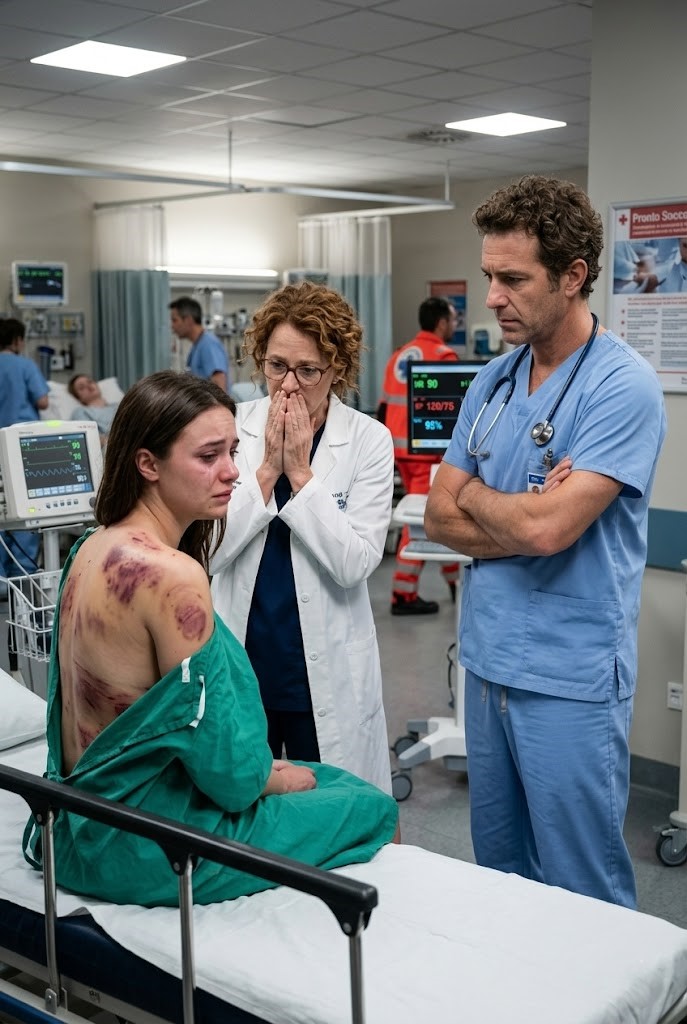
He pulled back the curtain. Anna lay on her stomach, face turned toward the door, lips split, one eye swollen nearly shut. The hospital air smelled of antiseptic, wet wool, and copper.
Then Margaret saw her daughter’s back. Bruises layered over bruises, old yellow beneath fresh purple. There was a burn near one shoulder and finger marks across her ribs.
For one breath, the room vanished. Not because Margaret had never seen violence. She had seen more human damage than most people could imagine. But this was Anna.
Anna opened her good eye. Her voice came out like thread dragged across glass. “Mom,” she whispered. “Don’t let him take me home.”
That sentence did what no injury could do. It cut through Margaret’s training and found the oldest part of her, the part that had once checked for fever in the night.
Something ancient and cold moved through her. Not grief. Not panic. Procedure. In the operating theater, horror becomes sequence: stabilize, document, isolate the threat.
Behind her, a man laughed softly. Daniel stood by the nurses’ station in an expensive coat, hair wet from rain, phone in his hand. His smile was smooth and practiced.
“My wife is clumsy,” he said. “She fell. Again.”
The desk froze around him. A nurse stopped typing. A resident held a chart against his chest. A medication vial stayed suspended over a tray while the coffee machine hissed on.
Nobody moved. That was the first ugly truth of the night. Cruel men are often protected not by loyalty, but by the silence of people who do not want trouble.
Margaret turned. Daniel smiled wider and said, “And before you start playing detective, remember you’re not her doctor. You’re retired.”
Ellis stepped forward. “Daniel, leave.”
Daniel ignored him. “Anna gets emotional. You know women. And Margaret here…” He looked her up and down. “She’s grieving, lonely, dramatic.”
Anna flinched at his voice. It was small, almost invisible, but Margaret saw it. Surgeons see the involuntary. They know which movements the body makes before pride can stop them.
Margaret touched Anna’s hair. It was damp with sweat at the roots. “You are safe,” she said.
Daniel leaned closer. “No, she isn’t. She’s my wife.”
For one second, Margaret imagined violence. She imagined lifting the IV pole and bringing it down across that expensive coat. Then she put her hand on the steel bed rail instead.
Rage is useless unless it can hold a scalpel steady.
“You should go home,” she said softly.
He smirked. “That’s it?”
“For tonight.”
He believed he had won. Cruel men often mistake calm for surrender. Daniel walked into the hallway laughing, and that laugh became the last free sound he made in St. Catherine’s.
Margaret turned to Ellis. “Did you photograph everything?”
His eyes met hers. “Yes.”
There was a hospital camera on the tray, Anna’s intake form clipped beneath the injury chart, and a sealed packet waiting for the forensic nurse’s signature. Evidence has a temperature. That night, it was ice cold.
“Good,” Margaret said. “Then let’s begin.”
The forensic nurse entered without drama. She documented each injury by location, color, size, and estimated age. She photographed Anna’s back, shoulder, ribs, face, and wrists.
At 11:52 p.m., the domestic violence intake form had already been started. Beside the nurse’s initials was one sentence Anna had managed before Margaret arrived: “Patient states husband caused injuries.”
Under that line was another note. It said Anna had hidden something because she was afraid Daniel would destroy it if he knew she still had it.
Ellis opened the evidence drawer and removed a small plastic bag. Inside was Anna’s phone, cracked at one corner, its case bent where someone had tried to pry it open.
Daniel had not known the phone was there. He had been standing near the nurses’ station holding another device, insisting Anna had fallen, while the real evidence sat fifteen feet away.
Anna had recorded the last argument. Not the worst moments, not all of it, but enough. Daniel’s voice was clear. So was the threat he made when Anna said she wanted to leave.
Margaret listened once. Her face did not change. Ellis looked away halfway through. The nurse swallowed hard and wrote the time on the chain-of-custody label.
Hospital security was called first. Then the police. Daniel tried to reenter trauma bay three before officers arrived, telling the desk that his wife was confused and needed him.
Margaret stepped into the hallway before he could reach the curtain. She did not raise her voice. She did not need to. Forty years in operating rooms had taught her how command sounds.
“You will not go near her again tonight,” she said.
Daniel laughed once, but it came out wrong. He saw the security guard. He saw Ellis with the chart. He saw the sealed evidence bag. For the first time all night, his smile disappeared.
When police arrived, Daniel shifted tactics. He became offended. Then wounded. Then loving. He asked Anna if she was really going to let her mother do this to their marriage.
Anna heard him through the curtain. Her hand tightened around Margaret’s fingers, but she did not call out. She did not apologize. She did not ask whether he was angry.
That was the first victory.
The police took statements at the hospital. The photographs, intake form, audio file, and injury chart were logged together. Ellis signed what he needed to sign. The nurse completed chain-of-custody documentation.
Margaret did not leave Anna’s side. She had learned long ago that families waiting outside operating rooms needed someone to tell them when to breathe. That night, Anna needed the same thing.
By morning, a protection order was in motion. Anna was admitted for observation, not only because of the injuries, but because everyone in that room understood the danger of sending her home.
Daniel called repeatedly. Then he texted. Then he demanded access through the front desk. Each attempt became another timestamp, another line, another small nail in the box he had built for himself.
In the days that followed, Margaret became what she had always been: precise. She packed Anna’s essentials with police present. She photographed damaged furniture. She preserved messages. She wrote down dates Anna remembered.
Anna’s recovery did not look like movie courage. It looked like sleeping badly, crying without warning, and flinching when doors closed too hard. It looked like learning not to defend him.
There were hearings. There were statements. Daniel’s lawyer tried to paint Anna as unstable and Margaret as controlling. Then the photographs were entered. Then the recording was played.
Daniel’s charm did not survive evidence. It never does. Charm is built for rooms where nobody checks the paperwork.
The final order kept him away from Anna. Later, the criminal case moved forward with the medical documentation, the recording, and the testimony from St. Catherine’s staff.
Margaret did not celebrate. Surgeons do not celebrate after removing rot. They close carefully, check for bleeding, and prepare the patient for the long work of healing.
Anna moved into Margaret’s house for a while. The room smelled of clean sheets and lavender soap. Some nights, she sat at the kitchen table with tea gone cold between her hands.
One morning, she asked, “How did you stay so calm?”
Margaret looked at her daughter’s hands, no longer hiding beneath sleeves. “I didn’t,” she said. “I just knew rage was not the tool you needed first.”
Months later, Anna laughed in that kitchen again. It was small at first, almost startled. Margaret did not interrupt it. She let the sound grow until the house remembered what safety sounded like.
My daughter’s husband smiled at dinner like a saint. Three hours later, I saw the map of his cruelty carved across her back.
But that was not where the story ended. It ended with Anna learning that a locked door can open, that evidence can speak, and that survival is not weakness.
It ended with Margaret understanding something she had known in surgery and forgotten in motherhood: sometimes love is not a soft hand on the forehead.
Sometimes love is a witness. Sometimes it is a chart, a photograph, a timestamp, and one calm voice saying, “Then let’s begin.”