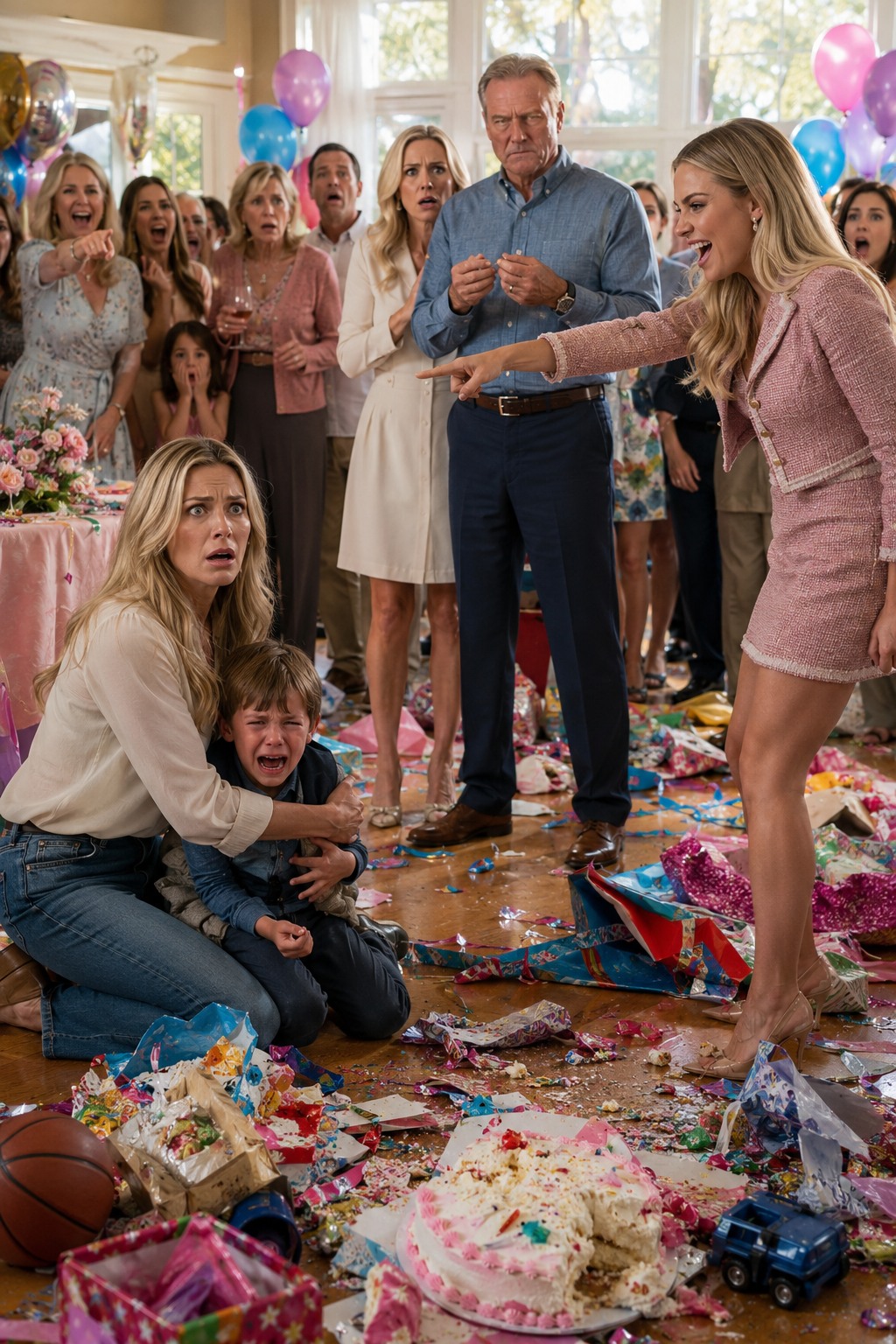
My Sister Broke All My Son’s Birthday Gifts While Everyone Laughed. Then My Father Took Off His Wedding Ring And Said Four Words That Changed Our Family Forever.
Part 1
The first thing Jessica broke was the dinosaur.
It was not expensive. It was a plastic green T. rex from Target, the kind that roared if you pushed the tiny red button under its belly. Jacob had picked it out himself three weeks before his seventh birthday, then put it back on the shelf because he knew I was counting groceries in my head.
So I went back after work and bought it.
I wrapped it in blue paper with crooked silver stars after Jacob fell asleep, sitting at my kitchen table under the buzzing light above the sink. I remember thinking how small the box looked beside the other presents. A watercolor set. A book about space. A cheap beginner telescope I found on clearance. A wooden puzzle my dad had made in his garage, each piece sanded smooth until it felt like river stone.
Jacob carried those gifts into my parents’ lake cabin like they were treasure from a shipwreck.
The cabin smelled the way it always did on Labor Day weekend: pine cleaner, charcoal smoke, lake mud, and my mother’s vanilla candle trying too hard to cover all of it. Outside, the water glittered under late-afternoon sun. Inside, the family performed happiness with paper plates and forced laughter.
My mother, Susan, met us at the door with frosting on her sleeve.
“There’s my birthday boy,” she sang, bending to kiss Jacob’s hair, but her eyes were already over my shoulder, searching the driveway. “Where’s Jessica? Did she text you?”
“No,” I said.
Mom’s smile tightened. “She’s probably just running late. You know your sister.”
I did know my sister.
Jessica was thirty-three, four years younger than me, and still entered every room like everyone had been waiting for the real party to start. She called herself a lifestyle creator, though mostly she posted filtered videos from restaurants she couldn’t afford and wrote captions about abundance while borrowing money from my parents. She had Mom’s cheekbones, Dad’s blue eyes, and the kind of confidence people mistake for charm until they have to clean up after it.
Jacob tugged my hand.
“Can Grandpa open his present first?” he whispered.
I looked toward the back porch. My father, David, stood by the grill in a faded Michigan sweatshirt, smoke curling around his gray hair. He was watching the driveway too, but not with Mom’s anxious hope. His face had that quiet, measured look he wore when he inspected a bad beam or a cracked foundation. My father was a structural engineer. He believed everything failed slowly before it failed all at once.
“After cake,” I said.
Jacob nodded, serious as a banker.
He had spent three days painting the lake for Grandpa. Blue water, green trees, a yellow sun bigger than a dinner plate. He had painted the cabin too, though it leaned sideways because perspective was still a mystery to him. He was proud of it in that soft, careful way kids are proud when they are afraid adults might laugh.
I placed the wrapped gifts on the long dining table, beside the cake.
Mom looked at them and made a tiny sound. “Oh, Sarah. You brought so many.”
“They’re birthday presents,” I said.
“I just mean…” She lowered her voice. “Don’t make Jessica feel bad if she forgot. She’s had a hard month.”
That was my family’s oldest weather system. Jessica created the storm; everyone else carried umbrellas.
At 4:07, gravel popped outside. A white SUV swept into the driveway too fast, stopping inches from Dad’s stack of firewood. Jessica climbed out wearing a cream silk dress, gold sandals, and sunglasses big enough to hide most of her face. She held a bottle of Pinot Noir in one hand and her phone in the other, already recording.
“Happy birthday to my favorite little man,” she called, not looking at Jacob but at her screen.
Jacob smiled because he was sweet. Because he still believed adults meant what they said.
Jessica swept into the cabin, kissed the air near Mom’s cheek, ignored me, and set her wine beside the cake.
Then she saw the pile of presents.
Her sunglasses slid down her nose. “Wow,” she said. “Somebody got spoiled.”
The room went still in that familiar way, everyone waiting to see whether Jessica wanted applause or blood.
Jacob looked at me, confused.
I opened my mouth to answer, but Jessica had already picked up the dinosaur box. She shook it beside her ear.
“Let’s see if birthday boy can handle a little life lesson,” she said, smiling at the room.
And before I understood what she meant, she pressed both thumbs into the plastic window until it cracked.
The sound was small, sharp, and impossible to take back.
### Part 2
For half a second, nobody moved.
The cracked plastic window caved inward over the dinosaur’s face. Jacob stared at it with his mouth slightly open, as if his brain had not found the right shelf for what had just happened. Jessica laughed first. Not loudly. Just a bright little puff through her nose, like she had made a clever joke.
“Oh, relax,” she said. “It’s packaging.”
“It’s his present,” I said.
My voice came out too low, almost unfamiliar.
Uncle Mark, my mother’s younger brother, sat on the couch with a beer balanced on his stomach. He slapped his knee. “Kid’s gotta learn sometime. Nothing survives forever.”
My cousin Tyler snorted into his soda.
Mom fluttered between us in her yellow apron, hands damp from washing lettuce. “Jess, honey, be careful. Sarah, don’t start. We’re having a nice day.”
A nice day.
That phrase was my mother’s favorite broom. She swept everything under it: insults, missing money, broken promises, the way Jessica could make a room colder just by deciding she was bored.
Jessica set the dinosaur box down, but she didn’t step away. She looked at Jacob and tilted her head.
“You’re not going to cry, are you?”
Jacob’s face changed. That is the only way I can describe it. The birthday glow faded first. Then his cheeks tightened. Then his eyes lowered, not to the broken box but to the table, as if the wood grain had suddenly become very important.
“No,” he whispered.
Jessica smiled. “Good boy.”
Something inside me twisted.
When I was eight, Jessica cut the hair off my favorite doll and told everyone I had done it because I was “trying to be interesting.” I cried, and Mom sent me to my room for making Jessica feel guilty. When I was fourteen, Jessica stole twenty dollars from my babysitting envelope, and Dad grounded both of us because he said he couldn’t prove it. When I was twenty-two, she wore a white lace dress to my courthouse wedding and told people she thought it was “cream.”
Every time, I learned the same lesson: swallow it before it becomes your fault.
But Jacob was seven.
He still slept with one sock on because he kicked the other off at night. He still asked if the moon followed our car because it liked us. He still drew hearts over the letter J in his name.
Jessica reached for the next gift.
I caught her wrist.
“Don’t,” I said.
Her perfume hit me hard, expensive and powdery over wine. She looked down at my hand like it was a bug.
“Let go.”
“No.”
The word hung there. Small, but it changed the air.
Mom’s eyes widened. Dad turned from the back door. Uncle Mark stopped smiling, then started again because discomfort made him mean.
Jessica yanked free. “My God, Sarah. It’s a joke.”
“It’s not funny.”
“It is if you have a sense of humor.” She looked around. “Right?”
Tyler looked at his phone. Mark shrugged. Mom gave a tiny laugh because silence frightened her more than cruelty.
Jessica took that as permission.
She grabbed the space book, tore off the wrapping, and flipped through the pages with theatrical boredom.
“Planets,” she said. “Cute. Very nerdy.”
Jacob reached for it. “Aunt Jessica, please—”
She lifted it out of reach. “Please what?”
He swallowed. “Please don’t mess it up.”
“Oh, honey.” Her voice softened in a way that made my skin crawl. “The world is going to mess up everything you love. Better you learn it here.”
Then she bent the cover backward until the spine cracked.
Jacob flinched.
The room laughed again, not everyone, not fully, but enough. Enough that the sound struck him. Enough that he understood something I had spent my whole life trying not to understand.
His pain was entertainment.
I stepped between them.
“That’s enough,” I said.
Jessica’s smile thinned. “You always were dramatic.”
Behind her, my father wiped his hands slowly on a dish towel. His wedding ring flashed in the window light. I noticed the skin around it was red, rubbed raw, as if he had been twisting it for hours.
Then Jessica’s eyes landed on the watercolor painting Jacob had propped near the cake.
“For Grandpa?” she asked.
Jacob whispered, “Yes.”
She picked up her wineglass.
And my father said, “Jessica, put it down.”
### Part 3
My father did not raise his voice.
That was the strange part.
Dad had never been a loud man, but he had always been a delaying man. He delayed conflict the way some people delay dentist appointments. He would clear his throat, change the subject, take out the trash, fix a squeaky hinge, anything to avoid standing in the center of a family fire.
So when he said Jessica’s name, quiet and flat, everyone heard it.
Jessica heard it too. Her hand paused over Jacob’s painting, wine trembling against the curved glass.
“What?” she said.
“Put it down.”
The cabin went silent except for the old refrigerator kicking on with a metallic shudder.
Mom stepped forward, palms raised. “David, please. She’s joking.”
“No,” Dad said. “She’s not.”
Jessica blinked. For the first time since she arrived, she looked uncertain. Not sorry. Never that. Just surprised, like a mirror had spoken.
Then Uncle Mark ruined it.
“Come on, Dave,” he said from the couch. “Don’t be a hard-ass. It’s a kid’s birthday party. Let people have fun.”
Dad looked at him.
Mark’s smile fell off in pieces.
Jessica laughed, sharp and fake. “Oh, this is rich. Grandpa suddenly has boundaries.”
The word boundaries sounded ugly in her mouth, like something she had heard on a podcast and saved for later.
Dad took one step into the room. “I said put it down.”
Instead, Jessica poured.
The wine hit the painting just above the yellow sun.
It spread fast. Dark red swallowed blue sky, then green trees, then the crooked little cabin Jacob had painted with such careful fingers. The paper buckled almost immediately. A wet, sour smell rose from it, grapes and alcohol and ruined effort.
Jacob made a sound I had never heard from him before.
Not a cry. Not exactly.
It was a tiny inhale that stopped halfway, like his body had tried to scream and remembered the rules.
Jessica set the empty glass on the painting with a wet thud.
“There,” she said. “Now it’s modern art.”
Mark barked a laugh.
Tyler laughed because Mark did.
Mom made that little panicked chuckle she used at church when someone said something racist and she wanted everyone to move on quickly.
I looked at my son.
His hands hovered over the ruined painting, fingers shaking, but he did not touch it. His lower lip disappeared between his teeth. His shoulders folded inward. He was trying to become smaller than the moment. Smaller than the laughter. Smaller than the adults who had decided his heartbreak was acceptable background noise.
And in that exact second, I saw myself.
Not as a memory. As a warning.
I saw every Thanksgiving where I laughed off Jessica’s insults. Every Christmas where Mom told me to be generous because “your sister is sensitive.” Every phone call where I let someone hurt me because correcting them seemed more dangerous than bleeding quietly.
Jacob was learning the family language.
Silence.
My throat burned. I walked around the table and stood between him and Jessica.
“You enjoyed that,” I said.
Jessica rolled her eyes. “Oh, here we go.”
“You enjoyed hurting him.”
“It’s paper, Sarah.”
“It was his gift.”
“It was clutter.”
“It was love.”
That shut her up for half a heartbeat.
Mom rushed in with napkins, but not toward Jacob. She attacked the table, wiping wine from the wood with frantic little circles.
“Oh, look at this stain,” she muttered. “Red wine is impossible. Jessica, honey, you need to be more careful. Sarah, don’t make that face. We can buy Jacob a new paint set.”
I stared at my mother.
She had frosting on her apron, wine on her fingers, and not one hand on my son’s shoulder.
“Mom,” I said. “He’s crying.”
Jacob wasn’t making noise, but tears had started slipping down his cheeks.
Mom did not look at him.
“He’s fine,” she said too quickly. “Children bounce back.”
Dad’s chair scraped the floor.
The sound was long and harsh, like something being dragged out of a grave.
He stood at the head of the table, eyes fixed on my mother. “You wiped the table.”
Susan froze.
Dad looked at the napkins in her hand, then at Jacob, then back at her.
“You wiped the table,” he repeated, “and you left the boy standing there with his heart in pieces.”
Mom whispered, “David, don’t.”
His hand went to his wedding ring.
And I suddenly knew, with a cold drop in my stomach, that my father had not just reached the end of his patience.
He had been waiting for proof.
### Part 4
Dad turned away from all of us and walked to the kitchen sink.
For a wild second, I thought he was going to get Jacob a towel. Maybe a cup of water. Maybe finally do one useful, gentle thing before Mom smoothed everything back into place.
Instead, he pumped dish soap onto his left hand.
The green soap slid over his knuckle. He gripped his wedding band and twisted.
Mom’s face changed first.
“David,” she said.
He kept twisting.
The ring did not want to come off. Forty years had pressed it into him. His finger had thickened around it, skin puffed and pale where the gold disappeared. He pulled harder, jaw tight. The room watched in horrified silence as if he were removing part of his own body.
“Dad,” Jessica said, but there was a nervous edge now. “What are you doing?”
He did not answer.
The ring slipped over the knuckle with a wet pop.
Mom covered her mouth.
Dad rinsed his hand, dried it on a towel, and walked back to the table. He stood over Jacob’s ruined painting. The wine had reached the bottom corner now, soaking into the paper towel Mom had shoved beneath it too late.
Dad held the ring above the mess.
“I have spent forty years protecting the wrong things,” he said.
Then he dropped it.
The ring landed in the wine-dark sky of Jacob’s painting.
A tiny splash hit Jessica’s cream dress.
She looked down, offended. “Seriously?”
Dad’s face did not move. “Yes. Seriously.”
Mom grabbed the back of a chair. “David, stop this. You are embarrassing yourself.”
“No, Susan.” His voice was calm, but something behind it had cracked open. “I embarrassed myself every time I called this family peace.”
Uncle Mark stood, beer in hand. “Maybe we should all take a breath.”
Dad turned his head. “Sit down, Mark.”
Mark sat.
I had never seen anything like it.
My father walked to the corner where he had left his old leather travel bag. It was the same bag he took to job sites, scuffed at the edges, one zipper pull replaced with a paper clip. I had noticed it earlier under the coat rack, but I hadn’t thought anything of it. Dad always carried measuring tape, notebooks, pens, sometimes blueprints rolled in rubber bands.
This time, he removed a black leather binder thick as a Bible.
Mom made a small sound.
Not surprise.
Recognition.
Jessica saw it too.
The confidence drained from her face in a thin stream. “What is that?”
Dad placed the binder on the table beside the cake, the broken dinosaur, the cracked book, and the painting with his wedding ring lying in the stain.
“This,” he said, “is the part where the house stops pretending the foundation is fine.”
Nobody spoke.
He opened the binder.
Inside were pages filled with columns. Dates. Amounts. Notes in Dad’s precise block handwriting. Some pages had printed bank statements clipped to them. Others had receipts taped along the margins. Color-coded tabs stuck out from the side like little warning flags.
My mother’s breathing got loud.
Jessica folded her arms, but the movement was too quick. Defensive.
“What is this?” she asked again.
Dad looked at Jacob first.
My son stood behind me, his hand gripping the back of my shirt. I could feel his fingers through the cotton, small and damp.
Dad’s face softened for one second. “Jacob, buddy, I am sorry. You should never have been used as the match.”
Then his eyes went back to Jessica.
“Three years ago,” he said, “you asked me for five thousand dollars for camera equipment.”
Jessica scoffed. “Oh my God. Are we really doing money right now?”
Dad turned a page.
“Two years ago, twelve thousand for a brand partnership buy-in. Last April, eight thousand for medical bills. Last November, thirty-two hundred for rent you said you were short on because a client paid late.”
Jessica’s mouth tightened. “Families help each other.”
“No,” Dad said. “Families help. What your mother did was finance destruction.”
Mom whispered, “Please don’t.”
That was when my stomach dropped.
Not because Dad had a binder.
Because Mom was not denying anything.
Dad turned another page, slower this time, and I saw a document with a police department header half-hidden beneath a bank transfer receipt.
I did not know what it meant yet.
But Jessica did.
She looked at the front door.
### Part 5
Jessica moved first.
It was tiny, just one step backward, but I saw it because I was watching her eyes. They flicked from Dad to the binder, from the binder to Mom, from Mom to the front door. She looked like a woman calculating distance.
Dad saw it too.
“Don’t run,” he said.
Jessica’s laugh came out thin. “I’m not running. I’m leaving this insane little courtroom you’ve decided to host at a child’s birthday party.”
“At my grandson’s birthday party,” Dad said. “The one you turned into a demonstration.”
“Of what?” she snapped. “That Sarah is raising him soft?”
“No.” Dad touched the broken dinosaur box with two fingers. “That you do not believe consequences apply to you.”
The room smelled like sugar, wine, grilled meat, and rain coming over the lake. The sky outside had darkened without me noticing. Wind pushed against the windows, making the glass tick softly in its frame.
Mom pressed her fingers to her temples. “David, whatever you think you know, this isn’t the place.”
“You’ve said that for forty years,” he said. “Not the place. Not the time. Not in front of the children. Not at Christmas. Not while Jessica is upset. Not while guests are here.”
He looked around at the guests.
Uncle Mark stared into his beer as if it held instructions. Tyler had stopped smirking. My aunt Linda, quiet until then, sat stiff-backed near the fireplace, her paper plate untouched on her lap.
Dad continued, “Well, here are the children. Here are the guests. Here is the place. And this is the time.”
My mother began to cry.
Not the way Jacob cried, silently and against his will. Mom cried beautifully. Chin trembling, eyes shining, shoulders curved in practiced fragility. It had worked on me my whole life. The sight of her tears usually made me feel cruel even when I was the one bleeding.
This time, I felt nothing but tired.
“Sarah,” Mom whispered, turning to me. “Please. Think of your son.”
I almost laughed.
“I am,” I said.
She flinched as if I had slapped her.
Jessica seized the opening. “This is exactly what I’m talking about. You all act like I’m some monster because I don’t worship Sarah’s little martyr routine.”
Dad flipped another page.
“June 18,” he said. “Two thousand dollars transferred from our savings into your account. Memo line: dental emergency.”
Jessica rolled her eyes. “I had a tooth problem.”
“You posted from Miami that weekend.”
Her face reddened. “So you stalk me now?”
“No. Your mother used the same account for your hotel deposit.”
The silence sharpened.
Mom sank into a chair.
Dad turned another page. “August 2. Forty-eight hundred dollars. Emergency car repair.”
Jessica’s lips parted.
“You said your transmission failed,” Dad said. “But the car was not at a dealership. It was at a private body shop in Lansing. A shop that takes cash and does not ask questions.”
Mom sobbed once. “David.”
He did not look at her. “I called them.”
Jessica’s voice dropped. “You had no right.”
“I had every right when money vanished from my retirement account.”
“You never cared about that account.”
“I cared about what it meant.” Dad’s hand tightened on the edge of the binder. “A quiet retirement. Medical bills. Security for your mother. Maybe helping Sarah if she ever needed it, though God knows she never asked because we trained her not to.”
My eyes stung.
Dad looked at me, and the shame in his face was so naked I had to look away.
Jessica slammed her palm on the table. The cake jumped.
“Enough. I borrowed money. Big deal. Mom helped me because she loves me.”
Dad stared at her for a long moment.
Then he said, “Your mother did not spend one hundred seventy-four thousand dollars because she loves you.”
The number hit the room like a thrown brick.
Even the refrigerator seemed to stop humming.
I heard myself whisper, “What?”
Jessica went pale.
Dad slid one sheet from the binder and laid it on top of Jacob’s ruined painting.
It was not a receipt.
It was a copy of a police report.
And the date on it was from the summer Jessica disappeared for a month.
### Part 6
I remembered that summer because Mom told everyone Jessica was in Europe.
“She needs to find herself,” Mom had said, stirring lemonade in the kitchen while I stood there with a toddler on my hip and a rent check I was afraid might bounce. “Your sister is sensitive to pressure.”
I had laughed then, not because it was funny but because the alternative was screaming.
Jessica had posted old beach pictures with captions about healing. Mom had told her church friends she was in Italy. Dad had looked confused whenever anyone mentioned it, but he never asked questions in public. In our family, questions were considered rudeness if Jessica might not like the answer.
Now the truth sat on the table, printed in black ink.
Police report.
I could see only pieces from where I stood. Date. Time. Intersection. Vehicle description. Pedestrian injury. Hit and run.
Hit and run.
The words expanded until they filled the cabin.
My hand went to Jacob’s shoulder. He leaned into me, still watching the adults with wide, frightened eyes.
Dad spoke slowly, each word chosen like he had carried it in his mouth for years.
“Three summers ago, Jessica left a party drunk.”
Jessica whispered, “Stop.”
“You drove through the west side of Lansing just after midnight,” Dad said. “You clipped a parked car, jumped the curb, and hit a nineteen-year-old girl walking her dog.”
Aunt Linda gasped.
Uncle Mark muttered, “Jesus Christ.”
Mom’s crying turned messy.
Jessica pointed at Dad. “You don’t know what happened.”
“I know you didn’t stop,” he said.
Wind hit the cabin hard enough to rattle the porch screen.
I had the strange sensation of being both inside my body and outside it. My fingers felt numb on Jacob’s shirt. The frosting smell made me nauseous. I kept seeing Jessica’s Instagram posts from that month: a pool, a sunset, a cappuccino. Not Europe. Not healing. Cover.
Dad’s voice remained steady, but his eyes were wet.
“The girl survived,” he said. “Barely. Broken pelvis. Concussion. Nerve damage in her left leg. Her dog died at the scene.”
Jessica looked at the ceiling. “It was an accident.”
“The crash was an accident,” Dad said. “Leaving her there was a choice.”
Mom shook her head violently. “She panicked. She was scared.”
“She was twenty-nine years old.”
“She could have gone to prison,” Mom cried.
Dad turned on her. “Maybe she should have.”
That sentence cracked something in my mother. Her face collapsed, not into guilt, but betrayal. As if Dad had broken a sacred rule by saying Jessica deserved consequences.
“You don’t mean that,” Mom said.
“I do.”
“You’re her father.”
“And I was Sarah’s father too.” His voice broke on my name. “I was Jacob’s grandfather. I was supposed to be a husband, not a silent partner in fraud.”
Fraud.
There it was, another word with teeth.
Dad tapped the binder.
“I did not know at first,” he said to the room. “Susan told me there had been a minor parking accident. She said Jessica needed help with legal paperwork and therapy. She said the withdrawals were temporary. She said she would handle it.”
Mom cried harder. “I handled it.”
“You hid it,” Dad said.
Jessica’s arrogance returned in pieces, dragged up by panic. “You don’t understand anything. That girl’s family got paid. Everybody moved on.”
I felt Jacob stiffen.
Everybody moved on.
As if pain could be settled like a restaurant bill.
Dad stared at her with a look I had never seen before. Not anger. Something colder. Recognition without love to soften it.
“You learned nothing,” he said.
Jessica threw her hands out. “What do you want from me? To ruin my life over one mistake?”
“One?” Dad asked.
He looked at the broken dinosaur. The cracked book. The wine-soaked painting. Then at me.
“This is what your mother bought,” he said. “Not your freedom. Your belief that other people are objects.”
Jessica’s face twisted.
“You think Sarah is better than me?” she spat.
Dad did not answer immediately.
Then he reached into the back pocket of the binder and removed a sealed envelope.
My name was written across the front.
Sarah.
And beneath it, in my mother’s handwriting, were the words: Do not give her this.
### Part 7
I recognized my mother’s handwriting instantly.
Pretty, slanted, controlled. The same handwriting that labeled Christmas cookie tins and church donation envelopes. The same handwriting that wrote “love you always” inside birthday cards she handed me while checking her phone for Jessica’s messages.
Dad held the envelope out to me.
Mom lurched from her chair. “No.”
I stepped back, startled by the violence in her voice.
“David, no,” she said again. “That has nothing to do with this.”
Dad’s hand stayed extended.
“It has everything to do with this.”
Jessica looked from the envelope to me. “What is that?”
Mom did not look at her.
That scared me more than anything.
I took the envelope. The paper felt thick and old, soft at the corners, like it had been handled many times. My name had been written years ago. I could tell because Mom had still made the S in Sarah with that little loop she stopped using after arthritis stiffened her fingers.
My mouth went dry.
“Dad,” I said, “what is this?”
His eyes filled with a grief so old it looked tired of itself.
“Your grandmother’s last letter.”
The room tilted.
My father’s mother, Evelyn, had died when I was twenty-six. She was the person who taught me how to make biscuits without a recipe and how to tell when lake water was too cold by the color of it. She smelled like lavender soap and library books. She sent me five dollars every Valentine’s Day until I graduated college.
I had not received a last letter.
Mom had told me Grandma Evelyn was too weak to write.
I looked at my mother.
She pressed both hands to her mouth.
“Open it,” Dad said.
“I don’t want to do this in front of everyone,” I whispered.
Mom exhaled, relieved.
Dad shook his head. “That sentence is the lock they used on you.”
I hated him for one second.
Then I opened the envelope.
Inside was a handwritten letter on cream paper, folded twice. My grandmother’s script was shaky but recognizable.
My dear Sarah,
I read only the first line before my eyes blurred.
I forced myself to continue.
She wrote that she was proud of me. That she knew I had always been asked to be the easy child. That easy children are often the ones carrying the heaviest load. She wrote that she had left me something small, not because I needed saving, but because she wanted me to have proof that someone saw me.
My hands began to tremble.
At the bottom, she mentioned a savings account.
Twenty-five thousand dollars.
For me.
For school, a home, or “anything that helps you stop apologizing for existing.”
I could not breathe.
I looked at Mom.
Her face was wet and gray.
“You took it?” I asked.
She shook her head, but it was not denial. It was pleading.
“Jessica needed help,” she whispered.
The words went through me clean.
Not jagged. Not explosive. Clean, like a blade sharpened for years.
My grandmother had left me money, and my mother had stolen it for Jessica.
Dad’s voice was low. “I found the copy last month in your mother’s old desk. Evelyn mailed it to the cabin and to the house, just to be safe. Susan intercepted yours.”
I heard a small sound and realized it came from me.
Jessica stared at Mom. “You used Sarah’s money?”
For one brief, stupid moment, I thought she might feel shame.
Instead, she said, “Why didn’t you tell me? I would’ve asked for more.”
The room froze.
Even Mom looked at her.
Dad closed his eyes.
That was the real confession, more honest than any police report. Jessica had not been corrupted by rescue. Rescue had simply revealed what she already was.
I folded the letter carefully, because it suddenly felt like the only clean thing in the room.
Jacob touched my arm.
“Mom?” he whispered.
I knelt and pulled him against me. His hair smelled like lake wind and frosting.
“I’m here,” I said, though I was not sure I had ever been fully there before.
When I stood, Jessica was staring at the front door again.
This time, flashing blue and red lights moved across the wet window glass.
And someone knocked.
### Part 8
No one breathed.
The knock came again, harder.
Three firm hits against the cabin door.
Mom whispered, “David, what did you do?”
Dad did not look surprised. That told me everything.
Jessica backed into the table, rattling paper plates. “No. No, you didn’t.”
Dad closed the binder. “I made a call.”
“You said you were just tracking money,” Jessica said.
“I was tracking failures.”
The porch boards creaked outside.
Uncle Mark stood halfway, then sat again, as if his knees had changed their mind.
Dad walked to the door. Rain blew in when he opened it. Two officers stood under the porch light, dark uniforms speckled with water. Behind them, a county sedan idled in the driveway, its red and blue lights painting the trees in violent color.
The older officer removed his hat. “David Whitaker?”
“Yes.”
“I’m Detective Harris. We spoke earlier.”
Mom made a wounded sound. “Earlier?”
Dad stepped aside. “Come in.”
Jessica’s face hardened with sudden desperation. “You can’t prove anything. It was handled.”
Detective Harris heard that.
His eyes moved to her. “Jessica Whitaker?”
She lifted her chin. “I want a lawyer.”
“That would be wise,” he said.
The younger officer remained near the door while Harris entered. Rainwater dripped from his jacket onto Mom’s braided rug. He glanced at the table, taking in the ruined gifts, the wine, the binder, the wedding ring lying on a child’s painting. Police see rooms fast. They know where the blood is even when there is no blood.
Dad handed him the binder.
Mom rushed forward. “That’s private financial information.”
Harris did not take his eyes off Dad. “Ma’am, step back.”
She stopped.
It was almost fascinating, watching my mother discover that her panic had no authority outside our family.
Jessica pointed at me. “Sarah did this. She’s always been jealous of me.”
I actually laughed then.
It came out once, sharp and ugly, and startled Jacob against my side.
Jessica’s eyes snapped to me. “You think this is funny?”
“No,” I said. “I think it’s familiar.”
She stared.
“You break something,” I said. “Mom cries. Everyone looks at me to fix the feeling. Not the damage. Never the damage.”
Detective Harris opened the binder, flipping through the tabs with careful fingers.
Dad said, “There are bank records, copies of repair invoices, the settlement agreement Susan kept in our safe, and the name of the attorney who arranged it.”
Mom whispered, “You went in my safe?”
“Our safe,” Dad said. “Paid for by our marriage. Emptied by your lies.”
Jessica’s breathing turned fast and shallow.
Harris looked up. “Mrs. Whitaker, you may also want counsel.”
Mom grabbed the chair again. “I was protecting my child.”
I stepped between her and Jacob before she could look at him for sympathy.
“No,” I said. “You were protecting your favorite mirror.”
She recoiled.
For once, I did not soften it.
Harris turned to Jessica. “We’re not making an arrest tonight. But you are being asked to come to the station to give a statement regarding reopened matters connected to the Woodward Avenue hit-and-run.”
Jessica’s lips trembled. “Reopened? That case was closed.”
“Cases close for many reasons,” Harris said. “Truth isn’t always one of them.”
My aunt Linda began to cry quietly by the fireplace.
Mark muttered, “I didn’t know.”
Dad looked at him. “You knew enough to laugh.”
Mark had no answer.
Jessica reached for her purse with shaking hands. “Fine. I’ll go. And when this turns into nothing, I hope you all remember who betrayed who.”
She looked at me last.
There was no apology in her face. Only calculation.
“You’re really going to let them do this to me?” she asked.
The old me would have explained. The old me would have said I was sorry, would have tried to make cruelty sound like misunderstanding.
The new me stood with my son’s fingers wrapped around mine.
“I’m going to let consequences find you,” I said.
Jessica flinched as if the word had teeth.
Then Detective Harris asked one more question.
“Before we leave, Mr. Whitaker, where is the original dashcam drive?”
Dashcam.
Dad turned toward my mother.
And Mom’s face told us she had hidden more than money.
### Part 9
The word dashcam opened a door in my memory.
Three years ago, Dad had bought a little camera for Mom’s car after a neighbor backed into her at the grocery store and lied about it. He installed it himself in the driveway, standing under the maple tree with a screwdriver between his teeth while Mom complained that wires looked tacky.
I remembered Jessica borrowing Mom’s car that summer.
I remembered because I had needed a ride to urgent care when Jacob had an ear infection, and Mom said she couldn’t help. Jessica had the SUV. Jessica always had whatever she needed.
Dad looked at Mom. “Susan.”
She shook her head. “I don’t know.”
Detective Harris watched her carefully.
Dad’s voice dropped. “Where is it?”
“I said I don’t know.”
But she looked toward the hallway.
Just a flicker.
I saw it. Dad saw it. Jessica saw it too, and her face went slack with terror.
Dad walked down the hall.
Mom lunged after him. “David, stop.”
The younger officer stepped in front of her. “Ma’am.”
“You don’t understand,” she cried. “He’s confused. He’s been angry. He’s not thinking clearly.”
I almost admired the reflex. Even now, she reached for the old script. Dad unstable. Jessica fragile. Mom suffering. Me responsible.
But the room had stopped performing.
Dad came back carrying a small cedar box.
Grandma Evelyn’s cedar box.
My throat tightened. It used to sit on her dresser, filled with brooches and folded handkerchiefs. After she died, Mom took it “for safekeeping.” I had not seen it since.
Dad set it on the table.
Mom whispered, “Please.”
He opened it.
Inside were old photographs, a yellowed baptism program, a few pieces of costume jewelry, and beneath them, a black plastic memory card case.
Jessica covered her mouth.
Detective Harris put on gloves.
The room watched as he opened the little case and removed a microSD card so small it seemed ridiculous that it could hold a life.
Mom sank to the floor.
Not fainting. Not dramatically. Just folding.
I looked at her sitting there on the pine boards, yellow apron spread around her, and I understood something that made me colder than anger ever could.
She had not hidden the dashcam because she was afraid.
She had kept it.
For three years, she had kept proof in Grandma Evelyn’s box, tucked beneath family pictures like a rotten tooth under a pillow. Maybe as insurance. Maybe as denial. Maybe because destroying it felt too much like admitting what Jessica had done.
Dad stared at the card. “You told me there was no footage.”
Mom hugged herself. “I couldn’t destroy it.”
Jessica exploded. “You kept it? Are you insane?”
Mom looked up at her, stunned. “I saved you.”
“You saved evidence.”
“You were my baby.”
“I was drunk,” Jessica hissed. “You think a jury cares that I was your baby?”
The naked selfishness of it filled the room.
Mom had destroyed her marriage, stolen my inheritance, drained retirement accounts, lied to police, and Jessica’s first real emotion was not guilt, not fear for the injured girl, not even horror.
It was anger that Mom had failed to erase the truth well enough.
Detective Harris placed the card in an evidence sleeve.
Jessica grabbed her purse. “I’m not saying another word.”
“That’s your right,” he said.
But her voice cracked. “I’m not going down for this.”
Dad looked at her. “You already went down. We just finally stopped pretending you were standing.”
Outside, thunder rolled over the lake.
Harris and the younger officer escorted Jessica to the porch. She did not look at Jacob. Not once. She stepped around the broken gifts as if they were trash on a sidewalk.
Mom crawled to her feet. “Jessie, wait.”
Jessica turned in the doorway, rain blowing around her.
“Don’t call me,” she said to Mom. “You made this worse.”
Then she walked out.
The door closed behind her, and my mother made a sound like an animal caught in a trap.
For one second, pity moved in me by habit.
Then Jacob whispered, “Is Grandma sad because Aunt Jessica broke my presents?”
I looked at my mother, waiting for her to answer him.
She wiped her face, looked at my son, and said, “This never would have happened if your mother hadn’t made a scene.”
And just like that, the pity died.
### Part 10
I felt Jacob’s hand go limp in mine.
That hurt more than Jessica’s cruelty. Jessica was a blade; you expect a blade to cut. My mother was supposed to be the bandage. Instead, she kept pressing dirt into the wound and calling it care.
Dad moved before I did.
“Susan,” he said.
She turned on him, mascara streaking down both cheeks. “What? What did I say that isn’t true? Sarah escalated everything. She always escalates. She can never just let things pass.”
I stared at her.
All those years, I thought I had been letting things pass.
Apparently, even bleeding quietly had been too loud.
Dad’s voice was almost gentle. “You blamed a child.”
“I did not.”
“You looked at your grandson, surrounded by gifts your daughter destroyed, and told him his mother caused this.”
Mom shook her head. “You’re twisting my words.”
“No,” he said. “I am finally repeating them accurately.”
Aunt Linda stood and began gathering her purse. “Susan, I think you should stop talking.”
Mom whipped toward her. “Don’t you start.”
Linda’s face hardened. “I watched you do this to Sarah when she was little. I told myself it wasn’t my business. That was cowardly of me.”
Uncle Mark mumbled, “Linda.”
“No,” she snapped. “You laughed at that boy.”
Mark flushed.
The cabin shifted again. For the first time in my life, people were choosing sides out loud, and not everyone chose Mom.
Dad removed his phone from his pocket.
“I called a locksmith this morning,” he said.
Mom blinked. “What?”
“He’ll be at the house tomorrow. The locks will be changed.”
Her mouth opened.
“I have also contacted an attorney,” Dad continued. “Divorce papers are being drafted. The accounts are frozen pending investigation. You will have access to funds for legal necessities, but not to move money, not to hide money, and not to give Jessica one more cent.”
Mom grabbed the edge of the table. “You can’t do that.”
“I can.”
“After forty years?”
“Because of forty years.”
Rain slapped the windows. The birthday candles still sat unlit beside the cake, seven little stripes of blue and white. The dinosaur’s cracked box reflected the red and blue lights fading down the driveway.
Mom looked at me.
This was the moment I had dreaded my whole life. The moment the family machine turned its gears toward me and demanded fuel.
“Sarah,” she whispered. “Tell him.”
I said nothing.
Her eyes sharpened. “Tell your father he’s overreacting.”
Still nothing.
“Tell him family doesn’t throw family away.”
That one almost got me. Not because I believed it, but because she did. My mother truly believed family meant the most wounded person in the room had to hand their bandages to the person holding the knife.
I looked at Jacob.
He was staring at the cake now, not the adults. Children know when they are too close to grown-up ugliness. They retreat into objects. Frosting. Plates. Carpet patterns. Anything safer than faces.
“I’m taking Jacob home,” I said.
Mom recoiled. “You’re leaving? Now?”
“Yes.”
“It’s his birthday.”
“I know.”
“You’re punishing me.”
“No. I’m protecting him.”
Her expression changed. For a second, I saw rage without tears dressing it up.
“You always thought you were better than us.”
“No,” I said. “I thought if I was useful enough, you’d love me the way you loved her.”
The room went still.
Mom looked away first.
That was answer enough.
I picked up Jacob’s backpack. The gifts were ruined, but I gathered what I could. The book with the cracked spine. The dinosaur in its crushed box. The telescope, somehow untouched, still wrapped in silver paper beneath a chair. Last, I reached for the painting.
The paper sagged when I lifted it.
Dad stepped beside me. “Let me.”
Together, we slid it onto a baking sheet. Wine dripped from one corner onto the floor.
Jacob watched, silent.
Dad took his wedding ring off the painting and wiped it once with a napkin. He did not put it back on. He slipped it into his pocket.
At the door, Mom called, “Sarah, please don’t do this.”
I turned.
For once, I did not see a mother. I saw a woman frightened by the bill arriving.
“You did this,” I said.
Then Jacob and I stepped into the rain.
Halfway to my car, Dad came after us carrying the black binder under his coat.
“I’m coming with you,” he said.
And behind him, through the cabin window, I saw Mom pick up her phone and dial someone with shaking hands.
### Part 11
The drive home was forty-six minutes.
I know because I watched every number on the dashboard clock change like it had been assigned to keep me alive. Rain hammered the windshield. The wipers dragged water aside in frantic arcs. Jacob sat in the back seat with the ruined dinosaur on his lap, his face reflected faintly in the window.
Dad followed behind us in his truck.
Every few miles, headlights flashed in my rearview mirror, and I had the childish fear that he might turn around. That the spell would break. That he would remember he was a husband before he was a father and go back to rescue Mom from the wreckage she had built.
But he kept following.
At home, my little duplex smelled like laundry soap and the cinnamon oatmeal Jacob had spilled that morning. The normalness of it almost broke me. His sneakers by the door. A library book on the couch. The night-light glowing in the hallway.
Jacob went straight to his room.
I stood in the kitchen, soaked through, hands braced on the counter.
Dad came in quietly and set the binder on my table.
“I should have done it sooner,” he said.
I laughed once, bitterly. “Yes.”
He accepted that like he deserved it.
For years, I had wanted my father to defend me. I had imagined it so many ways. Dad telling Jessica to apologize. Dad telling Mom to stop excusing her. Dad noticing when I washed dishes in the kitchen while Jessica posed for pictures on the porch.
But I had never imagined him standing in my duplex at nearly seven at night, rain dripping from his hair, carrying evidence of crimes and theft and forty years of cowardice.
“I’m angry at you,” I said.
“I know.”
“I needed you.”
“I know.”
“Jacob needed today not to happen.”
Dad closed his eyes. “I know.”
That was the worst part. No argument. No excuse for me to push against. Just his guilt sitting there between us, heavy and true.
From Jacob’s room came a small plastic roar.
Then silence.
I went down the hall.
He sat on the rug under his solar system poster, pressing the dinosaur’s red button. The sound came out warped now, a sad mechanical growl. He looked up at me.
“Can it be fixed?”
I knelt.
“I don’t know, baby.”
“Grandpa can fix stuff.”
“Yes.”
He rubbed the cracked plastic window of the box. “Was I bad?”
The question hit so hard I had to put one hand on the floor.
“No,” I said immediately. “No, Jacob. You were not bad.”
“Then why did Aunt Jessica break my things?”
I had promised myself I would never lie to him the way my mother lied to me. But truth for a child has to be held carefully. Too much burns. Too little poisons.
“Because Aunt Jessica makes cruel choices,” I said. “And because the adults around her let her make those choices for too long.”
He thought about that.
“Like when kids laugh with a bully?”
I swallowed. “Yes. Exactly like that.”
“Grandma laughed.”
I closed my eyes.
“Yes.”
“She didn’t say sorry.”
“No.”
His chin trembled. “Do I have to hug her next time?”
Something ancient inside me rose up, fierce and clean.
“No,” I said. “You never have to hug someone who hurts you. Not even family.”
He looked at me like I had just handed him a key.
Dad stood in the doorway. He had heard. His face crumpled, but he held himself together.
“I can try to fix the dinosaur,” he said.
Jacob looked at him. “And the painting?”
Dad’s voice broke. “We can make it safe.”
Not fix it.
Safe.
That was the first honest promise anyone made that day.
At 9:12, while Dad sat at my table removing tiny screws from the dinosaur with his glasses low on his nose, my phone buzzed.
Mom.
I let it ring.
Then a text arrived.
Your sister is missing. This is your fault.
Before I could react, Dad’s phone buzzed too.
He read his message, and all the color left his face.
### Part 12
Dad handed me his phone without speaking.
Jessica had texted him one sentence.
If you want a villain, I’ll give you one.
That was it.
No location. No threat clear enough to call 911 and know what to say. Just a sentence designed to make everyone run in circles around her again.
My stomach tightened by reflex.
“We should call someone,” I said.
Dad nodded. “I’ll call Detective Harris.”
Not Mom.
Not Mark.
Not Jessica.
Detective Harris.
That tiny change told me Dad was serious. He had finally stopped treating family chaos like a private weather event.
While he called, my phone kept lighting up.
Mom: Answer me.
Mom: She won’t pick up.
Mom: Are you happy now?
Mom: Your grandmother would be ashamed.
That one made me pick up the phone.
My fingers shook, but not from fear this time.
I typed: Do not use Grandma to manipulate me. Do not contact Jacob. Do not come to my home.
Three dots appeared immediately.
Then: You cruel girl.
I blocked her.
My thumb hovered for one second before I did it. A lifetime lived in that second. Birthday candles, hospital waiting rooms, school concerts where Mom arrived late because Jessica had a crisis, every apology I made just to be allowed back into rooms that never protected me.
Then the number disappeared behind a wall I built myself.
I put the phone down.
Dad finished his call. “Harris says they’ll put out a notice to locate her. He told me not to engage if she contacts us again.”
He rubbed both hands over his face.
“She’ll go to the condo,” I said.
Dad shook his head. “She lost it last month.”
“What?”
“She told your mother it was a temporary cash flow issue.” He looked sick. “I found eviction notices in Susan’s desk.”
Of course.
The successful daughter. The influencer. The one Mom protected because she was so special. She had already been collapsing. We had simply mistaken falling debris for glitter.
Dad’s phone rang.
Unknown number.
He answered on speaker.
For three seconds, there was only wind.
Then Jessica’s voice came through, thin and furious. “You froze my cards.”
Dad’s jaw hardened. “Where are you?”
“Wouldn’t you like to know.”
“Jessica.”
“You ruined everything over Sarah’s brat.”
My hand closed into a fist.
Dad’s eyes flicked to Jacob’s closed bedroom door.
“Do not talk about him.”
She laughed. “Oh, now you care about kids? Where was this energy when Sarah cried every other week because nobody liked her?”
I felt the old shame rise, then fail to find a place to land.
Dad said, “I was wrong then. I am not wrong now.”
A pause.
When Jessica spoke again, her voice had changed. Softer. Younger. More dangerous.
“Daddy, I’m scared.”
Dad closed his eyes.
There she was. The little girl voice. The one that had opened wallets, ended arguments, erased consequences.
I watched my father fight forty years of training in real time.
“I know,” he said.
My heart sank.
Then he continued, “Call your attorney. Then turn yourself in.”
Jessica inhaled sharply. “You’re choosing them over me.”
“No,” Dad said. “I am choosing the truth over the lie.”
Her voice turned venomous. “Mom was right about you. You’re weak.”
“Maybe,” he said. “But I am not yours anymore.”
The line went dead.
Dad lowered the phone slowly.
Neither of us moved for a long time.
Then Jacob screamed from his room.
I ran so fast my shoulder hit the hallway wall.
He stood at the window, pointing down at the street.
A white SUV idled at the curb with its lights off.
### Part 13
Dad reached the window behind me.
“Get away from the glass,” he said.
His voice was quiet, but Jacob obeyed immediately. I pulled my son against me and backed toward the hallway. My heart pounded so hard I could taste metal.
The white SUV sat under the maple tree, engine running, windshield dark. Rain blurred the shape of the driver, but I did not need to see her face.
Jessica had always liked an audience.
Dad called Detective Harris again. I called 911. My voice sounded strangely calm as I gave my address, described the vehicle, explained that my sister was under investigation and had sent threatening messages. The dispatcher told me officers were on the way.
Outside, the SUV door opened.
Jessica stepped into the rain.
She had changed out of the cream dress and into leggings and a sweatshirt, but her makeup still streaked her cheeks in black lines. She looked less like a glamorous woman and more like a child who had raided a grown-up closet and been caught in a storm.
She walked up the path holding something in one hand.
My stomach dropped.
Then I saw it was not a weapon.
It was Jacob’s telescope.
The wrapped gift had been in my trunk. I must have missed it when unloading, or maybe it had fallen out. Jessica held it by the torn silver paper, dragging one end against the wet sidewalk.
Dad opened the front door before she reached it, but he kept the storm door locked.
“Leave,” he said.
Jessica lifted the telescope and smiled at me through the mesh.
“You forgot something.”
Jacob whimpered behind me.
I stepped forward, but Dad put one arm out, blocking me.
Jessica’s eyes glittered. “What? Afraid I’ll break another toy?”
“You already did enough,” I said.
“No, Sarah.” She pressed the telescope against the storm door. “You did. You finally got what you always wanted. Poor Sarah. Saint Sarah. Everybody look at Sarah.”
Rain ran down her face. She was shivering.
For one old, stupid second, I saw my little sister at five years old, crying because she dropped her ice cream in the dirt. I saw the girl before the excuses hardened around her. Before Mom turned every mistake into someone else’s responsibility.
Then Jessica raised the telescope and slammed it against the porch railing.
The crack split the night.
Jacob cried out.
She hit it again. Plastic and glass scattered across the boards.
“There,” Jessica said, breathing hard. “Now he can learn the stars don’t care either.”
Police lights appeared at the end of the street.
Jessica saw them.
Her face changed.
She dropped the broken telescope and ran toward the SUV, slipping once on the wet grass. The officers reached her before she got the door open. She screamed when they took her arms. Not words at first, just rage. Then my name.
“Sarah! Tell them! Tell them I didn’t mean it!”
I stood in my doorway with Jacob behind me and Dad beside me.
For thirty years, my body had moved toward that voice.
This time, I did not move.
Jessica looked at me across the rain, eyes wide with disbelief.
“I’m your sister!” she screamed.
I answered softly, though she probably could not hear me.
“No. You’re the lesson.”
They put her in the back of the patrol car.
The street went quiet except for rain.
Jacob slipped his hand into mine. His palm was warm, small, alive.
“Mom,” he whispered, “is my birthday ruined?”
I looked at the broken telescope on the porch, the police lights on wet pavement, my father’s empty ring finger, and my son’s frightened face.
“No,” I said. “It changed.”
And for the first time that day, I knew exactly what came next.
### Part 14
Six months later, Jacob turned the ruined painting into something better.
Not prettier. Better.
Dad built the frame himself from maple, showing Jacob how to measure twice and cut once. They worked on my apartment floor over an old drop cloth, sunlight pouring through the windows and dust floating in the air like tiny planets. The wine stain was still there, spread across the paper in dark red clouds, but Jacob had painted around it.
He turned the stain into a storm over the lake.
Then he added a lighthouse.
“It means you can still find shore,” he told me, very seriously.
I had to go into the bathroom and cry into a towel for three minutes.
Life did not become magically easy. I will not lie about that.
Dad’s divorce was ugly. Mom fought everything. She wrote long emails about betrayal, reputation, church gossip, and the cruelty of abandoning “a mother in her later years.” She never wrote, I am sorry I stole from you. She never wrote, I am sorry I blamed Jacob. She never wrote, I chose wrong.
So I stopped reading.
My lawyer handled the inheritance theft. Dad’s attorney handled the divorce. Detective Harris handled what had waited three years too long to be handled.
Jessica was charged after the dashcam footage confirmed what the paper trail already suggested. The original hit-and-run case reopened. The private settlement came under review. The lawyer who helped bury it suddenly had memory problems. The body shop owner did not.
Jessica’s social media disappeared first.
Then her SUV.
Then the apartment she had been pretending to own.
The last time I saw her was at a preliminary hearing. She wore a navy blazer and no makeup, looking smaller than I remembered. When she saw me in the hallway, she walked straight over with tears already shining.
“Sarah,” she whispered. “Please. I was sick. I was drinking. I didn’t know how to stop.”
I looked at her and felt nothing move toward forgiveness.
That surprised me. I had thought refusing her would feel dramatic, like slamming a door. Instead, it felt practical. Like not touching a hot stove.
“I hope you get help,” I said. “But you will never be near my son again.”
Her mouth fell open. “You can’t mean that forever.”
“I do.”
“People change.”
“Then change away from us.”
She cried harder, but I had learned the difference between remorse and hunger. Remorse asks what it can repair. Hunger asks what it can eat.
I walked away.
Mom tried once too. She came to my apartment building on a Sunday afternoon wearing pearls and a beige coat, carrying a wrapped gift for Jacob. I met her outside, alone. The air smelled like wet leaves and car exhaust.
“I want to see my grandson,” she said.
“No.”
Her lips tightened. “I’m still your mother.”
“Yes,” I said. “That is the tragedy.”
She held out the gift. “At least give him this.”
I did not take it.
“What is it?” I asked.
“A telescope.”
I almost laughed.
Maybe she thought replacing the object would replace the harm. Maybe she thought every wound was just a shopping problem. Maybe she knew exactly what she was doing and wanted to force the old story back into my hands.
“No,” I said.
Her face hardened. There she was. The woman beneath the tears.
“You’re cruel,” she said.
“No,” I said. “I’m done being available for cruelty.”
She left the gift on the sidewalk.
I left it there.
Dad lives three blocks from us now in a small apartment above a bakery. He says the stairs are good for his knees, though he complains about them every Tuesday. He comes over twice a week for dinner. He and Jacob build things: birdhouses, model bridges, a wooden case for art supplies. Not everything can be fixed, Dad told him once, tightening a clamp around a fresh frame. But almost everything can be protected better next time.
I am learning that too.
I learned peace is not the same as quiet.
Quiet is what happens when everyone is afraid to speak.
Peace is what happens when the dangerous people are no longer invited in.
On Jacob’s eighth birthday, we had cake in the park. No big family performance. No forced laughter. Just my dad, Aunt Linda, two kids from Jacob’s class, and me. The sky was bright blue, the kind of blue Jacob used before Jessica poured wine over it.
He opened his gifts slowly, smiling after each one.
When he got to the last present, he looked at the tag.
From Grandpa.
Inside was a new watercolor set, better than the old one, with metal tubes and thick paper that smelled clean and expensive. Jacob ran his fingers over the colors like they were piano keys.
Then he looked at me.
“Can I paint the lake again?”
I kissed the top of his head.
“Yes,” I said. “Paint anything you want.”
That evening, after everyone left, Jacob taped a fresh sheet of paper to the kitchen table. Dad washed brushes at the sink. I lit a candle that smelled like cedar and orange peel. The apartment windows were open, and somewhere outside, a dog barked at passing bikes.
Jacob painted a cabin first.
This time, it stood straight.
Then he painted a storm, but far away.
Then he painted three people on the shore: a boy, his mother, and his grandfather.
No grandmother.
No aunt.
No empty space waiting for them.
When he was done, he wrote a title in careful pencil at the bottom.
The Family That Stayed.
Dad read it and turned toward the window, pretending to study the sunset.
I looked at my son, at his steady hands, at the colors he chose without fear, and I understood what my father had taken that day.
Not just his wedding ring.
Not just the money.
Not just the illusion my mother had protected like a holy object.
He took back the ending.
And he handed it to us.
THE END!