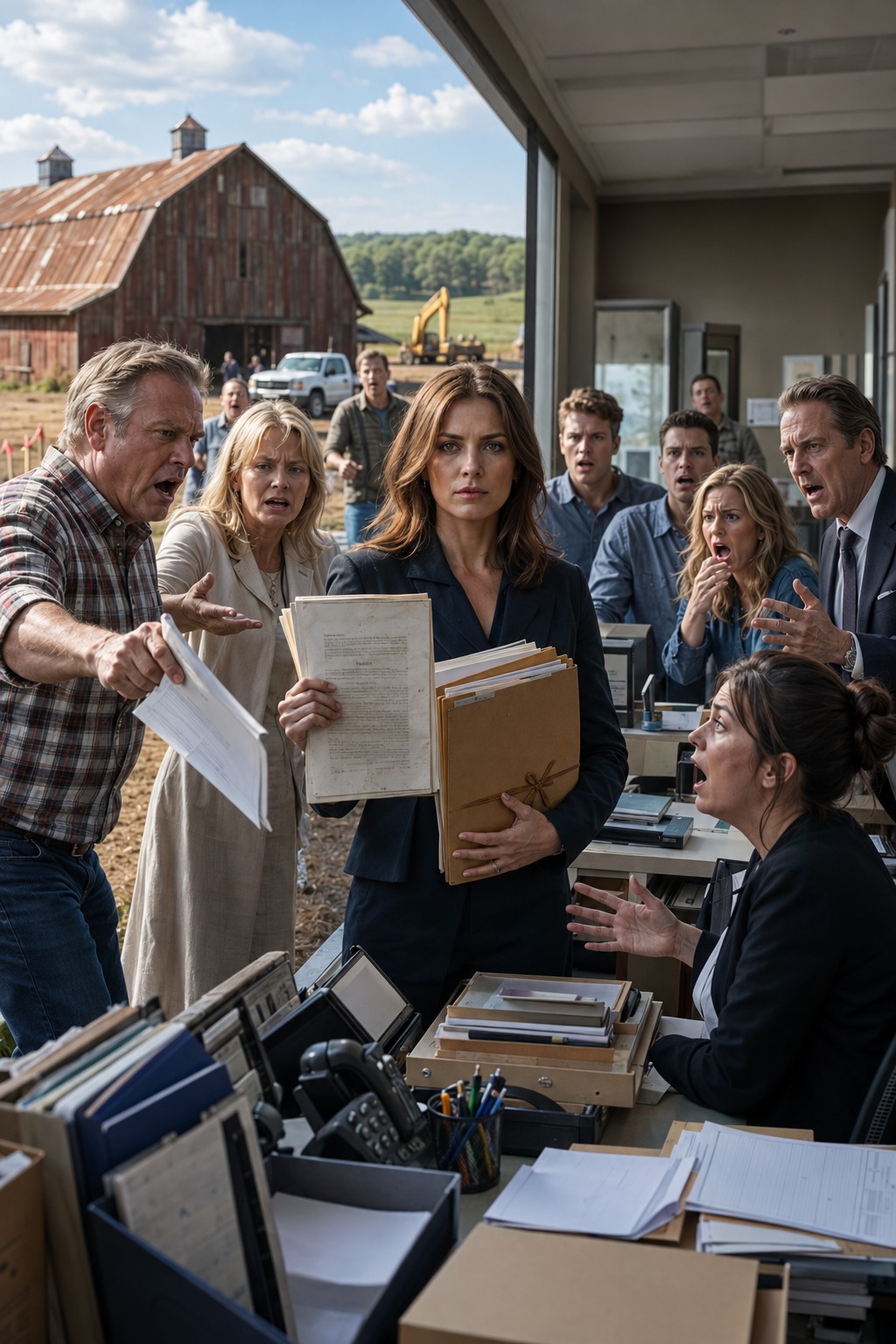
My Parents Announced They’d Sold Our Family Farm To A Developer And I Should “Be Grateful.” My Dad Shoved Papers At Me And Said, “Sign And Stop Acting Entitled.” My Mom Smirked, “You Don’t Own Anything Here.” I Didn’t Yell. I Drove To The County Clerk’s Office And Asked For The Deed History And Probate File. The Clerk Pulled Up The Transfer, Paused, Then Opened An Old Scanned Packet Labeled “Will.” Her Face Changed. She Leaned In And Whispered, “This Was Never Filed… And It Changes Who Owns The Farm…” And…
Court Order
Recorder
“One Line Changed Everything…”
Part 1
The first time I heard the word sold, I was standing in the middle of our family farm with dust on my boots and the wind dragging its fingers through the corn.
My father said it like he was talking about the weather.
“We sold the farm.”
He stood beside the equipment shed with one hand on his belt buckle and the other gripping a folder like it gave him authority. My mother was next to him, arms folded, chin lifted, wearing the same small pleased smile she used to wear when she corrected me in front of church people.
Behind them stood a man I didn’t know. Clean shirt. Shiny shoes. Sunglasses hooked on his collar. He kept checking his watch as if my grandfather’s land was just another delay in his afternoon.
I looked from him to my father.
“You sold what?”
“The farm,” Dad said louder, like volume could make the sentence legal. “To Cedar Ridge Development. It’s done.”
The hired hands near the shed went quiet. Even the old barn fan seemed to click slower.
My mother tilted her head. “Don’t start, Natalie.”
That was always her first move. Before I even said anything wrong, she warned me not to become difficult.
I wiped my hands on my jeans. “Grandpa’s estate isn’t settled.”
Dad’s jaw tightened. “Your grandfather is dead.”
The way he said it made my stomach turn. Not sad. Final. Useful.
“This land was always going to be ours to handle,” he said. “You should be grateful we’re telling you at all.”
The man in the button-down cleared his throat. “Ms. Rowan, I’m Evan Mercer with Cedar Ridge. We’re excited to bring housing and jobs to Hawthorne County.”
He said jobs like a magic word.
I stared past him at the farmhouse. Grandpa’s porch still had the blue rocker he refused to replace, even after the left arm cracked. The cottonwood trees along the creek flashed silver in the wind. The corn made that dry whispering sound I had known since childhood.
Then I looked back at my father.
“If it’s legal,” I said, “show me the probate case number.”
My mother laughed once. Soft. Sharp.
“Listen to her,” she told Evan. “Always acting like she’s the judge.”
Dad stepped closer and shoved a stack of papers against my chest. “Sign these.”
I didn’t take them.
“Sign what?”
“Acknowledgment. Consent. Whatever the lawyer called it.” His face darkened. “You don’t own anything here, but this makes it smoother.”
My mother leaned closer, perfume cutting through the smell of diesel and hot dust. “You don’t own anything here,” she repeated, slowly, as if she wanted to press the words into my skin.
For half a second, I was twenty-two again, home from college, finding Grandpa on that same porch with a yellow legal pad, an old ledger, and a weathered manila envelope.
“Someday,” he’d told me, tapping the envelope with one thick finger, “you may need proof. People get strange when dirt turns into money.”
At the time, I thought he meant boundary lines, taxes, maybe some neighbor dispute over creek access.
I didn’t think he meant my parents.
Dad shoved the papers again. “Don’t embarrass yourself.”
I finally took the stack, but only because paper has dates, ink has pressure, and people who lie often leave their fingerprints on the thing they want you to sign.
The top page had no court caption. No case number. No deed instrument number. No probate reference. Just a vague paragraph saying I acknowledged the sale and released any claims, with a blank line for my signature.
I handed it back.
“No.”
My father’s face flushed. “You can watch the bulldozers come, then.”
My mother smiled wider. “You always needed attention. This is why you ended up with a quiet little life and nothing to show for it.”
I felt that land somewhere soft, but I didn’t give it air.
I turned, walked to my truck, and got in without slamming the door. Gravel popped under my tires as I drove away, steady and slow.
Because the place that mattered now wasn’t the porch, the barn, or the field.
It was the county clerk’s office.
And as I pulled onto the road, my phone buzzed with a text from my father.
Sign by tomorrow, or you lose the chance to be reasonable.
That was when I knew they weren’t just hiding something.
They were racing me.
### Part 2
The Hawthorne County Clerk and Recorder’s Office sat between the courthouse and a bail bonds place, in a brick building that always smelled faintly of toner, old carpet, and somebody’s reheated lunch.
A small sign inside the lobby said: All records are public.
Good.
I walked to the counter with my folder under my arm and the dust of the farm still on my boots. A woman with gray-brown hair pulled tight at the back of her head looked up from her screen. Her reading glasses hung on a chain, and her expression said she had heard every family emergency in the county at least twice.
“Can I help you?”
“I need the deed history for the Rowan farm parcel,” I said. “And any probate file for Walter Rowan.”
She studied me for one beat. “Address?”
I gave it to her.
Her fingers moved across the keyboard. The keys clicked loudly in the quiet lobby. Somewhere behind her, a printer coughed and hummed.
“What’s your name?” she asked.
“Natalie Rowan.”
“Relationship to Walter Rowan?”
“Granddaughter.”
That made her pause.
Not dramatically. Just a small stillness in her shoulders, the way people go quiet when a puzzle piece doesn’t fit.
She typed again, leaned closer to the screen, and frowned.
“There was a transfer recorded yesterday,” she said.
Yesterday.
While I was at work. While my parents were probably standing at some counter, smiling, signing, pretending this was theirs.
“Can you print the last two recorded instruments?” I asked. “With instrument numbers and grantor information?”
She nodded. “I can.”
The printer started. Two pages slid out, warm and smelling of fresh ink. She set them on the counter.
The buyer line was exactly what I expected.
Cedar Ridge Development.
The grantor line was not.
Estate of Walter Rowan.
A cold, clean feeling moved through me. Not panic. Something sharper.
“The estate transferred it?” I asked.
“That’s what it says.”
“Where’s the probate case?”
She turned back to the screen. Clicked. Typed. Clicked again.
“There is no active probate case for Walter Rowan in Hawthorne County.”
I kept my hands flat on the counter. “Then how did the estate transfer property?”
She didn’t answer right away.
That was the first real crack in the day.
She clicked into another window, then another. Her mouth tightened. “There’s an attachment packet scanned with the transfer.”
“What kind of packet?”
She looked at me then, not like a clerk helping a customer, but like a person realizing the floor under both of us had shifted.
“It’s labeled will.”
The air in the lobby seemed to shrink.
My grandfather’s envelope flashed in my memory. His hands. The porch light. The way he had said proof like it was something people had to earn.
The clerk lowered her voice. “This does not appear to have been filed in probate.”
“What’s your name?” I asked.
Her eyes flicked to her badge. “Mara Ellison.”
“Mara,” I said carefully, “can you print me a certified copy?”
“I can print what’s scanned,” she said. “But I can’t give legal advice.”
“I’m not asking for advice. I’m asking for records.”
Before she printed, she hesitated. Then she clicked a small tab on the screen.
“What are you checking?” I asked.
“Access history.”
My pulse tightened.
“Why?”
“Because when a lost will suddenly appears attached to a questionable transfer,” she said quietly, “sometimes it wasn’t lost to everyone.”
She scrolled.
Then stopped.
The look on her face changed so slightly someone else might have missed it. I didn’t.
“It was opened yesterday morning,” she said.
“By who?”
Mara clicked again.
The name appeared reflected in her glasses before she said it.
Gail Rowan.
My mother.
I didn’t breathe for a second.
Mara kept her voice low. “She used a public records terminal under her own ID. Less than an hour before the transfer was recorded.”
So my mother had known.
She had opened Grandpa’s will, seen whatever it said, and still moved forward.
“Print everything,” I said. “The transfer. The affidavit. The will packet. The access log. Anything with her name on it.”
Mara stood. “I need my supervisor.”
As she disappeared through a back door, my husband Miles walked into the lobby, hair still damp from the rain that had started outside. He had left work when I called but hadn’t asked a single question on the phone. That was Miles. He knew when my voice had gone too calm.
“What did you find?” he asked.
I looked at the transfer page, at the words Estate of Walter Rowan, and then toward the back door where Mara had vanished.
“There’s a will,” I said. “And my mother opened it yesterday.”
Miles’ face changed.
Not with surprise.
With recognition.
Like the betrayal finally had paperwork.
Then Mara returned with a man in a gray cardigan, his badge clipped to his belt. He carried himself like procedure in human form.
“Ms. Rowan?” he said. “I’m Glenn Pritchard, records supervisor.”
He set one thin folder on the counter.
And when he opened it, the first page was Grandpa’s will.
The line that mattered was halfway down the second page.
I read it once.
Then again.
And my knees almost forgot how to hold me.
### Part 3
Grandpa had left the farm to me.
Not to my father. Not to my parents. Not divided among heirs, not held until somebody felt like being fair.
To me.
The legal description was right there, dry and precise: parcel number, boundary lines, references to the creek road and the old cottonwood stand. Grandpa had known how people wriggled out of plain language, so he hadn’t used plain language. He used land language. The kind that pins a field to the page.
I was also named executor.
Miles leaned closer over my shoulder. I heard his breath catch.
“Natalie,” he whispered. “He gave it to you.”
I nodded, but I still couldn’t feel the words properly. They were too big to fit inside the quiet county lobby.
Glenn stamped the certification page with firm, practiced pressure. The sound echoed off the tile.
“This is a certified copy of what is held in our deposited will records,” he said. “It has not yet been admitted to probate.”
“Understood.”
Mara’s eyes moved to the next scanned attachment. “There’s more.”
The next document was an affidavit of heirship.
I had heard of those. Everybody in a farm county had. They were supposed to be a shortcut when an estate was simple and uncontested.
This one claimed Walter Rowan died intestate.
Without a will.
It named Dennis Rowan and Gail Rowan as the proper heirs.
My father and mother.
It declared they had authority to transfer the farm to Cedar Ridge Development.
The signatures were notarized.
Dad’s signature leaned hard to the right, like he was trying to push through the page. Mom’s was neat and round, the same way she signed birthday cards she never meant.
“There are witnesses,” Mara said.
I looked.
Two names I didn’t know. Both with the same post office box listed as their address.
That detail sat strangely in my mind. Not proof by itself, but sour. Like milk that wasn’t fully spoiled yet but already wrong.
Mara printed the affidavit, the transfer, and the access log. Then she clicked into something else.
“Wait,” she said softly.
Glenn looked over. “What?”
“There’s a receipt history.”
Another page loaded.
Mara’s face hardened.
She printed it without asking.
When it came out, she set it on top of the stack and tapped a line with her finger.
Paid copy request: Gail Rowan. Deposited will packet copy fee.
Yesterday morning.
My mother hadn’t only opened the will.
She had paid for a printed copy.
Then signed an affidavit saying there was no will.
The lobby noise faded into a low hum. My body felt steady in the strange way it does when shock burns off and leaves only purpose.
Miles put a hand lightly against my back. “Call Tessa.”
I already had my phone out.
Tessa Marlo answered on the second ring. Probate and real property. No wasted words, no warm-up.
“Natalie?”
“Tessa, my parents recorded an affidavit of heirship claiming my grandfather died without a will, then transferred our farm to a developer. The clerk just found a deposited will that names me as executor and sole devisee of the farm. The access log shows my mother opened the will yesterday before the transfer. There’s also a receipt showing she paid for a copy.”
Tessa went quiet for half a second.
That half second told me more than a gasp would have.
“Do not confront them,” she said. “Do you hear me?”
“I already did before I knew all this.”
“Don’t do it again. You need to open probate immediately. Today. Then we record notices against the parcel and cloud title.”
“Can that stop Cedar Ridge?”
“It can stop clean title. If they move equipment before this is resolved, we seek emergency injunctive relief.”
“They said surveyors are coming tomorrow.”
“Then we move now.”
I looked across the lobby toward the hallway that led to the probate window. It suddenly seemed too far and not far enough.
Tessa continued, “Get certified copies of everything. Will, transfer, affidavit, access log, receipt. Email them to me. Then file the will with probate before you leave that building.”
After I hung up, Glenn finished stamping the packet. Each stamp landed with a blunt little thud.
He slid the documents toward me.
“I can’t tell you what to do,” he said, “but I can tell you the court needs this today.”
“I’m going there now.”
As I gathered the papers, my phone buzzed.
Dad again.
Don’t make this ugly. Survey crew comes tomorrow. Sign like an adult.
I showed the message to Miles.
His jaw tightened. “They know they’re running out of time.”
I looked down at the certified will, at Grandpa’s signature, at my mother’s receipt sitting above it like a confession she hadn’t realized she was writing.
Then I turned toward the probate hallway.
For the first time that day, I wasn’t asking whether my parents had lied.
I was wondering how many people had helped them.
### Part 4
The probate window was at the end of a narrow hallway where the carpet had been worn smooth by decades of bad news.
A young clerk with tired eyes looked up when I slid the certified will packet under the glass.
“I need to file this will for probate,” I said. “Today. Emergency if possible.”
She glanced at the top page. Then at the deposit stamp. Then her posture changed.
“This is a deposited will.”
“Yes.”
“And no estate case has been opened?”
“No.”
She typed Walter Rowan’s name. Her screen light reflected greenish across her face.
“No case,” she murmured.
“The farm was transferred yesterday using an affidavit claiming there was no will,” I said. “The recorder’s office has proof my mother accessed and copied the will before signing that affidavit.”
That moved her from tired to alert.
She slid a petition form under the glass. “Fill this out. Date of death, heirs, known assets, proposed executor. Attach the certified will.”
I took the pen she offered. It had bite marks near the cap.
My handwriting stayed steady.
Walter Rowan.
Date of death.
Known asset: Rowan family farm.
Proposed executor: Natalie Rowan.
When I checked the box confirming a will existed, something in my chest loosened and tightened at the same time. Grandpa’s last instructions were finally stepping into daylight.
The clerk reviewed the papers. “You’ll need a hearing for appointment.”
“How fast?”
“With an emergency motion, possibly soon. But you need counsel.”
“I have counsel.”
I slid Tessa’s card under the glass. The clerk nodded at the name like Tessa’s reputation had entered before she did.
Filing fees. Receipt. Stamp. Case number.
The small machine chirped as it printed, and there it was: Estate of Walter Rowan, with a real probate number beside it. Not a lie on an affidavit. Not my father’s hand crushing papers into my chest. A case.
I sent the number to Tessa.
Her reply came immediately.
Go back to recorder. Record notice of probate and notice of pending action. PDFs incoming.
I printed the documents at the public kiosk. The machine smelled hot and dusty. The pages slid out one by one, plain as grocery lists and twice as dangerous.
When I returned to Mara’s counter, she looked at the documents and gave one short nod.
“You opened probate.”
“Yes. I need these recorded against the farm parcel today.”
She took them without drama. “Give me ten minutes.”
Ten minutes can feel longer than a winter.
Miles and I sat on a wooden bench near a rack of county brochures. One promised permits made simple. Another showed smiling families at a summer fair. The fluorescent light buzzed overhead.
“You’re doing exactly what Grandpa wanted,” Miles said.
I looked at my hands. There was dust under one thumbnail from the farm. “He knew.”
“Maybe he suspected.”
“No.” I shook my head. “He knew.”
The memory of him on the porch sharpened. The envelope. His voice. People get strange when dirt turns into money.
Back then, I had rolled my eyes and told him nobody wanted our muddy fields that bad.
He had smiled sadly and said, “You’d be surprised what people can sell in their hearts before they sell it on paper.”
I wished I had understood him sooner.
Mara called my name.
The recorded notices came back with instrument numbers and barcodes. Public record. Permanent mark. A warning nailed to the land without touching a fence post.
“Anyone searching title will see these,” Mara said. “It won’t erase yesterday’s transfer. But it clouds it.”
“Good.”
Outside, rain had started tapping the windows. I called Cedar Ridge using the number on the papers Dad had shoved at me.
A receptionist answered with a polished voice.
“My name is Natalie Rowan,” I said. “The farm parcel you believe you purchased is subject to a probate action and recorded pending claim. A will has been filed. You do not have clean title.”
Silence.
Then a man came on. “This is Cole Jensen, counsel for Cedar Ridge.”
I repeated the facts. Calmly. Slowly.
He didn’t interrupt.
When I finished, he exhaled through his nose. “Your parents represented they had authority as heirs.”
“They represented falsely.”
“If what you’re saying is accurate, that creates serious exposure.”
“Yes.”
“We will not proceed with entry, survey, or development activity until reviewed.”
“Put that in writing.”
Another pause.
“I will.”
When I hung up, my phone lit again.
This time, it was my mother.
A photo.
The farm gate.
A brand-new sign hung from it.
No trespassing. Property under contract.
Under the photo, she had typed:
Come by tomorrow and watch what happens when paperwork meets real life.
I stared at the sign until the letters blurred.
Then Tessa called, and her first words were, “They’re going to force a scene.”
### Part 5
By the time I drove back to the farm, the rain had stopped, leaving the world rinsed and metallic.
The gravel road shone in patches. Water clung to the ditch grass. The corn was dark green under a bruised evening sky, whispering like it had secrets of its own.
The sign hung crooked on the gate.
No trespassing. Property under contract.
Bright red letters. Cheap plastic. New zip ties.
My father stood beside it with his arms crossed. My mother leaned against his truck, smiling like she’d set a pretty table.
“Ready to be reasonable?” Dad called.
I got out with my folder in one hand and my phone in the other.
“I opened probate,” I said. “The will has been filed. Notices were recorded against the parcel this afternoon.”
My mother’s smile did not disappear. It sharpened.
“That won’t stop tomorrow.”
“It already stopped Cedar Ridge. Their counsel confirmed no entry until the title issue is resolved.”
Dad snorted. “Lawyers say things. Crews show up.”
I looked past him and saw fresh wooden stakes along the front pasture. Orange flags fluttered in the damp air. Survey prep.
“You put those in after the notice was recorded?”
My father’s eyes narrowed. “It’s not your land.”
I took a photo of the stakes. Then the sign. Then a wider shot showing my parents, the gate, and the truck.
Mom pushed off the truck. “Stop taking pictures like a lunatic.”
“I’m documenting.”
“You’re harassing us.”
I didn’t answer. That was another family trap. She threw words like harassing, unstable, dramatic, selfish, and waited for me to wrestle them in public.
My phone buzzed.
Unknown number.
The voicemail notification appeared immediately, like someone had let it ring once and hung up.
I played it on speaker.
“Ms. Rowan, this is the Hawthorne County Sheriff’s Office. We received a complaint that you are trespassing on Cedar Ridge property. Please contact dispatch or wait for a deputy on scene.”
My father’s mouth lifted at one corner.
My mother looked pleased with herself in a way that made her almost beautiful and completely ugly.
“You called the sheriff on me,” I said.
“You’re trespassing,” Dad replied.
I called dispatch back with my phone still in my hand.
“This is Natalie Rowan. I received a voicemail about a trespass complaint at the Rowan farm. I need the incident number, reporting party, and assigned deputy.”
The dispatcher hesitated. “Are you currently on scene?”
“Yes.”
Typing. A pause.
She gave me the incident number.
“And the reporting party?” I asked.
Another pause.
“Gail Rowan.”
My mother’s eyes flicked once. Just once.
“Thank you,” I said. “Please add to the call notes that a probate case was filed today and a notice of pending action was recorded against the parcel. I have instrument numbers available for the responding deputy.”
The dispatcher’s tone changed. “I’ll add that.”
When I ended the call, Dad stepped close enough that I could smell coffee and chewing tobacco.
“You think paperwork makes you powerful?”
“No,” I said. “It makes you traceable.”
For the first time that day, his confidence twitched.
A patrol SUV rolled up ten minutes later, tires crunching over wet gravel. The deputy who stepped out was broad-shouldered, calm, with a body camera centered on his chest.
“Evening,” he said. “Deputy Scott Landry.”
He looked first at me, then at my parents, then at the sign.
My father started before anyone asked. “She’s trespassing. We sold this property. She’s interfering with a lawful sale.”
Deputy Landry turned to me. “Ma’am?”
I handed him the recorded notices, the probate case number, and Cole Jensen’s email on my phone.
“There is an active probate case and a recorded pending action,” I said. “A will was filed today. The transfer is disputed. Cedar Ridge’s counsel confirmed they will not proceed.”
My mother laughed. “She’s lying. There’s no will.”
I kept my eyes on the deputy.
“My mother accessed and paid for a copy of the deposited will yesterday before signing an affidavit saying there was no will. The county has the log and receipt.”
Deputy Landry’s expression didn’t change much, but his attention sharpened.
He took my papers. Then he asked my parents, “Do you have the recorded deed?”
Dad shoved his folder at him. “Purchase contract.”
The deputy flipped through it. “Recorded deed?”
“It’s in process,” Dad snapped.
Landry stepped aside and radioed dispatch, reading the instrument number from my notice.
We all stood in the damp air while the corn hissed and the sign knocked softly against the gate.
Dispatch crackled back.
“Parcel shows notice of pending action recorded today. Probate-related notice recorded today. Title flagged for dispute.”
Deputy Landry closed my folder and handed it back.
“This is a civil title dispute with active court filings,” he said. “I’m not removing her for trespass tonight.”
My mother’s face tightened.
Dad’s voice rose. “So she can just stand here?”
“No,” Landry said evenly. “And neither can you create problems here.”
He looked at the sign. Then the stakes. Then my parents.
“If a crew shows up tomorrow, nobody gets escorted onto disputed land based on a private contract.”
My father stared at him like the man had personally betrayed him.
My mother’s voice went sweet. “We just want peace, Deputy.”
Peace was her favorite word for obedience.
Landry took photos. The sign. The stakes. The papers. He documented everything with slow patience.
Before leaving, he turned to my mother. “Do not call this in as a simple trespass again while the title is flagged. False or misleading reports can create their own issues.”
Mom blinked twice.
When the patrol SUV disappeared down the road, she stepped closer to me.
“You think you won?” she whispered. “The will doesn’t matter if Grandpa’s gone and you can’t afford to fight.”
Then my phone rang.
Tessa.
Her voice was tight.
“Natalie, get to my office now. The clerk found another page in the deposited packet.”
I looked at my mother’s smile, and suddenly I knew she hadn’t told me the worst part.
### Part 6
Tessa’s office was above a pharmacy on Main Street, the kind of old building where the stairs creaked and the hallway smelled like lemon cleaner and radiator heat.
She met me at the door before I knocked.
Her hair was still pinned from court, but loose strands had escaped around her face. She held a paper in one hand and looked like she had just read a loaded gun.
“What did they find?” I asked.
“A codicil.”
Miles came up behind me. “A what?”
“An amendment to the will,” Tessa said. “Handwritten. Witnessed. Dated years after the original.”
She led us into her conference room. A courier envelope sat open on the table. Beside it was a scanned page in Grandpa’s handwriting.
I knew that handwriting immediately.
Blocky. Heavy. No patience for loops.
My throat tightened before I even read the words.
Tessa placed the page in front of me. “Read the middle paragraph.”
The room was quiet except for the pharmacy sign buzzing outside the window.
I read.
If Dennis Rowan or Gail Rowan attempt to sell, transfer, encumber, contract, pledge, or otherwise dispose of the farm parcel, they are immediately disinherited from any benefit under this estate. The farm shall pass solely to Natalie Rowan, who shall hold title free of their claims and may seek immediate injunctive relief to protect the property.
I read it again.
Then once more.
Grandpa hadn’t just left me the farm.
He had predicted the exact shape of the betrayal.
My mother had paid for a copy of this packet, seen this page or known it was there, and moved anyway.
Tessa sat across from me. “This changes the temperature.”
“How?”
“It shows intent. Not just ownership. Not just mistake. Your grandfather specifically warned against what they did. And your mother’s receipt shows she had access before the affidavit.”
Miles rubbed both hands over his face. “So this isn’t gray.”
“No,” Tessa said. “This is black ink on white paper.”
I looked at the codicil again. The paper had a slight tilt to it, like someone had fed it through a scanner too quickly. Grandpa’s signature sat at the bottom, familiar and blunt.
A memory came back so hard I smelled porch dust.
Grandpa sitting in his rocker, rubbing his thumb along the edge of that manila envelope.
“If anybody ever tells you family means you should sign fast,” he’d said, “that’s when you read slow.”
At the time, I thought he was just being old and suspicious.
Now I wondered what he had seen before I was old enough to notice.
Tessa opened her laptop. “We’re filing for a temporary restraining order tonight.”
“Can a judge hear it this late?”
“There’s an emergency duty judge. We have recorded notices, a filed probate case, a disputed transfer, evidence of a knowingly false affidavit, and a survey crew scheduled for morning. That’s enough to ask.”
She typed quickly. No wasted motion.
I signed an affidavit describing the day. The sale announcement. The papers Dad tried to make me sign. The clerk’s discovery. My mother’s access. The sign on the gate. The sheriff call. The stakes.
Writing it made the whole thing feel both smaller and worse. Smaller because facts fit in numbered paragraphs. Worse because there they were, lined up neatly, impossible to soften.
At 9:47 p.m., we joined an emergency video hearing from Tessa’s conference room.
The judge appeared on screen in chambers, tie loosened, reading glasses low on his nose. He looked tired in the way courthouse people look tired, not sleepy, just permanently unimpressed.
Tessa spoke first.
“Your Honor, this matter concerns a farm parcel transferred yesterday from the purported estate of Walter Rowan to a developer by affidavit of heirship. Today, a deposited will was located and filed. It names my client as executor and devisee of the farm. We also have an access log and receipt showing Gail Rowan obtained a copy of the will packet before signing the affidavit claiming no will existed.”
The judge looked down at the documents.
His pen stopped moving when he reached the receipt.
“Deposited will packet copy fee,” he read aloud.
Then Tessa held up the codicil.
“There is more, Your Honor.”
She read the paragraph.
The judge’s face did not change dramatically. But something in his eyes hardened.
“Ms. Rowan,” he said, looking at me through the screen. “What relief are you requesting?”
“No entry,” I said. “No survey, no grading, no staking, no alteration, and no one representing they have authority to act for the estate until probate determines ownership.”
He nodded once.
My palms were damp under the table.
The judge looked back down, turned a page, and said, “I’m granting the temporary restraining order.”
Miles exhaled beside me.
The judge continued. “No entry by Cedar Ridge or its agents. No survey activity. No disturbance of the property. Dennis and Gail Rowan are restrained from representing authority over the parcel. Any violation may be treated as contempt.”
Then he paused.
“And I am directing the clerk to forward the affidavit of heirship, the access log, and the receipt to the district attorney for review.”
Tessa’s eyes flicked toward me.
The judge added, “If someone obtained the will and then swore under oath that no will existed, that is not a family misunderstanding.”
After the hearing ended, the room was silent.
I looked down at Grandpa’s codicil.
For the first time since Dad said sold, I felt something like grief break through the adrenaline.
“He knew they might do this,” I said.
Tessa’s voice softened. “Yes.”
Outside the window, Main Street was dark except for one flickering pharmacy sign.
Then my phone buzzed.
A photo from an unknown number.
Two survey trucks parked outside the farm gate under headlights.
The message said:
Morning came early.
### Part 7
I reached the farm before sunrise.
The sky was still the color of dishwater, with a thin orange bruise forming over the tree line. My headlights swept across the gate and caught the red letters of the no trespassing sign, still hanging there like a bad joke.
Two survey trucks idled near the ditch.
Men in reflective vests stood around drinking gas station coffee from paper cups. Their equipment sat in the truck beds, yellow legs folded tight, blinking little red lights in the dim.
My father’s truck was already there.
Of course it was.
He stood by the gate with his hands in his jacket pockets, shoulders hunched against the cold, looking pleased in a rough, stubborn way. My mother sat in the passenger seat with the window cracked just enough to watch me.
I parked on the shoulder.
Miles parked behind me.
Before either of us got out, another vehicle turned onto the road.
A sheriff’s SUV.
Deputy Landry stepped out holding a folded court order.
My father’s face brightened for half a second, like he thought the cavalry had arrived.
Then Landry spoke.
“Mr. Rowan, I received the temporary restraining order this morning.”
The brightness vanished.
My mother opened her door.
Landry faced the crew chief first. “No survey activity. No entry. No staking. No disturbance. This property is subject to a court order.”
The crew chief looked at my father. “Dennis?”
Dad barked, “We hired you. Get started.”
Landry turned his head slowly. “You start work, you’ll be documented violating a restraining order.”
That did it.
The crew chief lifted both hands. “We’re not touching it.”
My mother stepped forward, coat swinging open, voice sharp. “This is ridiculous. She manipulated some sleepy judge in the middle of the night.”
Landry’s tone stayed level. “Ma’am, the order is signed.”
Dad pointed toward me. “She doesn’t own this land.”
“That’s for the court,” Landry said. “Today, nobody changes anything.”
I stood beside my truck with the cold air stinging my face and watched my parents discover the strange weakness of bluster when paper finally outranks it.
The crew began packing up. Tripods clanged softly against truck beds. One man poured his coffee into the grass, avoiding eye contact with everyone.
My father’s neck turned red.
“You can’t do this,” he snapped at Landry. “We already sold it.”
“Then you should have sold something you had the right to sell,” Landry said.
For one glorious second, no one spoke.
Then Dad marched to the ditch, grabbed one of the orange survey stakes from the night before, and yanked it out of the ground.
“Sir,” Landry said. “Stop.”
Dad threw the stake into the ditch.
It landed with a wet slap.
Landry’s posture changed. Not angry. Official.
“Hands behind your back.”
My mother screamed his name.
Dad spun. “For what?”
“Violation of the order after being directed to stop.”
The click of the cuffs was small. Almost delicate.
It still cut through the morning.
My mother rushed forward, then stopped when another sheriff’s unit rolled up behind Landry. Backup. Body cameras. Procedure.
“He’s an old man,” she cried.
“He’s an adult,” Landry said. “And he was warned.”
I expected to feel satisfaction.
I didn’t.
I felt hollow and awake.
My father looked at me as Landry guided him toward the SUV. His face was twisted with something I had never seen directed at me so openly.
Hatred, maybe.
Or fear wearing its clothes.
“This is your fault,” he said.
“No,” I answered quietly. “It’s your signature.”
The survey crew left.
The second deputy photographed the gate, the discarded stake, the trucks, the sign, and the court order. My mother stood by her open car door, breathing hard.
Then she turned on me.
“You think you’re safe because a judge signed a page?”
“I think you should call a lawyer.”
Her eyes went flat. “I think you should remember who raised you.”
That one landed.
Not because it was true in the way she meant, but because it was true in the way that mattered. She had raised me to read rooms, to stay calm, to watch her hands instead of her smile. She had made me good at surviving people like her.
Before I could answer, one of the deputies approached.
“Ms. Rowan,” he said, “the DA’s office has asked for copies of the affidavit and will records. Your attorney may already know.”
“They can have everything,” I said.
My mother heard that.
Her face changed.
Just a flicker.
Not anger this time.
Fear.
And it was the first honest thing I had seen from her all week.
### Part 8
Probate court does not look like justice on television.
There are no sweeping speeches, no gasps from packed galleries, no judge slamming a gavel while violins rise in the background.
There is fluorescent light. There are plastic chairs. There are attorneys whispering over files. There is a coffee stain on the table that looks older than half the marriages being argued in the building.
But when the judge admitted Grandpa’s will and codicil, it felt louder than thunder.
I sat beside Tessa with my hands folded. Miles sat behind me. My parents sat across the aisle with their lawyer, a man named Brant Kessler who kept smoothing his tie like the fabric was the problem.
Dad had been released after the incident at the farm, but the cuffs had changed him. He looked smaller somehow. Angrier, too, but not in control of it.
Mom looked perfect.
That was how I knew she was scared.
Hair set. Pearls on. Pale blue blouse. Face arranged into wounded dignity.
When the judge reviewed the will, Brant tried to argue uncertainty.
“Your Honor, there are questions about whether Mr. Rowan intended to exclude his son from meaningful participation in the family property.”
The judge looked at the legal description. Then at the codicil.
“Counsel, the document specifically says Dennis Rowan and Gail Rowan are disinherited if they attempt to sell or encumber the farm.”
Brant cleared his throat. “There may be context.”
“There is also a recorded affidavit claiming no will existed,” the judge said.
The room cooled.
Tessa rose. “Your Honor, my client requests appointment as executor under the will and authority to initiate proceedings to set aside the transfer.”
Brant stood again. “We object to appointment at this stage.”
“On what basis?” the judge asked.
Brant hesitated.
That hesitation told the truth. They had no good basis. Only discomfort with consequences.
The judge admitted the will. Then the codicil. Then appointed me executor.
Executor.
The word felt strange and heavy, like Grandpa had handed me a tool I had no choice but to learn how to use.
The judge also ordered the disputed transfer flagged, authorized a quiet title action, and maintained the restraining order.
Cedar Ridge’s counsel appeared by video. Cole Jensen looked calm, but his voice had the clipped edge of a man whose company had been embarrassed.
“Your Honor, Cedar Ridge relied on representations by Dennis and Gail Rowan. Upon learning of the probate dispute, Cedar Ridge ceased all activity. We reserve claims against the sellers.”
My father turned red.
My mother stared straight ahead.
Then the judge addressed the affidavit.
“I am referring this matter to the district attorney in open court,” he said. “The combination of the deposited will access record, copy receipt, and sworn affidavit raises serious questions.”
Mom’s hand tightened around her purse strap.
For years, she had controlled rooms by making other people feel rude for noticing facts.
That did not work in court.
After the hearing, I stepped into the hallway. The courthouse smelled like wet wool and vending machine coffee. My mother followed me before Tessa could block her.
“Natalie.”
Her voice was soft. Public soft.
I turned.
Dad stood behind her, jaw working.
Mom’s eyes shone, but no tears fell. She was too disciplined for that.
“We need to talk as a family,” she said.
“No.”
Her mouth twitched. “Don’t be cruel.”
I almost laughed.
Cruel.
They had tried to sell Grandpa’s farm, erase his will, sign away my rights, call the sheriff on me, and bring surveyors to the gate. But my refusal to stand in a hallway and absorb their version was cruelty.
Tessa stepped beside me. “All communication goes through counsel.”
My mother ignored her. “You’re letting outsiders turn you against your own blood.”
I looked at her pearls. One had a tiny chip near the clasp. I remembered noticing that same chip at Grandpa’s funeral while she accepted casseroles and whispered that grief made people dramatic.
“No,” I said. “You did that yourself.”
Dad stepped forward. “You think this farm will love you back?”
His voice cracked slightly on love.
That was the closest he came to sounding human.
I wanted to ask him why he hadn’t loved it enough not to sell it. Why he hadn’t loved Grandpa enough to obey him. Why he hadn’t loved me enough to tell the truth.
Instead, I said, “I think you should leave.”
Mom’s expression hardened.
Then she leaned in and whispered, “You haven’t found everything.”
The words were so quiet Tessa didn’t hear them.
But I did.
And my mother smiled when she saw that I had.
### Part 9
The first thing I did as executor was change the locks.
It felt petty until the locksmith opened the farmhouse back door and found fresh scratches around the plate. Someone had been forcing a key that didn’t fit anymore, or testing an old one, or trying to convince themselves the house still belonged to them if they touched the knob hard enough.
“Want this documented?” the locksmith asked.
“Yes.”
He took photos before replacing the hardware.
The farmhouse smelled exactly like Grandpa: cedar, coffee, tractor grease, and the faint mineral smell of old well water. Dust lay across the kitchen table in a thin gray film. The calendar on the wall was still turned to the month he died because none of us had been brave enough, or honest enough, to flip it.
Miles walked through the rooms quietly, opening curtains.
Late afternoon light poured in, showing every floating speck in the air.
I stood in Grandpa’s office.
It was barely a room, more like a converted pantry off the mudroom, with shelves crowded by coffee cans full of screws, seed catalogs, tax envelopes, fence maps, and old notebooks tied with twine.
This was where he had kept the manila envelope.
But the drawer where I remembered seeing it was empty.
I searched slowly. Not tearing through things, not yet. Grandpa had believed in systems nobody else understood. A tobacco tin might hold spare keys. A coffee can might hold receipts from 1987. A Bible might hold cash, but also tractor warranty papers.
Miles found the first clue.
“Natalie.”
He stood beside a shelf of county plat books. One had a yellow sticky note tucked inside.
On it, in Grandpa’s handwriting:
If they came this far, check the freezer.
“The freezer?” Miles asked.
The chest freezer sat in the mudroom, unplugged and empty, lid propped open with a block of wood. It hadn’t worked since before Grandpa died.
I lifted the lid anyway.
Inside smelled like cold metal and old cardboard. Nothing.
Then Miles tapped the side wall. “This panel’s loose.”
He pried gently with a screwdriver from Grandpa’s workbench. A thin piece of plastic popped free.
Behind it was an oilcloth packet taped flat against the insulation.
My hands went numb.
Inside were photocopies.
Not the will. Not the codicil.
Receipts. Notes. Letters.
I carried them to the kitchen table and spread them under the overhead light.
The first letter was from Cedar Ridge Development, dated nine months before Grandpa died.
Addressed to Dennis Rowan.
Not Grandpa.
Offer to purchase, contingent upon authority to convey.
My father had been negotiating before Grandpa was even gone.
The second document was worse.
A handwritten note from Grandpa to himself:
D. asked again about sale. Told him no. Gail angry. Said land is wasted on sentiment. Need revise will. Do not tell them.
I sat down hard.
Miles read over my shoulder, face pale.
There were more notes. Dates. Short entries.
Gail wants access to papers.
Dennis says developers won’t wait forever.
Told Natalie to read slow if pressured.
One note was circled twice.
If anything happens suddenly, ask Mara E. at county about deposited will.
Mara.
Grandpa had known her by name.
I thought of her face behind the counter, that careful stillness when she saw the access log. Had she remembered Grandpa? Had she known without saying too much?
At the bottom of the packet was a sealed envelope with my name on it.
Natalie.
My breath caught.
Miles touched my shoulder. “You don’t have to open it right now.”
“Yes,” I said. “I do.”
The envelope was brittle at the edges. Grandpa’s handwriting pressed hard through the paper.
Inside was one page.
My dear Nat,
If you are reading this, then I was right to worry and wrong to hope.
I stopped there.
For a moment, I was not executor, not plaintiff, not daughter of liars. I was just a granddaughter in an old kitchen, reading the voice of a dead man who had tried to protect me from people he still loved enough to mourn.
I forced myself to keep reading.
Your father thinks land is money. Your mother thinks money is proof she was right. Neither of them understands stewardship. I have given you the farm not because you never left, but because you came back without trying to own what wasn’t offered.
There are things I did not tell you while I was alive. I did not want to poison you against them. Maybe that was cowardice. Maybe mercy. You will decide.
If they try to sell, do not bargain. Do not forgive the theft because they wrap it in family words. Go to the clerk. File the will. Let records speak.
I pressed the page flat with both hands.
At the bottom, Grandpa had added one final line.
There is one more copy where Gail would never dirty her hands looking.
I read that line three times.
Then I looked toward the barn.
Because my mother had never stepped into the old calving stall in her life.
### Part 10
The barn smelled of hay dust, motor oil, and rain seeping through old boards.
Even in daylight, it had shadows that felt permanent. The kind that gathered in corners and stayed there, thick with cobwebs and memory. Pigeons shuffled in the rafters. Somewhere outside, a loose piece of tin ticked against the siding.
Miles carried a flashlight. I carried Grandpa’s letter.
The old calving stall was at the back, past the tractor bay and the wall where Grandpa hung his tools in outlines traced with black marker. My mother hated that part of the barn. She said it smelled like animals even after there hadn’t been calves there for years.
Grandpa knew that.
The stall door groaned when I opened it.
Inside was straw, a cracked mineral tub, and a wooden feed box built against the wall.
Miles shined the light across the boards.
“What are we looking for?”
“Something she’d never touch.”
He looked down. “That narrows it.”
The feed box lid was stuck. Miles worked it loose with a pry bar. Inside was old rope, a rusted curry comb, and a burlap sack stiff with dust.
Under the sack was a metal cash box.
Locked.
I laughed once, but it came out broken. Grandpa and his boxes.
Miles handed me a flathead screwdriver.
The lock was cheap and old. It gave after two tries.
Inside were duplicate copies of the will, the codicil, letters, and a small cassette tape in a plastic case labeled kitchen, August 14.
“A cassette?” Miles said.
“Grandpa never trusted phones.”
We found an old tape player in the office after twenty minutes of searching. It had corroded batteries inside, but Miles cleaned the contacts with vinegar and patience. When the tape finally clicked into place, the sound that came out was warped at first.
Then Grandpa’s voice filled the kitchen.
“Dennis, I told you. The farm is not for sale.”
My father’s voice answered, younger but unmistakable. “You’re being selfish.”
I sat very still.
The tape hissed.
Mom spoke next. “Walter, be practical. Natalie doesn’t need a farm. She has her little office job and that husband. Dennis is your son.”
Grandpa’s chair creaked on the recording. I could picture him at the table, coffee cup near his hand, jaw set.
“Dennis is my son. That doesn’t make him steward.”
Dad snapped, “You’d leave it to her over me?”
“I’d leave it to the person least likely to sell it to strangers before my body’s cold.”
Silence on the tape.
Then Mom, low and poisonous: “You’ll regret humiliating him.”
Grandpa answered, “No, Gail. I regret trusting you both as long as I did.”
The tape clicked, then continued with rustling sounds. A chair scraping. Dad cursing.
Then Grandpa’s voice again, closer to the recorder.
“Natalie, if you ever hear this, I’m sorry.”
I covered my mouth.
The tape ended with a hard click.
Miles shut it off.
Neither of us spoke for a long time.
The tape was not needed to prove the will. But it proved something else. Motive. Knowledge. Resentment. The long road leading to the false affidavit.
I called Tessa.
She listened without interrupting as I described the cash box, the duplicate papers, and the tape.
“Bring everything,” she said. “Do not play the tape for anyone else. We’ll preserve chain of custody as best we can.”
When I hung up, I looked around Grandpa’s kitchen.
The house no longer felt empty.
It felt watchful.
That evening, as we were leaving with the cash box, a dark sedan slowed near the gate. It didn’t turn in. Just rolled past, brake lights glowing red in the dusk.
Miles frowned. “Do you know that car?”
“No.”
It stopped fifty yards down the road.
A window lowered.
A camera lens appeared.
Then the car pulled away.
My phone buzzed seconds later.
Unknown number.
Better hope old Walter didn’t hide more than papers.
I stared at the message until my fingers tightened around the phone.
Grandpa had hidden the truth.
Someone else was still hiding the reason he feared it.
### Part 11
Tessa made three copies of everything and locked the originals in her office safe.
The cassette tape went into an evidence bag, which seemed strange and dramatic until I remembered my father in handcuffs and my mother lying to dispatch as easily as breathing.
“This is no longer just probate,” Tessa said. “The DA will want to know about the tape.”
“Will it matter?”
“It may. It shows your parents knew Walter intended to block a sale. It may also help Cedar Ridge prove they were defrauded.”
Cedar Ridge.
I had almost forgotten they were not only villains in my parents’ story. They were buyers who had wanted the farm, yes, but who had also been handed a poisoned title.
Cole Jensen called Tessa that afternoon and requested a meeting. We agreed to do it at her office with everything on record.
Cole arrived in a gray suit with a leather portfolio and the expression of a man who billed in six-minute increments. Evan Mercer came with him, the same man who had stood behind my parents at the farm.
Evan looked less polished now. There were shadows under his eyes.
He didn’t meet mine at first.
Tessa started. “My client is not negotiating a sale.”
Cole nodded. “Understood. Cedar Ridge is suspending all activity and pursuing remedies against Dennis and Gail Rowan.”
“Good.”
I watched Evan’s hands. He kept rubbing his thumb across a crease in his folder.
“You knew there was a problem,” I said.
His head lifted.
Cole glanced at him sharply.
Evan swallowed. “I knew there was family tension.”
“That’s not what I asked.”
The room went still.
Tessa leaned back slightly, letting me continue.
I said, “My father tried to get me to sign a fake consent document. No case number. No legal references. Just pressure. Did Cedar Ridge prepare that?”
Cole’s expression hardened. “No.”
Evan looked down.
There it was.
A red herring turning into something real.
Tessa’s voice became quiet. “Mr. Mercer?”
Evan exhaled. “Dennis said his daughter might cause trouble. He asked if an acknowledgment would help.”
“Did you draft it?” Cole asked.
“No. I swear. He brought it. I told him our counsel hadn’t approved it.”
“But you stood there while he shoved it at me,” I said.
Evan’s face reddened. “Yes.”
That yes mattered.
Not because he was the center of the fraud. Because lies grow best when decent people decide silence is safer.
Cole closed his portfolio. “Cedar Ridge will produce all communications with Dennis and Gail Rowan. Voluntarily.”
Tessa smiled without warmth. “Please do.”
Before they left, Evan turned to me.
“I’m sorry,” he said.
I studied his face. He looked embarrassed, maybe sincere, maybe just afraid.
“Sorry would have sounded better before the sheriff came,” I said.
He nodded once and left.
That night, the local paper published a small article online.
Probate Dispute Halts Farm Development.
By morning, the comments were full of people choosing sides with almost no information.
Some said I was greedy.
Some said my parents were crooks.
Some said farms had to become housing eventually.
One comment stood out because it mentioned something no article had reported.
Walter should’ve known Gail always gets what she wants. Ask what happened with the hospital papers.
Hospital papers.
I screenshot it before it disappeared.
Then I called Tessa.
She told me not to chase anonymous comments, which was good legal advice and useless human advice.
So I went back to the county building.
Not the recorder this time.
Vital records first. Then court archives. Then, after a long wait and three forms, I found a medical power of attorney document filed years earlier, around the time Grandpa had his first stroke scare.
It named my father as agent.
That was expected.
But the revocation filed six months later was not.
Grandpa had revoked Dad’s authority and named me alternate after his doctor signed a statement that Walter Rowan was competent and acting voluntarily.
The attached note was short.
Patient reports pressure from son and daughter-in-law regarding property decisions during hospitalization.
My hands went cold.
This had started before Grandpa died. Before the will was accessed. Before Cedar Ridge.
My parents had tried to control him while he was alive.
As the clerk printed the copy, she said, “You may also want the notary record.”
I looked up.
“What notary record?”
She slid a thin sheet toward me.
The same notary who stamped the false affidavit had also notarized a rejected power of attorney my father tried to file after Grandpa revoked him.
And the notary’s name was one of the “disinterested witnesses” on the affidavit of heirship.
The room tilted slightly.
Because now the lie had a third signature.
### Part 12
The notary’s office was in a strip mall between a nail salon and a tax prep place.
Tessa told me not to go there.
So I didn’t.
She sent an investigator.
That is one of the hardest lessons I learned during all of this: doing the smart thing often feels less satisfying than doing the dramatic thing.
I wanted to walk in, slap the affidavit on the desk, and ask how disinterested a witness could be when she had already helped my father try to grab authority over Grandpa years earlier.
Instead, I sat in Tessa’s office drinking coffee that tasted like burnt paper while her investigator made calls.
His name was Ray. Retired state police. Quiet. Built like a refrigerator someone had taught to wear khakis.
He came back with a folder.
“The notary, Linda Vale, admits she notarized the affidavit,” he said. “Claims Dennis and Gail brought two witnesses.”
“And the witnesses?”
“One is Linda’s sister. The other uses the same P.O. box because they receive mail at Linda’s business.”
Tessa’s eyes narrowed. “So not disinterested.”
“Not remotely.”
Ray set down another page. “Also, Linda notarized the rejected power of attorney after Walter’s revocation. She says Dennis told her the revocation was temporary confusion after a medical episode.”
I stared at the page.
“They tried to say Grandpa was confused?”
Ray nodded. “Doctor disagreed.”
The DA’s office moved faster after that.
Maybe because land fraud is easier to ignore when it looks like a family dispute, but harder when it becomes a pattern with notarized documents, false witnesses, a developer, a court order violation, and a cassette tape of the dead man saying exactly what he feared.
Charges were filed two weeks later.
Filing a false instrument.
Perjury-related offenses.
Attempted fraud.
Conspiracy.
The words appeared in black and white on a court docket that anyone in the county could read.
My parents called me from a blocked number that same night.
I let it go to voicemail.
My mother’s voice came through first, trembling in a way she probably practiced.
“Natalie, this has gone too far. Your father could go to jail. I know we made mistakes, but family doesn’t destroy family.”
Then Dad grabbed the phone.
“You call Tessa and fix this.”
There was rustling. Mom whispering.
Dad came back, lower.
“You owe us that much.”
I saved the voicemail and sent it to Tessa.
Then I sat on the farmhouse porch until dark, listening to crickets start up in the ditch.
Miles sat beside me, not pushing me to talk.
The porch boards still creaked under the rocker. I had oiled the hinges on the screen door that afternoon because the squeal made me think of Grandpa coming in from the fields.
“I keep waiting to feel worse,” I said.
Miles looked at me. “About not helping them?”
“About not wanting to.”
He took my hand.
“You’re allowed to be done.”
I watched lightning bugs blink over the grass.
Done.
It sounded too simple for something that had taken my whole life.
A few days later, my mother’s attorney requested a meeting. Not through criminal court. Through probate. She wanted to discuss “family resolution.”
Tessa advised against it, but said it was my choice if she attended and everything stayed formal.
I agreed for one reason.
I wanted to hear what my mother called resolution when she could no longer call it control.
She arrived at Tessa’s office without Dad.
No pearls this time. No blue blouse. She wore a gray sweater and carried a tissue balled in one hand.
She looked older.
For a moment, that almost worked on me.
Almost.
She sat across the conference table. Her attorney began with soft words about stress, misunderstanding, grief, financial pressure.
Then Mom interrupted.
“I want to speak to my daughter.”
Tessa looked at me. I nodded.
Mom leaned forward.
“Natalie, we panicked. Your father had debts. The developer money would have saved us. Walter was always cruel to Dennis. You don’t understand what it’s like to be passed over.”
I listened.
There it was. Not remorse. Explanation wearing its coat.
“You signed an affidavit saying there was no will after you copied the will,” I said.
Her eyes filled. “I didn’t read all of it.”
“You read enough to hide it.”
She flinched, then recovered. “You have the farm now. What else do you want?”
That was the clearest she had ever been.
To her, consequences were revenge.
I said, “I want you to stop asking me to make your crime comfortable.”
Her mouth opened.
Closed.
Then she whispered, “So you won’t forgive me?”
I thought of Grandpa’s letter.
Do not forgive the theft because they wrap it in family words.
“No,” I said. “I won’t.”
Her face changed completely then.
The hurt vanished.
The anger underneath stood up straight.
“You always thought you were better than us.”
“No,” I said. “I just finally believe your actions more than your speeches.”
She left without saying goodbye.
And for the first time, I did not feel abandoned when my mother walked away.
I felt free.
### Part 13
The quiet title order came four months later.
By then, summer had burned the fields gold at the edges. The corn stood high enough to hide a person. The creek ran low over flat stones. Every evening, the barn swallows cut the air above the pasture like thrown knives.
The court unwound the transfer.
The recorder updated the chain of title.
Cedar Ridge’s claim was removed from the farm, though their lawsuit against my parents marched on without me. Cole Jensen sent one final letter confirming Cedar Ridge had no continuing interest in the parcel and would not pursue development.
I saved it in three places.
Trust, by then, had become a filing system.
The criminal case did not end with fireworks. It ended the way many real things end: plea negotiations, restitution schedules, bond conditions, supervised terms, and a judge reading facts into a record my parents could not interrupt.
Dad served time.
Not decades. Not the kind of sentence people imagine when they want the universe to balance perfectly. But enough that he entered a jail in a county where everyone knew why. Enough that he could not step onto the farm. Enough that the word consequence became more than something he threatened other people with.
Mom took a plea that included restitution, probation, and a permanent restriction from representing authority over any estate property. The notary lost her commission and faced her own penalties. The false witnesses stopped being available for comment once subpoenas arrived.
People in town reacted the way people do.
Some lowered their voices when I walked into the feed store.
Some told me Grandpa would be proud.
Some said, “Still, they’re your parents,” as if biology were a receipt I had to honor forever.
I learned to answer that one plainly.
“Yes,” I would say. “And I’m still not forgiving them.”
The first time I said it, my voice shook.
The tenth time, it didn’t.
I placed the farm into a protective trust with Tessa’s help. No sale without strict conditions. No secret transfer. No emergency signature on the hood of a truck. Grandpa would have liked the structure. He respected anything that made foolishness harder.
Miles and I moved into the farmhouse at the end of August.
Not because the place was easy. It wasn’t. The roof needed work. The upstairs bathroom groaned like it was haunted. Mice had staged a small civilization behind the pantry wall.
But on our first night there, we sat on the porch with takeout burgers and paper cups of lemonade, watching the sun sink behind the corn.
The blue rocker was beside me.
I had repaired the cracked arm myself, sanding it smooth and rubbing oil into the grain until the wood warmed under my hand.
Miles looked out across the field. “What do you want to do with it?”
“The farm?”
“Yeah.”
I thought about that.
For months, the only goal had been stop them. Stop the sale. Stop the lies. Stop the bulldozers. Stop my parents from turning Grandpa’s life into a check.
But stopping is not the same as living.
“I want to lease part of the acreage to the Hendersons for corn,” I said. “Keep the creek buffer untouched. Fix the south barn. Maybe turn the old office into a farm records room.”
Miles smiled. “Of course you want a records room.”
“Records saved this place.”
“That they did.”
The wind moved through the corn, and for once it didn’t sound like warning. It sounded like breath.
Later, I took Grandpa’s letter from the drawer where I kept it and read the last lines again.
If they try to sell, do not bargain. Do not forgive the theft because they wrap it in family words. Go to the clerk. File the will. Let records speak.
I had done that.
But I had also done something Grandpa had not written down.
I had survived finding out that the people who raised me would erase me for money, and I had not become cruel to prove I was strong. I had become precise. I had become steady. I had become the kind of woman who reads slow when pressured and signs nothing in dust.
A year after Dad first said sold, I stood at the same gate where my mother had hung that cheap red sign.
The zip ties were gone. The survey stakes were gone. The developer trucks were gone.
In their place was a new wooden sign, simple and dark, carved by a local craftsman.
Rowan Farm.
Established 1948.
Protected 2026.
I ran my fingers over the carved letters.
My phone buzzed in my pocket.
Unknown number.
For a second, my body remembered everything.
Then I looked at the screen.
A blocked voicemail notification.
I deleted it without listening.
Some people call that cold.
I call it harvest.
Because not every seed deserves water, not every apology deserves an audience, and not every family gets to come back after trying to sell the ground out from under you.
THE END!