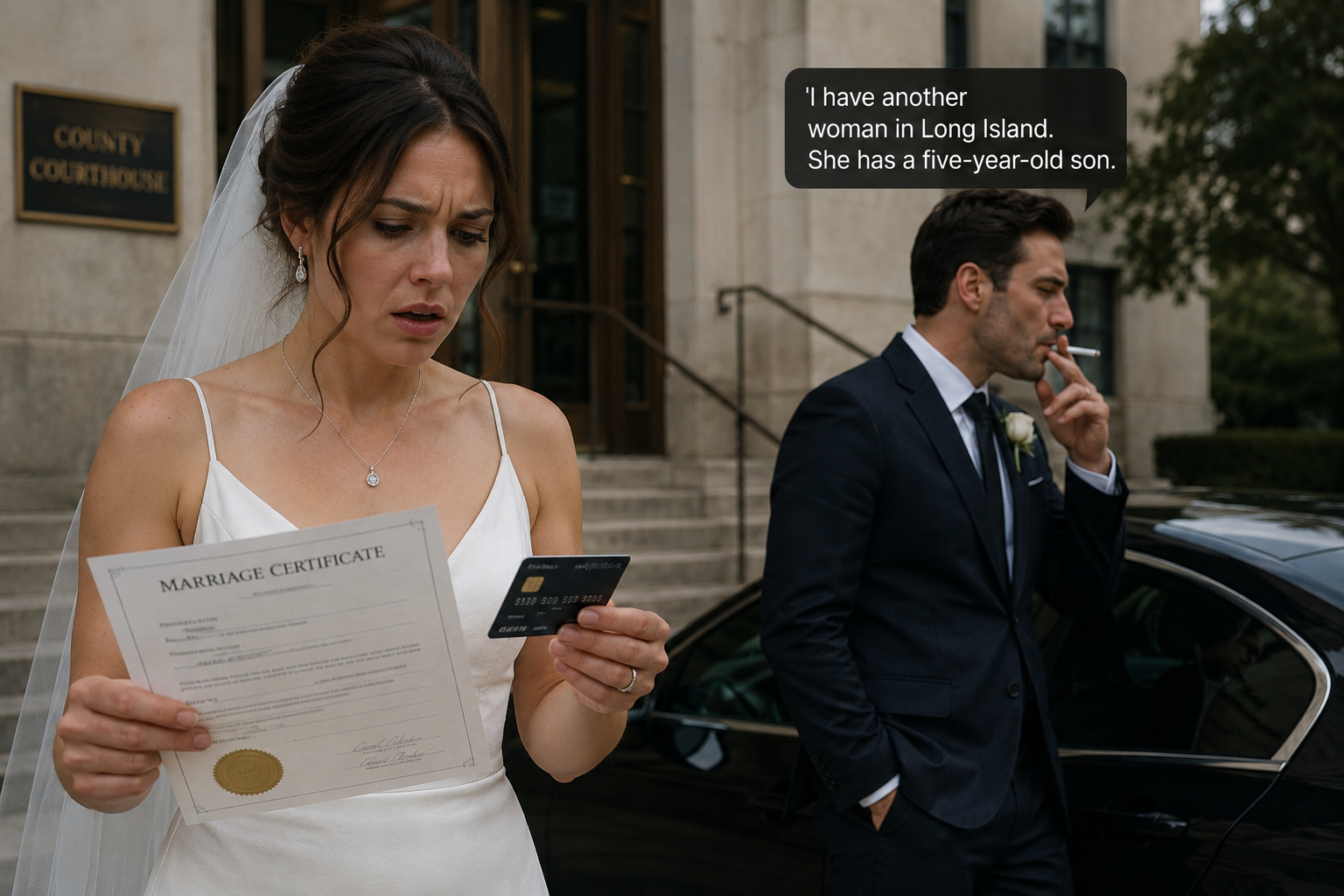
Santiago walked in as if that apartment were still his.
He had white roses, a crisp shirt, and the rehearsed smile he’d used to close deals for years. Valerie followed behind, pale, with a round belly under a beige dress and a boy with enormous eyes clutching her hand.
Mason.
The son he had hidden from me.
The black folder with my name on it looked heavier than the bouquet.
Diego stood up from the sofa.
“Santiago,” he said with a calm that terrified me. “Glad you didn’t come alone.”
Santiago saw him, and his smile vanished.
“What are you doing here?”
“Taking care of my sister. Someone had to.”
Valerie looked at Diego, then at me. She didn’t look like a woman arriving to flaunt a victory. She looked like a woman who didn’t know what kind of mess she’d been dragged into either.
“Santi, you said she already knew,” she whispered.
I let out a dry laugh.
“He told me a few hours ago. Outside the courthouse. With my marriage certificate still warm in my hand.”
Valerie pressed her lips together. Mason looked up at her.
“Mommy, are we leaving yet?”
The boy’s voice broke something inside me.
It wasn’t his fault. It’s never the child’s fault. And yet, seeing him there, with Santiago’s exact eyes, felt like another slap across the face without anyone moving a hand.
“Go into the kitchen, buddy,” Santiago said, forcing a tender tone. “The adults are almost finished.”
“No,” I said.
Everyone looked at me.
“You are not using that child to soften this. Not him. Not her. And not me.”
Santiago dropped the roses on the table. They fell right on top of the white ribbons I had torn off hours earlier.
“Mariana, you’re upset.”
“I’m awake.”
Diego held up the old phone.
“And we have everything.”
Santiago’s jaw tightened.
“That phone is mine.”
“And so are the crimes,” my brother countered.
Valerie took a step back.
“Crimes?”
Santiago snapped his head toward her.
“Don’t listen to them.”
“What crimes, Mariana?”
For the first time, I heard my name from her mouth. It didn’t sound like a taunt. It sounded like fear.
I took the black folder she was carrying and opened it without asking. Inside were several printed pages, color-coded tabs, copies of my ID, my Social Security number, the newly issued marriage license, and a document with sections marked by yellow arrows.
My signature was already on several pages.
My forged signature.
On the last page, there was an empty line waiting for the real signature—the one they needed to close the loop.
“What did he tell you this was?” I asked Valerie.
She swallowed hard.
“An authorization to recognize Mason and get his school records settled.”
“Lie,” Diego said. “This authorizes asset transfers within the Rivas family trust. And this scanned signature? Mariana didn’t sign that.”
Valerie looked at Santiago as if the floor had been pulled from under her.
“You used me?”
Santiago lost his patience.
“Don’t start with the melodrama. It’s a formality. Everyone benefits.”
“Everyone?” I asked. “Or just you?”
He stepped closer to me, lowering his voice.
“Just sign it. You keep the apartment, the card, the trips, whatever you want. Valerie will have her place in Long Island. My kids will have my last name. My father releases the shares. Nobody loses.”
“I already lost ten years.”
The silence fell heavy.
Through the window, the lights of Manhattan looked so clean from above, so detached from the filth one can keep in their own bedroom. Below, a car honked on Park Avenue, and life went on, indifferent.
Santiago looked at Diego.
“Stay out of this. This is between my wife and me.”
“Your wife just discovered a forgery,” Diego said. “And she’s not signing anything.”
Santiago smiled with contempt.
“And what are you going to do? Go to the District Attorney at ten at night with a soap opera about jealousy?”
Diego didn’t answer.
I did.
“I already forwarded everything to three email accounts. Including your father’s.”
Santiago froze.
It was only for a second, but I saw it. Fear crossed his face like a shadow.
“What did you do?”
“I sent him your texts, the PDF, the photos, the audio clips, and this conversation.”
It was a lie. I hadn’t sent it to his father yet. But Santiago didn’t know that.
Valerie stared at me, wide-eyed. Mason was still hugging her leg, confused, tired, with the face of a child who had already heard too many things he shouldn’t have.
“Mariana,” Santiago said, his smile gone for good. “Don’t be stupid.”
“You’re too late for that.”
He raised his hand.
I don’t know if he was going to point at me or grab the folder. I don’t know if he was going to touch me. All I know is that my body didn’t want to find out.
I took a step back, and Diego moved in front of me.
“Don’t even think about it.”
Santiago let out a harsh laugh.
“What, are you a bodyguard now?”
“No. A witness.”
Then he held up his own phone.
The screen was recording.
Santiago looked at the phone and, for the first time, understood that the apartment was no longer his stage. It was mine.
Valerie let go of Mason’s hand and knelt in front of him.
“Sweetie, go sit over there with your backpack. Put your headphones on, okay?”
The boy obeyed. He pulled out a tablet with a cracked screen and sat by the kitchen door. It hurt to see him so used to making himself small.
When Valerie stood back up, her face had changed.
“Santiago, tell me the truth. Is Mariana’s signature forged?”
He gritted his teeth.
“Don’t be naive.”
“Tell me.”
“I solved a problem.”
“You forged her signature?”
Santiago looked at her with rage.
“Did you want Mason to keep going without a last name? Did you want my father to keep treating him like a bastard? Did you want to keep living off the crumbs I give you every month while my ‘official wife’ played the part of the dignified spouse?”
Valerie put a hand to her stomach.
I felt nauseous.
There it was. The word hidden behind all his luxury.
Official wife.
Not beloved wife. Not partner. Not woman.
A seal. A requirement. A door.
“Is that why you married me?” I asked.
Santiago breathed heavily.
“I married you because it was the right thing to do.”
“No. You married me because your father wouldn’t release the shares without a wife to sign for them.”
He didn’t answer.
And that silence was a confession.
Diego tucked his phone away like a loaded weapon.
“Enough.”
Santiago tried to snatch the phone, but Valerie stepped in the way.
“No.”
He looked at her as if she had just betrayed him.
“Move.”
“I’m not going to let you sink us all.”
“You’re already sinking with me.”
Valerie turned pale.
“That’s what you told me when I got pregnant with Mason.”
I stood there looking at her.
She wasn’t my enemy. Not in the simple way I had wanted to believe a few hours ago. She was trapped in a different cage—one with a view of Long Island and paid credit cards—but a cage nonetheless.
“He promised me he was going to separate from you,” Valerie said, looking at me. “He told me you two weren’t a couple anymore, that you only stayed together for the business.”
I wanted to hate her. It would have been easier to hate her.
But I saw the dark circles under her eyes. I saw the hand protecting her unborn child. I saw Mason pretending to play so he wouldn’t cry.
“He never left me,” I said. “He never told me you existed.”
Valerie closed her eyes.
Santiago slammed the table.
“Enough!”
The roses shook. A few petals fell onto the marriage certificate.
“Tomorrow we are going to the notary,” he said, pointing at me. “You are going to sign. And after that, if you want to cry, you cry. But you are not going to destroy what I built.”
Something inside me straightened up.
“What you built, I worked for too.”
“You answered emails.”
“I found your first suppliers when nobody would take your calls. I did inventory in a warehouse in Queens with no AC, boxes stacked to the ceiling, and rats running past the pallets. I translated contracts while you played businessman at lunches in Midtown. I sold my car to pay for a container stuck at the port.”
My voice started to tremble, but it didn’t break.
“And when I lost our babies, you were ‘closing deals.’ Now I understand which ones.”
Santiago looked down for a second. Not out of guilt, but out of discomfort.
“That has nothing to do with this.”
“It has everything to do with this.”
I walked to the table, picked up the black card, and shoved it into his hand.
“I don’t want your money.”
Then I picked up the marriage certificate.
I folded it slowly. I didn’t rip it. It wasn’t necessary. The paper wasn’t to blame for the lie.
“I want a divorce.”
Santiago smiled again, but it came out twisted.
“You can’t force me.”
Diego let out a short laugh.
“In New York, she can. It’s called a no-fault divorce. You don’t have a choice.”
Santiago looked at him with hatred.
“Fancy law firm boy, right?”
“Lawyer with evidence,” Diego replied. “And a police report ready to go.”
The word “police report” finally broke the night.
Santiago lunged across the table and grabbed the black folder. I tried to pull it away, but he shoved me with his shoulder. I didn’t fall because Valerie caught me.
“Santiago!” she screamed.
Mason took off his headphones and started to cry.
“Daddy!”
That scream stopped him. It was small, high-pitched, full of terror.
Santiago turned toward his son with the folder clutched to his chest. For a split second, he looked human. Then he went back to being himself.
“We’re leaving.”
“I’m not going with you,” Valerie said.
“Yes, you are.”
“No.”
Her word sounded just like mine had earlier.
No.
Sometimes it takes a woman years to learn that word. But when it’s said right, it cuts like glass.
Santiago grabbed her by the wrist. Diego moved, but before he could get there, I held up the old phone and shouted:
“Everything is backed up!”
Santiago froze.
“If you walk out with that folder, tomorrow your father, your lawyer, and the District Attorney will also have the video where you confessed to ‘solving a problem’ by forging my signature.”
“You have nothing.”
“Try me.”
We looked at each other. Ten years summarized in a single glance.
The man who had proposed to me at a restaurant on Fifth Avenue, the one who sent me pastries when I was sad, the one who held me in the hospital after the first miscarriage with a shirt that smelled like someone else’s perfume—he was standing in front of me, and he could no longer deceive me.
You never lose love all at once. You lose it when you realize that what you loved was just a mask.
Santiago dropped the folder onto the table.
“You’re going to regret this.”
“I already regret loving you. The rest is just paperwork.”
Diego called building security. Santiago wanted to stay, to argue, to threaten with lawyers, money, and status. But the guard came up with two NYPD officers who were at the entrance, because in this neighborhood, even fear has a uniform.
They didn’t arrest him that night. It’s not that easy. Real life doesn’t work like the movies.
But they escorted him out.
And seeing him leave alone—without the roses, without the folder, without the boy, without either of the two women he thought he held in the palm of his hand—was the first bit of justice life gave me.
Valerie sat on the sofa, crying silently.
Mason fell asleep on her lap.
I brought her a glass of water.
We weren’t friends. Maybe we never would be. But that night, we were two women watching the same fire from different sides.
“Forgive me,” she said.
“I can’t do that today.”
She nodded. “I understand.”
“But tomorrow, you are going to give a statement.”
She looked at me. “Yes.”
And she said it without hesitation.
At dawn, the city woke up grey, with that low May sky that smells like rain even before it falls. My wedding dress was tossed in the bathroom, stained with makeup, dust, and a drop of blood from a lip I didn’t remember biting.
I put on black pants, a white blouse, and sneakers.
Diego made instant coffee in a mug that said “Mr. & Mrs.” I turned it around so I wouldn’t have to see it.
First, we went to a bank on Broadway to freeze accounts and cards where I was an authorized user. Then to Diego’s office, in a building where the elevators always smelled like expensive cologne and anxiety. We made certified copies, printed emails, downloaded audio, and built a timeline.
Then we went to the District Attorney’s office.
The DA didn’t greet me with dramatic music or movie lines. He greeted me with exhaustion, stacks of paper, stamps, a jammed printer, and a woman behind a desk who had already seen too many marriages turned into case files.
“Fraud, possible forgery, harassment, and whatever else sticks,” Diego said.
The woman looked at me.
“Do you want to file a formal complaint?”
I thought of my mom crying at the wedding. Of the bouquet. Of the white roses on the table. Of the two babies I lost believing that pain had united us. Of Mason asleep on my sofa, the son of a lie, but also its victim.
“Yes,” I said. “I want to file.”