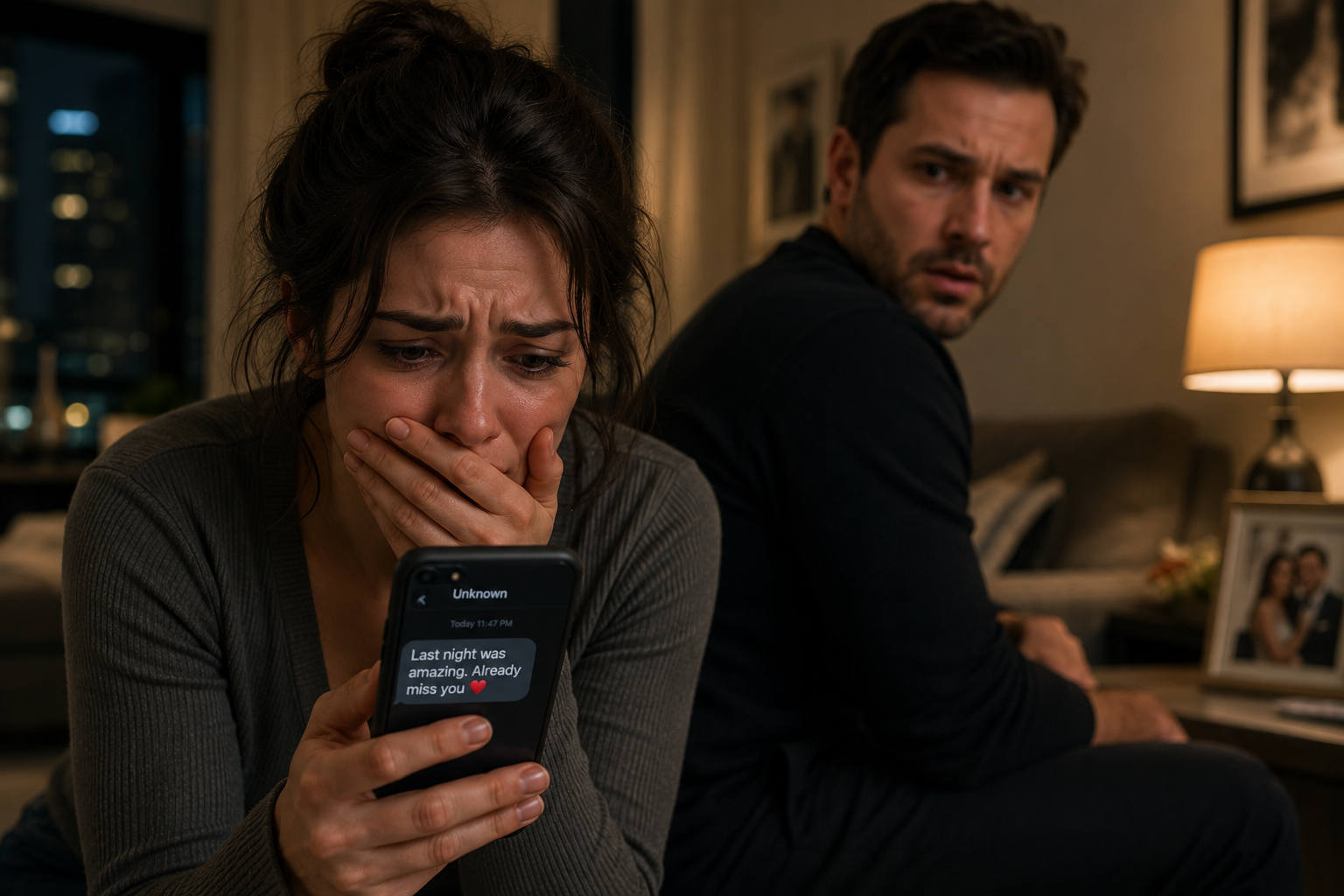
The first time I caught my husband cheating, he was making me breakfast.
That’s the part people never understand when I tell this story later.
They expect monsters to look cruel all the time.
But Ethan wasn’t cruel.
Not in the obvious ways.
He was standing barefoot in our kitchen on a quiet Sunday morning flipping pancakes while humming softly to old jazz music. Sunlight spilled across the marble countertops of our apartment, and the smell of coffee filled the air.
When he noticed me watching him from the hallway, he smiled immediately.
“There’s my girl,” he said warmly.
Then his phone lit up on the counter.
And everything changed.
I wasn’t trying to snoop.
Honestly.
I only glanced because the screen kept buzzing repeatedly beside the stove.
At first I thought it was work.
But then I saw the message preview.
“Last night was amazing. Already miss your hands on me ❤️”
My entire body went cold.
Ethan saw my face instantly.
The spatula slipped from his hand.
And for one strange second, neither of us moved.
The pancakes burned quietly behind him.
My husband looked exactly like the kind of man women trust too easily.
Forty years old.
Calm voice.
Tailored suits.
Patient smile.
The kind of man who opened doors without making it performative.
When we married two years earlier, everyone called me lucky.
Honestly?
I thought so too.
Because Ethan was wonderful in ways that mattered every single day.
He paid every bill without complaint.
Cooked dinner half the week.
Rubbed my shoulders after long workdays.
Remembered tiny details I forgot mentioning.
When I got sick, he slept beside me on the couch for three nights just to make sure I took medicine on time.
That’s what made the cheating so psychologically confusing.
If he had been cold or abusive, leaving would’ve felt obvious.
Instead, he loved me tenderly while betraying me repeatedly.
And somehow…
that hurt worse.
“Claire,” he whispered that morning in the kitchen, “I can explain.”
That sentence destroys trust faster than almost anything else.
Because it means the truth already existed before you discovered it.
“You slept with someone?” I asked quietly.
He looked devastated.
Actually devastated.
Not angry at being caught.
Heartbroken that I was hurting.
“Yes,” he admitted.
I remember gripping the edge of the counter so hard my fingers hurt.
“How long?”
His silence answered first.
Then finally:
“A few months.”
Something inside me cracked open.
Not loudly.
Quietly.
Like ice splitting beneath weight.
I moved into the guest room that same night.
Ethan didn’t fight me.
He didn’t yell.
Didn’t gaslight me.
Didn’t call me crazy.
Instead, he sat outside the door for nearly an hour apologizing softly through the wood.
“I love you.”
“I’m sorry.”
“I don’t know why I do this.”
That last sentence stayed with me most.
Because it sounded terrifyingly honest.
Over the next week, I learned the affair wasn’t even the first one.
There had been others before me too.
Short ones.
Meaningless ones.
Random women.
Coworkers.
One-night mistakes that somehow kept repeating.
When I finally asked him the question destroying me inside—
“Why did you marry me if you knew you were like this?”—
he broke down crying.
“You’re the only person I’ve ever actually loved.”
And God help me…
I believed him.
That was the problem.
I believed every word.
Because Ethan never cheated out of hatred.
He cheated because something inside him was broken in a way love alone couldn’t fix.
For three months after discovery, we tried rebuilding.
Therapy.
Long conversations.
Transparency apps.
Late-night crying.
Rules.
Promises.
Hope.
Ethan did everything right for a while.
He handed me passwords voluntarily.
Checked in constantly.
Read relationship books.
Scheduled couples counseling himself.
Some nights he’d hold me so tightly in bed it felt like he was terrified I’d disappear.
And honestly?
Part of me started believing we might survive it.
Until the second betrayal happened.
It happened on a Thursday.
Rainy.
Ordinary.
I had borrowed Ethan’s iPad because mine died during a client meeting.
I wasn’t searching for anything.
But an email notification appeared across the screen while I was opening Chrome.
A hotel confirmation.
Two guests.
King suite.
Tomorrow night.
My stomach dropped instantly.
At first I told myself there had to be some explanation.
A work booking.
A mistake.
Anything.
Then I opened the email fully.
And saw her reply underneath.
“Can’t wait to finally have you all night.”
The timestamp?
Sent three hours earlier.
Right after Ethan kissed me goodbye that morning and told me he loved me.
I physically threw up in my office bathroom.
That night, Ethan came home carrying flowers.
Flowers.
I still remember how surreal that felt.
Because while I stood there holding proof of betrayal in my shaking hands…
he walked through the door smiling like a loving husband.
The second he saw my face, the color drained from his.
“You checked my email.”
Not:
“I’m sorry.”
Not:
“It’s true.”
Just immediate fear.
And suddenly I understood something devastating:
No matter how much he loved me…
the cheating was stronger than his promises.
“You went to therapy,” I whispered.
“I know.”
“You watched me fall apart.”
“I know.”
“You swore you’d stop.”
Tears filled his eyes instantly.
“I tried.”
That answer broke me more than denial would have.
Because he meant it.
He truly had tried.
And still failed.
I sat down slowly on the edge of the couch feeling like my entire marriage had become something impossible to solve.
“How many times does someone have to betray you before love becomes irrelevant?” I asked quietly.
Ethan looked at me like I had stabbed him.
But neither of us had the answer.
The weeks after that became unbearable.
Not explosive.
Not dramatic.
Just emotionally exhausting.
Because Ethan remained… good.
That’s what tortured me.
He still made coffee for me every morning.
Still kissed my forehead before work.
Still cleaned the apartment.
Still noticed when I seemed sad.
Still loved me in all the visible ways.
Except the one that mattered most.
Faithfulness.
And slowly, I started losing myself trying to reconcile those contradictions.
How could someone care for me so gently while destroying my trust so completely?
How could someone look into my eyes lovingly at breakfast… and betray me by dinner?
I stopped sleeping properly.
Stopped concentrating at work.
Stopped feeling safe even during happy moments because I knew happiness could collapse at any second.
Every notification triggered anxiety.
Every late meeting felt suspicious.
Every business trip felt unbearable.
And worst of all?
I still loved him.
Which made me angry at myself too.
One night around 2 a.m., I found Ethan sitting alone in the dark living room.
His face looked exhausted.
Older somehow.
“I think something’s wrong with me,” he whispered.
That was the first moment I stopped seeing him as simply selfish.
And started seeing him as someone deeply damaged.
But damaged people can still destroy you.
Sometimes unintentionally.
Sometimes while loving you sincerely.
And that realization forced me to confront the hardest truth of my entire life:
Love by itself is not always enough to make a relationship safe.
After that night in the living room, things between us became strangely quieter.
Not better.
Just softer.
Like two people slowly realizing they were standing inside a house already burning down.
Ethan started individual therapy twice a week.
Not because I forced him.
Because for the first time, he looked genuinely terrified of himself.
One evening he came home carrying three books about compulsive behavior and attachment trauma.
“I think this started long before you,” he admitted quietly.
I sat across from him at the kitchen table while he explained things I had never heard him say before.
His father cheated constantly.
His mother knew.
Everyone knew.
But nobody left.
Nobody talked about it honestly either.
Instead, the family treated betrayal like weather.
Unpleasant.
Expected.
Normal.
“At some point,” Ethan whispered, staring at his hands, “I think I separated love from loyalty.”
That sentence haunted me.
Because it explained everything.
To Ethan, cheating didn’t erase love.
The two existed separately in his mind.
And while that might explain his behavior…
it still didn’t stop the damage it caused me.
For a while, I stayed because I saw him trying.
Really trying.
He deleted social media.
Stopped traveling alone.
Shared his location voluntarily.
Switched therapists after admitting he’d been minimizing things during sessions.
Some nights he cried harder than I did.
“I hate what I’m doing to you,” he whispered once against my shoulder.
And God…
that made everything worse.
Because cruel people are easier to leave.
But Ethan wasn’t cruel.
He was broken in a way that kept cutting both of us open.
Then came the dinner party.
The night something inside me finally changed permanently.
It happened at our friends Daniel and Priya’s apartment downtown.
Small gathering.
Wine.
Music.
Soft city lights glowing through huge windows.
At one point, everyone started telling stories about how they met their spouses.
People laughed.
Touched each other casually.
Shared inside jokes built over years of trust.
Then Daniel looked at Ethan smiling.
“You two honestly seem rock solid,” he said.
And before I could stop myself…
I almost laughed out loud.
Because nobody at that table knew I checked my husband’s location before bed every night.
Nobody knew I felt sick whenever his phone buzzed.
Nobody knew trust in our marriage now survived hour by hour instead of naturally.
They saw tenderness.
Routine.
Chemistry.
Not the constant emotional surveillance happening underneath everything.
Then Priya smiled warmly at me.
“You can always tell when a man truly adores his wife.”
That’s when it hit me.
Ethan did adore me.
And somehow…
I was still deeply unhappy.
The realization destroyed me quietly over the following weeks.
I kept waiting for clarity.
For some dramatic final betrayal.
For certainty.
But relationships rarely end in cinematic moments.
Sometimes they end because exhaustion slowly replaces hope.
I became someone I didn’t recognize.
Anxious.
Hyperaware.
Emotionally tired all the time.
I started checking mirrors before work wondering why my self-esteem felt thinner every month.
One afternoon during therapy, my counselor asked me a question that left me speechless.
“Claire,” she said gently, “if you met him exactly as he is today—not as you hope he could become—would you still choose this marriage?”
I opened my mouth immediately.
Then stopped.
Because deep down…
I already knew the answer.
Three months later, Ethan relapsed again.
Not physically this time.
Emotionally.
Secret messaging.
Deleted conversations.
Flirting that crossed boundaries.
I discovered it because I wasn’t even looking anymore.
That’s the sad part.
Once trust dies long enough, betrayal eventually becomes predictable instead of shocking.
When I confronted him, he looked devastated again.
“I didn’t sleep with anyone.”
But honestly?
By then, technicalities no longer mattered.
Because the real issue was never sex.
It was safety.
And I no longer felt emotionally safe with him.
That night, I sat alone in our bedroom folding laundry while Ethan cried quietly in the kitchen.
And suddenly, I pictured my future clearly.
Five more years of this.
Checking phones.
Second-guessing stories.
Monitoring behavior.
Waiting for improvement.
Recovering repeatedly from wounds that never fully healed.
I realized something terrifying:
I had become so focused on whether Ethan could change…
I stopped asking what staying was changing inside me.
And the answer was painful.
Staying was slowly teaching me to tolerate heartbreak as a lifestyle.
The next morning, I asked him to sit down.
He knew immediately.
You could see it in his face.
“No,” he whispered before I even spoke.
I started crying instantly.
Not because I doubted the decision.
Because I loved him.
That’s what made it unbearable.
“I can’t survive this anymore,” I said softly.
Ethan covered his mouth with both hands.
“I’m trying.”
“I know.”
“I love you.”
“I know.”
That was the tragedy.
None of those things were lies.
But they still weren’t enough.
“I would forgive almost anything once,” I whispered through tears. “Maybe even twice. But I can’t spend my whole life healing from the same wound.”
Ethan broke down completely then.
The kind of crying that comes from genuine grief, not manipulation.
“I don’t want anyone else,” he choked out.
I looked at him sadly.
“Then why do you keep choosing other people?”
He had no answer.
Because some people understand love emotionally but not behaviorally.
And relationships cannot survive on feelings alone.
The divorce process stayed surprisingly gentle.
No screaming.
No revenge.
No courtroom war.
Just two devastated people slowly untangling a marriage neither of them truly wanted to lose.
Ethan gave me everything easily.
The apartment.
The savings split.
No arguments.
No games.
Almost like punishing himself quietly.
The last night before I moved out, we sat together on the living room floor surrounded by boxes while rain tapped softly against the windows.
Neither of us spoke for a long time.
Then finally Ethan asked the question both of us had been avoiding.
“Do you think I’m a bad person?”
I looked at him carefully.
And honestly?
No.
That was the hardest part of all.
“You’re not bad,” I whispered.
“Then why couldn’t I love you correctly?”
My chest tightened instantly.
Because some questions don’t have clean answers.
Finally I said softly:
“Because love isn’t always the same thing as self-control.”
I moved into a smaller apartment downtown two weeks later.
The first month alone felt unbearable.
I missed him constantly.
His cooking.
His laugh.
The way he warmed my cold feet in bed without complaining.
Grief became confusing because I wasn’t mourning abuse.
I was mourning someone who loved me deeply and still hurt me repeatedly.
People around me kept saying:
“You did the right thing.”
But nobody talks enough about how painful the right decision can feel.
Nearly a year later, Ethan emailed me unexpectedly.
Just one paragraph.
“I still go to therapy twice a week. I’ve been sober from cheating behaviors for eleven months now. I finally understand that apologies without changed patterns are just rehearsed heartbreak. I hope someday your nervous system forgets what I put it through.”
I cried for almost an hour after reading it.
Not because I wanted him back.
But because part of me had waited so long to hear him fully understand the damage.
And strangely…
that helped me heal more than all his apologies ever did.
Two years after the divorce, I ran into Ethan accidentally at a bookstore café.
He looked healthier.
Quieter.
More grounded somehow.
We talked for twenty minutes about ordinary things.
Work.
Books.
Life.
And when we stood to leave, he smiled sadly.
“You were the love of my life,” he admitted softly.
I believed him.
Completely.
Then he added:
“And I still wasn’t healthy enough to keep you.”
That was the moment I finally understood something that changed me forever:
A person can love you sincerely…
and still be incapable of giving you the kind of relationship you deserve.
So I hugged him goodbye.
Walked out into the cold afternoon air.
And for the first time since our marriage ended…
I stopped confusing being loved with being safe.
Five years passed after the divorce.
Long enough for the sharpness to fade.
Long enough for memories to stop feeling like open wounds.
Long enough for me to finally understand that healing doesn’t happen all at once—it happens quietly, in ordinary moments when you suddenly realize something that used to hurt no longer controls your entire day.
I rebuilt my life slowly after Ethan.
Therapy helped.
Friends helped.
Time helped most of all.
For nearly two years, I couldn’t hear a phone buzz without anxiety tightening in my chest. I still caught myself checking the clock when someone came home late. Trust had become something my body physically struggled to believe in.
That was the hidden damage Ethan left behind.
Not hatred.
Fear.
But eventually, little things started changing.
I slept through the night again.
I stopped checking social media obsessively.
I stopped assuming betrayal was waiting behind every happy moment.
And slowly…
I became myself again.
At thirty-five, I met Noah.
Not dramatically.
Not romantically.
We met in line at a pharmacy while both buying cold medicine during flu season.
He made a joke about us looking like the “before” photos in medication commercials, and somehow we ended up talking for twenty minutes beside the cough syrup aisle.
Noah was different from Ethan in ways I noticed immediately.
Not more exciting.
Not more charming.
Safer.
That word mattered more to me now than chemistry ever had.
He was emotionally steady.
Transparent without being asked.
Consistent in boring, beautiful ways.
If he said he’d call, he called.
If he was late, he told me.
If something bothered him, he talked about it directly instead of hiding it behind silence or distraction.
At first, that consistency almost felt suspicious.
Traumatized people often mistake chaos for passion because unpredictability keeps the nervous system addicted to relief.
But Noah taught me something gentle:
Peace is not the same thing as boredom.
One night about a year into dating, Noah fell asleep on the couch while watching television.
His phone buzzed beside him.
Without thinking, my stomach tightened instantly.
That old fear.
That old reflex.
For one terrible second, I felt transported backward into my marriage again.
Noah woke up when I shifted beside him.
“You okay?” he asked sleepily.
And suddenly I started crying.
Real crying.
The kind you can’t control once it begins.
Poor Noah looked horrified.
“What happened?”
I shook my head, embarrassed.
“It’s stupid.”
“It’s not stupid if it hurts.”
That sentence alone almost broke me.
So I finally told him everything.
The affairs.
The therapy.
The constant fear.
The way betrayal rewired my brain.
Noah listened quietly the entire time.
Then he picked up his phone, unlocked it, and handed it to me gently.
“Claire,” he said softly, “I don’t want a relationship where you have to investigate me to feel safe.”
I stared at the phone without taking it.
“You can look if you need to.”
And that’s when I realized the difference between Noah and Ethan.
Ethan gave reassurance after betrayal.
Noah created safety before fear ever had a chance to grow.
I never opened the phone.
Because for the first time in years…
I didn’t want to.
Three years later, Noah proposed during a quiet weekend trip to Vermont.
No grand audience.
No dramatic performance.
Just snow falling softly outside a cabin window while he cooked pasta badly and nervously forgot half the speech he planned.
I said yes before he even finished asking.
Not because he was perfect.
Because I felt peaceful beside him.
That mattered more.
A month before the wedding, I received an unexpected email from Ethan.
Just one line:
“I heard you’re getting married. I truly hope this love feels safe.”
I stared at the message for a very long time.
Then finally replied:
“It does.”
Nothing else.
Nothing needed.
On my wedding day, while getting ready with my friends, someone asked me a question I hadn’t thought about in years.
“Do you regret marrying Ethan?”
The room became quiet instantly.
I looked down at my hands for a moment before answering honestly.
“No,” I said softly.
Because despite everything…
Ethan taught me something important.
He taught me that love alone cannot sustain a relationship without trust.
That apologies are meaningless without changed behavior.
That kindness in daily life does not erase repeated betrayal.
And most importantly…
he taught me never to abandon myself trying to love someone who refuses to heal.
A year after marrying Noah, I ran into Ethan one final time.
It happened unexpectedly at an airport in Seattle.
He looked older.
Calmer.
There was no wedding ring on his hand.
But there was something peaceful about him now that hadn’t existed before.
We sat together near the gate for almost an hour talking quietly about life.
He told me he still attended therapy regularly.
Still worked on understanding why validation once mattered more to him than loyalty.
“I hurt the only person I ever truly loved,” he admitted quietly.
I looked at him carefully.
“And you finally stopped?”
He nodded slowly.
“Yes.”
Then after a long silence, he smiled sadly.
“You leaving me saved me.”
That sentence stayed with me long after we boarded separate flights.
Because sometimes consequences are the only thing powerful enough to force real change.
Not ultimatums.
Not tears.
Loss.
When my daughter was born two years later, Noah held her in the hospital room with tears streaming down his face.
And while watching him whisper gently to this tiny new person we created together…
I suddenly thought about Ethan.
About my old marriage.
About every night I spent wondering whether being loved was supposed to hurt this much.
And I felt overwhelming gratitude that I eventually chose myself.
Because if I hadn’t…
I might never have discovered what emotionally safe love actually feels like.
Now, years later, when people ask why I left a man who “treated me so well,” I tell them something simple:
A relationship is not healthy just because someone is kind between betrayals.
Love is not measured only by affection.
It’s measured by consistency.
Safety.
Integrity.
And the ability to protect the person you claim to cherish.
Ethan loved me.
I truly believe that.
But Noah protects my peace.
And after everything I survived…
that became the greatest form of love I could ever recognize.