PART 1
The last winter in our old house nearly broke me.
Not dramatically.
Not all at once.
Just slowly… like age itself.
At seventy-one years old, I found myself standing on an aluminum ladder in thirty-degree weather trying to pull wet leaves from a clogged second-story gutter while freezing rain tapped against my glasses.
Halfway through, my knees started shaking.
Not from fear.
From exhaustion.
I climbed down carefully and stood in the driveway staring at the house my wife and I had spent nearly forty years building our lives inside.
Five bedrooms.
Cedar siding.
A massive backyard.
The same tire swing our children once fought over still hanging crookedly from the old maple tree.
It was beautiful.
And suddenly…
it felt enormous.
My wife, Ellen, opened the front door while wrapping a sweater tighter around herself.
“You’re done already?” she asked.
I looked back up at the gutters overflowing with leaves.
“No,” I said quietly. “I think I’m just tired.”
That sentence stayed with me long after the rain stopped.
Because deep down, I knew I wasn’t talking about the gutters anymore.
We raised five children in that house.
Five loud, messy, wonderful kids who turned every room into a memory.
Christmas mornings looked like natural disasters.
Science fair projects covered the dining room table.
Basketball shoes lined the mudroom.
There was always noise somewhere.
Laughter.
Arguments.
Music.
Slamming doors.
At one point, we had three teenagers learning to drive at the same time.
I still don’t know how we survived financially or emotionally.
But somehow we did.
And for decades, the house made sense because life itself was large back then.
Every bedroom was full.
Every bathroom occupied.
Every inch alive with movement.
But time changes a home quietly.
First the oldest leaves for college.
Then another.
Then another.
And eventually you wake up one morning standing in a kitchen built for seven people while eating toast alone with your wife in complete silence.
The hardest part wasn’t the quiet.
It was the maintenance.
Nobody tells you how quickly a house becomes physical labor once your body starts aging.
The yard that once felt satisfying suddenly became endless.
The leaves multiplied every year.
The deck needed restaining constantly.
Branches fell after storms.
The roof worried me.
The gutters clogged endlessly.
And every repair somehow required climbing, lifting, crawling, bending, or carrying things my body no longer recovered from easily.
One afternoon after spending four hours cleaning storm debris from the backyard, Ellen found me asleep in the recliner before dinner.
Not resting.
Completely exhausted.
She touched my shoulder gently.
“We can’t keep doing this forever.”
I opened my eyes slowly.
And for the first time…
I realized she was right.
Still, the idea of leaving felt almost disloyal somehow.
That house held our entire adult life.
Every birthday candle.
Every graduation photo.
Every Christmas Eve.
Our youngest daughter learned to walk in the family room.
Our oldest son announced he was becoming a father while standing beside the fireplace.
Even grief lived there.
We sat in that kitchen crying after funerals.
Held each other through layoffs, illnesses, and losses.
The walls knew everything about us.
How do you willingly walk away from that?
The conversation about moving began slowly after that.
Not because we wanted less life.
Because we wanted a different kind of life.
“We don’t need five bedrooms anymore,” Ellen said one evening.
“Yes we do,” I replied immediately.
She smiled knowingly.
“No,” she said softly. “We need space for people to visit. That’s different.”
That distinction changed everything.
We weren’t downsizing.
We were resizing.
There’s a difference.
A few months later, our daughter Megan invited us to tour a townhouse community nearby.
At first I resisted immediately.
“I’m not ready for some tiny retirement box.”
Megan laughed.
“Dad, just look at it.”
So we did.
And honestly?
The first townhouse surprised me.
Large open kitchen.
Main-level primary bedroom.
Wide hallways.
Office space.
Beautiful natural light.
And downstairs…
a fully finished lower-level guest suite big enough for grandchildren to spread toys across the floor without destroying the entire house upstairs.
Ellen squeezed my hand quietly while we toured.
I knew that look.
She could already picture holidays there.
The community itself sat only a mile from our old neighborhood.
That mattered more than I expected.
Same grocery stores.
Same church.
Same pharmacy.
Same coffee shop where Ellen and I met friends every Saturday morning.
We wouldn’t be abandoning our life.
Just changing the structure around it.
Still, I struggled emotionally afterward.
Because men of my generation often attach identity to responsibility.
The house represented success.
Protection.
Fatherhood.
Providing.
Selling it felt strangely like admitting time had won.
Then came the deck incident.
That’s what finally decided it.
Our old cedar deck needed another full restaining before winter.
Two levels.
Hundreds of square feet.
Hours bent over with brushes and rollers.
By the second day, my lower back hurt so badly I could barely stand upright.
Ellen walked outside carrying lemonade and stopped when she saw me sitting heavily against the railing breathing hard.
For a moment neither of us spoke.
Then quietly she asked:
“Are we taking care of the house… or is the house taking everything from us now?”
That question hit me harder than any physical pain.
Because suddenly I understood:
I was spending more time maintaining our life than actually living it.
Six months later, we sold the house.
The day the moving truck pulled away, Ellen cried standing in the empty living room.
Honestly?
So did I.
Not because we regretted the decision.
Because endings are painful even when they’re right.
I walked through every room one final time before locking the door.
The marks on the pantry wall where we measured the children’s heights were still there.
Tiny pencil lines climbing upward year after year.
I touched them gently before leaving.
Forty years of life inside one house.
And now suddenly…
silence.
The first night in the townhouse felt strange.
Too quiet.
Too clean.
No creaking staircase.
No giant backyard beyond the windows.
I remember standing in the kitchen at midnight wondering if we had made a terrible mistake.
Then three weeks later, Thanksgiving arrived.
And suddenly…
everything changed.
All five children came.
Eight grandchildren.
Chaos everywhere.
Toys downstairs.
Football on television upstairs.
Food covering every surface.
Laughter echoing through the townhouse.
At one point I stood near the kitchen island watching my grandchildren run through the lower-level guest suite screaming over board games while Ellen laughed with our daughters nearby.
And I realized something important:
The family had never lived inside the old house.
The family lived inside us.
PART 2
After Thanksgiving, Ellen looked at me one evening while we loaded the dishwasher and smiled.
“Well?” she asked.
I already knew what she meant.
The old house had always handled holidays beautifully because it was built for volume.
But this townhouse?
It handled connection differently.
Closer somehow.
The grandchildren naturally gathered downstairs in the guest suite while the adults stayed upstairs talking late into the night without constantly disappearing into separate rooms.
The kitchen opened directly into the living space, so nobody got isolated cooking alone for hours anymore.
Even cleanup felt easier.
For the first time in years, hosting didn’t leave us physically destroyed afterward.
And honestly?
That shocked me.
The freedom became noticeable slowly.
At first, I kept waking up Saturday mornings mentally preparing for chores that no longer existed.
No gutters.
No dragging ladders across the yard.
No hours spent blowing leaves.
No emergency roof worries after storms.
One rainy Sunday, I caught myself staring out the window waiting for anxiety that never came.
Ellen noticed immediately.
“You’re thinking about the old gutters again, aren’t you?”
I laughed softly.
“Maybe.”
She wrapped both hands around her coffee mug.
“You know what I love most?”
“What?”
“When it rains now… we just listen to it.”
That sentence stayed with me.
Because for years, bad weather meant work.
Now it simply meant weather again.
Travel changed too.
That was something we hadn’t fully anticipated.
Owning the old house made leaving stressful.
Every trip required planning around maintenance.
Who would check things?
What if branches fell?
What if pipes froze?
What if storms damaged something while we were gone?
Even vacations carried background worry.
But now?
We locked the townhouse door and left.
That simple.
The first long trip we took after moving was to Arizona for nearly three weeks to visit old friends and escape winter.
Halfway through the trip, I realized something strange.
I wasn’t anxious.
At all.
No mental checklist running constantly in the background.
No worrying about the yard or the roof or whether snow piled too heavily somewhere.
Just peace.
Real peace.
At seventy-two years old, that starts feeling more valuable than square footage.
Still, letting go of the old house remained emotionally complicated.
Sometimes we drove past it accidentally while running errands.
The new owners painted the shutters blue eventually.
Removed Ellen’s rose bushes.
Cut down the old maple tree in the backyard after a storm damaged part of it.
That one hurt more than I expected.
I sat quietly in the passenger seat staring at the empty space where the tire swing used to hang.
“That tree watched our whole family grow up,” I whispered.
Ellen reached over and squeezed my hand gently.
“But so did we.”
That’s when I finally started understanding something important about aging:
You cannot preserve every physical piece of your life forever.
At some point, memories must become enough.
The grandchildren adapted faster than anyone.
Actually, they loved the townhouse.
Especially the downstairs guest suite.
We turned part of it into what Ellen jokingly called “Grandkid Headquarters.”
Toy bins.
Board games.
Blankets.
Movie snacks hidden in drawers.
The older grandchildren taught the younger ones how to build pillow forts down there while Ellen pretended not to notice popcorn ground into the carpet.
One afternoon our nine-year-old grandson Liam looked around proudly and announced:
“This is way cooler than the old house.”
I gasped dramatically.
“Traitor.”
He laughed so hard he nearly fell off the couch.
And honestly?
Part of me agreed with him.
Because children don’t care about mortgage sizes or property value.
They care about warmth.
Attention.
Feeling wanted.
The townhouse still gave them all of that.
The biggest surprise after moving was how much easier life became physically.
Aging sneaks up quietly.
You don’t notice strength disappearing all at once.
It happens in small humiliations.
Carrying groceries becoming harder.
Recovering slower after yard work.
Avoiding ladders because balance feels less certain.
Needing to sit down more often without admitting why.
In the old house, I spent enormous energy simply maintaining appearances of capability.
Now?
Life matched our actual needs.
Main-level living changed everything.
Our bedroom.
Laundry.
Kitchen.
Office.
Everything essential existed without stairs.
That mattered more than pride.
Though admitting it took time.
One evening about two years after the move, Ellen and I sat on the back patio watching sunset colors spread across the quiet community while cicadas buzzed softly in the trees.
“I think we did this at exactly the right time,” she said.
I nodded slowly.
If we had waited another ten years, the move would’ve happened under pressure.
Illness.
Injury.
Emergency.
Instead, we moved while we still had the energy to choose intentionally.
That difference matters.
Because there’s dignity in choosing change before crisis forces it on you.
A few months later, our oldest granddaughter, Sophie, asked me something unexpected while helping bake Christmas cookies.
“Grandpa?”
“Yeah?”
“Do you miss the old house?”
I looked at her for a long moment before answering honestly.
“Sometimes.”
She nodded thoughtfully.
Then asked:
“Would you move back if you could?”
That question surprised me.
I thought about the giant yard.
The creaking stairs.
The maple tree.
The bedrooms filled with childhood memories.
Then I looked around the kitchen.
Ellen laughing while flour covered her sweater.
Grandchildren yelling downstairs.
Christmas music playing softly through the speakers.
Warmth everywhere.
And suddenly the answer felt clear.
“No,” I said softly.
“Why not?”
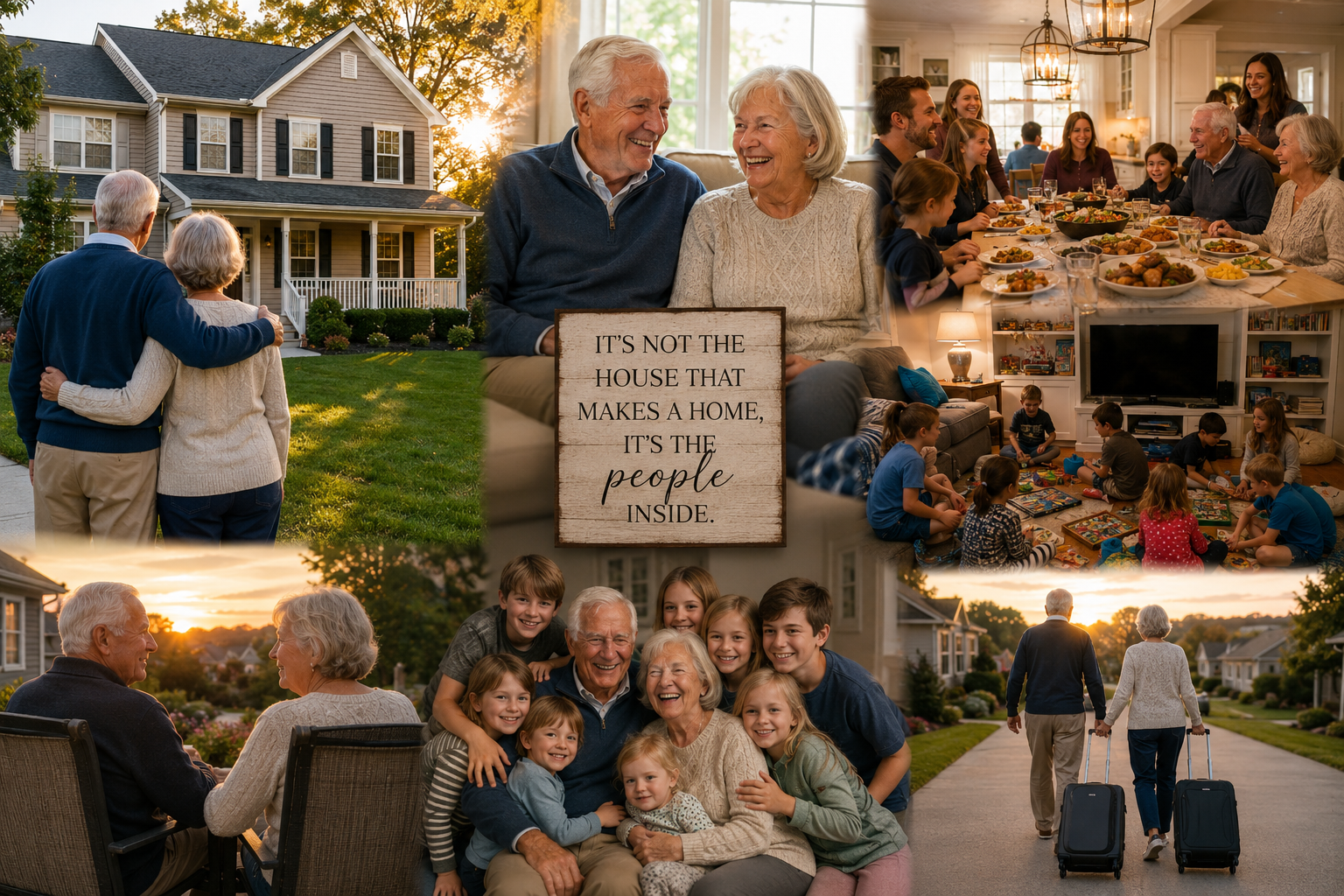
Because eventually, I realized home is not the building that held your life.
It’s the people still willing to fill new rooms with love.
Last spring, one of our neighbors in the community passed away unexpectedly.
He was eighty-one.
His wife told Ellen something during the funeral reception that stayed with both of us afterward.
“We waited too long to simplify,” she whispered quietly. “By the time we moved, we were already exhausted.”
That sentence haunted me for days.
Because she was right.
Aging becomes easier when you make decisions early enough to still enjoy the benefits of them.
Too many people spend their seventies protecting houses designed for their forties.
Not because they still need them.
Because letting go feels emotionally complicated.
I understand that now deeply.
But I also understand something else:
There’s wisdom in building a life that leaves room for living instead of endless maintenance.
Now, six years after the move, our townhouse feels fully like home.
Not because it replaced the old house.
Nothing ever truly replaces the place where you raised your children.
But this home fits who we are now.
Grandparents.
Travelers.
Hosts.
People learning how to age with intention instead of resistance.
And honestly?
That feels like its own kind of success.
Last week, after our entire family left following another loud chaotic Sunday dinner, Ellen sat beside me on the couch while the house finally became quiet again.
Toys still scattered downstairs.
Dishes drying in the kitchen.
Leftover pie in the refrigerator.
She leaned her head against my shoulder and smiled softly.
“You know,” she whispered, “we really did resize perfectly.”
I looked around the townhouse filled with echoes of another beautiful family gathering and realized she was absolutely right.
Because at this stage of life, luxury no longer means owning more house.
It means having enough space for the people you love…
and enough freedom left to actually enjoy them.
PART 3
Last Christmas, all five of our children slept under one roof again for the first time in nearly twenty years.
Not because we had more bedrooms.
Because people wanted to stay.
That difference matters.
The townhouse somehow changed the rhythm of family gatherings in ways I never expected. The smaller shared spaces pulled people together naturally instead of scattering everyone into separate corners of a giant house.
The grandchildren piled into the downstairs guest suite with sleeping bags, toy dinosaurs, tangled chargers, and enough snack wrappers to feed a small army.
At 2 a.m., I woke up thirsty and walked downstairs quietly for water.
Halfway down the staircase, I stopped.
The television still glowed softly.
Three of the older grandkids had fallen asleep mid-movie, legs tangled together beneath blankets while one of the younger boys snored loudly against a pile of stuffed animals.
And suddenly I felt something I hadn’t expected after leaving the old house years earlier.
Not loss.
Continuity.
Because family life hadn’t ended when we sold the house.
It had simply changed shape.
The older I get, the more I realize aging is mostly a series of invisible negotiations.
You negotiate with your knees.
With your energy.
With your pride.
With the growing awareness that time is no longer theoretical.
At seventy-two, I still feel mentally young most days.
Then I stand up too quickly and my back reminds me otherwise.
Or I spend an hour on the floor playing trains with my two-year-old grandson and need to grab furniture to stand back up.
The body starts speaking more loudly whether we want to listen or not.
And honestly?
The townhouse taught me something important:
There is wisdom in adapting before life forces adaptation upon you.
About a year ago, one of my closest friends suffered a bad fall cleaning snow from his roof.
Three surgeries.
Months of recovery.
His wife admitted afterward that they had talked about moving for years but kept postponing it because the house held too many memories.
I understood completely.
But sitting beside him in the rehabilitation center, watching this once-active man struggle just to walk to the bathroom with assistance, I also understood something else.
Sometimes we confuse holding onto the past with honoring it.
They are not always the same thing.
That realization changed how I viewed our move entirely.
For a long time, I secretly thought selling the old house meant closing a chapter of life I wasn’t emotionally ready to leave behind.
But now I see it differently.
We didn’t abandon our family home.
We protected the next stage of our lives together.
That’s not surrender.
That’s stewardship.
This past summer, Ellen and I celebrated our fiftieth wedding anniversary.
Fifty years.
Sometimes even saying the number feels surreal.
All five children came home early to help prepare dinner.
The grandchildren decorated the townhouse with handmade signs and crooked balloons.
At one point during the celebration, our oldest daughter tapped her wine glass gently and stood to speak.
“You know,” she said smiling toward us, “when Mom and Dad sold the old house, I was worried family gatherings would never feel the same.”
The room became quiet.
Then she looked around the townhouse filled wall-to-wall with children, grandchildren, noise, laughter, and half-eaten desserts.
“But honestly?” she continued softly. “I think we’ve somehow become even closer here.”
Ellen squeezed my hand under the table.
And suddenly I realized my daughter was right.
The old house gave us history.
This home gave us presence.
Later that evening, after everyone finally left, Ellen and I sat quietly in the living room surrounded by wrapping paper, empty wine glasses, abandoned toys, and the kind of silence that only follows a deeply happy day.
“I’m tired,” she whispered.
I smiled.
“Me too.”
But it wasn’t the old kind of tired.
Not ladder tired.
Not roof tired.
Not yard-work exhaustion.
This was good tired.
Life tired.
The kind earned from loving people fully.
There’s a huge difference.
Sometimes younger people assume aging is mostly about loss.
Loss of strength.
Loss of speed.
Loss of independence.
And yes, some of that is true.
But aging also brings clarity if you let it.
You stop performing success for strangers.
You stop needing excess to prove stability.
You stop confusing bigger with better.
At this stage of life, I no longer care about owning the largest house on the block.
I care about whether my wife feels safe walking through it.
Whether my grandchildren feel welcomed inside it.
Whether maintaining it steals energy from the years we still have left together.
That perspective took me seven decades to earn.
A few weeks ago, I drove past our old neighborhood again after a doctor’s appointment.
The new owners had renovated almost everything.
Different shutters.
Different landscaping.
Different porch furniture.
At first, I felt that familiar ache in my chest.
Then something surprising happened.
I smiled.
Because for the first time, I could look at the house without feeling like part of me still lived there.
Our life had already moved on.
The memories remained beautiful.
But they no longer needed a physical address to survive.
That night, back at the townhouse, Ellen sat beside me while we watched rain tap softly against the windows.
“No clogged gutters tomorrow,” she teased.
I laughed.
“Nope.”
Then after a long comfortable silence, she leaned against my shoulder and whispered something that nearly made me cry.
“We built two beautiful homes in our lifetime.”
Not one.
Two.
The first held the years where we raised a family.
The second holds the years where we get to truly enjoy them.
And honestly?
I think that may be the greatest privilege aging can offer.
Because in the end, home was never really about square footage or staircases or decks or roofs.
It was always about this:
Having a place where the people you love still want to gather.
And at seventy-two years old, with grandchildren laughing downstairs and my wife’s hand still resting warmly in mine after fifty years together…
I finally understand that means we were richer than we ever realized all along.