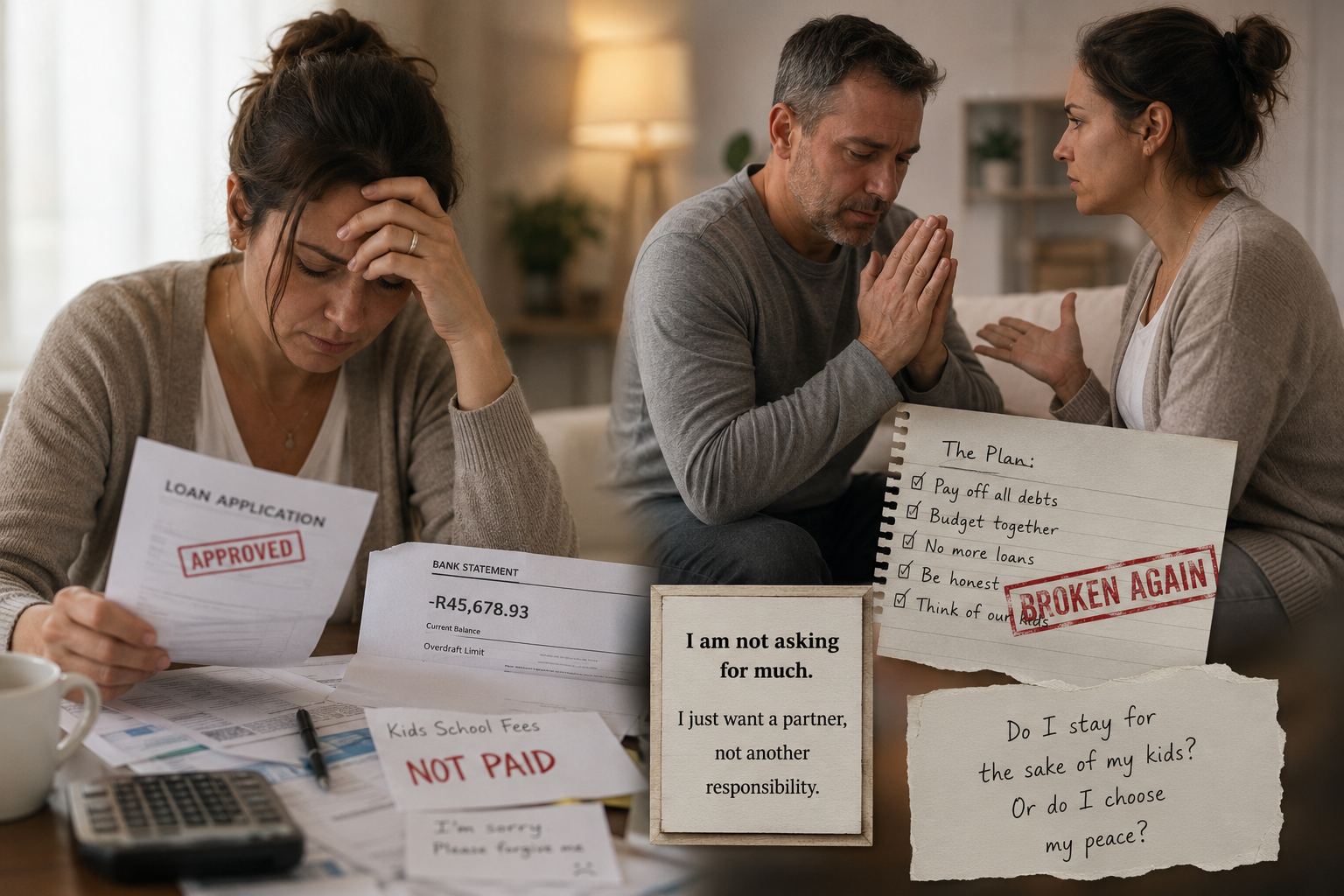
I Discovered My Husband’s Salary Was in the Negative — Then Learned He Hadn’t Paid Our Children’s School Fees Either

PART 1

The first lie I caught my husband in was about his salary.

At the time, it seemed small enough to forgive.

That’s what scares me now looking back.

How easily women are taught to minimize betrayal when it comes wrapped in apologies.

I was twenty-three when I married Daniel.

He was thirty-five.

Older.

Established.

Confident in ways that made me feel safe back then.

Everyone around me said I was lucky to marry a man who already had stability, a good job, and “knew how life worked.”

And honestly?

During the first few years, I believed them.

We weren’t rich, but we were comfortable.

We rented a small three-bedroom house near the edge of town. I decorated the kitchen with cheap curtains from discount stores while Daniel worked long hours and handled most of the finances.

Eventually we had children.

Then another.

Then another.

Three beautiful kids who somehow made exhaustion and happiness exist at the exact same time.

From the outside, we looked like a normal family.

And maybe for a while…

we actually were.


The first red flags didn’t look dangerous.

Just frustrating.

Daniel hated discussing money openly.

Anytime I asked about finances, he became defensive.

“If the bills are paid, why are you stressing?” he’d say.

At first I convinced myself maybe that was just how some marriages worked.

He earned more.

He handled finances.

I trusted him.

But little inconsistencies started piling up over the years.

He’d claim his paycheck was delayed.

Then somehow still spend money casually afterward.

Sometimes he hid paperwork.

Other times he’d snap at me for asking simple questions about bills.

One afternoon while cleaning laundry from our bedroom floor, I found a folded payslip tucked inside one of his jacket pockets.

I almost didn’t open it.

But something inside me already knew.

The salary amount printed there was nearly double what he told me he brought home that month.

I remember sitting on the edge of the bed staring at the numbers while my stomach slowly tightened.

When Daniel came home that night, I asked calmly:

“Why did you lie about your paycheck?”

His face changed instantly.

Caught.

Not angry.

Caught.

Then immediately remorseful.

“I was embarrassed,” he admitted softly.

“Embarrassed about what?”

“I spent too much this month.”

He looked genuinely ashamed.

And because I loved him…

I forgave him.

That became a pattern in our marriage.

Lie.

Discovery.

Apology.

Forgiveness.

Repeat.


Over time, I started noticing how casually Daniel used money without considering consequences.

Expensive electronics.

Random purchases.

Helping friends financially without discussing it first.

Loans to relatives that somehow never returned.

Meanwhile, I stretched grocery budgets, reused school uniforms, clipped coupons, and quietly managed the invisible labor of keeping a family stable.

I kept telling myself:

He’ll mature eventually.

Marriage is about patience.

People change.

But years passed.

And instead of improving…

the secrecy grew.


The worst part is that Daniel wasn’t cruel in daily life.

That made everything harder.

He played with the kids.

Made jokes during dinner.

Held my hand in public.

Sometimes he’d even thank me for being “such a strong wife.”

And those moments confused me enough to keep hoping.

Because how do you reconcile kindness with irresponsibility?

How do you explain to people that someone can love their family emotionally while still endangering them financially?


Around our twelfth year of marriage, things became tighter financially.

Not catastrophic at first.

Just strange.

Daniel always seemed stressed around payday.

He avoided checking online banking in front of me.

And every time I suggested sitting down together to create a proper budget, he found reasons to delay it.

“I’m handling it.”

“Stop worrying.”

“You overthink everything.”

Eventually I stopped asking as often because every conversation turned into tension.

But deep down…

anxiety started living permanently inside me.

I could feel something crumbling behind walls I wasn’t allowed to look behind.


Then came the loans.

Though I didn’t know about them at first.

What I noticed instead was absence.

Money disappeared constantly.

School expenses became harder to cover.

Daniel always had explanations.

Unexpected deductions.

Emergency expenses.

Delayed reimbursements.

Every month brought a new story.

And because I wanted peace more than conflict…

I kept believing him.

Until the day everything collapsed.


It happened on a Tuesday afternoon.

I remember because I had just returned from paying part of our youngest son’s school supply fees when I noticed Daniel’s phone buzzing repeatedly on the kitchen counter.

Normally I never touched his phone.

But the messages kept coming one after another from the bank.

Something inside me tightened immediately.

I picked it up.

And there it was.

Loan notifications.

Multiple ones.

Payment deductions.

Overdraft warnings.

Negative balances.

My hands literally started shaking.

When I opened the banking messages fully, my breath caught in my throat.

His salary wasn’t low.

It was gone.

Completely consumed by debt repayments.

Not just zero.

Negative.

Minus balance.

I sat down slowly at the kitchen table because suddenly I couldn’t feel my legs properly.

All those months of confusion.

All those strange excuses.

All those hidden payslips.

Daniel wasn’t struggling financially.

Daniel had buried our family alive in debt without telling me.


When he came home that evening, I was waiting at the table holding the phone.

He froze instantly.

Neither of us spoke for a moment.

Then quietly I asked:

“How long?”

He looked exhausted suddenly.

Older somehow.

“A while.”

“A while?” I repeated.

Tears already burned behind my eyes.

“We have children, Daniel.”

“I know.”

“You let me believe we were okay.”

“I didn’t want to stress you.”

That sentence nearly broke something inside me.

Because protecting me would have meant honesty.

Not deception.


Then things got worse.

Much worse.

While trying to understand the debt situation, I contacted the school regarding delayed payment notices I had been receiving.

That’s when I discovered he hadn’t been paying the children’s school fees properly either.

I remember sitting in my car outside the school office staring through the windshield while humiliation and panic crashed through my chest all at once.

Our children could have been sent home.

And I had no idea.

Because the man I trusted most kept choosing lies over partnership.


That night we had the biggest fight of our marriage.

Years of swallowed frustration exploded out of me.

“You made me look stupid,” I cried.

Daniel broke down apologizing immediately.

“I messed up.”

“You lied to me for YEARS.”

“I was trying to fix it.”

“No,” I snapped. “You were hiding it.”

And deep down…

we both knew that was true.


For the first time in fifteen years, I said the word divorce out loud.

The room went completely silent afterward.

Daniel stared at me like I had physically struck him.

“You don’t mean that.”

But I did.

At least in that moment.

Because suddenly I realized something terrifying:

I wasn’t married to someone irresponsible once.

I was married to someone who repeatedly chose deception every time accountability became uncomfortable.

And I no longer knew whether love alone could survive that kind of betrayal.

PART 2

After I said the word divorce, Daniel cried harder than I had ever seen before.

Real tears.

Shaking hands.

Promises pouring out faster than I could process them.

“I’ll fix this.”

“I swear I’ll change.”

“Please don’t destroy our family.”

That last sentence gutted me because deep down, part of me still loved him enough to wonder if leaving would make me the one destroying it.

That’s the complicated thing about long marriages.

Pain and loyalty become tangled together.


For several days afterward, our house felt unbearably quiet.

The children sensed tension immediately even though we tried hiding it.

Daniel became unusually attentive.

Helping with dinner.

Cleaning without being asked.

Checking on me constantly.

Almost like he suddenly remembered how much he stood to lose.

Then one night after the kids went to bed, he sat across from me at the dining table with a notebook in his hands.

“I want us to make a plan together,” he said quietly.

That sentence alone nearly made me cry.

Because after years of secrecy, partnership suddenly sounded beautiful.


We spent hours reviewing everything.

Debt totals.

Monthly payments.

Loan balances.

School fees.

Household expenses.

The numbers made me physically nauseous.

Daniel had taken multiple loans over several years without fully understanding how badly interest and deductions were compounding.

Some loans paid older loans.

Others funded random purchases I never even knew about.

A few went toward helping extended family members who never repaid him.

And through all of it…

he kept hiding the damage instead of stopping.

But that night, for the first time in years, he finally seemed honest.

Completely honest.

And honestly?

That gave me hope again.


We built a strict recovery plan together.

No more hidden spending.

No new loans.

Joint budgeting.

Full transparency.

We even created weekly financial check-ins every Sunday evening after the children slept.

Daniel promised to show me every payslip moving forward.

Every bank message.

Every deduction.

“I don’t want secrets anymore,” he whispered.

I believed him.

Again.

That’s what hurts most now.

How badly I wanted him to become the man he kept promising to be.


For a few months, things actually improved.

We cut expenses aggressively.

Canceled subscriptions.

Sold unnecessary electronics.

Stopped eating out.

I started taking extra freelance work from home after the children slept to help stabilize things faster.

Meanwhile, Daniel acted grateful constantly.

“You’re saving this family,” he told me one night while helping fold laundry.

I remember looking at him thinking:

Maybe we survived the worst part.

Maybe honesty finally changed him.

But trust rebuilt on apologies instead of character is fragile.

And eventually…

the cracks returned.


The first warning sign came during one of our Sunday financial meetings.

Daniel seemed strangely rushed while reviewing his banking app.

His body language shifted whenever I leaned closer.

At one point he quickly locked his phone screen.

That tiny movement sent cold anxiety through my stomach instantly.

Not because of the phone itself.

Because betrayal changes your nervous system.

Once trust is broken badly enough, your body notices danger before your mind wants to admit it.

“What?” he asked sharply.

“Nothing.”

But it wasn’t nothing.

Deep down…

I already knew.


A week later, I discovered another loan deduction.

Smaller this time.

But new.

Recent.

Hidden.

I stared at the bank notification while my chest physically hurt.

When I confronted him, Daniel immediately started apologizing.

“It was an emergency.”

“What emergency?”

“I needed breathing room.”

“You promised me.”

“I know.”

“No,” I snapped, tears rising instantly. “You lied to me again.”

And suddenly we were right back where we started.

Promises.

Excuses.

Apologies.

Broken trust.

Same cycle.

Different month.


That night I slept facing the opposite side of the bed while Daniel cried quietly beside me.

And honestly?

Something inside me started shutting down emotionally.

Not because I stopped loving him completely.

Because exhaustion was replacing hope.

There’s only so many times a person can rebuild trust before survival instincts start taking over.


Still, I stayed.

Partly for the children.

Partly because fifteen years is a long time to untangle emotionally.

And partly because every time I prepared myself to leave, Daniel became the version of himself I always wanted permanently.

Attentive.

Remorseful.

Present.

The problem was that accountability only seemed to appear after discovery.

Never before.

That distinction eventually became impossible to ignore.


We tried counseling again after that second financial betrayal.

Different counselor this time.

Older man.

Very calm.

At first I felt hopeful walking into those sessions.

Finally someone neutral could help us communicate honestly.

But within weeks, I noticed something deeply disturbing.

Daniel lied to the counselor exactly the way he lied to me.

Smoothly.

Confidently.

Without visible discomfort.

He minimized debts.

Changed timelines.

Left out critical details unless directly confronted.

One session in particular shattered something inside me permanently.

The counselor asked him gently:

“Why do you think your wife struggles to trust you now?”

And Daniel sighed dramatically before saying:

“She overthinks things because of anxiety.”

I physically froze.

Anxiety?

Not because he repeatedly lied?

Not because he hid debt severe enough to erase his salary?

Not because our children’s school fees went unpaid while he secretly borrowed money?

That moment changed how I viewed him completely.

Because suddenly I realized:

Daniel wasn’t just financially irresponsible.

He was willing to distort reality itself to protect his image.

Even in therapy.

Even with me sitting right there.


After that session, I cried in my car for almost an hour before driving home.

Not loud crying.

Quiet devastation.

Because I finally understood something painful:

You cannot repair a marriage with someone who refuses to stand fully inside the truth.

And Daniel still kept stepping outside it whenever accountability became uncomfortable.


Then came the final loan.

The one from four days ago.

The one that brought me here emotionally.

I discovered it accidentally while checking our shared email for school updates.

Loan approval confirmation.

Fresh.

Recent.

Secret.

Again.

I remember just staring at the screen numb at first.

No screaming.

No panic.

Just exhaustion so deep it almost felt peaceful.

Because suddenly the answer became clear.

This wasn’t a temporary mistake anymore.

This was who he was choosing to be repeatedly.


That night after the children went to bed, I sat quietly at the kitchen table waiting for him.

When Daniel walked in and saw my face, he immediately knew.

“You checked the email.”

Not:
“I’m sorry.”

Not:
“I messed up.”

Just fear of discovery again.

And honestly?

That hurt more than the loan itself.

Because after all these years…

his instinct still centered concealment first.


“Why?” I asked softly.

Daniel sat down slowly across from me looking defeated.

“I don’t know.”

“Yes you do.”

Silence.

Then finally:

“I thought I could fix things before you found out.”

There it was.

The core truth beneath fifteen years of chaos.

He kept believing future solutions justified present deception.

And every time reality caught up to him…

our family paid the emotional price.


I looked at this man I had spent half my life loving.

The father of my children.

The person whose last name I carried.

And for the first time…

I stopped asking myself whether he loved us.

I think he did.

In his own damaged way.

The real question became:

Can love survive where trust no longer exists at all?

PART 3

That night after discovering the newest loan, I didn’t scream.

I didn’t cry either.

And honestly?

That scared me more than any argument we’d ever had.

Because for the first time in fifteen years, I felt emotionally done.

Not angry.

Done.

Daniel sat across from me at the kitchen table trying to explain himself while I stared quietly at the same man I had forgiven over and over again throughout our marriage.

“I was trying to help us,” he whispered weakly.

“How?”

Silence.

Then the same answers.

Stress.

Pressure.

Fear.

Mistakes.

Promises.

I had heard every version before.

And suddenly I realized something painful:

Every apology in our marriage had become a bridge leading directly back to the same betrayal.


That night, after Daniel fell asleep, I sat alone in the living room while the house stayed completely silent around me.

Three children asleep upstairs.

School uniforms hanging ready for morning.

Lunch containers drying beside the sink.

Normal life everywhere.

And yet inside me, something enormous had shifted.

For years, I kept asking myself:

“How do I save this marriage?”

But sitting there in the dark at nearly 2 a.m., another question finally surfaced:

“What is staying teaching my children about love, trust, and partnership?”

That question broke me completely.

Because suddenly I imagined my daughter someday accepting lies because “people make mistakes.”

I imagined my sons believing apologies mattered more than accountability.

I imagined them growing up thinking financial secrecy and repeated betrayal were normal parts of marriage.

And deep down…

I knew I could not let that happen.


The next morning, I called my older sister.

The second she heard my voice, she asked quietly:

“What happened now?”

Now.

That word hit me hard.

Because even people outside the marriage had started expecting the cycle to repeat.

I told her everything.

The newest loan.

The counseling lies.

The exhaustion.

The numbness.

And after a long silence, she said something that changed my life:

“You’ve spent fifteen years trying to save him from consequences.”

I sat there speechless.

Because she was right.

Every time I stayed after betrayal without real change, I protected Daniel from fully confronting the seriousness of his behavior.

Not intentionally.

But still.


Two weeks later, I asked Daniel for a separation.

He stared at me like the floor disappeared beneath him.

“No,” he whispered immediately.

“I need space.”

“We can fix this.”

“We’ve been saying that for years.”

He started crying almost instantly.

The same devastated tears that used to soften me immediately.

But something inside me had changed now.

Because grief without changed behavior eventually starts feeling manipulative even when the emotion itself is real.

“I love you,” he kept repeating.

And maybe he did.

But love cannot function properly without honesty.

Without safety.

Without trust.

And our marriage had become emotionally unsafe for me.


The separation was hardest on the children initially.

That nearly destroyed me.

Explaining things without turning them against their father felt impossible some days.

But children notice more than adults think.

One evening my oldest son quietly asked:

“Are you and Dad fighting about money again?”

Again.

That word hurt almost as much as now did earlier.

Because instability had become part of our children’s normal.

And I finally understood that staying “for the kids” sometimes actually keeps children inside unhealthy patterns longer.


Daniel moved into a small rental apartment about twenty minutes away.

At first, he called constantly.

Long emotional messages.

Promises to change.

Requests for another chance.

But this time, I stopped listening only to emotion.

I started watching behavior.

That changed everything.

Because once you stop focusing on words, patterns become impossible to ignore.

Within three months, I discovered he had already taken another loan.

Even during separation.

Even after nearly losing his family.

That was the moment the last piece of hope inside me finally died.

Not dramatically.

Quietly.

Like a candle finally running out of oxygen.


The divorce process itself remained surprisingly calm.

Painful.

But calm.

No screaming court battles.

No revenge.

Just two people slowly acknowledging that love alone had not been enough to save what trust repeatedly destroyed.

Daniel looked devastated through most of it.

And honestly?

I believe he truly was devastated.

But devastation after consequences is not the same thing as transformation before consequences.

That distinction took me years to understand.


About a year after the divorce finalized, I started noticing something strange.

Peace.

Not happiness all the time.

Not relief every day.

Just peace.

Bills got paid consistently because I knew exactly where money was going.

No hidden debt.

No mysterious deductions.

No anxiety every payday.

No waking up terrified about what I might discover next.

For fifteen years, I had been carrying invisible financial panic without fully realizing how heavy it became.

And suddenly…

my nervous system could breathe again.


The children adjusted better over time too.

Actually better than I expected.

Because the house itself became calmer.

More stable.

More emotionally predictable.

One night while helping my youngest daughter with homework, she looked up suddenly and said:

“Mom, you smile more now.”

I had to turn away for a second because tears hit me instantly.

Not because she was criticizing the marriage.

Because children notice tension even when parents try hiding it.

And mine had been watching me slowly disappear for years.


Two years later, Daniel asked to meet for coffee.

I almost said no.

But eventually I agreed.

When I saw him sitting there waiting at the café, he looked older somehow.

Quieter.

Life had humbled him.

We talked politely about the children for a while before he finally looked down and admitted softly:

“I think I spent my whole life believing I could fix problems later instead of preventing them honestly.”

That sentence stayed with me afterward.

Because for the first time…

it sounded like genuine self-awareness instead of panic-driven apology.

Then he looked at me carefully and asked:

“Do you hate me?”

I surprised myself with the truth.

“No,” I said softly.

And honestly, I didn’t.

Hate requires emotional energy I no longer carried.

What I felt instead was sadness.

For both of us.

For the years lost to secrecy.

For the family instability.

For the version of our marriage that could have existed if honesty had arrived earlier.


Before we left, Daniel asked one final question.

“Do you think divorcing me was the right decision?”

I looked at him for a long moment.

Then answered honestly.

“I think staying was destroying me slowly.”

He lowered his eyes immediately.

And neither of us argued with that truth.


Now, several years later, I understand something I wish more women were told sooner:

You are not wrong for leaving someone who repeatedly breaks trust just because they apologize afterward.

Apologies matter.

But patterns matter more.

Love matters.

But safety matters too.

And eventually, every marriage reaches a point where intentions stop mattering as much as repeated behavior.

Daniel was not a monster.

That’s what made everything harder.

He loved his children.

He loved me in many ways.

But he also repeatedly chose secrecy over partnership whenever life became uncomfortable.

And eventually…

I had to love myself enough to stop surviving on potential.

Because a peaceful life built alone became far less lonely than a marriage where I never knew what hidden disaster waited behind the next payslip.


Leave a Reply

Your email address will not be published. Required fields are marked *