“So What, You File Paperwork For The Army?” My Cousin Grinned At The BBQ. I Wiped My Hands On A Napkin. “No. I Fly.” He Laughed. “Oh Yeah? What’s Your Call Sign?” I Said, “Iron Widow.” His Dad, A Navy Seal, Went Still. “Boy… Apologize. Now.” He Knew Exactly Who I Was.
Part 1
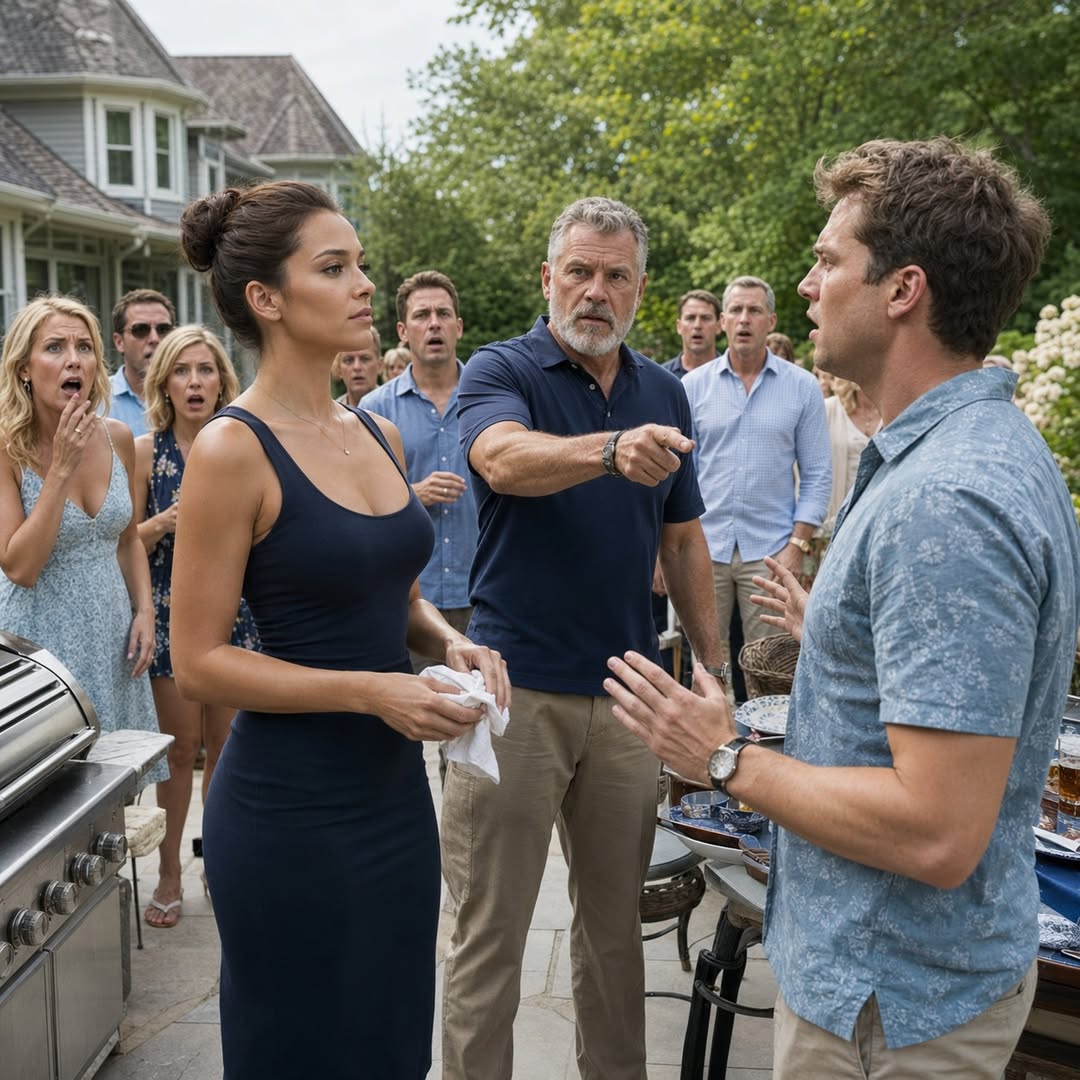
Zach Butler raised his beer like he was giving a toast at a wedding instead of standing beside a smoking grill with barbecue sauce on his shirt.
“To Michelle,” he said, grinning wide enough to show the little chip in his front tooth. “Our family’s paper pilot.”
The backyard exploded.
Not with fireworks, not yet. With laughter.
My aunt slapped the plastic table. One of Zach’s friends bent forward, coughing into his fist. My mother gave the kind of smile people give when they want a joke to pass quickly but do not have the spine to stop it. My uncle Roland sat in the big chair by the cooler, his SEAL cap pulled low, his face carved out of old pride and sun damage.
He did not laugh.
That should have meant something.
At the time, it only made the silence worse.
I sat with both hands around a cold beer can I had not opened. The metal sweated against my palms. Smoke from the grill drifted over the patio, heavy with charred ribs, lighter fluid, and sweet brown sugar. Somewhere past the dunes, the Atlantic kept dragging itself against the sand, slow and steady, like it was trying to erase something.
“Paper pilot,” Zach repeated, pleased with himself. “You know, forms, briefings, PowerPoints. Real dangerous stuff.”
More laughter.
I smiled because that was what I had learned to do when people threw knives wrapped in jokes. Smile, nod, let them feel clever, let them move on.
They did not know the smell of smoke that never left your hair after you flew through it. They did not know how blood smelled inside a rescue bird when heat and panic turned the cabin into a metal throat. They did not know what it sounded like when men who had been trained not to beg started screaming for air.
And they sure as hell did not know who Revenant One was.
Zach’s father did.
Captain Roland Butler knew.
That was the part I kept folded under my tongue like a razor blade.
He had been there in the dark, though not in my cockpit. His team had been pinned down outside Mogadishu, boxed in by gunfire, dust, and a burning transport. Command had called it nearly impossible. Weather bad. Visibility worse. Enemy fire unpredictable.
My aircraft had gone anyway.
I could still hear the radio sometimes when a grill hissed too sharply or a truck backfired in a parking lot.
Revenant One, do you copy?
I copy. I’m coming in.
I had said it calm, almost bored, because panic was contagious and I refused to spread it. But my hands had been slick inside my gloves. My throat had tasted like pennies. The night had been so bright with tracers that it looked like someone had ripped open the sky and poured sparks through it.
That mission had been buried under classification, then under politics, then under the comfortable laziness of family myth. Roland returned a legend. His team returned alive. I returned as the niece who “flew support,” whatever that meant to people who needed war to look like a movie poster.
Zach set his beer down and leaned one hip against the grill.
“No offense, Michelle,” he said, which meant he had every intention of offending me. “But pilots always talk like they’re warriors. You’re basically Uber with wings.”
His friends howled.
My cousin was thirty-four then, all gym muscle and borrowed glory. He ran a tactical fitness program in Jacksonville, where he charged young men too much money to crawl through mud while he shouted things he had heard from his father. He had never served. He told people he almost had, as if almost was a country you could defend.
I looked at Roland.
For one second, his eyes met mine.
Blue-gray. Tired. Knowing.
Then he looked away.
That small movement did more damage than Zach’s whole performance.
Because insults from fools are weather. You dress for them. You endure them. You let them pass.
But silence from someone who knows the truth is a locked door.
I stood before my face could betray me. My chair scraped against the patio concrete, loud enough that the laughter thinned.
“Where you going?” Zach called. “Flight deck?”
“Beach,” I said.
“Careful,” he said. “Sand can be hostile terrain.”
A few people laughed again, weaker this time.
I walked away with the unopened beer still in my hand. The grass was damp beneath my sandals. Past the porch lights, the yard fell into darkness, then dunes, then the pale stretch of shore. The air changed as I neared the water. Less smoke, more salt. Less noise, more truth.
I kicked off my sandals and stepped into the edge of the tide. Cold water bit my ankles. The shock steadied me.
Behind me, my family kept laughing.
Ahead of me, the moon dragged a silver road across the ocean.
I held the beer can until it crumpled.
For years, I had mistaken silence for discipline. That night, with salt on my lips and Zach’s joke still ringing in my ears, I finally understood it had become a cage.
Then I heard footsteps in the sand behind me, slow and heavy.
When I turned, Roland stood at the edge of the moonlight, holding his cap in one hand like he had come to a funeral.
### Part 2
Roland did not speak right away.
That was his gift and his curse. He could make silence feel like command. He stood there in the damp sand, boots sinking slightly, shoulders still squared though the years had thickened him around the middle. The wind ruffled what was left of his hair. Behind him, the porch lights made a golden blur through the dunes.
“You shouldn’t let him get to you,” he said finally.
I almost laughed.
Not because it was funny. Because it was exactly the kind of thing men like Roland said when they wanted peace without repair.
“Is that your advice as my uncle,” I asked, “or as the man who knows better?”
His jaw moved once.
Good. Let it hit.
The tide slid over my feet, then pulled back, stealing sand from under my heels. I stayed still.
Roland looked toward the water. “Zach runs his mouth.”
“He runs it because no one stops him.”
“He doesn’t know.”
“But you do.”
The words landed between us with the weight of a dropped weapon.
For a moment, I was back in that debriefing room overseas. Fluorescent lights humming. Coffee burnt in the pot. My flight suit stiff with dried sweat. My commanding officer, Colonel Hayes, closing the door before he spoke.
Captain Roland Butler owes you his men’s lives.
I had stared at him, too tired to understand.
He knows it was you, Hayes had added. Your call sign went over every channel that night.
Revenant One.
My name had not gone into the public report. The details had been sealed. The official language turned fire into “adverse conditions” and men screaming into “combat stress.” Roland’s team received decorations. I received a handshake behind a closed door and a warning not to talk about operational specifics.
I had accepted that.
Operational silence was one thing.
Family silence was another.
Roland rubbed his thumb along the brim of his cap. “I wanted to protect you.”
“No,” I said. “You wanted to protect Zach’s version of you.”
His face changed, not dramatically. Roland did not do dramatic unless someone was bleeding. But his eyes dropped, and for a second he looked older than sixty, older than command, older than the stories people told about him.
“I didn’t want him feeling small,” he said.
“So you let me be small instead.”
The ocean answered before he could, a long crash that rolled through the dark. I could smell seaweed now, and smoke from the party drifting thin across the dunes. Someone in the yard turned the music louder, a country song about whiskey and loyalty sung by a man who probably had too much of one and not enough of the other.
Roland took one step closer.
“That mission,” he said quietly, “was hell.”
“I remember.”
“You came in lower than anyone had a right to fly.”
“I remember that too.”
“Lieutenant Briggs was bleeding out. Harlan had shrapnel in his neck. Ortiz couldn’t breathe. If you hadn’t dropped through that smoke—”
“Then say it to them.”
He looked up.
“Say it where Zach can hear you,” I said. “Where my mother can hear you. Where every person who laughs at me because they think service only counts when it looks like your service can hear you.”
His fingers tightened around the cap.
“I can’t give them details.”
“I’m not asking for coordinates and weapons reports. I’m asking you to stop letting your son spit on something you know he doesn’t understand.”
Roland swallowed.
That, more than anything, told me he understood.
In our family, men apologized by fixing a fence, changing oil, carrying boxes no one asked them to carry. Women apologized with casseroles and soft voices. Nobody said the thing out loud. Nobody named the wound. Everybody just moved furniture around it.
I was done walking around furniture.
Roland’s voice came rough. “You were brave, Michelle.”
The words should have warmed me.
They didn’t.
They came too late and too quietly, tucked away on an empty beach where no one who needed to hear them could.
I nodded once. “Keep that for your conscience.”
He flinched like I had slapped him.
For one ugly second, I wanted to be sorry. Then I remembered Zach’s grin. I remembered my mother’s embarrassed little smile. I remembered years of holiday tables where Roland’s missions became scripture and mine became “travel.”
“No more,” I said.
“No more what?”
“No more letting people mistake quiet for weakness.”
His eyes held mine. In them I saw pride, regret, and something else. Fear maybe. Not of me exactly. Of what truth does once it gets loose.
From the backyard, Zach’s voice rose above the music.
“Where’s our paper pilot? Somebody check the tide schedule.”
Laughter followed.
Roland turned his head toward the house.
I watched his shoulders rise as if he meant to march back there and set the whole world straight.
Then he stopped.
That tiny hesitation told me everything.
I dropped the crushed beer can into his hand as I walked past him.
“Next time,” I said, “I won’t wait for you.”
At the top of the dune, I looked back once.
Roland still stood by the water, cap in one hand, my crushed beer can in the other, staring after me like he had just realized the war he feared most had always been inside his own house.
And behind him, washed clean by moonlight, something small and metallic glinted in the sand where he had been standing.
### Part 3
I almost kept walking.
That would have been easier. I had packed a bag in my mind already, folded my pride into neat corners, and told myself I would drive back to base before breakfast. The Butler family could have its smoke, its speeches, its cheap jokes. I had lived through worse than a barbecue.
But the glint in the sand tugged at me.
I went back down the dune after Roland disappeared toward the house.
The beach was darker now. Clouds had dragged over the moon, and the ocean had turned from silver to black. I crouched where he had stood and sifted my fingers through wet sand. Broken shell. Bottle cap. A smooth stone.
Then metal.
I pulled it free and wiped it against my shorts.
A coin sat in my palm, heavier than it looked.
Not money. A challenge coin.
Old brass. Edges worn. On one side, the SEAL trident. On the other, a date and three words stamped in a ring around a raven with spread wings.
We remember Revenant.
My hand closed around it so fast the edges bit my skin.
Roland had not dropped that by accident.
Or maybe he had. Maybe he carried it the way some people carried guilt, always in a pocket, rubbing it raw when no one watched. Maybe he had meant to give it to me and failed. Maybe failure had become a habit.
I stood there with the coin burning cold in my fist.
From the house came another burst of laughter, then the high squeal of children chasing each other across the patio. My cousin’s son, Evan, was four that summer. A sweet kid with big brown eyes and sticky hands, always asking questions no adult wanted to answer honestly.
Earlier that day, he had climbed into the chair beside me with a paper plate of watermelon.
“Aunt Michelle,” he had asked, “do planes have horns?”
“Not like cars.”
“What if someone’s in the way?”
“You talk on the radio.”
“What if they don’t move?”
“Then you fly better.”
He had accepted that with a solemn nod and offered me his last watermelon cube, which was the highest honor a child could give.
I had thought about that little boy when Zach mocked me. Not because I cared what Zach believed anymore, but because Evan was watching the shape of manhood being built in front of him, plank by plank. Loudness as strength. Mockery as charm. Silence as permission.
I looked again at the coin.
We remember Revenant.
They remembered me somewhere. Just not at the table where I had needed it most.
I walked back to the house with sand stuck to my wet feet and the coin in my pocket.
The patio had shifted into that late-party looseness where adults spoke too loudly and kids fell asleep in lawn chairs. Bug zappers clicked near the fence. The grill had burned down to a low orange glow. My aunt was wrapping leftovers in foil. My mother stood at the kitchen window, rinsing plastic cups as if cleanliness could save us all.
Zach saw me first.
“There she is,” he said. “Survived the beach deployment.”
This time, I did not smile.
The change was small, but people felt it. Zach’s friends quieted one by one, like porch lights clicking off. Roland stood near the cooler, cap back on his head, his face unreadable.
I reached into my pocket.
Roland’s eyes dropped to my hand.
For the first time all night, he looked afraid.
I placed the brass coin on the table. It landed with a hard, clean sound.
The adults closest to it leaned in. Zach squinted.
“What’s that?” he asked.
Roland did not move.
I looked at him, not Zach. “You lose something?”
His mouth parted.
The backyard seemed to shrink. Even the cicadas sounded distant.
Zach picked up the coin before Roland could answer. “We remember Revenant,” he read, stumbling a little over the words. He laughed, but it had no confidence in it. “Sounds like some video game squad.”
An older man at the far end of the table turned slowly.
I had seen him arrive earlier with two other veterans, all of them with the watchful posture of men whose bodies had come home before their minds fully did. His name was Mason Hale. I remembered him from a photograph on Roland’s wall, younger, leaner, grinning beside a sand-colored Humvee.
Mason set down his cup.
“Where did you get that?” he asked.
No one answered.
His gaze moved from the coin to Roland, then to me.
Something changed in his face.
Recognition did not arrive all at once. It flickered first, uncertain, then sharpened.
He took one step toward me.
“What was your call sign?” he asked.
Zach rolled his eyes. “Oh, come on. Don’t encourage—”
Roland’s voice cut through the humid air.
“Zach.”
Just his name.
But it snapped like a command.
Zach froze, the coin still between his fingers.
Mason kept looking at me, and in his eyes I saw a door opening that had been shut for years.
I should have lied. I should have walked away. I should have left them to choke on all the things they never asked.
Instead, I heard myself say, “Revenant One.”
Mason went pale.
The coin slipped from Zach’s hand and hit the table again.
And this time, no one laughed.
### Part 4
Silence has different textures.
There is the soft silence of snow, the nervous silence before a test, the holy silence inside an empty church. There is the operational silence before landing under fire, when every breath in the headset seems too loud and the whole world narrows to instruments, coordinates, and the voice waiting for you on the radio.
Then there is family silence.
That one smells like barbecue smoke and old beer. It sits heavy in plastic lawn chairs. It looks at the ground because eye contact might require courage.
Mason Hale stared at me as if a ghost had walked into Roland’s backyard wearing cutoffs and a faded Navy T-shirt.
“Revenant One,” he repeated.
His voice had dropped low, almost reverent.
Zach looked from him to me. “What is happening?”
Nobody answered him.
That was the first time I saw my cousin feel the shape of being outside a story. He hated it immediately. His face tightened, jaw working, the old grin trying to return and failing.
Roland walked to the table and picked up the coin. He did it slowly, with two fingers, like it was evidence.
“You kept it,” Mason said to him.
Roland nodded once.
“For ten years?”
“Eleven.”
Mason let out a breath. “Damn you, Ro.”
The nickname cracked something open. Suddenly Roland was not Captain Butler, not the family legend, not the man who had filled half my childhood with stories told from the center of the room. He was just Ro to another old man with scars hidden under a short-sleeved shirt.
My mother stepped out from the kitchen, dish towel in hand. “What’s going on?”
Zach laughed sharply. “That’s what I’m trying to find out.”
Mason ignored him. “You never told them?”
Roland’s eyes stayed on the coin. “It was classified.”
Mason took another step forward. “Her name, maybe. Details, sure. But you could’ve said enough.”
“I know.”
The words were small.
They did not fit the man who said them.
My aunt whispered, “Michelle?”
Her tone annoyed me more than Zach’s insults. Soft. Confused. As if I had suddenly changed shape in front of her. As if I had been hiding under a blanket at every Christmas dinner and only now pulled it off.
I wanted to tell her I had been there the whole time.
Instead, Mason turned to the people gathered under the string lights.
“That pilot flew into a kill box for us,” he said.
My stomach clenched.
“Mason,” Roland warned.
“No,” Mason snapped. “No more of that.”
The air shifted again. Nobody in my family had ever spoken to Roland like that in his own yard. Not even Zach.
Mason pointed at me, not accusing, but identifying. “We were pinned down. Bad visibility. Bad intel. Everything bad. We had wounded stacked like cordwood and no clean extraction. Command told us to hold.”
I could feel the cockpit around me as he spoke. The vibration in my bones. The heat blooming red on the warning panel. My co-pilot, Danny Ruiz, saying, “Shell, we’re taking too much.” My own voice answering, “Then stop counting holes and find me a lane.”
Mason’s eyes shone. “She found us anyway.”
Nobody moved.
A moth knocked itself against the porch light over and over, soft taps in the quiet.
Zach looked at me like he was waiting for me to deny it.
I did not.
My mother pressed the towel to her chest. “Michelle, why didn’t you tell us?”
That question, from her mouth, almost made me laugh again.
Because I had tried.
Not with details. Never details. But I had tried to tell them that my work mattered. I had tried after my first deployment, when I came home ten pounds lighter and woke at every slammed cabinet. I had tried when Thanksgiving turned into another Roland tribute and my uncle thanked “the boys on the ground” while I sat three chairs away, still smelling smoke in my dreams. I had tried when Zach called me “air mail” and everybody chuckled into their mashed potatoes.
Eventually, trying became begging.
I did not beg.
“You didn’t ask,” I said.
My mother’s face folded.
Zach set both hands on his hips. “Okay, hold up. So what? She flew a mission? Great. Respect. But everyone’s acting like I personally—”
“You mocked her,” Roland said.
Zach turned on him. “Because you let me!”
There it was.
The truth, ugly and fast.
Roland’s head lifted.
Zach’s voice rose. “You sat there year after year while everyone acted like she had some cushy office job. You told the stories. You let people think the SEALs were the only ones doing anything real. Now you want to bark at me like I invented it?”
For one second, I almost admired him.
Not because he was right to mock me. He wasn’t. But because he had finally hit the correct target.
Roland looked stricken.
Mason muttered, “Kid’s not wrong about that part.”
The yard held its breath.
Then Roland turned to Zach.
“You still owe her an apology.”
Zach’s eyes flashed. “For a joke?”
“For years.”
Zach’s pride fought for air. I could see it thrashing behind his face. Everyone watched him, and Zach Butler had never performed well without applause.
His mouth twisted.
“I’m sorry you took it wrong,” he said.
A few people looked relieved, eager to accept the shape of an apology without the substance.
I did not.
I stepped closer to him. The smell of beer on his breath hit me first, sour and sweet.
“No,” I said. “Try again.”
His eyebrows jumped. “Excuse me?”
“You heard me.”
Roland’s voice came hard as a door slam.
“Apologize. Now.”
The command cracked across the patio.
Zach stared at his father. Then at Mason. Then at me.
And for the first time in my life, my cousin looked smaller than the silence he had hidden behind.
But what he said next proved he had not learned a thing.
### Part 5
Zach smiled.
Not his usual loud, sunburned grin. This one was thin and mean, born out of embarrassment instead of confidence.
“Fine,” he said. “I’m sorry the family didn’t throw you a parade for doing your job.”
The words hit the yard and died there.
Even the kids stopped running.
Evan stood near the steps in dinosaur pajamas, a red popsicle melting down one hand. His eyes moved between his father and me, wide and uncertain. Behind him, my aunt made a tiny sound, like she wanted to call him inside but could not find her voice.
Roland’s face went still.
That was worse than anger.
Mason took one step toward Zach, but I lifted my hand.
“No,” I said.
My voice surprised me. It was calm. Too calm. The kind of calm that comes after the decision has already been made.
I looked at Zach. “Thank you.”
His eyes narrowed. “For what?”
“For making it easy.”
He blinked.
I turned to Roland. “This is what your silence raised.”
Roland flinched.
Good.
Then I faced my mother. “And this is what your comfort protected.”
Her lips parted, but no sound came out.
I could have stayed. I could have made a speech. The whole yard was finally quiet enough to listen, and some wounded part of me wanted to pour every year of humiliation onto the patio until they drowned in it. I wanted to list every joke. Every dismissal. Every time my service became smaller because it did not come wrapped in a man’s voice.
But that would still have been asking them to understand.
I was done asking.
I reached for the brass coin on the table. Roland did not stop me. I held it up once so the porch light caught the worn edges.
“This was never yours to hide,” I told him.
His eyes closed.
Then I put the coin in my pocket and walked toward the house.
My mother followed me into the kitchen.
The change in air hit hard. Cold from the air conditioner. Lemon cleaner on the counters. The sweet, sticky smell of pie cooling under foil. Outside, voices began to murmur, low and frantic, like people tidying up after a glass had shattered.
“Michelle,” my mother said. “Please don’t leave angry.”
I pulled my keys from the bowl by the door. “I’m not angry.”
“You are.”
“No,” I said, turning to her. “I was angry years ago. Then I was hurt. Then I was tired. Tonight I’m clear.”
She hugged the dish towel against herself. “We didn’t know.”
“You knew enough.”
“That’s not fair.”
The old line.
Fair.
As if fairness had ever been the family business.
I looked at her carefully. Her hair was pinned back with the same pearl clip she wore to church. A smear of flour marked one cheek. She looked soft, worried, ordinary. I loved her. That was the inconvenient truth. Love does not always leave when respect does.
“You watched them laugh,” I said. “You watched me disappear at your own table, and you decided peace mattered more.”
Tears gathered in her eyes. “I didn’t want conflict.”
“You chose it. You just made me carry it.”
That one landed.
She gripped the counter.
Outside, Roland’s voice rose, sharp and controlled. Zach answered louder. I caught only fragments through the glass.
“You knew…”
“My son…”
“Not her fault…”
“Then why didn’t you say—”
The argument spilled across the backyard, years late and still not mine to manage.
My mother whispered, “What do you want me to do?”
That question was too late too, but at least it was honest.
I slipped my keys into my palm. “Nothing tonight.”
“Michelle.”
I opened the door to the garage.
The familiar smell of motor oil and old beach towels came over me. My rental car sat under the buzzing fluorescent light, windshield filmed with salt dust. I tossed my overnight bag into the passenger seat, hands steady.
My mother stood in the doorway. “Will you come back tomorrow?”
“No.”
“For breakfast? Just to talk?”
“No.”
Her face crumpled like paper.
Maybe another version of me would have softened. The version trained since childhood to protect everyone else from discomfort. The good daughter. The quiet niece. The woman who smiled when men made themselves feel tall by standing on her shoulders.
That version had died somewhere between Zach’s fake apology and Evan’s frightened eyes.
“I love you,” my mother said.
I believed her.
That was the worst part.
“I love you too,” I said. “But I’m not available for this family’s denial anymore.”
I got into the car.
As the garage door rose, I saw Roland step into the driveway. He looked like he had aged ten years in ten minutes. Zach stood behind him on the lawn, arms crossed, face flushed with rage and shame. Evan clung to his mother’s leg.
Roland walked toward my window.
I lowered it halfway.
“Michelle,” he said, voice rough. “Please. Don’t go like this.”
I looked at the man who had carried my truth in his pocket for eleven years and mistaken that for honor.
“I’m not going like this,” I said. “You all made it like this.”
He absorbed that in silence.
Then he reached into his pocket and pulled out a folded piece of paper.
“Before you leave,” he said, “there’s something you need to see.”
I almost drove away.
Instead, against every instinct I trusted, I took the paper.
### Part 6
I did not open it in the driveway.
I laid the folded paper on the passenger seat like it might explode, then backed out while everyone watched. My headlights slid over the garage wall, the trash cans, Zach’s frozen face, Roland’s hand dropping uselessly to his side.
The road out of the neighborhood curved between beach houses with bright windows and dark porches. Sprinklers ticked over lawns. A dog barked at my car, then another answered down the block. Everything looked too normal for a night that had just split my life in half.
I drove until the Butler house disappeared behind the dunes.
Then I pulled into a gas station near the causeway.
The place smelled like diesel, hot rubber, and old coffee. Fluorescent lights buzzed above the pumps, making the pavement shine sickly white. A teenage clerk inside scrolled his phone behind bulletproof glass. Somewhere near the ice machine, a radio played a baseball game in a sleepy voice.
I sat in the car with the engine off.
The paper waited.
I had faced instrument failure, incoming fire, and a landing zone so hot my co-pilot had started praying in Spanish. Still, my hand hesitated before opening what Roland had given me.
Because war can kill you.
Family can rearrange you and call it love.
I unfolded the paper.
It was a copy of a letter, creased along old lines, the ink slightly faded. At the top was Navy letterhead. Beneath it, my full name.
Lieutenant Commander Michelle Anne Butler.
My pulse slowed.
The letter recommended me for an award I had never received. Not the quiet commendation that came months later. Something higher. Something that required signatures, statements, witness accounts.
I scanned the page, catching fragments.
Disregard for personal safety.
Extraordinary airmanship.
Directly responsible for the survival of twelve U.S. personnel.
My throat tightened.
At the bottom were names.
Mason Hale.
Thomas Briggs.
Luis Ortiz.
Daniel Ruiz.
And Roland Butler.
His signature sat there in black ink, hard and unmistakable.
Attached behind the letter was a handwritten note.
Michelle,
I submitted this after the mission. It died somewhere above my pay grade. Classification, politics, timing, all the usual excuses. I should have pushed harder. I should have told you. I should have told them.
Cowardice does not always look like running from bullets. Sometimes it looks like sitting at your own table and letting someone else bleed quietly.
I am sorry.
Roland
I read it three times.
The first time, I felt nothing.
The second, heat climbed my neck.
The third, I laughed once, sharp and ugly, alone in a gas station parking lot under lights that made everything look dead.
He had known.
More than known. He had written it down. Signed it. Carried the truth in official language, in ink, in whatever file cabinet or locked drawer he had kept this copy all those years.
And still he had let Zach call me a paper pilot.
My phone buzzed.
Mom.
I let it ring.
Then Zach.
I let that ring too.
Then an unknown number.
Against my better judgment, I answered.
“Commander Butler?” a man asked.
His voice was older, rough around the edges.
“Yes.”
“This is Mason Hale. Roland gave me your number. I hope that’s okay.”
It was not okay, but I was too tired to say so.
“What do you want, Mason?”
A pause. “To tell you I’m sorry.”
The baseball announcer on the gas station radio murmured something about a full count.
“I heard that already tonight,” I said. “It’s losing value.”
“I get that.”
“Do you?”
“Yes, ma’am,” he said, and the ma’am scraped strangely against my nerves. Respectful. Formal. Too late.
I leaned back and stared through the windshield at a moth circling the pump light. “Why didn’t any of you contact me?”
He breathed out slowly. “Some of us tried to get your name after. We were told to let it go.”
“But you had my call sign.”
“We did.”
“So you remembered a ghost and let the woman sit alone at family barbecues.”
“That’s fair.”
“No, Mason. It’s not.”
He went quiet.
Good. Let people sit in what they made.
Finally, he said, “Roland’s not the only one carrying something. I have copies. Statements. Photos. Audio fragments. Stuff that never made it anywhere official. We kept it because we knew someday somebody would need to tell the truth right.”
A cold thread moved through me.
“Why are you telling me this now?”
“Because Zach posted a video.”
My stomach dropped.
“What video?”
“The toast. The coin. Part of the argument. Someone at the party recorded it. Zach uploaded a clipped version making it look like you staged the whole thing to embarrass him.”
For a second, the gas station vanished.
All I could hear was the slow thud of my own heart.
Mason continued carefully. “It’s already getting shared around local veteran groups. People are asking questions.”
Of course.
Zach could not win the truth, so he had run to the internet with a costume version of it.
“What exactly did he say?” I asked.
Mason hesitated.
“Mason.”
“He called you a stolen valor pilot.”
My hand tightened around the phone until the case creaked.
The brass coin in my pocket pressed against my thigh, solid and sharp.
I closed my eyes, and behind them I saw Evan watching his father.
Then I opened them.
“Send me everything,” I said.
Mason’s voice changed. “Everything?”
“The statements. The photos. The audio. The letter. All of it.”
“What are you going to do?”
I looked at the folded recommendation on my passenger seat.
For eleven years, I had protected classified truth, family pride, Roland’s comfort, Zach’s ego, my mother’s peace.
Not one of those things had protected me.
“I’m going to stop being a ghost,” I said.
And before dawn, Zach Butler’s little lie was going to meet Revenant One.
### Part 7
Mason sent the files in batches.
I watched them land on my phone while sitting in the gas station lot with my hazard lights blinking for no reason except that my thumb had hit the button and I had not bothered to turn it off.
Photos first.
Grainy, low-light images of the extraction zone. Smoke folding over broken concrete. Rotor wash flattening dust into angry spirals. Men crouched under fire, faces blurred by motion and night vision. One shot showed my aircraft dropping low, nose angled like a hawk diving through flame. My call sign was stamped in the corner of the after-action image.
Revenant One.
Then came audio.
Mason warned me before sending it.
I listened anyway.
Static. Breathing. Someone cursing. A voice shouting for a medic. Roland, younger and sharper, calling coordinates while gunfire cracked around him. Then command telling him extraction was delayed.
I knew the next part before it came.
A woman’s voice cut through.
Calm. Low. Mine.
Revenant One copies. Mark your smoke. I’m not leaving you behind.
I put the phone face down on my lap.
For a while, I could not move.
People think memories live in the mind. They don’t. They live in the body. Mine were in my hands, which remembered the controls. In my teeth, which remembered the vibration. In the scar along my left forearm, which remembered a fragment of hot metal that nobody at Thanksgiving had ever noticed.
A pickup pulled in two pumps over. Two men got out laughing, buying late-night cigarettes and energy drinks. One of them glanced at me and looked away quickly. Maybe my face warned him off.
My phone buzzed again.
A video link from Mason.
Zach’s post.
I opened it.
There he was in his truck, baseball cap backward, eyes bright with fake hurt.
“Never thought I’d have to make a video like this,” he began.
That sentence alone told me he had practiced.
He talked for four minutes. He said a “certain relative” had shown up to his father’s birthday party with a “mysterious military coin” and claimed some classified hero story nobody could verify. He said his father was old-school and easily guilted. He said people were too afraid to question women in uniform now. He said he respected real service.
Real service.
My vision narrowed.
Under the video, comments stacked fast.
Some defended me. Mason had clearly already started calling people. Others did what strangers do best: built a courtroom out of ignorance.
Anybody can claim classified.
Sounds fishy.
Paperwork pilot lol.
Why wait years?
The last question hurt because it had a real answer, and the answer was not simple enough for the internet.
I saved the video.
Then I called Danny Ruiz.
He answered on the fifth ring, voice thick with sleep. “Someone better be dead.”
“Not yet.”
“Shell?”
“Yeah.”
A beat. Then fully awake. “What happened?”
I told him the short version.
Danny had been my co-pilot on the Revenant mission. He lived in San Diego now, flew test programs, married a pediatric surgeon, and sent me Christmas cards featuring three kids with his eyebrows. He was the closest thing I had to a brother who had not been issued by blood.
When I finished, the line was silent.
Then Danny said, “I’m going to kill him.”
“Get in line.”
“No, seriously. I have miles.”
Despite everything, I smiled.
It lasted half a second.
“I need help,” I said.
“You have it.”
“I don’t want classified details out there.”
“Then we don’t release classified details.”
“I don’t want a circus.”
“Shell,” he said gently, “the circus already has your name on the tent.”
I closed my eyes.
He was right.
That was the part I hated most. Zach had dragged my service into public because he could not survive private shame. Now silence would look like guilt. Dignity would look like defeat. The old rules had trapped me again, only this time on a bigger stage.
Danny’s voice softened. “What do you want?”
I looked at the gas station window. In the reflection, I saw a woman in her late thirties with tired eyes, wind-tangled hair, and a face too calm for the hour. Not the girl who once waited for her uncle to speak. Not the niece who swallowed insults to keep the peace.
“I want the truth documented,” I said. “Clean. Legal. Unemotional.”
“Unemotional,” Danny repeated. “From you? Easy. From me? We’ll see.”
“I’m serious.”
“So am I. We’ll put together a statement. Service record where releasable. Award citation. Witness confirmations. Nothing operational. Enough to bury the accusation.”
“And Roland?”
“What about him?”
I watched the first pink edge of dawn creep behind the gas station sign.
“He started this with silence,” I said. “He doesn’t get to fix it by hiding behind me now.”
Danny understood immediately. “You want him on record.”
“I want him to say publicly what he refused to say privately.”
“Will he?”
I thought of Roland on the beach, in the driveway, in the yard under his son’s rage. A man shaped by honor but trained to confuse truth with vulnerability.
“I don’t know.”
“Then call him.”
I looked at my phone.
There were seventeen missed calls now. Six from Mom. Four from Roland. Five from Zach. Two from my aunt.
No voicemail from Zach. Of course not. Men like him wanted live audiences.
I called Roland.
He answered before the first ring finished.
“Michelle.”
His voice sounded broken.
“Zach posted a video,” I said.
“I know.”
“Did you know before he posted it?”
A pause.
There it was again. The little silence that always came before betrayal.
“Roland.”
“He told me he was going to explain his side.”
His side.
The gas station lights clicked off as dawn strengthened.
I felt something inside me go very still.
“You had one more chance,” I said, “and you gave it to him.”
“Michelle, I didn’t know he’d say stolen valor.”
“But you knew he would lie.”
Roland said nothing.
I almost admired his consistency.
“I need you to listen carefully,” I said. “You are going to make a public statement today confirming what you know, within legal limits. You are going to say Zach’s accusation is false. You are going to apologize for your silence.”
His breath shook.
“And if I don’t?”
The question was soft.
The answer was not.
“Then I release your letter, your signature, and every witness statement without you. And everyone will see exactly how long you knew.”
On the other end, Roland exhaled like a man hearing a sentence passed.
“When?” he asked.
“Noon.”
“Michelle—”
“Noon.”
I ended the call.
The sun lifted over the pumps, clean and indifferent.
For the first time all night, my hands stopped shaking.
Then a message from Zach appeared.
You’re really going to destroy this family over a joke?
I stared at it for a long moment before typing back.
No, Zach. I’m going to let the truth show what already did.
His reply came almost instantly.
Then I guess we both go down.
And attached beneath it was a photo that made the blood leave my face.
### Part 8
The photo was old.
Not black-and-white old, but deployment old. Grainy. Harsh light. A dusty operations tent with folding chairs, cables snaking across the floor, maps taped to plywood walls. I stood near a table in flight gear, helmet under one arm, face turned partly away.
Beside me was Colonel Hayes.
His hand rested on my shoulder.
That was all.
But Zach had circled the hand in red and typed across the image:
Funny how classified careers get made.
For several seconds, I did not understand the accusation because my mind refused to bend itself that ugly.
Then I did.
My skin went cold.
Zach could not prove I was lying, so he was going to suggest I had slept my way into honor. Not directly, maybe. Men like Zach preferred poison clouds to bullets. Let other people inhale the meaning. Let them do the dirty work in comments while he shrugged and said he never technically said it.
The old humiliation rose in me, but this time it had teeth.
I called Danny again.
He answered with, “Tell me you’re not in jail.”
“Not yet.”
I sent him the photo.
His silence lasted longer than I liked.
Then he said, “I remember that day.”
“So do I.”
“You had just landed after thirty-one hours awake.”
“Thirty-two.”
“Hayes was keeping you from falling over.”
“I know.”
“He died, Shell.”
“I know that too.”
Colonel Hayes had died three years after Mogadishu from a heart attack while jogging at dawn. He was fifty-two. At his memorial, his wife had pressed both my hands in hers and said, “He always said you were the calmest person he ever saw in a cockpit.”
Now Zach was about to drag a dead man into the mud because his ego needed cover.
Danny’s voice hardened. “Do not respond to him privately again. Screenshot everything.”
“Already done.”
“I’ll call Hayes’s widow.”
“No.”
“Shell—”
“No,” I said, sharper. Then softer. “Not unless we have to. She doesn’t deserve this.”
“Neither do you.”
That was kind, but irrelevant.
I opened Zach’s message again. The photo stared back. My younger self looked exhausted in it, eyes hollow, cheeks streaked with dust. I remembered Hayes guiding me toward a chair because my knees had gone unreliable. I remembered him saying, “Sit down before you outrank gravity.” I had laughed so hard I almost cried.
Men like Hayes had made service bearable.
Men like Zach made memory unsafe.
I drove to a small hotel off A1A and rented a room under the stare of a clerk who looked too young to be awake. The lobby smelled like carpet cleaner and stale waffles. My room had beige walls, humming air conditioning, and a view of the parking lot. I locked the door, set my phone on the desk, and began building a folder.
Screenshots. Zach’s video. His messages. The letter. Mason’s statements. Audio clips marked for legal review. Photos with metadata. My releasable service record. Commendation documents. News clippings about the broader operation that named no one but matched the date.
By nine, Danny had looped in a lawyer friend named Priya Shah, a former JAG officer with a voice like a scalpel.
“You’re not going to argue with him online,” she said over video call.
“I wasn’t planning to.”
“You’re going to issue one clean statement. Then we send a preservation letter. Then, if he repeats the defamatory claim, we move.”
“Move how?”
“Public correction first. Civil action if necessary.”
I rubbed my eyes. They burned from lack of sleep. “I don’t want his money.”
“Good. This isn’t about money. It’s about stopping the bleed.”
Stopping the bleed.
I looked at my scar.
Priya continued. “Roland is key. If he confirms publicly, Zach collapses fast.”
“And if Roland protects him?”
“Then Roland collapses with him.”
That should have satisfied me.
It didn’t.
Because underneath all my anger was still a child’s stupid ache. I wanted my uncle to choose truth because it was right, not because I had cornered him. I wanted my mother to call and say, “We failed you,” not “Please don’t leave angry.” I wanted Zach to look at his son and understand that humiliation was not a family tradition worth passing down.
Wanting did not make people better.
At eleven forty-six, Roland called.
Priya was still on the line. Danny too. Mason had joined from his porch somewhere, wearing a ball cap and the haunted look of a man ready to testify before God.
I put Roland on speaker.
“I’ll do it,” he said.
No greeting.
“What changed?” I asked.
A long breath. “Evan asked me if heroes lie.”
The room went quiet around me.
Roland’s voice roughened. “He saw the video. He saw Zach yelling after. He asked me if you were bad or if his dad was scared.”
I closed my eyes.
That little boy again. Sticky fingers. Dinosaur pajamas. Watching adults poison the air and being smart enough to smell it.
“What did you tell him?” I asked.
“The truth.”
“And what was that?”
“That his dad was scared.”
Mason looked away on the screen.
Roland continued. “And so was I.”
There it was. The thing I had not expected.
Not enough. But real.
“I’ll make the statement at noon,” Roland said. “Mason’s here. Two others are coming. I’ll say what I should’ve said years ago.”
Priya leaned toward her camera. “Captain Butler, this is Priya Shah. Do not disclose classified operational details. Do confirm Commander Butler’s service, the falsity of stolen valor claims, and your firsthand knowledge of her role as Revenant One.”
“I understand.”
I looked at Roland’s name glowing on my phone.
“Roland,” I said.
“Yes?”
“If you do this to save Zach, don’t.”
A pause.
“I’m doing it because I should have done it when you were twenty-seven.”
My throat tightened, but I did not let the feeling rise any higher.
At noon, Roland went live from his backyard.
The same place Zach had mocked me.
The grill stood cold behind him. The string lights looked pale in daylight. Mason stood on one side, two other veterans on the other. Roland wore no cap. No sunglasses. No shield.
His first words were simple.
“My son lied.”
By the time he finished, Zach’s video was already disappearing.
But the worst thing about truth is this: once it starts moving, it wakes up everything buried near it.
At 12:19, my mother sent one text.
Michelle, there is something else Roland never told you.
### Part 9
I stared at my mother’s message until the words blurred.
There is something else Roland never told you.
My hotel room was too cold. The air conditioner rattled under the window, pushing out air that smelled faintly of mildew. On the desk, my laptop kept refreshing. Roland’s statement had spread faster than Zach’s lie. Comments turned, then sharpened. Veterans who knew Mason confirmed enough. Pilots I had not heard from in years sent messages with old photos and call signs. Strangers apologized as if they had personally been at the barbecue.
None of it reached me.
My mother’s text sat on my phone like a lit match.
I called her.
She answered with a sob already in her throat.
“Don’t cry yet,” I said. “Talk first.”
That sounded cruel.
Maybe I was becoming cruel.
Or maybe I had spent too many years translating other people’s tears into my responsibility.
She inhaled shakily. “I didn’t know how to tell you.”
“Start there and we’re done.”
A pause.
Then, quietly, “Your father knew about the recommendation.”
My hand went numb around the phone.
My father had been dead five years.
Lung cancer. Fast at the end. He had been the quietest person in our family and the only one whose silence ever felt like shelter. He fixed boats, read old aviation magazines, and never once called my work “nice” or “dangerous” in that soft dismissive way my mother did. When I came home from deployments, he checked my car tires, stocked my fridge, and left black coffee outside my bedroom door without knocking.
Some people get applause, he had once told me. Others get the sound of engines.
I had carried that sentence like a medal.
“What do you mean he knew?” I asked.
Mom sniffed. “Roland showed him the letter years ago. After the mission. Your father wanted to tell you, but Roland asked him not to.”
The room tilted.
“Why?”
“He said it would hurt you to know an award had been blocked. He said the details were sensitive. He said it was better to wait until things could be done properly.”
I stood and walked to the window, though there was nothing to see but parked cars and a palm tree bent by wind.
“And Dad agreed?”
“He argued. I remember them on the porch. Your father was furious. I had never seen him like that.” Her voice broke. “But later he said maybe Roland was right. Maybe telling you would only reopen things.”
Reopen things.
The phrase landed badly.
As if wounds politely closed when ignored.
My father had known I had been recommended for something more. He had known Roland carried proof. He had known I sat at tables where my service was treated like a hobby. And he had chosen, in his soft protective way, not to tell me.
A different kind of betrayal, but betrayal still.
I pressed my forehead to the cold glass.
“Did Zach know?” I asked.
“No. I don’t think so.”
“Did you?”
“Only that there was a letter. I didn’t understand what it meant.”
“You never asked?”
Silence.
There it was. The Butler family anthem.
“Michelle, your father loved you more than anything.”
“I know.”
“He thought he was protecting you.”
“I know.”
Both things could be true. Love and failure. Protection and theft. A gentle hand still closing around my right to know.
My mother whispered, “Please say something.”
I watched a man in swim trunks carry a foam cooler across the parking lot, completely unaware that my dead father had just become more complicated.
“I can’t do this with you right now,” I said.
“Will you ever?”
“I don’t know.”
That was honest.
She cried harder.
I ended the call before her grief could become a rope around my neck.
For the next hour, I did nothing. No statements. No calls. No strategy. I sat on the edge of the hotel bed and held Roland’s coin in one hand, my father’s memory in the other, and felt both change weight.
At two, someone knocked.
I did not move.
The knock came again. Gentle. Two taps, pause, one tap.
Not Zach. He would pound.
I checked the peephole.
Roland stood in the hallway.
His face looked gray. In one hand he held a manila envelope. In the other, my father’s old Navy ball cap.
He must have seen the shadow move under the door.
“I know you’re there,” he said.
I opened it only because I wanted the cap.
Roland did not try to step inside. Smart man.
“Your mother told you,” he said.
I took the cap from him. My father’s initials were written inside the band in faded marker. The smell of him was gone, replaced by dust and cardboard, but my chest still tightened.
“You let my father carry your lie too,” I said.
Roland’s mouth tightened. “Yes.”
“Did everyone in this family get a turn holding my life except me?”
He looked down.
The hallway smelled like chlorine from the hotel pool and somebody’s burnt microwave popcorn. A child laughed behind a door nearby. The ordinary world kept being rude enough to continue.
Roland lifted the envelope.
“Your dad wrote you letters.”
My breath stopped.
“What?”
“After he found out. He wrote them and never sent them. He gave them to me before he died.”
The walls seemed to lean closer.
“He told me to give them to you when I was brave enough,” Roland said. “I wasn’t.”
I looked at the envelope.
My father’s handwriting crossed the front.
For Michelle, when truth costs less than silence.
The grief that rose in me was so sudden and hot I almost shut the door in Roland’s face.
Instead, I took the envelope.
Roland’s eyes filled. “I’m sorry.”
I looked at him, really looked.
For the first time, his apology did not sound like command, excuse, or damage control. It sounded like a man standing barefoot on broken glass because he had finally run out of places to hide.
But it still did not give back the years.
“No,” I said.
His face crumpled slightly.
“No what?”
“No, I don’t forgive you.”
The sentence came out clean.
Not shouted. Not cruel. Just true.
Roland nodded once, as if he had expected it and deserved worse.
I closed the door between us.
Then I sat on the floor, opened my father’s envelope with shaking hands, and read the first line.
My brave girl, I was wrong to let silence wear the mask of love.
### Part 10
My father’s letters destroyed me quietly.
There were six of them, written over five years. Different pens. Different paper. One on the back of a marina invoice. One on yellow legal paper with a coffee ring in the corner. One on the thick stationery my mother used for Christmas lists.
His handwriting slanted left when he was tired.
I had forgotten that.
The first letter was angry.
Not at me. Never at me. At Roland, at the Navy, at himself. He wrote that men had been taking women’s victories and calling the theft complicated since before either of us was born. He wrote that classified did not have to mean erased. He wrote that he had watched me come home thin and quiet and had mistaken survival for healing.
The second was worse.
He admitted he had believed Roland when Roland said telling me about the blocked award would only hurt me. “I let another man convince me that your pain was safer in his hands than in yours,” Dad wrote. “That was arrogance dressed as concern.”
I had to stop there.
Outside my hotel window, afternoon light slanted across the parking lot. A cleaning cart rattled somewhere down the hall. My phone kept buzzing, but I had turned it face down. The world wanted reactions. I was busy meeting a version of my father who had loved me and failed me in the same breath.
The last letter had been written two months before his diagnosis.
Michelle,
If you are reading this, Roland finally found courage or shame. Either will do if it brings you truth.
I hope by now you know that I saw you. Not all of you, because no parent gets that privilege, but enough. I saw the way you checked exits in restaurants. I saw how you hated fireworks but stood outside with the kids anyway. I saw you smile when Zach talked over you, and I hated myself for not making the table stop.
I thought quiet support was enough. It wasn’t. Quiet love can comfort, but it cannot defend.
Do not let our family turn your mercy into a habit of self-erasure.
You do not owe forgiveness to people who needed proof of your pain before they respected it.
Build a life where you do not have to shrink to be loved.
Dad
I cried then.
Not pretty. Not movie tears.
The kind that bends you forward and makes your ribs hurt.
I cried for the father I missed, the father I was angry at, the daughter I had been, the woman I had become without asking permission. I cried until the hotel carpet blurred beneath me and the brass coin left a crescent mark in my palm.
When I finally stood, the room felt different. Not better. Clearer.
I washed my face in the sink with water that smelled faintly metallic. My eyes were red. My hair had dried into salt-stiff waves. I looked like someone who had flown through a storm and come out on the wrong coast.
My phone held thirty-nine notifications.
The top one was from Priya.
Zach has deleted the video. He posted an “apology.” Do not respond until you read it.
I opened it.
Zach sat in his truck again, but the confidence was gone. His face looked pale under the brim of his cap. His voice had that careful tone people use when lawyers and consequences have entered the room.
“I want to apologize for comments I made about Commander Michelle Butler,” he said. “I was misinformed and emotional. I respect all who serve. I never meant to question anyone’s honor.”
I stopped the video.
Never meant.
Misinformed.
Emotional.
The holy trinity of weak apologies.
Priya texted again.
Legally useful. Personally garbage.
Danny added:
I vote we still let Mason scare him.
Mason replied in the group thread:
I can be calm and terrifying.
For the first time all day, I almost smiled.
Then another message appeared.
Zach.
Can we talk? Just us.
I stared at it.
Priya immediately wrote:
No.
Danny wrote:
Hell no.
Mason wrote:
Absolutely not.
My father’s last sentence sat beside them in my mind.
Build a life where you do not have to shrink to be loved.
I typed back to Zach.
You can write what you need to say. I’m done giving you rooms where you perform.
Three dots appeared. Disappeared. Appeared again.
Finally:
I screwed up. I know that. Dad already tore me apart. Evan won’t look at me. My business page is getting slammed. Are you happy now?
There he was.
Not sorry. Injured.
I wrote:
No.
He replied:
What do you want from me?
That question again. From my mother. From Roland. Now from Zach.
What do you want?
People asked it when they had already spent years refusing to notice what you needed.
I answered honestly.
Nothing.
He did not reply for several minutes.
Then:
That’s cold.
I put the phone down.
Cold was not the absence of feeling. Cold was what happened when warmth had been used against you too many times.
That evening, I drove to the beach where Roland had first admitted he knew. The sky was bruised purple, clouds low over the water. Tourists had gone back to their rentals. A few fishermen stood knee-deep in surf, lines arcing into gray waves. The air smelled of salt, rain, and distant fried food from the pier.
I walked until the hotel lights were small behind me.
Then I took the brass coin from my pocket.
We remember Revenant.
I thought about throwing it into the ocean.
The impulse came fierce and clean. Let the tide have it. Let Roland’s guilt sink. Let the SEALs keep their symbols and late acknowledgements. Let the water swallow every version of respect that arrived after damage.
But my fingers would not open.
Because the coin was not just Roland. It was Mason’s shaking voice. Danny counting holes beside me. Men lifted bleeding into the cabin. My own hands steady when nothing else was.
I had earned it.
Their failure did not make it dirty.
Behind me, tires crunched on the beach access gravel.
I turned.
Zach stepped out of his truck.
Alone.
No grin. No beer. No audience.
The rain began before either of us spoke.
### Part 11
Zach looked smaller in the rain.
Not physically. He was still broad-shouldered, still gym-built, still dressed like a man who thought tactical pants were a personality. But without the backyard, without friends laughing, without Roland’s shadow to stand inside, he looked unfinished.
I stayed where I was, ten feet from the tide.
“You shouldn’t be here,” I said.
Rain dotted his shirt and darkened the brim of his cap. “I know.”
“Then leave.”
He glanced toward the water, then back at me. “Five minutes.”
“No.”
“Michelle—”
“No,” I repeated. “You do not get to show up and ask for time like you haven’t wasted enough of mine.”
His face tightened. The old Zach twitched under the surface, ready to fight, ready to twist this into me being unreasonable. Then he swallowed it.
That was new.
Not impressive. New.
He held up both hands. “I’m not here to argue.”
“Good. We’re done.”
I turned toward the beach access.
His voice followed me.
“I hated you.”
That stopped me.
The rain thickened, soft at first, then steady, ticking against palmetto leaves and flattening the sand around our shoes. A wave broke hard behind me.
I turned back slowly.
Zach’s eyes were red, though whether from rain, shame, or whiskey, I could not tell.
“I hated you before I knew anything,” he said.
I waited.
“My whole life, Dad was this… mountain. Everyone talked about him like he was carved out of something better than the rest of us. I couldn’t join. Asthma when I was younger, then the knee, then honestly maybe I was scared. I don’t know.” He rubbed both hands over his face. “So I built this fake version. The gym, the tough talk, all of it. And you’d come home quiet, and Dad would look at you sometimes like…”
He trailed off.
“Like what?” I asked.
“Like he respected you in a way he didn’t respect me.”
The words sat between us, pitiful and sharp.
I should have felt something tender.
I didn’t.
I felt tired.
“So you punished me for a look you never understood,” I said.
He nodded, jaw tight. “Yeah.”
“And when you learned the truth, you tried to ruin me.”
His face crumpled. “I panicked.”
“You chose.”
“I know.”
“No,” I said. “Do not make that small. Panic is what happens when an aircraft takes fire. Panic is what happens when a child runs into the street. What you did required steps. You recorded. You edited. You posted. You found an old photo and turned it into filth. That wasn’t panic, Zach. That was strategy.”
He looked down at the wet sand.
Rain ran off the bill of his cap.
“I deleted everything,” he said.
“Because it failed.”
“Because it was wrong.”
“Would it have become wrong if people believed you?”
His silence answered.
A truck passed on the road above us, headlights sweeping briefly across his face. For a moment he looked like a boy caught stealing, not a man apologizing.
“I’m sorry,” he said.
Plain this time.
No audience. No qualifiers.
It should have mattered more.
Maybe it would have once.
The strange thing about late apologies is that they can be real and still arrive at a locked door. People think sincerity is a key. It isn’t. It is only a hand reaching out after the house has burned.
“I hear you,” I said.
Hope flickered in his eyes.
I hated that too.
“I don’t forgive you.”
The hope died.
He nodded quickly, like the words hurt but he had expected them. “Okay.”
“No, listen to me. I need you to understand what that means. I am not saying it to punish you. I’m saying it because forgiveness is not the price of your growth. You can become a better father, a better son, a better man. You can spend the rest of your life telling the truth. I hope you do. But I will not be your proof that you’re redeemed.”
His breathing changed.
“I don’t know how to fix this,” he said.
“You don’t fix me. You fix what is yours.”
“Evan?”
“Start there.”
His face twisted at his son’s name. “He asked if I was a bully.”
“What did you say?”
Zach looked out at the black water. “Yes.”
That, finally, reached something in me.
Not forgiveness.
Recognition.
A man telling his child the truth about his own ugliness was not nothing.
But it was not mine to reward.
“Good,” I said.
He gave a wet, humorless laugh. “That’s all?”
“That’s a lot.”
Rain slid down my neck. My shirt stuck to my back. The brass coin rested heavy in my pocket, but for once it did not feel like evidence. It felt like a boundary marker.
Zach took a step back. “Will you come to Dad’s tomorrow? He wants everyone to talk.”
“No.”
“He’s pretty wrecked.”
“He should be.”
“My mom too.”
“She’ll survive.”
He stared at me. “You really are done.”
I looked past him toward the beach road, the town lights smeared by rain.
“With the version of this family that needed me silent? Yes.”
“And with me?”
I thought of every Thanksgiving joke, every barbecue laugh, every time his insecurity had worn my humiliation like cologne. I thought of Evan watching. I thought of my father’s letter.
“For now,” I said. “Maybe forever. That depends on what peace costs me.”
He nodded again.
This time, he did not argue.
As he turned to leave, his shoulders shook once. He wiped his face fast, angry at the weakness or maybe at himself. I let him have the privacy of looking away.
Then he stopped near the access path.
“Michelle?”
“What?”
“Was it worth it?”
I knew he meant the mission. The service. The truth. The fire. Maybe all of it.
The rain softened, and the ocean breathed in the dark.
“Yes,” I said. “Just not the silence after.”
He walked to his truck without another word.
I stood alone until his taillights vanished.
Then my phone buzzed.
A new email from Priya.
Subject: Official inquiry reopened.
For the first time that night, the past was not just coming back to haunt us.
It was coming back with paperwork.
### Part 12
Paperwork is not dramatic until it has your name on it.
The official inquiry reopened quietly, which meant it arrived first as emails, forms, requests for statements, and phone calls from people with calm voices who said things like “review board” and “supplemental documentation.” No trumpets. No justice music. Just PDFs and deadlines.
I went back to Pensacola three days after the barbecue.
Not home. Not yet.
The base air smelled like jet fuel, cut grass, and sun-baked asphalt. That smell had always done something to me. It made my shoulders loosen. It reminded me that not every place required translation. On a flight line, competence had a language. You either knew it or you didn’t.
Danny flew in the following week.
He met me outside the admin building wearing aviators and carrying two coffees.
“You look terrible,” he said.
“You flew commercial across three time zones to tell me that?”
“I also brought caffeine.”
I took the coffee. “Then you may live.”
He studied me over the rim of his cup. Danny had always been able to read what I did not say. It was annoying in the way useful things often are.
“How’s the family fallout?”
“Messy.”
“Zach?”
“Quiet.”
“Miracle.”
“Roland?”
I looked toward the runway, where a training jet lifted into the white morning sky. “Trying.”
Danny nodded. “And you?”
There was the harder question.
I watched the jet climb until sunlight swallowed it.
“I don’t know yet.”
That was the truest thing I had said in days.
The review board took six months.
During that time, my family became background noise that occasionally got loud enough to interrupt sleep. My mother wrote letters by hand, which I read slowly and answered rarely. She did not ask me to come home after the first month. That was progress. Roland sent copies of every statement he gave, every old contact he reached, every correction he forced into the record. He did not ask for forgiveness again. That was wisdom.
Zach disappeared from social media.
His gym lost clients, then more clients, then closed. I heard this from my aunt, who left a voicemail full of tears and blame until, halfway through, she seemed to hear herself and changed direction.
“He’s volunteering at the VA center now,” she said. “Not for show. I don’t think. Evan goes with him sometimes.”
I deleted the voicemail but remembered that part.
Sometimes consequences are not destruction. Sometimes they are demolition before rebuilding. Whether Zach rebuilt anything worth standing in was his business.
My business was flying.
And paperwork.
Priya handled the legal pieces with elegant brutality. Zach signed a formal retraction. He paid for publication of the correction in several veteran networks where his accusation had spread. He agreed, in writing, never to repeat or imply the claim. I donated the settlement money, small but satisfying, to a scholarship fund for women in military aviation.
When Priya told me the matter was closed, I sat in my car outside the legal office and felt nothing for five full minutes.
Then I felt hungry.
That seemed like healing, so I got tacos.
By winter, the review board issued its recommendation.
A Navy Commendation for outstanding service in joint operations, upgraded with additional language recognizing the extraordinary conditions of the Revenant mission. Not the higher award my father had once hoped for. Not a perfect correction. Institutions rarely do perfect. They do amended, revised, reconsidered.
Still, this time, my name stayed visible.
The ceremony was scheduled for spring in Pensacola.
I did not invite my family.
That was not pettiness. It was mercy for myself.
My mother asked once, gently, by letter.
I wrote back:
I need this day to belong to me, not to repair.
She respected it.
Roland did not ask.
But the morning of the ceremony, as I stood inside the hangar with my dress uniform sharp against my skin, I saw him anyway.
He stood near the back.
Old SEAL uniform. Ribbons faded. Cane in one hand. No Zach. No entourage. No attempt to take space.
Just Roland.
For a moment, anger rose. Then grief. Then something quieter.
Danny, standing beside me, followed my gaze.
“Want me to remove him?” he asked.
“Can you do that legally?”
“No. But I can be creative.”
I almost smiled.
“No,” I said. “Let him stand.”
The hangar doors were open. Sunlight flashed off polished brass, aircraft skin, medals, shoes. The band played with military steadiness. Cameras clicked. Names were called. Mine came.
Commander Michelle Anne Butler.
I stepped forward.
The medal was heavier than I expected.
Or maybe it carried more than metal.
As the citation was read, the words moved through the hangar in an official voice that could not hold the heat, smoke, fear, and fury of that night. No citation can. But it held enough.
Revenant One.
When applause rose, I did not look for Roland.
I looked at Danny, who had tears in his eyes and would deny it under oath.
Afterward, people shook my hand. Some I knew. Some I didn’t. Mason hugged me too hard and whispered, “About damn time.” Priya, who had flown in wearing a red suit and terrifying heels, said, “Good. Now let’s make sure they spelled everything correctly.”
Eventually, Roland approached.
He stopped an arm’s length away.
“You were right not to invite me,” he said.
I said nothing.
“I came anyway because your father would’ve wanted someone from the family to witness it. But I’ll leave if you ask.”
The old Roland would have assumed his presence was a gift.
This one understood it might be a trespass.
That mattered.
Not enough to erase. Enough to notice.
I looked at his cane, his uniform, the deep lines around his mouth.
“You can stay for the reception,” I said. “No speeches.”
His eyes shone. “No speeches.”
“And Roland?”
“Yes?”
“This doesn’t mean we’re good.”
He nodded. “I know.”
The reception smelled like coffee, floor polish, and cake frosting. People told stories that did not make me smaller. Danny introduced me to a civilian flight safety consultant named Claire Bennett, who had laugh lines, steady hands, and a habit of listening all the way to the end of a sentence.
We talked near a display aircraft while sunlight moved across the hangar floor.
“You look like someone who’s relieved and annoyed about it,” Claire said.
“That’s specific.”
“I’m good at reading rooms.”
“Dangerous skill.”
“So is flying into fire, apparently.”
I studied her, waiting for the usual hunger people had around war stories.
It wasn’t there.
She smiled slightly. “You don’t have to tell me about it.”
Something in me eased.
Across the room, Roland watched us for half a second, then looked away.
For once, he did not try to own the moment.
That evening, after everyone left, Danny walked me to my car.
“You okay?” he asked.
I touched the medal box in my bag.
“No.”
He nodded.
Then I added, “But I think I’m free.”
He smiled. “That’s better than okay.”
Maybe it was.
As I opened my car door, my phone buzzed.
A message from Evan, now a teenager.
Aunt Michelle, I saw the ceremony video. Dad said I should ask you myself instead of believing stories. Were you scared that night?
I stood under the pink Pensacola sky, reading the question from the only Butler who had learned the right lesson early.
And for once, I knew exactly what truth to give.
### Part 13
I wrote Evan back the next morning.
Yes. I was scared. Courage is not the opposite of fear. It is what you choose while fear is in the cockpit with you.
He replied three minutes later.
That makes more sense than what Dad used to say.
I laughed softly into my coffee.
Outside my apartment window, Pensacola was waking up under a clean blue sky. A garbage truck groaned down the street. Someone’s dog barked with great personal conviction. My uniform hung on the closet door from the ceremony, the medal box on the dresser beneath it. Ordinary sounds. Ordinary light. For years, I had thought peace would arrive like applause.
It arrived as breakfast.
Toast. Coffee. No one laughing at my expense.
Over the next two years, my life widened.
That is the only way I know how to say it. It did not transform overnight. I did not become a different woman because the Navy corrected a file or because Roland finally found his voice. Healing was less cinematic than that. It was grocery shopping without bracing at sudden sounds. It was sleeping through July fireworks with earplugs and no apology. It was telling my mother, “Not this Christmas,” and feeling sad instead of guilty.
Claire became part of that widening.
Slowly.
Carefully.
She never treated me like a wound to bandage or a legend to admire. On our third date, she took me to a seafood place with paper napkins and terrible parking. When the waiter asked if we wanted anything else, she said, “Better hush puppies and a justice system,” and I nearly choked on sweet tea.
Six months later, she met Danny and survived his interrogation by asking him which aircraft had humbled him most. He talked for forty minutes. She listened like she had all the time in the world.
“You can keep her,” Danny told me afterward. “But if you hurt her, I’m taking her side.”
“Good to know.”
My family remained complicated.
My mother kept writing. Eventually, I called. Then visited. Not the Butler house at first. Neutral places. Coffee shops. A park bench near the marina. She learned to apologize without asking me to soothe her afterward. I learned to let her be imperfect without handing her back the keys to my boundaries.
Roland and I became something quieter than close.
He sent messages sometimes. Articles about women in aviation. Photos of old team reunions where Mason looked half-annoyed, half-proud. Updates about Evan. He never asked when I was “coming back to the family.” He knew better.
Zach worked at the Veterans Outreach Center, first because the court of public opinion had cornered him, then because something in him seemed to take root there. I heard he became good at helping men admit they were lost without making them feel weak. That made sense. Shame can become poison or medicine depending on what you do with it.
He sent one letter a year after the ceremony.
It was four pages.
No excuses. No requests. No “I hope we can move on.” Just ownership. He wrote about Evan, about closing the gym, about learning that admiration for his father had curdled into resentment and then into cruelty. He wrote that my refusal to forgive him had forced him to stop performing remorse and start living with consequence.
At the end, he wrote:
I used to think forgiveness was the finish line. Now I think becoming someone who doesn’t need to demand it is the work.
I kept the letter.
I did not answer.
That was my right.
Twelve years after the first barbecue, I returned to Jacksonville for Roland’s funeral.
Cancer. Slow enough for goodbyes. Fast enough to still feel rude.
The Butler house looked smaller than I remembered. Sun-faded paint. Porch boards replaced in mismatched wood. Wind chimes tapping in the salt breeze. Photos lined the entry table: Roland in uniform, Zach and Evan at a Veterans Outreach event, my father holding a fish, me in my flight suit with my helmet under one arm.
Beneath my photo, someone had placed a small card.
Revenant One. Family of the brave.
I stood looking at it for a long time.
Claire squeezed my hand but did not speak.
That was one of the reasons I loved her.
Evan found me on the porch after the service. He was eighteen then, tall, calm, with Zach’s eyes and none of his old hunger for attention. In his palm lay the brass SEAL coin, the one Roland had once hidden and I had later returned to him with instructions to let the boy understand what it meant.
“I think he wanted you to have this,” Evan said.
The coin caught afternoon light. Edges worn smooth. Raven wings spread.
We remember Revenant.
I closed his fingers back around it.
“No,” I said. “He wanted you to know what silence costs. Keep it.”
Evan looked down at the coin. “Dad says you didn’t forgive him.”
I glanced across the yard.
Zach stood near the grill, older now, quieter, speaking with two veterans in low voices. He looked over once. Not pleading. Not performing. Just aware.
“No,” I said. “I didn’t.”
“Do you hate him?”
I thought about that.
The porch smelled of cut grass, coffee, lilies from the funeral arrangements, and the ocean beyond the dunes. Inside, my mother laughed softly at something Claire said. Mason argued with Danny near the steps about helicopter pilots versus fixed-wing pilots, an argument both of them were enjoying too much.
“No,” I said finally. “Hate keeps people too close.”
Evan nodded as if storing that away.
“Then what is it?”
“Distance,” I said. “Peace. Some doors stay closed, not because you’re angry, but because you learned what belongs on the other side.”
He looked at the coin again. “That sounds lonely.”
“It can be,” I admitted. “At first. Then you realize a closed door also makes room. For people who knock with respect. For quiet that doesn’t erase you. For love that doesn’t ask you to shrink.”
Claire looked up from inside and smiled at me through the screen door.
I smiled back.
Evan saw it and grinned a little.
“Yeah,” he said. “I get it.”
Later, near sunset, Zach approached me by the old grill.
For a second, time folded. Smoke. Beer. Laughter. Paper pilot.
But there was no beer in his hand now. No grin. No audience gathered to enjoy the show.
“Michelle,” he said.
“Zach.”
He looked toward the dunes. “Dad left you something else.”
“I don’t want anything else.”
“I know. It’s not an apology gift.”
He handed me a sealed envelope.
Roland’s handwriting crossed the front.
For when the sky is quiet.
I opened it after the funeral, alone on the beach where the first truth had cracked open.
The letter was short.
Michelle,
I spent too many years mistaking silence for strength. You taught this family the difference, and you paid too much for the lesson.
I do not ask forgiveness. I lost the right to ask. I only hope that, somewhere beyond my failures, you kept flying.
You were never our paper pilot.
You were the one who came when men like me were out of options.
Revenant One brought me home.
I am sorry I did not make home worthy of you.
Roland
The sun dropped lower, turning the water copper. Wind moved through sea oats behind me. I read the letter twice, then folded it carefully.
I did not cry.
Not because I felt nothing.
Because the grief had finally found its proper size.
Behind me, footsteps approached.
Claire stopped beside me, leaving space between us until I reached for her hand.
“You okay?” she asked.
I looked at the ocean. Years ago, I had stood in that same place waiting for someone else to tell the truth. Now the truth was mine, fully mine, and it no longer needed witnesses to exist.
“No,” I said.
She nodded.
Then I smiled. “But I’m whole.”
We stood there until the last light faded and the first stars came out over the Atlantic.
The Butler house glowed behind us, full of people still learning how to speak honestly. Some of them would do better. Some would not. That was no longer mine to manage.
Zach never asked me again for forgiveness.
That became the only apology of his I accepted.
I kept my distance. I kept my name. I kept flying.
And when the wind shifted over the dark water, carrying the faint smell of smoke from someone else’s barbecue, I no longer heard laughter first.
I heard engines.
Steady.
Rising.
Mine.
THE END!