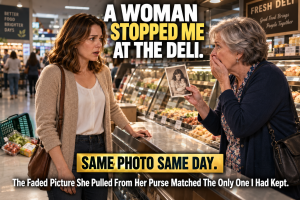
A woman at the Walmart deli stared at me for ten full seconds before saying I looked exactly like a girl named Catherine from 1987. My name is Catherine. I was adopted that same year. When she asked my birthday and I answered March 14, her basket hit the floor and she pulled out a faded photo I have carried my entire life.
Part 1
I only went to Walmart that Tuesday because we were out of the honey-glazed ham my husband liked on sandwiches. It was an ordinary errand on an ordinary afternoon. I had left work twenty minutes early, parked in the far lot because the close spaces were taken, and walked in without a list. The deli counter was slow. Two people ahead of me. I stood there looking at the prices of potato salad and thinking about whether we needed mustard.
That was when I felt it. The weight of someone staring.
I turned my head. An older woman stood two feet to my left, close enough that her coat almost brushed my sleeve. She was perhaps sixty-two or sixty-three, short gray hair combed neatly to one side, a navy cardigan buttoned over a blouse with small blue flowers. Her shopping basket hung from one arm. She was not looking at the meats. She was looking at my face.
She did not glance away when I met her eyes. She kept staring. I counted the seconds because the silence felt wrong. One. Two. Five. Ten.
“You look exactly like someone I used to know,” she said.
Her voice was low and careful, the way people speak when they are not sure they should be speaking at all.
I gave a small, polite smile. The kind you give strangers in grocery stores. “Who?”
“A girl named Catherine. She died in 1987. Car accident.”
The words landed strangely. Not because they were tragic. Because they were specific. Most people who say you remind them of someone leave it vague. This woman had a year and a cause.
I heard myself answer before I had decided to answer. “My name is Catherine. I was adopted in 1987.”
The basket slipped from her arm. It hit the linoleum with a dull plastic crack. A loaf of bread rolled out. She did not look down. She reached out and closed her fingers around my forearm, not hard, but as if she needed to confirm I was solid.
“What’s your birthday?”
“March 14.”
She covered her mouth with her free hand. The color left her face so quickly I thought she might be sick.
“That was her birthday.”
People at the counter had started to notice. The man behind me shifted his weight. The deli worker paused with the slicer in her hand. I felt heat rise in my own face, the particular embarrassment of being the center of a scene you did not create.
I did not pull my arm away. I should have. Instead I stood there while she stared at me as if I had walked out of a photograph.
I have always known I was adopted. My parents told me when I was six, sitting on the edge of my bed with a small white envelope. They said they chose me. They said the agency was private and respectable. They said my birth mother had been young and had wanted me to have a stable home. They paid twelve thousand dollars. I remember the number because my father mentioned it once, years later, when he was explaining why they never took expensive vacations. The agency closed in 1991. After that there were no more records to request, no more letters that could be sent. The trail simply ended.
I was thirty-nine years old standing in that Walmart, and I had made peace with the ending of that trail. Or I thought I had.
The woman lowered her hand from her mouth. She reached into her purse with fingers that trembled. She pulled out a wallet. From the inner sleeve she slid a photograph that had gone soft at the corners and yellow at the edges.
She held it up.
A young woman, maybe nineteen or twenty, dark hair falling over one shoulder, looking down at a newborn she held against her chest. The baby’s face was turned inward. The young woman’s expression was the particular mixture of exhaustion and fierce tenderness that I had seen in other old pictures of new mothers.
I knew that photograph.
I have the same one.
It sits in a small wooden frame on the bookcase in my living room, the only object my adoptive mother ever gave me that she said came “from before.” She told me the agency included it in the file. She told me it was the last picture taken before I was placed.
The woman in the photograph was my birth mother.
I looked from the faded print in the stranger’s hand to her face. The shape of the jaw. The set of the eyes. Thirty-nine years had changed the surface, but the structure underneath had not moved.
My mouth went dry.
The deli worker asked if anyone was ready to order. Neither of us answered.
Part 2
We did not stay at the counter. The woman—she told me her name was Margaret Ellis while we were still standing there—picked up her basket with one hand and kept the photograph in the other. I followed her to the small cluster of tables near the bakery, the ones no one really uses except people waiting for prescriptions. She set the basket down. I set my purse down. We sat.
For a moment neither of us spoke. The store noise continued around us: the beep of registers, a child asking for a cookie, the rumble of a cart with a bad wheel.
Margaret placed the photograph on the table between us, face up.
“I have carried this for thirty-nine years,” she said. “I used to take it out every March 14. Then I stopped for a while because it hurt too much. Then I started again.”
I reached into the inner pocket of my own purse. I keep the matching print in a small plastic sleeve so it will not bend further. I laid it beside hers.
They were not similar. They were the same picture. Same crease in the upper left corner. Same slight overexposure on the window behind the young woman. Same way the baby’s fist was curled against the blanket.
Margaret’s eyes filled. She did not wipe them.
“Her name was Sarah,” she said. “Sarah Catherine Ellis. She was my daughter. She was twenty when she had you. The plan was that she would keep you. We had the crib. We had the clothes. We had a name.”
She stopped. I waited.
“There was an accident two weeks after you were born. Rain. A curve on County Road 12. Sarah was driving. You were in the back in the infant seat. I was at work. By the time I reached the hospital they told me Sarah was gone and that the baby had not survived either.”
She said it the way people recite a story they have told themselves a thousand times so the words will not break them again.
“They gave me this photograph because it was in her hospital bag. They said it was taken the morning she was discharged. One last picture before they left.”
I looked at the young woman in the picture. Sarah. My birth mother. Dead at twenty, according to the story Margaret had lived with since 1987.
And yet I was sitting across from Margaret in a Walmart in 2026.
“I was adopted through a private agency,” I said. My voice sounded thin. “My parents paid twelve thousand dollars. The agency closed in 1991. There were never any more records.”
Margaret nodded slowly, as if a piece she had never been able to name had finally clicked.
“The hospital was small. Rural. After the accident there was confusion about transfers, about who had been taken where. I was in no condition to ask the right questions. I signed papers I barely read. I believed what they told me because the alternative was hoping, and hoping felt crueler.”
She reached across the table but did not touch me. Her hand rested near the two photographs.
“You have her mouth,” she said. “And her hands. Sarah had long fingers. She used to play piano badly and laugh about it.”
I looked down at my own hands on the table. I have never played piano.
A woman at the next table glanced over and then looked away, the way people do when they realize they have walked in on something private.
I asked the question that had been sitting in my throat since she said the year.
“If they told you I died, how am I here?”
Margaret shook her head. “I don’t know. I have asked myself that sentence every day for thirty-nine years in different words. I thought I was seeing ghosts in grocery stores. I thought I was losing my mind. Then I saw you standing there looking at the ham and I knew I was not crazy. I knew it in my body before I knew it in my head.”
We sat with that.
I thought of my adoptive mother, Diane, who had died two years earlier after a short illness. I thought of the way she used to smooth my hair when I was small and say, “You were wanted twice.” Once by Sarah, she meant, and once by them. I had never known if that first wanting was real. Now a woman who had kept a photograph for thirty-nine years was telling me it had been.
Margaret asked if I had children. I told her I had a son, eight years old, named Thomas. She smiled for the first time, a small broken thing.
“Sarah wanted to name you Catherine after her grandmother. That was the one thing she was certain about.”
My full name is Catherine Anne Walsh. Walsh is my husband’s name. Anne was Diane’s mother’s name. The Catherine had always been mine.
The fluorescent lights hummed. Somewhere a voice on the intercom called for a cleanup in aisle six.
I did not know what to do with my hands. I did not know what to do with the fact that the woman across from me had mourned me for longer than I had been alive in the life I knew.
Part 3
We exchanged numbers before we left the store. It felt both too much and not enough. Margaret wrote hers on the back of a receipt in small careful script. I put it in my wallet next to the photograph sleeve.
That night I sat at the kitchen table after Thomas was asleep and told my husband, David, everything. He listened the way he always does, elbows on the table, not interrupting. When I finished he looked at the two photographs I had laid out—the one from Margaret and the one from my bookcase.
“They’re the same picture,” he said.
“I know.”
“And she thought you died in the same accident that killed your birth mother.”
“Yes.”
He was quiet for a while. Then he said, “Do you want to see her again?”
I did. I also wanted to run from the entire thing. Both feelings sat in my chest at the same time.
The next afternoon Margaret called. Her voice on the phone was steadier than it had been in the store. She asked if I would come to her house. She lived twenty minutes outside town, a white farmhouse with a porch that sagged a little on the left side. I went on Saturday while David took Thomas to soccer.
Margaret had set out coffee and a plate of cookies she admitted she had bought that morning because she did not trust herself to bake. The living room was full of framed pictures. Sarah at sixteen in a choir robe. Sarah at eighteen leaning against a truck. Sarah pregnant, standing in a garden, one hand on her belly, squinting into the sun. I stood in front of that last one for a long time. I had never seen my birth mother’s face except in the one faded print. Here she was laughing.
Margaret watched me look.
“She was stubborn,” she said. “And kind in a way that made people underestimate her. She wanted to finish nursing school. She had one more semester when she found out she was pregnant. The father was a boy from two towns over. He left before you were born. Sarah said she did not need him. She said she had me.”
Margaret’s voice caught on the last sentence. I understood. She had not been enough to keep the story from breaking.
We sat with coffee growing cold. I asked about the days after the accident. Margaret described the hospital corridor, the chaplain, the way the doctor would not meet her eyes when he said both of them were gone. She described the funeral. A small one. Sarah in a closed casket. No baby to bury because they told her there were no remains that could be released. She had planted a rose bush anyway.
“I still tend it,” she said. “It feels foolish now.”
I told her about Diane and Robert, my adoptive parents. How they had been older when they adopted, how they had tried for years and then chosen the private agency because the wait was shorter. How Diane had kept the photograph in a drawer until I was old enough to ask questions. How Robert used to take me fishing and never once made me feel like I was a second choice.
Margaret listened with her hands folded in her lap. When I finished she said, “I am glad they were good. I needed them to be good. I have spent decades hoping whoever had you was good.”
The sentence landed in me with unexpected force. All those years she had been hoping for me in the dark.
Before I left she gave me a small box. Inside were Sarah’s high-school yearbook, a silver bracelet with a tiny piano charm, and a letter Sarah had started writing to the baby and never finished. The letter was dated two days before the accident. It began, “You are smaller than I expected and already you have changed the size of everything.”
I read it in my car before I drove home. I had to pull over.
That night I put the letter in the same drawer where Diane had once kept the photograph. Two mothers. Two sets of objects. One life that had been split down the middle without anyone meaning to split it.
Part 4
The questions started arriving in the middle of ordinary hours.
Why had the hospital told Margaret both had died if I had lived? Who had arranged the private adoption so quickly? Twelve thousand dollars in 1987 was not a small sum. Who received it? Why did the agency close four years later and leave no forwarding records?
I began with the easy things. I requested my own adoption file from the state. The reply came back thin: the private agency, Harvest Home Infant Services, had surrendered its license in 1991 after a series of complaints about incomplete paperwork and missing medical histories. The state had a cover sheet and a single page that listed my date of placement and the names of Robert and Diane Walsh. Nothing about a birth mother. Nothing about a hospital. Nothing about a car accident.
I called the county records office where the accident had happened. A patient clerk told me that traffic fatalities from 1987 were stored off-site and would take two to three weeks to retrieve. I gave her the date Margaret had given me. I gave her Sarah’s full name.
While I waited I drove out to County Road 12. It is a two-lane stretch with a sharp bend near an old oak that still has a faded scar in the bark. I parked on the shoulder and sat with the engine off. I tried to imagine rain, a twenty-year-old girl with a two-week-old baby in the back, the moment the car left the road. I could not make the picture hold. It kept sliding into the photograph of Sarah looking down at me with that exhausted tenderness.
Margaret and I began meeting once a week. Sometimes at her house, sometimes at a quiet diner halfway between us. We did not always talk about 1987. She asked about Thomas’s school. I asked about the rose bush. She taught me how Sarah used to take her coffee—too much sugar, no patience for waiting until it cooled. Small things. The kind of things that make a person real instead of a story.
One afternoon she said, “I need you to know I am not trying to replace the mother who raised you. Diane did the daily work. I only got the ghost of it.”
I told her I understood. I also told her that understanding and feeling were not always the same country.
David was careful with me during those weeks. He did not press. He did not dismiss. At night he would find me sitting in the living room with both photographs and the unfinished letter and he would sit down without asking what I was thinking. Sometimes that silence was the most useful thing he could give.
The county records arrived on a Thursday. I opened the envelope at the kitchen table after Thomas went to bed.
There had been an accident. Sarah Catherine Ellis, age twenty, pronounced dead at the scene. An infant, female, approximately two weeks old, listed as “unresponsive, transported separately.” The receiving hospital was not the same one where Margaret had been told to go. The infant’s chart, what little of it existed, noted “private placement pending” in a margin note dated three days later.
Private placement pending.
Someone had decided, while Margaret was identifying her daughter’s body, that the baby would not be going home.
I sat with that sentence until the refrigerator kicked on and startled me.
The next morning I called Margaret. I read her the line. There was a long quiet on her end.
“I never knew there was a second hospital,” she said. “They told me everything happened in one place.”
We were both thinking the same thing. Someone had separated us on purpose.
Part 5
Harvest Home Infant Services had operated out of a converted house two counties over. The building was now a dentist’s office. The name of the director in 1987 was a woman named Lillian Crowe. She would be in her late eighties if she was still alive.
I found an obituary from 2019. Lillian Crowe, 81, former social worker, survived by a niece.
The niece lived in the next state. I wrote a letter because a phone call felt too abrupt. I explained who I was, the year, the agency, the photograph, the accident. I did not accuse. I asked if any files or memories remained.
Three weeks later a package arrived. Inside was a photocopy of a handwritten ledger page and a short note from the niece.
“Aunt Lil kept some things she probably shouldn’t have. I don’t know if this helps. She used to say some babies needed to disappear to be safe. I never asked what that meant.”
The ledger page was dated April 3, 1987. One line:
Ellis, infant female. Birth mother deceased. Receiving family Walsh. Fee collected in full. No further contact.
No further contact.
The fee was listed as $12,000.
I stared at the words “Birth mother deceased.” Sarah had been dead. That part was true. But I had not been. The ledger treated my survival as an administrative detail to be managed.
Margaret came over the evening I received the package. We sat at my kitchen table with the photocopy between us. Thomas was in the other room building something loud with blocks. The ordinary noise of a child who existed because I had existed felt almost too much.
Margaret traced the line with one finger.
“She was twenty,” she said. “She had one semester left. She had a plan. And someone looked at her baby and decided the cleanest story was that both of us were gone.”
I thought about Diane and Robert writing a check for twelve thousand dollars, believing they were giving a home to a child who needed one. They had not known they were participating in an erasure.
That night I dreamed of the deli counter. In the dream Margaret never stopped staring. In the dream the photograph in her hand was blank.
I woke up and walked through the dark house to Thomas’s door and listened to him breathe. Then I went back to bed and lay there thinking about all the versions of a life that can be written down on a single ledger line.
Part 6
We decided to go to the second hospital, the one that had received the infant.
It was a regional medical center now, much larger than it had been in 1987. The records department required a formal request and proof of identity. I brought my birth certificate—the amended one that listed Robert and Diane as parents—and the original adoption decree. I also brought Margaret. The clerk looked at us for a long moment, two women a generation apart asking for the same baby’s chart, and then she disappeared into the back.
What she returned with was not a full file. Most of it had been destroyed in a flood in 1998, she said. What remained was a transfer sheet and a nurse’s note.
The transfer sheet listed the infant as “Baby Girl Ellis, approx. 14 days, condition stable upon arrival, private agency notified.”
The nurse’s note, written in hurried script, said: “Grandmother not present. Agency representative arrived with paperwork. Infant released to agency custody 4/2/87.”
Grandmother not present.
Margaret sat down hard in the plastic chair in the hallway.
“I was at the other hospital,” she said. “Identifying Sarah. They never called me. They never asked if there was family.”
The agency representative had arrived with paperwork. Paperwork that already listed the birth mother as deceased and the infant as available.
Someone had moved quickly.
We sat in the hospital cafeteria because neither of us was ready to drive. Margaret wrapped both hands around a cup of tea she did not drink.
“I keep trying to decide if I am angry at the dead woman who ran the agency or at the rain or at myself for believing the first story I was told.”
“You were in shock,” I said. “They handed you a finished story and you were in no condition to take it apart.”
She looked at me. “You sound like Sarah when you say things like that. She used to make excuses for people until I told her to stop.”
The comparison startled me. I did not know Sarah except through photographs and a half-finished letter. Yet Margaret kept finding her in my sentences.
On the drive home I asked Margaret if she wanted to stop at the rose bush. She did. It was late afternoon, the light low and gold. The bush was still there at the edge of the small cemetery, a little wild, a few late blooms. Margaret knelt and pulled a weed. I stood behind her and looked at the headstone that had only Sarah’s name and dates.
There was no second marker. There never had been.
Margaret spoke without turning around. “I used to talk to both of you here. I know that sounds unwell. I did it anyway.”
I did not tell her it sounded unwell. I told her I understood why she had needed someone to talk to.
Part 7
The more we learned, the more the original story Margaret had been given looked like a convenience.
A young mother dead. A grandmother in another hospital, unreachable in the first critical hours. An agency that specialized in private, quiet placements. A fee paid in full. A ledger that closed the file with two words: no further contact.
I started to wonder about the boy from two towns over, the one who had left before I was born. Margaret had a last name. We found him after two weekends of searching public records and an old high-school directory. He was living six hours away, married, three grown children. I did not want to call him. Margaret did it because she said she needed to know if he had ever been told anything.
He had not. He remembered Sarah. He remembered being frightened and young and leaving. He had never known there was a baby who lived. The conversation was short and awkward and left Margaret quieter than usual.
“He does not get to be part of this,” she said afterward. “He left. That is his whole contribution.”
I agreed. I already had a father. Robert had taught me how to change oil and how to apologize when I was wrong. I did not need a second origin story in that direction.
What I did need, I realized, was to tell Diane.
She had been gone two years. The conversations I wanted were no longer possible in the ordinary way. So I drove to the cemetery where she and Robert are buried and I sat on the little bench the cemetery provides and I told her the entire thing out loud. The Walmart. The photograph. The ledger. The second hospital. The rose bush.
I told her I was not trying to undo what she had done. I told her I was trying to hold both stories at once without dropping either.
A groundskeeper passed and nodded. I nodded back. Then I sat there until the sun dropped behind the trees.
That night Thomas asked why I looked sad. I told him I was thinking about grandmothers. He considered this with the seriousness of an eight-year-old.
“You have two now,” he said. “The one in heaven and the new one who makes cookies from the store.”
I laughed for the first time in days. Margaret did buy store cookies. She had said so herself.
The next week Margaret asked if she could meet Thomas properly, not just hear about him. We arranged a Saturday afternoon at the park. She brought a small wooden puzzle she said Sarah had liked at that age. Thomas was polite and then, after twenty minutes, forgot to be polite and just played. Margaret watched him with an expression I am still not sure I have the right word for. Grief and hunger and something like relief all occupying the same face.
When we left the park she said, “I missed his whole life until now. I do not want to miss any more of it if you will let me stay.”
I told her I would let her stay.
Part 8
Letting her stay turned out to be more complicated than a sentence in a park.
My life already had a shape. David, Thomas, the house, the job at the library, the friends who had known me as Diane and Robert’s daughter. Inserting Margaret meant explaining her. It meant deciding how much of the accident and the agency and the lie to tell people who did not need every detail.
Some friends were simply happy for me. Some asked careful questions about whether I was sure. One acquaintance said, “But you already had a family,” as if love were a limited resource that would run out if I acknowledged a second origin.
I got better at a short version: I met my birth grandmother. There was a mix-up after my birth mother died. We found each other by accident in a grocery store. That was usually enough.
Margaret and I kept looking for the last missing piece: who had made the call to send me to the agency instead of waiting for family. The niece of Lillian Crowe had no more papers. The hospital had no more notes. The county attorney’s office from 1987 was long reorganized.
We reached a point where the search itself became a way of not sitting still with what we already knew.
One evening Margaret said, “I think we have the shape of it. Someone decided a clean adoption was kinder than a complicated reunion. They were wrong. But they are gone. We are not.”
I wanted a villain I could still speak to. I did not get one.
What I got instead was a Tuesday afternoon in October when Margaret came to the library where I work and stood quietly by the new-books shelf until I noticed her. She had brought a manila envelope.
Inside was a photograph I had not seen. Sarah, maybe seventeen, sitting on the porch steps of the farmhouse, holding a cat, grinning at whoever held the camera. On the back, in handwriting I now recognized as Margaret’s from thirty years earlier: “Sarah, summer before everything changed.”
“I wanted you to have one where she looks happy,” Margaret said. “The hospital one is too heavy to be the only face you know.”
I took it home and put it on the bookcase next to the faded wallet print. Two versions of the same young woman. One exhausted and new. One still unmarked.
David looked at them that night and said, “She looks like you around the eyes when you are about to laugh.”
I had never noticed.
Part 9
Winter came. Thomas lost a tooth. The rose bush at the cemetery went dormant. Margaret started coming to Sunday dinners. She and David talked about gardens. She and Thomas built a crooked birdhouse. I watched them from the kitchen window and felt the strange sensation of a life rearranging itself without asking my permission first.
The last large question sat between Margaret and me for weeks before either of us named it.
What did we want this to become?
She was not trying to be my mother. Diane had been my mother. Margaret was the woman who had lost her daughter and then, decades later, found the granddaughter that daughter had left behind. The language for that is awkward. Grandmother is accurate and also too small.
One night after Thomas was asleep we sat on my back steps even though it was cold. Margaret had her coat wrapped tight.
“I used to think if I ever found you I would have a speech,” she said. “I would explain and apologize and make the years make sense. Now I think the years do not have to make sense. They happened. We are here anyway.”
I told her I did not need a speech. I needed time. I needed the ordinary repetitions of meals and phone calls and sitting in the same room without the past filling every silence.
She nodded. “I can do ordinary. I have had enough extraordinary to last.”
In January I requested a copy of Sarah’s death certificate for no reason except that I wanted to see the official version of the story next to the unofficial one we had rebuilt. The cause was listed as injuries from motor-vehicle accident. The informant was Margaret Ellis. The date matched everything we already knew.
I filed it in the same drawer with the letter and the ledger photocopy and Diane’s old notes about the adoption. The drawer was getting crowded. I did not mind.
The following month Margaret asked if I would go with her to the farmhouse attic. She wanted to look for a box of Sarah’s nursing-school books. We found them, dusty, the pages still marked with Sarah’s small handwriting in the margins. In one book was a scrap of paper with a list titled “Things to tell the baby someday.”
The list was short.
Your grandmother makes the best pie and the worst coffee. You can be loud. I will not leave.
Sarah had not been able to keep the last promise. The accident had taken that choice from her. But the list existed. I held it under the attic light and felt the particular ache of a message that had waited thirty-nine years for its reader.
Margaret watched my face.
“She would have liked you,” she said. “That is the part I keep coming back to. She would have liked the person you became.”
I did not answer right away. I was thinking of Diane saying I was wanted twice. I was thinking that the wanting had been real on both sides, even when the stories they were told did not match.
Part 10
Spring returned the way it always does, without asking whether we were ready.
On March 14 I woke before the alarm. Thomas had made a crooked card with too much glue. David had bought the good coffee. Margaret arrived mid-morning with a small cake she had actually baked this time, uneven and too sweet.
We did not treat the day like an anniversary of a death. We treated it like a birthday that had been celebrated in two different houses for a long time and was now being celebrated in one.
After cake we drove out to the cemetery. Margaret brought shears. I brought the photograph of Sarah on the porch, the happy one, and leaned it against the headstone for a few minutes so the light could fall on both the carved name and the living face. Then I put it back in my bag. Some things belong in houses, not in graves.
Margaret cut a few stems from the rose bush. She handed one to me.
“For Diane,” she said. “She kept you safe while I was looking in the wrong direction.”
I took it. We stood there a while. No speeches. The wind moved through the grass. A truck passed on the road beyond the fence.
In the months that followed the sharp edges of the discovery softened into something I could live inside. Margaret became a regular presence without becoming a replacement. Thomas started calling her Mags because grandmother felt too formal and she laughed every time. David built her a small raised bed in our yard so she could grow the tomatoes Sarah used to steal off the vine.
I still have days when the Walmart scene replays itself without warning: the ten-second stare, the basket hitting the floor, the two identical photographs side by side on a sticky bakery table. On those days I take both pictures down from the bookcase and look at them until the shock settles back into fact.
The fact is this. A young woman named Sarah had a baby she intended to keep. Rain and a curve in the road took her. People who thought they were being efficient took the baby and wrote “deceased” on a line so the paperwork would close. A couple who wanted a child paid a fee and loved that child without knowing the first chapter had been erased. An older woman carried a photograph for thirty-nine years and then reached for a stranger’s arm in a grocery store because the stranger had her daughter’s mouth.
I am the place where those facts meet.
I do not have every answer. I do not know the exact hour someone decided I should disappear from my own family. I do not know what Lillian Crowe told herself when she wrote “no further contact.” I have stopped needing those hours.
What I have is a son who builds birdhouses, a husband who sits with me in silence when the past gets loud, a mother who raised me and is gone, a grandmother who found me and stayed, and a young woman in two photographs who did not get to finish her list.
On ordinary Tuesdays I still buy ham at the same Walmart. Sometimes I glance at the deli counter. No one is staring. The fluorescent lights hum. Life continues in its unremarkable way, which is the only kind of miracle I trust now.
The woman in the photograph was my mother.
The woman who showed it to me is still here.
That is the ending I can live with.