Part 1: When Love Started Speaking Softer
For twenty years, he had known the sound of her footsteps in the house.
He knew the way she moved through a room when she was tired, the way she sighed when something was on her mind, the way she laughed when she forgot, even for a moment, the weight she carried. Seventeen of those years had been marriage. A life built together. Bills, birthdays, routines, inside jokes, arguments, apologies, quiet dinners, and thousands of ordinary days that somehow became a whole lifetime.
So when she finally said the words, they did not sound ordinary at all.
“I love you,” she told him, “but I don’t think I’m in love with you anymore.”
The sentence landed like something breaking in the dark.
He wanted to answer right away. He wanted to explain, fix, plead, promise, rewind. But there was no rewinding a moment like that. There was only the silence after it — and the terrible realization that she had probably been carrying those words long before she spoke them.
At first, all he could feel was fear.
Fear of losing her.
Fear of losing their life.
Fear that he had noticed too late.
Fear that the woman he loved had slowly become lonely beside him.
They started marriage counseling, and he started therapy on his own. At first, therapy felt like walking into a room full of mirrors he had avoided for years. He saw things he didn’t want to see. Patterns. Defenses. The way he shut down when emotions became too uncomfortable. The way he tried to explain away pain instead of sitting with it. The way he had mistaken problem-solving for listening.
And slowly, painfully, he began to understand.
She had not stopped speaking overnight.
There had been conversations she tried to have. Feelings she tried to share. Hurts she tried to name. But somewhere along the way, without meaning to, he had made those conversations harder. When she was upset, he became defensive. When she was hurt, he tried to correct the details. When she needed comfort, he offered explanations. When she needed to feel understood, he made her feel alone.
He had not meant to invalidate her.
But intention did not erase impact.
That was one of the hardest lessons.
In counseling, she admitted she saw a change in him. He was calmer now. More open. More willing to talk. He didn’t run from hard conversations the same way. He listened longer. He apologized differently. Not perfectly, but honestly.
And that gave him hope.
Not certainty. Not a guarantee.
Just hope.
She was beginning her own therapy too — to work on her self-esteem, her pain, and the part of her that had started seeking attention outside the marriage. That hurt him deeply, but he also knew their story was not simple. They had both arrived at this fragile place carrying wounds.
Still, every morning, he woke with the same question pressing against his chest:
How do I help her fall in love with me again?
He thought about the beginning.
Back when they were dating, he had been curious about her. He asked questions. He made plans. He noticed little things. He tried. Not because he was afraid of losing her, but because being close to her felt like a gift.
Maybe, he thought, that was where he had to begin again.
Not with grand gestures.
Not with pressure.
Not with begging her heart to feel something it could not yet feel.
But with small things.
A cup of coffee.
A walk.
A real question.
A quiet apology.
A moment where he listened and did not defend himself.
He could not force romance to return.
But maybe he could help rebuild the place where romance used to live.
And for now, that had to be enough.
Part 2: Learning to Listen
The first thing he had to learn was how not to chase her.
That was harder than he expected.
Every part of him wanted answers. He wanted to know where they stood, what she felt, whether she could imagine loving him that way again. He wanted to ask every morning, Are we better today? Are you closer to me? Are you staying?
But he was beginning to understand that his fear, if he handed it to her too often, could become another weight for her to carry.
So he practiced holding it himself.
Some nights, that meant sitting alone in the quiet after she went to bed, breathing through the ache in his chest. Some mornings, it meant writing in a notebook instead of asking her for reassurance. Other times, it meant telling his therapist the truth: that he was terrified, ashamed, hopeful, and angry all at once.
He learned that growth did not feel noble while it was happening.
Sometimes it felt like swallowing words he would have once thrown into an argument. Sometimes it felt like saying, “Tell me more,” when every defensive part of him wanted to say, “That’s not what I meant.” Sometimes it felt like apologizing without adding a reason at the end.
One evening, she sat across from him at the kitchen table, her hands wrapped around a mug of tea.
“I think what hurt the most,” she said slowly, “was feeling like I had to prove my feelings before you would care about them.”
His stomach tightened. The old version of him rose quickly.
That’s not fair.
I did care.
I was trying.
You never explained it that way.
He felt all of those sentences crowd his throat.
But he didn’t say them.
Instead, he took a breath.
“I can see how I made you feel that way,” he said. “I’m sorry. I think I was so focused on whether I was being blamed that I missed the fact that you were hurting.”
She looked down at her mug.
For a moment, he couldn’t tell if what he said had mattered. Then her shoulders softened just a little.
“That’s what I needed before,” she whispered.
The words were small, but they reached him deeply.
Not because they fixed everything.
Because they showed him the door was not completely closed.
After that, he stopped thinking of their marriage as something he could repair with one perfect conversation. It was more like rebuilding a bridge one board at a time. Every safe conversation added a board. Every moment of patience added another. Every time he listened without defending himself, another.
And every mistake still mattered.
There were days he slipped. Days fear got ahead of wisdom. Days he asked too many questions or looked too closely for signs of love in her face. On those days, he could see her retreat a little, like a hand pulling back from heat.
But now, instead of blaming her for pulling away, he tried to notice the fire.
“I’m sorry,” he told her once after pushing too hard. “I think I was looking for reassurance, and I put that pressure on you. I’ll bring that to therapy instead of making it yours to solve.”
She nodded.
“Thank you,” she said.
It wasn’t romantic.
It wasn’t passionate.
But it was trust.
And trust, he was learning, had to come before anything else.
He also began dating her differently.
Not like a man trying to win a prize. Not like a husband desperately auditioning for another chance. He asked her gently, with no trap hidden inside the question.
“Would you want to go for a walk with me after dinner? No heavy talk unless you want to. Just air.”
Sometimes she said yes.
Sometimes she said she was tired.
He practiced accepting both answers with the same kindness.
On the nights she said yes, they walked through their neighborhood under the dim streetlights. At first, they talked about simple things — work, errands, the neighbor’s dog, a show they had watched years ago. He missed the deeper closeness, but he didn’t force it.
One night, she laughed at something he said.
Really laughed.
The sound caught him off guard. It was familiar and distant at the same time, like hearing a song from another life.
He wanted to grab onto it. He wanted to say, See? We’re still in here somewhere.
But he didn’t.
He just smiled and let the moment breathe.
Because maybe love, when wounded, did not return through force.
Maybe it returned through safety.
Maybe it returned through ordinary evenings where nobody demanded that it prove itself.
A week later, before leaving for work, he left a note beside her coffee.
Not a dramatic letter. Not a plea.
Just a few words:
I’m grateful for the walk last night. I liked hearing you laugh.
When he came home, the note was still there.
But it had been moved.
Placed carefully near the window, beside the small plant she watered every morning.
He noticed.
And for the first time in months, hope did not feel like panic.
It felt quiet.
It felt patient.
It felt like maybe, just maybe, something fragile was still alive between them.
Part 3: What Love Became
He learned, slowly, that healing was not a straight road.
There were good weeks when they felt almost like themselves again. They cooked together. They walked after dinner. They sat on the couch close enough for their shoulders to touch. Sometimes she smiled at him in a way that made his chest ache with hope.
Then there were hard days.
Days when she grew distant again. Days when a small misunderstanding reopened an old wound. Days when he could see in her eyes that part of her still did not trust the change.
Before, that would have scared him into pushing.
Now, he tried to stay steady.
Not perfect. Never perfect.
But steady.
His therapy continued. Hers began. Marriage counseling became less about deciding who was right and more about understanding how they had both become so lonely. He learned to say, “I’m listening,” and mean it. She learned to say, “I’m scared,” instead of disappearing behind silence.
They spoke honestly about the attention she had been seeking outside the marriage. It was painful. There were tears, anger, shame, and boundaries that had to be named clearly. He told her it hurt him. She did not minimize it. She told him why it had happened, but also took responsibility for the choices she had made.
For the first time in a long time, neither of them ran from the truth.
That did not make the truth easy.
But it made it real.
One evening, months after the first terrible conversation, they went back to the little restaurant where they had eaten on one of their earliest dates. It had changed over the years. New paint. New tables. A different menu. Even the street outside looked busier than he remembered.
At first, he felt disappointed.
He had wanted it to feel the same.
He wanted proof that they could go back.
But as he watched her across the table, he realized something important.
They were not the same people who had sat there all those years ago.
She was older now, carrying wounds he had not always seen. He was older too, humbled by the ways he had failed and changed by the work it took to face himself. Their marriage was not young anymore. It had history. Scars. Regrets. Mercy.
Maybe the goal had never been to go back.
Maybe the goal was to meet each other again.
She looked around the restaurant and smiled faintly.
“Do you remember how nervous you were here?” she asked.
He laughed softly. “I thought I hid it better.”
“You didn’t.”
For a moment, the years between them softened.
They talked that night not about saving the marriage, not about therapy, not about what had gone wrong. They talked about music they used to love, places they still wanted to see, how strange it was to know someone for so long and still not know everything.
When dinner was over, they walked to the car slowly.
The air was cool. The sky was dark. And for once, he did not feel the need to ask what the night meant.
At the car, she paused.
“I don’t know if everything feels the way it used to,” she said.
His heart braced itself.
But then she reached for his hand.
“But I feel closer to you than I have in a long time.”
He looked down at their hands.
There was no dramatic music. No sudden certainty. No magical return to the beginning.
Just her fingers in his.
And somehow, that was more honest than any fairy-tale ending could have been.
“I’ll take closer,” he said quietly.
She squeezed his hand.
In the months that followed, love did not come rushing back like a storm. It returned like morning light — slowly, gently, almost unnoticed until one day the room was brighter.
There were still difficult conversations. Still moments of fear. Still old habits they had to catch before they became walls again. But there was also laughter. Touch. Curiosity. Apologies that did not come with excuses. Boundaries that protected them instead of punishing them.
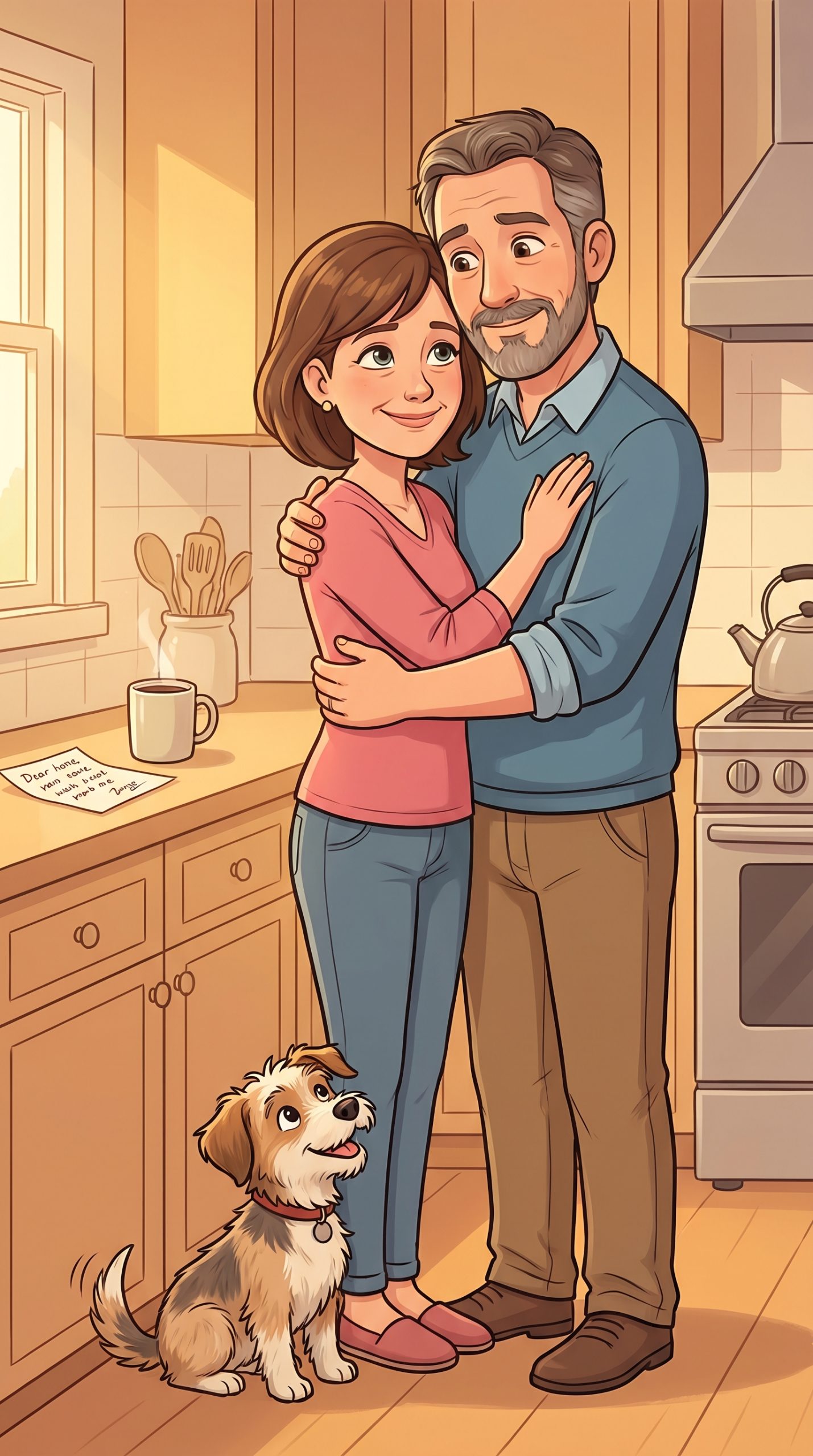
And one Sunday morning, while they stood together in the kitchen making breakfast, she looked at him for a long moment.
“What?” he asked, smiling nervously.
She shook her head.
“Nothing,” she said. “I just… I missed you.”
He felt the words settle somewhere deep.
Not because everything was fixed forever.
But because she was there.
Because he was there.
Because they had stopped trying to resurrect the marriage they once had and started building the one they needed now.
He stepped closer, giving her room to move away if she wanted to.
She didn’t.
Instead, she leaned into him.
And he held her carefully — not like something he owned, not like someone he had won back, but like someone he was still being trusted with.
That was what love became.
Not a return to the first spark.
Not a promise that they would never hurt each other again.
But a daily choice to stay awake, stay honest, stay gentle, and keep reaching for each other.
Years later, he would still remember the sentence that had almost ended them:
I love you, but I’m not in love with you anymore.
But he would also remember what came after.
The listening.
The work.
The patience.
The walks.
The quiet notes beside her coffee.
The courage it took for both of them to change.
And he would understand something he could not have understood in the beginning.
Sometimes love does not disappear.
Sometimes it is buried under years of unheard pain.
And if two people are willing to dig carefully — without blame, without force, without giving up too soon — they may not find the love they lost.
They may find something deeper.