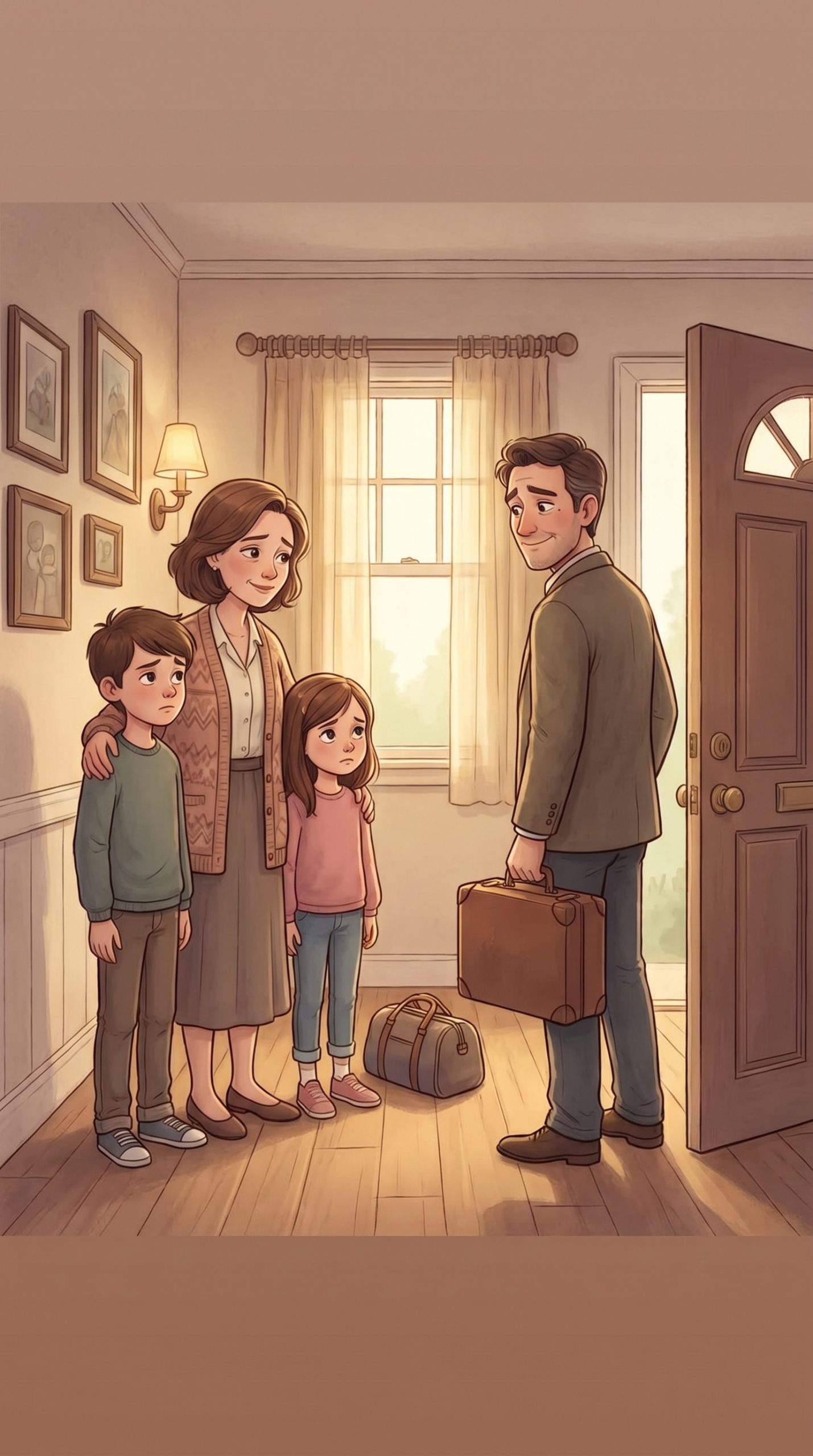
Part 1: The Meaning of the Story
This story is about a woman who has been in a relationship for 20 years, but in her heart, the relationship has already been over for 3–4 years.
She is not asking, “How do I fix this?”
She is asking, “How do I get him to understand that I am done?”
The main meaning is:
Sometimes a relationship ends emotionally long before it ends physically.
For her, the love, hope, and connection may have slowly disappeared over time. But for her husband, the ending may feel sudden because he is only now being forced to face it.
He is refusing to move out because he may be in denial, scared, angry, or hoping that if he stays, things will go back to normal.
But the story shows an important truth:
One person cannot keep a relationship alive if the other person has already decided it is over.
Because they have two children, ages 12 and 10, this situation is not just about emotions. It is also about creating a stable, safe, and respectful plan for the family.
The message of Part 1 is:
She does not need to convince him to feel ready.
She needs to be clear, calm, and take the right legal and practical steps.
It is a story about acceptance, boundaries, and choosing a peaceful ending when love has already faded.
Part 2: When One Person Won’t Let Go
For her, the relationship had ended quietly.
It had not happened in one dramatic moment. There was no single argument, no one sentence, no one night that changed everything. Instead, it had faded slowly over the years — through distance, disappointment, silence, and the heavy feeling of living beside someone while feeling completely alone.
For three or four years, she had known.
She had kept going for the children.
She had kept going because leaving felt complicated.
She had kept going because after 20 years, ending a life together was not simple.
But staying did not mean she was still in it.
By the time she finally said, “This relationship is over,” it was not a threat. It was not anger. It was not a test to see if he would change.
It was the truth.
Her husband, however, could not accept it.
To him, her words felt sudden, even though she had been carrying them for years. He argued. He refused to talk about moving out. He acted as if saying no could stop the ending from being real.
But denial did not rebuild love.
His refusal only made the house feel heavier.
The children, 12 and 10, felt the tension even when no one explained it. They noticed the quiet dinners, the closed doors, the sharp whispers, the way their parents moved around each other like strangers trying not to collide.
And that was when she understood something painful:
Protecting the children did not mean pretending everything was fine.
Protecting them meant creating honesty, stability, and peace.
She could not force her husband to accept the breakup emotionally. She could not make him grieve faster, understand sooner, or leave because she asked nicely.
But she could stop debating her decision.
She could stop explaining it a hundred different ways.
She could say, calmly and firmly:
“I know this hurts. But my decision is final. We need to make a plan for the children and the house.”
If he still refused, then the next step would not be another argument.
It would be action.
Legal advice.
A parenting plan.
Clear boundaries.
A safe living arrangement.
Support from people who understood.
Because sometimes the end of a relationship does not begin when both people agree.
Sometimes it begins when one person finally stops waiting for permission to leave.
Part 3: The Ending — Choosing Peace
In the weeks that followed, she stopped trying to make him understand.
That was the hardest part.
For so long, she had believed that if she explained it clearly enough, gently enough, or painfully enough, he would finally accept that the relationship was over. But every conversation turned into the same circle.
He said she was giving up.
She said she had been gone for years.
He said they could still fix it.
She said she no longer wanted to.
And in the middle of it all were their children.
Ages 12 and 10 — old enough to feel the tension, young enough to need both parents to be steady.
One evening, after another argument that left the house cold and silent, she sat alone in the kitchen and realized something:
She did not need him to agree with her feelings.
She needed a plan.
The next day, she called a family law attorney. Not because she wanted war, but because she needed clarity. She needed to understand the house, custody, money, and what could legally happen next. She also reached out to a counselor who specialized in helping families separate with children involved.
For the first time in years, she stopped feeling trapped by his refusal.
When she spoke to him again, her voice was calm.
“I know you don’t want this,” she said. “I know this hurts. But I am ending the relationship. We need to make a parenting plan and a living arrangement. If we can’t agree together, I will move forward through the proper legal steps.”
He stared at her as if waiting for anger.
But there was no anger left.
Only certainty.
At first, he still resisted. He refused to talk about dates. He avoided practical conversations. He told her she was destroying the family.
Those words hurt.
But she did not let them pull her back into proving herself.
“I’m not discussing whether the relationship is over anymore,” she told him. “I’m discussing how we separate in the healthiest way possible for the kids.”
That sentence became her boundary.
Slowly, reality began to reach him.
Not all at once. Not peacefully at first. But through meetings, paperwork, counseling, and the unavoidable truth that she was no longer asking for permission.
Eventually, they agreed on a temporary plan. The children would stay in their routines. School would remain the same. Both parents would have time with them. The house would be handled legally, not emotionally. And neither parent would use the children as messengers or weapons.
The day he packed some of his things, the house felt strangely quiet.
Not happy.
Not victorious.
Just quiet.
She watched him carry a bag to the car and felt a wave of sadness she had not expected. Even when something is right, it can still hurt. Twenty years do not disappear because a decision has been made.
He looked back at her from the doorway.
“I never thought we’d end up here,” he said.
She swallowed hard.
“Neither did I.”
For the first time, he did not argue.
The children cried when they were told. So did she. So did he. But they told them together, gently, with one message repeated more than once:
“This is between the adults. We both love you. You will still have both of us.”
Life did not become simple overnight.
There were schedules to adjust to. Holidays to rethink. Lonely evenings. Hard conversations. Moments of guilt. Moments of relief. Moments when the children were angry, confused, or sad.
But there was also something new in the house.
Peace.
No more pretending.
No more endless arguments about whether her feelings were real.
No more living inside a relationship that had already ended.
Over time, the children began to settle into the new rhythm. They learned that family could change shape and still hold love. They learned that honesty, though painful, was safer than silence. They learned that endings did not have to be cruel.
And she learned something too.
Leaving was not a failure.
Staying empty would have been.
The relationship had ended long before he moved out. But the day she stopped waiting for him to accept it was the day her life began moving forward again.
Not perfectly.
Not without grief.
But honestly.
And sometimes, honesty is the first doorway back to peace.