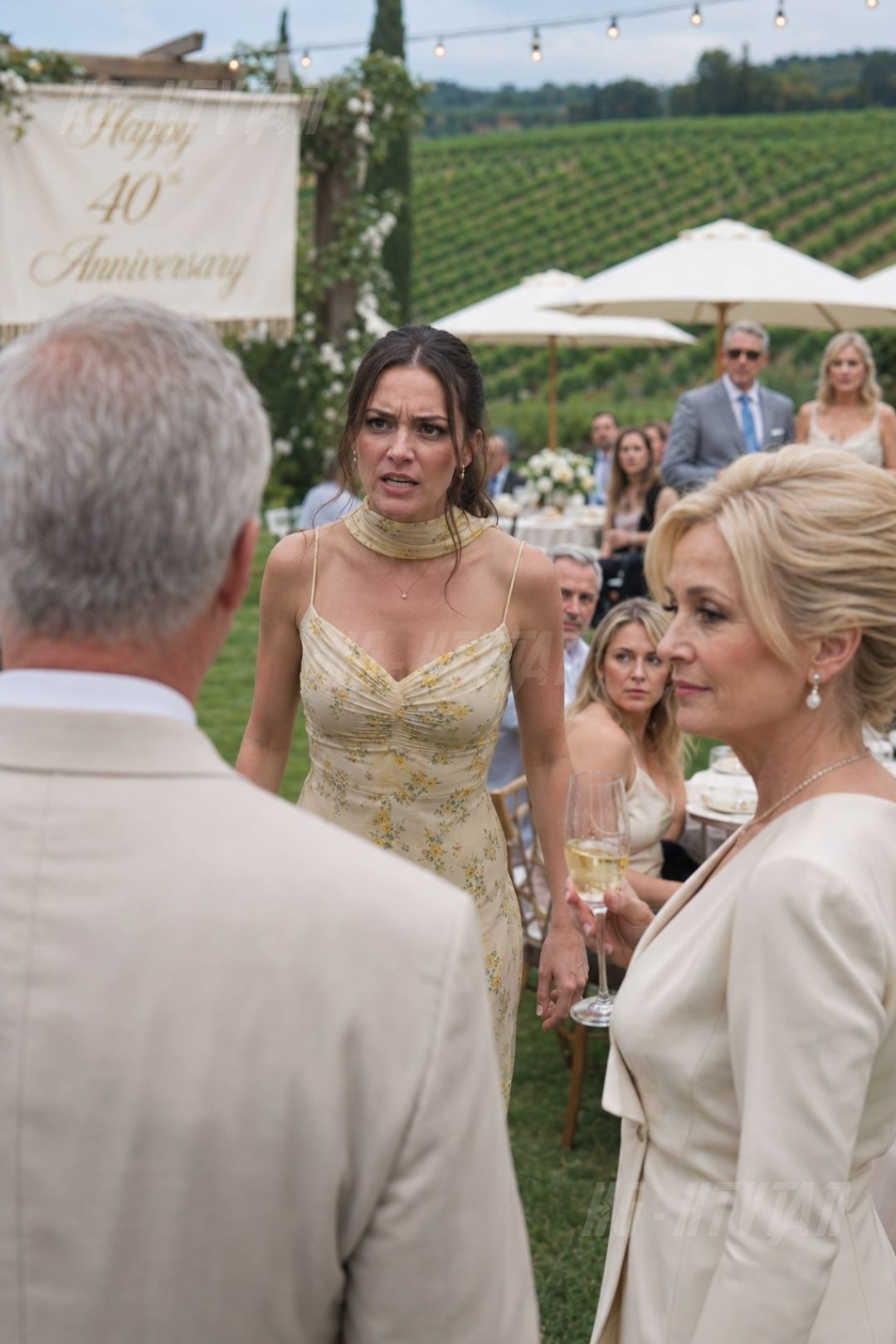

My name is Rebecca Collins, and the afternoon my daughter flew nearly twenty-three hundred miles from New York to California just to give her grandparents a handmade anniversary gift, my parents stood beneath the golden Napa Valley sun, looked into her face, and told her she was not really family.
They did not shout it.
Some cruelties do not need volume. Some of the deepest ones are delivered in clean, careful voices by people wearing pressed linen and anniversary smiles, with violin music floating behind them and rows of white chairs arranged on a vineyard lawn as if the world itself has agreed to bless the occasion. My mother, Evelyn Collins, did not scream at my daughter. She did not point toward the road or call security or create the kind of public scene that makes other guests turn around and whisper. She simply stood by the wooden gate decorated with ivory flowers, one hand resting lightly on the latch, and said, “Today is family only, sweetheart.”
Alyssa told me later that the word sweetheart was the part that made her feel cold.
Not the gate.
Not the rejection.
Not even my father standing beside my mother with his jaw set and his eyes looking somewhere past her shoulder, pretending the view of the vineyard required his full attention. It was sweetheart, that soft little sugar-coated word used to make exclusion sound polite. Used to remind a young woman who had spent her own money on a flight, dressed carefully, carried a gift she had carved by hand, and arrived with hope folded tightly inside her chest that the people hurting her still believed they were being gracious.
Alyssa had landed in California that morning after an overnight flight from New York. She was twenty years old then, studying communications at a university in Manhattan, living in a third-floor apartment with too much street noise, one narrow closet, and a roommate who labeled every shelf in the refrigerator. She had worked part-time for months at a campus bookstore to pay for the ticket herself. I offered to help, of course I did, but she said no in the gentle, stubborn way she inherited from me and her father. “I want to come because I choose to come,” she told me. “Not because someone bought my way in.”
That sentence should have warned me.
Alyssa had been trying to buy her way into the Collins family with kindness since she was old enough to understand that love there had rules. She remembered birthdays that no one remembered for her. She mailed thank-you notes for generic holiday cards that did not include her name. She asked after my mother’s garden, my father’s knee surgery, Eric’s promotions, Jessica’s children, cousins she barely knew. She showed up softly, never demanding, never dramatic, always careful not to take up too much space, as if politeness could make blood out of absence.
For my parents’ fortieth wedding anniversary, she made a gift by hand. A wooden frame, sanded and stained in the tiny craft studio near campus where she sometimes went to clear her head. Inside it, she placed a black-and-white wedding photograph of my parents from 1985, the one where my mother wore lace sleeves and held a bouquet too large for her body, where my father still had thick dark hair and the stern, confident face of a man who believed every room would eventually arrange itself around him. Alyssa had found the photo in an old album I kept in a closet. She scanned it, cleaned the edges digitally, printed it on thick paper, and wrapped the frame in pages from The New York Times because, as she said, “It looks kind of vintage.”
She picked out her dress a week before flying. Deep blue, modest neckline, soft fabric, something my mother had once complimented in passing when Alyssa wore a similar color to a cousin’s graduation. “That shade is feminine on you,” my mother had said, which was not affection, but Alyssa had preserved it anyway because children raised on crumbs can identify the shape of every crumb in the dark.
On the morning of the anniversary, Alyssa texted me from the airport.
Just landed. I’ll be there before the ceremony. Don’t tell Grandma. I want to surprise her.
I smiled when I read it.
That smile shames me now, though I know shame is not useful. I did not know what would happen. I did not know my parents had already decided what Alyssa was allowed to be. I did not know my daughter was about to stand at a flowered gate with a handmade gift pressed against her ribs while my mother told her she did not qualify for the word family. Still, some part of me should have known. Not the details, perhaps, but the pattern. The Collins family had been telling us who belonged for decades.
I simply kept hoping they would get tired of cruelty before it reached my child.
The vineyard venue looked like a painting when we arrived. Napa Valley in late afternoon has a way of making wealth seem natural, as if golden hills, neat grapevines, stone pathways, white umbrellas, and rows of roses grow for the sole purpose of framing expensive family photographs. My parents had rented an outdoor estate with a lawn overlooking the vines, a tiled courtyard, a long table for the private dinner, a smaller stage for speeches, and an arch covered in silk flowers that looked real enough from a distance. A violinist stood near the fountain, playing something delicate and familiar. Servers in black moved between clusters of guests carrying trays of champagne. The glasses caught the light like tiny bells.
My mother had called the event sacred.
She said that word three times in the planning emails.
Forty years of marriage deserved reverence, she wrote. Forty years was a sacred commitment. The day would be small, intimate, and sacred.
Small meant nearly a hundred guests.
Intimate meant the guest list included my father’s former banking associates, my mother’s book club, neighbors from Sacramento, distant cousins, two retired pastors, my brother Eric’s business partner, and several people I had not seen since childhood. Sacred meant expensive. It meant the violinist, the vineyard, the lanterns, the caterers, the photographer, the custom menus, the imported flowers, the white chairs, the cake with sugar pearls, the engraved champagne flutes, and the private tasting table my father insisted was “tasteful, not flashy.”
My siblings and I had been asked to split the cost.
Asked is too generous a word.
My brother Eric had sent a spreadsheet four months earlier with columns labeled Venue, Catering, Music, Photography, Flowers, Décor, Transportation, Miscellaneous, and Children’s Share. He divided the total among the three of us as if the matter were settled before discussion. Eric always treated decisions that benefited our parents as moral obligations, especially when they allowed him to appear authoritative without shouldering the full burden alone. My younger sister Jessica and I had both already made partial payments. I had not signed off on the final transfer yet because my lawyer, Mark Gillespie, had reviewed the contract and noticed the last payment would not be dispersed until after the event unless all three children confirmed.
At the time, that detail felt administrative.
Later, it became the doorway through which I finally walked out.
I was thirty-nine, living in Denver, working as a financial analyst for a large insurance firm. The work was not glamorous, but it suited me in ways I rarely admitted aloud. Numbers did not flatter Eric because he was the golden son. Numbers did not dismiss me because I was the complicated middle child. Numbers did not say Jessica was adorable and I was difficult. They lined up or they did not. They told the truth if you were willing to look long enough. My life had been built from looking long enough.
I had been a single mother for almost ten years before I met Tyler. He came into my life quietly, not like rescue, not like romance in movies, but like a person who kept showing up until safety became less theoretical. Tyler had two children from his first marriage, a son and a daughter, and when we married three years ago, we became one of those blended families people describe as complicated because they do not know how much gentleness it takes to make a home where no one feels like a guest. Tyler never tried to replace Alyssa’s father. That mattered. Jordan, my first husband, was still part of Alyssa’s life, though in his own wandering way. He was a tattoo artist, once lived in a rented RV parked behind a nail salon, wore old band shirts, and never learned how to impress people like my parents. He did not have a degree. He did not own a blazer. He said what he meant, sometimes too bluntly. But he loved Alyssa without hierarchy. He never once made her feel like she needed documentation to belong.
My parents hated him.
They hated him before they knew him.
Jordan represented everything they had taught themselves to fear: instability, visible tattoos, rent paid late but eventually, art without galleries, kindness without polish. When I married him, my mother said she hoped I understood “choices have social consequences.” When I became pregnant with Alyssa, she cried—not from joy, but from disappointment staged as concern. She asked if I was sure. She asked if I had thought about what kind of life I was attaching myself to. She asked whether I wanted to “make things harder forever.”
Alyssa was born on a rainy Tuesday morning with thick dark hair, strong lungs, and the most serious newborn face I had ever seen. I remember holding her in the hospital, exhausted and stitched and overwhelmed, while Jordan sat beside me crying openly, touching her tiny hand with one finger. My mother visited two days later. She held Alyssa for less than three minutes, smiled for a photo, and handed her back because she said newborns made her nervous.
She never held her longer than that.
Not really.
Not emotionally.
For twenty years, Alyssa remained just outside the circle. My parents sent handwritten cards to Eric’s children, each with a personal note, sometimes even a photograph tucked inside: To Ben, our little scholar. To Clara, who dances like sunlight. To Matthew, keep building those rockets. Jessica’s children received careful gifts too, wrapped in paper my mother chose to match each child’s personality. Alyssa received printed cards with generic holiday messages. Season’s Greetings. Warm wishes. Sometimes no name. Once, when she was twelve, the envelope said To Rebecca and Family.
And Family.
My daughter read it at the kitchen table, then looked up at me with a half-smile so mature it broke something in me.
“That means me, right?”
“Of course,” I said too quickly.
She nodded.
We both knew.
At Thanksgiving the year Alyssa turned sixteen, we were not invited. My mother said the table would be smaller that year, “keeping it simple.” Then she posted photos online with Eric, Jessica, their spouses, six grandchildren, three pies, two turkeys, and the caption: Whole family together.
Alyssa sent me a screenshot.
Oh, huh.
Three small characters, a comma, a breath of pain she refused to dress up.
That was the kind of child she became. Not dramatic. Not demanding. Not angry in ways adults could criticize. She simply noticed. Quietly. Accurately. She collected evidence inside herself and learned too early that exclusion does not always come with locked doors. Sometimes it comes through captions.
The day of my parents’ anniversary, I told myself not to worry.
Alyssa was arriving later, but she had sent her flight information, her ride was arranged, and she was used to navigating cities. She had crossed New York alone at night, found subways during delays, handled landlords, professors, strange roommates, winter storms, and heartbreak. She could get from the airport to a vineyard estate. What I did not account for was that getting to the gate was not the same as being allowed through it.
At 2:30 p.m., I checked my phone.
No message.
At 2:42, I checked again.
Nothing.
The ceremony was supposed to begin at 3:00. Guests were drifting toward the rows of white chairs on the lawn. Tyler stood beside a table holding two glasses of champagne, one for me, one for him, both already warming in the afternoon sun. His daughter fiddled with a purple hair clip and complained that it hurt. His son sat on a low stone wall with his headphones on, watching something animated on an iPad. Tyler kept smiling at relatives, keeping the mood light, but he saw me checking my phone again and his expression shifted.
“Still nothing?” he asked.
“She probably hit traffic.”
He nodded, but his hand found my elbow briefly.
By 2:49, sweat had gathered at the back of my dress even though the breeze was cool. I walked away from the seating area and crossed the lawn toward my mother, who stood between two long tables adjusting the spacing between glass lanterns. She was in pale beige silk, hair sculpted into a smooth twist, pearl earrings glowing at her ears. She had always known how to appear composed at the center of her own performance. My father stood beside her, wearing a navy suit and the expression he used at formal gatherings: firm mouth, lifted chin, eyes faintly disapproving of anyone who breathed too loudly near the décor.
“Mom,” I said. “I think we should wait a few more minutes. Alyssa hasn’t arrived yet, but I’m sure she’s close.”
My mother turned.
Her face did not register surprise.
That was the first crack.
“She already came,” she said.
For a second, I thought I misheard her.
“What?”
“She came around one.”
My heart slowed.
“Where is she?”
My father answered, his voice not loud but final.
“We told her today wasn’t the right day for her to be here.”
I stared at him.
The violin played somewhere behind us. Guests laughed near the bar. A server passed carrying champagne. Everything around me continued as if the air had not just vanished.
“What does that mean?”
My mother sighed softly, as if I had forced her into an unpleasant explanation.
“Rebecca, today is family only.”
“She is my daughter.”
My mother’s mouth tightened.
“You know what I mean.”
“No,” I said. My voice sounded strange. “I don’t.”
My father shifted his weight.
“She isn’t blood, not in the Collins sense. Not officially part of this family. We thought it would be less complicated if she didn’t attend.”
Less complicated.
Alyssa had flown across the country, paid for her ticket from bookstore wages, put on a blue dress, carried a handmade gift, and stood at their gate. My parents had looked at her and decided her presence was an administrative complication.
“Where is she now?” I asked.
My mother looked away.
“I assume she left.”
“You assume?”
“We couldn’t hold up the day over this.”
I remember the breeze moving across the tablecloths. I remember one of the glass lanterns tipping slightly, then righting itself. I remember my father’s hand closing around the navy file folder he had carried all day, as if paperwork might defend him from what he had done. I remember thinking I should scream. That would have been the expected version of me—the difficult middle child, the emotional one, the one who made scenes because she never learned her place. But rage did not come first.
What came was a hollow space.
Like a large room inside me had suddenly been emptied of furniture.
I turned.
No speech.
No accusation.
I walked back across the lawn to Tyler and the kids. He saw my face and set down the champagne immediately.
“Grab your bags,” I said. “We are leaving.”
He did not ask why.
That is one of the reasons I love him.
He looked at me for one second, understood enough, and told the kids to gather their things. His daughter protested because she had not tried the cake. His son asked if the Wi-Fi would work in the car. Tyler answered both gently while folding jackets, picking up the tote bag, and placing one steady hand at the small of my back.
We walked toward the gate as more guests arrived in their suits and floral dresses, carrying cards and laughing in clusters. No one stopped us. No one asked why the middle Collins daughter was leaving before the vows were renewed, before the speeches, before the cake, before the golden family photograph. Maybe they did not notice. Maybe we had always looked like people on our way out.
In the parking lot, sunlight flooded every windshield. The car was hot inside. I buckled my youngest stepdaughter with hands that moved automatically, then sat in the passenger seat while Tyler loaded the bags. My phone was in my lap. I did not call Alyssa yet. I knew if I heard her voice, I might lose the calm, and I needed the calm for what came next.
Instead, I scrolled to my contacts.
Mark Gillespie.
My lawyer.
He had handled the dispute with Jordan over the sale of our old house years earlier, and we had not spoken much since. He answered on the third ring.
“Rebecca,” he said. “What’s going on?”
“I want to withdraw my share of the payment for today’s event.”
A pause.
“The anniversary party?”
“Yes.”
“You haven’t signed the final transfer. There’s still over ten thousand that hasn’t been dispersed. The contract is in the names of the three children, but only two partial payments have cleared.”
“I want to cancel the rest.”
Another pause, shorter this time.
“Reason?”
“They turned my daughter away. Told her she wasn’t family.”
He exhaled lightly.
No shock.
No moral lecture.
No request that I calm down.
“I’ll send a confirmation email and draft the paperwork. If anyone responds, I’ll handle it. You don’t have to engage.”
“Thank you.”
My voice sounded far away, like it belonged to someone who had just come up from underwater.
Tyler slid into the driver’s seat and looked at me.
“Are you sure?”
I looked through the windshield at the flowered Collins gate, at guests taking photos beneath it, at the vineyard beyond, at the beautiful staged day my daughter had been barred from entering.
“If we don’t draw the line now,” I said, “our kids will grow up thinking this is where the line belongs.”
Tyler reached over and squeezed my hand.
We drove away.
Only then did I call Alyssa.
She did not answer.
I found her thirty minutes later in a small café two blocks from the venue, after asking three staff members whether they had seen a young woman in a blue dress carrying a canvas tote. A girl behind the pastry counter pointed toward the window.
Alyssa sat alone with her back to the room, both hands wrapped around a plastic cup of iced tea that had gone pale from melted ice. Beside her was the canvas tote she always carried, worn at the corners, likely holding her laptop, a book, lip balm, and the handmade frame she had not been allowed to deliver. Her shoulders were straight. Too straight. The kind of posture people adopt when they are trying not to crumble in public.
I approached slowly.
She looked up before I reached the table.
Her face did not show anger. That frightened me more than anger would have. There was no dramatic resentment in her eyes, no sobbing accusation, no childish confusion. There was something older. Dignity after impact. Pain organized into silence.
I sat across from her.
For a few seconds, neither of us spoke.
“I’m sorry,” I said.
She looked down at her tea.
“They were very polite.”
I swallowed.
“I know.”
“That made it worse.”
“I know.”
She pressed her fingertip along the rim of the cup.
“I didn’t even argue. I just stood there. I thought if I argued, they’d say that proved they were right.”
My throat tightened.
That was the legacy I had handed down without meaning to: the instinct to remain composed in the face of rejection so no one could call your pain evidence against you.
I reached across the table, not touching her yet.
“I left.”
Her eyes lifted.
“What?”
“I left the party. Tyler and the kids too. We’re not going back.”
Something flickered across her face. Not relief exactly. Not joy. Something smaller and more fragile.
“You didn’t have to.”
“Yes,” I said. “I did.”
Then I called Jessica.
My younger sister answered on the second ring. In the background, I could hear the celebration continuing: chatter, clinking glasses, the violin, my mother’s voice faint and bright as if nothing had happened.
“Becca?”
“I want you to know Alyssa came,” I said. “They turned her away at the gate.”
The background noise seemed to recede.
Jessica did not respond immediately.
I heard her breathing.
“What did they say?” she asked.
I looked at Alyssa. She was staring out the window now, her reflection faint in the glass.
“They said she wasn’t family. Not official. Not blood.”
Silence.
Then Jessica’s voice changed.
Not loud. Not dramatic. Calm in a way I had rarely heard from her.
“I’m leaving.”
My eyes closed.
“Jess—”
“No,” she said. “I’m not going to let that girl believe she’s wrong for being born.”
I could not speak.
For most of my life, Jessica had existed in a softer orbit than mine. She was the youngest daughter, the pretty one, the miracle baby, as my mother liked to say when guests were present. She had been adored in a way I resented when we were children and understood better as an adult. Being adored by my mother was not the same as being free. Jessica had learned to smile, to smooth, to make herself easy to love. But she had not been carved out the way I had. Or so I thought.
Fifteen minutes later, the bell over the café door rang.
Jessica walked in fast, cheeks flushed, coat draped over one arm, husband behind her with a tired, serious face. Her two children trailed after them, still wearing balloon bracelets from the anniversary lawn. They looked confused, sticky, and overheated from too much formal sunlight.
Alyssa turned.
For the first time that day, her expression cracked.
Not fully. Just enough.
Jessica came to our table and sat beside me without asking. She looked at Alyssa and said, “I’m sorry.”
Alyssa blinked.
Jessica continued, “What they did was wrong. You didn’t deserve it.”
No explanation.
No family politics.
No “they meant well.”
No “your grandmother is old-fashioned.”
Just wrong.
Alyssa’s face changed again, and I realized that was what she had needed more than comfort. Not a hug. Not pity. A witness.
Jessica reached across and placed her hand gently over mine. A brief touch. Not dramatic. Not symbolic to anyone but us. But I understood what it said.
You are not alone anymore.
We stayed in that café for nearly an hour. Three adults, three children, one wounded young woman, and a few cups of watered-down tea and coffee. No one solved anything. No one needed to. Some moments do not require speeches. They require someone to stand up and walk out of the room where harm is being celebrated.
By the time we left the café, my phone had begun buzzing.
Eric.
Again.
Again.
Then a message.
Are you kidding me?
I did not respond.
The next morning, I was standing in my kitchen stirring pancake batter when Eric called for the sixth time. Tyler had gone out for milk. Alyssa was asleep on the sofa, curled under a thin blanket, exhausted from a night of pretending not to be devastated. The kids were still upstairs. The apartment smelled of butter warming in a pan.
I answered.
“Are you kidding me?” Eric snapped before I could speak. “You think you can walk out in the middle of the event, cause a scene, and wipe your hands clean of the bill?”
I poured batter into the pan.
It sizzled softly.
“Good morning, Eric.”
“Don’t good morning me. Fourteen thousand dollars, Rebecca. Do you understand that? Fourteen thousand. Because you and Jessica decided to have some feminist meltdown over a misunderstanding.”
I watched bubbles form at the edges of the pancake.
“They rejected my daughter.”
“They didn’t reject her. They said it wasn’t the right setting.”
“They told her she wasn’t family.”
“She’s not blood,” he snapped. “Not to them.”
There it was, naked and ugly.
I flipped the pancake.
“Then I’m not paying for a family event that excluded my family.”
He scoffed.
“You’re using your daughter as a shield for some old resentment. You always do this. Everything is about your childhood. You always think you’re the victim.”
I set the phone on the counter, speaker still on, and walked to the balcony door. The morning air was cool when I opened it. Tree branches shook in the breeze like rain might be coming. Eric’s voice followed me, tinny and furious, talking about reputation, tradition, humiliation, how Mom was heartbroken, how Dad had barely slept, how guests were asking questions, how he had been left to explain our behavior like a grown-up.
I let him speak.
For once, I did not interrupt to defend myself.
I had defended myself for thirty years, and all it had done was provide them more language to twist.
Eventually, his voice slowed.
“Are you even listening?”
“No,” I said.
A beat.
“You need to grow up.”
I walked back inside, turned off the burner, and picked up the phone.
“I already did.”
Then I ended the call.
Mark called an hour later to confirm the official documents had gone to the event planners. The unpaid balance under my name had been canceled according to the terms of the contract. Jessica had refused to authorize her remaining share too. Eric, who had assumed his sisters would never dare withdraw, was now the only sibling still attached to the final liability.
“They may threaten,” Mark said. “They can’t do much. Send them to me.”
“I’m not hiding.”
“I didn’t think you were.”
After we hung up, I stood in the kitchen staring at the pancakes cooling on the plate. Alyssa appeared in the doorway, hair loose, eyes swollen.
“Is everything okay?”
“No,” I said.
She nodded.
Then, after a pause, she said, “Can I have one?”
I laughed then, unexpectedly, and put a pancake on a plate for her.
We ate in silence.
It was not a happy silence, but it was ours.
The weeks that followed did not pass calmly. They unfolded like a chemical reaction after the wrong substances finally touched. Eric told relatives that Jessica and I had abandoned him with the bill because we were “unstable women weaponizing hurt feelings.” My mother called people crying, saying her fortieth anniversary had been ruined by old bitterness. My father told anyone who would listen that modern families were too fragile and that my generation did not understand respect. Aunt Marlene left me a voicemail about forgiveness. A cousin sent a Bible verse. Someone else texted, Hope you find peace in your heart.
No one asked Alyssa what it felt like to stand at the gate.
No one asked why my parents considered a child they had known since birth unworthy of a seat.
The family machine knew its first task: protect the structure.
I did not post.
I did not explain.
Not because I lacked words. I had plenty. I could have written pages. I could have listed every slight, every missing birthday note, every generic card, every Thanksgiving photo, every “not blood” whispered in polite clothing. I could have shown the world what my parents had done. But for the first time in my life, I did not need strangers to validate the truth before I believed it.
The truth began surfacing anyway.
Jessica called me two weeks after the anniversary.
Her voice was tight.
“I spoke with Dad’s old financial adviser.”
“Why?”
“Eric started talking about inheritance.”
I sat down at my kitchen table.
“What inheritance?”
“The house. The retirement accounts. The investment portfolio. You know, all the things Mom and Dad have been implying for years are secure.”
I waited.
Jessica exhaled.
“Something doesn’t add up.”
That sentence carried more weight than she probably intended. In the Collins family, nothing ever “didn’t add up” publicly. The accounts were always strong. The house was always nearly paid off. The investments were always performing. The retirement plan was always safe. My father, once a respected banking executive, had built his authority on making money sound like moral proof. We were taught never to question it.
“What did you find?”
“The house isn’t paid off.”
I closed my eyes.
“How much?”
“Not a small amount. It’s tied to a floating interest loan. The savings account they bragged about is almost empty. The investments are mostly short-term contracts and a few risky private funds Eric apparently thought were guaranteed.”
“Eric knew?”
“I don’t know what Eric knew. I know he thought the house was his eventually. He’s been telling people that for years.”
Of course he had.
Eric Collins, national pride of the family. Firstborn son. Private tutors. Science camps. Business competitions. My father’s future leader. My mother’s “steady one.” Eric had been raised not only to believe he mattered, but that the family’s assets would naturally flow toward him, as if inheritance were a reward for being born in the right order and gender.
Jessica sent me a screenshot later that day.
Subject: Outstanding Liabilities – Collins Household.
I read the numbers and did not feel shocked.
I did not feel angry.
I laughed.
Coldly.
Hollowly.
The theater set was collapsing.
My family had always appeared pristine: candlelit dinners, carefully framed photographs, speeches beneath chandeliers, Sunday clothes, controlled smiles, the kind of public affection that made neighbors say, “What a beautiful family.” But behind the curtain, the tiles had been cracked for years. The wiring frayed. The beams rotting. I had sensed it as a child without knowing what to call it. Now the documents were saying what the rooms had always whispered.
There was no solid fortune.
No grand future.
No clean inheritance.
Only debt, control, performance, and people trained to keep the curtain closed.
A few days later, Eric disappeared from the family group chats.
No birthday messages.
No replies.
No updates.
Jessica texted me: Heard he got into a huge fight with Mom. First time I ever saw him yell back.
I did not ask for details.
I was not gleeful.
I simply thought, Now he knows.
Not exactly what Alyssa and I knew. Not the same wound. Eric had been lied to with numbers. We had been lied to with love. But the moment of discovery is similar: that cold drop inside when you realize the life built around you was staged by people who needed you to keep believing.
My parents came to my house at ten one morning without warning.
I was peeling apples in the kitchen when the doorbell rang, long and firm. Tyler had gone to the store. Alyssa was upstairs, sleeping late after another restless night. I looked through the window beside the front door and saw my mother in her beige blazer, the one she wore when dignity needed reinforcement, and my father holding a navy file folder from his banking days.
Not an apology visit.
A meeting.
I opened the door.
My mother smiled with careful softness.
“We thought we should talk about yesterday.”
“About yesterday?” I asked.
“The situation.”
There were so many situations by then that I almost asked her to specify which one.
Alyssa appeared at the top of the stairs after I called her down. She wore a loose gray sweater and sweatpants, hair tied back quickly, face pale from poor sleep. But when she reached the last step, I saw something new in her. Not anger. Not defeat. Clarity. She looked directly at my mother. No folded arms. No nervous fidgeting. No apology in her body.
My mother spoke first.
“We didn’t mean to hurt you, Alyssa. It’s just there was a lot happening that day, and we wanted to keep things simple.”
Alyssa tilted her head slightly.
“I’m not angry.”
My mother exhaled, and for one foolish second, I saw relief flicker across her face.
Then Alyssa continued.
“I’m just done.”
The house seemed to settle around us.
My father tightened his grip on the folder.
My mother opened her mouth.
“Alyssa, we didn’t mean it that way. We just thought—”
“I understand,” Alyssa interrupted, not rudely, but firmly. “You don’t need to explain. Really, I appreciate what you’ve done.”
My mother blinked.
“But some doors,” Alyssa said, “once closed, are better left that way.”
I stepped beside my daughter.
I did not touch her. Did not speak for her. I simply stood there, shoulder aligned with hers, so she would feel—not be told, feel—that she was not alone.
My mother looked between us.
For the first time I could remember, she seemed unsure of the next move. My father’s jaw worked once, then stopped. The folder in his hand suddenly looked less like evidence and more like a prop from a play no one wanted to continue.
“We should go,” my mother said at last.
At the door, she turned back.
“Thank you for giving us the chance to talk.”
Her voice no longer held its usual smoothness. It sounded tired. Breathless. Like someone realizing the steering wheel had come loose in her hands.
When the door closed, Alyssa stood still for a few seconds.
Then she walked to the kitchen, poured herself a glass of water, and sat at the table.
I remained in the hallway holding the paring knife from the apples, my fingers still sticky.
I looked at her and understood something so deep it almost hurt.
I had spent her childhood terrified that she would inherit my silence.
She had inherited my clarity instead.
Or maybe she had built her own.
Either way, she was not repeating my story.
She was rewriting the ending.
The anniversary fallout took months to settle, if settling is the right word. The final bill became Eric’s problem, though he tried every possible route to spread it back onto us. Mark handled the venue. Jessica held firm. I held firm. Eric sent one email full of accusations about betrayal, legal technicalities, and the death of family loyalty. I forwarded it to Mark and made dinner.
That became my new habit.
Forward the chaos.
Make dinner.
Not every storm deserved my emotional weather.
Jessica and I began texting more often after that. Not long emotional confessions, not dramatic rebuilding of sisterhood, but real messages. Photos of her kids. Recipes I attempted. Small jokes about our mother’s ability to turn any event into a stage. Once, late at night, Jessica wrote: If I hadn’t walked out that day, I don’t think I’d ever forgive myself.
I replied: If I hadn’t walked out, I would have taught Alyssa that silence is how you survive.
Jessica sent back only a heart.
It was enough.
We did not talk much about Eric, Mom, or Dad. Not out of bitterness, but because they were no longer the sun around which every conversation had to orbit. Some memories, when left untouched by constant explanation, stop bleeding. They remain things that happened. They no longer govern every room.
Alyssa returned to New York a week after the anniversary. I drove her to the airport myself. At security, she hugged me briefly, then pulled back.
“Mom,” she said, “I’m okay.”
“I know.”
“I mean, not completely. But I will be.”
“I know that too.”
She looked down at her shoes.
“Thank you for leaving.”
There are things mothers remember forever.
That sentence is one of mine.
Alyssa graduated two years later on a cloudy day in Oregon, after transferring from New York to a communications program in Portland that suited her better. The wind was cold but not bitter. I sat in the fourth row of the university quad wrapped in a long trench coat, holding a cup of coffee that had gone lukewarm, waiting through hundreds of names. Students crossed the stage in gowns that snapped in the wind, families applauding in waves.
Then they called her.
“Alyssa Monroe Collins.”
She walked forward with her back straight, gown fluttering around her legs, hand reaching for the diploma like she was lifting both our histories into the air. I did not blink. I was afraid that if I blinked, I might miss the exact moment she became fully herself—not the child at the gate, not the granddaughter turned away, not the evidence of my first marriage, not a footnote in anyone’s biography, but Alyssa. Independent. Free. Complete in a way no one else had the power to certify.
After the ceremony, neither of us cried.
We hugged briefly.
Then she said, “Let’s get sandwiches. I’m starving.”
That was Alyssa. Walking through a major chapter of her life, then wanting something crunchy, simple, ordinary.
She lives in Portland now, in a small third-floor apartment where morning light comes in at an angle. She has two lazy cats who nap all day on the armchair, a bookshelf she built herself, and one framed photo of the two of us from a walk we took in early spring. It is not polished. Our hair is messy. My shirt is wrinkled. Her eyes are half closed because she was laughing. It is the kind of photo my mother would never display because no one posed correctly. But to us, it is real.
Her job is not glamorous. She works at a small interior design firm that handles private clients and independent cafés. She does not make much money, but she has enough. Enough quiet when she closes her door. Enough warm light no one can take from her. Enough control over her own decisions. She once told me, “I’m living in a home I chose, not one someone gave me.”
Every time she says that, I nod.
I learned the lesson too late to teach it perfectly.
Thankfully, she learned it anyway.
As for me, I am still in Denver. Still working in the office overlooking the highway, where cars pass faster than people stop. My life is not shiny or dramatically remade. I did not move to Europe, open a bakery, write a viral essay, or become the kind of woman strangers quote beneath sunset photos. Every morning, I make coffee, listen to the news, and answer emails about actuarial assumptions and risk projections. Every evening, I come home, turn on the kitchen light, cook for one if Tyler is traveling for work or for four if the kids are home, and let the quiet settle around me without fear.
Quiet used to feel like punishment.
Now it feels like ownership.
My parents eventually moved from the big Sacramento house into a smaller place outside the city. The grand living room, the one staged for birthdays and anniversaries, the one where Eric’s awards and Jessica’s baby portraits once glowed beneath perfect lighting, is no longer theirs. The white curtains are gone. The lawn belongs to someone else. The gate, if the new owners kept it, opens for different people now.
When I heard they had moved, I did not feel victory.
I felt balance.
As if a table tilted for decades had finally leveled—not because I flipped it, not because I screamed, but because Jessica and I pulled our hands away and stopped holding up one side.
Eric has not reached out.
No calls.
No blame.
No apology.
I know enough to know he understands something now, though perhaps not the thing I would want him to understand. He knows what it means for a promise to dissolve. He knows what it feels like to discover that certainty can be an illusion curated by parents who needed someone to believe. Whether that makes him kinder, I do not know. His story is no longer mine to manage.
My mother sent one card after Alyssa graduated.
No personal note for Alyssa. Only Congratulations printed in gold letters and my mother’s signature at the bottom. I considered throwing it away. Instead, I let Alyssa decide.
She read it once.
Then placed it in the recycling bin.
No ceremony.
No tears.
Just done.
I used to think breaking free from a family like mine would require something dramatic. A slammed door. A speech at a table. A public confrontation. A letter that burned everything down. But in the end, the most important moments were quieter. A mother telling her children to grab their bags. A sister leaving a celebration without finishing her champagne. A lawyer canceling a transfer. A daughter saying, “I’m just done.” A card dropped into recycling. A life no longer organized around people who used belonging as a reward.
They said I ruined the family.
For a while, I almost believed them.
That is how old training works. Even when you know better, the accusation searches your body for a place to land. I would wake at night with my stomach tight, hearing Eric’s voice. You’re destroying this family. I would replay my mother’s face, my father’s file folder, the guests on the lawn, the unpaid bill. I would wonder if there was some version where I could have defended Alyssa without walking out, without canceling payment, without triggering the collapse.
Then I remembered the gate.
I remembered my daughter standing outside with her handmade frame.
I remembered my mother saying family only.
I remembered my father saying she was not blood.
And the guilt would leave.
Not all at once.
Enough.
The breaking did not happen when I walked out. It happened long before. It happened when I was ten and they left for the amusement park without me.
I still remember that day too clearly.
We had talked about the trip for weeks. My mother bought matching family T-shirts with our names printed on them. Eric’s was blue, Jessica’s yellow, mine green. I had taped a picture of a roller coaster into my notebook and memorized the park map until I knew which rides I wanted first, second, third. That morning, I woke early, dressed myself, brushed my hair, and waited at the kitchen table.
By eight, the house was quiet.
By nine, I began to worry.
By noon, my mother called.
“Don’t make a scene,” she said before I could ask where they were. “We just thought today you weren’t really part of the family mood.”
I did not understand.
I was ten.
“What did I do?”
She sighed.
“Rebecca, you’re too sensitive. Always making things bigger than they are.”
They came home that night smelling like sunscreen and fried food, carrying stuffed animals and souvenir cups. Eric talked about the roller coaster. Jessica wore a glitter crown. I ate a cold hot dog at the kitchen counter while everyone laughed over the photos. No one apologized. No one explained. My green T-shirt stayed folded on my dresser until I outgrew it.
For years, I told myself it was one bad memory.
It was not.
It was the pattern in miniature.
Alyssa at the gate was the same story written in a larger hand.
That was why I could not stay.
Not again.
Not through my child.
I used to believe endurance was love. I believed silence could protect people. I believed that if I absorbed enough, smiled enough, paid enough, showed up enough, my family would one day discover I had been there all along and be grateful. But silence does not teach people to love you. It teaches them that harming you has no cost.
Leaving had a cost.
But staying had already charged me more.
The first Christmas after the anniversary, Alyssa and I spent the holiday in Portland. Tyler came with the kids, Jessica visited for two days with her family, and we made dinner in Alyssa’s small apartment with too many people squeezed around a table meant for four. The turkey was too dry. The cats tried to steal butter. One of Jessica’s kids spilled cranberry sauce onto the floor. Tyler burned the rolls and claimed it was “artisanal char.” We laughed until the upstairs neighbor knocked gently and asked if we could keep it down.
At one point, Jessica lifted her glass.
“To family,” she said, then paused. “The kind that does not require permission.”
Alyssa smiled.
I looked around the crowded, messy, imperfect room and felt something settle inside me.
No vineyard.
No violinist.
No white chairs.
No sacred performance.
Just people who had chosen to stay.
That was enough.
Now, years later, when I tell this story, people sometimes ask whether I regret walking out. They ask if I wish I had handled it differently, if I wish I had confronted my parents before leaving, if I wish I had given them a chance to understand.
I always think of Alyssa’s face in the café.
Her hands around the watered-down tea.
The tote bag beside her.
The handmade frame she carried across the country.
No.
I do not regret leaving.
I regret that she had to stand there long enough to be hurt.
I regret that I kept hoping my parents would change before the pain reached her.
I regret every generic card I explained away.
Every Thanksgiving exclusion I swallowed.
Every time I told Alyssa, “They’re just like that,” when what I should have said was, “That is wrong, and I will not make you keep accepting it.”
But I do not regret the line.
Some lines are late and still necessary.
My parents may never understand. Eric may never apologize. The Collins family may continue telling versions of the story where I am bitter, dramatic, too sensitive, ungrateful, infected by resentment from childhood. That is fine. I have learned that needing people to understand you can become another form of captivity. Sometimes freedom begins when you no longer submit your truth for approval by those invested in denying it.
I know what happened.
Alyssa knows.
Jessica knows.
Tyler knows.
That is enough.
If you are sitting inside a family that calls exclusion tradition, hierarchy respect, silence maturity, and obedience love, I want you to know something I wish I had known earlier. You are not necessarily the one who broke the family when you leave. Sometimes the family was already broken, and your leaving is simply the first honest thing anyone has done there in years.
A house can look perfect from the street and still be unlivable inside.
A dinner can glow with candles and still be built on cruelty.
A gate covered in flowers can still be a locked door.
And a child turned away from that gate can become freer than everyone standing inside it.
My name is Rebecca Collins. I was the middle child, the overlooked daughter, the one trained to be grateful for scraps and ashamed of wanting more. I was the little girl left behind on amusement park day, the woman who tried to endure enough rejection for both herself and her daughter, the mother who finally understood that silence is not sacrifice when it teaches your child to accept harm. I walked out of my parents’ fortieth anniversary before the speeches. I canceled my share of the bill. I let Eric rage. I let the family talk. I let the house of empty promises collapse under its own weight.
And when my daughter said she was done, I did not ask her to soften it.
I stood beside her.
That is the family I choose now.
Not the one sealed by blood and guarded by gates, but the one built by presence, truth, and the courage to leave the table when love becomes conditional.
I do not need a dramatic ending.
I do not need a final apology.
I do not need the Collins family to admit I was right.
I only need to know that when the moment came, I did not teach my daughter to shrink.
I taught her to walk away.
And for the first time in my life, I am not sorry.