I used to think humiliation had to be loud to destroy you. I had seen the loud kind — the shouting matches, the slammed doors, the accusations leveled in parking lots and on front porches that carried far enough for the neighbors to hear. I had grown up in a family that knew exactly how to make noise when it wanted to make a point. But the quiet kind, the kind that comes wrapped in a smile and delivered at a dinner table with good silverware and lit candles, is something different entirely. It settles into you more deeply. It finds the specific places you’ve left unprotected because you never thought you needed armor there.
My name is Jasmine Reed, and I am twenty-nine years old, and on the night my brother tried to erase me in front of everyone who mattered, I learned something about silence that I have been turning over in my hands ever since. Not his silence, and not my father’s, though both of those were their own particular species of wound. My own silence. The eleven years of it I had accumulated before that dinner, swallowed down and stored somewhere beneath my sternum, quietly convincing myself that people who did meaningful work didn’t require an audience to validate the meaning.
I was half right about that, which is a very specific and uncomfortable position to occupy.
To understand what happened that night — what all of it meant, and what came before it, and what it cost, and what it gave back — you need to understand the name at the center of everything. Not Reed. Reed was my father’s name, ordinary and functional, a name that showed up on school forms and prescription bottles and the mailbox of a split-level house in a neighborhood where people kept their lawns trimmed and their opinions mostly to themselves. Reed was the name I was born into, and I have no quarrel with it. But it was never the name that made the air change when it entered a room.
That name was Calloway.
Theodore Calloway started with a failing repair shop near the river, two borrowed machines that he paid back ahead of schedule because his word was the only collateral he had at the time, and a reputation for answering his phone during storms. That last quality sounds small until you’ve spent a night watching a basement fill with water and realized that the person you’ve called isn’t coming. Grandpa came. He came in the rain and in the cold and at two in the morning and on holidays when everyone else had decided their family time outranked someone else’s emergency. He came because that was the promise he had made when he opened the shop, and he had a particular relationship with promises that I would not fully understand until I was much older.
Calloway Works grew slowly, the way things grow when they’re built to last rather than built to impress. One pump repaired became two. Two became a contract with the city’s drainage authority. The contract became a reputation, and the reputation became, over twenty years of early mornings and late nights and invoices paid on time, a name that meant something in our city — not luxury, not social prestige, not the kind of status that required a particular address or a certain vintage of wine. It meant reliability. It meant someone would answer the phone.
Later, when the shop had stabilized into something that could run without Grandpa’s constant presence, he took the old training bay at the back of the building and turned it into something else. A workshop. Not a workshop in the decorative sense — not the kind of room that looks like a workshop in a catalog, with neatly arranged tools that nobody actually uses. A real one, with real equipment and real instruction and young people who arrived with real deficits and real needs, and who left with skills that the city was always going to need regardless of what the economy was doing at any given moment.
The apprentices came from everywhere. Some had records. Some had aged out of the foster system at eighteen with a garbage bag of belongings and a pamphlet about available services. Some had been told, in so many words, by so many different authority figures, that they were not the kind of people who became anything. Grandpa looked at them and saw mechanics. He looked at them and saw welders and pump technicians and drainage specialists, and then he taught them to be those things, and he paid them while they learned, and he wrote their references when they were ready to go out into the world and prove the authority figures wrong.
The name Calloway, in those circles, meant something specific. It meant someone had believed in you when the evidence was thin. It meant you owed the same thing to the next person who needed it.
Inside my family, however, the name had been doing other work for years.
My mother, Marlene, was a Calloway by birth and by temperament. She loved her father with a completeness that was real and deep and also, I came to understand, entangled with her love for what he represented. The respect that followed his name was something she had breathed since childhood, and it had become as essential to her as air. She wore it with the unconscious ease of someone who has never had to consider what their life might look like without it. She was not unkind, my mother — I want to be clear about that, because what I have to say about her is complicated enough without flattening her into a villain. She was a woman who loved fiercely and narrowly, who had decided early which of her children was going to carry the family forward, and who organized her understanding of the world around that decision with the total commitment of someone who has bet everything on a single outcome.
The child she had chosen was Damon.
My brother was thirty-one — two years older than me — and from the time he was old enough to understand that there were hierarchies and that he was meant to be at the top of them, he had dedicated himself to that project with an almost admirable consistency. He was tall, handsome in the way that comes with expensive grooming rather than accident, and possessed of a social fluency that could pass, in short encounters, for genuine warmth. He sold high-end real estate. He sold luxury apartments in riverfront buildings and boutique condominiums in neighborhoods that had recently been described, in the marketing materials, as up-and-coming, which was a phrase that meant something specific: the people who had been there longest could no longer afford to stay.
Every deal Damon closed became a family announcement. Every photograph of him in a good suit became evidence of the future my mother had always known he was heading toward. When he talked over people, she called it confidence. When he dismissed uncomfortable facts, she called it vision. When I stayed calm and methodical and precise about things that mattered, she called it timidity, or stubbornness, or — and this one I heard with some frequency — being difficult.
I became a civil engineer for the city. Stormwater planning and flood prevention, specifically, which is a field that occupies a particular position in the hierarchy of public regard: essential in the abstract, invisible in the specific, noticed only when something goes wrong, and then blamed, rather than appreciated, by the people who had not thought about it until the basement filled with water. My days were spent with drainage maps and aging pipe inventories and neighborhood risk assessments and emergency system performance data. I knew which parts of the city were one heavy storm away from flooding, and which communities had been waiting for infrastructure upgrades for fifteen years, and which families lived in the precise intersection of old construction and inadequate drainage and civic neglect.
Grandpa understood this work. He was the only one in my family who asked questions about it — real questions, the kind built on genuine curiosity rather than the performance of interest. He asked which systems were most vulnerable, which neighborhoods were most at risk, what a good decision made early could save in damage and displacement and human cost later. When I answered him, he leaned in. He treated my words the way he had always treated information that mattered: as something worth receiving carefully.
At home, my mother would smile with gentle vagueness and say it sounded nice, honey, and then turn to Damon and ask about his latest closing. My father, Paul, who had married into the Calloway world twenty-five years ago and survived it by developing an exquisitely sensitive instrument for detecting which way the wind was blowing and adjusting accordingly, would nod without looking up from whatever he was eating. Damon would call me the pipe girl, which landed somewhere between affectionate and contemptuous, and always landed there intentionally. He knew exactly where the line was. He liked to stand right on it.
I told myself, for years, that this didn’t matter. That meaningful work didn’t require applause. That I was lucky to have a job that mattered to the people it protected, even if they never knew my name. All of that was true, and I believed it, and I also — if I’m being completely honest, the way this story requires me to be — felt, in the spaces between those truths, a specific and persistent ache. The kind that comes from being genuinely useful to strangers and genuinely invisible to the people who were supposed to see you first.
Grandpa used to say, “A name is not a trophy, Jasmine. It is a promise.”
I understood the words. It took me longer to understand what he was watching for in all of us, quietly, over years, to see who had actually learned what they meant.
The first sign that something was shifting came at a Sunday lunch in early spring, six weeks before Grandpa’s eighty-second birthday. Damon lifted his glass — he was always lifting his glass for reasons that felt performative even when they weren’t — and looked around the table with the particular expression of a man who has just said something he’s been rehearsing.
“Grandpa built the Calloway name,” he said, smiling, “but I’m the one who can finally sell it for what it’s worth.”
My mother laughed as though he had delivered wisdom. My father smiled into his coffee. Two of my cousins glanced at each other with the slightly uncomfortable expressions of people who’ve heard something they can’t quite categorize.
Grandpa did not laugh.
He looked at Damon with an expression I had seen before, when he was looking at a machine that was making the wrong sound — not alarmed, not accusatory, just very still, and very attentive, and working out what he was actually dealing with.
I thought at the time that Damon was simply being Damon: loud, overreaching, performing confidence for an audience because he had long since stopped being able to tell the difference between performing it and having it. I had no idea, sitting across from him at that lunch table with my untouched glass of iced tea, that he had already started turning my grandfather’s life’s work into a real estate transaction.
The family group chat, in the weeks leading up to Grandpa’s birthday dinner, took on a quality I can only describe as theatrical. My mother announced that this year’s birthday would be “very special,” which in our family’s vocabulary had the specific meaning of: something important is being decided and the decision has already been made, but we need everyone present to witness the announcement. She added that we should dress nicely, arrive on time, and avoid unnecessary drama, which meant: do not, Jasmine, make Damon face consequences.
Two minutes after my mother’s message, Damon posted a photograph. He was standing outside a glass office tower in a dark suit beside a man I didn’t recognize, and his caption read: Big things coming for the Callaway name.
My stomach tightened in the specific way that happens when you’ve been watching a pattern for years and you suddenly see where it’s heading. Damon had never volunteered at the workshop. He didn’t know the apprentices by name. He had complained, at a family gathering three years earlier, that the old building smelled like oil and rainwater, the way a man complains about something he considers beneath him. But the land the building sat on — riverfront property in a neighborhood that developers had been circling like patient birds for the better part of a decade — that was something different. That, Damon had noticed.
My father called during my lunch break two days later. His voice had the careful quality it always acquired when he wanted me to accept something unfair and needed me to feel that accepting it was my own idea.
“Your brother has been working on a proposal,” he said. “Your mother is very excited. I just want you to promise you won’t make things uncomfortable at dinner.”
I asked what kind of proposal.
He sighed. “It’s about modernizing the family assets.”
That phrase — modernizing the family assets — landed with the particular chill of language that has been chosen specifically to sound neutral while meaning something that isn’t. I asked if Grandpa had approved it. My father paused for too long, then said to just be supportive, that this could be good for everyone.
After we hung up, I sat at my desk looking at a flood risk map and thinking about the Calloway building. The old workshop sat on land that had become, quietly and then suddenly, very valuable. The neighborhood around it had been going through the transformation that American cities do in a particular and predictable order: first the industrial spaces, then the independent restaurants, then the boutique fitness studios, then the luxury condominiums, then the announcements that the neighborhood is thriving, accompanied by the rapid departure of the people who had built the neighborhood in the first place. Developers were looking at every remaining parcel on that riverside block. The Calloway workshop was, to them, an obstacle or an opportunity, depending on how the family felt about their own history.
That night, Damon emailed the family a forty-page presentation entitled A Future Worthy of the Callaway Legacy, which had the visual production value of a document prepared by someone who had hired a graphic designer and was aware that the graphics might need to compensate for something. The first page showed a rendering of luxury condominiums — glass-fronted, rooftop terraces, private parking — where the workshop currently stood. The old tools were gone. The welding area was gone. The courtyard where apprentices practiced their certifications was replaced by an outdoor café serving residents who would never know what the ground they were drinking coffee on had meant to the city.
Damon had written, in the body of the presentation, that the workshop was emotionally significant but financially inefficient. He described the apprenticeship fund as a legacy brand opportunity. He proposed negotiating a consulting fee for himself — a detail buried in the financial projections section, rendered in a font that assumed nobody would read that far — and suggested that the Calloway name be used in the building’s marketing materials. For the apprenticeship program itself, he proposed a photo wall in the lobby where residents could admire the faces of young people whose futures had been taken from them while drinking their morning coffee.
By the last page, my hands were shaking. Not from surprise — I had sensed the shape of this for weeks. From the specific anger that arrives when something you’ve been worried about becomes confirmed and suddenly, horribly real.
The next morning, I called Luis.
Luis had been one of the workshop’s apprentices seven years earlier. He was twenty-three at the time, had done eighteen months in juvenile detention as a teenager, and had arrived at Calloway Works through a referral from a community organization that believed, not always correctly, that second chances were worth offering. He was now the head of emergency pump maintenance for two hospital campuses and had, in that role, kept critical medical equipment running through three major storm events. When Grandpa talked about what the workshop was for, he meant Luis. He meant the specific, irreplaceable chain of events that started with a referral and a handshake and ended with two hospitals staying operational when the city’s power grid was compromised.
Luis told me that rumors had already started circulating. A developer had toured the block. Someone had asked the workshop manager about the timeline for clearing the training equipment. He said it with the controlled calm of a man who has learned, through experience, how to contain his own distress — and then, just before we hung up, the control slipped slightly and he said: “Jasmine, that place saved my life. Please don’t let them turn it into a lobby decoration.”
After that phone call, I stopped thinking like the daughter nobody listened to and started thinking like the engineer Grandpa respected.
I pulled the Calloway Trust documents, which I had access to because Grandpa had always believed that transparency was more protective than secrecy. I pulled tax records, flood zone designations, grant conditions tied to the apprenticeship program, city contract language, and the specific legal obligations attached to the property by virtue of agreements my grandfather had made with municipal partners over the previous two decades. I worked for five nights and produced a twelve-page analysis of what Damon’s proposal would actually cost — not in the glossy projected-revenue sense, but in the real sense: legal liability, grant violations, broken community commitments, reputational damage to an institution that had survived sixty years of storms precisely because it had never broken a promise.
I did not send it to the family chat. Damon would have performed outrage and the performance would have become the story. My mother would have called it jealousy. My father would have asked why I couldn’t let people be happy, which was a question he had asked me many times before and which had the specific quality of a man who conflated other people’s comfort with his family’s wellbeing.
Instead, I sent it directly to Grandpa, with a single sentence: I am not trying to interfere. I think you should see what this plan would really do.
He replied four hours later: Thank you. I needed facts, not noise.
For the first time in weeks, I felt something solid beneath my feet.
Grandpa’s eighty-second birthday dinner was held at a restaurant that occupied the original Calloway repair shop — the same brick building where he had once kept a space heater running all winter because he couldn’t afford to fix the furnace, and where he had taken his first municipal drainage contract on a handshake because the city inspector knew him and trusted him more than he trusted the paperwork. The restaurant owners had kept pieces of the old place deliberately: iron beams crossed the ceiling, the original concrete floors had been polished rather than replaced, and black-and-white photographs lined the walls showing the shop at various stages of its life. In one photograph, Grandpa stood in the courtyard with three teenage apprentices, all of them holding tools, all of them grinning with the particular joy of people who have just learned they’re capable of something they hadn’t believed about themselves.
I arrived ten minutes early with a simple gift and a folder tucked inside my coat. I had made myself a promise about the folder: I would not use it unless I had to. I did not want to ruin Grandpa’s birthday. I did not want to perform a confrontation for an audience. But I had learned, in twelve years of professional life spent managing systems that people only noticed when they failed, that it was better to have the documentation and not need it than to need it and not have it.
The private dining room was not what I’d expected. There were place cards and printed menus, two long tables arranged with the particular formality of an occasion that was pretending to be a celebration while actually being something else. At the far end of the room, seated quietly beside Grandpa’s empty chair, was Mr. Bell — the Calloway family attorney, who had handled the trust documents since before I was born.
Lawyers do not attend birthday dinners for the cake.
My mother saw me first and deployed the specific smile she used when people she didn’t fully account for showed up in spaces she had carefully arranged. “Jasmine, you made it.” The emphasis on made it was barely perceptible, but I had been hearing it my whole life and my ear was calibrated precisely to its frequency.
Then Damon arrived, and the room tilted toward him the way rooms had always tilted toward him in my family — not because of anything he’d done, but because of what everyone had decided he represented. My mother’s face brightened completely and immediately, the way a lamp brightens when someone hits the right switch. She crossed to him, touched his collar, told him he looked wonderful, told him that there he is, the future of this family, and Damon laughed with practiced, performative modesty while glancing over her shoulder at me to confirm I had heard.
I had heard. I always heard. That was something my family had never quite understood about me — that hearing quietly and not responding was not the same as being deaf.
My father stood near the bar holding a glass of water he was not drinking, looking like a man who was trying to calculate something difficult. He gave me a quick nod when I approached and then looked away, which was his specialty — almost kindness, almost courage, almost fatherhood, as close to the real things as he could comfortably get without actually arriving.
A moment of false hope: I saw an open seat near Grandpa and half-believed, for one honest second, that it might be mine. Then my mother materialized at my elbow and guided me, with gentle firmness, to a chair halfway down the table, between a distant cousin I’d spoken to twice in my life and one of my father’s golf friends who would spend the evening making careful conversation about nothing in particular. Damon settled into the seat beside Grandpa with the ease of a man taking a throne he’s been told his whole life belongs to him.
Grandpa had not yet arrived. Damon was arranging the scene before the principal walked in. I understood this and said nothing. Timing, I had learned from engineering, was everything. Systems didn’t fail all at once. They failed in sequence, at specific pressure points, and the people who understood the sequence were the ones who could manage the outcome.
While guests mingled and Damon moved from group to group like a man canvassing a room he already believed he owned, I stood near the wall and listened. I heard him tell one of Grandpa’s oldest business associates that the workshop was underperforming land. I heard him tell a foundation donor that younger leadership could repackage the mission for modern audiences. I heard him tell a man near the doorway — a man who had the particular posture of someone accustomed to touring properties rather than appreciating them — that the family was emotionally attached but ready.
Ready. That word. Ready to dissolve sixty years of kept promises into a lobby design feature and a consulting fee.
Damon came to stand beside me at one point, during a gap in his circuit of the room, and said quietly enough that only I could hear: “Try not to bring up pipes, permits, or poor people tonight. Grandpa deserves ambition.”
I looked at him. I had known my brother for twenty-nine years, and I had made allowances for him with a consistency that I am not proud of, because making allowances for Damon had been something my family modeled so thoroughly that it took me a long time to understand it was a choice rather than a natural law. But that sentence — the casual contempt of it, the way he reduced the people Grandpa had spent his life helping to an inconvenient detail that might complicate his presentation — landed somewhere in me that had not been touched before.
I was still formulating a response when I saw Grandpa in the doorway.
He had heard enough. I could tell by the quality of his stillness — not angry, not visibly moved, but the way a person looks when they have received information that confirms something they already suspected and are deciding what to do with the confirmation. Damon, still pleased with himself, had not noticed. He was admiring his own reflection in the darkened glass of the window overlooking the street.
Grandpa entered and the room rearranged itself around him in the way that rooms always had — not because he demanded it, but because sixty years of earned respect creates a kind of gravity that operates regardless of anyone’s intentions. He hugged my mother, shook my father’s hand, accepted Damon’s loud, theatrical birthday greeting, and then looked across the room and found me. For one second, his eyes held mine, and I felt something pass between us that I will not try to name because the right word for it doesn’t exist in English and probably doesn’t exist anywhere. Something between warning and comfort. Something between I see you and be patient and it’s almost time.
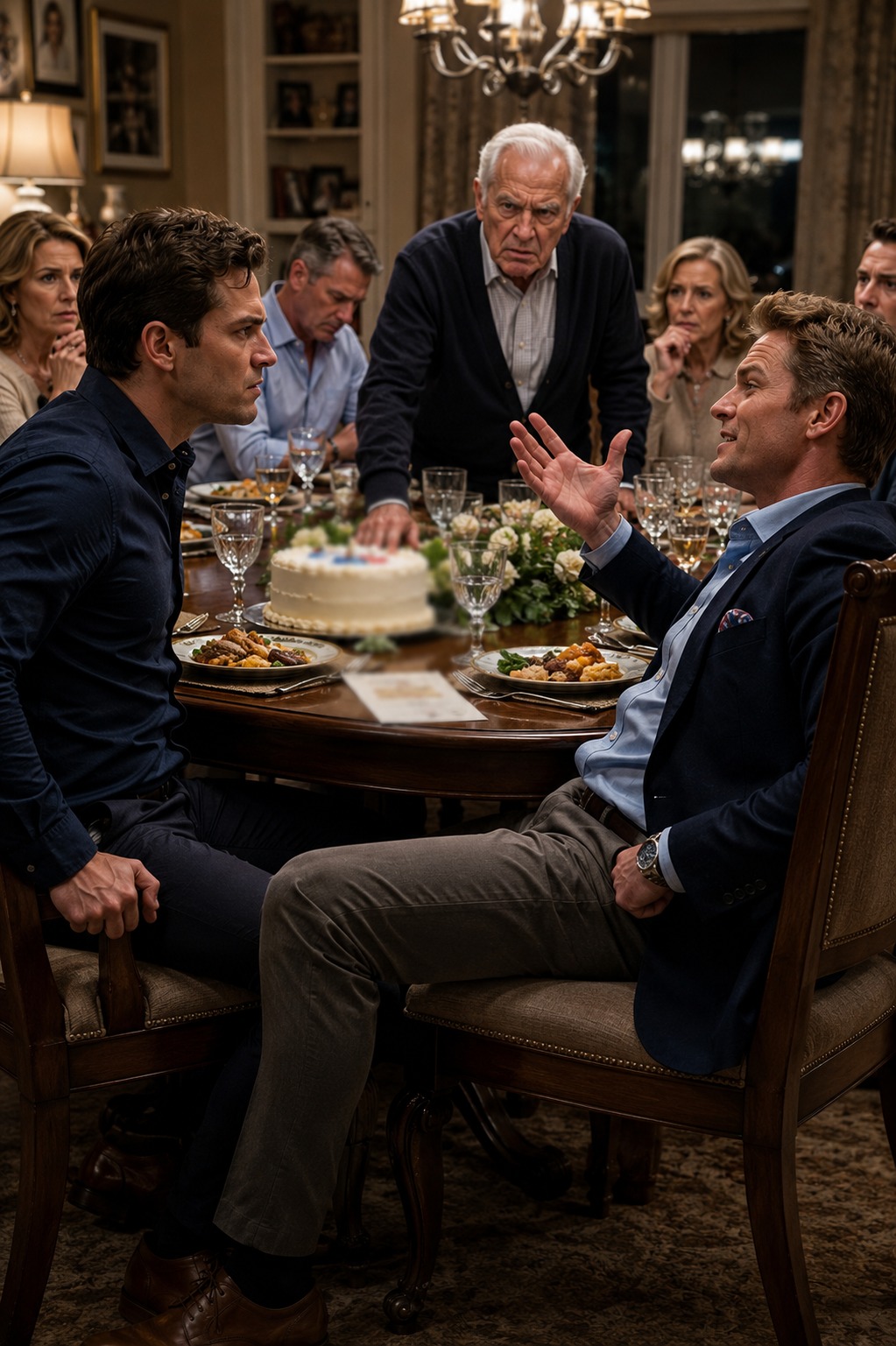
Dinner began with polite performances. The first course arrived, and Damon held court — not because anyone had appointed him to, but because he had the kind of confidence that occupies space regardless of invitation. Every topic became a doorway back to himself. Mention the riverfront development corridor: Damon talked about property values and first-mover advantage. Mention Grandpa’s old repair contracts: Damon talked about legacy brand equity and expansion potential. Mention the apprenticeship program: Damon smiled with the tolerant warmth of a person humoring a child’s attachment to a stuffed animal and said, “Of course the mission matters — every mission needs a modern model.”
My mother looked at him as though he were delivering revelation.
Grandpa ate slowly and said almost nothing, which emboldened Damon in a way that I could have predicted and he should have been more careful about. Silence from Theodore Calloway was not agreement. It was assessment. But Damon had spent his whole life in a family where the adults in the room had trained him to mistake their attentiveness for endorsement, and he carried that training with him into rooms where it did not apply.
About twenty minutes into dinner, one of Grandpa’s oldest friends, a retired contractor named Mr. Alvarez who had worked alongside Grandpa during the lean years, turned to me and asked about a stormwater project I’d managed on the east side of the city. The neighborhood had flooded three times in five years. We’d redesigned the drainage schedule and reinforced two failing pump stations and coordinated with three city departments to clear the backlog of deferred maintenance that had been building since the early 2000s. During the last heavy storm season, almost two hundred homes had stayed dry that would otherwise have flooded.
I answered Mr. Alvarez plainly, without drama, the way I always talked about my work. I was not performing humility. I was not fishing for admiration. I was explaining a project to someone who had asked a genuine question.
Damon laughed before I finished.
“That’s cute,” he said, leaning back with the comfortable authority of a man in his own territory. “But I think tonight is more about real money than city maintenance.”
The table did not respond the way he’d expected. Mr. Alvarez’s expression cooled with a precision that was almost mechanical. A few people gave the specific uncomfortable smiles of people who know that something cruel just happened and aren’t sure what to do about it. My mother shot me a look that meant you see, this is why we told you not to bring things up, as though I had caused Damon’s condescension by daring to answer a direct question.
I set my fork down and said nothing.
Damon, interpreting my silence as the surrender it had always been before, continued. He began describing his proposal to the table without anyone having invited him to, because Damon had never fully learned the difference between an invitation and an opening. He described the riverfront property as though he had discovered it personally, as though my grandfather had not spent thirty years of his life fighting off creditors and developers and one particularly aggressive zoning dispute to keep that land in the family’s hands. He called it undervalued — a word that meant I know the price but not the cost. He called the workshop symbolic, which was the kind of word you used when you wanted something to sound honored while you were in the process of eliminating it.
He called the apprentices a beautiful part of the story.
That phrase is the one I remember most clearly, even now, years later. A beautiful part of the story. As though they were set dressing. As though Luis, who had kept two hospitals running during a grid failure, was a decorative element in the narrative of Damon’s ambition. As though the young woman I knew who had arrived at the workshop at nineteen, fresh out of a system that had written her off, and who now ran a crew of four for a city infrastructure contractor — as though she were a photograph on a lobby wall rather than a person who had built something real with her hands in a space my grandfather had made for exactly that purpose.
I looked across the room toward the serving area. Luis was there, having helped with the catering as a favor to Grandpa. His jaw was tight. He had heard every word.
I spoke.
“What happens to the apprentices if the workshop closes?”
Damon turned his head toward me with the slow deliberateness of a man who has been waiting for an interruption and is pleased to have it arrive on schedule. It confirmed something for him — that I was what he had always said I was. Reactive. Small-minded. Attached to details at the expense of vision.
“They adapt,” he said. “Successful people always do.”
The room changed after that sentence in a way that was physical and immediate, the way air changes before weather arrives. Nobody shouted. Nobody stood up. But something that had been held loosely was suddenly held differently. Mr. Alvarez looked at his plate. A cousin near the middle of the table stopped smiling. The developer-looking man at the far end glanced toward Grandpa with something that might have been concern, or might have been reassessment.
My mother moved quickly, the way she always moved when Damon went slightly too far, to provide the cushion that would prevent him from feeling the consequence. “Jasmine, tonight is not the time for your little causes,” she said, with the brightness of a woman who genuinely believes she is being helpful. “This is about your grandfather’s legacy.”
I looked at her then and felt something loosen inside me that had been held tight for a very long time. Not rage. Not grief, exactly. Something older and quieter than both. For years, I had tried to make her understand me gently — had explained my work in terms she might appreciate, had minimized my own hurt to make conversations easier, had accepted half-apologies and vague acknowledgments and the particular modern kindness of people who would like to love you without changing anything about the way they see you. But hearing her call the futures of real young people my little causes told me something I had not allowed myself to know until that moment.
She had understood, all along, what she was doing.
She simply valued Damon’s version of the world more than she valued mine.
Damon, reassured, lifted his glass with the gesture of a man taking his curtain call. He said that the Calloway name needed someone visible, someone with real relationships, someone who could walk into any room and command respect through presence rather than reports. He said the family had been too sentimental for too long. He said change made some people uncomfortable, but not everyone was built to carry a family forward — some people maintained things, and other people led.
Every sentence was polished. Every sentence, underneath the polish, was the same sentence he had been saying to me my whole life.
You are small. You are boring. You are in the way.
I could have opened the folder then. I had the legal analysis, the grant violations, the consulting fee documentation, the flood zone complications that made Damon’s development proposal a liability as much as an opportunity. I had the facts, which Grandpa had said he needed and which I had spent five nights assembling with the same care I brought to every system I was responsible for maintaining.
But Grandpa had not moved. And I had learned, from watching him my whole life, that patience was not the same as passivity. It was a form of precision. You waited for the right moment not because you were afraid to act, but because you understood that acting too early was how you lost the room before you’d earned it.
Dessert arrived. Candles were brought out. The table sang happy birthday with the forced cheerfulness of people performing normalcy over subtext. Damon sang the loudest.
When the plates were cleared, Mr. Bell placed a gray envelope beside Grandpa’s coffee cup. I saw Damon notice it. Watched his posture change with the subtle physics of a man who believes his moment has finally arrived — the slight straightening, the adjusted jacket, the particular stillness of someone containing excitement they haven’t yet earned the right to express. My mother’s eyes went bright. My father looked pale.
Grandpa folded his hands and looked at Damon.
“Before I say anything,” he said, “I’d like to hear what Damon believes the Calloway name means.”
You have to understand what that invitation meant to Damon. He had been waiting for it, in various forms, for his entire adult life. He stood, thanked Grandpa with a warmth that was not entirely performed, thanked the family, thanked the friends and associates in the room. He talked about honor and legacy and the difficulty of hard decisions and the courage required to move a great institution into a future it was built for.
He was good at it. I want to say that clearly and honestly: Damon was genuinely good at this kind of speech. He had practiced it in enough mirrors and enough closing conversations to have refined it into something that could pass, for extended periods of time, as authenticity. People who didn’t know him well would not have heard anything wrong.
Then his gaze slid toward me, and the warmth drained out of his voice the way water drains out of a tub — not all at once, but quickly enough that you could watch it happening.
“Of course,” he said, “some people are attached to the past because the past is the only place they feel important.” He smiled. It was the same smile he’d had at Sunday lunch when he said the name was worth selling. “Some people hide behind quiet work and call it character. But a family name like ours deserves more than someone who fixes drains and writes reports.”
My mother did not stop him. My father did not stop him. Grandpa did not stop him, and the absence of intervention from that last quarter was the permission Damon needed to say the thing he had been building toward all evening.
He looked directly at me. His expression had the particular satisfaction of a man who has been saving a line for a long time.
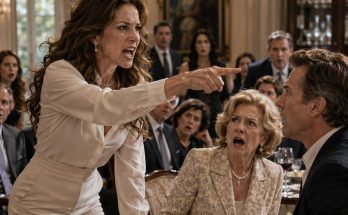
“Jasmine,” he said, “you don’t deserve to carry our last name.”
The room stopped.
Not the way rooms stop in movies, with sudden silence and everyone frozen mid-gesture. More subtle than that. The conversations that had been running in the background concluded themselves quietly. The servers near the doorway became very still. People who had been looking elsewhere looked at me, because the room had made a collective unconscious decision that whatever happened next needed witnesses.
My mother gave a small nod. Not a large one — she would later dispute this, would call it a reflex, would say she hadn’t meant it as agreement. But I saw it and so did other people and so, I believe, did Grandpa, because Theodore Calloway had been reading rooms for eight decades and he did not miss the things happening in them.
My father lowered his eyes to his plate.
For a moment, I was aware of very specific and irrelevant details: the chip on the rim of my water glass, the way the candle flame moved against the brick wall behind Damon’s head, the fact that Damon’s hand had come to rest near the gray envelope as though proximity to it constituted ownership.
I did not cry. I want to be clear about that — not because there would have been shame in it, but because it’s true. I felt the weight of the words, felt them land in the specific places in my chest where I kept the accumulated evidence of years of being seen as secondary. I felt them. I did not collapse under them.
Because I had done the work. Not to prove anything to Damon, not to earn my family’s regard, not to accumulate ammunition for this moment. I had done the work because the work mattered. Because two hundred families in a neighborhood I had never lived in had stayed dry during a storm they didn’t have to endure. Because Luis was running emergency pump maintenance at two hospital campuses. Because a young woman I’d mentored had a crew of four and a supervisor who valued her and prospects that the system she’d come out of had told her were impossible.
I had done the work, and the work was real, and Damon’s opinion of it was the thing that was hollow, not the work itself.
I was still looking at my brother, thinking these things, when the chair at the head of the table scraped against the floor.
The sound was not large. It was one wooden chair against a polished concrete floor. But it cut through the room the way specific small sounds do when a room has grown very quiet — absolutely, cleanly, with a kind of authority that had nothing to do with volume.
Grandpa stood slowly, one hand on the table. He was eighty-two years old, and he stood with the unhurried care of a man who has learned that patience and strength are the same quality wearing different faces.
He looked at Damon.
“You think she is not worthy of the family name.”
Damon’s smile appeared briefly, the reflex of a man who expects every statement to become a question he can answer in his favor. “I think,” he said, with a short laugh that was still trying to be confident, “someone had to say it.”
Grandpa nodded once. A single, slow nod.
“Then she’ll carry mine,” he said. “And everything that comes with it.”
What happened to Damon’s face in that moment is something I will carry for the rest of my life, not with cruelty — I am my grandfather’s student in that regard, if in nothing else — but as a specific and complete kind of knowledge. It was the face of a man discovering, at the precise moment he believed he had won, that he had fundamentally misunderstood the game he was playing.
The color drained from him. His fingers tightened around the chair back. When he finally spoke, his voice had lost the quality that made people want to listen to it.
“No,” he said. Then, louder: “Grandpa, you can’t do this to me.”
“I did not do this to you,” Grandpa said. His voice was calm in the way that still water is calm — not because nothing is happening beneath the surface, but because whatever is happening has long since resolved into clarity. “You brought me the truth and called it leadership.”
Damon shook his head with the jerky energy of a man whose calculations have come out wrong and who believes the error must be in the calculation rather than in himself. “You don’t understand. I was trying to protect what you built.”
“No.” Grandpa’s voice was quiet and complete. “You were trying to sell what you didn’t earn.”
He turned to Mr. Bell. The attorney opened the gray envelope with the practiced efficiency of a man who had prepared for this evening carefully. My mother’s hand flew to her necklace — a reflex, the gesture of someone whose world has just tilted and who is reaching for something solid.
“Dad,” she said, “maybe this should be handled privately.”
Grandpa did not look at her. “He made his judgment of Jasmine public,” he said. “The correction will be public, too.”
What followed was the most methodical dismantling I have ever witnessed, and I have watched systems fail in real time under emergency conditions. Grandpa went through the documents with the unhurried precision of a man who had built everything in his life on the understanding that the truth was always better than the alternative, even when it was painful, especially then.
He described Damon’s meetings with Mercer Lane Development — six months of them, conducted while implying an authority over the Calloway Trust that had never been granted. He described the proposal to sell the workshop property, close the apprenticeship floor, and use the Calloway name in the marketing of luxury housing. He described the consulting fee — the detail Damon had buried on page thirty-eight of his glossy presentation, in a font that assumed no one would read that far.
The developer at the end of the table shifted in his chair. Damon’s jaw went rigid.
“The proposal also recommends reducing the apprenticeship fund to a scholarship display,” Grandpa continued, “for publicity purposes.” He paused and looked at Luis, who was standing near the doorway. The room looked with him. “A display,” Grandpa said, “for people who will never meet the young men and women it is meant to represent.”
Luis looked away, his face holding something that was too complex and too private to read fully. But everyone in the room had seen it, and the room — which had contained, until that moment, people who had been mostly spectators — became something else. It became witness. It became community. It became consequence.
Damon pointed at me.
“She did this.” His voice had developed a ragged quality, the sound of confidence coming apart at its seams. “She poisoned you against me.”
“Jasmine sent me facts,” Grandpa said. “You sent me slogans.”
He lifted another page. “Her analysis showed legal risk, grant violations, flood zone complications, and damage to every community partnership this family has promised to protect. She did not ask for a title. She did not ask for money. She asked me to look at the truth before anyone signed away a responsibility.”
Damon’s voice went somewhere between disbelief and contempt. “She’s a city employee. She doesn’t know how business works.”
Grandpa’s voice sharpened — not loudly, but with the precision of a tool used by someone who knows what it’s for. “She builds systems that keep people safe,” he said. “You build speeches to sell what you never earned.”
The silence after those words was almost physical in its weight.
Damon looked around the room for rescue. He found my mother — torn, pale, reaching for the version of this situation that she could still manage. He found my father — who was, for the first time all evening, looking at me instead of away from me, and whose face held something I had never seen in it before. Not exactly guilt. Something more specific than guilt: the particular expression of a man who has, at long last, been required to see the shape of what his choices have built.
Grandpa placed both hands flat on the table. His voice remained level and complete.
“Tonight, I intended to announce a transition plan for the Calloway Trust. Damon believed that plan would place him in an advisory role with significant influence over the foundation’s assets.” He looked at Damon steadily. “After reviewing his actions over these past months, and after hearing his words this evening, that will not happen. Effective immediately, Damon holds no authority to represent Calloway Works, the Calloway Trust, or the Apprenticeship Foundation. Any agreement, suggestion, or implication he has made to Mercer Lane Development or any other party is void. Mr. Bell has prepared the appropriate notices.”
At the far end of the table, the developer stood. He buttoned his jacket with the deliberate efficiency of a man who has assessed a situation and determined that the meeting is over. He did not shake Damon’s hand. He did not speak to anyone. He simply left, and the sound of the door was quiet and absolute.
Damon watched him go. Something in his face broke open — not dramatically, not with the cathartic release that falling apart in movies looks like. Just a quiet, incremental collapse, the way structures fail when the load they were never actually designed to carry is finally removed.
Grandpa looked at me.
“Jasmine.” His voice had changed. Not in volume — still quiet. But the quality of it was different from the precision it had carried in the previous minutes. Something warmer. Something that had been waiting a long time to say itself. “I am asking you to serve as chairwoman of the Apprenticeship Foundation and voting steward for the workshop property. If you choose to take the Calloway name, I will support that legally and publicly.” He paused. “But whether you change your name or not, you have already carried its meaning better than anyone at this table tonight.”
I could not speak.
I have faced difficult moments in my professional life — meetings where I was the youngest person in the room and the only woman and was expected to have the most thorough command of the material, which I always did, because that was the only way I had learned to be taken seriously. I have sat with communities who were angry and frightened about infrastructure failures that weren’t their fault, and I have stayed in those rooms long past the point where staying was comfortable, because the community deserved someone who stayed. I have presented findings to people who didn’t want to hear them and advocated for resources in budget meetings where advocacy was not welcomed.
None of those moments required this specific kind of composure. Because in all of those professional situations, I was representing something external to myself — a project, a system, an analysis, a community’s need. In that dining room, Grandpa was looking at me and saying: I see you. Not what you’ve produced. You.
I had wanted someone in that family to say that for so long I had stopped letting myself want it. The wanting had become too expensive, the way certain things become too expensive when you can’t afford them and you’ve lived without them long enough to convince yourself you don’t need them after all.
Damon slammed his hand on the table.
“This is insane.” His voice had the quality of a man fighting to maintain authority he no longer had. “You’re giving everything to her because she made me look bad?”
“No,” Grandpa said, and his voice was gentle now, the way a verdict can be gentle when it’s built on clarity rather than anger. “I’m trusting her because you made yourself clear.”
My mother finally found her voice, reaching for the explanation that would reframe everything. “Damon was upset. He didn’t mean to hurt Jasmine.”
Grandpa looked at her for a moment. “He meant it,” he said. “And you nodded.”
My mother’s face crumpled. It was not a manufactured expression — her pain was real, and I knew it was real, and I held both things at once without resolving them: that she had caused me real harm, and that the accounting of that harm was also causing her real pain.
Grandpa looked at my father.
“And you looked away.”
My father’s shoulders dropped. He had never been named so plainly. The silence, the looking away, the careful fence-sitting that had allowed him to consider himself a neutral party while the family arranged itself around his son’s entitlement — it had been named. In public. By a man my father had spent twenty-five years trying to be worthy of.
Damon was breathing in the audible, effortful way of a person using breath to maintain control. Grandpa turned to him one final time.
“You owe your sister an apology.”
The room held still. I watched Damon, and for one genuine second — one actual moment of vulnerability — I thought he might do it. I saw something move across his face that might have been, in a different man with a different history, the beginning of real accountability. Then the reflex closed over it, and pride won the way pride always won with Damon, and he grabbed his jacket from the back of his chair.
“You’ll regret this,” he said.
Grandpa’s reply was quiet and final.
“No,” he said. “I would have regretted rewarding it.”
The door closed behind Damon, and the sound it made was not dramatic. Just a door closing. But in the silence that followed, beneath the polished brick and iron beams of the building my grandfather had built from nothing, the closing of that door felt like the end of a lie our family had been collectively agreeing to tell for a very long time.
The room did not recover immediately. These things don’t. People stood in small clusters, speaking quietly, rearranging their understanding of what they had witnessed. The photographer Damon had hired packed his camera with the efficient discretion of someone who understands that his services are no longer required. Mr. Bell spoke with Grandpa in low tones near the window.
My mother half-rose from her chair, reaching for the lifelong habit of following Damon when consequences arrived, of providing the cushion that prevented him from ever fully landing on anything hard. Grandpa said her name once, and she stopped.
“Sit down, Marlene,” he said. “For once, let him leave without teaching him that someone else will clean up what he breaks.”
She sat slowly, like a woman discovering that the ground she thought she knew has shifted.
My father looked at me from across the table with the specific expression of a man who has been required to see himself clearly and has found the seeing difficult. He opened his mouth, and closed it, and then said, “I knew Damon had spoken to developers. I didn’t know how far it had gone.”
It was not a defense. I don’t think he meant it as one. I think he was simply finding a way to begin the sentence he should have begun years earlier.
Grandpa looked at him. “You knew enough to ask Jasmine not to make things uncomfortable.”
My father flinched. And in the flinching, something was acknowledged that had not been acknowledged before: that the peace he had maintained in our family had always required someone to pay a price for it, and the person paying it had always been me.
Luis came to me near the doorway as the dinner concluded without concluding, people moving and gathering and saying quiet things to each other in the aftermath of what they’d witnessed. He was composed, the way he had always been composed since the days when he’d learned that composure was a skill as essential as any technical certification. He looked at me and said, simply: “Thank you.”
Two words. But they carried everything that the polished phrases of the evening had not — the weight of something real, between two people who had both spent time in rooms where they were not expected to matter, and who had both built something true anyway.
Grandpa asked me to walk with him.
We went through a side hallway that led to a preserved corner of the original workshop, tucked behind the restaurant’s kitchen. One workbench. The original tools, hung with deliberate care. A faded painted sign that read Calloway Works in letters that had survived decades of weather and renovation. In the softer light of that back hallway, away from the dining room and the documents and the gray envelope, Grandpa looked less like the man who had just dismantled his grandson’s ambitions with measured precision, and more like the grandfather who had once shown me how to hold a wrench when I was nine years old and had asked me, with genuine curiosity, whether I thought I might want to know how machines worked.
I had said yes. I had always said yes to that kind of question.
“I did not choose you because Damon hurt you,” he said. The workbench was between us and he rested one hand on it, not for support, just for the familiarity of it. “I chose you because when you saw something wrong, you protected the people who would have paid the price.”
I wiped my face then — not because I was broken, but because I had been holding myself together for so many weeks, so many years, that the sudden permission to stop holding was its own kind of release.
I told him I didn’t want what he was giving me to become a weapon against Damon. I didn’t want the foundation’s work to be shadowed by the circumstances of how I’d come to lead it. I didn’t want the apprentices — the actual people, the ones whose futures were at stake — to become collateral in a family drama.
Grandpa smiled. It was the sad, patient smile of a man who has spent eighty years watching people reveal themselves.
“That,” he said, “is exactly why I can trust you with it.”
I made three conditions before I accepted.
The apprenticeship program would remain open and fully funded — no reductions, no rebranding, no photo walls replacing actual rooms where actual learning happened. A fixed percentage of Calloway Works revenue would be dedicated to students who couldn’t afford tools, transit, or certification fees, because those specific barriers were the ones that stopped people who had the capability but not the cushion. And no family member would hold influence over the foundation unless they could demonstrate respect for its actual purpose, not its name recognition.
Grandpa agreed before I finished the third condition. He nodded the way he had always nodded when he’d already thought something through and was waiting for someone else to arrive at the same place.
The paperwork became official three months later.
Damon lost the Mercer Lane deal. Without the implied backing of the Calloway Trust, the development project lost the community-heritage angle that had been its primary marketing distinction, and without that angle, it became just another riverfront conversion competing with a dozen others for investor attention. His calls to several development contacts went unreturned. He did not lose everything — he was a skilled salesperson in a market that would always need skilled salespeople, and he landed on his feet in the way that people who have been told their whole lives they are special tend to land on their feet. But he lost the thing he had valued most: the belief that the family’s legacy was his birthright, that the name was his to spend.
My mother attempted reconciliation in pieces. Small messages. Careful voicemails that began with I never meant and trailed into qualifications before they reached full accountability. I did not rush to meet her. Forgiveness, I had learned, was something I was responsible for working toward on my own timeline, not a performance I owed to the person who had caused the harm because it would make her feel better. I worked toward it slowly, because I believe in working toward it, not because anyone required me to arrive at a particular pace.
My father wrote me a letter.
It was imperfect, the way real apologies tend to be imperfect — he didn’t get the words exactly right, and there were places where you could feel him reaching for a version of the past that was slightly more comfortable than the actual one. But it was the first time he had put into writing that he had looked away deliberately, and that looking away had been a choice, and that the choice had cost me something he had not previously allowed himself to calculate. I kept the letter. Not because it fixed anything, but because it was the first honest thing he had ever said about it, and honesty, even when it arrives late and imperfect, deserves to be kept.
As for the Calloway name: I did not take it immediately. People expected me to — expected me to claim it like a trophy, particularly after being told I didn’t deserve it. But that expectation was itself the lesson. A name taken as proof of victory over someone who denied it is not a name you carry freely. It becomes a weapon, and I had no interest in carrying weapons.
I used the Calloway name first for the scholarship program instead. The Calloway Works Apprenticeship Scholarship — for students who needed tools, transit passes, and paid placements with local maintenance and infrastructure crews. The first cohort was twelve students. At the ceremony, Grandpa sat in the front row in the good chair we’d brought from his office, and somewhere near the middle of the third student’s acceptance remarks, I looked over and found that his eyes had filled.
He did not wipe them. He just let them be full, the way a person does when they’ve waited a long time for something they were never completely sure was coming, and it has finally arrived.
I thought about what he had built. The borrowed machines and the unpaid invoices and the late nights in a building without proper heat, and the decades of kept promises, and the young people who had arrived with nothing that the world recognized as valuable, and who had left with skills and references and the specific dignity of a person who has been seen clearly and treated accordingly.
I thought about what I had built. The drainage maps and the pipe inventories and the two hundred families who stayed dry in a storm that they never had to know I’d been thinking about for three years. The twelve pages I had sent to my grandfather with one sentence, because he needed facts and not noise. The folder I had carried inside my coat to a dinner I hadn’t wanted to be a scene. The conditions I had set before accepting a responsibility I intended to take seriously.
I thought about my grandfather saying: A name is not a trophy. It is a promise.
I understood it now with a completeness I hadn’t had before. Not because it had been explained more thoroughly, but because I had lived it — had watched what happened when someone treated the name as a trophy, and had understood in contrast what it meant to treat it as a promise. The promise was not to the name. The promise was to the people who needed you to keep it.
At the close of the scholarship ceremony, I spoke briefly. I thanked Grandpa, because he deserved to hear it publicly from me. I thanked the students, for choosing to come to a place that would require something real from them. And I said, as plainly as I could: the Calloway name does not belong to the people who hold it. It belongs to the work it was built on, and to the people that work is built for.
Grandpa nodded from the front row.
I know what he was thinking, because it was what he had always been thinking when he looked at me that way — patient, and careful, and entirely certain.
She already knew.