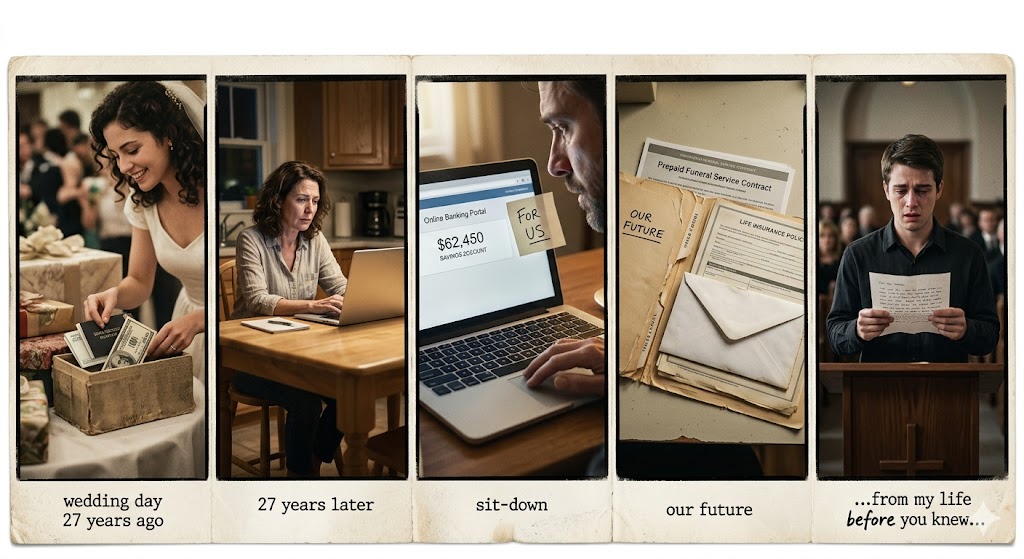
Part 1: The Secret Account
My wife and I were married for twenty-seven years.
Twenty-seven years of shared birthdays, late-night conversations, mortgage payments, family vacations, and ordinary Tuesday mornings that seemed insignificant at the time.
I thought I knew everything about her.
At least, that’s what I believed.
Three months before she died, she sat me down at our kitchen table.
The afternoon sunlight filtered through the curtains, painting soft golden patterns across the room. She looked tired. Cancer had taken much of her strength, but not her smile.
“I need to show you something,” she said.
There was a seriousness in her voice that immediately made my stomach tighten.
She opened her laptop.
“What is it?” I asked.
Without answering, she logged into a banking website and turned the screen toward me.
I stared at the numbers.
Balance: $62,418.37
I blinked.
“Whose account is that?”
“It’s mine.”
I looked at her, confused.
“You have sixty-two thousand dollars?”
She nodded.
I felt like the floor had shifted beneath me.
We had always shared finances. Every paycheck, every expense, every major decision—we handled together.
Or so I thought.
“When did you open this?” I asked.
“The day after our wedding.”
I laughed nervously.
“No, seriously.”
She didn’t smile.
“The day after our wedding.”
My heart skipped.
“You’ve had a secret account for twenty-seven years?”
She reached across the table and squeezed my hand.
“I deposited one hundred dollars every month.”
I couldn’t find words.
One hundred dollars.
Every month.
For twenty-seven years.
I wasn’t angry.
I was shocked.
“Why didn’t you tell me?”
For a moment, she looked down at her hands.
Then she said quietly,
“Because I always knew one of us would get sick first.”
The room seemed to grow still.
“I didn’t want the other one to suffer.”
My throat tightened.
She opened a manila folder she’d brought from the bedroom.
Inside were documents.
Funeral arrangements.
Insurance policies.
Lists of passwords.
Instructions for the house.
Even notes about who to call for repairs if something broke.
Everything organized perfectly.
Everything prepared.
Everything waiting for a day neither of us wanted to imagine.
“I’ve been planning this for years,” she said gently.
I couldn’t stop staring at the papers.
It felt impossible.
My wife had spent decades preparing for a future without herself in it.
And she’d done it completely alone.
Then she handed me a sealed envelope.
“Don’t open this until after I’m gone.”
I looked at the envelope.
My name was written across the front in her handwriting.
The handwriting I’d seen on birthday cards, grocery lists, and little notes left beside my coffee mug for nearly three decades.
“What is it?” I asked.
She smiled sadly.
“Just something I need you to read later.”
I wanted to argue.
I wanted to tell her there would be no “later.”
But we both knew better.
As I slipped the envelope into the folder, I noticed another stack of sealed letters underneath.
Each one had a name.
Our daughter.
Our son.
Her sister.
Even our grandchildren.
Every person she loved.
Every person she was preparing to leave behind.
And at the very bottom of the stack was a sealed envelope I had never seen before.
No name.
No address.
Just three words written across the front:
“The Truth Inside.”
I looked up at her.
“What is this?”
For the first time all afternoon, she looked genuinely nervous.
Then she slowly took the envelope from my hands and whispered:
“That’s the one nobody knows about.”
Part 2: The Letter No One Knew About
For several seconds, neither of us spoke.
My eyes remained fixed on the plain envelope in her hands.
“The Truth Inside.”
The words seemed heavier than they should have been.
“What do you mean nobody knows about it?” I asked.
She took a slow breath.
“Exactly what I said.”
Her voice was calm, but I could see the tension in her face.
In twenty-seven years of marriage, I’d learned to read the smallest changes in her expression.
She was afraid.
And that frightened me more than anything.
“Is it something bad?” I asked.
She shook her head.
“No.”
“Then what is it?”
For a moment, she stared out the kitchen window.
The silence stretched between us.
Finally, she said, “It’s something I’ve carried my entire life.”
I waited.
She didn’t continue.
Instead, she placed the envelope back into the folder and closed it.
“Promise me something.”
“What?”
“Don’t open it until after my funeral.”
I frowned.
“Why not tell me now?”
Tears appeared in her eyes.
“Because if I tell you now, you’ll spend the time we have left thinking about my past.”
She reached for my hand.
“I want you to spend it thinking about our life.”
I wanted answers.
I wanted to know what secret could remain hidden for nearly three decades.
But looking at her, weak from treatment and exhausted from the battle she was losing, I couldn’t push.
So I nodded.
“I promise.”
A small smile crossed her face.
“Thank you.”
The next three months passed faster than I could comprehend.
Family visited.
Friends called.
Doctors came and went.
Some days she seemed almost herself again.
Other days she barely had the strength to sit up.
Yet through it all, she remained focused on everyone except herself.
She checked on the children.
She organized photo albums.
She labeled old family recipes.
She even wrapped birthday presents for grandchildren whose birthdays were months away.
It was as if she were quietly leaving pieces of herself behind.
Preparing us for a world without her.
Then one rainy Thursday morning, she slipped away peacefully in her sleep.
Just like that.
The love of my life was gone.
The funeral was held four days later.
The church was overflowing.
Friends from work.
Neighbors.
Former classmates.
People I hadn’t seen in years.
All of them had come to honor the woman who had somehow touched every life she entered.
Our son stood at the front holding the letter she’d written for the family.
His voice trembled as he began reading.
People laughed through tears at her memories.
Then cried openly at her goodbyes.
Every word sounded exactly like her.
Warm.
Thoughtful.
Loving.
When he reached the final page, however, something changed.
His eyes widened.
He stopped reading.
The church grew quiet.
He looked directly at me.
“Dad…”
His voice cracked.
“Did you know about this?”
A cold feeling swept through my chest.
“No.”
He looked down at the letter again.
Then back at me.
And for the first time all day, he seemed completely stunned.
The room waited.
No one moved.
No one spoke.
Finally, he swallowed hard and read the next sentence aloud.
“If you’re hearing this, then it’s finally time for my family to know where I really came from.”
The entire church froze.
Including me.
Because after twenty-seven years together, I had absolutely no idea what she meant.
Part 3: The Truth She Carried
The church was silent.
You could hear people breathing.
Our son stood frozen at the podium, staring at the page in his hands.
Then he continued reading.
“If you’re hearing this, then it’s finally time for my family to know where I really came from.”
I felt my chest tighten.
What did she mean?
I knew where she grew up.
I knew her parents.
I knew her siblings.
Or at least I thought I did.
Our son read on.
“The people who raised me were not my biological parents.”
Gasps echoed throughout the church.
I couldn’t believe what I was hearing.
She had never mentioned being adopted.
Not once.
Not in twenty-seven years.
Not during our engagement.
Not during our marriage.
Never.
My son looked as shocked as I felt.
Still, he continued.
“When I was six years old, my biological mother left me at a church shelter. She never came back.”
The room became painfully quiet.
“For years, I believed she would return for me. Every birthday. Every Christmas. Every time the church door opened.”
I closed my eyes.
Suddenly, all the sadness she sometimes carried made sense.
The loneliness she never quite talked about.
The fear of being abandoned.
The way she always made sure everyone felt included.
Loved.
Wanted.
She knew exactly what it felt like to feel forgotten.
Our son wiped tears from his eyes and kept reading.
“The couple who adopted me gave me everything. They gave me a home, safety, kindness, and a future. They became my real parents in every way that mattered.”
Many people in the church were crying now.
But there was more.
Much more.
His voice shook as he read the next paragraph.
“Ten years ago, I hired a private investigator and found my biological mother.”
The room erupted in whispers.
I felt my heart stop.
Ten years ago?
How had I never known?
“She was living alone in another state. Sick. Broke. Forgotten by almost everyone.”
I could barely breathe.
“For months I drove to visit her without telling anyone. I wanted answers. Instead, I found regret.”
The church was completely silent again.
“She cried when she saw me. She apologized for abandoning me. She told me she was young, scared, and living in circumstances she couldn’t escape.”
My hands trembled.
Everything I thought I knew about my wife was changing.
Then came the revelation that stunned everyone.
“The savings account wasn’t only for my family.”
People exchanged confused glances.
Our son looked up from the page.
Then he continued.
“For the last ten years, part of that money helped support my biological mother. I paid her rent. I paid for her medicine. I made sure she never went hungry.”
Several people covered their mouths.
I couldn’t move.
I couldn’t speak.
My wife had secretly cared for the woman who abandoned her.
For ten years.
Without asking for recognition.
Without telling a soul.
Without bitterness.
Only compassion.
Tears streamed down my face.
The final paragraph remained.
My son struggled to read through his own tears.
“I forgave her long before she deserved it. Not because she earned it, but because carrying anger was too heavy. Forgiveness gave me freedom.”
He paused.
Then read the last words she ever wrote.
“If you remember anything about me, remember this: love is not measured by what people deserve. It’s measured by what we’re willing to give. I was abandoned once, but I spent the rest of my life making sure nobody around me ever felt abandoned again.”
The church fell completely silent.
No one moved.
No one spoke.
And in that moment, I understood the woman I loved more deeply than ever before.
For twenty-seven years, I thought her greatest gift was her devotion to our family.
I was wrong.
Her greatest gift was her capacity to love—even after life had given her every reason not to.
And somehow, even after she was gone, she taught us one final lesson:
The strongest hearts are often the ones that have been broken the most.
The End.