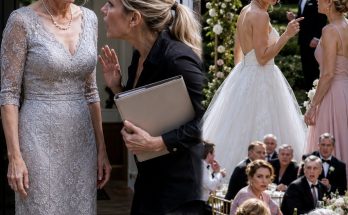
“I’m Not Walking You Down The Aisle In That Wedding Dress,” My Father Texted Fifteen Minutes Before The Wedding. “You’re Embarrassing Us,” My Mother Added. I Never Replied. But When The Doors Opened And They Saw Who Walked Beside Me, My Father’s Face Turned Completely White.
Part 1
Fifteen minutes before my wedding, my father texted me.
I’m not walking you down the aisle in that dress.
I read it once, then twice, then a third time because my brain refused to accept the words in the order they appeared. Outside the bridal suite, somebody laughed too loudly, and the church piano stumbled through the first few notes of Canon in D like even the music had gotten nervous.
Then my mother’s message appeared under his.
You’re embarrassing us.
For a second, the whole room tilted. Not dramatically, not like in a movie where the bride drops the bouquet and everyone gasps. It was worse than that. It was quiet. My chest went hollow, my ears rang, and the yellow vanity lights made my reflection look like a stranger wearing white satin.
Tasha, my maid of honor, stood behind me steaming a bridesmaid dress with the tiny hotel iron we had practically stolen from the Hampton Inn.
“Maya?” she asked.
I didn’t answer.
I stared at myself in the mirror. The dress was simple. White satin, square neckline, no sleeves. It showed my shoulders, my arms, the scar near my collarbone, the faint surgical marks around my knee when the slit moved just right. It showed the body I had brought home after the Army. Not the body my parents used to brag about. Not the polished Captain Maya Bennett from church bulletins and Memorial Day photos.
This was the softer body. The tired body. The body that had survived, healed wrong in some places, gained weight in others, and refused to apologize for still being alive.
My mother hated the dress because it told the truth.
Three weeks earlier, at a bridal shop outside Atlanta, she had stood behind me tugging at the sleeve of another gown and said, “This one is much more flattering.”
Flattering. I had grown to hate that word.
It meant hide your arms. Hide your scars. Hide the weight. Hide the evidence that life touched you and did not ask permission.
I tried calling my father.
Straight to voicemail.
I called again.
Declined.
That hurt worse than the text. For one stupid second, I had believed if he heard my voice, he might remember I was still his daughter.
Tasha set the iron down carefully. “Your parents left the chapel.”
I turned slowly. “What?”
“They got in their car maybe five minutes ago.” Her face tightened. “Your mom was crying. Your dad looked mad.”
I sat down hard in the makeup chair. The room smelled like hairspray, powder, and hot fabric. My bouquet sat on the counter beside a half-empty bottle of water, white roses wrapped in blue ribbon because Daniel said the ribbon matched my eyes. The whole wedding was still there, arranged and waiting, as if my parents had not just stepped out of it like it was a bad restaurant.
“I can change,” I said.
Tasha’s eyes sharpened. “No.”
“The other dress is in the garment bag.”
“The one your mother picked?”
I didn’t answer.
It was long-sleeved, heavy lace, high neckline. Beautiful, if you liked dresses designed like witness protection programs.
Tasha crouched in front of me. “Do you love Daniel?”
“Of course I do.”
“Then marry him in the dress you chose.”
Easy for her to say. Tasha had not spent her whole life earning love through performance. Straight A’s. Army scholarship. Officer training. Deployments. Promotions. Smiling through pain because the Bennetts did not fall apart in public.
A knock came at the door.
The chapel coordinator peeked in, pale and careful. “Captain Bennett?”
I wiped under one eye. “Yes?”
“There’s a retired command sergeant major outside asking for you.”
My breath stopped.
“He says he served with your father.” She swallowed. “And with you.”
Then I heard it.
A cane tapping slowly down the hallway.
Clock. Clock. Clock.
The coordinator stepped aside, and Frank Delaney appeared in the doorway.
Seventy-two years old. Army dress blues pressed like he had ironed them with a ruler. Medals across his chest catching the vanity lights. Left hand trembling slightly around the top of his cane. Spine straight. Chin lifted. Eyes sharp enough to slice through every lie in the room.
“Sergeant Major,” I said automatically.
He looked at me. Not at my weight. Not at my scars. Me.
Then his gaze moved to the dress.
“You know,” he said, voice rough as gravel, “I spent thirty years around uniforms.”
My throat tightened.
“If that dress tells the truth about what you survived,” he continued, “then it’s the finest uniform in this building.”
That sentence broke something open in me.
I covered my mouth and started crying so hard my ribs hurt. Not pretty wedding tears. Ugly tears. Soldier tears. Daughter tears. The kind that come from realizing someone has finally seen the thing you kept carrying alone.
Delaney waited.
When I could breathe again, he held out his arm.
“Now,” he said, “are we going to keep your future husband waiting, or not?”
I stared at his hand, at the old soldier standing where my father should have been, offering me the dignity my own blood had thrown away.
And slowly, I stood.
### Part 2
The strange thing about humiliation is how quickly your body learns to walk with it.
By the time Sergeant Major Delaney helped me down the hallway, my tears had dried into tightness on my cheeks. My hands still shook, but the panic had settled into something heavier and colder. Delaney walked beside me with that slow, stubborn rhythm of his.
Clock. Clock. Clock.
His cane hit the hardwood like a metronome counting down to my new life.
At the end of the hall, Tasha adjusted my train and pretended she was not crying. Downstairs, guests shifted in the chapel pews. I heard folding chairs scrape, someone cough, a child whisper too loudly, and a woman hush him.
Normal wedding sounds.
That made everything worse.
“You hungry?” Delaney asked suddenly.
I blinked at him. “What?”
“You have that look soldiers get when they forget to eat and start making emotional decisions.”
Despite myself, I laughed once.
“There she is,” he muttered.
I leaned against the wall to take pressure off my knee. “I can’t believe they left.”
“Yes, you can.”
That shut me up because he was right.
Maybe I could not believe the exact timing. Maybe I could not believe my father had chosen fifteen minutes before my wedding to punish me with a text message. But deep down, I had felt this coming for a long time.
My parents loved me best when I looked like proof.
Proof they had raised me right. Proof discipline worked. Proof the Bennett family produced winners.
I grew up outside Clarksville, Tennessee, in a neighborhood where everyone waved from porches and still knew exactly whose trash cans went out late. My father owned a construction business. My mother taught Sunday school and treated church potlucks like congressional hearings. Appearances mattered. The lawn mattered. The truck mattered. The Christmas card mattered.
And I mattered too, as long as I fit the picture.
When I joined the Army at nineteen, my father bragged so much I thought he might pull a muscle.
“My little girl can outshoot most men.”
“My daughter’s an officer.”
“My Maya is serving her country.”
He loved saying my Maya back then.
Then I came home different.
The injury was not dramatic enough for movies. No explosion. No heroic last stand. Just a bad landing during a supply transfer, one overloaded step, a sharp rip through my knee, and months of my body becoming a project other people discussed in careful voices.
I retired earlier than planned. I gained weight during recovery. I moved slower. Some days, my knee pulled like rusty wire under my skin.
My mother started saying things like, “Are you sure you want bread?”
My father started saying things like, “Maybe retirement was for the best.”
Tiny cuts. Always tiny. That was how they got away with it.
Delaney lowered himself onto a folding chair near the hallway window. He did it slowly, with the grim dignity of a man whose joints had filed formal complaints.
“You know your father wasn’t always this hard,” he said.
I looked at him. “You knew him back then?”
“Long time ago.”
“My dad?”
“Richard Bennett used to be funny.”
That almost made me laugh. My father had not been funny in at least fifteen years.
“He had a big stupid laugh,” Delaney said. “Could hear it across a motor pool.”
“What happened to him?”
The old man rubbed one knuckle, thinking. “Time. Pride. Fear. Same things that ruin a lot of men who think tenderness is weakness.”
I looked down at my bouquet.
I understood more than I wanted to.
My father’s business had slowed. Younger contractors got the bigger jobs. His hands cramped when he held tools too long. He had started moving like he was angry at gravity. Looking at me probably terrified him. I was proof that bodies changed. That strength could become memory. That nobody got to stay impressive forever.
Instead of grieving with me, he punished me for reminding him.
Heels clicked quickly down the hall.
My aunt Carol appeared, purse pressed to her chest. She froze when she saw Delaney.
“Oh,” she said. “There you are.”
“What’s wrong?” I asked.
“Nothing, sweetheart.”
“Aunt Carol.”
She glanced toward the chapel doors, then back at me. “Your daddy said things.”
My stomach tightened. “What things?”
She hesitated too long.
Finally, she whispered, “He said you used to make him proud.”
The hallway went quiet.
Not silent. I could still hear the piano warming up, the guests murmuring, the air conditioner rattling above us. But inside me, something stopped begging.
I looked down at my dress. My scars. My body.
Then I looked at Delaney.
“I don’t want to spend the rest of my life trying to earn love from people who keep moving the finish line.”
The old man stood and offered his arm again.
“Good,” he said. “Now let’s go get you married.”
Right before the chapel doors opened, I saw movement through the narrow window beside the entrance.
My father’s truck had pulled back into the parking lot.
### Part 3
For half a second, hope hit me so hard it felt like pain.
My father came back.
That was the thought. Stupid, bright, automatic. The little-girl part of me, the part that still remembered sitting on his shoulders at county fairs and falling asleep to the smell of sawdust on his work shirts, reached for that hope before the grown woman in me could stop it.
Maybe he regretted leaving.
Maybe he had looked at my empty place beside him and remembered.
Maybe my father was still in there somewhere.
Then I saw his face through the chapel window.
Not guilty.
Afraid.
He was not looking at me. He was looking past me, straight at Frank Delaney.
The chapel coordinator gave us the signal. Tasha squeezed my hand and whispered, “Make them choke on their own opinions.”
I snorted, nearly ruining my face. “That’s deeply un-Christian.”
“Good thing I skipped church last Sunday.”
Then the doors opened.
Every eye turned.
The chapel was small, maybe eighty guests, with white pews and tall windows full of late-afternoon Georgia sun. Battery candles flickered along the aisle because the church no longer allowed real flames after somebody’s aunt set her sleeve on fire during a Christmas service.
The room looked soft. Golden. Almost innocent.
Then Delaney took the first step.
Clock.
His cane struck the wood.
Clock.
Another step.
No one spoke. The piano continued, gentle and nervous. I felt every stare touch my shoulders, my arms, the scar near my collarbone, the body my parents had called embarrassing.
But people did not look disgusted.
They looked moved.
An old man near the aisle stood as we passed. He wore a Vietnam veteran cap and held himself carefully, like standing cost him something. His wife touched his arm, but he stayed up.
Then another veteran stood.
Then another.
No speeches. No drama. Just old soldiers recognizing one of their own.
Or maybe recognizing that survival has its own ceremony.
My throat tightened. Delaney’s arm was solid under my hand, though I could hear the strain in his breathing.
At the altar, Daniel saw me.
His whole face changed.
He looked like a man who had been holding his breath for twenty minutes and had finally remembered air existed. His eyes shone. His shoulders dropped. He mouthed, “You’re beautiful.”
Not polished. Not performative. Honest.
I almost made it to him without looking back.
Almost.
Near the rear of the chapel, my father stood half inside the doorway. My mother sat already in the back pew, clutching her purse with both hands. Her face was tight, confused, embarrassed in the way she always looked when life refused to follow the program.
But my father had gone pale.
Delaney noticed.
Without breaking stride, he turned his head slightly.
The two men locked eyes.
For one strange second, my father looked younger. Not physically. His hair was still gray, his face still lined. But something in his posture snapped backward through time. Shoulders straight. Chin lifted. Hands tense at his sides.
A soldier standing before someone he feared.
“Been a long time, Richard,” Delaney said calmly.
The piano player missed a note.
My father swallowed.
Nobody in that chapel understood what was happening. Not yet. But everyone felt the air change, like pressure building before a summer storm.
Delaney’s voice stayed low. “I wondered if you still recognized the sound of accountability.”
My mother turned toward my father, startled.
He said nothing.
Delaney kept walking.
That was what I loved him for in that moment. He did not turn my wedding into a courtroom. He did not expose my father in front of everyone just because he could. He kept his arm steady under mine and protected the moment my parents had tried to ruin.
When we reached the altar, he placed my hand into Daniel’s.
“Take care of her,” he said.
Daniel nodded immediately. “Yes, Sergeant Major.”
“Good answer.”
A few people laughed softly, and the tension loosened just enough for breath to return.
Then Delaney leaned closer to him, but I still heard it.
“She’s tougher than anybody in this room.”
Daniel looked at me. “I know.”
The ceremony began.
Simple vows. Shaking hands. Daniel’s thumb rubbing small circles against my palm. The pastor’s voice warm and steady.
Halfway through, I glanced toward the back.
My father had sat down, but sweat darkened his collar despite the air conditioning. His eyes kept drifting toward Delaney, who sat stiffly near the front like an old lion pretending to rest.
That was when I understood.
My father had not come back for me.
He had come back because the one man who knew what he had spent thirty-five years hiding was now sitting in the front row of his daughter’s wedding.
And whatever secret lived between them, it was bigger than my dress.
### Part 4
If you have never attended a Southern wedding reception, let me explain something important.
People can hate each other with biblical intensity while passing potato salad politely.
Our reception hall looked cheerful enough to fool strangers. White tablecloths. Mason jars filled with baby’s breath. Sweet tea sweating in plastic dispensers. Barbecue sliders on silver trays. A chalkboard sign Renee, Daniel’s daughter, had painted herself that said Pick a seat, not a side, you’re loved by both.
That sign had aged badly in under an hour.
Daniel and I finished our first dance to an old Otis Redding song while everyone clapped. He held me carefully because of my knee, one hand warm at my back, the other folded around mine.
“You okay?” he whispered.
“No idea.”
“Fair.”
That was one of the reasons I loved him. Daniel never tried to tidy up ugly feelings before I had finished having them.
Across the room, my parents sat near the wall. My father held a glass he barely drank from. My mother smiled too brightly whenever someone looked her way. Damage control had begun. I knew the routine. Act normal until shame gets tired and leaves.
Delaney sat with two older veterans from Daniel’s side. Every few minutes, my father’s gaze flicked toward him.
Like he was counting thunder between lightning strikes.
Daniel made me a plate and set it in front of me.
“I’m not hungry,” I said.
“You have eaten half a deviled egg and one emotional collapse today. Eat.”
I laughed because if I did not, I might start crying again.
I was halfway through a bite of potato salad when my mother appeared beside me.
“Maya,” she said softly.
Her voice had that church-lobby sweetness that meant she wanted witnesses to think she was kind.
She sat before I invited her and took my hand between both of hers.
“Your father and I were emotional earlier.”
There it was. Not an apology. A weather report.
I looked at her hands. Perfect pale polish. Pearl bracelet. Wedding ring turned just right.
“We wanted today to be perfect,” she continued. “Weddings bring out big feelings.”
“You left.”
Her smile twitched. “Sweetheart, we stepped away.”
“After Dad said he wouldn’t walk me down the aisle.”
She lowered her voice. “You know how he gets.”
“Yes,” I said. “I do.”
My mother glanced at Daniel, then at the nearby tables. People had started listening while pretending to butter rolls.
“I was only trying to protect you,” she said.
“From what?”
Her eyes flicked toward my arms. Quick. Almost invisible. But I saw it.
“You know how people talk,” she said. “Especially about women.”
There it was. The same poison, gift-wrapped.
I set my fork down carefully. “You weren’t protecting me from people.”
Her face tightened.
“You were protecting yourself from being embarrassed by me.”
She pulled back like I had slapped her.
“That is not fair.”
“No?”
“You have no idea what mothers carry.”
I stared at her for a long second. Something in me, something trained since childhood to soften my tone before hers cracked, finally refused.
“I managed supply routes in Afghanistan while running on two hours of sleep,” I said evenly. “I can survive people seeing my arms at a wedding.”
My father appeared beside the table.
“Don’t talk to your mother that way.”
Daniel stood before I could. Not aggressive. Not loud. Just steady.
“Richard,” he said. “You had a chance to stand beside her today.”
My father’s jaw tightened. “You don’t know our family.”
“You’re right,” Daniel said. “Because if I understood leaving my daughter alone fifteen minutes before her wedding, I’d be worried about myself.”
The room quieted in sections. First our table. Then the one behind us. Then the cousins near the dessert bar.
My father stepped closer. “This is between me and my daughter.”
“No,” I said. “You made it public when you walked out.”
That landed.
Before he could answer, Delaney’s voice cut through the room.
“Still walking away when things get uncomfortable, Richard?”
The reception hall froze.
Delaney approached slowly, cane tapping the floor.
Clock.
Clock.
Clock.
My father went white.
My mother looked between them, confused. “Frank, what exactly is going on?”
Delaney stopped a few feet from our table. His face was not angry. That made it worse.
He looked at my father and said, “Do you still keep that silver whistle in your desk drawer?”
My father’s glass slipped slightly in his hand.
My mother whispered, “What whistle?”
And for the first time all day, my father looked less ashamed of me than terrified of himself.
### Part 5
Nobody moved.
Not Daniel. Not Tasha. Not Aunt Carol, who had one hand pressed to her throat like she had accidentally walked into the final scene of a murder mystery dinner.
The only sound was the ice machine humming near the kitchen doors.
My father set his glass down very slowly. “Frank.”
Delaney rested both hands on top of his cane. “Richard.”
My mother looked at my father. “What whistle?”
“Nothing,” Dad said.
That word came out too fast.
I knew my father’s lies. Not because he was a bad liar, but because I had grown up needing to read weather in his face. He lied like a contractor giving bad news to a homeowner. Firm voice. Direct eye contact. Details kept to a minimum.
Delaney’s gaze did not move.
“You kept it,” he said. “Didn’t you?”
My father’s mouth tightened. “This is not the place.”
“No,” Delaney said. “A wedding reception probably isn’t the place for old cowardice. But here we are.”
The word cowardice traveled through the hall like someone had dropped a glass.
My mother stood. “I think everyone needs to calm down.”
Of course she did. Calm was my mother’s favorite word whenever truth threatened the furniture.
Delaney turned to me then, and his face softened. “Maya, this is your day. Say the word, and I’ll sit back down.”
That nearly undid me.
He was giving me the choice my parents had not.
I looked at my father. His eyes were locked on mine now, pleading and furious at the same time.
“Please,” he said quietly. “Not here.”
Please.
Not sorry. Not forgive me. Not I hurt you.
Just please protect my image.
I stood carefully, knee stiff under the satin. “Then tell me one thing.”
My father swallowed.
“Why are you so afraid of him?”
A few people shifted. Someone near the buffet whispered, “Lord have mercy,” and someone else shushed her.
Dad looked toward the exit.
Daniel stepped slightly beside me. Not blocking him. Just reminding him that walking away would be witnessed.
My father rubbed both hands over his face. When he lowered them, he looked older than I had ever seen him. Not weak exactly. Exposed.
“It was a long time ago,” he said.
“What was?”
Delaney answered before he could dodge.
“Fort Stewart. June 1989.”
My mother stared. “You told me you left the Guard because of your father’s business.”
“I did,” Dad snapped.
“No,” Delaney said. “You left because a young soldier got hurt during a training exercise after you ignored a safety protocol.”
The room went dead quiet.
My pulse beat in my ears.
Dad pointed at Delaney. “You always tell it like I meant for it to happen.”
“I have never said you meant for it to happen.”
“You ruined me anyway.”
“No, Richard,” Delaney said. “You ruined yourself when you cared more about looking competent than keeping people safe.”
My mother sat down like her knees had failed.
I looked at my father, and pieces began moving in my head. His obsession with discipline. His disgust when my body changed. The way he acted like injury was personal failure. The way my scars seemed to offend him.
“What happened to the soldier?” I asked.
My father closed his eyes.
Delaney’s voice softened, but not enough to hide the pain underneath. “He lived. Lost his career. Lost more than that, in ways paperwork never showed.”
The room blurred slightly.
My father had spent my whole recovery acting like my injuries embarrassed him.
All while hiding a past built around another injured soldier.
“Who was he?” I asked.
Delaney did not answer right away.
My father looked at him sharply. “Don’t.”
That single word changed everything.
Because suddenly I understood the injured soldier had not been some faceless young man in an old report.
He had a name.
And my father was still afraid of saying it.
### Part 6
I had imagined many disasters for my wedding day.
Rain. Cake collapse. A drunk uncle. Daniel forgetting the rings and trying to replace them with onion rings because he thought it would be funny.
I had not imagined standing beside a buffet tray of brisket while my father’s oldest shame crawled out from under thirty-five years of silence.
“Who was he?” I asked again.
My father looked at the floor.
Delaney’s jaw worked once. “Private Aaron Mills.”
The name meant nothing to me. That made me feel strangely guilty.
My mother covered her mouth. “Aaron?”
I turned to her. “You know him?”
She looked at my father, then away.
That was when the second crack opened.
“You knew?” I asked.
“I knew there had been an accident,” she whispered. “Not all of this.”
Dad’s face hardened. “Because there was no reason to drag it through our lives forever.”
Delaney let out a humorless breath. “It never left Aaron’s life.”
My father snapped, “You think I don’t know that?”
The rawness in his voice startled me. For a second, the room seemed to lean closer.
“I was twenty-nine,” he said. “I had a baby at home. A business barely getting started. One mistake, and everyone looked at me like I was some monster.”
Delaney’s eyes narrowed. “You skipped the safety brief because you wanted to finish early.”
“I said it was a mistake.”
“You told the men the rules were for people who needed hand-holding.”
My father flinched.
There it was. Not just an accident. A pattern.
Pride before safety.
Image before people.
My stomach turned because I had heard echoes of that sentence my whole life.
Don’t be dramatic.
Push through.
People are watching.
Daniel touched my back lightly. His hand was warm and grounding.
My father looked at me then. “You don’t understand what it’s like to lose who you were.”
The room softened around that sentence, and I hated that it reached me.
Because I did understand.
I understood lying awake after surgery, wondering whether pain would be permanent. I understood opening old photos and feeling betrayed by my own face. I understood walking into rooms where people’s eyes flicked over my body and made calculations they were too polite to say.
“Yes,” I said quietly. “I do.”
My father blinked.
“I lost my career. I lost my old body. I lost the version of me everybody applauded.” My voice shook, then steadied. “But I did not punish other people because I was ashamed.”
He looked down.
For once, no answer came.
Then my mother spoke, soft but sharp. “Maya, he is still your father.”
I turned toward her slowly.
That sentence had carried too many ugly things in my life.
He is still your father, so forgive the comment.
He is still your father, so ignore the tone.
He is still your father, so shrink yourself until he feels big again.
“No,” I said. “He is my father. That is exactly why this hurt.”
My mother’s eyes filled with tears. “Families make mistakes.”
I looked at her beautiful dress, her pearls, the perfect makeup she wore like armor.
“Families apologize,” I said.
Near the cake table, Renee whispered, “Oh crap.”
Everyone turned.
She held up her phone with a horrified expression. “I was trying to stop recording after the speeches and somehow recorded… all of that.”
For one second, nobody knew what to do.
Then Tasha, bless her reckless heart, said, “Well, at least the audio’s probably clear.”
A nervous laugh broke out. Then another. The room exhaled.
My father looked like he wanted the floor to swallow him.
Delaney raised his glass toward me.
“To Captain Maya Bennett,” he said.
I groaned. “Please don’t make this weird.”
“Too late,” he said. “Logistics officer. Pain in my ass for six straight years. Also the only person I trusted to find missing equipment in the middle of a sandstorm.”
That got real laughter.
Then applause.
Not giant movie applause. Messy, warm, human applause.
My father sat slowly while people clapped for me. Nobody insulted him. Nobody chased him out. But for the first time in his life, he had to watch people respect me without needing me smaller first.
And I think that hurt him more than rage ever could.
Then he looked up and said, barely loud enough for me to hear, “I don’t know how to talk to you anymore.”
I stared at him.
“Start with the truth,” I said. “Then try kindness.”
His lips parted like he might answer.
But my mother grabbed his arm and whispered, “Don’t. Not now.”
And just like that, I knew she was not protecting him from shame.
She was protecting the lie they had built their whole marriage around.
### Part 7
The rest of the reception moved forward because weddings have momentum even when families collapse in the middle of them.
Cake was cut. Speeches were made. Someone’s toddler knocked over a centerpiece and then blamed “the wind,” even though we were indoors. Daniel’s firehouse friends tied empty cans to the back of his truck while pretending they were too mature for it.
People hugged me carefully.
That was the part I hated most.
Careful hugs carry pity in their elbows.
Aunt Carol held me longer than usual and whispered, “I’m sorry I didn’t speak up sooner.”
I wanted to say, Then why didn’t you?
Instead, I nodded because I was too tired to spend my wedding night collecting everyone else’s delayed courage.
Near the doors, my father stood alone with his hands in his pockets. My mother was across the room talking to church friends, smiling too hard. She laughed at something that was not funny. The sound scraped across my nerves.
Daniel came up beside me. “We can leave whenever you want.”
I looked at the hall. At the guests. At the flowers. At Delaney sitting near the front with one hand braced on his cane, looking exhausted but alert.
“I want ten minutes,” I said.
Daniel followed my gaze. “With him?”
“With both of them.”
He nodded. “I’ll be right outside.”
That was Daniel. Not controlling. Not rescuing me from a conversation I needed to have. Just near enough that I did not feel alone.
I walked to my father first.
His face tightened when he saw me coming.
“Can we talk?” I asked.
He looked toward my mother.
“No,” I said. “You and me first.”
We stepped into the small side hallway near the church kitchen. It smelled like coffee grounds, dish soap, and old linoleum. A stack of metal folding chairs leaned against the wall. Through the door, I heard muffled music and laughter, the reception trying to pretend it was normal again.
My father stood with his arms crossed.
I knew that posture. Contractor posture. Father posture. Man-who-would-rather-build-a-wall-than-open-a-door posture.
“Why didn’t you tell me?” I asked.
“About what?”
I almost laughed. “Don’t do that.”
His eyes shifted away.
“Aaron Mills,” I said. “The Guard. Delaney. Any of it.”
He rubbed his thumb against his wedding ring. “Because it was over before you were old enough to understand.”
“But you carried it into my life anyway.”
His head snapped back. “That’s not fair.”
“No? Every time my body changed, you looked at me like I had failed an inspection.”
“I never said that.”
“You didn’t have to.”
That landed harder than I expected.
His face worked strangely, anger and shame fighting for the same space.
“You were always so strong,” he said.
“I still am.”
“You know what I mean.”
“Yes,” I said. “I know exactly what you mean. I used to be strong in a way you could show off.”
He looked wounded, and that made me angrier because he still thought the injury belonged to him.
“You think I wanted to leave today?” he asked.
“I think you wanted to punish me for not hiding.”
He shook his head. “That dress—”
“Careful,” I said.
The word came out low.
For once, he stopped.
My knee throbbed. I shifted my weight, hating that pain had chosen this moment to announce itself.
Dad noticed. His eyes dropped to my leg, then quickly back up.
I saw the disgust I had feared for two years.
But under it, I saw something worse.
Recognition.
“You look at me,” I said slowly, “and see Aaron Mills.”
His face emptied.
There it was.
Truth.
Not all of it, maybe. But enough.
Before he could respond, the kitchen door opened.
Delaney stood there.
He looked tired. Older than he had in the hallway before the ceremony. But his eyes were still sharp.
“No,” he said quietly. “He looks at you and sees himself.”
My father closed his eyes.
And I realized the secret had one more layer.
### Part 8
Delaney stepped into the hallway and let the kitchen door swing shut behind him.
The music became muffled again. Just bass notes through wood. Distant laughter. Forks tapping plates. Life continuing on the other side of a thin church door while my family stood in the wreckage.
My father’s voice dropped. “Frank, don’t.”
Delaney looked at him for a long second. “You’ve spent thirty-five years saying don’t.”
Dad’s face hardened. “You always needed to be the righteous one.”
“No,” Delaney said. “I needed you to tell the truth before it turned into poison.”
I looked between them. “What am I missing?”
My father leaned back against the wall. For a moment, he looked like a man bracing against a blow.
Delaney answered.
“After Aaron got hurt, your father was given a choice. Take responsibility publicly, accept discipline, stay in with a damaged reputation but maybe become a better leader.” He paused. “Or resign quietly and let people believe it was for family reasons.”
My father stared at the floor.
“He chose quietly,” Delaney said.
I looked at Dad. “You left instead of facing it.”
“I had a family.”
“You had an image.”
His eyes flashed. “You don’t know what people were saying.”
“No,” I said. “I know what people said when I came home heavier, limping, and tired. I know what it feels like to become a conversation.”
He had no answer.
Delaney’s voice softened. “The worst part was not the mistake, Richard. Young men make mistakes. Proud men make worse ones. The worst part was what you did afterward.”
My father swallowed.
“You visited Aaron once,” Delaney said. “Then never again.”
Dad’s jaw trembled. “His mother told me not to come back.”
“Because you kept explaining instead of apologizing.”
The hallway seemed to shrink around us.
I thought of every time my mother had explained instead of apologized.
I was only trying to protect you.
You know how your father gets.
People can be cruel.
All explanations. No ownership.
Dad looked at me, and his eyes were wet now. I could count on one hand the number of times I had seen him close to crying.
“I didn’t know how to fix it,” he said.
“You still don’t,” I answered.
That was not cruel. It was just true.
He flinched anyway.
The old version of me would have reached for him then. I would have softened. I would have said, It’s okay, Dad, because his pain always became the room’s emergency.
But standing there in my wedding dress, in the body he had rejected, I finally understood something that felt almost holy.
His shame was not my assignment.
My mother opened the door and stepped into the hallway.
Her eyes were sharp, not sad. “People are asking where the bride is.”
I laughed once. “Of course they are.”
“Maya, enough.” Her voice lowered. “You have made your point.”
I turned toward her. “My point?”
“Your father is humiliated.”
I stared at her.
Fifteen minutes before my wedding, they had humiliated me by text message.
But now, because the truth had found witnesses, his humiliation had become the emergency.
“No,” I said. “I am done making myself smaller so he can feel less ashamed.”
Her mouth tightened. “You will regret speaking to us this way.”
There it was. The old family weather. Guilt rolling in from the west.
I waited for it to hit me.
It didn’t.
That scared me more than anger would have.
Because for the first time in my life, my mother’s disappointment arrived and found no place to land.
Daniel appeared at the end of the hallway. He did not interrupt. He just stood there, steady as a porch light.
I looked back at my parents.
“I’m going back to my reception,” I said. “You can come in if you behave. If you can’t, you can leave again.”
My father stared at me like he did not recognize me.
Maybe he didn’t.
Maybe that was the point.
As I turned away, he said, “Maya.”
I stopped.
His voice cracked slightly. “Are you ever going to forgive me?”
I looked at him over my shoulder.
“I don’t know,” I said. “But not today. And not because you got caught.”
My mother inhaled sharply.
And when I walked back toward Daniel, I knew something had ended behind me.
Not love.
Hope.
### Part 9
Daniel and I left the reception under a tunnel of sparklers that the church technically did not allow but nobody stopped because half the guests were already emotionally exhausted.
The night smelled like smoke, cut grass, and buttercream. Someone had tied cans to Daniel’s truck after all, and they clattered behind us as we pulled away. In the rearview mirror, I saw people waving under the parking lot lights.
My father stood near the chapel steps.
My mother was beside him, arms crossed.
Neither waved.
I watched until the church disappeared around a bend.
Then I exhaled so hard my whole body folded.
Daniel reached across the console and took my hand. “You made it.”
“I don’t feel like I made it.”
“You did.”
The cans dragged behind us, ridiculous and loud. For some reason, that made me laugh. Then the laugh broke sideways into crying. Daniel kept driving with one hand and holding mine with the other, letting the feeling pass through without trying to name it.
We spent our wedding night at a tiny hotel off the highway because the cabin in Blue Ridge was booked for the next day. The room smelled like bleach and old carpet. The air conditioner rattled like a lawn mower. My dress hung from the curtain rod like a ghost.
I sat on the edge of the bed while Daniel knelt carefully and helped me out of my shoes.
My knee had swollen.
He saw it, but said nothing. Just touched the skin gently around the brace.
“I hate that they made today about this,” I whispered.
“They tried,” he said. “They failed.”
I looked at him.
He smiled faintly. “The wedding I saw was you walking down the aisle with a legend, making half the room cry, marrying a very handsome firefighter, and publicly scaring your father into honesty.”
“Very handsome?”
“Extremely.”
I laughed through my nose.
Then my phone buzzed.
I tensed immediately.
Daniel noticed. “You don’t have to look.”
But of course I did.
A text from my mother.
I hope you’re satisfied. Your father is devastated.
I stared at it until the screen dimmed.
No apology. No concern. No Are you okay?
Just his devastation. His feelings. His center of gravity pulling the whole family back into orbit.
Another message appeared.
One day we will be gone, and you will wish you had shown more grace.
For years, that sentence would have gutted me.
That night, sitting in a cheap hotel room with swollen knees and bobby pins still stabbing my scalp, it did something else.
It made me tired.
Not guilty. Not panicked. Just tired in the deepest part of my bones.
I typed back slowly.
I showed grace all day. I am done confusing grace with silence.
Then I blocked her until morning.
My hand shook after I did it. Not because I regretted it. Because peace can feel like danger when you were raised to earn it by surrendering.
Daniel sat beside me.
“I blocked my mother on my wedding night,” I said.
“Do you want me to say something supportive or make a joke?”
“Both.”
He thought for a second. “I support your emotional boundaries, and also this is definitely going to make Thanksgiving weird.”
That got me laughing again, real this time.
Later, after we changed into sweatpants and ate leftover cake from a plastic container, I lay awake listening to the air conditioner rattle. Daniel slept beside me, one arm heavy across my waist.
I thought about my father asking if I would forgive him.
I thought about how quickly my mother had turned his shame into my responsibility.
And just before sleep took me, my phone lit up again.
Unknown number.
I almost ignored it.
Then I read the message.
This is Aaron Mills. We need to talk.
### Part 10
I sat straight up so fast Daniel woke with a snort.
“What happened?” he mumbled, already reaching for glasses he was not wearing.
I held out my phone.
He squinted at the screen, then became very still.
This is Aaron Mills. We need to talk.
The hotel room suddenly felt too small. The air conditioner rattled. A car passed outside, headlights sliding across the curtains. My wedding dress hung in the corner, white and silent.
“How did he get your number?” Daniel asked.
“I don’t know.”
I stared at the message until the letters blurred.
Part of me wanted to throw the phone across the room. Another part wanted to call immediately. The soldier in me wanted facts. The daughter in me wanted one night untouched by my father’s past.
Daniel rubbed his face. “You don’t owe anyone a response tonight.”
“I know.”
But knowing and feeling are different countries.
I typed, then deleted. Typed again, deleted again.
Finally, I wrote:
I’m sorry, but tonight was my wedding. I can talk another day.
The reply came almost immediately.
I figured. Congratulations. I only reached out because Frank said the truth finally surfaced. I don’t want anything from you. Just thought you should know your father’s story may not be the same as mine.
I read that sentence three times.
“Great,” I whispered. “Another layer.”
Daniel took the phone gently and set it on the nightstand. “Tomorrow.”
“But—”
“Tomorrow,” he repeated. “Tonight you sleep next to your husband, not your father’s consequences.”
That sentence settled over me like a blanket.
The next morning, we drove north toward Blue Ridge under a sky washed clean by rain. Georgia hills rolled green and soft beyond the windshield. Gas stations flashed past with faded signs, boiled peanut stands, church billboards warning everyone to repent before it was too late.
I sat barefoot in the passenger seat drinking terrible coffee and watching fog sit low over the trees.
Daniel drove with both hands on the wheel like he was transporting explosives.
“We’re married,” I said eventually.
“Mhm.”
“You sound overwhelmed with passion.”
“I am concentrating.”
“On what?”
“Not driving us off a mountain because my wife is emotionally dangerous before noon.”
Despite everything, I smiled.
Wife still sounded strange. Good strange.
The cabin was small, crooked, and perfect. It smelled like cedar, dust, and old coffee. The couch sagged in the middle. The mattress leaned slightly to one side. Outside, a hot tub sat on the deck looking like it had survived several suspicious bachelor parties.
Daniel carried our bags inside and groaned while straightening.
I pointed at him. “There it is.”
“What?”
“The old man noise.”
“That was not an old man noise.”
“It absolutely was.”
He pointed at my knee brace. “We both sound like microwave popcorn when we stand up. Stay humble.”
I laughed harder than the joke deserved.
Maybe because laughter felt like proof my parents had not ruined everything.
That evening, we ate leftover wedding cake with plastic forks while rain tapped the windows. Daniel fell asleep early on the couch, mouth slightly open, remote balanced on his chest.
I sat beside him with my phone in my hand.
Aaron Mills’ message waited.
Finally, I stepped onto the porch and called.
He answered on the second ring.
“Captain Bennett?”
His voice was older than I expected. Warm, cautious, Southern around the edges.
“Maya,” I said. “Just Maya.”
A pause.
“Fair enough. I’m Aaron.”
Rain ticked through the trees.
“I don’t know what to ask you,” I admitted.
He let out a soft breath. “Then I’ll start with what matters. I don’t hate you. I don’t blame you. And I didn’t contact you to punish your father through his daughter.”
My throat tightened. “Thank you.”
“But,” he said, “there is something you deserve to know.”
I gripped the porch railing.
“Your father didn’t just visit me once after the accident,” Aaron said. “He came twice. The second time, he brought cash and asked my family not to make trouble.”
The wet forest seemed to go silent.
And suddenly, my father’s shame looked less like weakness and more like a choice.
### Part 11
I did not tell Daniel right away.
That was not noble. It was avoidance.
For two full minutes, I stood on the cabin porch with my phone pressed to my ear, rain misting my face, while Aaron Mills quietly changed the shape of my childhood.
“He brought cash?” I asked.
“My mother threw it at him.”
Aaron’s voice had no drama in it. That somehow made it worse.
“He was scared,” Aaron continued. “I get that now. We were all young. But scared men can still do cruel things.”
I looked through the window at Daniel asleep on the couch, one sock half off, chest rising steadily.
“What happened to you after?” I asked.
Aaron was quiet for a moment.
“Life happened,” he said. “Not the life I planned. Different work. Pain. Anger for a while. Marriage that didn’t make it. Then a better one later.” He gave a small laugh. “A stubborn daughter who thinks I don’t know how to use my own phone.”
I smiled sadly.
“Frank helped me more than your father ever did,” Aaron said. “That’s why Richard fears him. Not because Frank ruined him. Because Frank stayed.”
There it was.
Loyalty.
The thing my father mistook for image.
“Why reach out now?” I asked.
“Because Frank called me after your reception. Said Richard finally had to face some of it. I thought maybe you deserved the parts he’d leave out.”
I closed my eyes.
Of course. My father had told the story in the version where he was ashamed but not manipulative. Weak but not calculating. Human, but not responsible enough.
“Thank you,” I said.
“Maya?”
“Yes?”
“Don’t let his guilt become your inheritance.”
I gripped the railing harder.
After the call ended, I stayed outside until the rain soaked through the shoulders of Daniel’s sweatshirt. When I went back in, he opened one eye.
“You look like you talked to a ghost.”
“I talked to Aaron.”
Daniel sat up immediately.
I told him everything.
The cash. The second visit. The way my father had tried to make a family’s pain disappear quietly enough to protect his future.
Daniel listened without interrupting. When I finished, his jaw was tight.
“You okay?” he asked.
“No.”
He nodded. “Good. Honest answer.”
I sat beside him, suddenly exhausted. “I don’t know how to hold all of this. My father was cruel to me. But before that, he was cruel to Aaron. And my mother built a whole marriage around not knowing too much.”
Daniel took my hand.
“Then don’t hold it all,” he said. “Put down the parts that aren’t yours.”
That sounded simple.
It was not.
Three days later, after the honeymoon, we drove back to Columbus. Real life waited: laundry, bills, physical therapy, Daniel’s shifts at the fire station, my consulting work, and forty-seven unread messages from relatives who had apparently discovered boundaries at the same time they discovered gossip.
Tasha sent screenshots from the family group chat.
Aunt Carol wrote, Your mother is saying Frank ambushed Richard.
Cousin Emily wrote, Your dad says you planned the whole thing.
Then, from Aunt Carol again:
I told them that was nonsense.
I stared at that message for a long time.
A late defense is still late. But sometimes late is where people start.
One week after the wedding, a package arrived.
No return address.
Inside was a small cardboard box, old and soft at the corners. I opened it at the kitchen table while Daniel stood nearby pretending not to hover.
There were photographs inside.
My father in uniform, young and grinning beside a truck.
Delaney standing behind him, stern even then.
A group of soldiers in dusty training gear.
And one photo of a young man with bright eyes and a silver whistle hanging from his neck.
On the back, in my father’s handwriting, was one name.
Aaron.
Under the photos was a folded note.
I am sorry you learned it this way.
That was all.
No apology for the dress. No apology for leaving. No apology for the cash. No apology for making my survival feel like his shame.
Just sorry the truth had escaped badly.
Then my phone buzzed.
Dad.
Can we meet?
### Part 12
I almost said no.
Not because I hated him. Hate would have been cleaner.
I almost said no because I knew my father. I knew the pull of his silence, the gravity of his regret. I knew how easily one cracked sentence from him could make me forget every wound and rush back into being the daughter who translated his pain into excuses.
Daniel found me standing in the kitchen with my phone in my hand.
“You don’t have to,” he said.
“I know.”
“You keep saying that like knowing fixes things.”
I looked at him and felt my eyes sting.
“I want him to be better,” I admitted.
Daniel’s face softened. “That’s not the same as trusting him.”
We met at a diner halfway between Columbus and my parents’ house. Neutral ground. Fluorescent lights. Vinyl booths. Coffee strong enough to remove paint. The place smelled like fried potatoes and syrup.
Daniel sat in the truck outside because I asked him to stay close but not inside.
My father arrived wearing a plaid shirt tucked too neatly into jeans. He had shaved. His hair was combed. He looked like a man preparing for court.
When he saw me, he stood awkwardly.
“Maya.”
“Dad.”
We sat.
A waitress poured coffee and left menus neither of us touched.
For a while, we listened to plates clatter in the kitchen.
Finally, he said, “Your mother wanted to come.”
“I didn’t invite her.”
His jaw tightened out of habit, then relaxed. “I know.”
That small correction cost him something. I saw it.
He stirred his coffee though he had not added anything.
“I talked to Aaron,” I said.
His spoon stopped.
“I know about the cash.”
He closed his eyes.
There was no outrage this time. No denial. No contractor posture.
Just a tired man facing an unpaid bill.
“I was scared,” he said.
“I believe you.”
His eyes opened.
“But scared does not mean innocent.”
He looked down at the table.
“No,” he said quietly. “It doesn’t.”
The waitress passed by with a pot of coffee. Neither of us moved.
“I thought if I could make it quiet,” he said, “then I could keep going. I had your mother. You were little. The business was new. I told myself Aaron’s family needed help, and I was giving it.”
“Did you tell yourself they should be grateful?”
His face twisted.
There it was again. Truth, sharp and ugly.
“Yes,” he whispered.
I looked out the window at Daniel’s truck. He was sitting behind the wheel reading something, probably pretending not to watch the door every ten seconds.
Dad followed my gaze.
“He loves you,” he said.
“He does.”
“I’m glad.”
I wanted that to feel like enough.
It wasn’t.
Dad rubbed his hands together. They looked older now. Big hands, scarred from years of building, fingers slightly stiff.
“When you got hurt,” he said slowly, “I didn’t know what to do with it.”
“So you made it my fault.”
He flinched. “I thought if you pushed harder, if you got back to who you were—”
“I would stop reminding you?”
He said nothing.
The silence answered.
I swallowed. “You left me fifteen minutes before my wedding because I would not hide my body.”
His eyes filled.
“I know.”
“You texted me.”
“I know.”
“Dad, you did not even have the courage to say it to my face.”
A tear slid down his cheek. He wiped it angrily, embarrassed by his own body betraying him.
“I’m sorry,” he said.
The words sat between us.
Small. Late. Real, maybe.
But not magic.
I waited for the flood of relief I used to imagine. The music swelling. The daughter forgiven by being loved at last. It did not come.
All I felt was grief standing up straight.
“Thank you for saying it,” I said.
He looked at me, desperate. “Can we start over?”
“No.”
His face crumpled.
I kept my voice gentle because cruelty was not strength.
“We can start from here,” I said. “But we cannot start over. You don’t get the aisle back. You don’t get the years back. You don’t get to call one apology a bridge and ask me to cross it alone.”
He covered his mouth.
I thought it would break me to see him cry.
It didn’t.
It hurt, yes.
But it also freed me.
Because his pain was finally his.
### Part 13
My mother did not handle the diner meeting well.
I knew because she sent me a message before my father had probably made it back to his truck.
I hope you are happy making him beg.
I stared at it while sitting in Daniel’s passenger seat outside the diner.
Then I replied:
I asked for accountability, not begging. Do not contact me unless you can tell the difference.
She did not answer for two days.
Those two days were peaceful enough to feel suspicious.
Life after a family rupture is strangely ordinary. I still had invoices to send. Daniel still had twenty-four-hour shifts. The dog still threw up on the rug after eating something mysterious in the yard. My knee still ached before rain. Grocery stores still expected me to choose tomatoes like I had not recently discovered my family history was built partly on cowardice.
But something had shifted.
I started swimming at the community center three mornings a week. Not to shrink. Not to earn back anybody’s pride. Just to move in a way that did not feel like punishment. The water held my body without commentary. No one asked if I was getting back to my old self. No one told me what would be more flattering.
One morning, I floated on my back under the harsh indoor lights and cried quietly into my swim cap because I realized I had spent years treating my body like an apology.
That afternoon, I bought a sleeveless blue dress.
Not for an event.
For Tuesday.
When Daniel saw me in it, he leaned against the kitchen counter and smiled.
“What?” I asked.
“Nothing.”
“Daniel.”
“You look like trouble.”
“I am trouble.”
“Legally, I cannot argue.”
We built a life in small, stubborn ways.
Sunday pancakes. Physical therapy appointments. Fire station cookouts. Quiet nights on the porch. Renee coming over with laundry and pretending it was not because she missed her dad. Tasha dropping by with wine and increasingly unhinged commentary about my relatives.
Delaney became part of it too.
He called every other week and opened every conversation with, “You dead yet?”
“No, Sergeant Major.”
“Good. Stay inconvenient.”
At Thanksgiving, Daniel invited him before I could.
Delaney showed up with canned cranberry sauce, a pecan pie, and a dress jacket he did not need to wear but wore anyway. He sat at our table like he had always belonged there, arguing with Renee about football and telling Daniel the turkey was “acceptable under civilian limitations.”
My parents were not invited.
My mother cried to Aunt Carol about it. Aunt Carol, newly brave and clearly enjoying herself, told her, “Well, Linda, actions have side effects.”
I sent Aunt Carol flowers.
By Christmas, my father had started texting once a week. Nothing dramatic.
Hope your knee is okay in the cold.
Saw a red cardinal today. Made me think of your grandmother.
I found old photos if you want copies.
I answered sometimes. Not always.
My mother sent longer messages. They were full of feeling but short on responsibility.
I did the best I knew how.
You don’t understand what it’s like to be a mother.
I miss my daughter.
That last one almost got me.
I typed three different replies and deleted all of them.
Finally, I wrote:
You miss the daughter who made things easier. I am not her anymore.
She did not respond.
Two months later, my father asked if he and my mother could come to dinner.
I said yes, with terms.
No comments about my body. No rewriting the wedding. No blaming Delaney. No asking for forgiveness like it was a bill I had failed to pay.
They came on a rainy Saturday.
My mother brought a casserole in a glass dish and wore her church smile. My father brought a small wooden frame he had made himself.
Inside was a copy of my wedding photo.
The one of me walking down the aisle with Delaney.
I stared at it.
My mother looked uncomfortable.
My father said, “It seemed like the right one.”
For a moment, I could not speak.
Then my mother said, too softly, “It still hurts your father to see it.”
I looked at her.
“Good,” I said. “Then he’s seeing it clearly.”
My father nodded once.
My mother’s smile disappeared.
And I realized dinner was going to decide whether we had a future at all.
### Part 14
Dinner tasted like rosemary chicken, awkward silence, and old habits trying to resurrect themselves.
Daniel did most of the talking at first. Work stories. Renee’s classes. A neighbor’s dog that kept stealing shoes from porches. He gave everyone safe ground to stand on because that was Daniel’s quiet gift. He could make a room less dangerous without pretending danger was not there.
My mother picked at her food.
My father ate slowly, like every bite required thought.
Delaney was not there, but his photo sat on the bookshelf across the room. Me in white satin. Him in dress blues. Both of us looking straight ahead.
My mother kept glancing at it.
Finally, she set down her fork. “I don’t know how to be in your life if everything I say is wrong.”
There was the old trap.
Make the wound sound like a misunderstanding. Make accountability feel impossible. Make me comfort her.
I took a sip of water before answering.
“Start by not making my pain about your discomfort.”
Her eyes filled immediately. “I am trying.”
“No,” I said gently. “You are trying to feel better. That is not the same thing.”
My father looked at her, then at me. For once, he did not rescue her from the truth.
That alone told me he had changed more than she had.
My mother turned toward him, betrayed. “Richard?”
He rubbed his forehead. “Linda, she’s right.”
The room went still.
My mother stared at him like he had switched languages.
He looked at me. “I spent years punishing you for surviving in a way that scared me. Your mother helped me make it sound polite.”
My mother’s face crumpled. “That is not fair.”
Dad’s voice shook. “No. It’s true.”
I watched him carefully.
This was what accountability looked like when it first learned to walk. Uneven. Embarrassed. Late.
Still not enough to erase the aisle.
But real enough to notice.
My mother stood suddenly and carried her plate to the sink though there was still food on it. “I cannot sit here and be judged in my own daughter’s house.”
Daniel’s eyebrows rose slightly, but he said nothing.
I stood too.
“You are not being judged,” I said. “You are being known.”
She turned.
That sentence hit her harder than anger would have.
“You wanted me hidden because you were afraid people would see something imperfect and connect it to you,” I said. “But I am not your mirror. I am not Dad’s old guilt. I am not a before picture. I am a whole person.”
My father stared at the table.
My mother wiped at one eye, careful not to smear mascara. “So what do you want from me?”
“The truth,” I said. “And kindness. Without making me beg for either.”
She shook her head. “I don’t know if I can do this.”
For the first time, I did not chase her.
“Then you can’t have close access to me.”
Her mouth opened.
I kept going, voice steady.
“I love you because you’re my mother. But love that arrives only after humiliation, witnesses, and consequences does not get to pretend it was loyal all along.”
My father closed his eyes.
My mother whispered, “That’s cruel.”
“No,” I said. “It’s clear.”
She left ten minutes later.
My father stayed long enough to help Daniel wash dishes. They stood side by side at the sink, two men who loved me in completely different languages. One had learned early. One had learned late. Only one had earned my trust.
Before Dad left, he paused by the bookshelf.
He looked at the wedding photo for a long time.
“I should have been there,” he said.
I stood beside him. “Yes.”
“I can’t fix that.”
“No.”
His throat moved. “I’m sorry.”
“I believe you.”
He looked at me with careful hope.
I did not feed it more than truth allowed.
“I have not forgiven you,” I said. “I may someday. I may not. But if we have anything now, it will be built on what you do next, not what you regret.”
He nodded slowly.
For once, he did not ask for more than I could give.
After he left, Daniel found me on the porch wrapped in a blanket. The night smelled like wet leaves and wood smoke from someone’s fireplace down the road.
He sat beside me.
“You okay?”
I leaned against him. “Not completely.”
“Good honest answer.”
I smiled.
A week later, Delaney came over for dinner. I showed him the wooden frame my father had made.
He studied it for a long time, then cleared his throat.
“Good photo.”
“You’re only saying that because you look terrifying in it.”
“I look distinguished.”
“You look like you’re about to inspect God.”
He grunted. “God could use discipline.”
I laughed so hard my knee hurt.
That photo still sits in our living room.
Not because my father failed me, though he did.
Not because Delaney saved me, though in a way, he did.
It sits there because it tells the truth.
Blood gives you relatives. Loyalty gives you family.
My father would not walk me down the aisle because he could not bear the sight of what survival had done to me. So the man he feared most did it instead, not to shame him, not to replace him, but to stand where love should have stood all along.
And when I look at that picture now, I do not see the daughter who was abandoned fifteen minutes before her wedding.
I see the woman who kept walking anyway.
THE END!