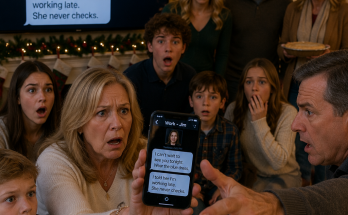
I Was In Combat Gear, Driving Straight From Base, When The ER Nurse Said: “Your Mom’s Crashing… And The Surgeon Refuses To Touch Her.” I Held A Black Card That Could Buy The Whole Hospital, But He Stared At My Dirty Boots And Told Them: “The Hallway Is Good Enough For People Like Them.” She Died In My Arms While He Checked His Rolex… And Later That Night, I Caught My Wife Laughing With Him Over Steak And Wine. I Signed One Document, Bought His Kingdom, And Lit His Life’s Work On Fire. “He Watched His Own Hospital Burn For What He Did.”
Part 1
The sound of a flatline is not loud in the way people think it is.
It does not explode. It does not shake the walls. It just slices through everything else, one thin scream from a machine that has nothing left to measure.
Beeeeeeep.
I stood beside my mother’s gurney in the hallway of Mercy General Hospital with her hand in mine, and for one terrible second, I thought if I squeezed hard enough, she might squeeze back.
She did not.
Her fingers were still warm. That was the part my mind kept grabbing onto. Warm meant alive. Warm meant I still had time. Warm meant some doctor, somewhere in that shining glass building, could still do something.
But my mother’s eyes were half-open, staring up at the fluorescent lights above us. Not a private room. Not even a curtained ER bay. A hallway. A polished white hallway that smelled like disinfectant, coffee, and rainwater from people’s shoes.
“Time of death,” someone said behind me, “8:42 p.m.”
The voice sounded bored.
I turned my head slowly.
Dr. Julian Voss stood three feet away, tapping a silver pen against a clipboard. His white coat looked expensive. His hair was perfect, gray only at the temples, like he had paid someone to place each strand there. A gold watch flashed on his wrist when he checked the time.
My mother had died, and he was checking his Rolex.
“Mr. Hunter,” he said, glancing at the clipboard as if he had forgotten my name on purpose. “I told you her condition was unstable.”
I had landed on American soil three hours earlier.
Nine months overseas. Nine months of dust in my teeth, sand in my boots, and sleep so light a closing door could wake me with my hand reaching for a weapon. I had not showered. I had not shaved. My Ranger fatigues were wrinkled and stained from travel. My boots were caked with mud from the airfield parking lot.
When my neighbor, Mrs. Alvarez, called and said, “Hunter, your mama collapsed on the porch,” I drove like the devil himself was behind me.
I found Mom on the living room floor, one hand still gripping the tablecloth she had pulled down when she fell. A bowl of chicken soup had shattered beside her, broth soaking into the rug. She looked small. Smaller than I remembered. Clara Hunter had raised me with two jobs, bad knees, and a spine made of steel, but in my arms she weighed almost nothing.
“I’m here, Mom,” I kept saying as I carried her to my truck. “I’m here. Stay with me.”
She tried to speak once on the drive.
All I heard was my name.
At Mercy General, nurses rushed forward when I burst through the automatic doors. One young nurse with freckles under her eyes grabbed a blood pressure cuff. Another shouted for a crash cart.
Then Julian walked in.
His gaze moved over me first. My torn sleeve. My dusty shirt. My boots. Then it moved to my mother.
“Transfer her to county,” he said.
A nurse froze. “Doctor, her pressure is—”
“County,” he repeated. “We don’t admit uninsured walk-ins without verification.”
“I can pay,” I said.
My voice cracked. I hated that. I was not a man who cracked in front of strangers, but my mother was gasping under a hallway light and I could feel her pulse fluttering under my thumb like a trapped bird.
“I can pay right now.”
I reached for my wallet. It was jammed deep in my pocket behind my folded deployment papers and a metal cardholder. My fingers shook. Inside that wallet was a black American Express card with a limit high enough to buy half the street this hospital sat on.
Julian looked at my hands, then at my boots.
He smiled.
Not kindly. Not professionally. He smiled like he had just discovered exactly what kind of man he believed I was.
“Soldier,” he said softly, stepping close enough for me to smell his sharp cologne, “this is a hospital, not a shelter. County is ten minutes away. Take her there before you waste any more of my staff’s time.”
The nurses hesitated.
That hesitation killed her.
Ten minutes later, I was standing beside her body.
And Julian was looking at his watch.
My mother’s hand slipped slightly in mine. Her skin was cooling now, and something cold opened inside my chest.
I looked at the man in the perfect coat.
He had not just refused her treatment.
He had decided she was not worth saving.
And in that hallway, with the flatline still screaming, I realized the war I had come home from was not over.
It had only changed locations.
### Part 2
“You didn’t even try,” I said.
The words came out quietly, but the hallway changed around them. A nurse at the station stopped typing. A security guard by the vending machine shifted his weight. Somewhere behind a curtain, an old man coughed twice and went silent.
Julian sighed.
That sound almost broke me.
Not my mother’s body on the gurney. Not the white sheet pulled up to her chest. Not the fact that I would never again hear her laugh from the kitchen while she burned toast and blamed the toaster.
His sigh.
Like I was wasting his evening.
“Mr. Hunter,” he said, “your mother was critically unstable when she arrived. We have procedures. Financial intake. Admission review. Transfer protocols.”
“She died in a hallway.”
“She arrived without proof of coverage.”
“I told you I could pay.”
“You looked like every other man who says that.”
My vision narrowed.
There are kinds of rage that make men stupid. Loud rage. Red rage. The kind that makes fists fly and doors break.
Then there is the other kind.
The military teaches you that one. The cold kind. The quiet kind. The one that slows your heartbeat and sharpens every detail.
The blue thread on Julian’s coat: Dr. Julian Voss, Chief of Surgery.
The tiny scratch on his watch face.
The faint smudge of steak sauce near his cuff.
He had eaten recently.
My mother died while he was full.
“You let her die because you thought I was poor,” I said.
His eyes finally met mine. No shame. No regret. Just irritation polished into confidence.
“I let nature take its course,” he said. “This hospital is not a charity ward. Now, I suggest you arrange removal of the body before additional storage fees apply.”
The security guard took one step forward.
I did not move toward Julian. I did not touch him. I did not raise my voice.
I turned back to my mother.
Clara Hunter had worked breakfast shifts at Dixon’s Diner for twenty-seven years. She smelled like coffee grounds and lavender soap. She used to slip five-dollar bills into my backpack even when I was thirty-three years old and making more money in a month than she had seen in a decade.
“Just in case,” she always said.
She never asked where my money came from. She knew I had done well before I enlisted, but I kept the true scale hidden from almost everyone. The patents. The encryption software. The early investments that turned into numbers so large they stopped feeling real.
Mom only cared that I came home alive.
And I had come home too late.
I leaned down and kissed her forehead.
“I’m sorry,” I whispered. “I’m so sorry, Mom.”
When I stood, something inside me had settled. It was not peace. It was worse.
Resolve.
I walked past Julian toward the exit.
“Mr. Hunter,” he called after me, with a little laugh in his voice. “I hope you understand there will still be a bill.”
The automatic doors opened to the humid night.
Rain had fallen while I was inside. The parking lot glowed under orange lights, every puddle reflecting the bright hospital sign: Mercy General.
Mercy.
I almost laughed.
I pulled my phone from my pocket and called Oliver Shaw.
He answered on the second ring. “Hunter? You’re back?”
“I need you to look up who owns Mercy General Hospital Group.”
There was a pause.
Oliver had known me since we were boys stealing apples from a corner store in North St. Louis. He was now my attorney, my portfolio manager, and the only person alive besides me who knew exactly how much I was worth.
“What happened?” he asked.
“My mother died.”
His breathing changed. “God, Hunter. I’m sorry.”
“I want the ownership structure. Board members. Investors. Debt. Pending lawsuits. Everything.”
“Why?”
I looked back at the glass entrance.
Julian walked out under the awning, laughing into his phone. He clicked a key fob. A silver Porsche chirped near the front.
His license plate read: SVRGN1.
Sovereign.
Like a king.
“Because I’m going to buy it,” I said.
Oliver went silent.
“Hunter, Mercy General is not a corner store. That could be a billion-dollar mess depending on the holding company.”
“Then find out how much the mess costs.”
Julian slid into his Porsche, still laughing.
“And Oliver?”
“Yeah?”
“I don’t want to save it.”
The Porsche engine roared, sleek and smug, as Julian drove away from the hospital where my mother’s body was still warm.
“I want to own the matches.”
### Part 3
I should have gone to my mother’s house that night.
I should have sat on her old couch, the one with the faded blue flowers, and let the silence punish me properly. I should have opened the fridge and found the leftovers she had probably saved for me, because she always believed a grown man could survive war but not hunger.
Instead, I drove home to my wife.
That was my second mistake.
The house sat at the end of a clean suburban cul-de-sac lined with trimmed hedges and porch flags. Two stories. White siding. Dark shutters. A little wooden swing Morgan had insisted we buy because, according to her, “families with money have charming porches.”
I had paid cash for the house, then taken out a mortgage anyway because Morgan thought normal debt made us look normal. She did not know about most of my money. She knew enough to enjoy comfort, not enough to understand power.
The downstairs lights were on.
I unlocked the door.
Cold air-conditioning brushed my face, carrying the smell of vanilla candles and white wine. My duffel hit the floor with a heavy thump.
“Morgan?”
She appeared from the kitchen wearing a silk robe the color of champagne. Her blonde hair was pinned up loosely, and she held a glass of wine like she had been waiting for a guest, not a grieving husband.
“You’re finally back,” she said.
I stared at her.
No hug.
No tears.
No “What happened?”
Just irritation.
“My mother is dead,” I said.
Her face changed, but not enough. It was like watching someone pick the correct expression from a drawer.
“Oh, Hunter,” she said. “That’s awful.”
She took a sip of wine.
I waited.
I do not know why. Maybe some stupid part of me still believed marriage meant she would cross the room. That she would put the glass down, hold me, and let me fall apart for thirty seconds.
Instead, she wrinkled her nose.
“Are you going to shower? You smell like jet fuel and sweat.”
Something inside me shifted.
“The doctor refused to treat her,” I said. “He thought I couldn’t pay.”
Morgan set her glass on the counter. “Well, hospitals are businesses, Hunter.”
I looked at her carefully.
She had said it too fast.
“What?”
“I’m not defending him,” she said, already defensive. “But you have to see how you looked. You can’t storm into a private hospital dressed like that and expect everyone to know you’re good for it.”
“My mother died.”
“I said I’m sorry.”
Her voice sharpened on the last word. Not grief. Annoyance. Like my pain was asking too much of her evening.
“I’m going upstairs,” I said.
As I passed her near the staircase, I smelled it.
Cologne.
Sharp. Expensive. Musky with a bitter edge.
My body remembered before my mind did.
Julian.
The same scent had clung to his white coat when he leaned in to call me “soldier.”
I stopped with one hand on the railing.
Morgan’s eyes flicked toward me.
“What?” she asked.
“Nothing.”
I kept walking.
Grief can make a man paranoid. I told myself that as hot water ran over my shoulders and turned brown near my boots. I told myself expensive cologne was common. I told myself Morgan had hugged a friend. Passed someone in a restaurant. Bought a magazine sample.
I told myself many things.
None of them helped me sleep.
The next three days passed in a fog of arrangements. Funeral home. Death certificate. Casket. Flowers. A black dress for Morgan, which she ordered online and complained would not arrive in time unless she paid for express shipping.
She did not help choose the hymns.
She did not ask about Mom’s house.
Not at first.
The funeral came under a gray sky that smelled of wet grass and old stone. Only nine people stood by the grave: me, Morgan, Mrs. Alvarez, two women from the diner, Mom’s pastor, and a few neighbors who remembered her Christmas cookies.
Morgan stood beside me under a black umbrella, looking down at her phone.
The pastor spoke of kindness.
Morgan smiled at her screen.
A small, private smile.
My eyes moved before I could stop them.
A text banner flashed across her phone.
Jay: Did the soldier boy cry yet?
She saw me see it.
The screen went black.
Her face arranged itself into sorrow so quickly it looked rehearsed.
“My heels are sinking,” she whispered. “Is this almost over?”
I looked at my mother’s casket.
Then at my wife.
“Yeah,” I said.
A drop of rain rolled off my jaw like a tear I refused to give her.
“It’s almost over.”
And for the first time since the hospital hallway, I wondered if Julian had not been a random monster at all.
I wondered if he had been invited into my life.
### Part 4
After the burial, Morgan said, “God, that was depressing,” before we even reached the car.
I drove.
She sat beside me, scrolling through her phone with one thumb, wiping invisible moisture from her dress with the other. The windshield wipers dragged across the glass, slow and tired. I could still smell the cemetery dirt on my shoes.
At home, she kicked off her heels in the foyer.
“They ruined the leather,” she said.
I loosened my tie and said nothing.
She went straight to the kitchen and poured wine before noon. The bottle made a hollow sound against the rim of the glass. That tiny noise seemed louder than the pastor’s prayers.
“Oh,” she said, as if remembering something casual. “We need to talk about your mother’s house.”
I looked up.
“What about it?”
“It’s old,” she said. “And honestly, it’s in a terrible neighborhood. You should sell it fast before something happens to it.”
“Something?”
“You know what I mean. Break-ins. Squatters. Mold. Poor people problems.”
My mother’s house had a porch that sagged on one corner and a stubborn maple tree that cracked the sidewalk every spring. It also held my school pictures, her handwritten recipes, my father’s old fishing hat, and every birthday card I had ever mailed from whatever base had owned me that year.
Morgan saw square footage.
“What would we do with the money?” I asked.
She smiled slightly. Too slightly.
“I thought maybe we could take a trip. Clear your head. Grief is heavy, Hunter. A beach might help.”
“A beach.”
“Or we could invest it. You’re out now. No more Army paycheck. We need to be realistic.”
I almost told her then.
I almost told her the “Army paycheck” had been the least important money in our lives. I almost told her I owned patents that paid me while I slept, that Oliver moved numbers between accounts so large most men would feel dizzy reading them.
But I watched her eyes.
Bright. Hungry. Measuring.
So I looked down and let my shoulders slump.
“Maybe you’re right,” I said.
Her smile widened.
Not much.
Enough.
“I’m going for a drive,” I added.
“Good,” she said, already looking at her phone. “Take your time. I have a migraine. I’m going to bed early.”
I drove my truck two blocks away, parked behind a row of overgrown hedges, and killed the lights.
Surveillance is mostly boredom.
People think it is dramatic. Binoculars. Foot chases. Whispered codes. Mostly, it is waiting while your back aches and your coffee gets cold. It is trusting the discomfort in your gut more than the explanations in your head.
Twenty-six minutes later, the garage opened.
Morgan’s red sedan backed out.
She was not wearing migraine clothes.
She wore a red dress I had never seen before.
I followed her into the city, keeping two cars between us when I could. She did not drive like someone going to a pharmacy. She drove like someone trying not to be late for pleasure.
The Prime Cut sat downtown beneath a black awning, all brass lamps and dark windows. The kind of steakhouse where men closed deals over $300 bottles and women laughed softly over plates they barely touched.
Morgan parked underground.
I parked three rows back.
Inside, the restaurant smelled like charred meat, butter, leather, and money. I pulled a cap low over my eyes and stood near the bar where shadows pooled against the wall.
It took me less than a minute to find her.
Back booth.
Candlelight.
Julian Voss sat across from my wife, his navy suit tailored perfectly, his hand resting on the table palm-up.
Morgan placed her fingers in his.
He lifted them to his mouth and kissed her knuckles.
The room tilted.
I did not move.
My hand closed around a glass of water the bartender had given me, and for one second I imagined walking over there, grabbing Julian by that perfect collar, and putting his face through the table.
But anger is only useful if it obeys.
I lifted my phone.
Photo one: hands.
Photo two: Morgan laughing.
Photo three: Julian feeding her dessert.
Photo four: a kiss.
Not a guilty kiss. Not a first kiss. A practiced kiss. Comfortable. Deep. Old.
My phone buzzed.
Morgan: Migraine getting worse. Going to sleep. Don’t wake me when you get in. Love you.
At the booth, she kissed my mother’s killer again.
And in the reflection of the restaurant glass, I saw my own face turn calm enough to frighten me.
### Part 5
I drove to Oliver’s office because it was the only place in the city where I trusted myself not to do something stupid.
His building sat above a closed bakery on a narrow street that still smelled faintly of sugar at night. The lights were on upstairs. They were always on. Oliver Shaw worked like sleep was a rumor invented by weaker attorneys.
He opened the door before I knocked twice.
One look at my face and he stepped aside.
“Who?” he asked.
I walked past him and placed my phone on his desk.
He swiped through the photos without speaking. His eyebrows pulled together. The office clock ticked in the silence.
“That’s the doctor,” he said.
“Yes.”
“And that’s Morgan.”
“Yes.”
Oliver set the phone down carefully, like it might bleed onto the desk.
“Hunter, listen to me. An affair is one thing. What happened to your mother is another. Don’t connect them unless you have—”
“Julian refused to treat Mom. Morgan knew I had insurance. Morgan knew I could pay. Maybe not everything, but enough. She could have told him.”
Oliver leaned back.
“She wasn’t there.”
“No,” I said. “But he knew my name. He knew enough to call me Mr. Hunter in that hallway. He knew enough to dismiss me before I could even open my wallet.”
“That could still be arrogance.”
“It is arrogance,” I said. “But arrogance had help.”
Oliver rubbed a hand over his jaw. “What are you thinking?”
I told him about Morgan pushing me to sell Mom’s house before the funeral flowers had wilted. I told him about the text from “Jay.” I told him about the cologne.
He listened without interrupting.
That was why Oliver was dangerous. He did not react first. He arranged facts in his mind and waited for the ugly picture to form.
“If she thinks you’re broke,” he said slowly, “she may believe the house is the only real asset.”
“And if I die?”
His eyes sharpened.
“She gets the house, the insurance, the accounts she knows about.”
“She doesn’t know about the rest.”
“No,” he said. “But greed doesn’t need the full map. It just needs a door.”
I sat down for the first time that night. My knees suddenly felt older than the rest of me.
“She laughed at my grave,” I said.
Oliver’s expression softened.
“No,” I corrected myself. “Not mine. Mom’s. She laughed at Mom’s grave.”
He opened his laptop.
“Mercy General,” he said, typing. “Privately held. Parent company is Meridian Health Assets. Board has been looking for liquidity for eighteen months. Debt-heavy. Several malpractice settlements. Bad press buried. Real estate value is better than operating value.”
“How much?”
“To buy the whole group? Too much and too slow. To take controlling interest in Mercy General specifically?” He clicked through something. “Around forty-five to fifty million if we move aggressively and quietly.”
“Do it.”
“Hunter.”
“Do it through a shell.”
He stared at me.
“I know how to buy things, Oliver. What I don’t know is how many patients died because men like Julian were useful to men in suits.”
Oliver’s fingers hovered above the keyboard.
“If we buy it, we can access internal records. But if Julian senses you’re behind it—”
“He won’t.”
“He’ll run.”
“He won’t.”
“Because?”
“Because he thinks I’m a grieving grunt trying to sell my dead mother’s house.”
Oliver exhaled through his nose.
“You’re scaring me.”
“I’m scaring myself.”
He nodded once, then began typing.
“Phoenix Holdings,” he said. “Clean ownership chain. Aggressive cash offer. Board will think it’s foreign capital or private equity.”
“Good.”
“It can close fast if they’re desperate.”
“Make them desperate.”
Oliver looked up. “And Morgan?”
“I go home.”
“To her?”
“Yes.”
“You can sleep beside that woman after this?”
I stood.
The air outside the office window shimmered with city heat. Somewhere below, a garbage truck groaned down the alley.
“I’ve spent nights lying in mud while men hunted me with rifles,” I said. “I can lie beside my wife while she hunts me with a smile.”
Oliver’s face went still.
“Hunter,” he said quietly, “that sentence worries me more than anything else tonight.”
My phone buzzed on the desk.
Morgan: Babe? You okay? Still driving?
I looked at the message.
Then I looked at the photos of her mouth on Julian’s.
I typed back: Yeah. Clearing my head. Love you too.
When I hit send, my stomach turned.
Not because the lie felt wrong.
Because it felt easy.
### Part 6
The next morning, I made coffee and performed failure.
I sat at the kitchen table in an old gray T-shirt with my head in my hands, bills spread in front of me like a man drowning in paper. Most of them were meaningless. A utility notice. A credit card statement with a balance Morgan had created buying designer shoes. A funeral invoice.
One was real.
Mercy General had billed me for “emergency assessment services.”
Five thousand dollars for letting my mother die in a hallway.
Morgan came downstairs in yoga clothes, hair tied high, skin glowing like she had slept well. She paused when she saw the papers.
“Bad?” she asked.
“Worse than I thought.”
She poured coffee.
I watched her over the rim of my mug. Every movement looked different now. The way she avoided the chair nearest mine. The way her phone stayed face down but within reach. The way she smiled before asking sad questions.
“The hospital billed me,” I said.
Her lips twitched.
She hid it behind coffee.
“That’s awful.”
“Funeral cost more than expected too.”
“Well,” she said, sitting across from me, “this is what I was trying to explain. We need liquidity.”
Liquidity.
My wife was using finance words over my mother’s ashes.
“I called a realtor,” she added.
I looked up slowly. “Already?”
“Just to ask. No commitment.” She reached across the table and touched my wrist. Her nails were pale pink, perfect little lies. “Hunter, I’m trying to help us.”
“Maybe you’re right.”
Her eyes brightened.
“I’ll go by Mom’s place later,” I said. “See what needs cleaning out.”
“Great. And maybe you could check with your Army friends about work? Security, maybe?”
“Security?”
She softened her voice. “I just mean you’re good at that. Standing guard. Being intimidating.”
Standing guard.
My whole life reduced to a useful body near a door.
“Yeah,” I said. “A buddy mentioned something.”
She kissed my cheek before leaving for yoga.
Her perfume lingered after the door closed. Under it, faint but unmistakable, was Julian’s cologne from the night before.
I waited ten minutes, then moved.
I did not install revenge. I installed truth.
Small cameras. Audio. Legal advice from Oliver first, because rage without paperwork is just a gift to your enemy. The living room. The kitchen. The bedroom doorway. Places where liars relax because they believe walls are loyal.
Then I drove to Oliver’s office.
He had documents waiting.
“Offer submitted,” he said. “Board chairman called within twenty minutes.”
“Hungry?”
“Starving. They’re acting offended while quietly begging for cash.”
“How long?”
“Forty-eight hours if no one gets cold feet.”
“Make it twenty-four.”
He gave me a look. “You understand this is an objectively terrible investment.”
“I’m not investing.”
He slid the papers to me.
Phoenix Holdings appeared at the top in crisp black letters.
My signature looked strange when I finished. Too neat for what it meant.
“Congratulations,” Oliver said. “You may soon own a hospital.”
“No,” I said. “I bought a trap.”
My phone vibrated.
Motion alert: Living room.
I opened the feed.
Morgan entered first, carrying two beers. Julian followed, wearing scrubs under a dark jacket. He looked irritated, pacing in my living room like he owned the air.
“Are you sure he’s gone?” Julian asked.
“He thinks he’s meeting some old Army friend about a security job,” Morgan said. “Relax.”
Julian took the beer but did not drink.
“The board is acting strange,” he said. “Rumors of a buyout. If new management audits ER intake, they might review Clara Hunter’s case.”
Morgan waved one hand.
“By then we’ll have the house money.”
“And him?”
My skin went cold.
Morgan set her beer on my coffee table.
“Hunter has PTSD,” she said softly. “Everyone knows soldiers come home unstable.”
Julian stopped pacing.
She smiled.
“If he has a tragic accident with his own gun, nobody will be surprised.”
Oliver, watching over my shoulder, went pale.
The room in his office seemed to tilt away.
On the screen, my wife leaned back on my couch and laughed.
I felt grief leave my body for one clean second.
In its place came something colder than hate.
“They weren’t waiting for me to break,” I said.
Oliver swallowed hard.
“No,” he said. “They were planning to break you.”
### Part 7
After that recording, everything became simple.
Not easy. Simple.
There is a difference.
Easy means your hands do not shake. Simple means you know where to place them despite the shaking.
Oliver wanted me to go to the police immediately. He was right, legally. Morally, probably too. But if we handed over one conversation, Morgan would cry coercion. Julian would deny context. Expensive lawyers would turn murder into marital stress and greed into misunderstanding.
I needed the whole structure exposed.
Not just the rats.
The nest.
“Pull Julian’s history,” I told Oliver. “Every complaint, every settlement, every sealed file you can legally obtain.”
“And illegally?”
I looked at him.
He sighed. “Fine. I’ll stay legal enough to sleep.”
“Find out if the hospital building has code violations.”
Oliver blinked. “Why?”
“Because if I own it, I want to know whether it deserves to stand.”
He hesitated. “Hunter.”
“My mother died on their floor. I want the floor inspected.”
By evening, we had the first pieces.
Mercy General was rotting under its polished glass skin. Electrical issues ignored. Mold complaints buried. Emergency overflow used as storage. Fire suppression failures patched instead of replaced. Three malpractice claims against Julian in five years, settled quietly by a board that praised his “revenue performance.”
Revenue.
That word kept appearing.
Patients were people in beds until they became numbers on reports. Mom had been a number too small to matter.
The acquisition closed the next morning at 9:07.
Phoenix Holdings became majority owner of Mercy General Hospital.
Julian did not know.
Morgan did not know.
The board knew only that money had arrived wearing a mask.
At noon, I walked into my kitchen and found Morgan scrolling real estate listings.
“I have news,” I said.
She looked up too quickly. “About the house?”
“Work.”
Her smile dimmed. “Oh.”
“An old contact offered me a private security contract. Three days. Dangerous, but good money.”
“How good?”
“Fifty grand.”
She tried to look worried, but greed is a bad actress.
“Dangerous how?”
“Extraction job overseas.”
Her eyes moved once toward the hallway closet, where I kept a locked gun safe.
“When do you leave?”
“Tonight.”
She stood and came to me, placing her hands on my chest.
“That’s so brave,” she said.
Her touch felt like spiders.
“I’m doing it for us,” I said.
“I know.”
No, I thought. You don’t.
I packed a duffel in front of her. Boots. Shirts. Passport. A few items heavy enough to sound convincing when the bag hit the truck bed. She watched from the doorway, pretending not to.
At the door, she kissed me.
It was dry. Quick. A receipt stamped paid.
“Come home safe,” she said.
“I always try.”
I drove away.
Three streets over, I parked behind a vacant rental and walked back through the wooded strip behind our subdivision. The air smelled of pine sap and wet soil. Mosquitoes whined near my ear. I set up where I could see the rear of my house and opened the live feed on my laptop.
Thirty-three minutes after I “left,” Julian’s Porsche rolled into my driveway.
He used a key.
My key.
I watched him step inside my home like a man entering a hotel suite he had already paid for.
Morgan met him with champagne.
They toasted in my living room.
“To freedom,” she said.
“To the idiot soldier,” Julian replied.
My hands stayed still on the keyboard.
I took screenshots. Saved audio. Backed up everything to Oliver. The more they laughed, the calmer I became.
Julian talked about the board meeting scheduled for the next day.
“New owners,” he said, stretching on my couch. “Probably foreign money. They’ll need me. I am Mercy General.”
Morgan curled against him.
“Then ask for more.”
“Oh, I will. A new contract. Better bonus. Maybe a research wing with my name on it.”
His name.
On a building where my mother died without a room.
I shut the laptop.
The sky above the trees had turned black, but behind my ribs, something bright and terrible had begun to burn.
The next day, Julian would walk into a boardroom expecting a crown.
And I would be waiting with a match.
### Part 8
I shaved before the meeting.
It felt ceremonial.
The beard came off in slow strokes, carrying deployment dust and hospital grief down the sink in dark streaks. I cut my hair short, pressed a charcoal suit, and opened the watch box I had not touched in years.
The man in the mirror did not look like the soldier Julian had dismissed.
He looked like the man I had been before the Army. Before I tried to bury wealth under service. Before I learned that some people only respect money because they have no language for honor.
At 11:55 a.m., I pulled into Mercy General.
I did not park in visitor parking.
I parked in the space marked Chief of Surgery.
Julian’s silver Porsche sat crooked near the ambulance bay, blocking a painted yellow line. Of course it did.
The lobby smelled the same as the night Mom died. Disinfectant. Burnt coffee. Nervous sweat. I paused near the hallway where her gurney had been, and for a second the fluorescent lights seemed to buzz louder.
A young nurse at the desk looked up.
“Can I help you, sir?”
“I’m here for the board meeting.”
She blinked. “Fourth floor, but it’s restricted.”
“I know.”
I walked past.
A security guard stepped into my path near the elevators. He was young, broad, uncertain.
“Sir, I need ID.”
I met his eyes.
“Not today.”
His hand lifted, then stopped.
Something in my voice made him reconsider being brave for minimum wage.
He stepped aside.
The elevator climbed slowly.
Second floor.
Third.
Fourth.
My phone buzzed.
Oliver: Everyone seated. Julian at head of table. He’s talking compensation.
I smiled for the first time that week.
The doors opened onto carpet soft enough to swallow footsteps. Mahogany walls. Framed donor plaques. A world built to separate suffering from profit.
Julian’s voice carried through the double doors.
“As chief of surgery, I believe continuity of leadership will be crucial under new ownership…”
I did not knock.
I opened both doors hard.
The room snapped silent.
Twelve board members turned. Julian stood at the head of the table with a presentation remote in hand. His eyes narrowed, irritated first, then confused.
He did not recognize me without mud.
“This is a private meeting,” he said. “Security.”
I walked to the opposite end of the table.
“You’re in my seat, Julian.”
His face changed.
Recognition moved through it like poison through water.
“Hunter?” he said, then laughed because men like him laugh when reality threatens them. “What is this? Are you here to complain again? I’m sorry, but grief doesn’t entitle you to—”
“I’m not here for an apology.”
“Then leave.”
Oliver stood from a chair near the wall.
“Dr. Voss,” he said, “Mr. Hunter is chairman of Phoenix Holdings, majority owner of Mercy General.”
No one breathed.
Julian looked at Oliver.
Then at me.
Then at the board.
“That’s impossible.”
“Why?” I asked.
His mouth opened.
Because I was poor?
Because my boots were muddy?
Because my mother died in a hallway?
I pulled a small remote from my pocket and pointed it toward the projector.
“Before we discuss my mother,” I said, “let’s review your latest performance.”
The screen flickered.
My living room appeared.
Morgan’s voice filled the boardroom.
Hunter has PTSD. Everyone knows soldiers come home unstable. If he has a tragic accident with his own gun, nobody will be surprised.
A woman on the board gasped.
Julian’s face went white.
The video continued.
Julian laughed on-screen, beer in hand.
Just make sure it looks messy enough to be believable.
I paused the video.
The room was so quiet I could hear the projector fan.
Julian swallowed.
“That’s fake,” he said. “AI. He’s a software man. He made it.”
I tossed an evidence drive onto the table. It slid to a stop beside his hand.
“Raw files. Metadata. Cloud backups. Chain of custody already delivered to my attorney.”
Oliver lifted his folder slightly.
“And to law enforcement,” he added.
Julian looked at the drive like it was a loaded gun pointed at his career.
The board chairman, Henderson, rose slowly.
“Dr. Voss,” he said, voice shaking, “is this authentic?”
Julian did not answer.
That was answer enough.
I looked around the table at the polished suits, the clean hands, the people who had sold mercy by the quarter.
“You all look shocked,” I said. “That’s interesting. Because your own files show three wrongful death settlements involving Dr. Voss in five years.”
Henderson’s cheeks flushed.
“Those cases were resolved confidentially.”
“My mother was resolved in a hallway.”
No one spoke.
“You kept him because he made money,” I said. “You buried complaints because he made money. You let him play God because God, apparently, had a good revenue stream.”
Henderson tried to straighten his tie.
“Mr. Hunter, we can manage this internally.”
“No,” I said. “You’re done managing.”
I placed both hands on the table.
“Effective immediately, this board is dissolved. Every executive who covered for Julian is terminated. Any document deleted after this moment becomes evidence tampering.”
A board member at the far end stood. “You can’t just destroy an institution.”
I looked at Julian.
Then at the Mercy General logo glowing behind him.
“Watch me.”
### Part 9
Julian cried badly.
That surprised me.
I had expected anger. Threats. Maybe arrogance dressed up as legal language. Instead, once the board members filed out and the room emptied, his face collapsed. The man who had called my dying mother a bad admission risk pressed both hands over his mouth and sobbed like a child denied a toy.
“Please,” he said. “Hunter. Mr. Hunter. I can fix this.”
“You can’t fix dead.”
“I didn’t know she was your mother.”
That almost made me laugh.
“You knew she was someone’s mother.”
He flinched.
Oliver stood near the door, arms folded, expression hard. He had seen me angry before. He had never seen me this calm.
“My license,” Julian whispered. “You don’t understand. Medicine is my life.”
“No,” I said. “Medicine was your costume. Power was your life.”
“I’ll testify against Morgan.”
“You already will.”
“She planned it. She wanted your money. She said you were unstable.”
“And you believed her because it suited you.”
He looked down.
For the first time, Julian Voss had nothing expensive to hide behind. No white coat. No board. No staff afraid of him. Just a man with soft hands and a ruined future.
Detective Mason arrived with two officers ten minutes later.
He was plain-looking in the way good detectives often are. Brown suit. Tired eyes. A face that had listened to too many lies and no longer enjoyed them.
He introduced himself, reviewed the evidence packet Oliver had sent, and looked at Julian with professional disgust.
“Dr. Voss,” he said, “stand up.”
Julian turned to me once more.
“Please.”
I thought of Mom’s hand in mine.
I thought of the hallway lights reflected in her half-open eyes.
“No,” I said.
The officers moved closer.
Before they cuffed him, I held up one hand.
“First, he makes a call.”
Mason frowned. “To whom?”
“My wife.”
Oliver looked at me but did not object.
Julian shook his head. “No. I can’t.”
“You can,” I said. “And you will.”
His fingers trembled as he dialed. I had him put the phone on speaker.
Morgan answered on the second ring.
“Baby?” she said brightly. “How did it go? Are you king of the hospital yet?”
Julian closed his eyes.
I pointed at the phone.
“Yes,” he said weakly. “It went well.”
“I knew it!” Morgan squealed. “Did you ask for the raise?”
“Come here,” he said. “I want to show you something.”
“At the hospital?”
“Yes. Lobby.”
“Is Hunter still gone?”
Julian looked at me.
I looked back.
“Yes,” he lied. “He’s gone.”
“I’ll be there in twenty.”
She hung up.
Twenty minutes is a long time when you are waiting for betrayal to arrive wearing perfume.
During that time, Mercy General began to change around us.
Inspectors I had authorized moved through the building. Department heads received emergency notices. Patient transfer arrangements began. Ambulances from Methodist Medical Center lined up outside under flashing lights. Good nurses moved fast. Bad administrators stood around asking about liability.
I went down to the lobby.
Not to hide.
To stand near the exact stretch of tile where my mother died.
The young nurse with freckles, the one I remembered from that night, saw me and froze.
“Sir,” she said.
“What’s your name?”
“Sarah.”
“Were you here when Clara Hunter came in?”
Tears rose instantly in her eyes.
“Yes. I tried to get him to admit her. I told him her pressure was dropping.”
“I know.”
Her mouth trembled.
“I’m sorry.”
Those words, from her, landed differently. Not like Julian’s future panic. Not like Morgan’s empty performance. Sarah meant them. Her grief had no profit in it.
I nodded once.
“Stay close.”
The sliding doors opened.
Morgan walked in wearing a white sundress and oversized sunglasses, carrying a designer bag I had paid for. She looked radiant. Excited. Like a woman arriving at a celebration.
“Julian!” she called.
He stood near the reception desk between two security contractors. His face had turned gray.
She hugged him.
He did not hug back.
She pulled away, frowning.
“What’s wrong?”
“Morgan,” he whispered, “Hunter isn’t overseas.”
The smile fell from her mouth.
“What?”
“He’s here.”
I stepped out from behind a pillar.
“I was waiting for you.”
Morgan gasped like she had seen a ghost.
In a way, she had.
The man she thought she had buried under grief, debt, and war had come back wearing a suit and owning the building.
“Hunter,” she said, voice shaking. “Baby. What is this?”
I stopped five feet from her.
“The mission was domestic.”
Her eyes flicked to Julian, to security, to the nurses watching from the desk.
“What did he tell you? Whatever he said, he’s lying. He’s obsessed with me. I came here to end it.”
Julian let out a broken laugh.
“End it?” he said. “You told me to make it look like suicide.”
Her mask shattered.
“You idiot,” she hissed. “You said he was stupid.”
I looked at them both.
“Stupid enough to love you,” I said. “Not stupid enough to die for you.”
Her face twisted.
Then she remembered money.
Her voice softened instantly.
“Hunter, please. We can talk. We’re married.”
“No,” I said. “We were married. Now you’re evidence.”
### Part 10
Morgan screamed when the officers took her outside.
Not from fear, at first. From humiliation.
That mattered to her more.
She screamed my name. She screamed that half of everything was hers. She screamed that I had trapped her, that Julian had manipulated her, that grief had made me dangerous. Her voice bounced off the glass front of Mercy General and came back thinner every time.
Julian said nothing.
He let the officers guide him like a man whose bones had been removed.
Detective Mason paused near me.
“You understand this is going to get ugly,” he said.
“It already was.”
“I mean public.”
“I stopped caring about public when my mother died privately.”
He studied me for a second, then nodded.
Behind us, staff gathered in frightened clusters. Some had worked under Julian for years. Some had feared him. Some had protected him. Some had simply survived the place.
I turned toward them.
“This hospital is closing effective immediately,” I said.
A low panic moved through the room.
A man in administration raised his voice. “You can’t close a hospital in one day.”
“I can close an unsafe building in one hour.”
“What about the patients?”
“They are being transferred with full coverage at my expense.”
“What about jobs?”
“That depends.”
The room quieted.
I looked at Sarah.
“People who helped bury complaints, falsify records, delay treatment for payment reasons, or intimidate nurses will be gone before sunset.”
Several faces changed.
Fear is honest in a way words are not.
“The rest of you,” I continued, “the people who came here to care for patients and got trapped under bad leadership, will have a choice.”
I pulled a card from my jacket and handed it to Sarah.
“The Clara Memorial Foundation is opening a nonprofit trauma and family care center on this site. Veterans, low-income families, emergency walk-ins. No one waits in a hallway because their wallet is ugly.”
Sarah stared at the card.
“I need a head nurse who knows what courage looks like when it has freckles and shakes while telling the truth.”
She began to cry.
“I don’t know what to say.”
“Say yes later. Work now.”
The lobby moved after that.
Ambulances arrived under controlled chaos. Patients were wheeled out under blankets. Nurses carried charts. Families asked questions. Fire personnel and city inspectors moved through corridors with clipboards.
By late afternoon, the building stood empty.
No patients.
No families.
No one left inside for Mercy General to harm.
The fire chief arrived near sunset.
Captain Miller was broad, gray-mustached, and practical. He shook my hand with the kind of grip that did not need proving.
“Mr. Hunter,” he said, looking up at the hospital. “You’re certain?”
“Yes.”
“City approved the training burn because the structure’s condemned. We’ll control the perimeter. No one goes near it.”
“I don’t need details,” I said. “Just make sure it doesn’t survive.”
He looked at me carefully.
“That building take someone from you?”
“My mother.”
His expression changed.
“Then I’m sorry.”
The words were simple. Clean.
I accepted them with a nod.
Across the street, Morgan and Julian sat in separate patrol cars. Morgan had stopped screaming and started bargaining with anyone who came near her window. Julian stared forward. His white coat was gone. Without it, he looked like a tired man in an expensive shirt.
The sun dropped behind the skyline, turning the hospital glass red.
Captain Miller handed me a ceremonial control switch connected to the authorized ignition system his team had already secured. Heavy. Metal. Cold.
“You press when ready,” he said.
I looked at Mercy General.
I thought of Mom’s last morning. Had she made coffee? Had she watered her plants? Had she looked at the clock and wondered how soon I would come home?
I thought of Julian checking his watch.
I thought of Morgan asking if my heels were sinking.
No.
Her heels.
Her voice.
Her irritation at death being inconvenient.
I lifted the switch.
Across the street, Morgan saw me.
Her face changed.
She understood then that this was not about money. That was why she could not stop it. Money was the only language she spoke, and I had chosen fire.
“You’re insane!” she screamed through the patrol car glass. “You’ll get nothing!”
I looked at her.
“I already got something.”
The first flames bloomed inside the lower wing, orange behind glass.
“What?” she shouted.
I watched the fire climb.
“You finally know how it feels to watch something you love refuse to save you.”
The windows shattered one by one.
Mercy General began to burn.
And in the roar of it, I heard the flatline stop.
### Part 11
Fire is honest.
It does not flatter. It does not negotiate. It shows you what was solid and what was only pretending.
Mercy General burned through the night under the supervision of men who knew exactly how far flame should go and where it must never pass. The city gathered behind barricades with phones raised. News vans arrived. Reporters spoke into cameras with the solemn excitement of people standing near disaster they did not have to feel.
To them, it was scandal.
To me, it was burial.
The old ER entrance collapsed first.
A groan moved through the crowd as steel twisted and glass fell inward. Sparks rose into the night like thousands of tiny souls escaping a bad place.
I stood beside Captain Miller until the heat dried my eyes.
Morgan had been driven away.
Julian too.
Their absence felt cleaner than their punishment.
Near midnight, Oliver arrived with ash on his coat and exhaustion under his eyes.
“You’ll be called a monster tomorrow,” he said.
“Probably.”
“You’ll be called a hero too.”
“That might be worse.”
He stood beside me in silence.
Finally, he said, “There’s something else.”
I turned.
His face told me I would not like it.
“What?”
“During records extraction, one of our forensic auditors found references to off-book storage under the east wing.”
“Storage?”
“Basement level not on current public plans. Old construction. Maybe abandoned. The fire team couldn’t access it before ignition, but thermal scans suggest part of it remained sealed.”
The heat in front of me suddenly felt far away.
“Why are you telling me now?”
“Because I didn’t know until ten minutes ago.”
Behind us, the hospital frame shifted with a deep metallic moan.
“What was stored there?”
Oliver hesitated.
“Patient records. Maybe biological samples. Possibly remains from unresolved cases.”
The word remains entered my body like a blade.
“My mother?”
“We don’t know.”
I looked back at the burning ruin.
For one night, I had believed the fire was an ending.
But endings, I was learning, are often just doors you have not opened yet.
At dawn, smoke hung low over the site. The hospital was no longer a building. It was a black skeleton surrounded by wet ash and twisted beams. Fire crews moved through carefully, checking hot spots.
I had not slept.
My phone buzzed as I stood near the barricade.
Unknown number.
One message.
You burned the house, Ranger. You didn’t burn the basement.
A photo loaded beneath it.
Dark concrete wall. Metal shelving. A sign half-covered in soot.
Mercy General — Lower Storage Wing.
The timestamp read 3:14 a.m.
My pulse slowed.
Not quickened. Slowed.
Combat does that sometimes. Fear enters, and training puts a hand around its throat.
A second message appeared.
Ask what Julian kept after your mother died.
Oliver read over my shoulder.
“Hunter—”
“I’m going in.”
“No. Structural team first.”
“I’m going in.”
“You are not fireproof.”
“No,” I said, stepping over the caution line, “but apparently lies are.”
A supervisor tried to stop me until I showed ownership credentials. Then he cursed, handed me a hard hat, and pointed toward the east foundation.
“Five minutes,” he said. “If anything shifts, you run.”
The ground was soft with ash. Every step sank slightly, leaving black prints behind me. The old hospital smell was gone, replaced by wet soot, melted plastic, and something metallic underneath.
At the east wing, a cracked concrete slab had lifted like a trapdoor.
Cold air breathed from below.
Not warm.
Cold.
I crouched, flashlight in hand.
Metal stairs descended into darkness.
Oliver arrived behind me, breathing hard.
“Hunter, wait.”
I looked down into the hidden level beneath the hospital that had killed my mother.
Somewhere below, a machine hummed.
Not loud.
Not dead.
Hummed.
I tightened my grip on the flashlight and stepped onto the first stair.
Because if Julian had stolen even one more piece of Clara Hunter, then the fire had not been revenge.
It had been an invitation.
### Part 12
The hidden basement smelled older than the hospital.
Not just ash and water. Old dust. Rust. Cold metal. A faint sour chemical smell that clung to the back of my throat. My flashlight beam cut through the dark, catching pipes overhead and walls sweating with condensation.
Oliver followed three steps behind me, muttering every legal consequence he could think of.
I ignored him.
At the bottom, the corridor opened into a narrow service hall lined with doors. Most were warped by heat. One was not.
It was steel, thick and frost-rimmed, with a keypad still blinking green.
“How does it still have power?” Oliver whispered.
“Private backup.”
“For what?”
I looked at the door.
“For something he didn’t want anyone to lose.”
We did not break it open. A fire rescue technician did that after Oliver threatened, begged, and finally signed enough liability paperwork to make everyone unhappy.
The door released with a hiss.
Cold rolled out so hard it fogged my face shield.
Inside, the room glowed blue.
Rows of refrigerated cabinets lined the walls. Not science-fiction pods. Not anything dramatic enough to comfort me with unreality. Just cabinets, sealed drawers, monitors, binders, and labeled containers arranged with the tidy arrogance of a man who believed organization made evil professional.
Oliver swore softly.
A forensic technician stepped in behind us.
“Don’t touch anything.”
But I had already seen the label.
CH-07.
Clara Hunter.
My mother’s initials.
My knees almost buckled.
The technician photographed the drawer before opening it. Inside were sealed sample containers, tissue records, and a folder marked cardiac viability study.
Julian had not merely let my mother die.
He had used her afterward.
Without consent. Without dignity. Without even the mercy of leaving her body whole.
Oliver put a hand on my shoulder.
I shook it off.
My anger did not roar this time. It went deep. Quiet. An underground river cutting through stone.
The folder contained notes in Julian’s handwriting.
Subject arrived unstable. Family interference minimal. Tissue response unusual. Potential value high.
Family interference minimal.
That was me.
Holding her hand in a hallway.
Minimal.
A second folder sat beneath it.
Other names.
Dozens.
Some old. Some recent. Poor patients. Unclaimed patients. Elderly patients. Veterans. People who had entered Mercy General alone and never truly left.
Sarah arrived an hour later with Detective Mason.
She looked into the cold room and covered her mouth.
“I heard rumors,” she whispered. “Night nurses talked about transfers that didn’t match logs. Patients listed as moved, but nobody saw transport.”
“Why didn’t anyone report it?”
Her eyes filled.
“Some did.”
She looked at the folders.
“They disappeared from the schedule. Fired. Blacklisted. One nurse, Violet, said she had proof. Then she vanished.”
Violet.
The unknown number.
Maybe.
Maybe not.
Mason’s face hardened as he scanned the evidence.
“This changes everything,” he said.
“No,” I replied. “It reveals everything.”
The state took over the basement by noon.
Julian, already in custody, denied the lab until Mason showed him one photograph. Then he asked for an attorney and vomited into a trash can.
Morgan tried to claim she knew nothing.
This time, I believed her.
Not because she was innocent.
Because Morgan had never been interested in secrets that did not come with jewelry.
Julian’s crimes were deeper than her greed.
But greed had opened my door for him.
Two weeks later, the full story broke.
Not the clean version.
The real one.
Mercy General had run illegal preservation studies for years under research shells and buried consent violations inside administrative coding. The board had ignored warning signs because Julian attracted grants, wealthy donors, and prestige. The dead had been turned into data. The poor had been turned into inventory.
My mother became the face of the scandal because I refused to let them reduce her to initials.
I gave one interview.
Only one.
I wore my dress uniform because Mom had loved it, and I placed her diner name tag on the table in front of me.
“My mother’s name was Clara Hunter,” I said into the camera. “She made pancakes for truckers at five in the morning. She remembered birthdays. She packed leftovers for neighbors. She was not a subject. She was not a case. She was not poor enough to be disposable.”
I paused.
The studio lights were hot on my face.
“And no one else will be, either.”
The Clara Memorial Foundation received more donations in forty-eight hours than Oliver’s team knew how to process.
But that night, alone in Mom’s old kitchen, I opened her recipe drawer and found an envelope with my name on it.
Hunter.
The handwriting was hers.
My hands shook as I opened it.
And before I read the first line, I knew my mother had left me one final order.
### Part 13
My dearest Hunter,
If you are reading this, I am either gone or finally brave enough to let you see how much I worried.
That was the first line.
I sat at Mom’s kitchen table while rain tapped the window above the sink. The house smelled faintly of dust, old coffee, and lemon cleaner. Her yellow curtains hung crooked because she never let me fix the rod properly. She said it had “personality.”
The letter trembled in my hands.
You always wanted to protect me, even when you were little. You stood between me and storms as if a boy in dinosaur pajamas could fight thunder. I loved you for that. But baby, you cannot fight every cruel thing by becoming crueler.
I stopped reading.
Outside, rainwater slid down the glass in silver lines.
I thought of the hospital burning. Julian weeping. Morgan screaming. The basement opening like the mouth of hell.
Had I been cruel?
Maybe.
Had I been wrong?
No.
I kept reading.
If the world hurts me one day, do not waste the rest of your life standing in the ashes. Build something where the fire was. Help somebody who cannot pay you back. That is how you beat people who think money is the only proof a life matters.
By the end, I was crying.
Not the silent kind.
The ugly kind. The kind I had refused at her grave. The kind I had swallowed in the hallway. It came out of me in broken breaths while rain blurred the whole world beyond her kitchen window.
I pressed the letter to my forehead.
“I’m trying, Mom,” I whispered.
The divorce took nine months.
Morgan fought at first. Of course she did. She demanded half of assets she could not find, then claimed emotional distress, then claimed Julian had manipulated her, then claimed I had been hiding wealth and therefore our marriage had been built on deception.
The judge listened to the recordings.
Morgan left court with less than she arrived with.
She was convicted later on conspiracy and fraud-related charges tied to the plan against me. Not for Julian’s hidden lab; she truly had not known about that. Her evil was smaller, more ordinary, and somehow uglier for it. She had been willing to kill a man she married because she wanted a richer life than patience could provide.
She wrote me one letter from county jail.
Hunter, I know I made mistakes, but grief confused us both. I still love you. When I get out, maybe we can talk.
I read it once.
Then I placed it in the fireplace at Mom’s house and watched the paper curl black.
Late love is trash when it arrives after betrayal.
I owed Morgan nothing.
Julian’s trial lasted longer.
Doctors testified. Nurses testified. Families testified. Sarah testified with her hands shaking but her voice clear. The hidden basement became national news. His medical license disappeared first. His reputation followed. Then his freedom.
When the sentence came down, Julian looked back at me from the defense table.
I expected satisfaction.
Instead, I felt only distance.
He had become what he always feared being.
Ordinary.
The Clara Memorial Center opened the following spring.
The building looked nothing like Mercy General. Warm brick instead of cold glass. Wide windows. A garden near the entrance with benches under young maple trees. Inside, the lobby smelled like fresh paint, coffee, and clean linen. No billing counter faced the doors. The first thing people saw was a desk staffed by volunteers trained to say, “How can we help?”
Above the entrance, carved into pale stone, were my mother’s words:
No one deserves to be left waiting.
Sarah became head nurse.
Oliver chaired the legal oversight board.
Mrs. Alvarez ran the family kitchen twice a week and told everyone my mother’s soup recipe was almost as good as hers, which was the highest praise she knew how to give.
I kept no office there.
That mattered to me.
The place was not a monument to my revenge. It was not a billionaire’s apology to himself. It belonged to the people who walked in scared, hurting, embarrassed, broke, tired, and still deserving of care.
On opening day, a veteran came through the doors carrying his father in his arms.
For half a second, the entire lobby vanished.
I saw myself again. Muddy boots. Panic. My mother’s head against my chest.
Then Sarah moved.
Fast.
“Room three,” she called. “Now.”
No one asked for insurance.
No one checked his shoes.
No one looked at him like poverty was contagious.
They treated his father first.
I stepped outside before anyone could see my face.
The garden was bright with morning sun. A white lily bloomed near the dedication stone, its petals open like a small, stubborn flag. I knelt and touched the soil.
“Built something,” I said softly. “Just like you told me.”
A breeze moved through the maple leaves.
For the first time since that flatline, the silence did not feel empty.
It felt like peace.
Not clean peace. Not perfect. Scars do not vanish because justice arrives. Some nights, I still heard the hallway machine. Some mornings, I woke reaching for a weapon I no longer needed. Some losses become rooms inside you, and you learn to walk around them with the lights off.
But I did not stand in the ashes anymore.
I stood where the fire had been, watching people walk through doors my mother’s name had opened.
And when the sun hit the stone above the entrance, I finally understood what revenge could never teach me.
Burning Mercy General ended the lie.
Building Clara Memorial saved the truth.
THE END!