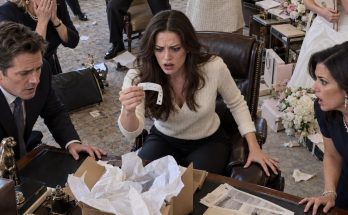
Three weeks after my mother died, Dad announced he was marrying her sister. I already knew their affair had begun while Mom was fighting cancer, but I congratulated them and promised to attend. Eight months later, I walked into their wedding carrying a white gift box containing everything they thought was secret.
My mother’s laugh could fill an entire house.
That is what I remember first.
Not the hospital.
Not the chemotherapy.
Not the scarf she wore after losing her hair.
Her laugh.
It came from somewhere deep and surprised even her. She never seemed to decide to laugh. It simply escaped, loud and warm and completely unconcerned with whether anybody else thought the moment was funny enough.
Her name was Donna.
She was fifty-two when she was diagnosed with breast cancer and fifty-four when she died.
During the two years between those facts, cancer took a great deal from her.
Weight.
Strength.
Sleep.
Privacy.
Eventually, time.
It never completely took the laugh.
I am grateful for that.
Because when I think of the afternoon I discovered what my father and my mother’s sister were doing behind her back, I need something good to place beside the memory.
Otherwise, that day becomes too large.
I was in college when Mom got sick.
Three hours from home.
Close enough to come back on weekends, far enough that every trip had to be planned around classes and deadlines.
Mom told me herself.
“It’s cancer,” she said over the phone. “Breast. We have treatment options, so nobody panics yet.”
I was already crying.
“Mom—”
“Save some of that for finals.”
That was Donna.
Then her voice softened.
“I need you to keep doing your life.”
“How?”
“Study. Come home when you can. Call me. And remind your father about my appointments because he can remember every baseball score since 1985 and somehow forget Tuesday at ten.”
I laughed because she wanted me to.
I did not understand until much later how much truth was hiding inside that joke.
My father, Raymond, had been married to my mother for twenty years.
I assumed that meant something permanent about him.
Children make that mistake.
Even adult children.
We confuse how long somebody has occupied a role with how deeply they deserve it.
Dad could be charming.
He could be funny.
He knew how to make strangers like him quickly.
He was also very good at accepting my mother’s kindness as though it were simply a natural resource provided for his comfort.
I did not recognize that until after she was sick.
Aunt Lisa was my mother’s younger sister.
Only two years apart.
They had grown up sharing clothes, bedrooms, friends, secrets.
At least that was the family story.
Lisa was at every birthday.
Every Thanksgiving.
Every Christmas.
Sunday phone calls went back decades.
If Mom needed something, Lisa was one of the first people I expected to show up.
So when I came home unexpectedly one October afternoon and heard Lisa’s voice from the kitchen, I smiled.
Of course she was there.
Family was helping.
I unlocked the front door quietly because I wanted to surprise Mom.
She had been having a bad week after treatment.
I had finished a project earlier than expected and decided to come home three weeks before my next planned visit.
I was halfway through the hallway when I heard Lisa laugh.
Then she said:
“I can’t wait until we can finally stop hiding.”
I stopped.
There are sentences your mind rejects before it understands them.
That was one.
My father answered.
“Just be patient.”
I stood behind the wall near the kitchen entrance.
I could see neither of them.
I could hear everything.
Lisa said something about living in the house.
Their house, she called it.
Then something about a wedding.
My father laughed.
“We’ve already waited this long.”
His tone was relaxed.
Affectionate.
Nothing like the voice of a husband worrying about his dying wife.
Then he said the sentence that changed everything.
“The house is still in Donna’s name. I need her to sign the papers first. Until then I keep playing the devoted husband.”
Lisa laughed softly.
Dad added:
“Once that’s handled, we won’t have anything to worry about.”
I do not remember breathing.
The house had belonged to my mother before she married him.
Her parents left it to her.
She grew up there.
I grew up there.
And my father was standing in her kitchen with her sister, talking about waiting for her to die while arranging to secure the house first.
I left without letting them see me.
For three hours, I sat in a coffee shop two miles away.
My coffee went cold.
I kept replaying the conversation.
Maybe I misunderstood.
Maybe they were discussing something innocent.
Maybe—
No.
Shock sometimes makes intelligent people work very hard to manufacture explanations they know are false.
I eventually stopped.
Then I made the hardest decision of my life.
I did not tell my mother.
People have opinions about that.
I have opinions about it too.
They have changed repeatedly over the years.
Was she entitled to know?
Absolutely.
Would knowing have helped her?
I still do not know.
At that point she was exhausted.
Chemotherapy had stripped twenty pounds from a woman who had never carried much extra weight.
Some days she needed help walking from the bedroom to the kitchen.
Every ounce of energy was being spent on remaining alive.
I looked at that reality and decided I would not hand her one more unbearable thing unless I absolutely had to.
Perhaps I was wrong.
But I made the decision out of love.
Then I did something more useful than confronting Raymond.
I found an attorney.
Her name was Patricia Huang.
I deliberately chose someone two hours away who knew none of my family.
I sat across from her and told her the entire story.
She listened without interrupting.
Then she asked:
“Whose house is it legally?”
“My mother’s.”
“How do you know?”
“Her parents left it to her.”
“Was your father ever added to the deed?”
“I don’t think so.”
“Thinking is not enough.”
That was the first useful sentence anyone had given me since the coffee shop.
Patricia pulled the property records.
Mom owned the house individually.
Inherited before the marriage.
No later deed had added Raymond.
“That matters,” Patricia said.
Then she asked whether Mom had recently signed any property paperwork.
I said I did not know.
So I found out.
During my next visit, I sat beside Mom sorting insurance forms.
I made the question sound ordinary.
“Dad mentioned updating some house paperwork. Did you sign anything?”
Mom frowned.
“He gave me something a few weeks ago.”
My stomach tightened.
“What?”
“Something about making things easier later.”
“Did you sign it?”
“No. I told him I was tired of paperwork.”
I nearly cried from relief.
Instead, I said:
“Before you sign anything involving the house, will you have your own lawyer look at it?”
Mom studied me.
That look frightened me more than anything.
She knew me too well.
“Why?”
“Because you should.”
“Is something wrong?”
I swallowed.
“I just want everything to be clear.”
Mom watched me for several seconds.
Then nodded.
“All right.”
She never signed Raymond’s paperwork.
Over the next several months, Patricia helped Mom review her estate properly.
Not secretly from Mom.
That would have defeated the point.
I simply framed the conversations around preparation.
Mom was dying.
Estate planning was sadly reasonable.
We reviewed her will.
Ownership records.
Accounts.
Beneficiary designations.
Personal possessions.
The house.
Mom made decisions.
I made sure they were documented.
Once, while we were signing papers, she looked at me and said:
“You’re being very serious about all this.”
“I inherited that from you.”
“No. You inherited my inability to fold fitted sheets.”
She smiled.
Then she took my hand.
“Whatever you’re worried about, I trust you.”
That sentence almost broke me.
Sometimes I think she knew.
Not details.
But something.
Perhaps she had noticed Raymond drifting away.
Perhaps Lisa’s behavior felt wrong.
Perhaps she simply knew her daughter was protecting her and decided not to force open the thing I was keeping closed.
I will never know.
While Mom fought to stay alive, I also began documenting.
I did not become a private detective.
I did not follow them.
I did not hack phones.
But Patricia showed me which records I could legally access through accounts and documents already belonging to my mother or the estate.
Phone statements.
Shared financial records.
Credit card charges.
Calendar entries.
Nothing by itself said affair.
Together they told a story.
Hotel charges on days Raymond claimed he was working late.
Long calls between his number and Lisa’s.
Charges at restaurants Mom had never visited.
The calls began more than a year before Mom died.
During chemotherapy.
During hospital visits.
During nights when I believed Lisa was helping her sister.
Patricia referred me to a forensic document specialist who organized everything chronologically.
No drama.
No accusations.
Just dates.
Records.
Cross-references.
Facts.
By January, the file was thick.
Then Mom died.
Tuesday evening.
Winter pressed against the windows.
Hospice had been helping us for weeks.
I was sitting beside her.
Holding her hand.
Raymond stepped outside to take a phone call.
Twenty minutes later, my mother stopped breathing.
People use the word peaceful because they need a word.
Death was not peaceful to me.
But she was not frightened.
I was there.
Her hand was in mine.
And even now, years later, that matters.
Raymond was outside on the phone.
I have never asked who he was calling.
I do not need the answer.
Three weeks after the funeral, he called me.
His voice sounded rehearsed.
“I need to tell you something difficult.”
“You and Lisa.”
Silence.
“How did you—”
“Go ahead.”
He began explaining.
Grief.
Unexpected comfort.
Two broken people finding each other.
Life being short.
The usual language people use when they need a clean narrative to cover a dirty timeline.
He told me they had recently realized they were in love.
Recently.
I looked at the binder sitting on my desk.
Fourteen months of phone records.
Hotel receipts.
Credit card charges.
“Congratulations,” I said.
He went quiet.
Then cautiously:
“We’re planning something small in April.”
“I’ll be there.”
That answer frightened him.
I could hear it.
But he wanted badly to believe everything would be fine.
So he did.
The wedding was held at an elegant restaurant in late April.
Around one hundred guests.
Many had known my parents as a couple.
They had attended anniversary parties.
Holiday dinners.
Fundraisers.
They believed Donna had died, grief had brought Raymond and Lisa closer, and love had grown from mutual loss.
That was the story being celebrated.
I wore sage green.
Mom’s favorite color.
Lisa wore ivory.
Raymond looked relaxed in a dark suit.
For most of the ceremony, I felt strangely detached.
I watched my father marry my mother’s sister less than four months after burying his wife.
I expected rage.
Mostly I felt tired.
After the ceremony came cocktails.
People congratulated them.
Lisa laughed.
Dad moved through the room accepting hugs like a man who had successfully reached the ending he wanted.
Then I picked up my gift.
White box.
White ribbon.
Heavy enough to feel expensive.
I walked toward them.
Dad saw me and smiled with visible relief.
“Sweetheart.”
“I brought you something.”
“You didn’t have to.”
“I wanted to.”
He took the box.
Several guests stood nearby.
Not gathered intentionally.
Just close enough to notice.
Dad untied the ribbon.
Lisa leaned toward him.
He lifted the lid.
Inside sat the binder.
The cover page read:
DOCUMENTATION: NOVEMBER 2022–JANUARY 2024.
Dad stopped breathing normally.
Lisa reached inside.
Opened the binder.
First section:
Phone records.
Dates.
Times.
Duration of calls.
Fourteen months before Mom’s death.
Lisa made a small sound.
Not a scream.
More like a gasp that escaped too quickly to control.
Dad looked at me.
“What is this?”
He knew.
“The timeline.”
His face reddened.
Lisa turned a page.
Then another.
Hotel records.
Credit card charges.
Corresponding calendar entries.
Mom’s oncology appointments.
One hotel charge appeared the night after a chemotherapy infusion that had left my mother vomiting for nearly twelve hours.
Lisa shut the binder.
People nearby had gone silent.
Dad lowered his voice.
“What are you doing?”
“Giving you your wedding present.”
“This is completely inappropriate.”
“So was planning your second marriage in Mom’s kitchen while she was still alive.”
The sentence traveled farther than I intended.
The room changed.
I did not raise my voice again.
I had no need.
Then I removed an envelope from beneath the binder.
“This part concerns the house.”
Dad’s expression changed.
“What about it?”
“The deed was never changed.”
He stared at me.
“Mom’s will was updated before she died.”
“What did you do?”
“I made sure her documents reflected her decisions.”
“You manipulated a sick woman.”
That almost made me lose control.
Almost.
Instead I said:
“She had independent legal advice.”
Lisa looked at Raymond.
He looked away.
“The house is not yours,” I continued. “It passes according to Mom’s will. Patricia Huang represents the estate. Her contact information is inside.”
Dad’s face went pale.
That was the moment I understood how much the house had mattered to him.
Not his wife.
The house.
Lisa whispered:
“Raymond, you said—”
He snapped:
“Not here.”
The irony nearly made me laugh.
Not here.
As if location were suddenly important.
I looked at both of them.
“Mom deserved better than what you did.”
Dad began:
“You don’t understand—”
“I understand enough.”
I picked up my purse.
“I’m leaving.”
He stepped toward me.
“You cannot come here and destroy our wedding.”
I looked around.
Nobody needed me to explain what had happened.
The binder sat open.
Guests had heard enough.
“I didn’t destroy anything.”
I looked at Lisa.
Then him.
“I brought the dates.”
I walked out.
I cried in the parking lot.
Not victorious crying.
Not satisfied crying.
I leaned against my car and sobbed until my chest hurt.
Because nothing had actually been repaired.
My mother was still dead.
No binder could give her back the months her husband spent betraying her.
No exposed lie could return her sister to the person she believed Lisa was.
No legal document could erase the indignity of being discussed as an obstacle while fighting to stay alive.
I had protected the house.
Protected the estate.
Protected the truth.
Those were real things.
They were not the same as saving her.
I drove home eventually.
Monday morning, Patricia called.
Raymond had contacted the estate through his own attorney.
He had apparently considered challenging the will and asserting rights to the house.
His lawyer reviewed the deed.
The estate documents.
The chronology.
Then advised him against proceeding.
“There is very little ambiguity here,” Patricia told me.
“Will he fight?”
“I don’t believe so.”
He did not.
The house came to me.
I did not move in immediately.
I finished school.
Took a job in the city.
Rented an apartment.
On weekends, I visited the house.
At first, entering it felt almost unbearable.
Mom existed everywhere.
Her mug.
Her recipe binder.
A cardigan hanging behind the laundry-room door because nobody had thought to remove it.
A grocery list held to the refrigerator with a magnet.
Milk.
Lemons.
Rice.
Toothpaste.
Ordinary words from a person who had expected another week.
The first Sunday I stayed overnight, I cooked one of her recipes.
Chicken.
Potatoes.
Green beans.
Nothing special.
I stood at her stove and suddenly remembered her laughing so clearly that I had to turn off the burner.
I sat at the kitchen table and cried.
Then I finished dinner.
That became a habit.
Sunday meals.
At first alone.
Then I invited a college friend.
Then another.
Mom’s old neighbor Gloria started coming.
Eventually four people became six.
Six became ten.
The house became noisy again.
Not the same noise.
Nothing replaces someone.
But life began entering the rooms without asking whether grief had finished using them.
Two years later, I moved in permanently.
I repainted the living room the same warm off-white Mom had chosen.
She once described it as “the color of a Sunday morning.”
The paint-store employee looked at me strangely when I said that.
Then he helped me find the closest match.
I planted a garden in the back.
Mom had always wanted one.
Sage grew best.
That felt appropriate.
I kept photographs of her throughout the house.
Young Donna.
Newly married Donna.
Donna holding me as a baby.
Donna laughing at Thanksgiving.
Donna without hair during chemotherapy, still laughing because someone had apparently said something ridiculous just before the picture was taken.
I did not keep photos of Raymond or Lisa on the walls.
I did not destroy them either.
They went into a box.
History does not disappear because you dislike it.
Sometimes it simply does not deserve display space.
I have not spoken to my father or Lisa since their wedding.
As far as I know, they are still married.
I do not know whether they are happy.
For several years, I wondered.
Then I realized the question was keeping them in a room inside my life they no longer deserved.
So I stopped asking.
Every March, on the Saturday nearest Mom’s birthday, I host dinner.
Last year twelve people came.
Some never met her.
That amazes me.
They know Donna through recipes.
Stories.
Photographs.
Through Gloria.
Through me.
They know about the laugh because I have described it enough times that they say they can almost hear it.
Sometimes during dinner somebody says something unexpectedly funny.
Everyone starts laughing at once.
And for half a second, I hear her.
Not literally.
I do not believe in ghosts.
But people leave patterns behind.
Ways of loving.
Ways of cooking.
Ways of making rooms feel safe.
Ways of laughing.
Those survive if someone carries them.
For a long time, I thought the binder was the thing I had carried from that terrible year.
Evidence.
Dates.
Betrayal.
The proof that my father and my aunt had lied.
I was wrong.
The binder was temporary.
I have not opened it in years.
What I actually carried forward was my mother.
Her house.
Her recipes.
Her insistence that joy was not something to ration.
Her trust in me.
That last one matters most.
She never knew exactly what I was protecting her from.
At least I do not think she did.
But when I told her not to sign papers without independent advice, she listened.
When I asked her to update her estate, she trusted me.
When she looked at me and said, “Whatever you’re worried about, I trust you,” she gave me something heavier than any legal responsibility.
I have spent years trying to deserve it.
The house has a garden now.
Sage.
Tomatoes.
Lavender.
Mom always said she wanted to plant one but never had time.
I have time.
On warm evenings, I sit outside after work and look back through the kitchen window.
Sometimes friends are inside.
Someone is opening wine.
Gloria is arguing with somebody about how much garlic belongs in Mom’s sauce.
There is laughter.
The real kind.
Too loud.
Uncontrolled.
The kind my mother would have loved.
My father wanted the house because he saw property.
Lisa wanted the life because she saw something my mother had.
I wanted neither of those things in the way they did.
What I wanted was for what belonged to Mom to remain connected to her.
And it has.
Raymond did not get the house.
Lisa did not replace my mother.
Their wedding did not rewrite the years that came before it.
The binder made sure the lie could not become the only story.
But the house did something better.
It kept the truth alive after nobody needed the evidence anymore.
My mother had a laugh that filled rooms.