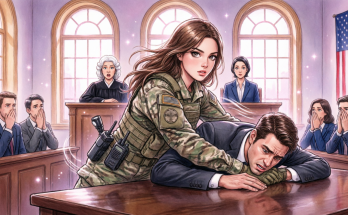
For My 20th Birthday, Grandpa Handed Me The Keys To His Million-Dollar Company. But After The Party, Mom Announced: “From Now On, My New Husband Will Run The Business.” “Absolutely Not. I’m The Owner Now,” I Shot Back. Her Eyes Narrowed. “Then Pack Your Bags And Get Out.” That’s When Grandpa Chuckled… And Revealed A Surprise That Made The Entire Room Fall Silent.
Part 1
The night I turned twenty, the ballroom in our house looked like it had been rented from a dream.
Crystal chandeliers hung over the marble floor, throwing little white sparks across the walls. A string quartet played near the windows, soft enough to make people feel rich and important, not loud enough to interrupt the lies they were telling each other. The air smelled like roses, expensive perfume, polished silver, and champagne.
I stood near the French doors in a navy-blue dress my mother hated.
“You should be wearing gold,” she had said two hours earlier, standing behind me in my bedroom mirror. “Tonight is not about being simple, Natalie. Tonight is about looking like a Hamilton.”
My name is Natalie Hamilton.
And being a Hamilton was apparently the most important thing in the world.
My grandfather, Preston Hamilton, had built Hamilton Meridian from a two-room parts shop in Ohio into a company with factories, patents, private contracts, and a board full of men who smiled like knives. My father had died when I was sixteen. My grandmother had been gone for years. So everyone knew what tonight meant.
At twenty, my trust activated.
At twenty, the majority shares Grandpa had locked away for me would finally come under my control.
At twenty, I stopped being “the little heiress.”
I became a problem.
Across the room, my mother, Celeste, floated between guests in an emerald silk gown. Her laugh carried above the violins. Beside her stood her new husband, Adrian Vale.
Adrian was thirty-eight, twelve years younger than my mother, with bright white teeth, perfect hair, and the kind of handshake that made people count their fingers afterward. He wore a black tuxedo like he had been born in it. His smile never touched his eyes.
They had been married seven months.
My father had been dead three years.
That math had always made my stomach twist.
Adrian saw me watching and lifted his glass.
I looked away.
A warm hand touched my elbow.
“There she is,” Grandpa said.
He was smaller than everyone expected. Age had bent his shoulders a little, but it had not softened him. His eyes were pale gray, sharp and steady. He leaned on a silver-headed cane that made a hard, satisfying sound whenever it hit the marble.
“You look like your grandmother,” he said.
“Mom says I look underdressed.”
“Your mother thinks volume is the same thing as power.”
I tried not to smile.
He looked across the ballroom at Celeste and Adrian. His face did not change, but something in the air tightened.
“You ready?” he asked.
“No.”
“Good,” he said. “Only fools are ready for everything.”
Before I could answer, my mother tapped a spoon against her champagne glass.
The music faded.
A hundred people turned.
“Friends, family,” Mom began, her voice bright and polished. “Thank you for joining us to celebrate my beautiful daughter, Natalie.”
She smiled at me.
It was not a mother’s smile. It was a camera smile.
She talked about my childhood. My father’s death. My “difficult years.” She called my grief difficult. She called my silence stubborn. She called my distance immaturity.
Then she placed one hand over her heart.
“Preston has carried Hamilton Meridian for so long,” she said. “And of course, everyone expects Natalie to try to step into that legacy someday.”
To try.
The words slid under my skin.
“But running a company of this size requires experience. Strength. Maturity.” She turned to Adrian and took his hand. “So tonight, as a family, we have decided that Adrian will take over day-to-day operations as acting director.”
The room went completely still.
Even the waiters stopped moving.
Adrian lowered his eyes in fake humility. My mother squeezed his hand like they had just rescued me from myself.
I looked at Grandpa.
He was watching my mother with the calm expression of a man waiting for a door to close.
“No,” I said.
My voice was not loud.
It did not need to be.
My mother’s smile cracked.
“What did you say?”
“I said no.”
Adrian gave a soft laugh. “Natalie, sweetheart, this is not the time to be emotional.”
“I’m not talking to you.”
The laugh died in his throat.
Mom stepped toward me, eyes flashing. “After everything I have done for you, this is how you behave?”
“What have you done?” I asked. “Besides replacing Dad before the house stopped smelling like his books?”
A gasp moved through the room.
My mother’s face hardened.
“Enough,” she hissed. “If you want to humiliate me in my own home, then get out.”
The marble floor seemed to tilt under me.
She pointed toward the staircase.
“Pack your bags. Tonight.”
For one second, I was sixteen again, standing in a black dress beside my father’s coffin, waiting for my mother to hold my hand.
Then Grandpa chuckled.
It was low, cold, and dangerous.
His cane struck the floor.
Thud.
“Good,” he said softly.
Everyone turned to him.
“Now,” Grandpa said, looking from my mother to Adrian, then back to me, “we find out who truly deserves the Hamilton name.”
And that was when I understood.
This party was never a celebration.
It was a test.
And my mother had just failed.
### Part 2
My mother was not always cruel.
That is the part that makes betrayal hard to explain. People want monsters to arrive wearing warning signs. They want sharp teeth, black eyes, a dramatic entrance.
My mother used to smell like vanilla lotion and laundry soap.
When I was little, she would sit on the edge of my bed and read the same stories in different voices until I laughed so hard I forgot to be sleepy. She kept Band-Aids in every purse. She cried at school plays. She danced barefoot in the kitchen with my father when she thought no one was watching.
My father, Daniel Hamilton, was quiet. He designed buildings and loved old maps. He could spend an hour explaining why a bridge was beautiful. Grandpa loved him because Dad never wanted anything from him.
“Your father is the only man in this family who doesn’t look at me like a bank,” Grandpa once said.
My mother had been different. Bright. Restless. Hungry for rooms to notice her.
But Dad softened her.
Then he died.
The crash happened on a rainy Thursday. A truck jackknifed on the interstate. My father never made it to the hospital.
For months after, Mom slept with the lights on. Sometimes she crawled into my bed at two in the morning and cried against my shoulder.
“It’s just us now,” she whispered. “You and me, baby. I will never let anything happen to you.”
I believed her.
I was sixteen, and I held my mother together with both hands.
A year later, Adrian appeared.
He came into our lives at a charity auction downtown. He was introduced as a financial consultant. He had no old family name, no real connection to our circle, but he moved through rich people like he had studied them in a lab.
He knew when to laugh.
When to listen.
When to touch my mother’s arm.
The first time he came to dinner, he asked me about Grandpa before he asked me about school.
“So you and Preston are close?” he said, cutting into his steak.
“Yes.”
“That must be special. Being his only grandchild.”
I shrugged.
“And the trust,” he continued. “That all goes to you at twenty?”
My fork stopped.
Mom laughed lightly. “Adrian, don’t interrogate her.”
He smiled at me. “Just curious. That’s a lot for a young girl.”
“I’m not a young girl.”
His smile widened.
“No,” he said. “Of course not.”
After that, everything changed in small ways.
Mom stopped watching old movies with me. She hosted dinner parties instead. Adrian’s friends filled our house with loud jokes, strong cologne, and conversations that stopped when I walked into the room.
He began “helping” with family matters.
He reviewed household expenses.
He spoke to lawyers.
He asked about Grandpa’s health.
“Is he still sharp?” I heard him ask once.
My mother answered too quickly. “Sharp enough.”
Adrian laughed. “That can be managed.”
I told Mom I didn’t trust him.
We were in the upstairs hallway. Rain tapped against the windows. She had just come home from dinner with him, cheeks flushed, diamonds at her ears.
“He wants the company,” I said.
Her face closed.
“That is a disgusting thing to say.”
“It’s true.”
“You are jealous.”
“I’m scared.”
“No,” she snapped. “You are spoiled. You hate that I’m happy.”
“Dad has only been gone a year.”
Her hand flew before I saw it coming.
The slap cracked through the hallway.
My cheek burned. My eyes filled, but I did not cry.
Mom looked shocked for half a second. Then pride covered it.
“Never speak about my life like you own it,” she said.
That night, I packed a bag and went to Grandpa’s.
I still came home sometimes, because part of me was stupid enough to hope. I thought maybe my mother would wake up. Maybe she would see Adrian clearly. Maybe she would choose me.
The night I stopped hoping, I was eighteen.
I had come home late from a study group. The house was dark except for the light under Mom’s office door. I heard voices.
Adrian’s first.
“We can’t wait forever.”
Mom answered, tired. “Preston is not stupid.”
“He is old.”
“He is still chairman.”
“And Natalie is still the obstacle.”
My name made me freeze.
Adrian’s voice dropped lower.
“She’s emotional. Isolated. Still grieving. If she has a breakdown, if people start questioning whether she can handle the trust, a responsible mother would step in.”
I waited for Mom to scream at him.
To defend me.
To throw him out.
Instead, there was a long silence.
Then my mother said, “She is stubborn.”
Adrian laughed softly.
“Then break that first.”
I backed away from the door with one hand over my mouth.
That was the night I learned betrayal did not always sound like shouting.
Sometimes it sounded like your mother saying nothing.
### Part 3
Grandpa’s collapse came on a Tuesday morning in October.
I was in my dorm room, surrounded by finance notes, cold coffee, and a half-eaten granola bar, when my phone rang.
Mom.
For one second, I considered not answering.
Then I did.
“Natalie,” she sobbed. “It’s your grandfather.”
The room narrowed.
“What happened?”
“He collapsed at the office. They’re taking him to St. Catherine’s. It’s bad. Oh God, Natalie, it’s bad.”
I drove two hours in seventy minutes.
I do not remember most of it. Just rain on the windshield. My hands gripping the steering wheel. My father’s funeral flashing behind my eyes. The smell of hospital disinfectant hitting me before I even reached the ICU.
Mom sat in the waiting room, mascara smeared, wrapped in a cream coat. She looked shattered.
Adrian did not.
He stood near the nurse’s desk with his phone pressed to his ear.
“Yes, he’s unavailable,” he said quietly. “All board questions can come through me for now. No, we cannot wait on Preston’s signature.”
I stopped walking.
Adrian saw me and ended the call.
“Natalie,” he said, opening his arms like we were family. “Thank God.”
“How is he?”
His expression turned soft and fake. “He is very old.”
“Do not say that.”
“We need to prepare for every outcome.”
I pushed past him.
Grandpa survived.
Barely.
For two weeks, he lay in the ICU looking smaller than I had ever seen him. Tubes ran from machines that beeped all night. His hand felt dry and light in mine.
I read to him from my textbooks. I told him about campus gossip. I described the weather. I refused to speak as if he were already gone.
Mom visited.
Adrian visited more.
But they never sat with him the way I did. They stood in corners. Whispered to doctors. Took calls in hallways. Brought in lawyers I had never seen before.
Then Adrian began his “temporary assistance.”
He moved into Grandpa’s office at Hamilton Meridian.
Just to keep things steady, he said.
He reviewed contracts.
Just to help, he said.
He attended board meetings.
Just until Preston recovered, he said.
Within a month, Grandpa’s longtime CFO had been forced out. His assistant, Mrs. Bell, who had known me since I was in diapers, was dismissed for being “redundant.” Adrian hired three men from his old firm and gave them titles that sounded expensive and meant nothing.
Mom signed whatever he placed in front of her.
She told everyone Adrian was saving us.
I knew he was looting us.
But knowing and proving were different things.
So I remembered Grandpa’s oldest lesson.
When I was twelve, he taught me chess at the lake house. I hated it. I wanted to take pieces fast. I wanted victory to be loud.
After I lost for the fifth time, I knocked over my king.
Grandpa calmly reset the board.
“You lose because you think power is attacking,” he said.
“What else is it?”
He moved his knight.
“Power watches. It waits. It lets greedy people reveal where they are weak.”
At nineteen, sitting beside his hospital bed while Adrian stole his chair at the company, I finally understood.
I started watching.
During the day, I became exactly what Adrian wanted me to be.
Quiet.
Tired.
Overwhelmed.
At breakfast, he would smile over his newspaper.
“Don’t worry your pretty head about business, Natalie. You focus on school. What is it again? Interior design?”
“Finance,” I said.
“Right. Cute.”
Mom laughed.
I smiled.
At night, I used the old service stairs.
Adrian had installed new cameras, but he did not know the house. He did not know about the narrow servant hallway behind the linen room, or the second door into Grandpa’s study hidden behind a wall of built-in bookshelves.
He had redecorated Grandpa’s office in white leather and glass.
It looked like a hotel lobby.
It smelled like lemon cleaner and Adrian’s sharp cologne.
But he had kept the old desktop.
He changed the password.
Grandpa had taught me to keep a list of likely passwords for arrogant men.
Adrian’s was ValeCapital2024.
I almost laughed.
For weeks, from two to four in the morning, I copied files.
Invoices.
Transfer requests.
Consulting contracts.
Board memos.
At first, it looked messy but explainable. Then I found the pattern.
Money was moving through fake consulting fees into a holding company called AV Strategic.
Adrian Vale.
Then I found a folder labeled N.H. Transition.
My initials.
Inside were scanned copies of my signature.
Not one.
Hundreds.
Natalie Hamilton.
Natalie Hamilton.
Natalie Hamilton.
Some shaky. Some nearly perfect.
My skin went cold.
The last file was a draft letter dated for my twentieth birthday.
It said I felt overwhelmed.
It said I did not believe I could manage my inheritance.
It said I voluntarily transferred control of my shares to my mother and stepfather for my own protection.
I sat in Adrian’s white leather chair until dawn turned the windows gray.
They were not planning to take the company from me.
They were planning to make the world believe I had handed it over.
And my mother was helping him hold the pen.
### Part 4
The next morning, I ate breakfast with them.
That was the hardest acting I had ever done.
Mom sat at the end of the table in a silk robe, scrolling through her phone. Adrian drank black coffee and read a financial paper like a man who thought headlines were written about him personally.
I buttered toast with hands that did not shake.
“Natalie,” Mom said without looking up, “you look pale.”
“Bad sleep.”
Adrian folded his paper. “Stress will do that. This is exactly why your mother and I worry about you taking on too much.”
I looked at him.
His smile was gentle.
His eyes were not.
“You’re probably right,” I said.
Mom finally looked up.
Adrian leaned back, pleased.
“I mean,” I continued carefully, “the company is huge. Grandpa always made it seem simple, but maybe I don’t really understand what I’m walking into.”
My mother’s face softened with relief.
Not love.
Relief.
“That is very mature of you,” she said.
Adrian reached across the table and patted my hand.
I wanted to break his fingers.
Instead, I smiled.
“I’m lucky you’re helping.”
He loved that.
For the next week, I fed his ego like tossing meat to a dog.
I asked small questions.
I acted confused.
I let him explain basic finance to me as if I had not been studying balance sheets since I was fourteen.
Every night, I copied more files.
But Grandpa had taught me another lesson too.
Evidence hidden in a drawer is fear.
Evidence placed in the right hands is power.
So I went to Arthur Sloan.
Mr. Sloan had been Grandpa’s attorney for forty-seven years. He wore old gray suits, carried a leather briefcase, and spoke so slowly people mistook him for harmless.
He was not harmless.
We met at a diner downtown at seven in the morning. Not a trendy place. A real diner with cracked red booths, burnt coffee, and a waitress who called everyone honey.
Mr. Sloan slid into the booth across from me.
“You look like you haven’t slept in a month,” he said.
“I found something.”
I pushed a flash drive across the table.
He did not touch it right away.
“Does your grandfather know?”
“No.”
His eyes narrowed.
“He’s recovering. I didn’t want to—”
“You didn’t want to scare him,” Mr. Sloan finished.
I nodded.
He took out a small laptop. While he read, the diner moved around us. Plates clattered. Bacon hissed on a grill. Someone laughed near the register.
Mr. Sloan did not move for twenty minutes.
Then he closed the laptop.
“That snake,” he said.
It was the first time I had ever heard him swear.
“Can they do it?” I asked.
“They can try.”
“Can they win?”
He looked at me over the top of his glasses.
“Not if we control the paper.”
I almost cried from relief.
But then he added, “The documents prove preparation. Transfers prove movement. The forged signatures prove intent. But for the board, for a judge, for public record, it would help to have their own voices.”
I knew what he meant.
A week later, I gave my mother a birthday-week gift.
It was a sleek digital photo frame for her office, silver-edged, expensive, loaded with family pictures I had chosen carefully.
Me at six, missing a front tooth.
Mom and Dad dancing in the kitchen.
Grandpa holding me on his sailboat.
My mother stared at the slideshow, and for one brief second, grief crossed her face like a shadow.
“Oh, Natalie,” she whispered.
“I thought you’d like it,” I said.
Adrian walked in behind her. “Nice little gadget.”
“It has voice memo features,” I said, keeping my tone light. “You can leave reminders. I set it up for you.”
“Sweet,” Mom said.
I smiled.
The frame recorded continuously.
The audio uploaded to a secure server Mr. Sloan controlled.
For seven days, Mom and Adrian talked in front of it.
About my trust.
About making me look unstable.
About board votes.
About pressure.
About signatures.
About how easy I would be to handle once Grandpa was too weak to interfere.
On the afternoon before my birthday party, I visited Grandpa in his sunroom.
He sat near the windows with a crossword puzzle in his lap. Sunlight fell across his white hair.
“Seven letters,” he said. “A fraud wearing a friendly face.”
“Adrian.”
“Too many letters.”
“Parasite.”
He smiled. “That fits.”
I sat beside him.
“Grandpa,” I asked, “did you know they would try something tonight?”
He looked at me for a long moment.
“I knew they were greedy.”
“That’s not an answer.”
“It is the only answer that matters.”
I swallowed.
“What are you going to do?”
He placed his pen down.
“Nothing.”
“Nothing?”
“I am going to give my granddaughter her birthday gift. Then I am going to watch.”
My chest tightened.
“This is your board now, Natalie,” he said softly. “I set the pieces. You make the move.”
“I’m scared.”
“I would be worried if you weren’t.”
He reached for my hand.
“They want a frightened girl,” he said. “Give them a Hamilton.”
That night, as the ballroom filled with gold decorations and champagne, I taped one last copy of the evidence beneath my vanity drawer.
Then I put on a red dress Grandpa had sent me.
Not gold.
Not blue.
Red.
A warning color.
And I walked downstairs to let my mother betray me in public.
### Part 5
The ballroom glittered like a treasure chest.
Gold curtains. Gold tablecloths. Gold ribbons around the champagne flutes. Even the cake was dusted with gold leaf. My mother had built an altar to wealth and called it my birthday.
Guests turned when I reached the top of the staircase.
I felt their eyes move over me.
The red dress was simple, fitted, and sharp. My hair was pinned back. Around my neck were my grandmother’s pearls, the ones my mother had asked to borrow for years and Grandpa had never let her touch.
Adrian saw them first.
His jaw tightened.
Mom saw them next.
Her smile flickered.
Good.
Grandpa sat near the front in a high-backed chair, cane resting against his knee. He looked frail under the lights, but his eyes were awake.
“You wore red,” he said when I reached him.
“You said give them a Hamilton.”
His mouth twitched.
Dinner moved slowly. I tasted nothing. Forks chimed against plates. Wine poured. People laughed at things that were not funny.
Mom sat beside me, hand cold when she touched my wrist.
“You look dramatic,” she murmured.
“It’s a dramatic night.”
Adrian leaned around her. “A new beginning.”
“Yes,” I said. “It is.”
At nine o’clock, the lights dimmed.
Grandpa stood.
The room quieted instantly.
“Thank you all for coming,” he said.
His voice was rough but steady.
“We are here tonight for my granddaughter, Natalie. My only grandchild. My heir.”
A polite wave of applause moved through the room.
Grandpa lifted one hand, and silence returned.
“When my father started this company, he kept one key in his pocket. It opened the first shop. Later, it opened the first office. Then the first factory. I carried that key after him.”
He looked at me.
“Natalie.”
I stood.
My legs felt weak, but I walked to him.
He opened a black velvet box.
Inside was a heavy silver key ring with the Hamilton crest engraved into it: a hawk with wings spread wide.
“This was my father’s,” Grandpa said. “Then mine.”
He pressed the box into my hands.
“Now it is yours.”
The applause was louder this time. Cameras flashed softly from the family photographer near the back. I stared at the key in my palm. It was heavier than I expected.
“Thank you,” I whispered.
I started to return to my seat.
Adrian stood.
The room stilled again.
“A beautiful tradition,” he said, raising his glass. “Truly. Preston, your faith in Natalie is touching.”
Grandpa did not move.
Adrian put his arm around my mother’s waist.
“But symbolism and operations are two different things.”
There it was.
My mother stepped forward.
Her voice was bright and awful.
“We are so proud of Natalie,” she said. “But we all know she has been through a great deal. She is young. Emotional. Still finding herself.”
A few guests shifted uncomfortably.
Mom continued.
“So, to protect Natalie and to protect Hamilton Meridian, Adrian will take over as acting director effective immediately. I will remain involved as family representative.”
She smiled.
She expected applause.
She got silence.
I looked at her.
“No.”
The word landed cleanly.
Her eyes sharpened.
“Natalie,” she warned.
“No,” I repeated. “You do not get to announce my future like a menu change.”
Adrian laughed softly. “This is exactly the kind of reaction we were hoping to avoid.”
“I’m sure.”
Mom’s cheeks flushed dark red.
“You ungrateful child,” she hissed. “After everything I sacrificed—”
“What did you sacrifice?” I asked. “Me?”
The room inhaled.
Her control snapped.
“If you refuse to respect me in my own house,” she said, voice trembling with rage, “then leave it. Pack your things and get out tonight.”
For one moment, everything froze.
My mother had done exactly what Grandpa had waited for.
His laugh rolled through the ballroom.
Cold.
Satisfied.
Terrifying.
Mom turned toward him. “Father?”
Grandpa lifted his cane.
Thud.
The sound echoed off the marble.
“Arthur,” he said.
At the back of the room, Mr. Sloan stepped away from the wall.
The lights dimmed.
Adrian’s face changed first.
Not fear yet.
Recognition.
Then the speakers cracked to life.
A recording began.
And Adrian’s own voice filled the ballroom.
“She’ll sign if Celeste pressures her hard enough. Natalie still wants her mother to love her. That’s the weakness.”
My mother’s mouth opened.
No sound came out.
### Part 6
The room did not breathe.
Adrian’s recorded voice continued, smooth and smug.
“Her birthday is the perfect night. She’ll be emotional. Surrounded. If she refuses, we make her look unstable in front of everyone.”
Then my mother’s voice.
“What if Preston interferes?”
Adrian laughed.
“He’s old. He can glare from his chair all he wants. The board wants control, not sentiment.”
Several board members turned pale.
My mother whispered, “Turn it off.”
No one moved.
The recording kept playing.
“And the transfer letter?” my mother asked.
“Ready,” Adrian said. “Her signature is close enough. If she fights later, we say she was confused. Overwhelmed. You say she begged you to take control.”
A woman near the front covered her mouth.
My hands were cold around the velvet box.
Then came the part that hurt most.
My mother’s voice, low and tired.
“She won’t forgive me.”
Adrian answered, “She doesn’t have to. She only has to lose.”
The recording stopped.
The lights rose slowly.
The ballroom looked different now. The gold seemed cheap. The flowers too sweet. The champagne untouched.
Adrian recovered first.
“That is fake,” he snapped. “Obviously fake.”
Grandpa stood straighter than I had seen him stand in months.
“No,” he said. “It is not.”
“You recorded private conversations,” Adrian said, voice rising. “That’s illegal.”
“My house,” Grandpa replied. “My office. My attorney.”
Mr. Sloan stepped forward with his briefcase.
“And probable cause of fraud, conspiracy, and attempted theft,” he said calmly. “You may argue privacy later. I look forward to hearing it.”
Adrian’s face shone with sweat.
Mom looked at me.
For one wild second, I saw hope in her eyes.
She thought I might still save her.
That was the ugliest thing about being loved badly. People who break you still expect you to protect them from the glass.
I stepped forward.
“My mother was right about one thing,” I said.
Her face lifted.
“Hamilton Meridian is not a toy. It is not a gift basket for whoever marries into the right family. It is not Adrian Vale’s retirement plan.”
Mr. Sloan opened his briefcase.
He placed stacks of documents on the table.
“These are transfer drafts prepared under my initials,” I said. “These are forged signatures. These are payments routed through AV Strategic. These are consulting invoices for work that was never performed.”
The projector lit again.
Page after page appeared.
Numbers.
Accounts.
Emails.
Signature samples.
I looked at the CFO Adrian had installed.
“Mr. Keller,” I said, “did you approve the ten-million-dollar transfer to Northbridge Advisory?”
He swallowed.
“Adrian told me it was confidential.”
“There was no advisory work,” I said. “Northbridge routes to AV Strategic. AV Strategic is owned by Adrian.”
Adrian lunged toward me.
“You little—”
Security moved faster.
Two men in black suits caught his arms before he made it three steps.
His face twisted.
The polished husband vanished.
What remained was small, furious, and ugly.
“You think you can run this company?” he spat. “You’re a spoiled little girl wearing borrowed pearls.”
I held up the silver key.
“They’re mine.”
Grandpa looked at the board.
“As chairman, I call an emergency vote,” he said.
Mr. Sloan’s voice was steady.
“Motion to remove Adrian Vale and Celeste Hamilton Vale from all operational roles, board access, financial authority, and company premises, effective immediately.”
The room stayed silent for one heartbeat.
Then the first hand rose.
Then another.
Then all of them.
Even the men who had smiled at Adrian last month lifted their hands like their lives depended on it.
“The motion passes,” Mr. Sloan said.
My mother made a broken sound.
“No,” she whispered. “No, I am Preston’s daughter.”
Grandpa looked at her.
“You were,” he said.
The words hit harder than shouting.
Adrian fought security as they dragged him toward the doors.
“You’ll regret this!” he screamed at me. “You have no idea what you’re doing!”
The ballroom doors opened.
Camera flashes exploded.
Not gossip bloggers.
Business press.
Financial reporters.
People Mr. Sloan had quietly invited for a “major leadership announcement” at Hamilton Meridian.
They saw Adrian pulled out by security.
They saw my mother standing in emerald silk, face ruined.
They saw Grandpa at my side.
They saw me in red, holding the key.
By midnight, the story would be everywhere.
By morning, Adrian Vale would not be a businessman.
He would be evidence.
### Part 7
After the press left, the ballroom emptied fast.
People who had eaten our food and praised my mother’s dress now avoided her eyes as they hurried out. Board members shook Grandpa’s hand, then mine. Their palms were damp. Their promises came too quickly.
“We stand with you, Natalie.”
“Whatever you need.”
“Your grandfather made the right decision.”
I knew better than to believe all of them.
Loyalty spoken under cameras is not loyalty.
It is survival.
Mr. Sloan handled the reporters in the foyer. Grandpa’s nurse appeared at his side, whispering that he needed rest. He looked suddenly older, the strength draining out of him now that the performance was over.
He touched my shoulder.
“One more thing,” he said quietly.
I knew who he meant.
My mother had not left.
She sat on the bottom step of the grand staircase, shoes off, emerald dress pooled around her like spilled paint. Her hair had fallen loose. Mascara ran down her cheeks in black rivers.
Grandpa looked at her once.
Then he looked away.
“Finish it,” he said.
The nurse led him out.
The doors closed.
It was just my mother and me in the destroyed gold ballroom.
For a while, neither of us spoke.
The silence felt bigger than the room.
I walked toward her. My heels clicked against the marble.
Click.
Click.
Click.
She looked up.
Her eyes were red.
“You destroyed me,” she whispered.
I stopped a few feet away.
“No,” I said. “I stopped you.”
Her mouth trembled.
“You humiliated me in front of everyone.”
“You tried to erase me in front of everyone.”
“I am your mother.”
I almost laughed, but it would have come out like crying.
“I know.”
That was the whole wound.
She pressed one hand to her chest.
“I did it for us.”
There it was.
The last costume.
The victim.
“No,” I said. “You did it for control.”
Her face hardened.
“Your grandfather poisoned you against me.”
“Grandpa protected me from you.”
She flinched.
Good.
“I loved you,” I said, and my voice cracked before I could stop it. “After Dad died, I would have done anything for you. I held you while you cried. I defended you when people whispered. I tried to warn you about Adrian.”
“He loved me,” she said.
“He loved access.”
She closed her eyes.
“You don’t understand what it felt like,” she whispered. “To be Preston Hamilton’s daughter and still have no power. To watch your father hand everything to your child. To be treated like decoration in your own family.”
For the first time all night, I saw the truth clearly.
It was not just Adrian.
He had opened the door, but the bitterness had already been living inside her.
“You hated me for inheriting what Grandpa never gave you,” I said.
Her silence answered.
My chest ached so sharply I almost touched it.
“I was your daughter,” I said.
She looked down.
“And I was his daughter,” she whispered.
There was no apology in it.
Only resentment.
That was when the last small, foolish part of me stopped waiting.
“I’m not forgiving you,” I said.
Her head snapped up.
“Natalie—”
“No. You do not get to betray me for years, help a man steal my future, and then hide behind the word mother.”
Tears filled her eyes.
Real ones this time.
Too late.
“I loved you,” I said again. “But I am done paying for that love with pieces of myself.”
She reached for my hand.
I stepped back.
The movement broke something in her face.
“Where will I go?” she whispered.
“Your attorney can speak to Mr. Sloan.”
“I’m your mother.”
“You were.”
The same word Grandpa had used.
It tasted bitter.
It tasted final.
I turned and walked away.
Behind me, she began to cry, softly at first, then harder.
I did not turn around.
I left her sitting on the staircase in the house she had tried to use as a throne.
For years, she had made me feel like a guest in my own life.
That night, I finally walked out as the owner.
### Part 8
Grandpa lived two more months.
People expected those months to be peaceful because the big scene was over.
They were not.
Hamilton Meridian was a mess.
Adrian had left fingerprints everywhere. Bad contracts. Hidden obligations. Inflated consulting fees. Employees loyal to him. Board members pretending they had never trusted him. Reporters calling every hour. Lawyers sending letters thick enough to use as doorstops.
I worked until my eyes burned.
I learned fast who was useful, who was scared, and who needed to be removed before they became dangerous.
Mr. Sloan stayed beside me through all of it.
“You do not need to be your grandfather,” he told me one night, when I was staring at a stack of reports at three in the morning.
“Good,” I said. “I can’t be.”
“No,” he said. “You need to be you. Cleaner. Quieter. Harder to buy.”
Every day from four to five, no matter what was burning down, I went home to sit with Grandpa in the sunroom.
We did crosswords.
Sometimes he slept through most of the hour.
Sometimes he told stories about my father. How Dad once refused a company car because he said his old truck still ran. How he proposed to my mother under an oak tree during a thunderstorm. How he could look at an empty field and already see a building full of light.
Grandpa never talked much about the party.
Neither did I.
On his last afternoon, the sky was pale blue. Winter sunlight fell across his blanket. His hand was thin in mine.
“Natalie,” he whispered.
“I’m here.”
His eyes opened.
“Now you know.”
“Know what?”
“What family is.”
I swallowed hard.
He took a shallow breath.
“It isn’t blood.”
His fingers tightened around mine.
“It’s loyalty.”
Those were his last clear words.
He died before sunset.
I buried him beside my grandmother and my father, under a white stone with his name cut deep into it. At the funeral, my mother stood far back behind a line of reporters and security.
She wore black.
She looked smaller.
I did not speak to her.
Adrian went to prison the following year. Fraud, forgery, embezzlement, conspiracy. The sentence was long enough for his hair to turn gray behind bars.
My mother avoided prison by testifying, signing away every claim to Hamilton Meridian, and accepting a settlement Grandpa had already arranged in case mercy became legally useful.
She remained rich.
She did not remain a Hamilton.
I sold the mansion.
People were shocked by that. They thought I would keep it as a symbol.
But that house was not a home anymore. It was a ballroom full of ghosts. A staircase where my mother chose power over me. A study where my future had been discussed like stolen furniture.
I moved into a brick townhouse downtown, fifteen minutes from the office. It had creaky floors, bad water pressure, and morning light that came through the kitchen windows like forgiveness.
Hamilton Meridian survived.
Then it grew.
Not because I was ruthless like Adrian.
Not because I was feared like Grandpa.
But because I listened. I hired people smarter than me and made sure they were honest. I cut out rot. I promoted Mrs. Bell, Grandpa’s old assistant, to executive operations director because she knew more about the company than half the board combined.
On my twenty-first birthday, there was no ballroom.
No gold.
No orchestra.
Just pizza in the conference room with the people who had stayed late to finish a factory renewal deal. Someone brought grocery-store cupcakes. Mrs. Bell stuck one candle in mine.
I laughed when I blew it out.
Really laughed.
For the first time in years, nothing in the room felt fake.
Sometimes my mother sends letters.
Mr. Sloan reads them first. Most are apologies wrapped in excuses. Some are memories. A few are angry. I keep none of them.
Maybe one day I will stop feeling the sting when I see her handwriting.
But forgiveness is not a door people get to kick open because they are lonely.
Love that arrives after betrayal is just noise.
I am twenty-three now.
The silver key sits in my desk drawer at Hamilton Meridian. I do not carry it around. I do not need to.
I know what it opens.
I know what it cost.
And every once in a while, when a boardroom goes quiet and someone looks at me like I am too young to understand the game, I think of Grandpa’s cane striking the marble.
Thud.
I think of my mother’s face when the recording started.
I think of Adrian being dragged into camera flashes.
I think of the girl in the red dress who finally stopped begging to be loved by people who only wanted to own her.
Then I smile politely.
I let them talk.
I watch the whole board.
And I wait.
THE END!