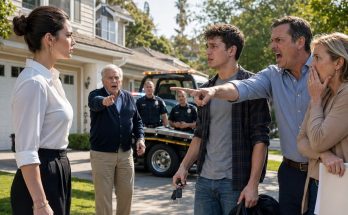
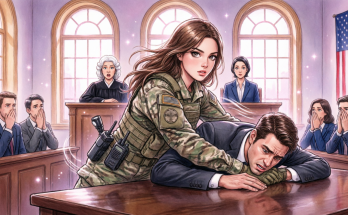
At My Brother’s Graduation Party, My Dad Demanded That I Sign Over My $450,000 House To My Brother. I Refused. Furious, He Flipped My Wheelchair While I Was 8 Months Pregnant. My Belly Hit The Floor So Hard That I Screamed… Then My Water Broke. As I Cried In Pain, I Looked Them In The Eye And Said: “You’ll Regret This.” Only Minutes Later, The Sirens Arrived…
Part 1
The first thing I remember is the floor.
Not my father’s face. Not the guests screaming. Not the champagne glasses shattering somewhere behind me.
The floor.
Cold, polished hardwood pressed against my cheek while my wheelchair lay on its side beside me, one wheel still spinning in the air with a soft, stupid clicking sound.
Like it was counting down the seconds before my whole life changed.
I was eight months pregnant, face down in the middle of my brother Mason’s graduation party, with warm fluid spreading through my dress and a pain so sharp it made the chandelier lights blur above me.
My water had broken.
A month early.
Because my father had just flipped my wheelchair.
His name is Victor Hale, and for most of my life, people in Austin knew him as a polished man. Executive. Donor. Country club member. The kind of man who shook hands firmly, remembered names when it mattered, and smiled like a campaign poster when cameras came out.
To me, he was the first person who ever taught me that love could feel like a debt.
My name is Claire.
If you passed me on a sunny sidewalk in Austin, Texas, you might think I had everything handled. I work from home as a graphic designer. I own a beautiful ranch-style house tucked into a quiet hill road lined with old oaks. I married a man who looks at me like I am not missing anything. And until that summer, I believed I had finally built a life my father could not touch.
I was wrong.
I have used a wheelchair since childhood because of a progressive spinal condition. When I was little, other kids counted birthday candles and scraped knees. I counted ramps, curb cuts, hallway widths, and how long I could sit upright before the ache in my lower back turned from a dull hum into a hot wire.
My mother, Diane, used to say things like, “Your father just doesn’t know how to express worry.”
But Victor was never worried about me.
He was embarrassed.
At parties, he positioned me near walls. In family photos, he made sure Mason stood in front of my chair. At school events, he introduced my brother first, then lowered his voice when he mentioned me, as if disability was a private family stain.
Mason was two years younger than me and born with everything Victor respected. Straight back. Long legs. Easy smile. Baseball trophies. Expensive haircuts. A handshake he practiced in the mirror because Dad said men were judged before they opened their mouths.
I learned early that Mason’s wants were emergencies. My needs were burdens.
When I needed physical therapy, there was always a reason to postpone it.
When Mason needed elite travel baseball, money appeared overnight.
When my chair needed repairs, my mother sighed over invoices.
When Mason wanted a graduation watch, my father called it “investing in his future.”
The only person in my blood family who saw through all of it was my grandfather Walter.
He was my mother’s father, a retired contractor with rough hands, sharp eyes, and a laugh that sounded like gravel in a tin can. He never spoke to me like I was fragile. He asked about my designs. He argued with me about old movies. He let me beat him at cards and pretended not to notice when I cheated.
“You’re the strongest person in this family,” he told me once, when I was sixteen and crying because Dad had left me home from a company picnic.
I laughed bitterly. “Strong people don’t get hidden.”
Grandpa Walter looked toward the kitchen, where my parents were pretending not to hear us.
“No,” he said. “Weak people hide what they can’t control.”
When he died three years ago, the house changed forever.
Not because of grief.
Because of money.
Grandpa left me his paid-off historic ranch house in the Austin hills and a medical trust he had quietly built in my name. He left my mother a small account. Mason received a watch and a letter. Victor received nothing.
I still remember the sound of my father’s leather shoes pacing across the lawyer’s office after the will was read.
“You can’t be serious,” he said.
The lawyer adjusted his glasses. “Mr. Hale was very clear.”
Victor looked at me then, not as a daughter, not even as a person.
As an obstacle.
That was the day the first invisible chain wrapped around my throat.
My mother began calling every week. Sometimes crying. Sometimes whispering. Sometimes saying things like, “Your father has been under so much pressure,” or “Mason deserves a real start,” or “Your grandfather never meant to divide us like this.”
But he had.
He had divided truth from greed.
I just didn’t understand that yet.
For three years, I paid. Mason’s rent. His meal plan. His books. His “networking trip” to Europe. Eighty thousand dollars disappeared from the trust Grandpa built to protect me, and every transfer came with the same quiet lie I told myself:
Maybe this will make them love me.
Then Mason graduated.
And my father decided money was not enough.
He wanted the house too.
### Part 2
June sixth smelled like cut roses, grilled steak, and money.
My parents had turned their home into a magazine spread for Mason’s graduation party. White tents stretched across the backyard. A jazz trio played near the pool. Caterers in black shirts moved between guests with trays of tiny food nobody could pronounce without sounding pretentious.
There were over a hundred people there. Victor’s coworkers. Local politicians. Country club friends. Neighbors who had never spoken to me unless they wanted to compliment my “bravery.”
I arrived with my husband, Ethan, just after four in the afternoon.
Ethan drove slowly up the long driveway, his hand resting on the steering wheel, jaw tight.
“We don’t have to stay long,” he said.
“I know.”
“You don’t owe them a full evening.”
“I know.”
He glanced at me. “Claire.”
I turned from the window. The Texas sunlight was bright enough to make the white tents glow like bones.
“What?”
“You get quiet when you’re about to let them hurt you.”
I hated how well he knew me.
Ethan and I met five years earlier at a coffee shop downtown. I had dropped a folder of prints while trying to balance coffee on my lap, and he helped gather them without making a single awkward comment about my wheelchair. He just held up one of my poster designs and said, “This color choice is either genius or dangerous.”
I said, “Both.”
He smiled.
That was it.
No pity. No heroic savior energy. No fake softness.
Just Ethan.
When we found out I was pregnant, he cried before I did. Not dramatic crying. Just silent tears, one hand pressed over his mouth while the ultrasound technician smiled and turned the screen toward us.
Every night after that, he rested his palm on my belly and talked to our son.
“Hey, little guy,” he would whisper. “I’m your dad. I already like you better than most people.”
At the party, Ethan stayed beside me like a shield. He brought me water, adjusted my cushion, and kept asking if the heat was too much. I was swollen, tired, and sore. My back felt like it had been filled with hot sand.
Mason barely acknowledged me.
He stood near the pool in a tailored navy suit, accepting congratulations like he had personally invented higher education. Every few minutes, Victor clapped him on the shoulder and introduced him to another important man.
“My son,” Victor said loudly. “Future of the family.”
Diane floated through the party in cream silk, smiling too hard. She kissed my cheek once and left a cold smear of perfume on my skin.
“You look tired,” she said.
“I’m eight months pregnant.”
Her smile tightened. “Don’t be sensitive today, honey. This is Mason’s moment.”
Of course it was.
At six, the sun lowered enough to throw gold light through the glass doors into the main hall. The band shifted into something slow and expensive-sounding. I had just finished a glass of iced water when pain flared across my lower spine so suddenly I inhaled through my teeth.
Ethan leaned down. “Brace?”
I nodded. “I left it in the trunk.”
“I’ll get it.”
“It’s okay. I can wait.”
“No.” He kissed my forehead. “Two minutes.”
I watched him disappear through the front doors.
That was all the time they needed.
I was parked just inside the hall near the open doors to the backyard, close enough to hear laughter but far enough from the crowd that nobody had to make room for me. My hands rested on my belly. The baby shifted once, hard, like he was annoyed by the music.
Then the air changed.
You know that feeling when a room doesn’t get quieter, but your body does?
My father walked toward me with Mason at his side.
Victor’s smile was gone.
Mason’s was not.
He looked pleased. Eager, almost.
My father stopped in front of my wheelchair, blocking the light.
“Claire,” he said.
“Dad.”
He reached inside his suit jacket and pulled out a thick packet of papers.
My mouth went dry before I saw the words.
He dropped the papers into my lap.
“Sign it.”
The top page was a quitclaim deed.
My grandfather’s house.
My house.
Transferred to Mason Hale.
For zero dollars.
I looked up slowly. “No.”
Victor’s nostrils flared. “Don’t start.”
“I told you last week. I’m not signing anything.”
Mason gave a short laugh. “You’re really doing this here?”
“You brought it here.”
He leaned closer, smelling like whiskey and expensive cologne. “Because you keep acting like that house is yours.”
“It is mine.”
His smile sharpened. “Grandpa was confused at the end.”
That was the first moment anger broke through my fear.
“Don’t you dare.”
Victor’s hand landed on my armrest.
Hard.
“Your brother needs that property for collateral. He has opportunities in Houston. Real opportunities.”
“My son is going to grow up in that house.”
“Your son,” Mason said, “doesn’t need acreage. He won’t even remember where he lived.”
I looked past them toward my mother.
Diane stood ten feet away with a champagne glass in her hand.
She saw me.
She saw Victor gripping my chair.
She saw the papers in my lap.
For one second, our eyes met.
Then she turned away and laughed at something a neighbor said.
Something inside me cracked, but it did not break.
Not yet.
I shoved the papers off my lap. They scattered across the floor like white birds.
“I’m done paying for him,” I said. “I already gave you eighty thousand dollars. I’m done.”
Victor’s face went dark red.
People nearby began turning.
“Lower your voice,” he hissed.
“No.”
His grip tightened.
“Let go of my chair.”
“Sign the papers.”
“No.”
The next few seconds were both instant and endless.
Victor looked around and saw people watching. His perfect party. His perfect son. His broken daughter refusing him in public.
His control snapped.
He grabbed the left side of my wheelchair with both hands and yanked.
The world tilted.
I heard someone gasp.
I grabbed for my wheel, missed, and then my body slammed sideways onto the hardwood floor with a force that knocked the air from my lungs.
Pain exploded through my back.
My belly hit the floor.
For one horrifying second, there was no sound at all.
Then warmth spread beneath me.
Too much warmth.
My dress soaked through.
My baby kicked once.
And I knew.
### Part 3
Nobody moved.
That is the part I still dream about.
Not the fall. Not even the pain.
The stillness.
Over a hundred people watched me lie on the floor, pregnant and shaking, while my overturned wheelchair sat beside me like evidence. The jazz band had stopped mid-song, but one cymbal was still vibrating faintly in the backyard.
My cheek stuck to the hardwood.
I could smell lemon polish, spilled wine, and the metallic edge of fear.
A contraction tightened around my stomach like a fist.
I cried out.
That sound finally broke the room.
Someone whispered, “Oh my God.”
Someone else said, “Call an ambulance.”
Mason stepped back so fast he nearly tripped over the scattered papers.
Victor did not kneel.
He did not say my name.
He did not ask if the baby was alive.
He looked at the guests.
That was all.
His eyes moved from face to face, calculating damage, measuring witnesses, searching for a version of the story he could still control.
Diane pushed through the crowd, but only halfway. Her hands flew to her mouth.
“Victor,” she whispered. “What did you do?”
He turned on her. “Quiet.”
I tried to lift my head. My arms trembled under me, useless against the weight of pain and pregnancy.
“Help me,” I said.
I do not know who I said it to.
My mother.
The guests.
God.
Nobody reached me first.
Because Victor started talking.
“She fell,” he announced, voice loud and shaking. “She got overheated. She lost her balance.”
I let out a sound that was almost a laugh.
Lost my balance.
From a wheelchair.
Mason whispered, “Dad, everyone saw.”
Victor shot him a look so vicious Mason shut up.
Another contraction rolled through me, worse than the last. My lower back seized, and the baby pressed downward with a terrifying heaviness.
I knew enough from my high-risk appointments to understand that this was bad. Very bad. Early labor from trauma could go wrong quickly. My spinal condition made everything more complicated.
But panic did something strange inside me.
It cleared the room.
For years, I had been trying to convince myself that my family loved me badly but loved me still. That my mother’s silence was fear. That Mason’s selfishness was immaturity. That my father’s cruelty came from disappointment he did not know how to process.
Lying on that floor, I finally understood.
They did not love me badly.
They loved what they could take.
And when I refused to give more, I became disposable.
My left wrist was trapped under my chest. Slowly, carefully, I dragged my hand toward my body. The movement sent pain flashing down my spine, and black dots crowded my vision.
Victor was still performing.
“She’s always been medically fragile,” he told someone. “This is exactly why I said she shouldn’t have come today.”
Something cold settled in my chest.
Months earlier, Ethan had helped me set up an emergency shortcut on my smartwatch. Because of my pregnancy. Because of my condition. Because he said, “I don’t care if it feels dramatic. Dramatic is better than helpless.”
One button.
Emergency call.
Location sent.
Audio recording uploaded to the cloud.
I pressed it.
The watch vibrated against my skin.
Silent.
Red.
Alive.
I lowered my face to my arm and breathed through the pain while the room recorded itself.
Victor’s voice came through clearly.
“She caused this scene on purpose.”
Mason, panicked: “What about the papers?”
Diane crying softly: “People are filming, Victor.”
Victor again, low and furious: “Get them to stop.”
No one mentioned the baby.
No one.
Then the front doors slammed open.
“Claire!”
Ethan’s voice cut through the room like a blade.
I turned my head just enough to see him standing there with my orthopedic brace in one hand. For one second, he did not move. His eyes took in my body on the floor, the wet fabric of my dress, the wheelchair tipped beside me, the papers scattered around me, and my father standing above it all.
Then he dropped the brace.
It hit the floor with a hard plastic crack.
Ethan ran.
He slid to his knees beside me, hands hovering because he was terrified to touch me wrong.
“Baby, look at me. Claire, look at me.”
“My water broke,” I gasped. “He pushed me.”
Ethan’s face changed.
I had seen him angry before. At rude strangers. At inaccessible buildings. At doctors who dismissed my pain.
But this was different.
This was not anger.
This was protection.
He looked up at Victor, and the entire hall seemed to shrink around them.
Victor lifted both hands. “Ethan, listen. She fell.”
Ethan stood slowly.
He placed himself between my body and my father.
“Don’t say another word.”
“Now hold on—”
“I said don’t speak.”
His voice was not loud at first, but it carried. Every person in that room heard the steel in it.
Victor tried to recover, smoothing his jacket. “This is a family matter.”
Ethan stepped closer. “You assaulted my pregnant wife.”
My mother sobbed louder.
Mason backed behind a table.
And then, far away at first, came the sound that made my father’s face drain of color.
Sirens.
Not one.
Several.
Growing louder in the Austin evening.
My watch had worked.
Victor looked down at me for the first time with real fear.
Not fear for me.
Fear of me.
### Part 4
The emergency lights painted my parents’ windows red and blue.
They flashed across the glass doors, the white tents, the silver trays, the faces of rich people who had come expecting salmon bites and career congratulations and had instead witnessed a crime.
Two police officers entered first, followed by paramedics with a stretcher and medical bags.
The room parted for them.
Funny, how fast people make space when uniforms arrive.
A paramedic knelt beside me, her voice calm and firm.
“Ma’am, my name is Carla. I’m going to help you. How far along are you?”
“Thirty-five weeks,” Ethan answered before I could. “High-risk pregnancy. Progressive spinal condition. She fell on her abdomen. Her water broke.”
“I didn’t fall,” I whispered.
Carla looked at me. “Okay. Tell me.”
“My father flipped my wheelchair.”
The officer nearest us, a woman with dark hair pulled into a tight bun, turned sharply.
Victor stepped forward. “Officer, that is not accurate.”
Ethan whipped around. “Back up.”
The officer raised one hand. “Sir, stay where you are.”
Victor’s face twitched. He was not used to being spoken to like that in his own house.
Carla and another paramedic worked quickly. Blood pressure cuff. Pulse check. Questions. Pain scale. Baby movement. Any bleeding. Could I feel my legs. Could I breathe.
The answers came out broken between contractions.
Yes, the baby had moved.
No, I could not sit up.
Yes, my back hurt badly.
Yes, my water had broken.
Yes, I was scared.
Ethan crouched beside my head, one hand touching my hair.
“I’m here,” he kept saying. “I’m right here.”
The female officer knelt where I could see her.
“I’m Officer Patel. Can you tell me what happened?”
I lifted my wrist.
“My watch recorded it.”
Victor made a sound behind her.
Small.
Animal.
Officer Patel took the watch only after asking my permission. I gave her the passcode with shaking lips. She tapped the emergency file.
The recording began.
At first, it was muffled. Party music. Glasses. My own breath.
Then my father’s voice.
Sign it.
My voice.
No.
Mason’s voice, smug and cruel.
You and Ethan can live in some apartment.
Victor again.
I paid for your doctors. I paid for your chair. You will not embarrass me.
Then my scream.
Let go of my chair.
The violent crash sounded worse on the recording than it had in my memory.
Metal against wood.
A crowd gasping.
My body hitting the floor.
My own cry afterward, thin and terrified.
Ethan closed his eyes. His jaw flexed like he was biting down on a storm.
The room did not breathe.
Officer Patel stopped the recording.
She looked at Victor.
“Turn around.”
Victor blinked. “Excuse me?”
“Turn around and place your hands behind your back.”
Diane screamed, “No!”
It was not a scream for me.
It was a scream for the room.
For the phones already raised.
For the board members watching.
For the neighbors whispering.
For the party collapsing around her perfect cream silk dress.
Victor stiffened. “Officer, I am Victor Hale. I think there has been a misunderstanding.”
“No misunderstanding,” Officer Patel said.
The second officer moved behind him.
Mason’s mouth opened, but no words came out.
The handcuffs clicked shut.
That sound was clean and final.
For one second, my father looked smaller than I had ever seen him. Not weak. Not sorry. Just exposed.
The paramedics lifted me with careful precision onto a rigid stretcher. Pain screamed through my spine, and I cried into Ethan’s hand.
“I know,” he whispered. “I know, baby. Stay with me.”
As they wheeled me out, we passed through the front hall, past the giant framed photo of Mason in his graduation gown, past the flowers Diane had ordered from Dallas, past the caterer standing frozen with a tray of untouched crab cakes.
Outside, the entire driveway had become a theater.
Guests stood under the tents, silent. Some were crying. Some were filming. Some had the decency to look ashamed.
Victor was led out behind me in handcuffs.
His corporate friends watched him pass.
Nobody stepped forward to defend him.
That may have hurt him more than the arrest.
Diane followed, sobbing, “Please, Victor, say something.”
He did not look at her.
He looked at me.
For the first time in my life, I saw my father understand that I had power.
Not because I could stand.
Not because I could run.
Because I had finally stopped protecting him.
They loaded me into the ambulance. Ethan climbed in after me without asking anyone’s permission.
As the doors closed, I saw Mason standing on the porch beneath the golden party lights, his graduation sash hanging crooked across his chest.
His whole future was still dressed for celebration.
But his face already knew it was over.
### Part 5
Hospitals at night have their own weather.
Cold air. White light. Rubber soles squeaking down polished floors. Machines beeping in rhythms that make time feel mechanical instead of human.
At Saint David’s, everything moved fast.
Nurses took my vitals. A doctor checked the baby. Someone cut my dress away because it was soaked and twisted beneath me. Ethan stood near my shoulder, answering questions when pain swallowed my voice.
I remember staring at the ceiling tiles and trying to count them.
One.
Two.
Three.
Contraction.
Start over.
The baby’s heartbeat filled the room through the monitor, fast and steady.
That sound saved me from falling apart.
“He’s okay?” I kept asking.
The doctor, Dr. Maren, had kind eyes above her mask. “Right now, he’s doing well. But labor has started, and given your trauma and spinal condition, we’re watching you very closely.”
“Can you stop it?”
She hesitated just long enough for me to understand.
“We’re going to do what’s safest for both of you.”
That was doctor language for nothing is simple.
Ethan pressed his forehead to my hand.
“I should’ve stayed,” he whispered.
“No.”
“I left you alone with them.”
“You got my brace.”
“I should’ve known.”
His guilt hurt almost as much as the contractions.
I squeezed his fingers weakly. “He did this. Not you.”
His eyes were red.
“He’s never getting near you again.”
That sentence became a wall around me.
For fourteen hours, my body fought.
Labor was not like the movies. It was not one dramatic scream and then a baby. It was sweat and shaking and fear. It was my spine reacting badly to positions other women might have handled easily. It was nurses moving me with care. It was Ethan holding water to my lips. It was Dr. Maren calling for specialists, checking monitors, making decisions with a calmness that kept the room from tipping into panic.
Between contractions, the police came.
Officer Patel stood beside my bed, softer now but still professional.
“Mrs. Carter, we can wait.”
“No,” I said. “Take the statement.”
Ethan frowned. “Claire, you don’t have to—”
“Yes, I do.”
Because I knew my family.
If I waited, Victor would build a story. Diane would polish it. Mason would cry about stress and misunderstandings and how I had always been dramatic. They would make my broken water, my bruised body, and my terrified baby into an unfortunate accident.
So I told Officer Patel everything.
The house.
The trust.
The eighty thousand dollars.
The calls.
The pressure.
The deed.
My mother turning away.
The hands on my wheelchair.
The fall.
Officer Patel wrote it all down.
At one point, she asked, “Do you believe your father intended to injure you?”
A contraction hit before I could answer.
When it passed, I stared at the ceiling and said, “I believe he intended to make me obey. He never cared what that cost.”
Officer Patel’s pen stopped for half a second.
Then she nodded.
Around midnight, Diane called Ethan’s phone.
He showed me the screen.
Mom.
For a moment, the old reflex rose in me.
Answer. Smooth it over. Hear her cry. Feel responsible.
Then I remembered her champagne glass.
Her turning away.
Her hands over her face because people were filming.
“Block her,” I said.
Ethan did.
At 3:40 a.m., the room changed. Nurses moved faster. Dr. Maren’s voice became sharper. The baby was coming.
I was exhausted beyond anything I had words for. My body felt split between fire and ice. I kept thinking of my grandfather’s porch, the smell of sawdust on his shirt, the way he once told me weak people hide what they can’t control.
“I can’t,” I sobbed.
Ethan leaned close, his forehead touching mine.
“Yes, you can. Claire, look at me. Our son is almost here. You are not in that house anymore. You are here. With me.”
The next minutes blurred.
Pain. Pressure. Voices. Light.
Then, at 4:12 a.m., the room filled with a cry.
Small.
Furious.
Alive.
The doctor lifted him for just a second before placing him on my chest.
My son was warm and slippery and impossibly real. His face was wrinkled with outrage, his tiny mouth open, his fists clenched like he was ready to fight the whole world for waking him early.
I laughed and cried at the same time.
“Hi, Henry,” Ethan whispered.
Henry.
We had chosen the name months earlier, after no one, owing nothing to either family.
Our son blinked against my skin.
His heartbeat had survived my father’s rage.
His first breath had defeated every person who wanted my life smaller.
And as Ethan wrapped one arm around us both, I felt the chain around my throat finally snap.
### Part 6
The first message came before sunrise.
Not from my mother.
Not from Mason.
From a woman I barely knew named Celeste, wife of one of my father’s senior partners.
Claire, I saw everything. I gave my statement to police. I am so sorry.
Then another.
I recorded part of it. Sending to Officer Patel.
Then another.
Your mother told people you fainted. We all know that isn’t true.
By noon, Victor’s world had begun eating itself.
Ethan kept my phone away from me at first. I was recovering, Henry was in a neonatal observation unit because he had arrived early, and every inch of me hurt. But I needed to know.
“Tell me,” I said.
He sat beside my hospital bed with dark circles under his eyes and Henry’s tiny hospital bracelet looped around his finger like a sacred thread.
“It’s spreading.”
“How bad?”
“For them?” He looked at me. “Bad.”
One guest had posted a blurry video of Victor being escorted into a police cruiser. Another had recorded Diane screaming on the driveway. Someone else had captured Mason trying to gather the quitclaim papers from the floor before an officer stopped him.
By evening, a local news station called it an alleged assault at a graduation party involving a prominent Austin executive.
By the next morning, they had my father’s name.
Victor Hale.
Arrested.
Accused of assaulting his pregnant disabled daughter during a dispute over inherited property.
There are sentences you never imagine reading about your own life.
That was one.
The hospital social worker helped me file protective orders. Officer Patel returned with updates. The district attorney’s office was taking the case seriously because of the recording, the witnesses, the medical reports, the pregnancy, and the financial motive.
Victor’s attorney tried the accident story for exactly one day.
Then more recordings came out.
Not just mine.
Guests had captured pieces from different angles. One showed Victor standing over me after the fall, not helping. Another caught Mason saying, “What about the papers?” while I cried on the floor.
That video ruined him.
The company that had offered Mason a position in Houston withdrew quietly at first, then not quietly enough. His classmates stopped tagging him in graduation photos. Former friends deleted posts. The golden child learned something I had known since I was seven:
People can make you invisible very quickly when your existence embarrasses them.
Diane tried to reach me through everyone.
Voicemails from unknown numbers.
Emails with subject lines like Please hear your mother out.
A handwritten letter delivered to the hospital.
Ethan asked if I wanted him to throw it away.
“No,” I said. “Read it.”
His mouth tightened as he unfolded it.
“She says she froze,” he said. “She says she was afraid of your father. She says she loves you and Henry. She says she wants to visit.”
I looked toward the nursery window where Henry slept under soft blue light, tiny chest rising and falling.
“What else?”
Ethan hesitated.
“She says she hopes I won’t let anger destroy the family.”
There it was.
Not my father’s violence.
Not my baby’s early birth.
My anger.
I laughed once, quietly.
It hurt my ribs.
“Throw it away.”
He did.
A week later, I went home.
Not to my parents’ house.
Never again.
To Grandpa Walter’s ranch house.
Our house.
Ethan had cleaned everything before we arrived. Fresh sheets. Soft blankets. A bassinet beside the bed. My wheelchair ramp swept clear of leaves. On the kitchen counter stood a vase of yellow flowers and a note in Ethan’s handwriting.
Welcome home, Claire and Henry. No fear lives here.
I cried harder over that note than I had over my father’s arrest.
Healing was not cinematic.
It was slow.
It was ice packs and medication schedules and lactation appointments and nightmares that made me wake up reaching for a child already safe beside me. It was Ethan sitting on the floor at 2 a.m., rocking Henry while I shook through memories of the fall. It was learning that freedom can feel frightening when chaos was the only family rhythm you ever knew.
Two months after Henry was born, I received notice that Victor’s legal team wanted a plea deal.
My father would admit to a lesser charge if I agreed not to speak at sentencing.
I read the offer at the kitchen table while Henry slept against Ethan’s chest.
For years, Victor had counted on my silence.
At family dinners.
At doctor appointments.
At parties.
In rooms where he hid me and rooms where he used me.
I folded the paper once.
Then twice.
“No.”
Ethan nodded slowly. “You want to speak?”
I looked out the window at the oak trees moving in the hot Texas wind.
“Yes,” I said. “For once, he’s going to sit quietly while I talk.”
### Part 7
The courtroom smelled like old wood, paper, and rain.
A storm had rolled through Austin that morning, turning the courthouse steps slick and dark. Ethan pushed Henry’s stroller beside me while I rolled through security, my hands steady on my wheels even though my stomach twisted with every breath.
Henry was six months old by then, round-cheeked and alert, wearing a tiny blue sweater because courthouse air-conditioning has no mercy.
Victor sat at the defense table in a gray suit.
For a second, my body forgot time.
I was ten again, waiting for him to approve a report card.
Fourteen, listening to him tell Diane that my new chair cost more than a used car.
Twenty-one, hearing him say Grandpa had made a mistake.
Then Henry made a soft sound in his stroller.
I came back to myself.
My father was not a giant.
He was just a man.
A cruel one.
Mason sat behind him, looking thinner than I remembered. Diane sat beside Mason, clutching tissues. When she saw Henry, her face crumpled.
I looked away.
The prosecutor spoke first. She laid out the facts with a precision that made them sound both smaller and worse than memory.
Property dispute.
Financial pressure.
Victim in wheelchair.
Victim eight months pregnant.
Wheelchair overturned by force.
Premature labor.
Medical complications.
Audio recording.
Multiple witnesses.
Victor’s attorney tried to paint him as a stressed father who made one terrible mistake in an emotional moment.
But mistakes do not bring legal documents to a party.
Mistakes do not demand a house for zero dollars.
Mistakes do not stand over your injured pregnant daughter and lie.
When it was my turn, Ethan touched my shoulder.
“You’re safe,” he whispered.
I rolled to the front of the courtroom.
The judge looked at me kindly. “Mrs. Carter, take your time.”
I had written my statement three times and thrown it away three times.
In the end, I spoke without paper.
“My father did not hurt me because he lost control for one second,” I said. “He hurt me because control is the only language he ever used with me.”
The room went still.
“He taught me that my disability made me expensive. Inconvenient. Less worthy of space. When my grandfather left me a home and money for medical care, my father saw it as theft from my brother. For three years, I paid to keep peace. I paid for rent, school costs, travel, and comfort for a brother who never thanked me. I thought if I gave enough, they would finally love me.”
My voice shook.
I let it.
“I was wrong. People who love you do not require you to buy your place in the family.”
Diane began crying.
I did not look at her.
“On June sixth, my father put papers in my lap and demanded that I sign away the home my grandfather left to protect me. When I refused, he flipped my wheelchair. My pregnant body hit the floor. My water broke. My son came into the world early because of violence.”
Victor stared at the table.
Not at me.
Never at me.
“I survived. My son survived. But survival is not the same as no harm done. I still wake up hearing my wheelchair hit the floor. I still remember my mother turning away. I still remember my brother asking about paperwork while I was in labor.”
Mason covered his face.
Good.
“I am not here asking for revenge,” I said. “I am asking for truth to matter. I am asking for a world where a disabled woman’s body is not treated like property that can be moved, hidden, or punished. I am asking this court to understand that my father did not just attack me. He attacked my child, my safety, and the future my grandfather tried to give me.”
I turned slightly, just enough to face Victor.
“You wanted my house, Dad. You wanted my silence. You get neither.”
The judge sentenced Victor to a long prison term.
Not as long as my anger wanted.
Long enough for justice to have weight.
When officers led him away, Diane stood suddenly.
“Claire,” she cried. “Please. I’m your mother.”
The whole courtroom turned.
I looked at her then.
Really looked.
She seemed older. Smaller. Her makeup had settled into the lines around her mouth. Her hands trembled around a tissue shredded to pieces.
For most of my life, that sight would have pulled me back.
Not anymore.
“You watched,” I said.
Her lips parted.
“You watched him put hands on my chair. You watched me beg. You turned away.”
“I was scared.”
“So was I.”
She sobbed. “I’m sorry.”
I nodded once.
“I believe you.”
Hope flashed across her face.
Then I said, “But sorry doesn’t make you my mother again.”
Her hope died right there in the aisle.
I rolled past her, Ethan walking beside me, Henry sleeping peacefully between us.
Outside, the rain had stopped.
The air smelled clean.
### Part 8
One year later, Henry took his first steps on Grandpa Walter’s porch.
Not on the grass like Ethan had imagined. Not in the nursery like I had guessed. On the porch, between my wheelchair and an old wooden rocking chair Grandpa used to sit in with a sweating glass of iced tea.
Henry stood with both hands on my knees, wobbling dramatically like a tiny drunk cowboy.
Ethan crouched three feet away, arms open.
“Come on, buddy,” he whispered. “You’ve got it.”
Henry looked at him.
Then at me.
Then at the dog.
Then he laughed and took two stumbling steps before collapsing straight into Ethan’s chest.
Ethan shouted like Henry had won Olympic gold.
I cried so hard I scared the dog.
That was the thing about peace. It made ordinary moments feel impossible.
After Victor went to prison, the rest of my biological family unraveled in ways that would have once made me feel responsible.
Diane sold the big house. Not because she wanted a fresh start, but because legal bills and lost status ate through everything faster than pride could hide. She moved into a small apartment across town and sent birthday cards to Henry that I never opened.
Mason lost his job offer, then most of his friends, then his confidence. For a while, he tried blaming me online. That ended when people posted clips from the party in the comments. Eventually, he disappeared into some low-level sales job outside Houston.
Once, he emailed me.
Subject line: You ruined my life.
I stared at it for a long time, then deleted it unread.
He had mistaken consequences for cruelty.
That was no longer my problem.
The ranch house became exactly what Grandpa wanted it to be.
Safe.
Ethan widened the garden paths so I could roll beside the flower beds. We turned the old study into my design office, with big windows facing the oaks. Henry’s nursery became a riot of color because I refused to raise a child in beige just because influencers liked it.
I worked while Henry napped.
Ethan learned to make pancakes shaped like dinosaurs.
On weekends, friends came over with casseroles and loud kids and no pity in their eyes. They sat on our porch, drank lemonade, and treated my wheelchair like part of the furniture of my life—not tragedy, not inspiration, just reality.
Sometimes people ask if I forgive my family.
They usually ask softly, as if forgiveness is the final exam of healing.
Here is my answer.
I forgive myself.
I forgive the little girl who thought being quiet would make her easier to love.
I forgive the young woman who sent eighty thousand dollars into a bottomless pit because she wanted a father.
I forgive the pregnant wife who attended that party hoping, even then, that maybe her family would behave for one afternoon.
But Victor?
Diane?
Mason?
No.
I do not carry them like hot coals in my chest anymore. I do not spend my nights imagining speeches or revenge. But I also do not open my door. I do not answer calls. I do not soften history to make other people comfortable.
Late love, when it only arrives after exposure, is not love.
It is damage control.
One evening, just after Henry’s first birthday, I found Ethan on the porch holding our son while the sky turned pink over the hills. The air smelled like cut grass and rain coming from far away.
Henry reached for me, babbling nonsense with great seriousness.
I pulled my chair close and took him into my lap. He patted my face with sticky fingers.
Ethan watched us quietly.
“What?” I asked.
He smiled. “Nothing. I just like seeing you here.”
“On my porch?”
“In your life.”
I looked across the yard where the oak trees moved in the wind, their shadows long and soft over the land my grandfather had protected for me.
For years, my father made me feel like my chair meant I could be pushed wherever he wanted.
He was wrong.
My chair carried me out.
My voice carried me further.
And my son would grow up knowing a truth I had to learn the hard way:
Family is not the people who demand your sacrifice.
Family is the people who make sure you survive long enough to stop sacrificing yourself.
THE END!