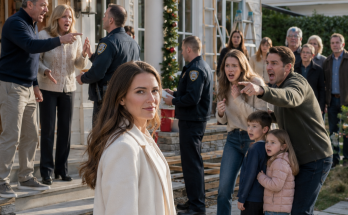
At My Sister’s Wedding Reception, The Projector Displayed: “Infertile. Divorced. Loser. College Dropout. Penniless. Forgotten.” The Crowd Exploded In Laughter. My Sister Smirked, “Be Careful, She Might Burst Into Tears!” Mom Sipped Her Champagne. Dad Grinned, “Lighten Up, Honey.” I Picked Up My Phone, Then Sent One Word: “Now.” The Entire Room Went Silent.
Part 1
Failure.
Divorced.
Infertile.
Those three words burned across a giant screen behind my sister’s head table, tall enough for nearly two hundred wedding guests to read without squinting.
For one strange second, I noticed everything except my own breathing.
The clink of forks against china. The sweet, yeasty smell of champagne. The heat from the kitchen doors brushing the back of my neck. My mother’s diamond bracelet flashing as she lifted her wineglass. My father’s smile stretching slowly across his face like he had been waiting sixteen years for this exact moment.
Then my sister Marissa, glowing in white lace and cruelty, leaned into her microphone.
“Don’t laugh too hard,” she said, giggling. “Aubrey might actually cry.”
A few guests laughed because they thought they were supposed to. Others stared into their salads. One older man near the dance floor looked at me, then looked away as if shame were contagious.
I didn’t cry.
I looked at the screen. Then at my family.
After sixteen years, they still believed I was the same scared eighteen-year-old girl they had pushed out of their perfect white-columned house with one duffel bag and forty-six dollars.
They thought I had come back small.
They thought humiliation still worked on me.
They were wrong.
Under the table, my phone was already in my hand. My thumb hovered over one message to one person.
Begin.
I pressed send.
Three seconds later, the music cut out.
The screen went black.
The entire ballroom fell so quiet I heard ice crack inside my mother’s glass.
But that moment didn’t start at the wedding. It started four weeks earlier, on a Thursday night in Richmond, Virginia, when my phone rang at 10:47 p.m.
I was at my desk, barefoot, wearing an old college sweatshirt, surrounded by blueprints for a courthouse renovation. My coffee had gone cold hours before. Rain tapped against the windows of my apartment, and my shoulders ached from leaning over drawings all day.
Unknown number.
I almost ignored it.
Then I saw the area code.
My hometown.
I answered carefully. “Hello?”
A woman’s voice said, “Is this Aubrey Caldwell?”
“Yes.”
“My name is Paula Martinez. I’m a nurse at Maple Grove Care Center.”
My pen slipped from my fingers.
My grandmother lived at Maple Grove.
Grandma June was eighty-five, stubborn, sharp-eyed, and the only person in my family who had loved me without keeping score.
“Is she okay?” I asked.
“She’s stable,” Paula said gently. “But she’s scheduled for surgery in three weeks. She asked me to call you.”
I closed my eyes.
I hadn’t seen my grandmother in two years. Not because I didn’t try. Because my father, Richard Caldwell, had removed my name from her visitor list after discovering I’d visited her secretly.
One hour with her had cost me two years.
“She wants to see you,” Paula continued. “But your father told her there’s a condition.”
I let out a dry laugh. “Of course there is.”
“You have to attend your sister’s wedding first.”
Rain slid down the window in crooked lines.
My sister Marissa was getting married to Graham Bellamy, whose family owned half the commercial real estate in our county. My parents had sent me an invitation three months earlier, not with warmth, but with warning. Dress appropriately. Don’t cause tension. Remember this day is not about you.
I had thrown it into a drawer.
“There’s something else,” Paula said, lowering her voice.
My fingers tightened around the phone. “What?”
“Your grandmother told me to warn you.”
“Warn me about what?”
A pause.
“She said they’re planning something at the reception. Something involving you.”
The room felt colder.
I looked at the framed award on my wall: Virginia Preservation Architect of the Year. The brass plate caught the lamplight.
I had rebuilt courthouses, mills, churches, and schools. I had rebuilt myself.
And still, one phone call from home could make my stomach drop like I was eighteen again.
“What exactly did she say?” I whispered.
“Only this,” Paula said. “Be ready.”
After we hung up, I sat there listening to the rain.
Four weeks before my sister’s wedding, I knew two things.
My family had set a trap.
And this time, I wasn’t walking into it empty-handed.
### Part 2
The first time my father called me a disgrace, I was eighteen and sitting at the kitchen table with a peanut butter sandwich I suddenly couldn’t swallow.
He slid a stack of legal papers across the polished wood.
“Sign these.”
Richard Caldwell never barked. He didn’t have to. He spoke softly, with the flat certainty of a man who expected rooms, employees, waiters, wives, and daughters to arrange themselves around his wishes.
I looked at the papers.
Property transfer agreement.
Two acres by Willow Creek.
My grandmother had given that land to me on my sixteenth birthday. Not verbally. Not as a sweet family promise. Legally. Officially. She had taken me to an attorney, signed the paperwork, and told me, “This is yours, Aubrey. No one can build over your life unless you let them.”
At sixteen, I hadn’t understood why her voice trembled when she said it.
At eighteen, with my father watching me from the head of the table, I began to.
“I’m not signing this,” I said.
My mother, Celeste, sat at the far end of the table pretending to read a decorating magazine. Her pearl earrings glowed against her neck. She turned a page slowly.
My father folded his hands. “That land is needed for the Caldwell Ridge development.”
“It belongs to me.”
“It belongs to this family.”
“Grandma gave it to me.”
His eyes sharpened.
My little sister Marissa stood in the doorway holding a soda, watching like it was a TV show she didn’t fully understand but hoped would get dramatic.
“Sign,” my father said.
I didn’t.
Three days later, my college fund vanished.
One week later, he stood in the foyer beside my packed duffel bag and said, “If you leave this house, don’t come crawling back.”
I kept waiting for my mother to move.
She adjusted a flower arrangement.
That was her goodbye.
So I left.
By the end of that month, everyone in town had heard Richard Caldwell’s version. I had run away. I had wasted my opportunities. I had broken my mother’s heart. I had become unstable, ungrateful, impossible.
None of it was true.
Truth didn’t matter much in my hometown. Not when my father’s voice carried more weight than mine.
I slept in my car for eleven nights behind a twenty-four-hour grocery store. I worked morning shifts at a diner and night shifts at a gas station. I learned how to wash my hair in public bathrooms and how to smile at customers while my feet burned.
I earned scholarships. I went to community college. Then university. Then graduate school.
I missed birthdays, holidays, Sunday dinners, and every family photo that would later be used to prove I had abandoned them.
At twenty-four, I graduated with my master’s degree in architecture.
Nobody came.
I stood in a black gown under a bright May sky while families screamed and waved flowers around me. Afterward, I bought Chinese takeout, carried it to my apartment, sat on the floor, and cried so hard the rice went cold.
I told myself that was the last time I would cry over an empty chair.
I was wrong.
At twenty-six, I married Daniel Mercer because he looked nothing like my father at first.
He was charming. Funny. Impressive in public. He remembered everyone’s name and tipped well at restaurants. My family hated him until they realized he hated my independence more than they did.
Little by little, he tightened his grip.
My friends were “bad influences.” My overtime was “selfish.” My phone was “ours.” My paycheck was “family money.” Every disagreement became proof that I was damaged from my upbringing.
When I finally left him at twenty-nine, he told everyone I was cold, broken, and impossible to love.
My family believed him instantly.
Then came the doctor’s office.
I still remember the humming lights, the lemon disinfectant smell, the paper gown sticking to my legs, the doctor’s careful voice explaining what my body would not do.
I sat in my car afterward with both hands on the steering wheel, unable to turn the key.
Some griefs don’t scream.
Some just sit beside you and breathe.
Somehow, Marissa found out.
Daniel had stayed friendly with my family after the divorce. In the Caldwell house, private pain was not protected. It was stored for later use.
By thirty-four, I had become a senior architect at a respected firm. I owned a small brick townhome. I had friends who knew how I took my coffee and coworkers who trusted me with million-dollar restorations.
But back home, I remained the story my father wrote.
Dropout.
Divorced.
Barren.
Failure.
And now Grandma June was warning me that my family was preparing to read that story aloud in front of everyone.
The morning after Paula’s call, I walked into my coworker Lucas Bennett’s office and closed the door.
Lucas looked up from a set of structural reports. “That face means either the roof collapsed or your family called.”
“My family called.”
He took off his glasses. “Worse, then.”
I told him everything.
The surgery. The wedding condition. Grandma’s warning.
Lucas listened without interrupting. That was one of the reasons I trusted him. He didn’t rush in with easy comfort. He let the ugly thing exist in the room first.
When I finished, he leaned back.
“You’re still going?”
“My grandmother might not survive surgery.”
He nodded once. “Then we make sure you’re not alone in that room.”
“I don’t want revenge.”
“No,” he said. “You want insurance.”
That word landed exactly right.
Insurance.
Not cruelty. Not chaos. Not a scene.
A shield.
Two days later, Lucas called me while I was measuring window casings at a project site.
“You know the venue hired temporary AV technicians?”
I froze with my tape measure in hand. “Lucas.”
“I applied.”
“Please tell me you’re joking.”
“They needed weekend help. I start at the Bellamy-Caldwell reception.”
I closed my eyes. “You’re insane.”
“I prefer loyal.”
A worker nearby dropped a hammer, and the crack echoed through the empty hall.
Lucas lowered his voice. “They’re bringing a knife to your back, Aubrey. I’m just making sure you’re wearing armor.”
For the first time since Paula’s call, I smiled.
Not because I was ready.
Because I wasn’t going alone.
### Part 3
Three weeks before the wedding, my father ordered me to attend a “family dinner” before he would allow me to visit Grandma June.
Ordered. Not invited.
The Caldwell house looked exactly the same when I pulled into the circular driveway.
White columns. Black shutters. Perfect hedges. Warm porch lights. A house designed to convince strangers that kindness lived inside.
My mother opened the door before I knocked.
She looked me up and down, her eyes pausing at my shoes, my coat, my hair.
“You look tired,” she said.
“Hello to you too, Mom.”
Her smile tightened. “Still sensitive.”
The foyer smelled like lemon polish and expensive candles. Every framed photo on the wall showed Marissa: Marissa at ballet, Marissa at prom, Marissa holding awards, Marissa smiling between our parents on vacations I had never been invited to.
There was one photo of me.
I was twelve, standing slightly apart from everyone else at a Christmas tree farm, squinting into the sun.
My mother had always said it was the only picture where I looked “pleasant enough.”
Dinner was roast chicken, garlic potatoes, and old tension served on china plates.
My father sat at the head of the table.
“So,” he said, cutting into his chicken. “What is it you do now?”
“I’m a senior architect.”
Marissa snorted softly into her wine.
My father didn’t look at her. “Commercial drafting?”
“Historic restoration.”
“Sounds unstable.”
I chewed slowly. “It pays my mortgage.”
My mother’s fork paused.
Marissa looked up.
There it was. The tiny shift that happened whenever I mentioned a life they didn’t control.
A mortgage meant I owned something. Stability meant their story had cracks.
Marissa arrived halfway through dinner even though she lived ten minutes away. She swept in wearing cream silk and an engagement ring large enough to signal aircraft.
“Aubrey!” she sang, kissing the air beside my cheek. “You came.”
“As requested.”
She laughed like I’d made a joke.
After dessert, she pulled me into the hallway beneath the staircase where I had once waited for someone to defend me.
“I need a favor,” she said.
“No.”
Her smile froze. “You don’t even know what it is.”
“I know the tone.”
She sighed dramatically. “Please don’t wear anything attention-seeking to the wedding.”
“I wasn’t planning to.”
“Good. Graham’s family is traditional. Important people will be there.”
“Important people?”
“You know what I mean.”
I did.
People whose opinions mattered.
Unlike mine.
She touched my arm with two fingers. “And maybe don’t bring up your career too much. It can come off like you’re trying to prove something.”
I looked at her hand until she removed it.
Then she leaned closer and lowered her voice.
“And please don’t get emotional. Weddings can be hard for women in your situation.”
My situation.
The hallway seemed to narrow.
She smiled sweetly. “I’m only saying it because I care.”
No, I thought. You’re saying it because you enjoy knowing where the bruise is.
Before I left, my mother handed me a garment bag.
Inside was a beige dress two sizes too large, with sleeves that looked like curtains and a neckline designed by someone who feared collarbones.
“This would be appropriate,” she said.
“For a witness protection program?”
Her eyes cooled. “Don’t be vulgar.”
At the front door, my father placed a hand on my shoulder.
It looked affectionate to anyone watching.
It felt like a lock.
“The Bellamys are connected,” he said quietly. “One wrong scene could ruin things that matter.”
“Your business things?”
“Our family things.”
I looked at him. “Am I family tonight?”
His fingers tightened once, then released.
“Don’t embarrass us.”
I drove back to Richmond with the beige dress thrown across the back seat like a dead animal.
Halfway home, one word from dinner kept tugging at me.
Bellamy.
Graham Bellamy.
His family’s name was familiar, but not because of Marissa.
When I got home, I opened my work laptop and searched our client records.
There it was.
Bellamy Preservation Trust.
A major donor connected to the Halstead Foundation, which was funding one of our largest restoration projects.
The foundation chair’s name glowed on my screen.
Margaret Halstead.
I had been emailing with Margaret Halstead for seven months. She approved budgets. She asked intelligent questions. She praised my field reports. She trusted my judgment.
We had never met face-to-face.
I stared at the screen for a long time.
My father thought the Bellamys were his ladder.
He had no idea I was already standing on the floor above him.
I didn’t plan to use it.
But I saved the information.
Just in case.
The next day, Lucas came over with takeout and a laptop. My apartment smelled like Thai basil and rain-wet wool from his coat.
“We prepare two versions,” he said.
“One where nothing happens?”
He nodded. “And one where they do what we think they’ll do.”
I opened a folder on my computer.
Graduation photo. Architectural license. Award ceremony. Restoration site photos. Property records. Emails from clients.
Lucas scrolled through them quietly.
“No insults,” he said.
“No.”
“No petty captions.”
“No.”
“Just facts.”
“Exactly.”
He leaned back and studied me. “That will scare them more.”
One week before the wedding, Marissa accidentally sent the wrong message to the family group chat.
Or maybe she did it on purpose.
A video preview loaded on my phone.
Wedding slideshow.
Baby pictures. Vacation clips. Engagement photos.
Then came a section titled, Meet the Family.
My face appeared.
An old photo from high school. Bad angle. Cropped cruelly.
A caption slid across it.
Dropout.
Then another.
Divorced.
Then another.
Broke.
Then another.
Alone.
My throat tightened.
Then the final slide appeared.
A cartoon baby bottle crossed out with a red X.
Infertile.
Below it, Marissa had added laughing emojis.
Mom replied first.
Keep it tasteful.
Not “take that down.”
Not “that’s your sister.”
Not “how dare you.”
Keep it tasteful.
My father didn’t reply at all.
I screenshotted everything and sent it to Lucas.
He called within thirty seconds.
I answered, but I couldn’t speak.
For a while, neither could he.
Finally, he said, “Send me the final file.”
My voice sounded far away. “They’re really going to do it.”
“I know.”
“I thought maybe Grandma misunderstood.”
“She didn’t.”
I looked at the word on my screen.
Infertile.
My private grief, dressed up for public laughter.
That night, I added one final slide to my own presentation.
White text. Black background.
A family is not revealed by how proudly it displays perfection. A family is revealed by what it does when someone is hurting.
Then I closed my laptop.
And for the first time, I stopped hoping they would choose kindness.
### Part 4
My father allowed me thirty supervised minutes with Grandma June five days before the wedding.
Supervised.
As if I had ever been dangerous to anyone except his version of the truth.
Maple Grove Care Center smelled like antiseptic, boiled carrots, and lavender air freshener fighting a losing battle. A television murmured in the common room. Somewhere down the hall, a woman laughed at something no one else could see.
My mother sat outside Grandma’s room scrolling through her phone.
“She tires easily,” she said without looking up. “Don’t upset her.”
“I’m not the one who upsets people for sport.”
Her eyes flicked up. “Still dramatic.”
I went inside before I said something I couldn’t swallow.
Grandma June was sitting by the window with a blue blanket over her knees. She looked smaller than I remembered, her silver hair thinner, her hands more fragile. But her eyes were the same. Clear. Sharp. Waiting.
“There you are,” she said.
I crossed the room too quickly and knelt beside her chair.
Her hand found my cheek.
“My girl.”
That was all it took. My eyes burned.
“I’m sorry I stayed away,” I whispered.
“You didn’t stay away.” She squeezed my fingers. “You were kept away.”
No one in my family spoke that plainly. Not ever.
We sat together while late afternoon sunlight spilled across the floor. Dust floated in the gold light. Her room held small treasures: a ceramic robin, a stack of mystery novels, a photo of me at sixteen standing beside the creek on the land she gave me.
“I tried to call,” I said.
“I know.”
“I wrote letters.”
“I got two.”
“I sent more than two.”
Her mouth tightened. “I know.”
The silence between us filled with stolen things.
Then she leaned closer.
“Listen to me. Your father is afraid.”
I almost laughed. “Dad?”
“Afraid men are the cruelest kind,” she said. “They confuse control with safety.”
“What is he afraid of?”
Her eyes shifted to the closed door.
Then she reached beneath her blanket and pulled out a thin envelope.
“Paula hid this for me.”
My pulse quickened.
Inside was a photocopy of a property deed.
Willow Creek parcel.
My name.
Still my name.
I stared at it, confused.
“I thought he got it somehow,” I said. “I thought after I left…”
“He tried.” Grandma’s voice hardened. “Lawyers. Pressure. Lies. But I had the deed recorded properly. He never owned it.”
My chest tightened.
Sixteen years.
For sixteen years, I believed he had won.
“He tells people it’s part of Caldwell Ridge,” she said.
“It’s not.”
“No.”
The room tilted slightly.
My father had built promises, partnerships, and probably contracts around land he did not own.
Land he threw me out for refusing to surrender.
Grandma touched my wrist. “That is why he needs you small. A small woman does not ask questions. A small woman signs papers.”
My throat ached.
“What do I do?”
“You stand straight.”
A soft knock sounded.
My mother opened the door before waiting for an answer. “Time’s up.”
Of course it was.
I folded the deed copy and slid it into my purse.
Grandma gripped my hand with surprising strength.
“Remember who you are, Aubrey.”
I kissed her forehead.
“I’m trying.”
“No,” she said. “Remember. Don’t try.”
My mother walked me out like a guard escorting a prisoner.
In the parking lot, the sky had turned pink and purple. Cars whispered past on the road beyond the trees.
“How was she?” I asked.
My mother checked her lipstick in a compact mirror. “Old.”
Something inside me went very still.
“Do you ever hear yourself?”
She snapped the compact shut. “Don’t start.”
I looked at her, really looked.
For years, I had searched her face for trapped love. Some secret softness. Some hidden regret. I used to imagine she cried after I left, that maybe she defended me when no one was around, that maybe she was weak instead of willing.
But standing under the buzzing parking lot light, I finally understood.
My mother had not failed to protect me because she couldn’t.
She had chosen not to because protecting me would have cost her comfort.
That realization hurt.
Then it freed something.
Back in Richmond, Lucas was waiting at my apartment with coffee and two laptops.
I laid the deed copy on the table.
He read it once. Then again.
“Your father doesn’t own the center parcel.”
“No.”
“And he’s representing that he does?”
“Looks that way.”
Lucas gave a low whistle. “That’s not a family secret. That’s a business grenade.”
“I don’t want to throw grenades.”
“You may not have to.” He tapped the paper. “Sometimes all you do is stop hiding the pin.”
We worked until after midnight.
Not on revenge.
On sequence.
If they left me alone, nothing would happen. Lucas would work the AV booth, eat bad wedding food, and drive back with me afterward.
If they humiliated me privately, I would leave.
If they projected those slides publicly, then my truth would become public too.
That was the line.
They would choose whether to cross it.
I slept badly the night before the wedding.
I dreamed of the old foyer, my father’s hand on my shoulder, my mother’s magazine pages turning, Marissa watching from the stairs.
In the dream, I was eighteen again.
But this time, when the door opened, I didn’t walk into the dark.
I walked into a ballroom full of people.
And every one of them was staring at me.
### Part 5
The wedding day arrived bright and cold, with an October sky so blue it looked polished.
I wore a navy dress I had bought myself. Simple. Fitted. Elegant. Not flashy, but not apologetic either. I pinned my hair back, put on pearl earrings Grandma June had given me years ago, and left the beige dress hanging in my closet like a defeated insult.
The church parking lot was full when I arrived.
Luxury SUVs. Black sedans. Men in tailored suits. Women stepping carefully over the pavement in heels too delicate for real weather.
Inside, the church smelled like lilies and candle wax. A string quartet played near the front. White roses climbed the aisle in expensive arrangements.
I sat in the last pew.
Of course I did.
That was the seat printed on the place card my mother had mailed with the rehearsal information. Back left. Away from family. Away from photographs. Close enough to be present, far enough to be erased.
Near the front, the Bellamy family occupied the first two rows. I recognized Graham’s mother, Margaret Halstead, from photos attached to foundation newsletters.
She was in her sixties, elegant in a silver-blue suit, with the calm posture of a woman accustomed to boardrooms and difficult men.
She didn’t recognize me.
Why would she? Our work had lived in emails, reports, and careful drawings.
Lucas stood near a side door wearing black slacks and an AV staff badge. He adjusted a wireless microphone and never once looked suspicious.
Our eyes met for half a second.
He nodded.
The ceremony began.
Marissa floated down the aisle on our father’s arm, smiling like the world had finally admitted she was its center.
I expected to feel bitterness.
Instead, I felt distance.
Like I was watching a play whose script I had outgrown.
Graham cried during his vows. Real tears. His voice cracked when he promised to build a life of honesty, tenderness, and partnership.
I looked at Marissa to see if she understood the weight of those words.
She was checking how the photographer framed her face.
At the reception, the country club glittered with chandeliers, crystal glasses, and white tablecloths. The ballroom smelled like roses, butter, perfume, and money.
My place card sent me to Table 14.
Closest to the kitchen doors.
Every time servers pushed through, warm air and the metallic crash of pans rolled over my chair.
Perfect.
A woman seated across from me smiled politely. “Bride’s side or groom’s side?”
“Bride’s sister.”
Her eyes widened. “Oh! I didn’t realize she had a sister.”
I took a sip of water. “That happens.”
At the head table, Marissa held court. She laughed too loudly, touched Graham’s arm every time someone looked their way, and kept glancing toward me to make sure I was watching.
My parents sat beside her.
My father looked pleased. My mother looked polished. Together, they were a portrait of respectable cruelty.
Dinner passed slowly.
Salad. Toasts. Chicken with rosemary. More toasts.
Marissa’s maid of honor told a story about how Marissa always got what she wanted because “the universe just knew who deserved sparkle.”
People laughed.
My father stood next.
He talked about family values. Loyalty. Legacy. The importance of surrounding yourself with people who uplift your name.
His eyes found mine on that last sentence.
I smiled into my wineglass.
Then Marissa took the microphone.
“My amazing family,” she said, pressing a hand to her chest. “Mom, Dad, you gave me everything.”
Applause.
“And Aubrey…” She paused.
Every head turned toward Table 14.
“My sister managed to show up tonight.”
Scattered laughter.
My mother appeared beside my chair moments later, perfume arriving before her body.
“Smile,” she whispered.
I looked up at her. “Why?”
“Because people are watching.”
“They always were.”
Her mouth tightened. “Don’t ruin this.”
“I’m sitting quietly at the kitchen table.”
“You know what I mean.”
Yes.
Don’t exist too loudly.
Don’t make anyone remember what they did.
Don’t bleed where guests can see.
The lights dimmed before I could answer.
A cheerful song began.
The giant screen behind the head table lit up.
Baby photos appeared first. Marissa in bows. Marissa on ponies. Marissa blowing out birthday candles. Marissa at Disney World. Marissa at the beach. Marissa graduating. Marissa laughing in every season of a life where nobody ever told her she was too much.
Not one photo of me.
Then the music shifted.
Something playful. Cartoonish.
My stomach cooled.
A slide appeared.
Meet the rest of the family.
Under the table, I unlocked my phone.
Lucas stood at the AV table, expression unreadable.
The next slide appeared.
Me at seventeen, cropped mid-blink.
Dropout.
Laughter rippled across the ballroom.
My thumb hovered over the message.
I waited.
One last chance, I told myself.
One chance for my father to stand.
One chance for my mother to say, “Enough.”
One chance for Marissa to prove there was a line even she wouldn’t cross.
The next slide appeared.
Divorced.
More laughter.
Then: Broke.
A man near the bar chuckled openly.
Then: Alone.
My father lifted his glass toward me and smiled.
My mother swirled her wine like she was watching theater.
Then the final slide appeared.
Infertile.
The room changed.
Some guests laughed because cruelty had momentum.
Others went rigid.
The woman across from me whispered, “Oh my God.”
Marissa leaned into her microphone, eyes bright.
“Don’t laugh too hard,” she said. “Aubrey might actually cry.”
My grief stopped being grief.
It became clarity.
I pressed send.
Begin.
### Part 6
Three seconds.
That was all it took.
Three seconds for the slideshow to freeze.
Three seconds for Marissa’s smile to falter.
Three seconds for my father to realize something had moved outside his control.
The screen went black.
The music died.
A low technical hum filled the ballroom.
Marissa turned sharply toward the AV table. “What happened?”
Lucas adjusted something calmly. He looked like a man fixing a loose cable, not detonating sixteen years of lies.
Then the screen lit again.
White letters on black.
The Aubrey Caldwell They Didn’t Tell You About
The ballroom went silent.
My father stood so fast his chair scraped the floor.
“What is this?”
No one answered.
The first slide appeared.
A photo of me at graduation, black gown, tired smile, sunlight in my eyes.
No one came. I graduated anyway.
Whispers started near the back and moved forward like wind through dry leaves.
Second slide.
My architecture license.
Third slide.
Me in a hard hat inside a half-restored courthouse, dust on my boots, rolled drawings under one arm.
Fourth slide.
A newspaper clipping about the Miller Textile Mill restoration project.
Fifth slide.
An award ceremony photo. Me at a podium, stunned and smiling.
Virginia Preservation Architect of the Year.
The woman across from me turned slowly. “That’s you?”
“Yes.”
My mother’s face had gone pale beneath her makeup.
Marissa grabbed Graham’s sleeve. “Make them stop it.”
But Graham wasn’t looking at the screen.
He was looking at her.
The next slide appeared.
You called me a dropout. I earned two degrees.
You called me broke. I bought my own home.
You called me a failure. I built a career restoring what others abandoned.
My father started across the room.
Fast.
People shifted out of his way.
When he reached my table, he bent close enough that I smelled the whiskey on his breath.
“Sit down,” he said.
I hadn’t realized I was standing until then.
I looked at him. “No.”
His eyes hardened. “Turn it off.”
“No.”
His voice dropped lower. “If you continue this, you will never see your grandmother again.”
There it was.
The old chain.
The one he had wrapped around my throat for years.
But this time, I had Grandma’s deed in my purse and her voice in my head.
Remember who you are.
I looked him straight in the eyes.
“You don’t get to use Grandma June as a weapon anymore.”
For the first time in my life, I saw fear move across my father’s face.
Not guilt.
Fear.
The difference mattered.
Graham stood.
“Let her speak.”
Marissa spun toward him. “Graham, sit down.”
He gently removed her hand from his arm. “No. I want to hear this.”
My mother rose, trembling with fury disguised as distress.
“Aubrey, please. This is a family matter.”
I turned toward her.
“You made my medical history part of the entertainment.”
She flinched.
Good.
I walked toward the center of the ballroom. My heels clicked against the polished floor. Every sound seemed too loud.
I didn’t take the microphone.
I didn’t need it.
The room was quiet enough to hear breathing.
“I didn’t drop out,” I said. “My father cut off my tuition because I refused to sign over land my grandmother legally gave me.”
Gasps.
My father’s jaw tightened.
“I left home with forty-six dollars. I slept in my car. I worked two jobs. I went back to school. I built my life without help from anyone at that head table.”
I looked at Marissa.
“My divorce was not a punchline. It was me surviving a marriage that tried to turn me into someone I didn’t recognize.”
Her mouth opened, then closed.
Then I looked at the giant screen.
“And infertility is not a joke.”
No one moved.
“You put one of the most painful things that ever happened to me on a ten-foot screen for strangers to laugh at.”
My voice almost broke, but it didn’t.
“That doesn’t make me pathetic. It makes you cruel.”
A chair scraped near the front.
Margaret Halstead stood.
The room turned toward her immediately. Power has its own sound, and hers was silence.
She walked across the ballroom with measured steps and stopped in front of me.
“A. Caldwell,” she said softly.
I nodded. “Yes.”
“You’re the architect on the Halstead Mill project.”
“Yes.”
She turned to my father.
The temperature in the room seemed to drop.
“This is your daughter?”
My father opened his mouth. “Margaret, this is being taken out of context.”
“Is it?”
He swallowed.
She looked at the screen, then at Marissa, then back at him.
“The woman you humiliated tonight is the professional my foundation trusts with a twelve-million-dollar restoration.”
Murmurs exploded.
My mother stepped forward. “Margaret, this really isn’t—”
Margaret cut her off without raising her voice.
“You made it public when you projected it.”
Graham’s father stood now too, face dark with embarrassment.
My father tried to recover. “The Caldwell Ridge partnership is still mutually beneficial.”
Margaret’s expression did not change.
“There will be no partnership.”
The words landed like a glass dropped on marble.
My mother gripped the back of a chair.
Marissa whispered, “What?”
My father’s face drained.
Then I reached into my purse.
My hands were steady as I removed the deed copy.
“And there’s something else,” I said.
My father looked at the paper and went still.
I held it up.
“The center parcel for Caldwell Ridge doesn’t belong to my father. It belongs to me.”
Silence.
Margaret’s eyes narrowed. “Richard, did you represent ownership of that land?”
My father said nothing.
For a man who had built his life on speaking first and being believed, silence looked unnatural on him.
Graham stepped away from Marissa.
Not far.
Just enough.
But she felt it. I saw her feel it.
“Aubrey,” she said, voice shaking now. “You’re ruining my wedding.”
I looked at her beautiful dress, her perfect hair, her trembling mouth.
“No,” I said. “You used your wedding to ruin me. I just refused to cooperate.”
### Part 7
People began leaving in clusters.
Not dramatically at first. Quietly.
A couple near the bar collected their coats. Then one of Graham’s cousins. Then an entire table of my father’s business associates, who suddenly remembered early mornings, babysitters, headaches, anything that allowed them to escape the stink of exposure.
The ballroom that had glittered an hour earlier now looked too bright, too open, too honest.
Servers moved carefully along the walls, pretending not to hear.
Marissa stood beside the head table clutching her bouquet so tightly white petals bent under her fingers.
Graham spoke quietly with his parents. His face looked older than it had at the altar.
My mother came toward me first.
Tears streaked her makeup, but I knew those tears. They were not grief. They were panic with mascara.
“How could you do this to us?” she whispered.
I stared at her.
For a second, I almost laughed.
Not because it was funny. Because the question was so perfectly hers.
Not, “How could we do this to you?”
Not, “Are you okay?”
Not, “I’m sorry.”
How could you do this to us?
“I didn’t make those slides,” I said. “Marissa did.”
“You could have ignored it.”
“I did. For sixteen years.”
Her chin trembled. “You think you’re better than your family now.”
“No.” My voice was tired. “I stopped believing I was worse.”
That shut her up.
My father was across the room with Margaret Halstead, trying to speak in a low controlled voice. But control had abandoned him. His hands moved too much. His smile kept twitching.
Margaret listened for maybe ten seconds.
Then she said, loud enough for half the room to hear, “All future communication will go through counsel.”
Counsel.
One word, and my father looked like someone had cut the strings holding him upright.
Marissa rushed to me next, dragging lace across the floor.
“You jealous, bitter little—”
Graham said her name sharply.
She stopped, breathing hard.
I looked at him. “Did you know?”
His face crumpled with shame. “No.”
Marissa spun. “It was a joke.”
He stared at her. “About her medical condition?”
“She always acts like a victim.”
I almost smiled because there it was again. Their favorite trick.
Hurt someone, then accuse them of bleeding too loudly.
Graham looked at me. “I’m sorry.”
“You don’t owe me the apology she does.”
Marissa’s eyes flashed. “I will not apologize for one slideshow after years of you making this family miserable.”
“What did I do to make you miserable?”
“You left.”
The word came out childish and raw.
For the first time all night, I saw something real under her cruelty.
Not regret.
Resentment.
“You left,” she repeated, quieter. “And everything was about you. Mom crying. Dad furious. Grandma asking for you. Everyone whispering.”
I stared at her.
“You were fourteen.”
She wiped at her face angrily.
“You could have called me,” I said.
“Dad said you didn’t want us.”
“And you believed him because it was easier.”
Her expression hardened again. “You don’t know what it was like.”
“No,” I said. “I know what it was like to be thrown away. You know what it was like to be rewarded for helping them pretend.”
That landed.
Her lips parted, but no words came.
My father returned then, face gray with rage.
“You have no idea what you’ve cost this family.”
I looked at him. “Tell me.”
His eyes narrowed.
“The partnership? The investors? The lie about the land? Which part did I cost you?”
He stepped closer. “You ungrateful girl.”
I heard a small gasp from someone nearby.
Girl.
I was thirty-four years old. Licensed. Established. Standing in a ballroom full of people who now knew exactly who he was.
And still, he reached for the smallest version of me.
It didn’t fit anymore.
“I’m not signing anything,” I said.
His face changed.
There it was.
The real reason under all the humiliation.
They hadn’t only wanted to shame me.
They wanted me weakened. Off-balance. Desperate to be accepted again. Easier to pressure after the wedding, maybe in some quiet room, maybe with Grandma used as bait.
My fingers tightened around my purse strap.
“You were going to ask for the land again,” I said.
My mother closed her eyes.
That was my answer.
Marissa looked confused. “What land?”
I laughed once, softly. “You didn’t even know.”
My father said, “That parcel is worthless to you.”
“There it is.”
“It would create jobs.”
“It would make you rich.”
“It would benefit the family.”
“I am family,” I said. “You just remembered when you needed my signature.”
His nostrils flared.
For one second, the room blurred, and I was eighteen again at the kitchen table.
Then Lucas appeared at my side.
He didn’t touch me. He just stood close enough for me to know I wasn’t alone.
My father looked at his AV badge. “You.”
Lucas smiled pleasantly. “Me.”
“I’ll have you fired.”
“From my temporary Saturday job?” Lucas asked. “Tragic.”
A few people actually laughed.
My father looked like he might choke on it.
I turned away from him and walked to the head table where the microphone still rested in its stand.
This time, I picked it up.
My voice carried through the half-empty ballroom.
“I want to be very clear,” I said. “I did not come here to destroy a wedding. I came because my grandmother asked me to attend, and because I was told I could see her only if I did.”
My mother covered her mouth.
“My family chose what happened next. They chose the slideshow. They chose the words. They chose to make private pain public.”
I looked at each of them.
“I don’t hate you.”
Marissa started crying harder.
“But I am done loving you at my own expense.”
The words came from somewhere deep and clean.
“If you ever want a relationship with me, it begins with accountability. Not excuses. Not pressure. Not business deals. Not access to Grandma. Accountability.”
My father stared at me with cold hatred.
My mother looked at the floor.
Marissa sobbed into her hands.
None of them spoke.
That was answer enough.
I set the microphone down.
Then I walked toward the exit.
At the door, Margaret Halstead stopped me.
“Monday morning,” she said.
I blinked. “I’m sorry?”
“My office. Nine o’clock. We have a mill to finish restoring.”
For the first time all night, warmth entered my chest.
“I’ll be there.”
Outside, the air was cold enough to sting.
Lucas waited beside my car holding two paper cups of coffee.
“You okay?” he asked.
I took one and laughed shakily.
“No.”
He nodded. “Fair.”
I looked back at the glowing country club windows.
“But I think I’m free.”
My phone buzzed.
A message from Paula.
Your grandmother watched the livestream someone posted. She is laughing so hard the night nurse came in. She says, “That’s my girl.”
I pressed the phone to my chest.
For the first time that night, I cried.
And the tears didn’t feel like defeat.
### Part 8
The wedding did not survive the week.
Graham moved out of the townhouse he and Marissa had decorated together. The official announcement said they were “taking time to reflect.” My aunt called it tragic. My cousin called it karma. I called it none of my business.
My father’s deal collapsed faster than anyone expected.
Margaret Halstead withdrew funding. Two investors followed. Then a local reporter started asking questions about the Willow Creek parcel, and suddenly Richard Caldwell, respected developer and family-values speaker, had to explain why he had promised access to land he did not own.
He called me eleven times.
I did not answer.
My mother texted first.
Your father is under enormous stress.
Then:
This has gone too far.
Then:
Grandma is upset.
That one almost worked.
Almost.
I called Paula directly.
Grandma was fine. Better than fine. She was eating peach cobbler and telling anyone who would listen that her granddaughter had “finally learned to stand like a house with good bones.”
So I blocked my mother for three days.
Not forever.
Just long enough to teach my nervous system that I was allowed to choose silence.
Grandma’s surgery happened the following Tuesday.
I sat with her before they took her back. Her hand felt dry and warm inside mine.
“You caused quite a storm,” she said.
“You warned me.”
“I told you to be ready. I didn’t tell you to be magnificent.”
I laughed through tears.
She looked toward the window where morning light touched the blinds.
“Do not let them turn your mercy into a doorway.”
I knew exactly what she meant.
People like my parents treated forgiveness like permission to repeat themselves.
Grandma squeezed my hand.
“You can release hatred without reopening the door.”
That became the sentence I carried.
Her surgery went well.
Recovery was slow, but Grandma June complained about the pudding, flirted shamelessly with her physical therapist, and demanded I bring real coffee instead of “institutional sadness in a cup.”
I visited every week.
No permission. No supervision. No conditions.
The first time I signed myself in at Maple Grove without seeing my mother’s name anywhere near the visitor sheet, I stood there for a moment with the pen in my hand and felt something inside me unclench.
Life did not become perfect.
That only happens in bad movies and family Christmas letters.
Some mornings, I still woke up angry.
Some nights, I replayed Marissa’s voice in my head: Don’t laugh too hard.
But the difference was, her voice no longer got the final word.
Work helped.
The Halstead Mill project became the most demanding restoration of my career. The old textile mill sat by the river with broken windows, weathered brick, and beams that smelled like dust, oil, and rain. Every day, I walked through that building and saw proof that damaged things could still hold.
Lucas stayed close.
He never pushed. Never turned my pain into romance. Never tried to rescue me from a life I had already rescued myself from.
One evening, months after the wedding, we stood inside the mill while sunset poured through newly restored windows.
“You know,” he said, “this place reminds me of you.”
I raised an eyebrow. “Old and full of structural concerns?”
He smiled. “Still standing after everyone underestimated the foundation.”
I looked away because my eyes had started burning.
“Careful,” I said. “That was almost poetic.”
“I’ll deny it.”
We did eventually become something more.
Slowly.
Carefully.
Not because I needed a man to prove I was lovable.
Because he had already proven he could stand beside me without trying to own the ground under my feet.
My family tried to return in pieces.
My mother sent a birthday card with no apology inside, just a check and a note: Hope we can move forward.
I mailed the check back.
Forward requires truth.
My father sent a letter through his attorney requesting a “reasonable discussion” about Willow Creek.
I declined.
Then I placed the land into a conservation trust in Grandma’s honor.
No Caldwell Ridge.
No luxury subdivision.
No forced signature.
Just creek water, oak trees, walking trails, and a small bronze plaque that read:
June Caldwell Preserve
For every person who needed a place no one could take away.
Marissa called once.
I answered because curiosity is not the same as forgiveness.
She cried. She said Graham had left for good. She said Mom and Dad were impossible. She said she didn’t know who she was without people clapping for her.
For a moment, I felt sorry for her.
Then she said, “I just think you could have handled it privately.”
And there it was.
Not remorse.
Only disappointment that consequences had witnesses.
“I wish you well, Marissa,” I said. “But I’m not available for this anymore.”
“You’re really cutting me off?”
“No. I’m letting go.”
“That’s the same thing.”
“It isn’t.”
I hung up gently.
That was the last time we spoke.
A year after the wedding, the Halstead Mill opened as a community arts center.
On opening night, the building glowed against the river. Music spilled through the doors. Children ran across polished floors where machines once stood. People touched the brick walls like they could feel history breathing through them.
Grandma June came in a wheelchair, wearing red lipstick and a blue scarf.
Lucas pushed her carefully up the ramp.
When she saw the restored windows, she took my hand.
“You did this?”
“We did.”
“No.” Her eyes shone. “You did.”
Across the room, Margaret Halstead raised a glass to me. My colleagues applauded. Lucas winked. Grandma cried openly and blamed allergies.
For once, I didn’t search the room for my parents.
I didn’t imagine them walking in with apologies.
I didn’t wonder whether Marissa had seen the article.
Their absence no longer felt like a missing piece.
It felt like space.
Clean, open space.
People had called me failure, divorced, infertile, broke, bitter, difficult, dramatic, disgrace.
Some of those words described moments.
None described me.
I was the woman who left with forty-six dollars and kept walking.
The woman who survived a cruel marriage.
The woman who sat alone in waiting rooms and still built a life full of light.
The woman who finally pressed send.
Begin.
That word did not ruin my sister’s wedding.
It ended my silence.
And it began the first life I never had to beg anyone to let me live.
I walked away from Table 14 forever.
THE END!