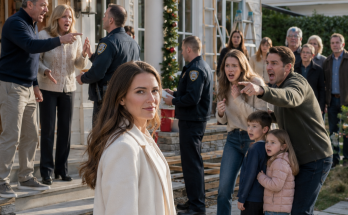
At Dinner, My Husband Slapped Me, Breaking Two Ribs. His Mom Laughed And Yelled, “Get Out Of My House!” Little Did They Know, The Apartment Was In My Name. I Called The Police. Fifteen Minutes Later, Their Lives Turned Into Hell.
Fifteen Minutes After He Hit Me
### Part 1
The first thing I remember after Mason hit me was the sound of my fork sliding off the plate.
It made a small, ridiculous clink against the hardwood floor, too delicate for what had just happened. My cheek was burning. My left side had struck the sharp corner of the dining table, and the pain came so fast I could not even scream. For one second, all I could do was stare at the steam rising from the prime rib in the center of the table.
Vivienne, my mother-in-law, still had her napkin folded neatly across her lap.
She had spent the whole dinner carving me apart with that polite society voice of hers. Three years married, still no baby. Three years in her son’s life, still not enough. Three years of cooking for holidays, smiling through insults, sending money when she “forgot” her card, and listening to her call me defective with a crystal wineglass in her hand.
That night, she finally dragged my parents into it.
“Maybe this is what happens when girls are raised with no proper family discipline,” she said, tilting her head. “Charleston manners don’t mean much if a woman can’t even give her husband a child.”
Something in me went still.
I put my fork down. I remember the butter knife beside my plate, the candle flickering near Mason’s glass, the way his father, Conrad, pretended to examine the pepper grinder.
“This condo is mine,” I said quietly. “My income pays the bills. My body is not family property. And my parents are not your punching bag.”
Vivienne gasped as if I had thrown wine in her face.
Mason stood so fast his chair scraped backward.
Then his hand came across my face.
I fell sideways, caught the table edge, and heard something inside me crack.
For a few seconds, the room blurred. Mason was breathing hard above me. Vivienne’s mouth hung open, then curled into a cruel little smile when she realized I was not getting up quickly.
“Get out,” she said. “Get out of my house.”
My house.
The words landed in me colder than the winter wind slamming against the fifteenth-floor windows.
Mason pointed at the floor. “Apologize to my mother.”
I looked up at the man I had shared a bed with, the man who knew how badly I had wanted peace, how many nights I had cried in the bathroom with the faucet running. There was no guilt in his eyes. Only anger. Entitlement. Fear that I had embarrassed him.
So I smiled.
Not because anything was funny.
Because something inside me had finally died, and something sharper had taken its place.
I dragged myself up by gripping the chair. Every breath stabbed my ribs. My lip tasted like blood. I walked past them without a word and locked myself in the bedroom.
I packed five things.
The deed to the condo. My passport and driver’s license. My bank tokens and checkbook. A change of clothes. And a small silver USB drive I had hidden in a jewelry box for six months.
On that drive were videos Mason never knew I had saved.
Plates smashing. Doors kicked open. His hand gripping my arm hard enough to bruise. Vivienne screaming outside our bedroom door while Conrad said nothing from the sofa.
When I came out with my suitcase, Vivienne laughed.
“Don’t crawl back tomorrow,” she said.
I looked at her once, then at Mason.
“I won’t.”
The elevator mirror showed me a woman with a swollen cheek, blood on her mouth, and eyes that looked almost calm.
Downstairs, in the lobby, I called my attorney.
Fifteen minutes later, police sirens rose through the Gold Coast night.
And upstairs, the people who thought they had thrown me away finally heard the consequences knocking at their door.
### Part 2
Elias picked up on the second ring.
He had been a year ahead of me at Northwestern, one of those people who seemed born wearing a suit. Six months earlier, after Mason shoved me into a closet door during an argument about his mother’s spare key, I had called Elias “just to understand my options.”
He had told me then, “Claire, hope is not a safety plan.”
I hated him for being right.
Now I stood near the lobby’s glass entrance with one hand pressed against my ribs and the other gripping my phone so tightly my fingers went numb.
“He hit me,” I said. “My ribs may be broken. I left. The footage is backed up.”
His voice changed. Not louder. Sharper.
“Call 911 yourself. Report domestic battery. Then go straight to Northwestern Memorial. Do not go back upstairs. Do not negotiate. Do not answer Mason.”
“I want the account frozen,” I said.
“We’ll move on it.”
“There’s more than three hundred thousand dollars in there. Almost all of it came from me.”
“I know.”
“And the restraining order.”
“I’m drafting it tonight.”
I hung up and called the police with a voice that did not sound like mine. I said the words clearly. My husband assaulted me. I have injuries. I have video evidence. I am afraid of further violence.
By the time a cab pulled up, my phone was buzzing nonstop.
Not Mason.
Mrs. Alvarez.
She lived next door and had once brought me pozole after hearing Vivienne scream at me through the wall. She never asked questions. She only looked at me with a kind of quiet knowledge that made me want to cry.
Her first text said: Police are here.
The next was a video.
I should not have watched it, but I did.
The clip shook because she was filming from behind her half-open door. Two officers and a detective stood in our hallway. Vivienne had opened the door in her pearls and silk robe, still trying to look offended instead of afraid.
“This is a private residence,” she snapped.
One officer said something I could not hear.
Then Mason appeared behind her, pale and barefoot.
He looked nothing like the man who had towered over me ten minutes earlier. His shoulders were rounded. His mouth opened and closed. Vivienne grabbed his sleeve like she could physically hold the law away from him.
Another message came through.
They’re cuffing him.
The next video showed Mason being led into the elevator with his hands behind his back. Mrs. Alvarez did not zoom in, but I could see his face clearly enough. Confusion. Humiliation. Rage trying to hide under panic.
Vivienne screamed so loudly the sound distorted.
“She’s lying! That snake is lying!”
Doors opened along the hallway. Neighbors watched in robes, sweatpants, slippers. People who had nodded politely to Vivienne in the mailroom now stared at her like they had always known what she was.
Then Conrad collapsed.
Mrs. Alvarez texted: Ambulance coming now. He grabbed his chest.
I turned off my phone.
In the cab, Chicago moved past me in strips of black glass and white streetlight. The driver kept glancing at me in the rearview mirror but did not ask. I was grateful. Some kinds of pain do not survive conversation.
At the hospital, the emergency room smelled like antiseptic, wet coats, and burnt coffee. A nurse saw my face and came toward me immediately.
“Ma’am, are you safe right now?”
That question nearly broke me.
I nodded once. “I am now.”
They put me in a wheelchair. A doctor examined my side, ordered X-rays, and asked gently what happened. His fingers barely touched the bruising near my ribs, but the pain made black spots bloom in my vision.
When the X-ray came back, he pointed at the screen.
“Sixth and seventh ribs. Left side. Both fractured. You’re lucky there’s no puncture.”
Lucky.
I almost laughed.
He asked how he should document the cause.
I sat straighter despite the bandage around my torso.
“Write that my husband struck me and I fell into a solid wood dining table.”
The doctor paused only long enough to meet my eyes.
Then he wrote it down.
Every word felt like a brick being removed from my chest and placed into the foundation of my new life.
When I left the trauma bay hours later, wrapped tight and exhausted, I saw Vivienne through the glass doors of the cardiac waiting area.
Her hair was loose. Her lipstick was smeared. Conrad lay behind her on a cot with an IV in his arm.
She saw me.
Her face twisted.
She charged through the doors with her hand raised.
I stepped back once.
“Touch me,” I said, “and I will add your name to the report.”
Her hand froze in the air.
For the first time since I had met her, Vivienne looked afraid of me.
### Part 3
Vivienne’s hand trembled above her shoulder as if her body had not received the message her brain already understood.
She could still hate me. She could still blame me. But she could not hit me in a hospital hallway under fluorescent lights, not with nurses nearby and cameras tucked into black domes on the ceiling.
So I gave her the rest.
“The joint account is being frozen,” I said. “You and Mason will not touch one cent.”
Her mouth opened.
“And you and Conrad have one week to leave my condo.”
“That is my son’s home.”
“No,” I said. “It was mine before I married him. The deed has one name on it.”
Her eyes flickered. She had always known. That was the first clue I had ignored for too long: the way she called it Mason’s place only when other people were listening.
I stepped closer.
“And the money you borrowed from me? The transfers? The texts? The excuses about family emergencies in Savannah and medical bills and charity auctions? I kept everything.”
For once, Vivienne had no speech prepared.
I walked out before she recovered.
Outside, the air was so cold it made my ribs seize. I sat carefully on a bench under the awning and answered Elias’s call.
“Claire,” he said, “Mason is trying to get released tonight. His family has an attorney making calls.”
“Of course they do.”
“There’s something else. He told the detective you’re pregnant.”
The world narrowed to the white cloud of my breath.
For a moment, I heard nothing but wind.
Four mornings earlier, I had stood barefoot in the bathroom before sunrise, staring at two faint lines on a test. I had not told Mason. I had wanted confirmation first. I wanted one tiny pocket of happiness untouched by Vivienne’s hands.
I wrapped the test in tissue and buried it deep in the trash.
But Vivienne had a habit of searching. Closets. Receipts. Medicine cabinets. My calendar. My laundry if I left it unattended.
She knew.
And if Mason told the detective, then Mason knew.
My hand slid to my stomach.
He had known when he hit me.
The pain in my ribs disappeared beneath something colder.
“Claire?” Elias said.
“I’m here.”
“Do you need me to send someone?”
“No.”
But when the call ended, I bent forward as far as my bandages allowed and cried until my throat hurt.
Not for Mason.
Not for my marriage.
For the tiny life I had wanted so badly, now tied by blood to people who treated love like ownership and silence like obedience.
The next morning, I went to the police station with Elias.
The detective was a broad-shouldered woman named Ramirez. She gave me water in a paper cup and did not rush me. I handed over the medical report, the X-rays, and the USB drive.
Then the footage played.
Vivienne’s voice filled the room first, sharp and poisonous. My own voice followed, low but steady. Then Mason’s chair scraped back.
Even though I knew what was coming, I flinched.
The sound of my body hitting the table made Detective Ramirez stop typing.
Elias’s jaw tightened.
The room became very still.
“There are more files,” I said. “Dates are labeled.”
We watched enough.
Mason had not made one mistake. He had built a pattern and called it marriage.
Afterward, Ramirez told me he wanted five minutes with me. Elias advised against it.
I went anyway.
Mason sat in the visitation room wearing yesterday’s dress shirt, wrinkled and stained at the collar. When he saw me, he stood, then dropped to his knees.
“Claire, please,” he sobbed. “I lost control. I was stressed. My mother pushes me. You know how she is.”
I stared at him.
He promised therapy. Distance from his parents. A new apartment. His paycheck deposited into my account. Anything, everything, just not prison. Just not a record. Just not consequences.
“Did you know?” I asked.
He blinked. “Know what?”
“That I was pregnant.”
His face answered before his mouth could lie.
I nodded slowly.
Then I told him my decision.
I would not bring a child into a house where violence was waiting at the dinner table with polished silverware.
For one second, Mason looked devastated.
Then his face changed.
He called me cruel. Sick. Heartless. He shouted that I was punishing him, that I was taking his child because I wanted revenge.
There he was.
The real Mason.
Not the crying husband. Not the begging man on his knees.
The same man who had broken my ribs and still believed he was the victim.
I leaned close enough for him to see the bruise his hand had left on my cheek.
“You lost the right to be a father the moment you raised your hand knowing what I carried.”
Then I walked out while he screamed my name.
This time, hearing him beg did not make me turn around.
### Part 4
Elias found me a secure short-term rental in the West Loop, a small apartment with key-card elevators, thick doors, and windows overlooking a narrow street where delivery trucks rattled by before dawn.
It was not beautiful, but it was quiet.
Quiet became my favorite luxury.
The first night, I locked both deadbolts, sat on the edge of the bed, and listened for footsteps that never came. My body did not trust peace yet. Every pipe knock sounded like Mason. Every elevator ding made my pulse jump.
My director, Helen, called late that evening.
“I heard enough to be worried,” she said. “Not enough to pry.”
That was Helen. Direct, warm, careful.
She told me my medical leave was approved. Fully paid. My projects would be covered. If I needed legal support or private security referrals, the company would help.
I had spent three years trying to earn warmth from people who only respected control. Then, in one phone call, my workplace gave me more kindness than my married family ever had.
After we hung up, I video-called my parents in Charleston.
My mother smiled when she answered, then froze.
The porch lamp behind her glowed gold. I could almost smell the jasmine climbing the railing, almost hear the ceiling fan in the kitchen where my father read the paper every night.
Then my father appeared on screen and saw my face.
“Who did that?” he asked.
His voice was terrifyingly calm.
I told them everything.
My mother cried into her apron. My father slammed his hand on the table and said he was booking the first flight to Chicago with my brothers.
“No,” I said quickly. “Please. Don’t give them a chance to make this about two families fighting.”
“He broke your bones.”
“And the court will know that.”
“He hurt my daughter.”
“I know, Daddy.”
That was when I finally broke.
Not in the hospital. Not at the police station. Not in front of Mason.
But hearing my father breathe like he was trying not to fall apart, I became a child again for ten minutes. I cried so hard my ribs screamed.
My mother kept saying, “Come home, baby. Just come home.”
“I will,” I whispered. “But not yet.”
I needed to finish this in Chicago. I needed the law to put its stamp on the truth so no one could rewrite my pain into gossip.
The next morning, an attorney named Caldwell called from an unknown number.
He spoke in a polished voice, the kind men use when they are trying to put a velvet cover over a knife.
He expressed regret. He called the incident “unfortunate.” He said Mason was a good man under extreme pressure. He said all families had private storms.
Then he offered me one hundred thousand dollars to sign an agreement and stop cooperating with prosecution.
I looked around the apartment. At the pharmacy bag on the counter. At the hospital bracelet I had not yet thrown away. At the bruises blooming purple under my sweater.
“One hundred thousand dollars?” I asked.
“Yes. Immediately wired.”
“For two broken ribs, three years of abuse, and a husband who hit me knowing I was pregnant?”
Silence.
“The law is not a flea market,” I said. “Speak to Elias from now on.”
Then I blocked the number.
By the end of the week, my injuries had been photographed for the case. My bank had begun restricting the joint account. The restraining order was moving forward.
That should have warned them.
Instead, Vivienne came to my office.
She arrived with Caldwell and a performance.
The lobby receptionist called me upstairs, panicked. “There’s a woman here saying she’s your mother-in-law. She’s crying on the floor.”
Of course she was.
When I came down, half the morning staff had gathered near security.
Vivienne sat on the marble floor in a camel coat, dabbing fake tears with a lace handkerchief.
“There she is!” she shrieked. “That gold digger ruined my innocent son!”
People turned toward me.
She accused me of faking my injuries. Stealing Mason’s home. Destroying her grandchild for money. Caldwell stood nearby, pretending to look concerned while letting her lies fill the lobby.
I did not shout.
I opened my briefcase and removed the medical report.
Then I held it up.
“This document confirms two fractured ribs caused by assault,” I said clearly. “The police have the video. Security here is recording you. If you continue, I will add workplace harassment and defamation to the civil complaint.”
Vivienne’s tears stopped as if someone had turned off a faucet.
Caldwell went pale.
I dialed 911 in front of them.
They left before the call connected.
For the first time in three years, I watched Vivienne run from me.
And I felt nothing but relief.
### Part 5
The clinic appointment was on a Thursday morning.
The sky was flat and gray, the kind of Chicago sky that made the whole city look like it had been drawn in pencil. I wore sunglasses even though there was no sun. My face was healing, but the swelling had not fully gone down, and I did not have the strength to absorb strangers’ curiosity.
Inside the clinic, the air smelled like lemon cleaner and paper gowns.
Women sat in the waiting room with husbands, sisters, mothers. One man rubbed his wife’s back while she leaned against his shoulder. Another held a small ultrasound photo between both hands as if it were made of glass.
I looked down at my own hands.
They were empty.
A counselor named Marlene brought me into a small room with a blue couch and a box of tissues on the table. She had silver hair, soft eyes, and the careful patience of someone who had heard every kind of heartbreak and still chose kindness.
“You don’t have to convince me,” she said. “You only have to tell me what you need.”
So I told her.
About the dinner table. The slap. The table edge. The ribs. The hidden test. The fact that Mason knew.
Marlene listened without judgment.
When I said I could not carry a child into that family, my voice cracked so badly I had to stop.
She passed me a tissue.
“Safety matters,” she said. “Yours matters.”
No speech. No pressure. No pretending the choice was simple.
Just that.
My safety mattered.
I signed the forms with a shaking hand.
I will not describe the rest. Some grief deserves a closed door.
Hours later, I returned to the West Loop apartment feeling hollowed out, as if someone had scooped all the sound from the world. I changed into loose pajamas, drank tea I could barely taste, and sat by the window until the streetlights came on.
The next afternoon, I went downstairs to the quiet café in my building because I could not stand the silence of the apartment.
I had just wrapped both hands around a mug of chamomile when I heard the tap of a cane.
Conrad entered like a ghost.
He looked ten years older than he had at dinner. His expensive overcoat hung off his shoulders. His face was gray. One hand trembled around the cane handle.
I knew then they had found me somehow.
He sat across from me without asking.
“Claire,” he said softly. “Sweetheart.”
I almost smiled at the word. He had never called me that when Vivienne mocked me at his table.
He cried. Real tears, I think. He apologized for Vivienne. For Mason. For “the unfortunate escalation,” as if my broken ribs were a weather event.
Then the truth came out.
“Have the baby,” he whispered. “Please. Whatever happens with Mason, let the baby be born. Our family line—”
I set my cup down.
His eyes were wet and desperate.
“I ended the pregnancy yesterday.”
The words hit him harder than any slap.
His cane slipped and clattered onto the floor.
For a moment, he looked at me like I had personally burned down every portrait hanging in his family home.
I leaned forward despite the pain.
“You watched your wife humiliate me for three years. You watched your son become violent. You heard me insulted at dinner and kept eating. Your silence raised him just as much as Vivienne’s cruelty did.”
He covered his face.
I did not soften.
“You cared about legacy only after your family destroyed the woman carrying it.”
Conrad sobbed into his hands in the middle of the café.
People turned to stare.
I stood slowly, left money for the tea, and walked away.
His regret followed me to the elevator, but it could not enter with me.
### Part 6
For two days, there was silence.
I made soup. Took slow walks down the hallway. Slept sitting halfway upright because lying flat made my ribs ache. I began to believe Vivienne had finally understood that every attack only tightened the case around her son.
Then my cousin Lila sent me a link.
Her message said: Please don’t read comments. Just call your lawyer.
Of course I read it.
The post was on a relationship forum, written by Mason’s younger sister, Brielle. She used her real name because people like Brielle believed confidence could substitute for truth.
The title called me a gold digger who framed her brother.
The post included a wedding photo of Mason and me. In it, I was laughing under a spray of white flowers, my hand on his chest, my whole face open with trust. I stared at that version of myself until I felt sick.
Brielle wrote that I had brought nothing into the marriage. That I was obsessed with money. That I hated Vivienne for being “traditional.” That I threw myself into the dining table to fake injuries and steal the condo.
Then came the ugliest lie.
She claimed I had ended the pregnancy out of spite.
The comments were already a wildfire.
Strangers called me evil. Greedy. A monster. Someone found my old Instagram and filled my messages with threats. Another posted the name of my company.
Elias called before I could call him.
“Do not respond emotionally,” he said. “We document everything. Screenshots. Archives. Defamation complaint.”
“I’m responding.”
“Claire—”
“No. I stayed quiet for three years. I’m done letting their family speak over my bruises.”
I did not write like a wounded wife.
I wrote like a woman building a case in public.
I introduced myself as the person Brielle had accused. I stated that I would answer with documents, not insults.
First, I posted the medical report with private details covered, leaving visible the diagnosis: two fractured ribs from external trauma.
Second, I posted screenshots of bank transfers to Vivienne, each labeled with her requests. Emergency gift. Family obligation. Temporary help. Never repaid.
Third, I posted the property record showing the condo belonged to me before marriage.
Last, I posted the security footage.
I hesitated before uploading it.
Not because Mason deserved protection.
Because I knew once strangers saw the worst moment of my life, I could never take it back.
Then I remembered Vivienne in my office lobby calling me a liar.
I clicked publish.
The internet turned in less than an hour.
The same strangers who had cursed me began apologizing. Women shared their own stories. Attorneys commented that the footage was devastating. Domestic violence advocates reposted it. Someone identified Mason’s employer from his badge in the video.
By sunset, Brielle deleted her post.
By evening, Mason’s company placed him under review.
By the next morning, he was fired for gross misconduct and reputational damage.
Elias was not thrilled with my method, but even he admitted it had changed the pressure around the case.
“They wanted shame to isolate you,” he said. “It isolated them instead.”
A month later, my ribs were healing, but not enough for sudden movement. I was grocery shopping near my rental, reaching carefully for pasta on a high shelf, when I felt someone watching me.
Mason stood at the end of the aisle.
I almost did not recognize him.
His hair was greasy. His beard uneven. His designer coat was gone, replaced by a wrinkled hoodie. He looked thinner, smaller, stripped of every polished thing he had once used to seem important.
“Claire,” he said.
I kept my hand on the cart.
He came closer.
“Please. I lost everything. My job. My friends. My parents are sick. People spit my name like poison.”
“You should not be near me.”
“I just need you to listen.”
“No.”
He grabbed the front of my cart.
A woman nearby looked over.
Mason noticed and let go quickly.
“I’ll give you anything,” he whispered. “My retirement. The rest of the account. I’ll sign whatever divorce terms you want. Just don’t make me a felon.”
I looked at him for a long moment.
Once, I had begged this man to defend me at dinner.
Now he was begging me to save him from himself.
“There will be no settlement,” I said. “No mercy bargain. No quiet ending.”
His lips trembled.
“You loved me.”
“I loved someone who never existed.”
I pushed my cart past him.
Behind me, Mason said my name once more.
I did not turn around.
### Part 7
The courthouse looked almost beautiful on the morning of the hearing.
The sky was clear for once, washed clean after days of rain. Sunlight flashed off glass windows and puddles near the curb. I wore a black suit, low heels, and a thin gold necklace my mother had mailed from Charleston with a note tucked into the box.
Stand straight. We are standing with you.
Elias met me at the steps.
“How are your ribs?”
“Angry.”
“How are you?”
“Angrier.”
He smiled a little. “Good.”
Inside, the courtroom smelled like old wood, coffee, and nerves. Mason sat at the defense table in a navy suit that no longer fit him properly. Vivienne sat behind him with a scarf pulled high around her neck, as if fabric could hide her from consequences. Conrad leaned on his cane, staring at the floor.
No one looked like royalty now.
The defense attorney argued that Mason was a first-time offender. A respected professional. A husband under pressure. A man who had suffered enough public humiliation.
I listened without blinking.
Then the prosecution played the footage.
There is a special kind of silence that falls when a room stops imagining and starts knowing.
Vivienne’s insults came through the speakers. My calm reply. Mason’s chair. The strike. The impact.
Someone in the gallery gasped.
The judge’s face hardened.
More clips followed. Mason shouting. Mason throwing a bowl against a wall. Mason blocking a doorway while I asked him to move. Each clip was a small window into the house I had survived.
When it was my turn to speak, I stood carefully.
My ribs still protested, but my voice did not.
“I used to think keeping peace made me strong,” I said. “I thought if I stayed patient enough, polite enough, quiet enough, my marriage would become safe. It did not. Silence only taught him there would be no consequences.”
I looked at Mason then.
“He hit me in front of his parents. They did not help me. His mother told me to get out. His father stayed silent. That was the family I was supposed to bring a child into.”
Mason lowered his head.
I continued.
“I am not here because I want revenge. I am here because what happened in that dining room was not private. Violence is not private just because it happens at home.”
When I sat down, Elias squeezed my shoulder once.
The judge delivered the ruling in a voice that filled the courtroom.
Mason was convicted and sentenced to eighteen months in state prison, with mandatory counseling and a protective order barring contact with me. The divorce judgment followed separately: the condo remained mine, the frozen savings were mostly awarded to me based on contribution records, and Mason was ordered to cover medical costs and damages.
The gavel struck.
Vivienne collapsed into loud sobs.
“My son,” she wailed. “My baby.”
I looked at her and felt nothing.
Mason turned as the bailiff cuffed him. His eyes found mine, empty and stunned, as if he still could not believe the world had chosen my evidence over his excuses.
Then they led him away.
No music swelled. No one applauded. Justice was not dramatic in the way movies promised. It was paperwork, testimony, fluorescent lights, and the sound of handcuffs closing.
But it was enough.
Three days later, sheriff’s deputies escorted me back to the condo.
Vivienne and Conrad were packing.
The woman who had once pointed at my door and ordered me out now flinched when I stepped inside. Conrad would not meet my eyes.
I watched them carry boxes past the same dining table where everything had ended.
When the door closed behind them, the condo became silent.
Mine again.
But not home.
Every corner remembered too much. The kitchen. The hallway. The bedroom door I had locked with shaking hands. Even the view of Lake Michigan felt cold.
I called a real estate agent that afternoon.
“List it,” I said. “Fast.”
Within days, it was under contract.
I did not care about squeezing out every dollar.
Some places cost too much to keep.
### Part 8
Two weeks after the condo sold, Helen called me into a video meeting.
I expected project updates. Maybe a gentle reminder not to rush back before medical leave ended.
Instead, three executives were on the call.
Helen smiled. “We want you to consider a regional director role.”
I stared at the screen.
“It’s a new expansion project,” she continued. “Honolulu office. Significant raise. Relocation covered. You would lead from the ground up.”
Honolulu.
The word sounded unreal.
Blue water instead of gray river ice. Warm wind instead of glass towers. A place where no hallway carried Mason’s voice.
“When would you need an answer?” I asked.
Helen’s smile widened. “I think you already have one.”
I signed the offer letter that afternoon.
My parents flew to Chicago to help me close the last pieces of my old life. My mother cried when she saw how carefully I still moved, but she did not treat me like broken glass. She made soup in the rental kitchen and bossed my father around until the room smelled like garlic, ginger, and home.
My father packed my books himself.
At one point, he found the framed wedding photo I had forgotten in a drawer.
He held it for a second, then looked at me.
“Trash?”
“Trash.”
He dropped it into the bin without ceremony.
At O’Hare, I wore a yellow dress because I wanted to leave in a color Vivienne would have called too bright. My mother hugged me so tightly I had to remind her about my ribs. My father kissed my forehead and said, “You did not just survive, Claire. You came back for yourself.”
That stayed with me.
On the plane, I watched Chicago shrink beneath the clouds.
For three years, I had mistaken endurance for love. I thought being a good wife meant absorbing every insult until no one else felt uncomfortable. I thought family meant staying even when the table became a battlefield.
I was wrong.
Love does not require a woman to disappear.
Family does not get to break your bones and call your silence respect.
When the plane lifted higher, sunlight spilled across my hands. The bruises had faded to yellow. My ribs still ached when I breathed too deeply. Some losses would take longer to heal than others, and I knew there would be nights when grief found me again.
But grief was not a chain.
It was proof that something in me had loved honestly, even in the wrong place.
Months later, I stood barefoot on a balcony in Honolulu, listening to waves roll against the shore. The air smelled like salt and flowers. My new apartment was small, bright, and entirely mine. No spare keys in Vivienne’s purse. No footsteps outside my door. No dinner table where I had to measure every word.
Mason wrote once from prison.
Elias forwarded the letter because legally, he had to ask whether I wanted it.
I did not open it.
“Return it,” I said.
Vivienne tried too. A birthday card. A long apology. A message through Brielle claiming she had changed, that losing her son to prison had taught her humility.
I deleted it.
Some people do not deserve access to the person you become after surviving them.
I built a new life slowly. Morning coffee by the ocean. Work that challenged me. Friends who asked real questions and listened to the answers. Calls with my parents every Sunday. Long walks where my body learned it was safe again.
I did not rush into love.
I did not need a man to prove I had healed.
My name was enough.
Claire Whitmore.
Not Mason’s wife. Not Vivienne’s daughter-in-law. Not the woman on the floor.
Just Claire.
Free, breathing, standing in the sunlight on my own terms.
THE END!