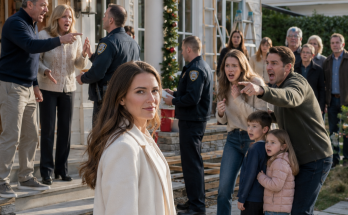
My Daughter-In-Law Turned My Son Against Me For Nine Years. They Kept Me From My Granddaughter. When I Sold My Restaurant For $62 Million, She Showed Up With A Suitcase And Said, “We Need To Move In. Lily Will Love This Place.” I Looked Her In The Eyes And Said Four Words That Made Her Drop That Suitcase.
A Fortune Too Late
### Part 1
My daughter-in-law erased me from my granddaughter’s life for nine years.
She did not do it with one dramatic fight or one slammed door. That would have been easier to understand. No, Marissa did it slowly. Politely. With soft smiles, careful excuses, and the kind of voice that made cruelty sound like good parenting.
My name is Arthur Bennett. I am sixty-seven years old, and for most of my life, people in Savannah knew me as the man behind Bennett’s Table, a Southern restaurant that smelled like smoked ham, hot butter, pepper gravy, and the peach cobbler my wife used to say could make a Baptist preacher forget his sermon.
I started in kitchens before I could legally drink. I washed dishes in a greasy spoon near the bus station, worked breakfast shifts with burned wrists and sore feet, learned how to cut onions fast enough to keep up with men twice my age. By thirty, I had my own place. By forty, I had a line out the door every Sunday.
But before all that, before the articles and the awards and the money people suddenly cared about, I was just a husband to Nora and a father to our boy, Caleb.
Caleb grew up in that restaurant. I can still see him at six years old, sitting on an upside-down milk crate behind the counter, swinging his legs while Nora wiped flour from his nose. He would sneak hush puppies from the warming tray and grin at customers like he owned the place.
Nora died when Caleb was nineteen.
Cancer took her in less than a year. Some pain is too private to dress up for strangers, so I will only say this: after we buried her, my son and I became two people holding up the same broken roof. He came home from college on weekends. We ate Sunday dinner together at the small oak table Nora had picked out at a flea market. Sometimes we talked. Sometimes we just sat there while the ceiling fan clicked above us and grief breathed in the corners.
Then Caleb met Marissa.
She was beautiful in a bright, polished way. Blonde hair always smooth. Nails always perfect. Smile always ready. She called me “Mr. Bennett” at first, then “Arthur” once she decided she belonged.
I liked her.
That is the embarrassing truth. I liked her because she looked at Caleb like he was special. She complimented my cooking. She asked about Nora with moist eyes and a hand over her heart. She told me once, right in front of my son, “Caleb is lucky to have a father who loves him this much.”
I believed her.
The first time she moved a door between us, I barely noticed.
Caleb and I had planned a fishing weekend near Tybee, something we had done since he was a boy. Two days before we were supposed to leave, he called and said Marissa had a migraine and he didn’t want to leave her alone.
I understood.
Then my birthday dinner turned into a short phone call because Marissa’s mother needed help with something urgent. Then Thanksgiving changed because Marissa said holidays were overwhelming. Then Sunday dinners became “maybe next week.”
Every excuse was reasonable by itself.
Together, they were a fence.
They married when Caleb was twenty-six. I paid for the wedding because he was my only child and because Nora was not there to see it. I stood in a rented ballroom under white lights, wearing a suit that felt too tight around the heart, and danced with Marissa while she smiled up at me.
“I’m so happy we’re family now,” I told her.
“So am I,” she said.
Her eyes slid past me to Caleb, checking whether he was watching.
My granddaughter, Sophie, was born fourteen months later on a rainy March morning. Caleb called before sunrise, his voice shaking with joy. I drove to the hospital so fast I barely remember the road.
Sophie was seven pounds, tiny and red-faced, with Caleb’s dark eyes and Nora’s stubborn little chin. When the nurse placed her in my arms, something inside me opened that I thought had died with my wife.
I whispered to that baby, “Your grandmother would have loved you wild. And I will always be here.”
Across the room, Marissa watched me.
She was smiling.
But the smile did not reach her eyes.
### Part 2
When Sophie was little, she reached for me like she knew me from somewhere before this world.
At six months, she laughed whenever I made a popping sound with my lips. At one, she grabbed fistfuls of my shirt and refused to let go. At two, she called me “Pop-Pop” and ran to me with her arms up every time I came through the door.
That was when Marissa started correcting the room.
Not loudly. Never loudly at first.
“Arthur, she just ate. We don’t want her getting sick.”
“Arthur, she gets overstimulated when there’s too much excitement.”
“Arthur, we’re trying to teach her not to cling.”
Cling.
That word sat in my mouth like a fish bone.
I had raised a son. I knew children cried, laughed, reached, hid, demanded, refused, and changed moods faster than Georgia weather. But Marissa spoke like Sophie’s love for me was a symptom.
One Sunday, I arrived early for dinner. Caleb had told me years before to stop knocking, so I let myself in. The house smelled like lemon cleaner and roasted chicken. I was hanging my jacket in the hallway when I heard Marissa in the kitchen.
“She cries after he leaves,” she said.
Caleb answered, “She’s two. She cries when her sock feels wrong.”
“I’m not attacking your father,” Marissa said, in a tone that meant she was absolutely attacking me. “I just think we need healthier boundaries.”
Boundaries.
Another fish bone.
I stood there with my hand still on my jacket sleeve. For a second, I thought about walking out and pretending I had never come. Instead, I stepped into the kitchen.
Marissa turned with a bright smile.
“Arthur! We didn’t hear you.”
“No,” I said. “I suppose not.”
Caleb looked at me too quickly, then looked away.
I said nothing about what I had heard. I washed my hands, helped set the table, and watched Sophie mash peas into her high chair tray while she laughed at the family dog. After dinner, she crawled into my lap with a picture book.
Marissa took the book from her hands.
“Bedtime routine,” she said.
It was barely six-thirty.
By Sophie’s second birthday, the fence had become a wall with flowers planted in front of it.
The party was in Caleb and Marissa’s backyard. There were pink balloons tied to white chairs, cupcakes on tiered trays, and mothers in sundresses standing in small circles. Sophie had frosting on her face when she came running to me.
“Pop-Pop!”
I picked her up. She smelled like sugar, sunscreen, and grass.
Marissa crossed the yard so fast her heels sank into the lawn.
“We’re not doing too much holding today,” she said, still smiling for the guests. “It makes transitions harder.”
I put Sophie down.
She cried.
Marissa gave me a look that said, See?
That night, Caleb called.
“Dad,” he began.
I already knew from his voice. Careful. Flat. Like he had rehearsed.
“Marissa and I think visits should be more structured for a while.”
“Structured how?”
“Planned in advance. Shorter. Just until Sophie’s routine settles.”
“She’s my granddaughter, Caleb.”
“I know.”
“Do you?”
Silence.
Then he sighed, tired and distant. “Dad, please don’t make this harder.”
I almost laughed. Harder for whom? For the woman who had decided love was a threat? For the son who had forgotten the man who sat beside him in the dark after his mother died?
But I swallowed it.
That became my mistake for years. Swallowing.
The Sunday dinners became monthly. Then rare. Then awkward. My calls went unanswered until the next day, then the next week. When I asked to take Sophie to the park, Marissa said they were limiting outside stimulation. When I asked to attend her preschool holiday show, Caleb said the school had limited seating.
Later, I found out that was a lie.
I sent birthday cards. Christmas gifts. Easter dresses. Books. A tiny apron embroidered with Sophie’s name.
Some were acknowledged.
Some disappeared.
When Sophie turned four, I was “allowed” to attend her birthday. That is the only honest word for it.
She stood behind Marissa’s leg when I arrived.
My little girl, who once shouted Pop-Pop across a room, looked at me like I was a neighbor whose name she had been told to remember.
I knelt and held out her gift.
“Happy birthday, sweetheart.”
She looked up at her mother first.
Marissa’s hand rested on her shoulder.
Permission granted.
Sophie took the box.
“Thank you,” she whispered.
I drove back to the restaurant afterward and sat in my truck behind the building while the kitchen fans roared against the brick wall. Through the back door, I could smell fryer oil, onions, and cornbread.
For forty minutes, I could not move.
That day, I understood something.
A child does not become a stranger by accident.
### Part 3
The silence did not arrive all at once.
It came in pieces.
A voicemail Caleb forgot to return. A text answered with three words. A holiday invitation declined because “things are complicated.” A birthday card returned with a yellow sticker across the front.
Return to sender.
I stood by my mailbox holding that envelope while the afternoon heat pressed against my neck. I recognized the card inside by its weight. It had a watercolor rabbit on the front because Sophie loved rabbits when she was little.
Or maybe she did not anymore.
I had no way of knowing.
Caleb moved to Charlotte when Sophie was six. He told me after the decision was made. Not before. Marissa had found a better school district, he said. His firm had opportunities there, he said. It would be good for everyone, he said.
Everyone.
I asked if I could come visit once they settled.
“Of course,” he said.
I never received an address from him.
For the first year, I kept asking. Then I started asking less because every unanswered question took something out of me. Pride, maybe. Or hope. Maybe those are the same thing when family is involved.
People at the restaurant noticed I worked too much.
My manager, Denise, would find me in the kitchen at midnight, sleeves rolled, checking inventory I had already checked.
“Arthur,” she’d say, “go home.”
“Home’s quiet.”
“That’s not a reason to kill yourself over biscuits.”
But work was easier than sitting in a house full of old photographs. In the restaurant, knives hit cutting boards. Servers shouted orders. Pans hissed. Customers laughed. The place had a pulse.
So I expanded.
First, I bought the empty storefront next door and built a private dining room. Then I opened a second Bennett’s Table near the river, where tourists lined up for shrimp and grits. Then Charleston called, and I answered.
Food magazines started using words like “legacy” and “institution.” A television crew came one morning and filmed me pulling biscuits from the oven while a host with perfect teeth asked about “the heart behind the brand.”
I said, “Family.”
The lie tasted like burnt coffee.
By year five of not seeing Sophie, the business had become a machine. Catering, frozen products, licensing deals, a cookbook I barely wrote because a cheerful young woman from Atlanta interviewed me for six months and turned my memories into recipes.
Every success widened the empty place inside me.
I wanted to call Caleb when the Charleston location made its first million.
I wanted to send Sophie a photo of the mural we painted in the Savannah dining room, the one with Nora’s favorite camellias blooming along the wall.
I wanted to tell my granddaughter that the biscuit recipe came from her great-grandmother, who never measured anything and judged dough by touch.
Instead, I signed payroll checks and smiled for newspaper photographers.
When I turned sixty-five, I woke before dawn with a pain in my shoulder and thought, calmly, So this is how it ends.
It was not a heart attack. Just a pinched nerve, according to the doctor. But lying in that examination room under fluorescent lights, wearing a paper gown that opened in the back, I had a clear and terrible thought.
If I died that day, Sophie might hear about it from a stranger.
That changed me.
I hired advisors. I took meetings with a hospitality group from Atlanta that had been circling for years. They wanted Bennett’s Table: the name, the recipes, the catering contracts, the Charleston lease, the whole story.
At first, I said no.
Then one afternoon, I stood alone in the original restaurant before opening. Sunlight came through the front windows in pale strips. The chairs were still upside down on the tables. The whole place smelled like lemon polish and cold coffee.
I touched the counter where Caleb used to sit as a boy.
I could almost hear Nora say, Arthur, don’t confuse keeping busy with living.
I sold the company on a Wednesday in October.
Sixty-two million dollars.
The number looked ridiculous on paper. Like something belonging to another man.
My lawyer, Paul Hanley, slid the final documents across the conference table. “You understand what this means?”
“It means I can sleep past five.”
He smiled, but his eyes were wet. “Nora would be proud.”
That almost broke me.
The sale hit the local paper three weeks later. A record-breaking restaurant acquisition. A Savannah success story. A photograph of me in a navy jacket I had worn to a charity dinner.
For a few days, my phone buzzed with congratulations from people I had not heard from in years.
Then, on a Sunday morning, Caleb called.
For the first time in four years.
I looked at his name glowing on the screen and felt my whole body go still.
### Part 4
“Dad,” Caleb said, warm as July, “it’s so good to hear your voice.”
I sat at my kitchen table and watched steam rise from my coffee.
“You called me,” I said.
A small pause.
“Yeah. I know. I should’ve called sooner.”
I could hear traffic in the background. Or maybe rain. Something restless.
“How are you?” he asked.
“I’m fine.”
“That’s good. That’s really good.”
He sounded like a man walking across thin ice and pretending it was a sidewalk.
Then came the sentences I had once prayed to hear.
“We’ve been thinking about you. Marissa and I. Sophie too.”
My fingers tightened around the mug.
“Sophie?”
“Yeah. She found some old pictures. From when she was little. There was one of you holding her in the restaurant kitchen.”
I closed my eyes.
A photograph. That was what I had become. A man in an old picture.
“She asked who you were,” Caleb said.
The coffee went bitter in my mouth.
He rushed on. “Not like that. I mean, she knows you’re her grandfather. But she got curious. And honestly, Dad, I think it’s time we all reconnect.”
Reconnect.
As if we had lost each other in a grocery store.
“As family,” he added.
There it was. The word people use when they want the benefits of blood without accounting for the blood they spilled.
I asked, “What changed?”
Another pause.
“Life, I guess. Things got away from us.”
“Things don’t get away by themselves, Caleb.”
He exhaled. “I know.”
For one second, I heard my son. Not Marissa’s husband. Not the careful voice. My son.
Then he said, “We’d like to come down next weekend. Me, Marissa, Sophie. Spend some time. Maybe talk.”
I looked out the window at Nora’s camellia bushes along the fence. They were green and stubborn, even in the wrong season.
“Come down,” I said.
They arrived the following Saturday in a silver SUV with North Carolina plates.
I saw them through the front window before they rang the bell.
Caleb got out first. He had gained weight around the middle, and his hair was thinning at the crown. He looked tired in a way that had nothing to do with age.
Marissa stepped out wearing white pants, gold earrings, and sunglasses large enough to hide half her face. She smiled before she reached the porch.
Then Sophie climbed out of the back seat.
Thirteen years old. Long dark hair. Tall. Thin wrists. Nora’s chin still there like a message sent through time.
I opened the door before they knocked.
For a heartbeat, nobody spoke.
Then Sophie said, “Hi, Grandpa Arthur.”
Polite. Careful. Practiced.
The sound of it cut me clean.
“Hi, Sophie.”
Marissa hugged me like we had seen each other last Thanksgiving.
“Oh, Arthur,” she said, pressing perfume and silk against me. “It has been too long.”
“Yes,” I said. “It has.”
She stepped inside and immediately looked around my house.
Not with nostalgia. Not even curiosity.
Assessment.
Her eyes moved from the staircase to the crown molding, from the hardwood floors to the antique sideboard, from the framed restaurant awards to the view of the garden through the back windows.
“This house is just beautiful,” she said. “So much space.”
Caleb gave her a quick glance.
Sophie noticed. She looked down at her shoes.
We sat in the living room. I had made coffee, sweet tea, and a plate of ham biscuits because I did not know how to receive family without feeding them.
Marissa took a biscuit and moaned softly after one bite.
“I forgot how incredible these were.”
I doubted that.
Caleb talked about Charlotte. His job. The firm restructuring. Stress. Long hours. Marissa talked about Sophie’s school not being “a good emotional fit.” Sophie sat on the edge of the couch holding a glass of tea with both hands.
She watched me when she thought I wasn’t looking.
I wondered what she had been told.
That I was difficult? Too intense? Unsafe? Uninterested? Had they made me a villain or just an absence?
After twenty minutes of drifting conversation, Marissa set down her plate.
“Arthur,” she said gently, “we want to be honest with you.”
My skin went cold before I knew why.
Caleb stared at the rug.
Marissa leaned forward, hands clasped, wedding ring flashing.
“We’ve been through a very hard season. Financially and emotionally. And when we saw the news about the sale, it felt like maybe God was opening a door for healing.”
I said nothing.
She smiled wider.
“We need to move in, Dad. Sophie would love having her grandfather close.”
Dad.
She had never called me that in her life.
Beside her, a suitcase stood near the hallway, upright and waiting.
### Part 5
I looked at the suitcase first.
Dark leather. Gold zipper. A pink ribbon tied to the handle, probably so it would stand out at baggage claim.
Then I looked at Marissa.
She was still smiling, but her eyes had sharpened. She thought the hard part was over. She thought showing up with my son and granddaughter had softened me enough to make the next word easy.
Yes.
That was the word she had driven three hundred miles to collect.
Caleb rubbed both hands over his knees.
Sophie stared at the suitcase as if she wished she could disappear inside it.
I asked, “You packed before asking me?”
Marissa laughed lightly. “Just essentials. We didn’t want to presume.”
“You arrived at my door with luggage.”
“Well, we hoped,” she said. “There’s nothing wrong with hope.”
“There is when it wears perfume and calls itself family.”
The room changed.
Caleb looked up. Marissa’s smile flickered. Sophie’s eyes widened, not scared exactly, but alert.
Marissa lowered her voice. “Arthur, I know there’s been pain. I know mistakes were made on all sides.”
“No,” I said.
She blinked.
“No?” she repeated.
“Mistakes were not made on all sides. Choices were made. Mostly by you. Then by Caleb when he allowed them.”
Caleb flinched.
Marissa’s face tightened. “That’s not fair.”
“You kept my granddaughter from me for nine years.”
“We protected our child’s boundaries.”
“She was four.”
“She was sensitive.”
“She loved me.”
Marissa’s jaw moved like she was biting down on something.
I turned to Caleb. “Tell me one true thing.”
His face went pale.
Marissa said quickly, “This is not productive.”
“I didn’t ask you.”
The silence after that was so sharp I could hear the old clock ticking in the hallway.
Caleb swallowed.
“Dad…”
“One true thing,” I said again.
He looked at Sophie, then at Marissa, then down at his hands.
“At first,” he said, voice rough, “Marissa thought you were too involved.”
Marissa made a sound. “Caleb.”
He kept going, quieter. “She said you were trying to replace Mom through Sophie. That you needed grief counseling, not more time with the baby.”
My chest tightened.
Sophie looked at her mother.
Marissa’s face flushed. “That is a cruel oversimplification.”
I did not look away from Caleb.
“And you believed her?”
“I didn’t know what to believe. I was tired. Sophie was little. Marissa cried every time I pushed back. She said I was choosing you over my own household.”
“And later?”
His eyes filled.
“Later I knew it had gone too far.”
The room held its breath.
“But by then,” Caleb whispered, “I didn’t know how to undo it.”
That was the first honest thing my son had given me in almost a decade.
It was not enough.
I stood and walked to my study. My knees ached with each step. In the desk drawer was a blue folder I had prepared after the newspaper story ran. Not because I knew exactly who would come. Because I knew money is a dinner bell, and I had heard it ring before.
When I returned, Marissa’s hand was gripping the suitcase handle.
I placed the folder on the coffee table.
“What’s that?” Caleb asked.
“The reason you came too late.”
Marissa’s eyes narrowed.
I opened the folder. Donation receipts. Trust documents. Letters from foundations. Scholarship papers in Nora’s name. A college fund established directly for Sophie, protected from her parents, available when she turned eighteen.
Caleb picked up the first page.
His face changed slowly, then all at once.
“What did you do?” he whispered.
“I gave most of it away.”
Marissa’s hand slipped from the suitcase handle.
“What do you mean, most?” she asked.
“I kept this house. Enough to live comfortably. Enough for medical care. Enough to help Sophie directly when she’s grown. The rest is gone.”
“Gone?” Her voice cracked.
“Food banks. Cancer research. Culinary scholarships. A foundation that helps grandparents fight for visitation rights when family courts make it impossible.”
Marissa stood so fast the suitcase tipped and hit the floor with a heavy thud.
I looked her in the eyes.
“You waited too long.”
Four words.
That was all it took.
Her mouth opened, but nothing came out.
### Part 6
For years, I had imagined confronting Marissa.
In some versions, I shouted. In some, I threw her out. In others, Caleb fell to his knees and begged forgiveness while Sophie ran into my arms, suddenly remembering everything we had lost.
Real life was quieter.
Marissa stared at the papers like they had personally betrayed her.
“You can reverse some of this,” she said.
“No.”
“You’re emotional right now.”
“No.”
“Arthur, think about Sophie.”
That made me laugh once, without humor.
“I have thought about Sophie every day for nine years.”
Sophie’s face tightened. She looked between us, trying to read a language she had been forced to inherit.
Marissa noticed and softened her voice.
“Honey, why don’t you step outside?”
“No,” Sophie said.
It was the first firm word I had heard from her.
Marissa froze.
Sophie set her tea down carefully. Her hands were trembling. “I want to hear.”
Caleb covered his face.
Marissa turned to him. “Are you going to let this happen?”
He dropped his hands. His eyes were wet, but his voice, when it came, was steadier than I expected.
“I think it already happened, Marissa.”
She looked at him like he had slapped her.
“So that’s it?” she said. “You’re just going to sit there while your father punishes us?”
“He’s not punishing us,” Caleb said. “He’s refusing to rescue us.”
Another silence.
That sentence landed in the room like a verdict.
Marissa’s eyes shone, but not with grief. With calculation under pressure.
“We are your family,” she said to me.
“No,” I answered. “You are my son’s wife. Sophie is my family. Caleb is my family, though I don’t know what that means anymore. You? You are the woman who taught a child to treat love like danger.”
Sophie’s eyes dropped.
I regretted saying it in front of her, but I did not regret saying it.
Marissa grabbed the suitcase upright.
“Come on,” she snapped. “We’re leaving.”
Sophie did not move.
“Sophie,” Marissa said.
My granddaughter looked at her father.
Caleb’s shoulders sagged. He looked ten years older than when he had arrived. “Maybe we should all take a breath.”
“No,” Marissa said. “We came here to heal, and he humiliated us.”
I said, “You came here for a house.”
Her face twisted.
“The Isle of Hope property,” I added. “Two million, give or take. Waterfront. Dock. Fresh start. Isn’t that how you planned to say it?”
Caleb closed his eyes.
Sophie turned sharply toward her mother.
“You were going to ask him to buy us a house?”
Marissa’s face changed instantly. “For all of us. So we could be close.”
“But you told me we were coming because I asked about the picture.”
Her voice was small.
That hurt more than Marissa’s anger.
I watched Sophie put the pieces together. Children know more than adults think. Teenagers especially. They live in the weather of a house. They know when bills are hidden, when voices drop, when smiles are used as tools.
Marissa reached for her. “Sweetheart—”
Sophie stepped back.
It was not dramatic. Just one step.
But it was the first brick falling from Marissa’s wall.
Caleb stood.
“I need to talk to Dad alone.”
Marissa laughed bitterly. “Of course you do.”
“No,” he said. “I need to tell him the rest.”
Her face went white.
The rest.
There it was. The door I had not known existed.
Sophie looked at me.
I felt my stomach drop.
Marissa whispered, “Caleb, don’t.”
But my son was already crying.
### Part 7
Caleb sat back down like his legs had stopped working.
Marissa remained standing, one hand on the suitcase, the other pressed flat against her stomach. Sophie stood near the fireplace, eyes fixed on her father.
I did not speak. Some truths need silence around them before they can come out.
Caleb wiped his face with his sleeve.
“When Sophie was five,” he said, “Dad sent a letter.”
My heart thudded.
“I sent many letters.”
“I know.” His voice broke. “Marissa kept them.”
Sophie whispered, “What?”
Marissa said, “They were inappropriate.”
Caleb shook his head. “No. They weren’t.”
He looked at me, and for the first time in years, I saw the boy who used to sit in my truck after baseball practice, sweaty and hungry and honest.
“They were in a box in the closet,” he said. “Cards, photos, little notes. The apron you sent. Books. Birthday checks. She told me she returned everything.”
I stared at Marissa.
She looked away.
“Why?” Sophie asked.
Marissa’s mouth trembled. “Because he was confusing things. Because you were too young. Because I was your mother and I knew what was best.”
“You kept my birthday cards?”
“They would have upset you.”
Sophie’s face hardened. “Or they would have told me he cared.”
That sentence nearly brought me to my knees.
Caleb continued, each word dragged out of him.
“I found the box two years ago. I should have called you then, Dad. I should have packed Sophie into the car and come here. But Marissa said if I opened that door, she’d leave. She said she’d take Sophie and make sure I only saw her through lawyers.”
The room blurred at the edges.
“So you chose peace,” I said.
He looked down. “I chose fear.”
It was honest.
It was also unforgivable in the way some things are unforgivable even when you understand them.
Marissa’s voice went cold. “You have no idea what it was like being married into a ghost. Nora this, Nora that, Bennett family tradition, Sunday dinner, biscuits, fishing trips. There was no room for me.”
I looked at her for a long moment.
“There was room,” I said. “You just wanted the whole house.”
Her eyes filled with tears then, real ones or useful ones, I no longer cared.
Sophie turned to me. “Did you really write?”
“Yes.”
“Every birthday?”
“Yes.”
“Christmas?”
“Yes.”
“Did you ever stop?”
I swallowed. “Eventually, I stopped sending them. But I never stopped writing.”
Her face changed. “What does that mean?”
I went back to the study.
In the bottom drawer of my desk, beneath tax files and old menus, were nine notebooks. Plain black covers. One for each year. I had written in them when the returned cards became too painful to mail. Little things. Memories. Recipes. Stories about her father as a boy. Notes about Nora. Things I would have told Sophie if anybody had allowed me to know her.
I carried them into the living room and placed them on the table.
Sophie stared.
“These are for you,” I said. “Not today, unless you want them. Not because you owe me anything. They’re just yours.”
She touched the top notebook with two fingers.
Marissa said, “This is emotional manipulation.”
Sophie snapped, “Stop.”
The word cracked through the room.
Marissa recoiled.
Sophie picked up the first notebook and held it against her chest.
“I want to stay tonight,” she said.
“No,” Marissa said immediately.
Caleb said, “Marissa.”
“No. Absolutely not.”
Sophie looked at her father. “I’m thirteen, not three. I want one night with my grandfather.”
Marissa laughed, sharp and frightened. “You don’t even know him.”
Sophie’s eyes filled, but she did not look away.
“Whose fault is that?”
No one moved.
Outside, a car passed slowly on the street. Somewhere in the kitchen, the refrigerator hummed. The house smelled faintly of coffee and ham biscuits cooling on the plate.
Marissa’s control, which had once seemed so smooth and permanent, was cracking in ordinary afternoon light.
Caleb took a breath.
“She can stay,” he said.
Marissa turned on him. “Then don’t come home.”
He closed his eyes.
When he opened them, something had settled there.
“Maybe I shouldn’t.”
### Part 8
Marissa left before sunset.
She did not storm out the way people do in movies. She moved quickly and quietly, which was worse. The suitcase rolled behind her across my hardwood floor, its wheels clicking like teeth.
At the door, she turned to Sophie.
“You’re making a mistake.”
Sophie stood beside the staircase with the notebook in her arms.
“No,” she said. “I’m learning what mistakes were already made for me.”
Marissa looked at Caleb next. For one second, I thought she might soften. Instead, her face closed.
“You’ll regret humiliating me.”
Caleb looked exhausted. “I regret a lot already.”
She left.
The SUV backed out of my driveway too fast, tires crunching over gravel. Then she was gone, and the silence she left behind felt different from the silence I had lived with for nine years. This one had air in it.
Sophie stayed that night.
I made chicken and rice because it was simple and because my hands needed something to do. She sat at the kitchen island while I chopped celery. Caleb sat at the table, staring at a glass of water he never drank.
No one knew how to be natural.
So I started with the only thing I trusted.
“Your grandmother hated celery,” I told Sophie.
She looked up. “Really?”
“Despised it. Said it tasted like wet string. But she put it in chicken and rice because she said tradition requires sacrifice.”
Sophie smiled.
Small, but real.
After dinner, Caleb went to a hotel. He asked if he could stay, and I told him no.
Not cruelly. Calmly.
“I love you,” I said. “But I cannot carry your guilt tonight.”
He nodded as if he deserved that.
At the door, he whispered, “Can we ever fix this?”
I looked at my son, and my heart ached with the memory of every age he had ever been.
“No,” I said. “Not fix. Maybe build something new. But not tonight.”
He cried then. I let him. I did not hug him. That may sound harsh to some people, but there are moments when comfort becomes another way of letting someone avoid the weight of what they did.
After he left, Sophie and I stood in the kitchen.
She pointed at the counter. “Can you teach me biscuits?”
I almost had to turn away.
“Now?”
She shrugged. “I’m awake.”
So at nine-thirty on a Saturday night, I taught my granddaughter how to make biscuits.
I showed her how to keep the butter cold. How to press it into flour with her fingertips. How not to twist the cutter because that seals the edges. She listened with the fierce concentration of someone trying to recover more than a recipe.
The first batch came out uneven.
She held one up. “It’s ugly.”
“Most good things start ugly.”
She laughed.
That sound reached places in the house I thought had closed forever.
Over the next months, life did not become clean or easy.
Marissa filed for separation. Then she changed her mind. Then she demanded money from Caleb. Then she blamed me in messages I did not answer. Caleb started therapy. He called every Sunday. I answered every other Sunday at first, because trust is not a faucet you turn back on.
Sophie came for spring break.
Then two weeks in summer.
Then Thanksgiving.
She read the notebooks slowly. Sometimes she asked questions. Sometimes she got angry. Not at me exactly. Not only at her parents. At the whole stolen shape of things.
One afternoon, she found the tiny apron I had once sent her, still folded in the box Caleb eventually brought from Charlotte. She held it up against herself and laughed because it was far too small.
Then she cried.
I stood nearby and let her.
When she turned eighteen, the trust became hers. Not her mother’s. Not Caleb’s. Hers. She used part of it for college and saved the rest. She chose culinary science first, then changed to business, then somehow found a way to do both.
Marissa sent me one letter after Sophie’s high school graduation.
It was four pages long. She wrote about stress, motherhood, insecurity, grief, intentions, misunderstandings, and how she hoped we could all move forward “as a healed family.”
I read it once.
Then I placed it in the fireplace and watched the flame take it.
I did not hate her anymore.
But forgiveness is not the same as reopening the door.
Caleb and I are not what we were. We meet for breakfast sometimes. He tells me the truth now, even when it makes him look bad. That matters. It does not erase anything. He knows that.
Sophie is twenty-one now. Last month, she came home from college and stood beside me in the kitchen of the house Marissa once tried to claim with a suitcase and a smile. We made biscuits for a neighborhood fundraiser benefiting families who needed meals after hospital stays.
Nora’s camellias were blooming outside the window.
Sophie dusted flour from her hands and said, “Grandpa?”
I looked over.
“I wish I’d known you sooner.”
The old wound opened, but it did not swallow me.
“Me too,” I said.
She leaned her shoulder against mine.
“But I know you now,” she said.
And that, I have learned, is not the same as getting back what was stolen.
But it is something real.
At sixty-seven, I know this much: money can expose people, but it cannot repair time. Love can survive a locked door, but it should never have to beg outside one. And when people come back only after your life looks useful to them, you are allowed to look them in the eyes and let them learn they arrived too late.
Marissa wanted my fortune.
Caleb wanted relief from the consequences of his silence.
Sophie wanted the truth.
Only one of them deserved what I had left to give.
THE END!