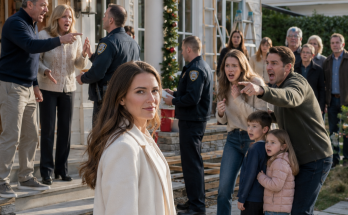
On Christmas Eve, My Sister Shattered My Late Father’s Memorial Frame. When My Mom Walked In, She Pointed At My 6-Year-Old Daughter And Screamed, “She Did It!” Before I Could Speak, My Mother Grabbed A Pot Of Boiling Soup And Poured It Over My Little Girl. As My Daughter Screamed In Agony, My Mom Called It An Accident. They Had No Idea The Worst Few Minutes Of Their Lives Were About To Begin…
### Part 1
I used to think the coldest thing in Ohio was the wind that came off the Scioto River in December.
Then I stood in my mother’s living room on Christmas Eve and heard my little girl scream.
Her name is Maisie. She was six years old then, all soft curls, missing front teeth, and a habit of believing every adult meant what they said. If someone smiled at her, she smiled back twice as brightly. If someone said they loved her, she trusted it with her whole tiny chest.
That was what I hated myself for later.
I brought her into that house because I still wanted to believe my mother could love someone innocent.
My name is Clara Mitchell, and for most of my life, I was the daughter who fixed things. Bills, arguments, late notices, broken appliances, Thanksgiving disasters, my mother’s mood, my sister’s mistakes. If something went wrong, my family looked at me, even when I had nothing to do with it.
My younger sister, Tessa, was different. Tessa was “sensitive.” Tessa was “special.” Tessa was “going through a lot.” If she forgot a payment, I covered it. If she wrecked a car, I helped with the insurance. If she said something cruel, Mom called it honesty.
My father, Henry, was the only person in that house who ever looked ashamed about it.
He had bad joints and worse lungs by the time I was in my twenties, but he still had gentle hands. He used to sit at the kitchen table late at night while I came home from work smelling like printer ink, burnt coffee, and winter pavement.
“You don’t owe them your whole life, Clara,” he would whisper.
But I thought I did.
That was how I was raised. My mother, Diane, never asked for help like a normal person. She assigned guilt. She could look at me over a stack of unpaid bills and make it sound like my selfishness had personally caused the lights to flicker.
“You know Tessa can’t handle stress,” she would say. “You’ve always been stronger.”
Stronger meant useful.
For years, I was useful.
Then I met Ryan.
Ryan was steady in a way I didn’t understand at first. He didn’t shout to win. He didn’t punish silence. He noticed when my hands shook after phone calls with my mother. He once took my phone from me after Diane called six times in one evening and said, “You are allowed to be unavailable.”
I cried in the laundry room after that, holding a warm towel to my face like a fool.
When Maisie was born, everything inside me rearranged. Suddenly, the word family didn’t mean duty. It meant protection. It meant Ryan asleep in a hospital chair with one hand on my blanket. It meant our baby blinking at the world like she had just arrived somewhere safe.
I wanted safe to last.
So I pulled away from Diane and Tessa. Slowly at first. Then completely after my father died.
His funeral was the last time I saw them for three years.
Mom cried loudly at the church, pressing tissues under dry eyes whenever someone looked. Tessa wore black sunglasses indoors and accepted hugs like a grieving movie star. I stood beside the casket with my hand on the polished wood, remembering how Dad had once slipped twenty dollars into my coat pocket even though he had almost nothing.
After the burial, no one invited me back to the house.
No one called on Maisie’s birthday.
No one checked on me.
For three years, silence became peace.
Then, two weeks before Christmas, a cream-colored envelope appeared in our mailbox. My mother’s handwriting curled across the front.
Clara,
Life is too short for old hurt. Your father would want us together. Come to Christmas Eve dinner. Bring Ryan and my granddaughter. Let’s start over.
I read it so many times the paper softened at the fold.
Ryan stood at the kitchen island, watching my face.
“Clara,” he said carefully, “three years is a long time to remember you exist right before Christmas.”
“I know.”
“Do you?”
I looked toward the living room, where Maisie was lying on her stomach, coloring a picture of a snowman with purple arms.
“She asked about having a grandma last week,” I whispered.
Ryan’s expression changed. Not agreement. Not relief. Just sadness.
That was how Diane got me back into that house.
Not through love.
Through the one place I was still vulnerable.
Hope.
### Part 2
Snow started falling before we left Columbus.
It came down thick and soft, blurring the headlights and turning every lawn into a Christmas card. Maisie pressed her mittened hands to the backseat window and gasped every time we passed a house wrapped in lights.
“Does Grandma have a Christmas tree?” she asked.
“She always does,” I said.
“Will she like my dress?”
I glanced at her in the rearview mirror. Red velvet. White tights. Little black shoes. She had chosen a gold bow for her hair because, in her words, “Grandmas like shiny things.”
My throat tightened.
“She should,” Ryan said from the driver’s seat.
That word should sat between us all the way to my childhood home.
Diane’s house looked exactly as I remembered, but bigger somehow, like distance had stretched it. The porch rails were wrapped in garland. White candles glowed in every front window. A wreath the size of a tire hung on the door, dusted with fake snow and silver berries.
For a second, standing there with a casserole dish in my hands and Maisie beside me holding a wrapped gift, I let myself imagine something foolish.
My mother opening the door with tears in her eyes.
Tessa apologizing.
My father’s absence making all of us kinder.
Then Diane opened the door.
She wore a dark green dress, pearls, and the same cool expression she used to wear when I brought home a report card with one B.
“Oh,” she said. “You’re here.”
No hug.
No warmth.
Her eyes slid over me, paused on my coat, then moved to Ryan like she was inspecting furniture delivered to the wrong room.
Maisie lifted the gift with both hands.
“Merry Christmas, Grandma.”
Diane looked down at her.
For one bright second, my daughter smiled with all her heart.
Diane took the gift without bending. “Put your coats in the den. Guests will be here soon.”
Ryan’s jaw shifted.
I touched his sleeve.
Not yet, my fingers said.
The house smelled like pine, butter, roasted onions, and something creamy simmering in the kitchen. Music played low through hidden speakers. Every surface glittered. Diane had always been good at making a room look warm.
Tessa was on the sofa in a cream sweater dress, scrolling through her phone. She looked up when we entered, gave me a tiny smile with no teeth, and looked back down.
“Hi, Tessa,” I said.
“Hey.”
Maisie leaned against my leg.
I wanted to leave then.
I should have left then.
But one of Diane’s neighbors came in behind us, carrying wine and calling, “Diane, your house is gorgeous!” And my mother instantly transformed.
Her shoulders softened. Her laugh floated. She kissed cheeks. She touched my back and said, “And this is my eldest, Clara. We finally have her home.”
Finally.
Like I had been the one missing.
Like I had abandoned them.
For the next hour, I understood exactly why we had been invited.
Diane introduced me to people as proof. Proof she had a daughter. Proof she had a granddaughter. Proof no one should whisper about estrangement or ask why her Christmas cards never included us.
Maisie tried twice to talk to her. Diane answered both times with a distracted “That’s nice, sweetheart,” before turning away.
Ryan stayed close to me, one hand resting lightly at my back. He didn’t say I told you so. He didn’t need to.
Then I saw my father’s memorial table.
It stood in the corner near the fireplace, under a framed watercolor of a snowy barn. His portrait sat in a heavy silver frame, polished so brightly it reflected the candle beside it. A small vase of winter roses leaned toward the glass.
My chest hurt.
Maisie followed my gaze.
“Is that Grandpa Henry?”
I nodded. “Yes, baby.”
“He looks kind.”
“He was.”
She took one careful step closer, hands folded in front of her like she was in a museum.
Behind us, Tessa’s voice sharpened.
“No, I told you I’m not covering that,” she hissed into her phone.
She stood from the couch and began pacing, heels clicking hard against the floor. Her face was twisted, her free hand waving as she argued. I barely noticed until she crossed behind Maisie.
Then her elbow struck the memorial table.
The frame tipped.
For one slow second, I saw my father’s face tilt toward the floor.
Then the glass shattered at my daughter’s feet.
Maisie screamed in surprise, not pain. Just fear.
Tessa froze.
Her eyes flicked to the broken frame, then to the kitchen doorway, where Diane had just appeared holding a wide stainless-steel pot with both hands.
Tessa pointed at Maisie.
“Mom!” she cried. “She did it!”
### Part 3
Everything after that happened too fast and too slowly at once.
The room went quiet in a strange, sucking way. Music still played. A woman near the tree still held a glass of wine halfway to her mouth. Somewhere in the kitchen, a timer beeped once, then again.
Maisie looked up at me, confused.
“I didn’t,” she whispered.
I opened my mouth.
But Diane moved first.
Her face changed into something I had seen all my life but never directed at my child. Rage, yes, but not wild rage. It had aim. It had a target.
“You careless little brat,” she snapped.
“Diane,” Ryan barked.
I stepped toward Maisie.
Diane came out of the kitchen still holding the pot. Steam rose from it in pale ribbons. I remember the smell clearly, even now: leeks, cream, pepper, hot metal.
Tessa backed away from the broken glass, one hand over her mouth.
“Mom, she threw a fit,” Tessa said, voice shaking. “She smashed Dad’s picture.”
That lie landed like gasoline.
Diane’s eyes locked on Maisie.
My daughter stood perfectly still, her little black shoes surrounded by glittering pieces of my father’s memorial frame.
“I didn’t,” she said again, smaller this time.
Diane lifted the pot.
At first, my mind refused to understand.
Maybe she meant to set it down.
Maybe she stumbled.
Maybe no mother, no grandmother, no human being could do what my eyes were telling me she was about to do.
Then Ryan shouted my name.
The pot tipped.
The soup hit Maisie across the side of her head and shoulder.
For half a heartbeat, there was no sound at all.
Then my daughter screamed.
Not a normal scream. Not a startled child’s cry. It was a sound that ripped the air open.
I lunged forward, slipping on the rug, grabbing her under the arms, pulling her away from the puddle spreading across the hardwood. Her velvet dress clung wetly to her skin. She clawed at me, sobbing, “Mommy, it hurts, it hurts, it hurts.”
I do not remember deciding to move.
I only remember Ryan taking her from me with a calm so hard it frightened me. He carried her straight down the hall to the bathroom.
“Cool water,” he said. “Now.”
I turned the shower on with hands that no longer felt like mine. Ryan stepped in fully clothed, holding Maisie beneath the gentle stream, speaking to her in a low, steady voice.
“Look at me, bug. Breathe with Daddy. I’ve got you. I’ve got you.”
Her cries echoed off the tile.
I stood there for one second, staring at my little girl’s red face, her soaked hair, her terrified eyes.
Then something in me went still.
Not calm.
Still.
Like a lake freezing over.
Ryan pulled his phone out with one hand and dialed.
“We need an ambulance and police,” he said, voice sharp and clear. “A six-year-old child has been burned with scalding liquid. It was intentional. Send officers now.”
From the hallway, Diane’s voice cut through.
“Hang up that phone.”
I turned.
She stood near the kitchen, blouse damp at the cuffs, empty pot on the floor beside her. Her guests had scattered into corners, stunned and whispering. Tessa hovered near the fireplace, pale and shaking, but not with guilt.
With fear of consequences.
“Clara,” Diane said, lowering her voice into the old tone. The one that used to make me apologize before I knew what I had done. “This was a horrible accident.”
I stared at her.
She smoothed her hair.
“She knocked over Henry’s frame. She panicked. I was carrying soup. She ran into me.”
Tessa nodded too quickly.
“That’s what happened,” she said. “I saw it.”
Ryan’s voice continued behind me, giving the dispatcher the address.
Diane took a step closer.
“You are not destroying this family because your child misbehaved.”
For thirty-two years, that sentence would have worked on me. Maybe not those exact words, but the shape of them. Family. Shame. Silence. My fault.
But Maisie cried behind me, and I felt the last thread tying me to my mother burn clean away.
I walked toward Diane.
She flinched, just slightly.
“Do you hear her?” I asked.
Diane’s lips pressed together.
“Clara—”
“Do you hear what you did?”
Her face hardened. “Lower your voice.”
I laughed once. It sounded nothing like me.
“You should be worried about my voice,” I said. “Because I’m going to use it.”
The first siren wailed in the distance.
Diane looked toward the front window, and for the first time that night, real panic entered her eyes.
### Part 4
The police arrived before the ambulance doors had even fully opened.
Red and blue lights flashed across the snow outside, turning Diane’s perfect Christmas windows into something harsh and ugly. The neighbors who had been so impressed with her garland now stood in silence, coats clutched around their shoulders, watching officers step into the house.
The lead officer was a broad man with tired eyes and snow melting on his shoulders.
“What happened here?” he asked.
Diane was ready.
She became fragile in an instant.
Her voice trembled. Her hands fluttered. She leaned against the counter like she might faint.
“Officer, thank God. It was awful. My granddaughter knocked over my late husband’s memorial frame. She got scared and ran into me while I was carrying soup. It spilled everywhere. My daughter attacked me afterward.”
I almost admired how fast she built the lie.
Almost.
Tessa moved beside her, arms crossed tightly.
“That’s exactly what happened,” she said. “Maisie was throwing a tantrum.”
The officer looked at me.
Behind him, paramedics hurried down the hall toward the bathroom. I heard Ryan giving them information. I heard Maisie sobbing softer now, exhausted.
Every instinct in my body wanted to follow her.
But I knew Diane.
If I left that room too soon, she would fill it with poison.
“My mother and sister are lying,” I said.
Diane made a wounded sound.
I didn’t look at her.
“My sister knocked over the frame while arguing on her phone. She blamed my daughter. My mother came out of the kitchen with the pot and poured it on her.”
Tessa barked out a laugh. “That’s insane.”
The officer’s face remained unreadable. “Is there anyone else who saw it?”
The room shifted.
Guests looked down. One woman pressed a hand to her mouth. Another man glanced toward Diane, then away. Cowards, all of them, trapped between truth and social discomfort.
I felt anger rise, but I pushed it down.
Then I saw it.
The small black camera mounted near the crown molding, angled toward the living room.
My father had installed it years earlier after someone stole packages from the porch. Diane had complained about it constantly until she realized it made her feel important to say she had security.
I pointed.
“That camera records the whole living room.”
Diane’s head snapped toward it.
Tessa whispered, “No.”
It was so soft I almost missed it.
The lead officer followed my finger. “Who has access?”
Diane said nothing.
I looked at her.
“Mom?”
Her mouth opened, then closed.
The officer turned to her. “Ma’am?”
“It’s probably not working,” Diane said quickly. “It hasn’t worked right in months.”
That was lie number three.
Before I could speak, a man near the tree cleared his throat. It was Mr. Whitaker from across the street. He had aged since I last saw him, but his voice was still firm.
“Diane showed me the app earlier tonight,” he said. “She was bragging about the new cloud storage.”
Diane turned on him with pure hatred.
He looked away, but the damage was done.
The officer requested her phone.
She refused.
He asked again.
This time, his voice changed.
Diane handed it over with shaking fingers.
The next few minutes were quiet except for Maisie’s crying, the murmur of paramedics, and the wet sound of melting snow dripping from boots onto the entryway tile.
When the officer played the footage, the whole room watched Diane’s life split in half.
There was Tessa pacing.
There was her elbow striking the table.
There was the frame falling.
There was Maisie freezing, nowhere near it.
There was Tessa pointing.
There was Diane rushing forward.
There was no stumble. No accident. No frightened child running into danger.
Only my mother, choosing.
A woman gasped.
Tessa sat down hard on the sofa.
Diane stood motionless, her face gray beneath her makeup.
The officer stopped the video.
For once, no one in that house had anything to say.
Then he turned to Diane.
“Put your hands behind your back.”
My mother blinked.
“What?”
“Now.”
The click of the handcuffs was quiet.
Barely louder than the Christmas music still playing through the speakers.
But to me, it sounded like a door locking between my daughter and everything I had survived.
### Part 5
I rode in the ambulance with Maisie.
Ryan followed behind in our car because the paramedics needed space, and because he knew I would shatter if he did not stay close. Through the back window, I could see his headlights behind us, steady through the snow.
Maisie lay wrapped in clean white sheets, her face turned toward me.
“Mommy,” she whimpered, “was Grandma mad at me?”
I took her hand carefully.
“No, baby,” I said, though my voice broke. “Grandma was wrong. You did nothing wrong.”
Her eyelids fluttered.
“I didn’t touch the picture.”
“I know.”
“Will Grandpa be mad?”
That nearly ended me.
I bent over her hand and kissed her knuckles.
“Grandpa Henry loved gentle people. He would never be mad at you.”
At the hospital, everything smelled like antiseptic, wet coats, and burnt coffee. Nurses moved quickly but kindly. Doctors asked questions. Ryan answered the ones I couldn’t. Time lost its edges.
I remember a blue curtain.
A paper cup of water untouched in my hand.
Ryan’s palm on the back of my neck.
Maisie’s small voice asking for her stuffed rabbit, which was still in the car.
The injuries were serious but treatable. That was the phrase the doctor used. Serious but treatable. I held on to those words like a rope over a cliff.
“She’ll need specialized care and follow-ups,” he said. “But you acted quickly with cool water. That helped.”
Ryan closed his eyes.
I looked at him and realized his shirt was soaked, his sleeves clinging to his arms from standing in the shower with our daughter.
Only then did he begin to shake.
Not much. Just enough that I saw.
I reached for him, and he folded me against his chest in the hallway while hospital staff moved around us.
“I should have stopped it,” I whispered.
He pulled back immediately.
“No.”
“I brought her there.”
“Clara.”
“I let hope make me stupid.”
His face tightened with pain.
“You trusted your mother to behave like a human being. That is not a crime.”
Maybe not.
But it felt like one.
The first call from Diane came at 2:17 in the morning.
Then another.
Then one from a number I didn’t recognize.
Then Tessa.
Then Diane again.
Ryan took my phone, turned it off, and put it in his pocket.
“She can talk to a lawyer,” he said.
By morning, the police had taken full statements. The security video had been preserved. Several guests, suddenly brave after seeing handcuffs, admitted the footage matched what they had seen.
Diane was booked.
Tessa was questioned.
And my mother’s version of reality, the one she had spent decades forcing down my throat, finally met something it couldn’t bend.
Evidence.
Two days after Christmas, a detective came to the hospital.
He spoke gently, but nothing he said was soft.
Charges were being pursued. Child endangerment. Assault. Obstruction issues for Tessa. More would depend on the prosecutor.
I listened without crying.
Ryan held Maisie’s stuffed rabbit in his lap, rubbing one worn ear between his fingers.
The detective asked if I wanted to make a formal statement.
“Yes,” I said.
My voice sounded different.
Lower. Cleaner.
For the first time, I told the whole truth.
Not just about Christmas Eve.
About the years before it.
About the money. The manipulation. The way Tessa lied and Diane enforced the lie. The way my father had been the only kindness in that house. The way silence had always been the price of belonging.
When I finished, the detective closed his notebook slowly.
“Mrs. Mitchell,” he said, “people like this often count on family members backing down.”
I looked through the glass into Maisie’s room.
She was asleep, one small hand curled near her cheek.
“Then they counted wrong,” I said.
### Part 6
Diane’s lawyer tried to make me sound unstable.
That was the first strategy.
He suggested I had exaggerated old family tensions. He hinted that I resented my mother. He asked whether I had ever received therapy. He asked whether motherhood had made me “overprotective.”
I sat in the prosecutor’s office under fluorescent lights, hands folded in my lap, and answered every question the truth required.
Yes, I resented my mother.
Yes, I had gone to therapy.
Yes, I was protective of my daughter.
No, none of that made the video lie.
Tessa’s strategy was different.
She cried.
She cried in interviews. She cried in court appearances. She cried when she saw cameras outside the courthouse. She claimed she had panicked. She claimed she had only repeated what she “thought” happened. She claimed she loved Maisie.
That was the one that almost made me stand up and shout.
Love does not point at a terrified child surrounded by broken glass and offer her up as a shield.
But I stayed quiet.
I had learned something by then.
Rage feels powerful, but discipline wins.
The prosecutor, Ms. Alvarez, was a compact woman with silver-threaded black hair and the kind of stare that made people sit straighter. She never promised us anything she couldn’t control.
“The footage is strong,” she told us. “The medical records are strong. Your statements are consistent. But court is still court.”
I appreciated that.
After a childhood full of dramatic certainty from liars, honest caution felt like respect.
Maisie healed slowly.
The burns improved. The bandages got smaller. The nightmares did not.
For weeks, she woke crying that someone was mad at her. She stopped wanting soup. She stopped wearing red. She asked if Christmas would come back next year.
Ryan and I took turns sleeping on the floor beside her bed.
We found a child therapist with warm eyes and a basket of puppets. Maisie liked the turtle puppet best because, she said, “He can hide when people are mean.”
I cried in the parking lot after that appointment.
Ryan sat beside me and let the car idle, heat blowing against the windshield.
“We’re going to build her a world where she doesn’t have to hide,” he said.
So we did.
We packed away the dress.
We changed our locks even though Diane was in custody.
We blocked every relative who sent messages about forgiveness.
There were more than I expected.
A cousin wrote, Your mom made a mistake, but prison is harsh.
An aunt wrote, Think of how this looks for the family.
I stared at that one for a long time.
Then I typed back: I am thinking of how my daughter looked in an ambulance.
After that, I stopped answering.
Three months later, the plea offers came.
Tessa took hers first.
She admitted to lying to officers and obstructing the investigation. The plea spared her a longer fight but not consequences. She would serve jail time, complete community service, pay fines, and carry a record that would follow her into every job interview she thought her charm could win.
Diane refused at first.
Of course she did.
Diane believed rules were for people without good lighting and respectable shoes. She believed if she sat up straight enough, cried at the right moment, and said “tragic accident” enough times, the world would rearrange itself around her version.
Then her attorney watched the security footage frame by frame with the prosecution.
After that, his confidence changed.
The trial lasted less than a week.
I testified on a Tuesday morning.
Diane sat at the defense table in a navy blazer, hair neat, mouth small and tight. She did not look at me when I walked in.
That was fine.
I was not there to be seen by her anymore.
I was there to be heard.
### Part 7
The courtroom was colder than I expected.
Not emotionally. Literally.
A vent above the witness stand pushed dry air down the back of my neck while I raised my hand and swore to tell the truth. The wood beneath my palm was smooth from hundreds of other people promising the same thing.
Ms. Alvarez started gently.
She asked my name. My relationship to Maisie. Why we had gone to Diane’s house that night.
I told her.
I described the invitation. The snow. Maisie’s red dress. The gift she had carried for a grandmother who barely looked at her.
Diane stared down at the table.
Tessa was not beside her. Her part was already settled. Still, I could feel her absence like a stain.
Then came the footage.
The courtroom screen showed my mother’s living room in clear color.
I watched myself enter the frame beside Maisie. I watched my daughter lean toward my father’s picture. I watched Tessa pace, careless and angry, until she knocked the frame down.
Even knowing what came next, my body reacted.
My hands went cold.
Ryan sat behind the prosecutor’s table, close enough that I could hear his breath catch.
When the video showed Diane lift the pot, someone in the courtroom whispered, “Oh my God.”
The judge told them to remain quiet.
I kept my eyes on the screen.
I made myself watch.
Because Maisie had lived it.
The defense attorney tried his best with me afterward.
He asked if I hated Diane.
“I have no love left for her,” I said. “That isn’t the same as lying.”
He asked if my memory might have been distorted by panic.
“The camera wasn’t panicking.”
He asked if Maisie had been moving unpredictably.
“She was standing still.”
He asked if I wanted my mother punished.
I looked at Diane then.
Really looked.
She met my eyes for the first time.
There was no apology there. No grief. Only anger that I had not stayed obedient.
“I want my daughter protected,” I said. “Punishment is the court’s job.”
Diane chose to testify.
That surprised everyone except me.
She wore a soft gray sweater the next day and spoke in a wounded voice about motherhood, grief, and confusion. She said losing my father had changed her. She said she had been overwhelmed. She said she never meant to hurt Maisie.
Then Ms. Alvarez stood.
Her cross-examination was quiet and surgical.
She asked Diane why she told police Maisie ran into her when the video showed Maisie standing still.
Diane said she was confused.
Ms. Alvarez asked why she claimed the camera was not working.
Diane said she didn’t remember.
Ms. Alvarez asked why, after seeing her granddaughter injured, she first demanded that Ryan hang up the phone instead of asking if Maisie was breathing, conscious, or safe.
Diane’s mouth opened.
Nothing came out.
That silence did more than any dramatic confession could have.
The verdict came on Friday.
Guilty.
Diane closed her eyes as if deeply offended by reality.
At sentencing, the judge spoke about trust. About a child’s vulnerability. About how family relationships do not reduce harm but can deepen it.
Diane received five years in state prison.
Tessa received one year in county jail under her plea agreement, plus probation and community service.
When they led Diane away, she finally turned toward me.
“Clara,” she called, voice breaking now that consequences had arrived. “Please. I’m your mother.”
I stood beside Ryan, holding Maisie’s little hand.
For one second, the old reflex stirred.
Then Maisie pressed closer to my leg.
I looked at Diane and felt nothing but distance.
“No,” I said. “You’re the woman who hurt my child.”
Her face collapsed.
I turned away before she could use tears as another weapon.
### Part 8
The first peaceful Christmas after that was almost too quiet.
No grand dinner. No relatives. No crystal bowls or forced smiles or old wounds dressed in ribbon.
Just our little house outside Columbus, warm with cinnamon rolls, pine needles, and the hum of the dishwasher. Snow tapped softly against the windows. Ryan wore pajama pants with reindeer on them. Maisie sat cross-legged under the tree, opening presents slowly because she liked to admire the wrapping paper first.
She was seven then.
Her skin had healed beautifully. The doctors were pleased. The nightmares came less often. She wore red again for the first time that morning, a sweater with a tiny embroidered cardinal on the pocket.
When she came downstairs wearing it, I had to turn toward the sink and pretend to rinse a mug.
Ryan noticed.
He always noticed.
He came up behind me and kissed my temple.
“She’s okay,” he whispered.
I nodded.
But healing is a strange thing. Sometimes the body repairs before the heart believes it has permission.
Maisie carried one gift to me after breakfast.
It was wrapped in construction paper and held together with half a roll of tape.
“I made it at therapy,” she said.
Inside was a drawing.
Three stick figures stood in front of a yellow house. One tall figure had glasses like Ryan. One had curly hair like mine. The smallest had a red sweater and a crown.
Above us, in careful uneven letters, she had written:
My safe family.
I sat down right there on the floor and cried.
Not the helpless crying I had done as a daughter begging to be loved.
This was different.
This was grief leaving the body.
Maisie climbed into my lap.
“Are you sad, Mommy?”
I held her carefully, even though she no longer needed careful holding.
“No, baby,” I said. “I’m grateful.”
Life did not become perfect after Diane and Tessa were gone.
Real life never does.
There were court bills, therapy appointments, bad nights, awkward school questions, and relatives who still believed forgiveness meant pretending nothing happened.
But the air in our home changed.
No one called to demand money.
No one punished me for having boundaries.
No one rewrote reality at my kitchen table.
When Diane sent letters from prison, I returned them unopened through our attorney.
The first one came on pale blue paper.
The second arrived near my birthday.
The third was addressed to Maisie.
That one made Ryan so angry he walked outside in the snow without a coat.
I watched him stand in the yard, fists at his sides, breath white in the dark.
Then I called the attorney and made sure no more letters reached our mailbox.
Tessa tried once after her release.
She emailed from a new address, saying jail had changed her, saying she missed her niece, saying we were sisters and sisters should not let one bad night erase a lifetime.
I read it twice.
Then I wrote back one sentence.
You tried to sacrifice my child to save yourself.
I blocked her before she could answer.
People like Diane and Tessa always want the ending rewritten.
They want the story to become complicated enough that blame gets blurry. They want time to soften the edges. They want outsiders to say, “But she’s your mother,” or “But she’s your sister,” as if blood is a magic solvent that dissolves cruelty.
It isn’t.
My father understood that before I did.
Sometimes I still visit his grave. I bring winter roses when the weather allows it, and I tell him about Maisie. I tell him she likes turtles, hates loud timers, reads above grade level, and has Ryan wrapped completely around her finger.
I tell him I finally ran.
Not away from family.
Toward it.
Because family is not the person who gave birth to you and then spent your life collecting payment. It is not the sister who smiles while pushing you into the fire. It is not the house where your pain is always inconvenient.
Family is the man standing fully clothed in a shower, holding your child under cool water with steady hands.
Family is the little girl who still believes in Christmas because you built it again from the ashes.
Family is peace.
Diane lost her reputation, her freedom, and the daughter she thought would always break first.
Tessa lost the polished future she had used everyone else to protect.
And me?
I lost the fantasy that my mother might someday love me the way I deserved.
For a while, that loss felt unbearable.
Then one ordinary evening, I watched Maisie fall asleep on the couch with her head in Ryan’s lap, her fingers sticky from a candy cane, her red sweater sleeve pushed up to her elbow.
The Christmas tree lights blinked gold across the walls.
The house was quiet.
No guilt. No fear. No waiting for the next demand.
Just warmth.
That was when I understood.
Some doors do not close because you are cruel.
They close because, at last, you are free.
THE END!