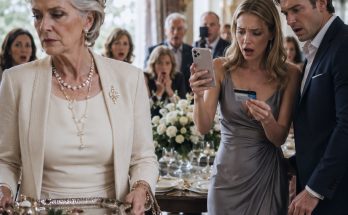
“She’s Just A Guest. The Coward Who Abandoned Her Squad,” My Dad Mocked As He Introduced Me To My Sister’s Fiancé—A SEAL Commander. They All Chuckled. The SEAL Commander Politely Shook My Hand… Until He Saw The Scar On My Wrist. He Froze In Shock And Stuttered, “Ma’am… Are You… The ‘Black Panther’ Of The Marine Corps?”
### Part 1
“She’s just a guest.”
My father said it with one hand on the back of my younger sister’s chair and the other wrapped around a glass of bourbon he had not paid for. The country club ballroom was full of gold light, white tablecloths, crystal water glasses, and women in pastel dresses who all turned at the exact same time.
I stood near the gift table with a wrapped stand mixer in my arms, still smelling faintly of rain from the parking lot.
Not his daughter.
Not “my oldest.”
Not even “this is Sloane.”
Just a guest.
Then he added, louder, because Grant Mercer never wasted a chance to make sure humiliation reached the back of the room, “The one who walked away from the family when things got hard.”
A few people laughed.
It was the polite kind of laugh rich people use when they are not sure whether cruelty is supposed to be a joke. Silver forks paused over crab cakes. A woman in pearls gave me a quick pitying glance, then looked away like sympathy might stain her dress.
My sister, Livia, froze beside her fiancé.
Her engagement party was beautiful. That was the first thing I noticed when I walked in. White roses climbed the columns. A string quartet played near the balcony doors. The whole room smelled like lemon polish, champagne, and those expensive candles that try to pretend they are not candles.
I had almost not come.
For six years, I had lived forty miles away in a small blue house with a stubborn front gate, a coffee maker that whistled when it brewed, and a job that let me sleep at night most of the time. I managed emergency preparedness for Briar Ridge Regional Hospital. Fire drills, evacuation maps, backup generators, winter storm plans, staff training. Quiet work. Useful work.
The kind of work my father called “hiding.”
Livia had called me three weeks earlier while I was standing in aisle nine of a grocery store, comparing canned soup prices.
“Sloane, please come,” she had said. “I know Dad makes everything weird, but I want you there.”
I had stared at a dented can of chicken noodle soup and listened to the hum of the fluorescent lights above me.
“Liv, he doesn’t want me there.”
“I do.”
That was why I came.
I wore a dark green dress from a consignment shop and the only heels I could stand longer than an hour. I pinned my hair low at the back of my neck. I brought a gift because manners mattered even when people did not.
And for the first twelve minutes, I thought maybe the night might pass without damage.
Then my father saw me.
He looked older than I remembered, but not softer. His silver hair was combed neatly back. His cuff links flashed every time he lifted his drink. His mouth still had that same sharp bend, like he was always halfway through correcting someone.
“Sloane,” he said.
“Dad.”
No hug. No touch on the shoulder. No, “You look nice.” Nothing.
Then he turned to a cluster of guests and made me smaller in one sentence.
Livia’s face went pale. “Dad.”
“What?” he said, smiling. “She is a guest.”
I set the wrapped gift carefully on the table so my hands would not shake. The ribbon slid under my fingers, smooth and silver. My right sleeve shifted just enough to reveal the faded scar along the inside of my wrist.
I pulled the sleeve down.
Old habit.
“Enjoy your evening,” I said.
My father laughed under his breath. “Always so dramatic.”
I walked toward the bar and asked for water with lime. The bartender gave me the look service workers give people they have seen get publicly crushed. Kind, quiet, careful.
“Rough night?” he asked.
“Family event,” I said.
He nodded like that explained everything.
Across the ballroom, Livia stood beside her fiancé, gripping his arm. I had seen pictures of him on her phone but had not met him in person. Commander Callum Voss. Navy SEAL. Late thirties. Calm eyes. Straight posture. The kind of man who noticed exits without looking like he was looking.
Livia had described him as “steady.”
My father had described him as “finally, someone in this family with discipline.”
That line had made me laugh into my coffee when Livia told me.
Callum spotted me by the bar and said something to my sister. Livia nodded quickly, almost gratefully, and they crossed the room together.
“Sloane,” she said, her voice soft. “I want you to meet Callum.”
He smiled warmly and held out his hand.
“Commander Callum Voss,” he said. “It’s an honor to meet you.”
I gave him my hand. “Sloane Mercer. Congratulations.”
His grip was firm, respectful, ordinary.
Then his eyes dropped to my wrist.
The scar was barely visible anymore, a pale line crossing the skin just below my palm. Most people never noticed it. The ones who did usually assumed kitchen accident, old glass cut, maybe a fall.
Callum noticed.
His smile disappeared so fast it felt like the room lost heat.
He did not let go of my hand. He looked from the scar to my face, then back again. Something changed in his posture. Not fear. Not exactly shock.
Recognition.
The quartet kept playing. Glasses clinked. Someone laughed near the dessert table.
Callum’s voice dropped until only Livia and I could hear him.
“Ma’am,” he said carefully, “were you ever assigned to Task Unit Raven?”
My stomach tightened.
I had not heard those words in years.
Livia blinked. “Task what?”
I held Callum’s gaze.
For one second, I considered lying.
Then I nodded once.
“Yes.”
Callum released my hand like he had realized he was still holding it. His face went pale beneath the ballroom lights.
Then, in front of my sister, my father, and every guest who had laughed at me five minutes earlier, a Navy SEAL commander straightened to full attention.
And I knew the quiet life I had built was about to crack open.
### Part 2
“Callum?” Livia whispered.
He did not answer her right away.
His eyes stayed on me, not staring at the scar anymore but searching my face as if he were comparing the woman in front of him to a story he had carried for years.
“Ma’am,” he said again, lower this time. “I apologize. I didn’t know.”
“There’s nothing to apologize for.”
My mouth felt dry. The lime in my water had left a bitter taste on my tongue.
My father drifted closer, drawn by silence the way some men are drawn by applause. He had always hated any conversation that did not include him.
“What is this?” he asked. “Some military inside joke?”
Callum turned toward him with the kind of restraint that made the air tighten.
“No, sir.”
“Then why are you standing like that?”
Livia looked between us. “Sloane, do you know Callum?”
“No,” I said. “Not personally.”
Callum’s jaw shifted. “But I know of her.”
That sentence spread through the nearby guests faster than a spilled drink. People turned. Conversations thinned. A man near the shrimp tower lowered his plate.
My father gave a short laugh. “You know of Sloane?”
“Yes, sir.”
“From where? She was never exactly public-facing.”
I felt the old heat rise behind my ribs, the one that came from being talked about like a failed investment.
“Grant,” my mother murmured from behind him.
My mother, Maribel, had been sitting with two of her book club friends at the table closest to the windows. She wore a pale blue dress and a necklace my father had given her after a fight. She had perfected the art of looking helpless while doing nothing.
“What?” Dad said. “I’m asking a question.”
Callum did not look at me this time. He looked at my father.
“Your daughter’s name was used in training more than once.”
The ballroom grew quieter.
My father’s smile flattened. “Training for what?”
“Leadership under pressure,” Callum said.
I closed my eyes for half a second.
Not here.
Not beside the champagne fountain. Not with Livia’s engagement cake waiting beneath a glass dome. Not with my mother twisting her napkin and my father already preparing to defend an opinion he had built without facts.
“Callum,” I said.
He heard the warning. He nodded once. “Understood.”
But the damage had begun.
My cousin Bram, who had once told a Thanksgiving table that “military women always exaggerate,” leaned toward his wife and whispered too loudly, “I thought she quit before anything serious.”
My father heard it and seized it like a rope.
“She did,” he said. “That is what I was trying to explain. Sloane had opportunity. Real opportunity. Then one day she walked away. No explanation. No ceremony. No pride. She came back different and expected everyone to pretend it was noble.”
Livia flinched.
I looked at the condensation sliding down my water glass. There were tiny scratches on the bar top. Someone had carved initials into the underside where only people sitting alone would see.
“I didn’t expect anything,” I said.
Dad laughed. “That was always your specialty. Saying nothing, then acting wounded when people filled in the blanks.”
The sentence landed too close to old truth.
I had said nothing.
For years.
When I came home after my last deployment, I did not bring stories. I brought two duffel bags, a tremor in my left hand that showed up when I was tired, and a habit of standing with my back near walls. I stayed in the guest room for sixteen days. My father asked no real questions. He only asked what came next.
“Promotion track?”
“Defense consulting?”
“Public speaking?”
“Something useful?”
When I said I was leaving active service and wanted quiet work, he looked at me like I had sold the family name for gas money.
“You quit,” he said then.
And kept saying it for six years.
Callum’s voice cut through the memory.
“Sir, with respect, that is not the version I was taught.”
My father’s face reddened. “Taught? You don’t know my daughter.”
“No,” Callum said. “But I know what people said when her name came up.”
A woman in pearls leaned forward. “What did they say?”
I gave her a look. She sat back.
Livia stepped closer to me. “Sloane, what is he talking about?”
“Old work,” I said. “Nothing that belongs at your engagement party.”
“Apparently it does,” Dad snapped. “Because your fiancé seems to think he knows more about my family than I do.”
Callum’s expression did not change, but something in him hardened.
“Sir, I don’t know your family. I know what happens when people mistake silence for emptiness.”
The room went still.
My father stared at him. “Excuse me?”
I touched Livia’s arm. “I’m going to step outside.”
“No,” she said quickly. “Please don’t leave.”
“I just need air.”
I turned toward the balcony doors, but my father spoke behind me.
“There she goes. Same as always.”
I stopped.
The quartet faltered. One violin note scratched too sharp.
Dad took a step forward, fueled by the audience. “Everyone sees it now, don’t they? The second things get uncomfortable, Sloane walks away.”
Callum’s voice came quiet and cold.
“Sir, I would be very careful with that sentence.”
My father turned on him. “Why?”
Callum looked at me, silently asking permission.
I should have said no.
Instead, I stood in that ballroom with the lime bitterness still on my tongue and the scar on my wrist uncovered, and I was suddenly too tired to keep protecting a lie I had never told.
“Because,” Callum said, “the last thing your daughter is known for is walking away.”
### Part 3
Nobody moved.
Even the waiters seemed to freeze between tables, silver trays balanced in white-gloved hands. Outside the windows, the country club lawn glowed under floodlights. Rain tapped softly against the glass, steady and polite, as if the weather had better manners than my family.
My father looked amused at first.
Then he saw Callum’s face.
“What exactly are you implying?” Dad asked.
Callum did not raise his voice. That made it worse.
“I’m not implying anything, sir.”
“Then say it.”
“Not without Sloane’s permission.”
Every eye turned to me.
That was the part I hated most. Not the insults. Not the laughter. Attention. The weight of strangers wanting a story with enough shine to justify their curiosity.
I thought about leaving again.
Then I saw my sister.
Livia stood with one hand pressed against her stomach, her engagement ring catching the light in nervous flashes. She had spent years trying to keep both sides of the family from splitting apart completely. She sent birthday texts. She invited me to coffee. She apologized for Dad in small, embarrassed bursts.
But she had never really defended me.
Maybe because I had never given her the tools.
Maybe because she had never tried hard enough to ask.
Both could be true.
I set my water glass on the bar. “You can say what is public record.”
Callum held my gaze. “Only that?”
“Only that.”
He nodded.
My father scoffed. “Public record? This is absurd.”
Callum turned to the room, not performing, not grandstanding, simply making sure his words could not be twisted.
“Years ago, during a joint emergency support assignment, Sloane Mercer was attached to a task unit that operated under extreme pressure. Details are limited and should remain that way. What is not limited is the leadership evaluation that came out afterward.”
My mother whispered, “Leadership evaluation?”
Callum continued. “Her name was cited because she maintained command discipline during a failure cascade that could have cost many more lives.”
The words were clean and official. They left out the smell of burning plastic. The alarms. The taste of dust. The cold metal under my palm when I crawled through a service corridor because the main passage had jammed shut. They left out the voice on the radio that kept cutting in and out.
They left out a lot.
My father looked irritated, not convinced. “That sounds very impressive in a vague way.”
A few guests shifted uncomfortably.
Callum’s eyes narrowed just enough. “Sir, vagueness is called discretion.”
My cousin Bram muttered, “Convenient.”
I almost smiled. There was always one man at every family function who thought confidential meant fake.
Callum heard him. So did Dad.
Dad lifted his chin. “No one is questioning discretion. But I know what I saw. My daughter came home and refused to speak about anything. She avoided ceremonies. She ignored calls from people who wanted to help her. She hid in that little house and took a hospital job planning fire drills.”
“Emergency preparedness,” I said.
“What?”
“My job is emergency preparedness.”
He waved his hand. “Same thing.”
That stung more than I wanted it to.
Because I loved my work. I loved checking generator logs before blizzards. I loved making sure the pediatric wing had evacuation sleds that were not expired. I loved training nurses how to move patients when elevators failed. I loved knowing that if something bad happened, fewer people would suffer because somebody had cared about the boring details.
My father did not see service unless it came with a uniform people admired.
Callum did.
He looked at me, then back at Dad.
“That job probably fits her exactly.”
Dad gave him a sharp look. “You don’t know that.”
“I know enough.”
“Do you?”
The room held its breath.
Dad pointed at me with his glass. “Ask her why she didn’t attend the commendation dinner they invited her to. Ask her why she sent back the plaque. Ask her why she would not let us put one photograph of her in uniform on the wall. Ask her why she acted ashamed.”
The old accusation finally came into full view.
Ashamed.
That was what he had decided.
Not hurt. Not tired. Not done. Ashamed.
I looked at my mother. “You told him that?”
She stared at her napkin.
Of course she had.
Years ago, I had told her one thing, late at night in the kitchen while Dad slept upstairs. I had stood barefoot on cold tile, unable to hold a mug steady, and said, “I don’t want to be displayed like proof that this family produced something valuable.”
My mother had touched my cheek and said, “I understand.”
Then she had translated it into something easier for my father to resent.
Callum said, “She wasn’t ashamed.”
My voice came before I could stop it.
“No. I was grieving.”
The word hit the floor harder than a dropped plate.
Livia covered her mouth.
My father’s expression flickered.
I had not planned to say that. I had not planned to give the room anything real. But once the word left me, I could not pull it back.
“I didn’t walk away because I was embarrassed,” I said. “I walked away because I had spent years being useful in places where useful meant staying calm while people around me broke. And when I came home, I wanted to be a person, not a trophy in your hallway.”
Dad stared at me.
For once, he had no immediate answer.
Then Callum reached slowly into the inside pocket of his suit jacket.
He pulled out a small, worn challenge coin.
Dark metal. Raven etched on one side. A thin silver edge.
My breath caught.
I knew that coin.
I had carried one like it for years, hidden in a wooden box under winter gloves and old tax returns.
Callum held it carefully, like it meant something.
“This was given to me by my first team chief,” he said. “He told me it belonged to the kind of story young officers should listen to before they ever tried to lead.”
He turned the coin over.
On the back were two words.
Hold steady.
Livia whispered, “Sloane?”
I stepped back from the bar.
Because suddenly, I knew exactly which story Callum had been taught.
And I knew whose life had carried it forward.
### Part 4
The challenge coin looked smaller than I remembered.
Memory had made it heavier.
My father’s eyes moved from the coin to me. “What is that?”
“A reminder,” Callum said.
“Of what?”
Callum’s fingers closed around it. “That calm is not the same thing as weakness.”
The room was silent enough for me to hear the ice settling in my glass.
I said, “Who gave you that?”
“My team chief. Marcus Bell.”
The name struck me in the chest.
For a second, the ballroom dissolved. I was not standing under chandeliers anymore. I was sitting on a folding chair outside a rehab room, smelling antiseptic and burnt coffee, watching a young man with bandaged hands pretend he was not afraid of what came next.
Marcus Bell had been twenty-seven when I met him.
Funny. Loud. Always chewing cinnamon gum. He called everyone “boss” when he disagreed with them. During the worst thirty-six hours of that assignment, his voice had been one of the few that stayed steady over the radio.
He survived.
Not everyone did.
I swallowed carefully. “How is Marcus?”
Callum’s expression softened. “Retired. Married. Three kids. He runs a youth sailing program in Maine.”
I let out a breath I had not realized I was holding.
“Good.”
My father looked lost, and I hated that a small part of me was satisfied by it.
All those years he had talked like he owned the story of my life. Now he stood inside a chapter he had never bothered to read.
Livia moved closer. “You know his mentor?”
“I knew him a long time ago.”
Callum smiled faintly. “He talks about you like you walked out of a storm carrying the weather on your back.”
A few guests made soft sounds. My mother pressed her fingers to her lips.
I shook my head. “Marcus always exaggerated.”
“No,” Callum said. “He edited.”
That was when my father finally lost patience.
“Enough,” he snapped.
The word cracked across the ballroom.
Livia jumped. Her fiancé turned toward him slowly.
Dad set his glass on a cocktail table hard enough that bourbon sloshed over the rim. “This is my daughter’s engagement party. Not some military reunion. Not a chance for Sloane to rewrite history in front of strangers.”
I almost laughed.
“Rewrite history?”
He pointed at me. “Yes. Because I remember who sat across from me at breakfast and said she was done. I remember who would not answer when I asked what happened. I remember who left this family to explain her failure while she played mysterious and wounded.”
“Grant,” my mother whispered.
“No, Maribel. I’m tired of being made the villain because I expected my child to finish what she started.”
The old room inside me opened.
The breakfast table. The smell of toast burning because my mother forgot it in the toaster. My father in his robe, reading an article about military promotions on his tablet, not looking at the dark circles under my eyes.
“So what now?” he had asked.
“I submitted my separation paperwork.”
He lowered the tablet.
“You what?”
“I am done.”
“Done? People like you do not get done. They advance.”
“I can’t.”
“You mean you won’t.”
I remembered touching my wrist under the table, pressing my thumb into the scar until the skin hurt.
“I won’t,” I said then, because it was easier to let him believe stubbornness than explain the truth to a man who only respected wounds if they came with ceremony.
In the ballroom, Dad’s face was red now.
“You had every chance,” he said. “You threw it away.”
Callum stepped forward, but I raised one hand.
“No,” I said. “Let him finish.”
Dad blinked.
The room shifted. He expected me to fold, leave, swallow it like always.
I did not.
“Go ahead,” I said. “Say all of it. Say what you have been saying behind my back for six years.”
His mouth tightened. “Fine. You embarrassed me.”
There it was.
Not “you worried me.”
Not “you scared me.”
Not “you changed and I didn’t know how to help.”
You embarrassed me.
Livia’s eyes filled with tears.
My mother looked down.
Dad continued, quieter but harsher. “People asked about you. They asked what you were doing next. I had nothing to say except that my brilliant daughter had decided to become a hospital safety clerk.”
A sound went through the guests. Not loud. Worse. Disgusted.
I felt my heartbeat in my wrist.
“Emergency preparedness,” I said again.
Dad ignored it. “Do you know what that felt like?”
“Yes,” I said. “I know exactly what it feels like to have your life reduced to one sentence by someone who does not understand it.”
He recoiled slightly.
Callum’s voice came low. “Mr. Mercer, I would stop.”
Dad turned on him. “You are marrying my younger daughter, Commander. That does not give you permission to lecture me.”
“No,” Callum said. “But basic decency does.”
Livia whispered, “Dad, please.”
But Dad was trapped now. Pride had taken the wheel.
He looked at the guests. “Everyone is acting like I insulted a saint. You know what Sloane did after leaving? She cut off the family. Missed holidays. Ignored calls. Didn’t even come when I had surgery.”
I turned cold.
That was not a red herring. That was a lie with teeth.
“You told me not to come,” I said.
He froze.
My mother closed her eyes.
Livia looked from him to me. “What?”
I reached into my small clutch and pulled out my phone. My fingers were steady now. That almost scared me more than shaking would have.
“Dad had surgery three years ago,” I said. “I drove two hours to the hospital after a twelve-hour shift. Mom met me in the parking garage.”
My mother’s face crumpled.
I looked at her. “She said Dad didn’t want stress. She said seeing me would upset him. She told me to go home.”
Livia turned slowly toward our mother. “You did what?”
Maribel whispered, “I thought it was better.”
“For who?” Livia asked.
My phone lit up in my hand. The old text thread was still there because I never deleted anything important.
I read the message aloud.
“Mom, I’m in the parking garage. Are you sure he doesn’t want me upstairs?”
Then my mother’s reply.
“Please don’t make this harder. Your father needs peace. Go home, Sloane.”
The room seemed to tilt.
My father stared at my mother. “You told her that?”
She began to cry. Quiet, pretty tears. The kind that had saved her from consequences for decades.
“I was trying to protect everyone,” she said.
I put the phone away.
“No,” I said. “You were protecting the version of the family where I stayed useful as a disappointment.”
### Part 5
Livia took one step back from our parents.
It was small, but I saw it. So did my father.
“Liv,” he said sharply.
She did not answer him. Her eyes were on our mother.
“You let me think she didn’t care,” Livia whispered. “You both did.”
Dad’s mouth opened. Closed. Opened again.
For the first time that evening, he looked less like a judge and more like a man watching furniture move by itself in the dark.
“I didn’t know about the parking garage,” he said.
I believed him.
That did not make him innocent.
“You didn’t ask,” I said.
A woman near the cake murmured, “Oh my God.”
Bram’s wife elbowed him when he tried to whisper again.
Callum stayed beside Livia, but his attention remained on me. Not protective in a possessive way. Just present. Ready if the room turned ugly, but wise enough not to take over a fight that belonged to me.
That was leadership too.
Knowing when not to step in.
My father rubbed a hand over his face. “Sloane, I—”
“No,” I said. “Not yet.”
His hand dropped.
“I have listened to you for six years. At Thanksgiving. At Grandma Celine’s memorial. At Livia’s graduation dinner. In text messages. Through relatives. Through Mom. Through little comments you dressed up as jokes.”
The words came out calm.
That was the strange part. I had imagined this conversation before, usually in the shower or while driving home after bad shifts. In those versions, I screamed. I cried. I slammed doors.
In real life, I stood under soft gold lights with rain tapping the windows and spoke like I was reviewing an emergency plan.
“Tonight you introduced me as just a guest,” I said. “Before that, you told people I walked away from the family. Before that, you told them I threw away my future. You let them believe I was cold, ungrateful, cowardly, ashamed.”
Dad flinched at the last word.
“You never asked why I left. You never asked what I carried. You never asked what kind of life I was trying to build. You only asked how my choices reflected on you.”
The ballroom doors opened, and a late guest stepped in, laughing with an umbrella in one hand. He noticed the silence, slowed, and backed toward the wall.
No one laughed now.
Livia wiped under her eyes. “Sloane, why didn’t you tell me?”
I looked at her.
That question hurt more than Dad’s insults.
“Because you always wanted peace more than truth.”
She inhaled sharply.
I regretted the pain in her face but not the sentence.
“When Dad made comments, you squeezed my hand under the table. When Mom lied, you looked uncomfortable. When relatives joked, you texted me later saying you were sorry.” I swallowed. “But you never stopped them in the moment.”
Her tears spilled over.
“I was scared,” she said.
“I know.”
“I thought if I pushed him, he would turn on me too.”
“I know that too.”
The chandelier light trembled in her diamond ring.
“But I needed a sister,” I said. “Not a witness.”
That broke something open in her. She covered her mouth and turned away, shoulders shaking.
Callum placed one hand gently at the center of her back. He did not speak.
My mother reached for a chair as if her legs had weakened. “Sloane, I did not know you felt abandoned.”
I looked at her. “You handed me the map.”
Her tears stopped.
That was the difference between sadness and exposure.
I turned back to Callum. “You said Marcus is in Maine?”
“Yes, ma’am.”
“Please stop calling me ma’am.”
A tiny smile touched his mouth. “Yes, Sloane.”
My father looked at the coin in Callum’s hand. “What happened back then?”
The question came too late. Six years too late. Maybe longer.
I studied him. His face had changed. The anger had drained, leaving confusion and something like fear. He wanted the answer now because the room demanded it. Because his authority had slipped. Because my silence was no longer convenient.
“You don’t get the full story because an audience finally made you curious,” I said.
His eyes widened.
Callum looked down, and I could tell he respected the line.
Dad’s voice softened. “I’m your father.”
“Tonight, you called me a guest.”
A flush crept up his neck.
“That was wrong,” he said.
“Yes.”
“I was angry.”
“Yes.”
“I didn’t know.”
“You chose not to know.”
The sentence hung between us.
A plate clattered somewhere near the buffet. Someone whispered an apology. The rain got harder, drumming against the windows now.
Then Callum spoke.
“Mr. Mercer, there is one thing I can say without crossing any line.”
Dad looked at him like a drowning man spotting a dock.
Callum turned the challenge coin in his hand. “Every person who spoke about Sloane spoke with respect. Not casual respect. Not polite respect. The kind people reserve for someone they would follow into uncertainty because she had already proven she would not spend them cheaply.”
My throat tightened.
Callum’s voice remained steady. “That is not a person who ran from duty.”
Dad looked at me.
But I was not watching him anymore.
I was watching Livia.
She had taken off her engagement ring.
Not thrown it. Not dramatically. She simply slid it from her finger and held it in her palm while staring at Callum.
The entire room saw.
Callum went still. “Liv?”
She wiped her face. “I love you.”
“I love you too.”
“But I can’t marry into a life built on pretending things are fine just because everyone is dressed nicely.”
His face softened with understanding, not panic.
Livia turned toward our parents.
“This party is over.”
My father’s mouth fell open.
“Livia,” my mother gasped.
“No,” my sister said, voice shaking but clear. “For once, no.”
And in that moment, I realized the truth had not only exposed what my father did to me.
It had reached into my sister’s future and pulled a hidden wire loose.
### Part 6
Nobody knew what to do with a canceled engagement party.
That was the strange, almost funny part.
Guests who had been hungry for drama now looked terrified of being seen enjoying it. The country club coordinator appeared near the kitchen doors with a clipboard pressed to her chest. The string quartet packed their instruments quietly, one bow at a time. A waiter began collecting untouched plates of beef tenderloin as if cleaning could make the room normal again.
Livia stood near the cake with her ring still in her hand.
Callum stayed beside her.
He did not look offended. He looked heartbroken and proud at the same time.
“Are you ending us?” he asked quietly.
Livia shook her head. “No. I am ending this.”
She gestured around the ballroom. The flowers. The champagne. The family tables organized like alliances. My parents near the center of it all, stunned that a production they controlled had gone off-script.
“I don’t want a wedding where Dad gives a speech about family honor,” Livia said. “I don’t want Mom crying in the front row like she hasn’t spent years rearranging the truth. I don’t want Sloane invited as decoration so everyone can pretend we’re whole.”
Callum nodded slowly. “Then we don’t have that wedding.”
Dad snapped back to life. “You are embarrassing yourself.”
Livia laughed once. It sounded painful. “No, Dad. I’m finally joining the family tradition.”
My mother whispered, “Please don’t do this here.”
Livia turned on her. “Where should I do it, Mom? In a parking garage? By text?”
Maribel recoiled as if slapped by the memory.
I did not feel victory.
I felt tired.
The kind of tired that settles in bone after years of carrying something too carefully.
Guests began leaving in clusters. Some hugged Livia. Some avoided my eyes. Bram and his wife slipped out without saying goodbye, which was probably the most generous thing they had done all night.
My father stood near the bar, staring into the middle distance.
For a while, no one spoke to him.
That may have hurt him more than anything said aloud.
I walked out to the covered terrace. Rain fell beyond the stone railing in silver sheets. The golf course looked ghostly under the lights, all rolling hills and black trees. The air smelled like wet grass and expensive cigars.
I gripped the railing and finally let my shoulders drop.
The door opened behind me.
I expected Livia.
It was Callum.
He stayed several feet away. “I can leave if you want privacy.”
“No. You’re fine.”
He joined me at the railing, the challenge coin resting in his open palm.
“I should have asked before saying anything,” he said.
“You did.”
“Not soon enough.”
I looked at him. “You stopped when I told you to.”
“Still.”
Rainwater ran down the stone in thin streams.
“You didn’t expose me,” I said. “You exposed the lie.”
He took that in.
Then he held out the coin.
“I think this belongs closer to you than to me tonight.”
I did not take it.
“No. Marcus gave that to you.”
“He gave it to me because of you.”
“Then carry it well.”
Callum closed his fingers around it.
A small smile passed between us.
After a while, he said, “Livia loves you.”
“I know.”
“She’s ashamed.”
“She should be.”
He did not argue. That made me like him.
Inside the ballroom, through the glass, I saw my sister speaking with our parents. Her arms were folded. Her face was pale, but she was not backing away. My mother kept reaching for her hand. Livia kept stepping out of reach.
Dad spotted me through the window.
For a moment, we looked at each other through rain-speckled glass.
Then he came outside.
Callum straightened, but I shook my head.
Dad stopped a few feet away. Rain mist dotted the shoulders of his suit.
“Sloane,” he said.
I waited.
He looked smaller out here without the room behind him.
“I was wrong.”
The words sounded rusty.
I said nothing.
He swallowed. “I should not have introduced you that way.”
“No.”
“I should not have said those things.”
“No.”
His eyes glistened. “I thought if I admitted I didn’t understand your life, it meant I had failed as a father.”
I looked at him. “You did fail as a father.”
He flinched hard.
The old Sloane would have softened the sentence. Added, “But.” Made it easier for him to survive.
I did not.
Dad’s voice dropped. “Is there any way to fix it?”
The rain filled the silence.
Behind him, through the glass, I saw Livia watching.
My mother too.
Guests lingering near the doors pretended not to.
I turned back to my father.
“You want a repair plan because you think damage is uncomfortable,” I said. “I have spent six years living inside the damage.”
He wiped his mouth with one hand.
“I don’t know what to do,” he admitted.
That was probably the most honest thing he had ever said to me.
I believed it.
But belief was not the same as forgiveness.
“Start by not asking the person you hurt to teach you how to feel innocent again,” I said.
His face crumpled.
I stepped away from the railing.
“I am going home.”
“Sloane, please.”
There it was again. The word people use when they arrive late and want the door held open anyway.
Please.
I paused with my hand on the terrace door.
“I came tonight because Livia asked me to,” I said. “Not because I was ready to be your daughter again.”
His eyes filled.
“And after what happened tonight?” he asked.
I looked at him for a long second.
“After what happened tonight, I’m even less ready.”
### Part 7
I drove home in the rain with my heels on the passenger floor and my phone buzzing in the cup holder.
Livia called first.
Then my mother.
Then an unknown number I guessed belonged to a relative who suddenly remembered I existed.
I let every call go to voicemail.
The highway shimmered under my headlights. Trucks hissed past in the right lane. My green dress felt too tight around my ribs. I kept one hand on the wheel and one resting near my wrist, thumb brushing the scar.
When I reached my little blue house, the rain had slowed to a mist.
The porch light flickered twice before staying on. I had been meaning to replace the bulb for a week. My neighbor’s dog barked once, recognized my car, then gave up.
Inside, everything was exactly as I had left it.
Mug in the sink. Hospital binder on the kitchen table. A half-read paperback facedown on the couch. My ordinary life waiting patiently, asking for nothing dramatic.
I changed into sweatpants, washed my face, and stood barefoot in the kitchen while the kettle boiled.
Only then did I listen to the voicemails.
My mother’s was first.
“Sloane, honey, tonight got very emotional. I think everyone said things they didn’t mean. Your father is devastated. Livia is confused. Please don’t punish the whole family over one bad evening.”
I deleted it.
Not because I hated her.
Because I recognized the shape of the trap.
One bad evening.
Families like mine loved shrinking patterns into incidents. A lifetime of cuts became a misunderstanding. Years of silence became “distance.” Public cruelty became “emotion.”
The next voicemail was Dad.
He sounded old.
“I don’t know what to say except I’m sorry. I have been sitting in the car for twenty minutes because your mother is crying and Livia won’t speak to me. I keep thinking about what Commander Voss said. I keep thinking about that coin. I keep thinking maybe I didn’t know you at all.”
A long pause.
“Call me when you can.”
I did not delete it.
I did not call either.
Livia’s voicemail came last.
“Sloane, I don’t deserve an answer tonight. I know that. I just need you to know Callum and I are okay. We’re not ending the engagement, but we’re canceling the wedding plan. We’re going to do counseling before we set another date. I should have defended you years ago. I didn’t because I was scared. That doesn’t excuse it. I love you. I’m sorry.”
I sat at the kitchen table until the tea went cold.
At 6:10 the next morning, my hospital phone rang.
A water main had broken near the west entrance. The emergency department was still functioning, but facilities needed an alternate flow plan before morning surgeries backed up. Real life has a rude way of continuing.
By 7:00, I was in jeans, boots, and a hospital fleece, walking through a corridor that smelled like bleach and coffee while a maintenance supervisor named Niko showed me a damp ceiling tile.
“Could be worse,” he said.
“It can always be worse,” I replied. “That’s why we plan.”
For the next nine hours, nobody cared about my father’s apology or Task Unit Raven. They cared about water pressure, patient transport, portable handwashing stations, and whether the outpatient entrance had enough signage. Nurses shouted updates. Security moved traffic cones. A surgeon complained about a delayed room, then apologized when he saw environmental services hauling buckets.
I loved all of it.
Not the crisis. The usefulness.
At 4:30, while I was labeling temporary access routes with blue tape, my assistant, Priya, appeared with a strange look on her face.
“There are people in the lobby asking for you.”
“Patients?”
“No.”
“Vendors?”
“No.”
She hesitated. “Family.”
I closed my eyes.
When I reached the lobby, my father stood near the information desk holding a bouquet of white lilies. My mother was beside him, wearing sunglasses indoors. Livia stood several feet away from both of them.
Callum was not there.
Good.
Dad looked at the hospital fleece, the radio clipped to my shoulder, the ID badge at my chest. For once, he seemed to understand that he had walked into my world, not the other way around.
“Sloane,” he said. “Can we talk?”
I looked at the lilies.
My wrist scar prickled under my sleeve.
“No,” I said.
His face fell. “Just five minutes.”
“I’m working.”
“We can wait.”
“Please don’t.”
My mother removed her sunglasses. Her eyes were red, but her voice had that careful softness again. “Honey, your father came all this way.”
I looked at her.
“Mom, I drove to his hospital three years ago. You sent me home from the parking garage.”
Her mouth shut.
The receptionist suddenly became fascinated by her keyboard.
Dad lowered the flowers. “I deserved that.”
“This is not about what you deserve,” I said. “This is my workplace. You don’t get to bring a family performance into it because the country club version failed.”
Livia’s eyes met mine. She nodded once, like she understood.
Dad glanced around at the busy lobby, at patients in wheelchairs, at staff moving with purpose.
“I wanted to see what you do,” he said quietly.
I felt something sharp and sad move through me.
Six years ago, that sentence would have meant everything.
Today, it arrived like a package sent to the wrong address.
“You can read the hospital website,” I said.
He swallowed.
I turned to Livia. “You can call me later. Alone.”
She nodded again. “I will.”
My father took one step forward. “Sloane, please. I am trying.”
I looked at the lilies in his hand. Funeral flowers. Apology flowers. Flowers men buy when they want beauty to do language for them.
“I believe you,” I said.
Hope flashed in his face.
Then I finished.
“But your trying does not obligate me to receive you.”
The hope vanished.
I walked back through the double doors before he could answer.
Behind me, I heard my radio crackle.
“Preparedness, can you advise on south stairwell traffic?”
I lifted it to my mouth.
“On my way.”
And for the first time in years, leaving my father behind did not feel like running.
It felt like choosing the emergency that was actually mine.
### Part 8
Livia called me two nights later from her car.
I could hear traffic moving around her and the soft click of her turn signal.
“I’m parked outside your house,” she said.
I looked through the front window.
Her white sedan sat under the maple tree, headlights off, windshield reflecting the porch light.
“You could have knocked,” I said.
“I didn’t want to assume I was welcome.”
That sentence did more than any apology she had offered so far.
I opened the door.
She came in wearing leggings, a college sweatshirt, and no makeup. Her hair was in a messy knot. She looked less like the glowing bride from the ballroom and more like the little sister who used to crawl into my bed during thunderstorms.
I made coffee even though it was too late for coffee.
We sat at my kitchen table with the chipped blue edge, the one my father had once called “depressing.”
Livia wrapped both hands around her mug.
“Callum told me more,” she said. “Not details. Just what he could. He said people like you don’t talk because the truth isn’t entertainment.”
I stared into my coffee.
“He’s a good man.”
“He is.”
“Don’t punish him for my family.”
She shook her head. “I’m not. He and I had the first honest conversation we’ve ever had because of you.”
“Because of what happened.”
“Because you stopped letting us stand behind not knowing.”
That was fair.
She took a breath. “I canceled the country club contract.”
“Expensive?”
“Very.”
“Good.”
She laughed through her nose, then started crying.
I handed her a napkin.
She wiped her face. “Dad is a mess.”
“I assumed.”
“Mom is worse.”
“I also assumed.”
“They want a family dinner.”
“No.”
“I told them that.”
I looked at her.
She sat up straighter. “I told them they don’t get to ask you for healing on their schedule. I told Mom she needs to apologize without crying first. I told Dad that calling you a guest might be the most honest thing he has said, because he has treated you like someone outside the family for years.”
I felt my throat tighten.
“Thank you.”
“I should have said it sooner.”
“Yes.”
She nodded, accepting it. “I know.”
That was the beginning of something. Not repair. Not yet. Maybe not ever in the way she wanted. But something clean.
Three weeks passed.
My father sent one letter. Not a text. Not a voicemail. A letter on thick cream paper because Grant Mercer could not apologize without stationery.
I almost threw it away.
Then I opened it over the trash can like a coward and read it twice.
He did not ask for dinner.
He did not ask me to call.
He wrote about the night I came home from military service and how he remembered being angry that I would not discuss promotions. He admitted he had liked the idea of my success more than he had cared about my peace. He said he had turned my silence into an insult because it was easier than admitting he had no idea how to reach me.
Then he wrote the only line that mattered.
“I am sorry I made you earn a place in a family where you should have belonged without performance.”
I folded the letter and put it in a drawer.
I did not answer.
Some apologies deserve to be received.
That does not mean they deserve immediate access.
Two months later, Livia and Callum got married in a small ceremony at a public garden near the river. No country club. No champagne tower. No guest list built like a business strategy.
There were thirty-two chairs, white folding ones that sank slightly into the grass. The aisle was lined with wildflowers in mason jars. The air smelled like cut grass and river water. A little girl in a yellow dress dropped petals too early and then looked proud of herself anyway.
My father was invited as a guest.
He did not walk Livia down the aisle.
She walked herself halfway.
Then she stopped beside me.
I had not known she planned it.
She held out her hand.
For a second, I saw her at eight years old with scraped knees and a popsicle-stained mouth. Then I saw her in the ballroom, silent while Dad made me small. Then I saw her in my kitchen, learning how not to ask for forgiveness like it was a coupon.
I stood and took her hand.
We walked the rest of the aisle together.
My father watched from the second row, tears running down his face. My mother sat beside him, stiff and quiet, a tissue folded untouched in her lap.
At the front, Callum looked at Livia like she had brought the sunrise with her.
During the vows, he promised not to confuse peace with silence.
Livia promised not to confuse loyalty with obedience.
I stared at the river until my eyes stopped burning.
At the reception, which was really just lunch under a white tent, my father approached me with two glasses of lemonade.
He held one out.
I took it.
“Thank you,” I said.
He looked startled by the politeness.
For a while, we stood watching Livia dance barefoot with Callum on the grass.
Dad cleared his throat. “You looked happy walking with her.”
“I was.”
“I am glad she had you.”
“So am I.”
He nodded slowly. His fingers tightened around his glass.
“I won’t ask for anything today,” he said.
“Good.”
A sad smile passed over his face. “I deserved that too.”
I looked at him then.
He seemed older in daylight. Not weak. Not harmless. Just human in a way I had refused to let myself see because seeing it once would have made me excuse too much.
“I don’t hate you,” I said.
His eyes filled instantly.
“But I don’t trust you with my life anymore.”
The tears did not fall. He held them there, maybe because he finally understood they were not a key.
“I understand,” he said.
I believed that he was beginning to.
That was enough for the day.
Not enough for forgiveness. Not enough for Sunday dinners. Not enough for holidays with everyone pretending old wounds had retired because someone said sorry near a cake.
But enough to stand in the same patch of grass without bleeding.
Callum found me later near the edge of the tent. He was still wearing his suit jacket, but his tie was loosened and there was frosting on his sleeve.
“Sloane,” he said. “Marcus Bell sends his regards.”
My breath caught. “You talked to him?”
“He heard I met you.”
I smiled despite myself. “Of course he did.”
Callum reached into his pocket and pulled out a small envelope. “He asked me to give you this.”
Inside was a photograph.
Marcus stood on a dock in Maine, older now, grinning with three kids hanging off him like small monkeys. Behind them, a row of sailboats tilted in bright blue water.
On the back, in messy handwriting, were three words.
Still holding steady.
I pressed the photo to my chest.
For years, I had thought leaving the old life meant burying every piece of it. I thought silence was the only way to keep grief from becoming a public exhibit. I thought if my family could not see me clearly, maybe nobody could.
But that was not true.
Some people had seen me.
Some remembered.
Some carried the best parts forward without asking me to perform them.
When the music started again, Livia waved me over. Callum held out his hand to her. My father stayed seated, watching but not interrupting. My mother dabbed her eyes and, for once, did not call attention to it.
I slipped Marcus’s photograph into my purse and walked toward the dance floor.
That night at the country club, my father had called me “just a guest.”
He had meant to erase me.
Instead, he accidentally gave me the cleanest truth I had ever received from him.
I was a guest in the life he built around pride, appearances, and old stories.
I did not belong there anymore.
And I no longer wanted to.
My name is Sloane Mercer. I am thirty-seven years old. I manage emergency preparedness at a hospital where people know my work matters even when nobody applauds. I have a small blue house, a sister who is learning how to stand beside me, and a past I no longer have to hide just to keep other people comfortable.
My father did not get his daughter back that night.
He lost the version of me he could insult without consequence.
And I finally kept the only promise that ever mattered.
I held steady.
THE END!