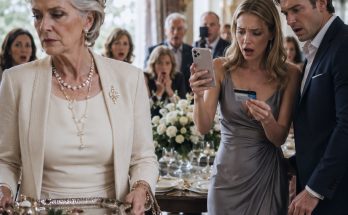
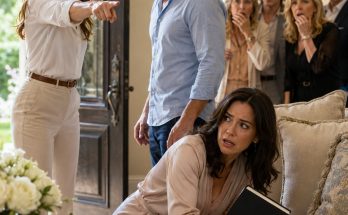
At The Crowded LAX Premier Check-In Line, Mom Threw My Economy Ticket Onto The Granite Floor. “Pick It Up, You Disgrace! Go Sit By The Toilet!” I Calmly Swiped My Black Card—And Six Federal Guards Stormed In. Steel Blast Doors Locked Shut, Instantly Wiping The Smirk Off Her Face. She Panicked And Cried, “Colonel?! Why Is A Private VIP Jet Calling You ‘Boss’?!”
### Part 1
The crumpled coupon slid across the polished mahogany table and tapped the base of my water glass.
It was damp at one corner, probably from the condensation of my mother’s champagne flute. The paper had been folded and unfolded so many times the blue ink had gone fuzzy. I looked down and saw a grocery-store tuna coupon that had expired six days earlier.
My mother, Aurelia Voss, smiled like she had handed me a gift.
“I found this in the kitchen drawer,” she said loudly enough for all fourteen people at the Thanksgiving table to hear. “Maybe if you make a scene at the register, they’ll feel sorry for you and honor it. You need it more than anyone here.”
A few forks paused. Only for half a second.
Then the chewing started again.
My sister-in-law, Briony, covered her mouth with her napkin, but not before a sharp little laugh escaped. My brother, Callahan Voss, leaned back in his chair and smirked into his wine. He was wearing a navy suit that cost more than my truck. His cuff links flashed every time he lifted his glass, tiny silver squares catching the chandelier light.
Beside him, my twelve-year-old nephew, Paxton, leaned toward me over his plate.
“Dad says, “You’re the embarrassment of the Voss family,”” he whispered.
He said it like he was repeating a joke he knew would get him praised later.
I did not look at him. I did not look at anyone.
Under the table, my posture stayed perfectly straight. My right thumb pressed hard against the screen of my phone inside my jacket pocket. The banking app glowed against my palm. A scheduled transfer sat there waiting for the first of the month.
$8,500.
The mortgage payment for the roof above my mother’s head.
The roof above my brother’s smug face.
The roof above every crystal glass, gold-rimmed plate, and expensive oil painting in that dining room.
My finger hovered over the transfer details, but I did not cancel it. Not yet.
To understand why I let my mother humiliate me in front of her guests, you have to understand the game they thought we were playing. They believed I was poor. They believed I worked some dead-end government desk job in a windowless basement. They believed my dented Ford F-150 and clearance-rack coat told the whole story.
They had no idea how much of their lives I had been quietly holding together.
Twenty minutes before that coupon hit my glass, my truck had crawled up the long gravel driveway of the Voss estate in Northern Virginia. Cold rain had turned the edges of the road into gray mud. My windshield wipers dragged across the glass with a tired squeak, and my lower back throbbed from a twenty-four-hour shift underground.
The house stood at the end of the drive like a magazine spread. White columns. Black shutters. Gas lanterns. Perfect wreaths hanging from every window.
Aurelia opened the front door before I reached the porch.
Her eyes moved straight past my face to my truck.
“Do you really have to park that awful thing where people can see it?” she snapped, lifting her champagne flute toward the side yard. “Your brother’s investors are coming by later. Move it behind the shed. You’re ruining the entrance.”
I looked at the wet grass. Then at the mud behind the shed.
I said nothing.
Inhale four seconds. Exhale four seconds.
I backed the truck into the mud until the tires sank with a wet, ugly sound.
Inside, the house smelled of roasted butter, cinnamon, and expensive perfume. The heat was turned too high. My mother’s laugh floated from the dining room, bright and sharp, the same laugh she used at charity luncheons when she wanted people to think kindness ran in her blood.
At the table, they had seated me at the far end.
Everyone else had cloth napkins folded into little fans. I had a paper napkin from the kitchen counter. Everyone else had gold-rimmed china. I had a chipped ceramic plate with a crack running through the glaze like a lightning strike.
Aurelia carved the turkey at the head of the table.
“For Callahan,” she announced, placing a thick slice of dark meat on my brother’s plate, “the genius CEO who built an empire from nothing.”
Callahan dipped his chin, pretending to be humble while his investors smiled from the other side of the table.
Then my mother turned to me.
Her smile disappeared.
She cut off a dry sliver of white meat and dropped it onto my chipped plate.
“Eat that,” she said. “That government desk job is making you soft. No man wants a broke woman who lets herself go.”
The investors heard her.
The cousins heard her.
My nephew heard her.
Nobody corrected her.
Then she tapped her knife against her glass.
“Attention, everyone. The Hawaii trip is officially booked. Callahan and Briony have the ocean suites. First class, of course. The children are next to us.”
She looked at me.
“Rowan, you’re in economy. I found you a cheap motel near the airport. You’ll carry the trunks because your brother’s back is delicate.”
Callahan grinned over the rim of his wine glass.
Something cold opened in my chest.
I stood.
The chair scraped against the hardwood floor, loud enough to kill every conversation at the table. My mother’s face tightened.
“Where do you think you’re going?”
I walked out without answering.
The cold air hit my face, wet and clean after the suffocating dining room. I climbed into my truck, shut the door, and sat in the mud behind their million-dollar house.
That was when my secure phone buzzed.
The screen flashed red.
An emergency alert from the Office of Special Investigations filled the display.
A financial algorithm had flagged my $8,500 transfer.
It had traced the money through a Delaware shell structure connected to Callahan’s company.
The family lifeline I had hidden for nineteen years was no longer private.
And the first word at the top of the alert was enough to turn my blood cold.
“Federal.”
### Part 2
At 10:17 that night, I pressed my eye against a retinal scanner three levels beneath Washington, D.C.
The hallway was concrete, cold, and clean enough to smell faintly of bleach. A camera clicked above my head. Somewhere behind the wall, locks released in a sequence of heavy metallic thuds.
A mechanical voice echoed through the corridor.
“Welcome, Colonel Voss.”
I stood still for half a breath.
Then the steel door opened.
The woman who had sat at the end of my mother’s Thanksgiving table with a chipped plate and a tuna coupon in front of her did not exist down here. Down here, nobody called me broke. Nobody told me to carry luggage. Nobody laughed because my truck had rust on the bumper.
Down here, men twice my size stood when I entered the room.
I walked into the secure washroom and shut the door behind me. The fluorescent light above the mirror buzzed with an irritating hum. I shrugged off my thrift-store jacket and tossed it over the back of a metal chair.
Eleven dollars at a Goodwill in Arlington.
A prop.
A costume.
A shield.
Under the cheap cotton of my shirt, two identification tags rested against my skin. Beneath them, scar tissue pulled tight across my left shoulder. I unbuttoned my shirt slowly and looked at myself in the mirror.
The first scar was a raised, jagged line from a valley most people couldn’t pronounce. A round had torn through me before I dragged a communications specialist through two hundred yards of filth and broken concrete. He had been heavier than me by nearly seventy pounds. I still remembered the sound of his breathing against my neck.
He did not make it to the helicopter.
Before he died, he left me something I never wanted and could never give back.
His insurance payout became the seed of the trust.
The second mark was lower, twisted and pale, a burn from a fire outside a field station where three servers, two generators, and one terrified nineteen-year-old analyst had to be pulled out before everything went black.
For nineteen years, the money I earned from pain, hazard pay, classified bonuses, and the inheritance of a dead friend had flowed through a blind trust.
It paid for Aurelia’s mortgage.
It saved Callahan’s company when his servers were days from repossession.
It covered private school tuition for children who had been taught to call me a disgrace.
I buttoned my shirt again, hiding the evidence under cheap fabric.
In my quarters, I knelt in front of the floor safe. The lock opened with a soft click. Inside sat a dress uniform jacket, pressed so sharply the sleeves looked carved. Silver eagles gleamed on the shoulders.
Beside it was a battered wooden box.
I opened the lid.
A single envelope sat inside.
Christmas, 2009.
I had written that letter to my mother on a folding table while artillery shook dust from the ceiling. I had told her I loved her. I had told her I missed the smell of pine in the foyer and the sound of her humming while she wrapped gifts. I had tucked three crisp hundred-dollar bills inside because the heating bill was overdue.
Four years later, I found that same envelope at the bottom of a blue recycling bin in Aurelia’s garage.
The cash was gone.
The seal was unbroken.
She had sliced open the corner, shaken out the money, and thrown my words away unread.
I kept that envelope because it was the first physical proof that my love had always been treated like packaging.
Useful only if there was money inside.
I sat at my secure desk and opened Callahan’s financial ledger. On paper, his company looked brilliant. Investor decks. Growth curves. Silicon Valley praise. My brother had built a public myth around himself as a self-made visionary.
The numbers told a different story.
Ten years earlier, when his partners were threatening lawsuits and his servers were nearly seized, my blind trust had wired $250,000 to keep him alive.
He used part of the breathing room to buy our mother a Lexus.
He used another part to put a deposit on a penthouse in San Jose.
The ledger scrolled under my fingertips.
Total family disbursements: $1,938,000.
Nearly two million dollars.
Paid quietly.
Mocked loudly.
I did not cry. That surprised me, though maybe it shouldn’t have. There comes a point where pain stops arriving as a storm and begins arriving as weather. You wake up under it. You drive through it. You learn how to function while soaked.
But that night, sitting under fluorescent lights with the expired coupon still folded in my coat pocket, I felt something different.
Not rage.
Not grief.
Precision.
I opened a termination protocol for the Delaware trust. It would stop all family transfers, recall collateral connected to Callahan’s company, and freeze any account using my backing as hidden liquidity.
I could have pressed the final key right then.
Instead, I scheduled it.
1:00 p.m. the next day.
Exactly when Callahan’s flight to Hawaii was supposed to leave the runway.
My secure phone rang before I could close the laptop.
A red alert filled the screen.
Pacific network intrusion.
Oahu grid compromised.
I stared at the words as the room around me sharpened.
While my family prepared to fly first class to the island they expected me to serve them on, someone was trying to push that same island into darkness.
Hospitals. Water treatment. Military systems. Civilian neighborhoods.
Everything depended on the next forty-eight hours.
I reached for my badge.
The daughter was finished for the night.
The colonel was needed.
### Part 3
By 7:00 the next morning, the underground control room was screaming.
Not people. Machines.
Sirens pulsed from the walls in brutal red waves. The main screen showed the Pacific map burning with warning lights. Analysts shouted across rows of consoles. Someone knocked over a coffee cup, and the smell of burnt espresso spread under the sharper scent of hot circuitry.
I stepped onto the central platform.
“Lock down the Pacific servers,” I said.
My voice was not loud. It did not need to be.
The room snapped toward me.
“Isolate Oahu. Pull contractor access. Bring the cyber teams online and freeze every external handshake until I say otherwise.”
A young technician with dark circles under his eyes turned from his screen.
“Colonel, if we cut contractor access now, we may lose live diagnostics.”
“If we don’t cut it now,” I said, “Tripler loses ventilators by morning.”
His face went pale.
“Yes, ma’am.”
The malware had entered through a federal contractor near Pearl Harbor. Smart enough to hide. Patient enough to wait. Whoever built it had not wanted headlines. They had wanted a slow failure at the worst possible moment.
While we worked, my personal phone vibrated against the metal console.
A message from Aurelia.
“Reminder: buy your own cheap sunscreen for Hawaii. Do not touch Briony’s organic cream. It costs more than your grocery budget.”
Another message followed.
“You will carry four trunks through LAX. Do not embarrass Callahan in front of the Apex investors. Walk behind us.”
I stared at the screen for one second.
Then typed, “I have an emergency at work.”
The phone rang instantly.
I answered because some old reflex still believed a daughter should answer when her mother called.
Aurelia did not say hello.
“It’s a desk job, Rowan. Nobody has an emergency over paper clips.”
Behind her, I heard ice clink against glass.
“Your brother has investors on this flight. Do not create drama.”
I looked at the red map pulsing above my team.
“People could die if I leave this.”
She laughed once, cold and flat.
“People always make themselves sound important when they’re trying to avoid family obligations.”
I ended the call.
For the next six hours, I did not think about her.
By early afternoon, I stood in an E-ring office at the Pentagon while Major General Abram Hale reviewed the Hawaii assignment file. Hale was built like an old oak door, broad, scarred, and hard to move. He had once pulled two Marines out of a burning vehicle with shrapnel in his thigh and never mentioned it unless someone else brought it up.
He turned a page.
Then stopped.
His eyebrows drew together.
“What is this?”
I looked at the paper in his hand.
My civilian travel itinerary had been clipped to the back of a security packet by mistake.
United Airlines.
Economy.
Seat 42F.
Near restroom.
Hale read the line twice. Slowly.
“Seat 42F,” he said. “Back row. By the toilet.”
The air in the office changed.
He looked up at me.
“Colonel Voss, you are commanding a tier-one cyber defense response connected to the Pacific grid, and your family has you flying next to a restroom like baggage?”
I stared straight ahead.
“Sir, it’s personal.”
“That was not my question.”
Silence stretched until I could hear the wall clock.
So I told him.
Not everything. Not at first. But enough. Then more. The nineteen years. The mortgage. The blind trust. Callahan’s company. The shell accounts. The Thanksgiving table. The coupon. The letter in the recycling bin.
Hale listened without interrupting.
His face did not soften.
When I finished, he set the file down with careful, frightening control.
Then his fist hit the desk.
The coffee mug near his elbow jumped, toppled, and shattered on the hardwood floor. Dark coffee splashed across the baseboards.
“You once talked an armed teenager into surrendering outside a market while people were screaming behind you,” he said, voice low. “You have pulled grown men out of fire. You have kept cities alive from rooms no one will ever see.”
He stood.
“But you let your mother treat you like a rented cart.”
My throat tightened.
He came around the desk and stopped in front of me.
“DNA is a biological accident, Rowan. Respect is a choice.”
I could not speak.
He picked up the secure red phone.
In three clipped sentences, he ordered a C-37B aircraft prepared at a private tarmac near LAX. Then he signed a protection authorization connected to my travel, my security clearance, and the active grid response.
Finally, he opened his desk drawer and removed a black biometric access card.
He slid it across the desk.
“This activates priority-one movement and federal protective detail,” he said. “You will go to LAX. You will not crawl into anyone’s luggage space. You will not sit by a toilet. You will not carry trunks for people who cannot carry basic decency.”
I looked down at the card.
It felt heavier than metal.
Hale leaned forward.
“Stand up straight, Colonel.”
My spine locked.
“That is a direct order.”
### Part 4
At 9:00 the next morning, a black Cadillac Escalade idled outside my apartment building.
Cold air rolled across the curb, smelling of exhaust, rain, and the stale coffee someone had spilled near the entrance. Aurelia lowered the passenger window exactly two inches.
“Don’t scratch the leather handles,” she said. “Your government paycheck couldn’t replace the zipper on one of these trunks.”
I lifted the fourth Louis Vuitton trunk into the back.
It weighed nearly sixty pounds. My lower spine sent a hot line of pain down both legs. I gripped the bumper and counted.
Inhale four.
Exhale four.
Callahan did not get out to help. He sat in the heated front seat, scrolling on his tablet with a crease between his eyebrows. He was waiting on a final digital signature from the Delaware trust by noon. Without that backing, Apex Capital would not release the next funding round.
He did not know the signature would never come.
Inside the Escalade, everything smelled of vanilla air freshener and expensive leather. Aurelia sat up front like a queen. Callahan and Briony occupied the middle row with their children spread between them, all soft coats and wireless headphones.
Aurelia glanced back.
“Get in the cargo area.”
I looked at her.
She stared back as if daring me to object.
“We need leg room,” she said. “You’re small enough to fit.”
Briony laughed under her breath.
So I climbed into the back, between the trunks and the rear window. The tailgate closed, sealing me into a cramped, dark space that smelled like leather polish and old dust. A hard plastic corner pressed directly into the scar on my shoulder.
The rear vents were shut.
Within minutes, the air turned hot and stale.
One of the kids tossed a candy wrapper over the seat. It stuck to the side of my coat. I did not move it.
At a drive-through, Aurelia bought coffees for everyone except me. Caramel for Callahan. Oat milk for Briony. Hot chocolate for the children. She lifted the empty cardboard tray, looked at me through the rearview mirror, and smiled.
“Oh, I forgot you. There’s probably an old water bottle in the door.”
Callahan mouthed, “Loser.”
His daughter turned around and studied me with the open cruelty children learn from adults.
“Aunt Rowan, why don’t you get a real job so you can be rich like Daddy?”
Callahan laughed.
“Kids tell the truth.”
I looked through the tinted glass as Los Angeles slid past in bright strips of freeway, palm trees, concrete, and morning glare.
The black biometric card rested in my pocket.
At Tom Bradley International Terminal, the Escalade rolled into the drop-off lane. Travelers moved in every direction, dragging suitcases, hugging relatives, shouting into phones. Sunlight poured through the high glass walls until the polished floors looked wet.
Before the tailgate opened, Aurelia turned around.
“Listen carefully,” she said. “Your brother’s investors are on this flight. You will walk ten paces behind us. You will not speak unless spoken to. You will act like help because that is the only version of you that won’t embarrass us.”
I gave her one slow nod.
It was the last command she would ever give me.
Inside the terminal, I walked exactly ten paces behind them.
I carried two trunks. Then three. Then four, stacked badly on a cart with a wheel that squealed every few feet. My shoulders burned. My palms stung. The crowd parted around us.
Behind a wall of soundproof glass, the Apex investors were visible in the VIP lounge. Two men in tailored jackets looked down over their coffee cups as Callahan lifted his chin and performed success for them.
At Premier Access, Aurelia took my economy ticket from her purse.
She did not hand it to me.
She threw it on the floor.
The paper slid across the granite and stopped near my boot.
“You are forty-two years old and you don’t own the dirt under your feet,” she hissed. “Your brother was a millionaire by thirty. Pick up your ticket and go sit where you belong.”
She leaned closer.
“By the toilet.”
The line went quiet.
Callahan raised his phone and started recording.
Briony crossed her arms.
Aurelia waited for me to bend.
I did not.
I stepped around the ticket.
My mother’s mouth opened.
I walked to the emergency intercom panel beside the security gate, removed the black card from my pocket, and slid it into the reader.
A green light flashed.
“Colonel Rowan Voss,” I said clearly. “Priority-one clearance. My detail is waiting.”
The TSA agent behind the counter froze. His eyes moved to the screen. His posture changed so quickly Aurelia actually stepped back.
Then the reinforced steel doors beside the checkpoint opened with a heavy mechanical clunk.
Six federal security officers walked through.
They did not rush. They did not shout. They moved with calm, terrifying precision, spreading into a protective circle around me with their eyes facing outward.
Callahan’s phone slipped from his hand.
It hit the floor and cracked.
Aurelia let out a strangled sound that was almost a scream.
Behind the glass, the Apex investors stood up.
A tall man in a dark suit entered through the circle of guards and stopped in front of me.
“Colonel Voss,” he said with a formal nod. “Major Keaton Weller. The aircraft is fueled and waiting.”
I looked at the ticket on the floor.
Then at my mother.
For once, she had nothing to say.
### Part 5
The private tarmac at LAX smelled like jet fuel, hot asphalt, and ocean wind.
The C-37B waited under the white morning light, sleek and quiet, with its stairs lowered like it had been expecting me all along. Every step up into that aircraft felt like removing a weight from my spine.
Inside, the cabin was dark mahogany, cream leather, and clean silence.
No children kicking seats.
No mother barking orders.
No brother filming my humiliation.
I sat in the forward chair and set my hands flat on the polished table. My palms still held red marks from the luggage handles. A flight attendant placed a glass of water beside me without asking. Not champagne. Not a performance. Just water, cold enough to bead on the glass.
Major Weller sat across from me with a tablet.
“We have movement on the trust deadline,” he said.
I nodded.
“Show me.”
He turned the screen.
Callahan’s funding structure depended on a final verification from the Delaware blind trust by noon Pacific. Apex Capital had approved the public story of his success. Behind the story, however, their risk model was tied to hidden collateral they did not fully understand.
My collateral.
My dead friend’s insurance money.
My hazard pay.
My years.
The jet engines deepened into a steady roar. The plane began to move.
I opened the secure banking portal. The interface was plain, gray, and emotionless. That was the mercy of numbers. They did not flatter. They did not scream. They did not say blood was blood while reaching for your wallet.
Four confirmations waited.
Pause recurring mortgage payment.
Cancel family disbursement schedule.
Initiate collateral recall.
Confirm trust liquidation.
My finger hovered for one breath.
I thought of the tuna coupon.
The chipped plate.
The letter in the recycling bin.
The cargo space of the Escalade.
Then I tapped.
One.
Two.
Three.
Four.
The system processed for eight seconds.
Complete.
Just like that, nineteen years ended without a raised voice.
Somewhere in the commercial terminal, Aurelia was likely still demanding an explanation. Somewhere in first class, Callahan was probably pretending the federal officers had been some misunderstanding he could spin into a story later.
He would not have long.
At exactly 1:00 p.m., while our aircraft cut through the clouds, his tablet would receive an error.
Apex Capital would receive a risk alert.
His board would see the collateral disappear.
His self-made empire would discover the foundation had never belonged to him.
My personal phone buzzed on the table.
Weller glanced at it.
“Your brother posted the video.”
I unlocked the screen.
There I was in the terminal, filmed from below by Callahan’s shaking hand. Aurelia’s voice carried clearly through the clip.
“Pick up your ticket and go sit where you belong. By the toilet.”
Then came the moment I stepped to the intercom.
The green flash.
The doors.
The six federal officers.
The internet had already found it.
Millions of views in hours.
Comments stacked too fast to read. Some mocked Aurelia. Some demanded to know who I was. Some froze the frame on my mother’s face the second she realized the woman she had treated like baggage was guarded by the federal government.
Aurelia tried to respond from her charity committee account.
“My daughter abused government power today and abandoned her elderly mother in an airport.”
I stared at the statement for a long moment.
It was almost elegant in its dishonesty.
“Release the financial summary,” I said.
Weller looked up.
“The whole file?”
“The clean version. Nineteen years. Mortgage payments. Tuition. Business rescue transfers. No classified sources. No commentary.”
He nodded once.
Within minutes, the statement went to a national wire service through proper channels. It did not need adjectives. It did not need tears.
Total paid to Aurelia Voss and connected family accounts: $1,938,000.
The internet did the rest.
By the time we crossed the Pacific, Aurelia’s charity board had issued a resignation notice. Callahan’s investors had requested emergency review. Briony had deleted every photo of their vacation from her social media and then restored them badly, as if panic could be edited.
My phone began to vibrate without stopping.
Cousins.
Aunts.
An uncle in Chicago.
Callahan.
Aurelia.
I blocked fifteen numbers in three minutes.
Then I placed the phone face down on the table.
Ahead of me, the encrypted monitor showed Oahu still flashing red.
The family performance was over.
The real emergency was waiting under the island.
### Part 6
The air under Pearl Harbor was cold enough to bite.
By 8:00 on December 18th, I stood fifty feet below ground in a federal server facility that smelled of metal dust, hot plastic, and industrial coolant. Fans roared from every wall. Blue-white lights flickered across rows of black equipment racks.
The malware had burrowed deeper than anyone wanted to admit.
It was patient, layered, and ugly. It had hidden inside maintenance pathways, mimicking ordinary contractor signals until it reached places no civilian attacker should have known existed.
For four hours, I worked with a manual team pulling infected hardware from live racks. My hands blistered through gloves. My shoulder screamed every time I reached overhead. Sweat ran down my spine under my uniform shirt, turning the cotton stiff.
At 11:42, one of the engineers shouted, “Substation handshake restored.”
At 11:58, the hospital backup pathway cleared.
At noon, the main board flickered.
Red.
Red.
Then blue.
A steady, beautiful blue.
The room did not cheer. Not right away. Everyone just stared, too exhausted to trust it.
Then someone exhaled.
Then someone laughed once, shaky and disbelieving.
Oahu stayed lit.
Tourists kept swimming at Waikiki without knowing their hotel elevators had almost stopped. Elderly patients at Tripler kept breathing through machines that never lost power. Children kept watching cartoons in cool hotel rooms while their parents complained about room service.
That was the strange cruelty of good work.
When you did it perfectly, nobody knew you had done anything at all.
My personal phone lit up on the metal desk.
I should have ignored it.
Instead, I glanced.
Callahan had been removed as CEO by emergency board vote. His access to company systems had been revoked. Apex Capital had frozen the Series B transaction. Briony’s personal accounts were under court review because several pieces of heirloom jewelry had been used as collateral without her informed consent.
Then came the hotel alerts.
Royal Hawaiian.
Card declined.
Second card declined.
Third card declined.
A voicemail from Aurelia appeared.
I played the first five seconds.
Her voice poured out frantic and shrill over soft lobby music.
“Rowan, you need to wire money immediately. They’re humiliating us. Do you understand? They won’t even give us the suite keys. This is your fault.”
I deleted it.
At 5:00 that evening, I stood alone in my concrete quarters and opened the garment bag hanging from the door.
My dress uniform jacket waited inside.
Dark blue.
Stiff.
Perfect.
I slid it onto my shoulders. The weight settled over the scars like a truth finally being worn in public. I fastened each brass button. The clicks sounded small and final in the room.
Then I pinned the silver eagles at my shoulders.
Colonel.
Not paper pusher.
Not baggage.
Not the woman by the toilet.
I placed three rows of ribbons above my heart. Bright strips of color that looked almost pretty until you knew what each one had cost.
At 5:45, I closed my briefcase over the financial clearance files required for my promotion board. The trust liquidation had to be documented cleanly by midnight. No loose ends. No family contamination. No hidden accounts tied to people who had spent nineteen years confusing my silence for weakness.
A government SUV took me to the Royal Hawaiian Hotel.
The Pacific breeze moved through the open window, warm and rich with orchids and salt. The hotel glowed pink against the evening sky, elegant and old, with palms swaying like nothing ugly could ever happen there.
But ugly things happened everywhere.
They just wore better clothes in expensive places.
At 6:00, I walked through the heavy glass doors.
The lobby smelled of flowers, polished wood, and expensive panic.
A man in a white dinner jacket played soft jazz on a grand piano. Guests drifted through with shopping bags and cocktails. Near a velvet seating area, hotel staff stood in a tense cluster, whispering.
My family sat in the corner like royalty after a flood.
Aurelia’s hair had fallen from its perfect shape. Her silk blouse had a coffee stain down the front. Her Chanel bag lay on the marble floor as if even she no longer had the energy to pretend.
Callahan sat hunched forward, elbows on knees, eyes bloodshot. His expensive polo shirt was wrinkled. His jaw twitched as he stared at nothing.
Paxton sat beside him, silent for once.
Then Briony stormed through the lobby doors holding a stack of legal papers.
She did not look polished now. She looked furious enough to burn.
“You lied to me,” she said to Callahan, voice shaking.
He stood too fast.
“Briony, not here.”
“Here is perfect.”
Cameras flashed from near the entrance. Reporters had found them.
Briony threw the papers against his chest.
“You used my grandmother’s diamonds as collateral for your fake company. My accounts are frozen because of you.”
Callahan grabbed the papers before they fell.
“I was going to fix it.”
“You were never going to fix anything. You were waiting for your sister to pay for it like she paid for everything else.”
The lobby went quiet.
That was when Aurelia saw me.
Her eyes dropped to the silver eagles on my shoulders.
Then she ran.
Not toward me like a mother relieved to see her daughter.
Toward me like a debtor spotting the last open bank.
She fell to her knees on the marble and grabbed the hem of my trousers with both hands.
“Rowan,” she sobbed. “You have to save us.”
### Part 7
For a moment, the whole lobby disappeared except my mother’s hands.
Her fingers dug into the wool of my uniform trousers. Her nails were polished a pale pink, chipped at the tips. A diamond bracelet slid down her wrist and knocked softly against my shoe.
“Please,” Aurelia choked. “I’m your mother.”
The piano stopped.
The silence that followed was thick enough to feel against my skin.
Hotel guests turned. A waiter froze with a tray of champagne flutes balanced in one hand. Near the doors, cameras lifted. Callahan stood five feet behind Aurelia, unable to look at me. Briony stood rigid with her legal papers pressed against her chest.
I did not pull away immediately.
I let my mother kneel there.
Not because I enjoyed it.
Because for once, she needed to feel the full weight of the person she had spent nineteen years shrinking in public.
“Save us,” Aurelia whispered again. “We’re family.”
My voice came out calm.
“You are begging the wrong person.”
Her face twitched.
“You don’t mean that.”
“I do.”
She tightened her grip.
“You’re angry. I understand. I said things I shouldn’t have said, but mothers and daughters fight. You can’t destroy your own blood over hurt feelings.”
There it was.
The old script.
Shrink the injury. Rename the abuse. Turn the victim into the cruel one for finally stepping away.
I looked down at her.
“This is not about hurt feelings.”
Her eyes were wide now, wet and desperate.
“You publicly humiliated me over an expired tuna coupon while I was paying your mortgage. You told me to sit by a toilet while I was responsible for keeping power running on the island you wanted to vacation on. You let your grandson call me a disgrace while I was paying his tuition.”
Paxton made a small sound from the couch.
I did not look at him.
Aurelia’s mouth trembled.
“I didn’t know.”
“No,” I said. “You didn’t care.”
The words landed harder than shouting would have.
I opened my briefcase and removed a single folder. It held no classified details. Only clean numbers, dates, transfers, and signatures. I handed it to the hotel’s legal liaison standing nearby, not to my mother.
“These records are already filed,” I said. “The trust is closed. The collateral is recalled. Any attempt to access funds through my name will trigger review.”
Callahan finally looked up.
“Rowan,” he said, voice rough. “Come on. We can talk.”
I turned toward him.
He flinched before I said a word.
“You built your empire on money you mocked me for not having.”
His jaw tightened.
“I didn’t know it was you.”
“That makes it worse, Callahan. You thought some faceless account saved you, and instead of being grateful, you used the breathing room to perform success while stepping on everyone beneath you.”
Briony laughed once, bitter and broken.
“Faceless account. That’s what he called it.”
Callahan shot her a panicked look.
“Not now.”
“Yes, now,” she said. “For once, now.”
Aurelia tried to rise, failed, and stayed on her knees.
“Rowan, please. The house is in foreclosure review. The charity board is calling me a fraud. Your brother’s company is collapsing. If you just make one transfer, we can fix the rest quietly.”
I stared at her.
Quietly.
That was the word they loved.
Keep it quiet when they insulted me.
Keep it quiet when they took my money.
Keep it quiet when they wanted the world to believe I had abandoned them.
“When was the last time you read a letter I wrote you?” I asked.
Aurelia blinked.
“What?”
“The Christmas letter. The one with the red wax seal.”
Her face changed before she could stop it.
There it was.
Recognition.
Not guilt.
Fear of being seen.
“You opened the corner for the cash,” I said. “You threw the letter away unread. I found it in your recycling bin between wine bottles.”
A low murmur moved through the lobby.
Aurelia shook her head.
“I don’t remember that.”
“I do.”
Her hands loosened slightly.
“I was under stress. Your father had just died. The bills were terrible.”
“And I paid them.”
She started crying harder, but the sound no longer moved anything inside me.
For years, I had mistaken her tears for proof of a heart. Now I understood they were tools. Some people used knives. Aurelia used sobs.
I bent just enough to remove her fingers from my trousers.
One hand at a time.
Gently.
Firmly.
When she reached for me again, I stepped back.
“You broke this family,” I said. “You clean it up.”
Her hands fell to the marble with a hollow slap.
“No,” she whispered.
I looked at Callahan.
“You are not my responsibility.”
Then at Briony.
“Neither are you.”
Then at Paxton, who looked smaller than he had at the Thanksgiving table.
“You are old enough to remember what cruelty sounds like. Be careful who you copy.”
His eyes dropped.
Aurelia let out a wail behind me.
I turned and walked toward the doors.
The cameras flashed. The waiter still held the champagne tray. The piano player’s fingers hovered above the keys, waiting for permission from a room that had forgotten how to breathe.
I pushed through the glass doors into the warm Hawaiian evening.
Behind me, my mother screamed my name.
For the first time in my life, I did not turn around.
### Part 8
Outside, the air smelled like saltwater and night-blooming flowers.
The sky over Oahu had gone deep orange, the last light spreading across the water like fire. Far off, beyond the darkening curve of the harbor, the memorial rested in silence. A place built for people who gave everything for strangers who would never know their names.
I stood on the hotel steps and listened to my mother’s voice fade behind the glass.
For nineteen years, I had believed endurance was love.
I had believed silence was dignity.
I had believed that if I gave enough, paid enough, carried enough, saved enough, one day Aurelia would look at me and finally see a daughter instead of a resource.
But some people do not become kinder when they are rescued.
They become better at drowning you.
Major Weller waited beside the SUV.
“Are you all right, Colonel?”
I looked at the ocean.
“No.”
He nodded once, accepting the truth without trying to decorate it.
“Do you need a minute?”
“I already gave them nineteen years.”
He opened the door.
Back at the federal housing facility, the hallway was dim and quiet. My room was plain: concrete walls, narrow bed, metal desk, small mirror above the sink. No chandeliers. No expensive rugs. No family portraits arranged to impress guests.
Just silence.
Beautiful, clean silence.
I locked the door.
The deadbolt slid into place with a heavy clack.
I took off my uniform jacket slowly. Brass button by brass button. The silver eagles came next, then the ribbons. I placed everything into the wooden box and closed the lid.
The woman in the mirror looked tired.
Not weak.
Not broken.
Just tired in the way soldiers are tired after walking out of a long war and realizing no one is shooting anymore.
My personal phone lit up on the bed.
A message from my uncle Soren in Chicago.
“Whatever happened today, you need to fix it. Your mother is getting older. Her heart can’t handle stress. Blood is blood. Apologize, send the money, and keep family business inside the family.”
I read it twice.
Not because I was tempted.
Because I wanted to see if the words could still hook into me.
They could not.
I blocked him.
Then another aunt.
Then three cousins.
Then two old family friends who had suddenly remembered my number now that Aurelia’s version of the story had collapsed.
Block.
Delete.
Block.
Delete.
Each small beep felt like a window opening.
At 10:30, Major General Hale called.
“You cleared the financial review,” he said. “Promotion board has the corrected file.”
I sat on the edge of the bed.
“Thank you, sir.”
“You did the work.”
I looked at the wooden box on my desk.
“No. I mean for seeing it.”
Hale was quiet for a moment.
“Get some sleep, Brigadier General select.”
The words moved through the room slowly.
I closed my eyes.
For once, the first person I wanted to tell was not my mother.
That was how I knew I was free.
Three months later, the Voss estate sold at auction.
I did not attend.
Aurelia moved into a small condo outside Richmond paid for by the liquidation of jewelry she once told people was “family legacy.” Callahan’s company was absorbed by a competitor for parts. He sent one letter through an attorney, not to apologize, but to ask whether I would consider making a “strategic family investment” in his next venture.
I returned it unopened.
Briony divorced him before spring.
Paxton wrote me one email.
It said, “I’m sorry I repeated what Dad said. I know that doesn’t fix it.”
I stared at that message for a long time.
Then I replied, “Learn from it. That will matter more than apologizing.”
I did not become close to him. I did not step back into the family. I did not attend holidays with people who had needed federal records to believe I deserved basic respect.
But I did not hate him.
That surprised me too.
Freedom did not feel like rage.
It felt like having nothing to prove.
The following December, I spent Thanksgiving in a different room underground, surrounded by analysts eating grocery-store pie from paper plates. Someone brought dry turkey from the cafeteria. Someone else burned the coffee. The fluorescent lights buzzed. The table wobbled.
Nobody had gold-rimmed china.
Nobody had crystal champagne.
But when I sat down, a young lieutenant slid a real cloth napkin toward me because he had noticed mine was missing.
“Here you go, ma’am,” he said.
Such a small thing.
Such a human thing.
I looked at that napkin for a second longer than I should have.
Then I smiled.
“Thank you.”
Outside, the city lights stayed on.
Inside, nobody asked me to sit by the toilet.
Nobody asked me to carry what they could carry themselves.
And when my phone stayed silent all night, I finally understood the difference between loneliness and peace.
Loneliness is waiting for people to love you.
Peace is no longer waiting.
I ate the dry turkey. I drank the terrible coffee. I laughed when the lieutenant dropped cranberry sauce on his boot.
For the first Thanksgiving in my life, I left the table full.
THE END!