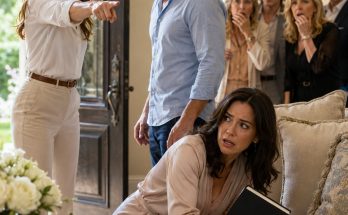
On Father’s Day, Dad Humiliated Me In Front Of The Entire Family. “I’m Proud Of All My Children… Except The Disgrace Sitting At This Table.” Nobody Defended Me. I Smiled, Handed Him An Envelope, Wished Him A Happy Father’s Day, And Left. Moments Later… He Opened It And Started Screaming So Loudly The Neighbors Came Outside…
### Part 1
My name is Maren Lowrie, and I was 34 years old the day my father decided to make me small in front of twenty-three people and a smoking grill.
It was Father’s Day in Briar Glen, Ohio, the kind of June afternoon where the grass smelled hot and sweet, paper plates curled at the edges, and every plastic cup on the picnic table sweated like it was nervous. My parents’ backyard looked exactly the way it had looked every summer since I was seven: the same leaning maple tree near the fence, the same rusted horseshoe pit nobody used anymore, the same long wooden table my brother dragged from the garage and covered with a red checkered cloth my mother only brought out when she wanted us to pretend we were a happy family.
I had driven three hours from Columbus that morning with a gift bag on the passenger seat and an envelope tucked inside my purse.
The gift was a watch. Nothing flashy. Silver face, brown leather strap, clean numbers because my father’s eyes had started getting tired even though he refused to admit it. His old watch had stopped working in March, and I remembered him tapping it at Easter like he could bully time into moving again. I saved for two months to buy the replacement. Every time I skipped takeout or put groceries back because the total was too high, I pictured him opening it and saying, just once, “You noticed.”
That was all I wanted.
Not praise. Not an apology. Not some movie scene where everyone realized they had misjudged me and clapped while I stood there glowing.
I just wanted to sit at that table and be treated like one of Harlen Lowrie’s children.
When I pulled into the gravel driveway, my brother Baylor was already at the grill, wearing the navy apron with the Lowrie Hardware logo stitched crooked across the chest. He had taken over the family store two years earlier, and everyone acted like he had carried the whole town on his back instead of inheriting a building, three employees, and a customer list our grandfather had built before Baylor was born.
My younger sister, Veda, was showing off her engagement ring near the cooler. Every few minutes, she lifted her hand into the sun and waited for somebody to notice again. Her fiancé, Callum, stood beside her in boat shoes, laughing too loudly at every joke my father made.
My mother, Etta, hurried toward me with a dish towel over one shoulder and a smile that looked practiced from the car.
“You made it,” she said, like I had a long history of not showing up.
“I said I would.”
“Well, your father’s in a mood, so don’t start anything today.”
The sentence hit me softly at first, like a napkin brushing my arm. Then the meaning sank in.
I had been in the yard for less than a minute, and I was already the problem.
“I’m not planning to start anything,” I said.
She squeezed my elbow, not warmly, but as a warning. “Good. It’s his day.”
His day.
As if every day in that house had not always been his day.
I kissed his cheek when I reached him. His skin smelled like beer, charcoal smoke, and the peppermint gum he chewed when he was pretending his hip didn’t hurt.
“Happy Father’s Day, Dad,” I said.
He patted my shoulder without looking all the way at me. “Maren.”
Just my name. No smile. No question about the drive. No “good to see you.”
Still, I sat where my mother pointed, between my cousin Miri and Aunt Lenora’s empty chair. The plate in front of me had a crack down the side. A yellow jacket crawled across the lip of the lemonade pitcher. Somewhere behind the garage, the sprinkler clicked in slow, metallic circles.
For twenty minutes, I let myself believe the day might pass without damage.
I ate potato salad. I laughed when my nephew fell backward into a lawn chair. I complimented Veda’s ring and listened to Callum talk about mortgage rates like he had discovered money himself. Baylor flipped burgers, pointed at the smoke, and told everyone the store had just had its best spring in years.
My father smiled at that.
A real smile. Wide and warm and proud.
I watched it cross his face and felt that old, childish ache open under my ribs.
Then Uncle Orson stood up, lifted his plastic cup, and said, “Harlen, say a few words. It’s your table.”
Everyone cheered.
My father rose slowly from his lawn chair, one hand braced against the armrest, the other holding his beer. The yard quieted around him. Even the kids seemed to sense that Grandpa was about to perform the yearly ceremony of gratitude.
He looked at Baylor first.
Then Veda.
Then me.
And something in his eyes went flat.
### Part 2
My father cleared his throat and smiled at the table like he owned every face sitting around it.
“I’m a lucky man,” he began. “A man gets to my age, he starts thinking about what he’s built. What he’s leaving behind. What kind of children he raised.”
My mother clasped her hands under her chin. Veda leaned into Callum’s shoulder. Baylor stood behind the grill with his spatula held like a trophy.
I sat very still, my fork resting against the edge of my plate.
My father turned toward Baylor. “Some sons step up when a family needs them. Some sons understand legacy. Baylor kept Lowrie Hardware standing when I couldn’t be there every day anymore.”
Baylor looked down with that fake humble smile he had perfected in high school, the one that made older relatives call him dependable. Nobody mentioned the fact that I had spent most of my twenties doing the store’s books after work, or that I had built the online inventory system Baylor still used but claimed he had “modernized.”
My father turned to Veda next.
“And my baby girl,” he said, voice softening, “found herself a good man. She’s making a home the right way.”
Veda blushed. Callum kissed her temple. My mother dabbed at her eyes with the corner of her napkin.
I knew what came next. I could feel the shape of it before it arrived.
My father looked at me.
He did not smile.
For half a second, I thought maybe he would surprise me. Maybe he would say I had worked hard. Maybe he would mention my apartment in Columbus, my job helping small clinics untangle insurance billing, the clients who sent me Christmas cards because I had saved them from losing their businesses over paperwork mistakes.
He lifted his cup.
“I’m proud of all my children,” he said.
The pause that followed was small, but I felt every inch of it.
A few relatives smiled at me, already preparing their polite nods.
Then my father said, “Except the disgrace sitting at this table.”
The yard went quiet so fast it felt like someone had dropped a glass dome over us.
The sprinkler clicked behind the house.
A burger hissed on the grill.
A child whispered, “Mom?”
My face went hot first. Then cold. Then strangely hollow, like my bones had turned into dry paper.
Nobody laughed, because he had not said it like a joke. He said it the way he said “rain’s coming” or “the truck needs gas.” Plain. Certain. Bored.
Across from me, Baylor stared at his plate. Veda froze with her drink halfway to her mouth. My mother looked down at the tablecloth and pinched at a fold like it had suddenly become urgent. Uncle Orson shifted in his chair. Aunt Lenora’s lips parted, then closed again.
Miri sat beside me, so close our knees almost touched. I heard her breath catch. She had sleepover memories with me. She had seen me cry in my parents’ downstairs bathroom at seventeen because my father had called me “dramatic” for getting a scholarship instead of staying to work weekends at the store. She knew. She knew more than most of them.
Still, she said nothing.
Twenty-three people in that yard, and not one of them asked him to stop.
My father took another drink.
The silence gave him permission.
He continued, “Some people chase nonsense and call it independence. Some people turn their backs on family and expect to be respected for it.”
My fork was still in my hand. A piece of potato salad clung to the tines, yellow with mustard. I remember that detail more clearly than anything else. Not his face. Not my mother’s cowardice. The fork. The little smear of mustard. The absurdity of being humiliated while holding picnic food.
I could have stood up and screamed.
I could have told the table how many times I had answered my mother’s calls at midnight because Dad’s hip was swollen and he refused urgent care. I could have told them how many invoices I had quietly corrected for the store after Baylor messed up supplier codes. I could have told them I had not turned my back on family.
Family had simply learned to take from my back while spitting at my face.
But a strange calm came over me.
Not forgiveness. Not peace.
More like the final click of a lock.
I set my fork down. I wiped my mouth carefully with my napkin. Then I reached into my purse and pulled out the envelope.
It was cream-colored, thick, and plain. I had written “Dad” on the front in blue ink two nights earlier at my kitchen table, my hand shaking because the letter inside had been harder to write than I expected.
My father watched me slide it across the table.
“What’s that?” he asked.
“Your Father’s Day card,” I said.
My voice sounded so steady that I almost didn’t recognize it.
His eyes narrowed, maybe waiting for me to make a scene. Maybe hoping I would, so he could point at my reaction and say, “See? That’s what I mean.”
I stood up.
The chair legs scraped softly over the patio stones. Everyone flinched like the sound had accused them.
I looked at my father one last time.
“Happy Father’s Day.”
Then I walked away from the table, through the smell of smoke and cut grass and sweet tea, past my mother whispering, “Maren, don’t,” past Baylor pretending to check the grill, past Veda’s pale, open mouth.
I did not turn around.
But behind me, I heard my father pick up the envelope.
### Part 3
I made it to my car before my hands started shaking.
The driveway gravel shifted under my sandals as I opened the door and slid behind the wheel. My gift bag sat on the passenger seat, tissue paper still neat, watch box still inside. I had forgotten to hand it to him. Or maybe some part of me had known not to.
Through the windshield, I could see the corner of the backyard. Bright shirts moving. People leaning toward each other. My mother’s hydrangeas bobbing in the wind like they were nodding along with whatever lie the family would tell about me later.
I started the engine.
For a moment, I just sat there with both hands on the wheel, listening to the air conditioner cough itself awake. My throat hurt, but no tears came yet. I was too stunned. Too cleanly cut.
Then my phone buzzed.
A text from Miri.
“I’m sorry.”
Two words. No defense. No action. No table-flipping speech on my behalf. Just a quiet little apology sent after the damage was done.
I looked at it until the screen dimmed.
Then I put the car in reverse.
The three-hour drive back to Columbus looked different through tears I refused to shed until I hit the highway. Cornfields blurred gold and green. A church sign flashed past that said “HONOR THY FATHER,” and I laughed once, sharp and ugly, so hard it scared me.
The first tear came somewhere past Dayton.
Then another.
Then my chest broke open, and I cried with the windows down so the wind could steal the sound before it filled the car.
I cried for the watch. For the card. For the seven-year-old girl who used to wait on the porch when his truck came home. For the twenty-two-year-old who turned down a better job in Cincinnati because her mother said, “Your father needs help at the store right now.” For every holiday where I arrived early, cooked, cleaned, balanced, fixed, softened, and left with less of myself than I brought.
By the time I pulled into a gas station outside London, Ohio, my phone had started buzzing so often it slid off the passenger seat and thudded onto the floor mat.
I wiped my face with a napkin from the glove compartment and picked it up.
Eleven missed calls from my mother.
Five from Baylor.
Two from Veda.
One from Uncle Orson.
Then one voicemail from Aunt Lenora, who hated leaving voicemails because she said talking to a machine felt like “confessing to a toaster.”
I played it with the phone pressed tight to my ear.
At first, all I heard was noise. Wind. Voices. Someone crying. Then Aunt Lenora’s breath, thin and panicked.
“Maren, honey, it’s me. I don’t know what was in that envelope, but your father opened it, and everything just—”
A man shouted in the background.
My father.
I knew his voice even distorted through the phone. I had spent my life measuring rooms by the weather of that voice.
Aunt Lenora lowered hers.
“He read the first page, and then he started yelling. Not at you. At himself, I think. At your mother. At Baylor. I don’t know. The neighbors came out. Etta’s trying to get him inside. Orson said someone’s going to call the sheriff if he doesn’t calm down.”
My stomach tightened.
The gas station smelled like hot asphalt, spilled fuel, and old coffee drifting from the store. A truck rumbled beside me. A teenage cashier leaned against the window, scrolling through his phone, completely unaware that my family was apparently detonating three counties away.
Aunt Lenora kept talking.
“He keeps saying, ‘She paid it? She paid all of it?’ Then he says, ‘No, no, no,’ over and over. Honey, call me. Or don’t. I don’t blame you if you don’t. But something happened after you left, and I think you need to know.”
The voicemail ended.
I sat in silence.
Then the phone buzzed again.
My mother’s name filled the screen.
I let it ring.
The envelope had not contained rage. It had not contained revenge. It had contained the last kind thing I was ever going to do quietly for that family.
And somehow, that was what finally made them scream.
### Part 4
Two months before Father’s Day, my mother called me at 10:42 on a Tuesday night.
I remember the time because I had just taken banana bread out of the oven. My apartment was warm with cinnamon and sugar, rain tapped against the kitchen window, and for once I had planned to spend the evening doing absolutely nothing useful for anyone.
Then my phone lit up with “Mom.”
I almost didn’t answer.
That sounds cruel unless you know what her late-night calls usually meant. Not emergencies, exactly. More like emotional plumbing leaks. Dad was angry. Baylor forgot something. Veda needed help wording an email. A bill looked confusing. Somebody had upset somebody, and I was expected to become a soft place for the whole family to throw their panic.
I answered anyway.
“Your father had his follow-up today,” she said without hello.
“How did it go?”
“He’s fine. Stubborn. The doctor says he needs more therapy.”
I heard cabinets opening behind her, then closing. My mother always cleaned when she was worried.
“Okay,” I said. “That’s good, right?”
She didn’t answer.
“Mom?”
“There’s paperwork,” she said finally. “Hospital paperwork. I don’t understand any of it.”
That was how I ended up driving to Briar Glen the following Saturday to help organize my parents’ files.
Their dining room smelled like lemon furniture polish and old mail. My father sat in the recliner in the living room, watching a baseball game with the volume too high, pretending not to listen while I sorted insurance statements, therapy referrals, pharmacy receipts, and bills into piles.
I found the hospital balance folded inside a grocery flyer.
$8,914.27.
Past due.
Final notice.
My mother snatched it from my hand so fast the paper tore at the corner.
“That’s nothing,” she said.
“Mom.”
“It’s handled.”
“It says final notice.”
She looked toward the living room. My father coughed but did not turn around.
“Don’t bring it up,” she whispered. “He’ll be humiliated.”
Humiliated.
The word sat between us like a dirty plate.
My father, who had publicly mocked my rented apartment, my unmarried life, my career, my choices, my clothes, my old car, my “city attitude,” could not survive anyone knowing he had a medical bill.
“What’s the plan?” I asked.
My mother’s eyes filled with tears, but I had learned not to trust the first version of her tears. Sometimes they meant sadness. Sometimes they meant she wanted me to carry something.
“Baylor says the store is tight this month,” she said. “Veda has wedding expenses. Your father won’t ask Orson. He’d rather be buried than ask his brother.”
I stared at the paper.
There it was.
Not a request. My family rarely made requests. Requests could be refused. They preferred to set a burden down in front of me and wait for me to pick it up out of guilt.
“What do you want me to do?” I asked.
My mother’s mouth trembled.
“You’re good with these things.”
These things.
Bills. Shame. Silence. My father’s pride.
I took the notice home with me. I called the hospital on Monday during my lunch break. I negotiated the balance down. I set up payments from my own account. Then, after two sleepless nights, I paid the remaining amount with money I had been saving for a down payment on a condo I had looked at near Schiller Park.
No one asked me to.
That was what made it worse. I had volunteered for my own erasure.
The first payment receipt arrived by email, and I stared at the zero balance until my eyes burned. I told myself I had done it for him because he was my father. I told myself love did not need witnesses. I told myself dignity mattered, even when the person whose dignity you protected had spent years grinding yours down.
But another part of me, quieter and colder, opened a document on my laptop and began to write.
“Dear Dad,” I typed.
Then I deleted it.
Then I typed it again.
The letter took three weeks.
Not because it was long. It was only one page. But every sentence had to fight its way through thirty-four years of wanting to be understood.
I did not write, “Please love me.”
I did not write, “Please be proud.”
I wrote the facts.
I wrote that I had found the balance by accident, paid it in full, and kept it private because I knew he valued pride more than comfort. I wrote that I hoped his hip healed. I wrote that I had wanted him to enjoy Father’s Day without that weight hanging over him.
Then, near the end, I wrote the line I almost removed a dozen times.
“I have spent years protecting your pride while you treated my heart like it was disposable, and this is the last time I will confuse silence with love.”
I printed the letter. Folded it behind the paid statement. Slipped both into the envelope with the card.
I thought he would open it later, maybe after everyone left. I thought he might sit alone in the den, read it privately, and maybe, just maybe, understand something.
I did not expect him to call me a disgrace first.
I did not expect the envelope to become a mirror in the middle of the backyard.
### Part 5
I did not answer my mother until I was back inside my apartment.
By then, the sun had dropped behind the brick buildings across the street, turning my living room orange at the edges. My purse lay on the floor where I had dropped it. The watch box sat on the kitchen counter beside the banana bread I had never cut.
My phone buzzed again.
Mom.
I let it ring until the last second, then answered without saying hello.
Her voice rushed out. “Maren, what did you do?”
I actually laughed.
It came out soft, empty, almost polite.
“What did I do?”
“You know what I mean.”
“No,” I said. “I really don’t.”
There was noise behind her. Cabinets. Footsteps. A door closing. Then her whisper.
“Your father is in the den. He won’t talk to anyone. Baylor left furious. Veda’s crying. Orson and Lenora took half the food home because nobody could sit at the table after that.”
“The table seemed fine when I left.”
“Maren.”
“No, Mom. Don’t use that tone. I sat there while he called me a disgrace, and all of you looked at your plates like the potato salad needed protection.”
She inhaled sharply. “He was wrong to say it that way.”
“That way?”
“You know your father. He gets emotional.”
“He looked pretty calm to me.”
“He didn’t know about the bill.”
“And that would have changed what? If he knew I paid it, I would have been respectable for the day?”
Silence.
That was the first honest thing my mother gave me.
Then she said, “He wants to speak to you.”
“I’m not ready.”
“He’s your father.”
“I know. I was there for the speech.”
Her voice hardened. Not much. Just enough to remind me she had spent decades protecting the wrong person and calling it marriage.
“You embarrassed him, Maren.”
I looked at the watch box on the counter.
The second hand on the display model ticked behind plastic, steady and innocent.
“I embarrassed him?”
“The whole family knows now.”
“The whole family heard him call me a disgrace before they knew anything.”
“That’s different.”
“No,” I said. “That’s the part you’re used to.”
She started crying then, but quietly, the way she did when she wanted sympathy without admitting fault.
“I don’t know how we got here,” she said.
I did.
We got there one swallowed insult at a time.
We got there every Thanksgiving I drove home early to help cook and got seated near the folding chairs while Baylor sat beside Dad. We got there when Veda borrowed money for “just two weeks” and my mother told me not to make her feel bad by asking for it back. We got there when my father introduced Baylor as “the one who stayed” and me as “the one who visits when she remembers where she came from.”
We got there because I kept showing up.
“I’m hanging up now,” I said.
“Maren, wait. Tomorrow we can all sit down.”
“No.”
“Your father is sorry.”
“Good. He can sit with that.”
I ended the call.
For the first time all day, the apartment went fully quiet.
No grill smoke. No relatives. No sprinkler. No family voice telling me who I was allowed to be.
I walked to the kitchen and opened the gift bag. The watch box was heavier than I remembered. I took it out, placed it on the table, and ran my thumb over the smooth cardboard lid.
Then my phone buzzed again.
This time, it was Baylor.
I almost ignored it. Then I saw the text preview.
“Call me before Dad ruins everything.”
Not “before Dad hurts himself.” Not “before Mom falls apart.” Not even “I’m sorry.”
Before Dad ruins everything.
I opened the message.
“He’s talking about stepping back from the store. You need to fix this. You have no idea what you just set off.”
My pulse slowed.
There it was, the real emergency.
Not my humiliation.
Not the fact that my father had cracked open in shame.
The store.
The inheritance.
The Lowrie name.
I typed back one sentence.
“What exactly am I supposed to fix?”
Three dots appeared. Vanished. Appeared again.
Then Baylor replied.
“You always have to make yourself the victim.”
I looked at that sentence for a long time.
Then I blocked his number.
Not because I was angry.
Because I finally understood that some people only call you family when they need your hands.
### Part 6
Baylor showed up at my apartment two nights later.
He did not buzz first. He pounded on my door like he still lived in a world where volume counted as authority.
I looked through the peephole and saw him standing in the hallway, baseball cap backward, jaw tight, one hand braced against the doorframe. He looked less like my older brother and more like a customer about to demand a refund.
“Open up, Maren,” he called. “I know you’re home.”
My neighbor’s dog barked.
I opened the door with the chain still latched.
His eyes dropped to it and narrowed. “Seriously?”
“Say what you came to say.”
He laughed once. “You’re enjoying this.”
“Enjoying what?”
“Dad feeling like garbage. Mom crying. Veda saying she doesn’t know if she can have the engagement brunch at the house now because everything feels weird.”
“That sounds hard for Veda.”
His mouth twisted. “You always do that. You act calm so everyone else looks crazy.”
“No, Baylor. Everyone else has been doing fine on their own.”
He stepped closer. The chain held.
“You need to call Dad and tell him you forgive him.”
“No.”
His face changed, just slightly. He had expected tears. He had expected bargaining. He had expected the old Maren, the one who would rather injure herself than make the hallway uncomfortable.
“You don’t get to blow up the family because Dad said one stupid thing.”
“He said what he meant.”
“He was embarrassed.”
“He should be.”
Baylor leaned in, voice dropping. “You think paying one bill makes you a saint?”
There it was.
One bill.
As if he knew exactly how to make kindness sound small.
I felt a memory rise before I could stop it: me at twenty-three, standing in the back office of Lowrie Hardware, staring at a supplier notice after Baylor had ordered inventory the store could not afford and then blamed the bookkeeping system I had built. My father had stormed in, red-faced, asking how I could be so careless. Baylor had stood behind him, silent, letting me absorb the blame.
I had paid that shortage from my savings too.
Three thousand dollars and change.
At the time, I told myself I was protecting the store. I told myself Baylor had panicked. I told myself Dad would never believe me anyway.
That was the first time I became useful as a scapegoat.
It was not the last.
“I’ve paid more than one bill,” I said.
Baylor’s eyes flickered.
Small. Fast.
But I saw it.
“What’s that supposed to mean?”
“It means you should leave.”
He pointed at me through the gap in the door. “Listen to me. Dad is talking about having Orson review the store accounts. He’s suddenly asking questions about things from years ago. Supplier problems. Old shortages. Who covered what. Why Mom kept calling you whenever money got tight.”
My skin prickled.
The envelope had not just made my father feel guilty.
It had made him curious.
And curiosity was dangerous in a family built on carefully arranged ignorance.
“That sounds like a conversation for you and Dad,” I said.
Baylor’s face flushed. “Don’t play dumb. You know he can’t handle stress right now.”
“Funny. Nobody worried about what I could handle when he called me a disgrace in front of the family.”
“You left town,” he snapped.
“I moved three hours away.”
“You left.”
“I left because every room in that house needed someone to blame, and my name fit too easily in everyone’s mouth.”
He looked away first.
That should have felt like victory.
It didn’t.
It felt like finding mold behind wallpaper. Proof that the rot had been there long before the smell.
Baylor lowered his voice. “Just tell him you forgive him. That’s all.”
“No.”
“Why?”
“Because I don’t.”
His hand dropped from the doorframe.
For a second, he looked genuinely confused, as if forgiveness had always been a button on my chest he could press whenever the family needed the machine to start working again.
I closed the door before he could speak.
The knock came again once. Hard.
Then footsteps retreated down the hall.
I stood there, forehead against the wood, heart pounding, and realized the envelope had done something I had never managed to do.
It had made my family afraid of my silence.
### Part 7
My father called me on Thursday morning.
I was in my office nook with a cup of coffee gone cold beside my keyboard, reviewing claims for a pediatric clinic in Toledo. Outside my window, a garbage truck groaned down the alley. A woman in the building across from mine watered basil plants on her fire escape.
When my father’s name appeared on my phone, my first instinct was still obedience.
That bothered me more than the call itself.
I let it ring three times before answering.
“Hello.”
For a moment, there was only breathing.
Then he said, “Maren.”
His voice sounded smaller than I remembered. Not weak. Harlen Lowrie would have hated sounding weak. But stripped down. Like the voice that had commanded a backyard had been left outside in the rain.
“What do you need?” I asked.
He flinched at that. I heard it.
“I don’t need anything.”
“Then why are you calling?”
A long silence.
“I read your letter.”
“I figured.”
“I read it a lot of times.”
I looked at the spreadsheet on my screen until the numbers blurred.
He cleared his throat. “I didn’t know about the hospital bill.”
“No.”
“I didn’t know you paid it.”
“No.”
“I didn’t know…” He stopped. Swallowed. “I didn’t know you thought I treated your heart like it was disposable.”
There it was. My own sentence, in his mouth.
It should have satisfied something in me.
Instead, it made me tired.
“Dad, you didn’t have to know I thought it. You just had to notice I had one.”
He breathed out, rough and shaky.
“I was angry,” he said.
“At what?”
“At you.”
“I gathered that.”
“No, I mean…” He struggled. My father could rebuild a porch, fix a pipe, argue down a supplier, and charm an entire Rotary Club breakfast, but emotional truth made him clumsy. “I mean I was angry because I thought you didn’t care about this family.”
I closed my eyes.
“Why?”
“You left. You got your job in Columbus. You stopped coming by the store.”
“I stopped working unpaid shifts after my actual job.”
“You never said it like that.”
“I said it plenty. You called it attitude.”
Silence again.
Then, very quietly, he said, “Baylor told me you hated the store.”
I almost laughed, but it would have hurt too much.
“Baylor told you a lot of things.”
“I’m starting to see that.”
The sentence hung between us.
A door opening.
A trapdoor, maybe.
“Are you calling to apologize,” I asked, “or are you calling because you found out Baylor lied?”
His breath caught.
That answered me before he did.
“I’m calling because I’m sorry,” he said.
“For what?”
“For what I said.”
“That’s not enough.”
The words came out before I planned them. Once spoken, they stood firm.
He was quiet.
I kept going.
“You don’t get to apologize only for the sentence people heard. You have to apologize for the years that made you comfortable saying it.”
On the other end, something creaked. His recliner, probably. I pictured him in the den, one hand pressed to his forehead, the paid statement lying on the side table beside his reading glasses.
“I don’t know how to fix that,” he said.
“You can’t.”
It was not cruel. It was simply true.
Some plates can be glued. Some become evidence.
He whispered, “You’re my daughter.”
“I was your daughter at the table too.”
That one landed.
I heard him make a sound I had never heard from him before. Not a sob. Not quite. More like a breath collapsing under weight.
“I want to see you,” he said.
“No.”
“Please.”
“No.”
“Maren, I’m trying.”
“I know.”
“Then what do you want from me?”
I looked around my apartment. The secondhand couch I bought myself. The framed print above my desk. The mug Veda once called “sad single-woman pottery.” The quiet life I had built from the scraps of energy they left me.
“I want you to understand that my forgiveness is not the price of your growth.”
He did not answer.
“I hope you become a better man,” I said. “I really do. But I’m not volunteering to stand close enough to prove it.”
When I hung up, my hands shook for a full minute.
Then an email notification appeared on my laptop.
Subject: “Lowrie Hardware Account Review.”
It was from Uncle Orson.
And attached were copies of old store records Baylor never thought anyone would find.
### Part 8
Uncle Orson had been a quiet man my whole life.
He was the kind of uncle who fixed screen doors without being asked, brought deviled eggs in the same blue-lidded container every Easter, and disappeared during arguments by pretending to check tire pressure. I had always mistaken his silence for kindness.
After Father’s Day, I learned silence has categories.
Some silence is fear.
Some is convenience.
Some is a witness hiding from the stand.
His email was only four lines.
“Maren, I should have sent this years ago. Harlen asked me to look over store records after what happened Sunday. Some of these files involve you. I am sorry I kept my mouth shut. You deserved better from more than one of us.”
The attachments were scans.
Old invoices. Supplier notices. Deposit records. Handwritten notes from the back office.
And there, in black and white, was the first lie that had changed the way my father looked at me.
Twelve years earlier, Baylor had missed a supplier payment after using store funds to cover a personal truck repair. When the account froze, he told my father I had entered payments incorrectly before leaving for Columbus. My father believed him because it fit the story he already preferred: Baylor was loyal, Maren was restless, Maren thought she was better than everyone, Maren complicated things.
But the files showed the truth.
A cashier’s check from me.
$3,482.19.
A note in Baylor’s handwriting: “Maren covered this. Don’t tell Dad.”
My stomach turned.
I kept scrolling.
Another year. Another shortage. Another “temporary” fix I had made because my mother called crying and said the store could not miss payroll. Another repayment Baylor had promised but never made. Another secret I had buried because exposing him would have meant detonating the family.
I thought I had been protecting them.
Really, I had been training them.
Training them to believe I could be wounded without consequence.
By noon, I had forwarded the documents to a lawyer a client had recommended. Not because I wanted to sue my family into dust. I didn’t. Money had never been the deepest wound.
But I needed clean edges.
I needed every automatic payment, informal obligation, shared account access, and emergency arrangement cut so neatly nobody could pretend confusion later.
The lawyer’s name was Della Wren. She had gray hair in a sharp bob, red reading glasses, and the calm voice of a woman who had watched too many families turn affection into unpaid labor.
In her office, everything smelled like coffee and paper. A small brass lamp glowed on her desk though it was noon, making the room feel warmer than I did.
She read the records, then looked over her glasses at me.
“Do you want money back?”
I thought about it.
I thought about my condo down payment. The years of smaller choices. The vacations not taken. The dental appointment delayed. The birthday dinners I skipped because someone else had an emergency.
“Not from my parents,” I said. “Not right now.”
“And from your brother?”
I looked at the old note in Baylor’s handwriting.
“No,” I said slowly. “I want him to know I could.”
Della smiled faintly.
“That can be arranged.”
She drafted letters. Precise, bloodless letters. The kind my family could not argue with because every sentence carried a date, a figure, a record, a boundary.
One to my parents, stating I would no longer pay, manage, negotiate, or privately cover any household, medical, or business expenses.
One to Baylor, preserving my right to pursue repayment if he used my name again or misrepresented my involvement in store debts.
One to my mother, removing me as the default contact for billing matters.
One to my father, short enough to fit on a single page.
It said I wished him recovery, but I would not attend family gatherings for the foreseeable future. It said all future communication needed to be respectful and direct. It said I was not available for public humiliation, private repair work, or emotional cleanup.
I signed each one.
My signature looked strange at first. Then powerful.
When I got home, there was a voicemail from Veda.
She sounded annoyed, not sorry.
“Everybody’s acting like you’re the only person who got hurt. My engagement brunch is ruined because Dad is depressed and Baylor’s mad and Mom keeps crying. I hope you’re happy.”
I deleted it.
Then I took the watch back to the store where I bought it. The clerk asked if anything was wrong with it.
“No,” I said. “It just doesn’t belong where I thought it did.”
I used the refund to pay the lawyer’s retainer.
It felt like breathing.
### Part 9
The family reunion table did not come out again that summer.
I heard that from Miri, who sent careful updates every few weeks like she was leaving food at the edge of a forest for a wounded animal.
“Your dad stepped back from the store.”
“Your mom is mad at everyone.”
“Baylor says you poisoned Dad against him.”
“Veda moved her engagement brunch to Callum’s parents’ country club and told people it was because your house has bad energy now.”
I never asked for details, but sometimes they arrived anyway.
Baylor had to explain the old records. Then the newer ones. Then why supplier accounts had been juggled so often. Lowrie Hardware did not collapse, but the myth of Baylor did. My father hired an outside accountant, which Baylor called betrayal with no sense of irony at all.
My mother sent me a card in August.
No apology. Just a watercolor bird on the front and inside, in her slanted handwriting, “We miss you.”
I stood over the trash can for a full minute before dropping it in.
They did not miss me.
They missed the version of me who absorbed impact.
My father called once a month. I did not always answer. When I did, I kept the calls short.
He apologized more than once, and each apology improved slightly. The first was about his embarrassment. The second was about his words. The third, in October, finally touched the truth.
“I liked having someone to blame,” he said. “And you were the one who kept coming back.”
I sat on a bench outside a coffee shop when he said it. Leaves scratched along the sidewalk. A bus sighed at the curb. The air smelled like rain and espresso.
“That’s probably the most honest thing you’ve ever said to me,” I told him.
“I’m ashamed.”
“You should be.”
He accepted that.
A year earlier, he would have exploded. That day, he just said, “I know.”
I did not forgive him.
People think forgiveness is always the prize at the end of pain, like a ribbon tied around a healed wound. Maybe for some people it is. For me, forgiveness would have been another room where everyone expected me to do the cleaning.
So I gave him something else.
Accuracy.
When he asked if I hated him, I said, “No.”
When he asked if I loved him, I said, “Some part of me probably always will.”
When he asked if things could go back, I said, “No.”
That was the answer he struggled with most.
Not hatred. Not anger.
No.
Clean, final, immovable.
By winter, my life had grown quieter in ways I had not known I needed. Sunday mornings belonged to me. Holidays became simple. I spent Thanksgiving with a coworker named Selene who made jalapeño cornbread and did not ask why I went quiet during grace. I bought a small condo in Columbus with blue cabinets, crooked floors, and a balcony just big enough for two chairs and a pot of lavender.
The first night I slept there, rain hit the windows, and I woke up at 2 a.m. confused by the absence of dread.
No one needed me to fix a bill.
No one needed me to calm Dad down.
No one needed me to make Baylor feel less guilty or Veda feel more special or Mom feel less responsible for the man she kept choosing.
Just silence.
Mine.
In February, my father asked if I would come by for his birthday.
I said, “No.”
He was quiet for a long time. Then he said, “I understand.”
I believed him.
That did not change my answer.
### Part 10
The last time I saw my father in person, it was not at a reunion.
It was not at Christmas. Not at Easter. Not at some carefully arranged family dinner where my mother placed me near an exit and called that progress.
It was at a diner off Route 42, halfway between Briar Glen and Columbus, on a bright April morning that smelled like wet pavement and burned coffee.
He asked for the meeting. I agreed because Della said the last paperwork regarding old store matters was finished, and because I wanted to see what my body did when I looked at him after all that distance.
He was already in a booth when I arrived.
Older. That was the first thing I noticed. Not dramatically, not tragically. Just honestly. His hair had thinned at the crown. His shoulders sat lower. He wore a flannel shirt I remembered from childhood and the old broken watch he still had not replaced.
The waitress poured coffee into thick white mugs. Forks clinked somewhere behind the counter. A man in a work jacket read the local paper two booths away.
For once, my father did not command the room.
He stood when I approached.
“Maren,” he said.
“Dad.”
We sat.
Neither of us touched the menus.
He looked at me for a long time. Really looked. It was uncomfortable, being seen by someone who had spent decades looking through me.
“You look well,” he said.
“I am.”
His eyes dropped.
“I’m glad.”
I waited. I no longer rushed to rescue people from pauses.
He folded his hands on the table. The knuckles were large, rough, familiar.
“I signed everything Orson brought me,” he said. “The store is clean now. Baylor’s still angry, but he’s working under supervision.”
“That sounds necessary.”
“It was.”
He nodded slowly. “Your mother wanted to come.”
“I’m glad she didn’t.”
Pain crossed his face, but he did not argue.
Another change.
He reached into his jacket pocket and pulled out an envelope.
For one strange second, the room tilted.
Then he slid it across the table.
I did not touch it.
“What is that?”
“Not money,” he said quickly. “Not a bill. Not something for you to fix.”
“Then what?”
“A letter.”
I looked at the envelope. My name was written on the front in his blocky hand.
“Read it or don’t,” he said. “I just wanted to give it to you. And I wanted to say something without anybody else around.”
The diner hummed around us. Coffee poured. A bell rang over the door. Somewhere in the kitchen, a cook laughed.
My father’s eyes filled, but he held my gaze.
“I called you a disgrace because I was too proud to admit I had become one.”
The words landed quietly.
No backyard. No audience. No grill smoke. No table full of cowards.
Just the truth, late and small, sitting between two cooling cups of coffee.
“I let your brother lie because believing him was easier than questioning the son I wanted him to be. I let your mother use you because it kept peace in my house. And I used your silence because it made me feel like I had not failed you.”
His voice broke.
“You were never the disgrace, Maren. I was.”
For years, I had imagined hearing something like that. I thought it would unlock me. I thought the right apology might travel backward through time and stand beside every younger version of me who had needed protection.
But apologies do not time travel.
They arrive in the present, carrying only what the present can hold.
I picked up the envelope and placed it in my purse.
“Thank you for saying it.”
He stared at me like he was waiting for the rest.
There was no rest.
“Can I ask you something?” he said.
“You can ask.”
“Will you ever come home again?”
I looked out the diner window. Across the road, a family loaded groceries into a minivan. A little girl in pink boots jumped over a puddle, and her father reached out to steady her before she fell.
Home.
Such a small word for such a complicated wound.
“I have a home,” I said.
His face crumpled, but he nodded.
This time, he understood exactly what I meant.
We left separately. He held the door for me, and I stepped into the white April sunlight without looking back to see if he watched me go.
In my car, I opened his envelope.
The letter was three pages. Messy. Honest. Too late.
I read every word.
Then I folded it carefully and put it in the glove compartment, not as a treasure, not as proof that everything was fixed, but as a record. Evidence that the truth had finally been spoken, even if it had arrived after I no longer needed it to survive.
I drove back to Columbus with the windows cracked open. The air smelled like rain, gasoline, and spring grass.
My phone stayed quiet on the passenger seat.
For the first time in my life, nobody at a family table was waiting for me to shrink.
And I did not mistake that silence for loneliness.
I knew exactly what it was.
Freedom.
THE END!