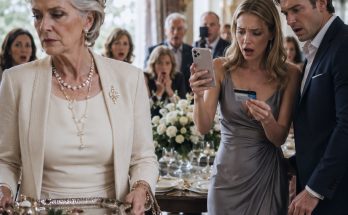
At My Wedding, My Parents Handed Me An Invoice. It Read, “$240K: The Cost Of Raising You. Payable Now That You’re Married.” The Guests Went Silent. I Looked At The Bill. Then I Handed Them An Envelope Of My Own. “Funny,” I Said. “I Have An Invoice Too.”
### Part 1
The envelope looked too elegant to be cruel.
That was the first thing I noticed when my father walked toward the microphone at my wedding reception, smiling like a man about to make everyone cry for the right reason. It was thick cream paper, tied with a narrow gold ribbon, and my mother carried it in both hands as if it were a newborn baby or a family Bible.
The ballroom smelled like buttercream frosting, white roses, and the faint lemon polish the hotel staff had used on the dance floor. Late afternoon sunlight came through the tall windows in wide, clean stripes, catching on the champagne glasses and the tiny crystals sewn into my dress. For once, every table in the room looked peaceful. My college friends were laughing near the bar. My husband, Callum, had one warm hand resting against the small of my back. His thumb moved gently, like he was reminding me to breathe.
I had spent three years planning that day carefully, not because I cared about centerpieces or linen colors more than anyone else, but because I knew my family. I knew how quickly they could turn a happy occasion into a courtroom.
My father, Silas Wren, loved an audience. He had a square jaw, silver hair, and the kind of deep voice that made bank tellers, waitresses, and church ushers hurry to please him. My mother, Maribel, stood beside him in a pale blue dress, her pearls shining at her throat. She was smiling too, but her smile had always been harder to read. It could mean pride. It could mean warning.
“Ladies and gentlemen,” my father said into the microphone.
The room quieted. Forks paused above plates. Someone at table nine gave a soft whistle.
My stomach tightened, but I told myself to stop being childish. Maybe this was the moment I had spent my whole life wanting. Maybe my father was going to say he was proud of me. Maybe he would mention how I had built a stable career in financial risk analysis, bought my own condo before thirty, and married a man who loved me without making me perform for it.
Maybe, for once, he would look at me and see his daughter instead of a running balance.
“Before my daughter begins her new life,” he said, “her mother and I have one final gift for her.”
People clapped politely. Callum leaned close and whispered, “You okay?”
I nodded, though my mouth had gone dry.
My mother stepped forward with the envelope. She handed it to me with both hands. Her nails were painted pale pink, the same color she had worn to my high school graduation, when she told me in the bathroom that my scholarship speech sounded “a little full of myself.”
“Open it, Arden,” she said.
My name is Arden Vail. I was thirty-four years old, standing in a wedding gown I had paid for myself, beside a man who had promised to build a life with me, when my parents decided to collect.
I untied the ribbon.
At first, my eyes refused to understand what they were seeing. The top page was printed neatly, with columns, dates, categories, and totals. There was a heading centered in bold black letters.
Invoice for the Cost of Raising Arden Vail.
A small laugh escaped someone near the back. Not a happy laugh. The kind people make when they are begging reality to be a joke.
I looked down the page.
Hospital delivery fees. Formula. Winter coats. School supplies. Piano lessons. Braces. Birthday parties. Summer camp. Groceries. Car insurance. College application fees. “Emotional labor from parents.” “Housing from birth through age eighteen.”
At the bottom, the number sat fat and final.
Total due upon marriage: $240,000.
My ears began to ring.
My father was still smiling.
Callum reached for the papers. I held them tighter.
“Dad,” I said softly, because even then a part of me wanted to give him one last chance. “What is this?”
He chuckled into the microphone. “A little family accounting.”
More awkward laughter moved through the room, thin and nervous.
Then his voice sharpened.
“Your husband has a good job. You have a good job. We figured now that you’re starting this big adult life, it’s time to recognize the investment that made it possible.”
My mother lifted her chin. “We sacrificed everything for you.”
I looked at her. Her eyes were clear. Not embarrassed. Not uncertain. Proud.
That was the moment my sadness shifted into something colder.
Because this was not spontaneous. This was typed, printed, organized, tied with ribbon, carried to a microphone, and presented in front of everyone I loved.
For years, their favorite sentence had followed me through every room of my life.
“After everything we spent on you, you owe us.”
They said it when I asked to join the debate team. They said it when I needed braces. They said it when I got accepted to college and cried because the scholarship letter was the first piece of mail that had ever felt like freedom. They said it when I bought my first used car, when I moved into a tiny apartment with a leaking kitchen window, when I sent them money after my father’s store had a bad winter.
I used to think they were just dramatic.
Parents complained. Parents exaggerated. Parents said things they didn’t mean.
But nobody accidentally brings a $240,000 bill to their daughter’s wedding.
The ballroom seemed to tilt slightly. I could see my younger brother, Beck, sitting three tables away, staring at the papers with his mouth parted. My aunt Junie covered her lips with a napkin. Callum’s mother looked horrified. My boss, who had been laughing ten minutes earlier, now sat perfectly still.
My father folded his arms.
“Well?” he asked into the microphone. “Are you going to say thank you?”
My mother’s smile widened.
The old Arden would have cried. She would have apologized for making the room uncomfortable. She would have folded the invoice and hidden it in her purse. She would have spent the entire honeymoon replaying the humiliation, wondering how to earn back warmth from people who used love like a toll road.
But the old Arden had started dying quietly seven months earlier, in a storage unit that smelled like dust, cardboard, and old cedar.
I lowered the invoice.
Then I reached beneath my chair.
Callum saw the movement and looked at me, surprised. He was the only person in that room who knew I had brought my own sealed envelope, but even he didn’t know everything inside it.
My envelope was plain gray. No ribbon. No gold seal. Just my name written across the front in my own handwriting.
I set it on the head table.
“Funny,” I said, my voice calm enough to scare even me. “I brought paperwork too.”
My father’s smile twitched.
My mother blinked once.
And in the silence that followed, I broke the seal.
### Part 2
I had not planned to read it.
That is the truth, no matter what my parents later told people. I had not come to my own wedding looking for revenge. I had not hidden evidence under my chair because I wanted a public execution. I had brought the envelope for the same reason some people carry umbrellas when the sky looks uncertain. Not because they want rain, but because they have been soaked before.
Seven months before the wedding, my grandmother’s house had been cleaned out.
My grandmother, Odessa Vail, had lived in a narrow yellow house outside Ashford, Ohio, with a screened porch, rose bushes, and a kitchen that always smelled like cinnamon gum. She was my father’s mother, and she was the only adult in my childhood who never made affection feel expensive.
When she got sick, I was twenty-six. I had just started my first serious job, the kind where you buy two blazers and pretend you aren’t eating peanut butter sandwiches for dinner. Every evening, after work, I drove forty minutes to Grandma Odessa’s house. I washed dishes. I sorted pills without ever calling them by name because she hated sounding like a hospital. I changed sheets. I sat with her while game shows flickered blue across the living room wall.
My parents said they were too busy.
My brother Beck was still in high school, and I didn’t blame him. He was a kid. My father’s hardware store needed help. My mother said her back hurt. So I went. I went until the nights blurred together and my car smelled permanently like drive-thru coffee and hand lotion.
Grandma used to squeeze my wrist and say, “You don’t have to keep proving you’re good, little bird.”
I never knew what to say to that.
After she died, the house sat mostly untouched. My father said it was too painful to sort through. My mother said old houses made her allergies act up. Years passed. Then, in January, my father called and told me he had finally rented a storage unit for the remaining family items.
“You should come get whatever little sentimental things you want,” he said. “Nothing valuable, obviously.”
That “obviously” stayed with me.
I went on a cold Saturday morning. The storage unit was at the edge of town behind a tire shop, with dirty snow pushed into gray piles along the fence. My father gave me the key but did not come inside.
“Take what you need,” he said. “Just don’t make a mess.”
Inside, I found boxes labeled in my grandmother’s handwriting. Quilts. Christmas ornaments. Church cookbooks. Old photographs. I touched everything carefully, like dust could bruise.
Near the back, under a cracked lamp shade, I found a green metal recipe box.
I opened it expecting index cards.
Instead, I found folded receipts, old bank slips, handwritten notes, and one photograph of me at fourteen, standing behind the counter of my father’s hardware store with a price gun in my hand and a smile too tired for a child.
The first note was written in my grandmother’s looping script.
“Arden keeps saving them. One day she may need proof.”
I sat down on the concrete floor and read until my fingers went numb.
There were copies of schedules from the hardware store, summers when I had worked full-time without pay. Receipts from groceries I bought for my parents after college. Copies of electric bills with my checking account number printed at the bottom. A small calendar marked with nights I stayed with Grandma Odessa. There were notes about babysitting Beck, school pickups, sick days, parent-teacher meetings my mother had skipped but told everyone she attended.
At first, I cried.
Then I got angry.
Then I got practical.
Numbers have always calmed me. Numbers don’t flatter you. They don’t gaslight you. They don’t rewrite a memory and dare you to argue. A number is a small, cold object you can hold up to the light.
So I started building a timeline.
Not because I wanted money. Not because I believed love should be reimbursed. I built it because my whole life, my parents had acted like I was a debt they were kind enough not to collect. For once, I wanted proof that I had not been only a taker in my own family.
Callum found me at our dining table three nights later, surrounded by bank statements, photographs, and old calendars.
He didn’t ask me to stop.
He made tea, sat across from me, and said, “Tell me where to start.”
That was Callum. Steady. Brown-eyed. Patient in a way that never felt weak. He worked as a civil engineer, designing bridges and drainage systems, and he had a habit of studying problems before touching them. When I told him my father sometimes joked that he expected a “return on investment” after the wedding, Callum’s jaw tightened.
“Do you think he’ll actually do something?” he asked.
“I don’t know,” I said.
That was only half true.
Two weeks before the wedding, my mother called me while I was checking final guest counts.
“Your father wants to make a small speech,” she said.
“Of course,” I replied.
“He’s been working on something special.”
Her voice had that bright, brittle sound, like glass tapped with a spoon.
“What kind of special?”
“Oh, don’t ruin it.” She laughed. “You’ve always been so suspicious.”
Behind her, I heard my father say, “She’ll finally understand.”
I stood in my kitchen holding the phone, watching rain streak down the window above the sink.
That night, I printed one copy of my timeline and slid it into the gray envelope.
Still, standing at my wedding, with two hundred guests watching and my father’s invoice trembling slightly in my hand, I hoped I would not need it.
Hope is stubborn that way. It keeps showing up with flowers after the funeral is already over.
I looked at my parents. Then I looked at Callum.
He gave one small nod.
I turned toward the room.
“I wasn’t planning to share this today,” I said. “I actually hoped we could celebrate love without turning family into a ledger.”
My father laughed under his breath. “Don’t be dramatic.”
I lifted the first page.
“This is not an invoice,” I said. “It’s a record.”
My mother’s face changed first. The proud smile thinned. Her hand moved toward my father’s sleeve.
“Arden,” she warned.
But for once, I did not stop when my mother said my name like a leash.
“For years,” I continued, “I was told that raising me created a debt. Since my parents chose to present that idea publicly, I think the full accounting should also be public.”
I glanced down at the first entry.
“Age fourteen,” I said. “Unpaid childcare.”
Beck’s head came up.
My father’s mouth tightened.
And the room leaned in.
### Part 3
When I was fourteen, I knew the sound of my brother’s school bus better than I knew my own friends’ voices.
It coughed at the corner at 3:18 every weekday, brakes squealing like an old screen door. I would already be waiting on the porch with my backpack still on, because if Beck got off the bus and nobody was there, he cried. He was six then, all knees, cowlicks, and dinosaur sneakers. My mother said he was sensitive. My father said boys toughened up eventually.
I made him grilled cheese. I checked his homework. I learned which cough meant he was faking and which cough meant he needed ginger ale and a blanket. I signed reading logs when my mother forgot. I washed grass stains out of his jeans before Dad could yell.
At the time, I thought every oldest daughter lived like that.
“This first section covers four years of after-school childcare,” I said into the microphone. “School pickups, meals, homework help, sick days, and weekends.”
My father let out a sharp breath. “You watched your brother. That’s what siblings do.”
I nodded. “I agree.”
That confused him.
“I agree completely,” I repeated. “That’s why I never billed you.”
The room stayed quiet.
I turned the page. “But since today you counted groceries, winter coats, birthday candles, and housing as debts I owe for being born, I used a standard local childcare rate and calculated only the hours I can document.”
My mother whispered, “Stop this.”
I looked at Beck.
He stood slowly from his chair. He was twenty-six now, tall and thin, with the same nervous habit of twisting his napkin that he’d had as a boy.
“She picked me up almost every day,” he said. His voice cracked, and he cleared it. “When I had the flu in second grade, Mom was at a salon appointment and Dad was at the store. Arden stayed home from school with me for three days.”
My father snapped, “Beck, sit down.”
Beck did not sit.
“I remember because she burned tomato soup and cried in the kitchen because she thought she was going to fail a biology test.”
A small sound moved through the room. Not laughter. Recognition.
I had forgotten that soup until he said it. Suddenly I could smell it again, sour and scorched, stuck to the bottom of a saucepan while Beck slept on the couch under my purple blanket.
I turned another page before memory could soften me too much.
“Age sixteen,” I said. “Summer employment at Wren Hardware.”
My father’s face flushed. “Family business.”
“Yes,” I said. “A family business where I worked forty hours a week for three summers without payroll records, while part-time employees my age earned minimum wage.”
“That money stayed in the household,” he argued.
“No,” I said quietly. “My labor stayed in the household. The money stayed with you.”
My uncle Dorian shifted in his chair. He owned a landscaping company and had always treated work like religion.
“Silas,” he said slowly, “you told me she was on payroll.”
My father’s eyes cut toward him. “Not now.”
But it was now. That was the thing about public cruelty. Once you open the door, you don’t get to decide which truths walk through it.
I held up photocopies of old schedules. The paper shook slightly, but my voice did not.
“I opened the store on Saturdays. I stocked shelves. I ran inventory. I handled returns. I missed two summer birthday trips because Dad said the store came first.”
My cousin Lark whispered, “I remember that.”
So did I. I remembered smelling like fertilizer, cardboard, and metal keys. I remembered older men calling me “sweetheart” while asking for plumbing parts. I remembered hiding in aisle six during my lunch break, eating crackers from a vending machine because I had forgotten to pack food and Dad said buying lunch made people lazy.
My mother lifted her chin. “You had a roof over your head.”
There it was again. The roof. The old family crown jewel. The thing they had provided because the law and decency required it, polished into a weapon.
“Yes,” I said. “And apparently today I was billed for it.”
A few guests shifted uncomfortably. My father glanced toward the invoice he had given me, as if wishing he could pull it back with his eyes.
I turned to the next section.
“Age nineteen. College.”
My mother straightened, relieved. She thought she knew this part. She had told people for years that they “put me through school,” even though the truth was more complicated and less flattering.
“My parents told me there wasn’t money for tuition,” I said. “So I applied for scholarships, worked evenings at the campus library, and cleaned offices on Sunday mornings.”
My mother interrupted, “We helped when we could.”
I nodded again. “You paid for one semester of used textbooks. I included that as a credit in your favor.”
That got a few startled looks.
My father looked almost triumphant until I continued.
“Three months after telling me there was no money for tuition, my parents remodeled their kitchen.”
The room changed temperature.
My aunt Junie whispered, “The granite counters.”
I placed a photograph on the head table. My parents standing in their new kitchen, smiling beside a double oven. I had taken that picture during Thanksgiving break, two days after I pawned a gold bracelet Grandma Odessa had given me because my rent was short.
My mother’s face went pale.
“That photo doesn’t prove anything,” my father said.
“No,” I replied. “But the contractor deposit paid from your checking account three months after my scholarship appeal does.”
The wedding photographer stood frozen near the cake, camera hanging at his chest. I suddenly wondered if he was capturing this. Then I realized I didn’t care.
I turned the page again.
The next section was smaller, but heavier.
“Age twenty-two through twenty-four,” I said. “Family support after graduation.”
My father’s eyes dropped.
That was how I knew he remembered.
### Part 4
After college, I moved into an apartment above a laundromat where the walls sweated in July and smelled like dryer sheets in winter.
The floors sloped so badly that if I dropped a pen, it rolled toward the bathroom. I owned two plates, one saucepan, and a thrift-store couch that scratched the backs of my legs. Still, I loved that place. It was mine. Nobody could knock on the door and tell me I owed them rent for the privilege of breathing.
My first job paid less than I pretended. I wore blazers from clearance racks and kept a pair of heels under my desk because the ones I wore on the bus got ruined in rain. Every Friday, I allowed myself one expensive coffee. Every Sunday, I called my grandmother’s old number and listened to the disconnected tone for three seconds before hanging up.
Then my father’s hardware store had a bad winter.
It began with a phone call from my mother.
“The electric bill is late,” she said.
I was standing in the frozen-food aisle at Kroger, comparing prices on store-brand vegetables.
“How late?”
She sighed like my question hurt her. “Late enough that your father is embarrassed.”
That was all it took then. Their embarrassment had always been my emergency.
I paid the bill.
Then I paid another.
Then I paid the phone line for the store because Dad said customers couldn’t call in orders. I paid the overdue supplier balance once because my mother cried and said the town would talk. I paid their car insurance one month because Beck needed rides to basketball practice and my father said I was being selfish if I let the policy lapse.
At my wedding, I lifted the bank statements one by one.
“Eighteen months of documented utility and business support,” I said. “Not loans. I was never repaid, and I never asked.”
My father finally stepped away from the microphone. He no longer seemed interested in performing.
“That was private,” he hissed.
“So was my childhood,” I said. “Until you itemized it in front of my guests.”
Callum’s hand found mine under the table. His palm was warm. Mine was ice-cold.
My mother looked around, suddenly aware of every eye. “We were struggling.”
“I know,” I said. “That is why I helped.”
“You’re making it sound ugly.”
“No,” I answered. “You made help ugly when you called it debt.”
She flinched, but only for a second. My mother recovered quickly. She had survived for decades by turning every accusation into an injury against herself.
“We gave you life,” she said.
A chair scraped somewhere in the back. Callum’s sister muttered something I couldn’t hear.
I folded the statement and set it down.
“And I spent years trying to be grateful enough for that life,” I said. “But gratitude is not supposed to be a payment plan.”
I moved to the next section.
Grandma Odessa.
The room softened when her photograph appeared. Even my father looked away.
In the picture, she was sitting in her floral armchair with a crocheted blanket over her knees. I was beside her, younger and thinner, my hair falling out of a messy bun, both of us laughing at something outside the frame.
“For seven months,” I said, “I cared for Grandma Odessa after work.”
My father barked, “Don’t drag my mother into this.”
That was the first time anger cracked my calm.
“You dragged your mother into this when you included family vacations and lunch money on an invoice,” I said. “You don’t get to decide which memories count.”
The microphone picked up the sharpness in my voice. I heard it echo lightly through the speakers.
I took a breath.
“I’m not listing this because I regret loving her,” I said. “I don’t. Those evenings with her were some of the only peaceful parts of my twenties.”
For a moment, I was back in that yellow house, hearing the hum of the refrigerator and the soft tick of the kitchen clock. Grandma’s hands smelled like lavender lotion. She liked her tea lukewarm and her toast almost burned. Some nights she knew exactly who I was. Some nights she called me by my mother’s name and cried because she thought she had forgotten to pick me up from school.
I never told my father those details. He wouldn’t have known what to do with tenderness he couldn’t spend.
“I missed work events,” I continued. “I used vacation days. I drove back and forth after twelve-hour days. I bought groceries, paid for supplies, cleaned, cooked, and sat beside her when she was afraid.”
My aunt Junie began crying silently.
My father stared at the floor.
“Grandma kept records,” I said.
His head snapped up.
That was the first real clue I had not meant to reveal so early. I saw panic flicker across his face, quick as a match.
My mother saw it too.
“What records?” she asked.
I looked at the green recipe box sitting open beside my envelope. I had brought it wrapped in a linen napkin, tucked into a tote bag behind the head table. Until that second, no one had noticed.
I touched the lid.
“Enough,” I said.
My father’s face changed in a way I had seen only twice before. Once when a bank letter arrived certified. Once when Grandma Odessa asked him why Arden was paying bills a child should never carry.
He reached toward the box.
Callum moved first. Not aggressively. Just enough to place his body between my father’s hand and the table.
“Don’t,” Callum said.
One word. Quiet. Final.
My father froze.
The ballroom held its breath.
And for the first time all day, my mother looked afraid.
### Part 5
People think the truth arrives like thunder.
Sometimes it arrives like paper.
Thin paper. Faded ink. A receipt folded into quarters. A note written by an old woman who knew her son better than she wanted to.
I opened Grandma Odessa’s green recipe box and took out the first card. It was not one of the worst ones. I chose carefully. Even in that moment, even after everything, some old foolish part of me still tried to protect my father from the full shape of himself.
“This is from March 12, twelve years ago,” I said.
My father’s jaw worked.
I read, “Arden paid store electric again. Silas said he would repay her after spring sales. I do not believe him.”
My mother pressed a hand to her throat.
I took out another.
“June 3. Arden worked open to close. No wages. Silas called it character building. She looked exhausted.”
A murmur spread through the room.
My father lunged verbally because he could no longer control physically.
“My mother was old,” he snapped. “She wrote all kinds of things.”
“She wrote dates,” I said. “Amounts. Check numbers. Names.”
My father looked toward the exits.
There it was, the red herring everyone had believed for years: that my grandmother had been confused, sentimental, maybe unreliable. My father had leaned on that idea whenever she challenged him. He called her dramatic. Forgetful. Too attached to me.
But Grandma had been sharper than any of us.
I pulled out a small stack of photocopies.
“These are not all of the records,” I said. “I’m not reading all of them today.”
My mother whispered, “Then why bring them?”
I looked at her. “Because I knew you might try to humiliate me, and I wanted to remind myself I wasn’t crazy.”
That sentence landed harder than any number I had read.
For years, their greatest talent had been making me doubt my own memory.
If I remembered working at the store unpaid, Dad called it “helping out.” If I remembered missing school events to watch Beck, Mom called me “dramatic.” If I remembered paying bills, they called it “temporary family support.” If I remembered crying in bathrooms after their phone calls, they called me “too sensitive.”
But there, under ballroom chandeliers and white roses, my memories had paper bodies.
My father grabbed the microphone again. His hand was shaking.
“All right,” he said loudly. “Enough. This was meant as a joke. Arden has always struggled to take a joke.”
The old accusation. The old trap. If I reacted, I proved him right. If I stayed silent, he rewrote the room.
I smiled slightly.
“A joke usually has a punchline,” I said. “Yours had a due date.”
Several guests gasped. Someone near the bar made a sound like they were trying not to clap.
My mother stepped forward, tears shining now. Not guilt tears. Performance tears.
“Is this what you wanted?” she asked. “To destroy your parents at your wedding?”
“No,” I said. “I wanted my parents to give a toast.”
She looked struck. For one second, I almost felt sorry for her. Then she said, “After everything we did, you still find a way to be cruel.”
Callum’s mother stood.
She was a small woman named Elowen Hart with silver-blond hair and a voice soft enough that people leaned in automatically.
“Maribel,” she said, “your daughter is not being cruel. She is responding to cruelty.”
My mother turned red.
My father pointed at Callum. “This is your influence.”
Callum did not raise his voice. “I helped Arden organize documents. I did not create them.”
“You think you know our family?”
“No,” Callum said. “But I know what shame looks like when someone tries to gift-wrap it.”
That was when Beck walked to the front.
He had been quiet too long. His face was pale, and his tie hung loose at his collar. My little brother, the boy I had once carried from the couch to bed because he fell asleep during cartoons, stood between our parents and me like he was finally seeing the furniture in a room after living there blindfolded.
“I need to say something,” he said.
My father groaned. “Beck, don’t start.”
But Beck took the microphone from him.
“I used to think Arden liked taking care of me,” he said. “I thought she was just better at everything. Better at homework, better at cooking, better at making Mom stop crying and Dad stop yelling.”
My eyes burned.
Beck looked at me. “I didn’t know they made you responsible for me. I didn’t know you were missing things. I didn’t know you were paying bills.”
My mother whispered, “You were a child.”
“So was she,” Beck said.
Those three words cracked something open in the room.
So was she.
I had spent twenty years being treated like a backup adult, an unpaid worker, a spare parent, a family wallet with a polite smile. Hearing Beck say it plainly made the air leave my lungs.
My father turned away, but there was nowhere for him to go.
Then Aunt Junie rose.
“I remember the winter Odessa called me,” she said. “She said Arden looked worn down. She said Silas was taking advantage.”
My father slammed his palm on the table. Silverware jumped.
“That is enough.”
No one moved.
Aunt Junie lifted her chin. “No, Silas. It wasn’t enough then. Maybe it should be enough now.”
The ballroom lights glowed warm against the white tablecloths. Outside the windows, the sun had lowered, turning the trees gold. It should have been the hour for dancing, cake, and photographs. Instead, my family history sat open on the head table beside my bouquet.
I picked up the final page of my own document.
My hands no longer shook.
“At the bottom,” I said, “using your method of assigning dollar values to family life, the estimated total of my unpaid contributions is $312,480.”
The number rippled through the guests.
My father stared at me.
My mother sat down as if her knees had vanished.
“And unlike yours,” I added, “mine does not include the cost of emotional damage, missed childhood, or learning too young that love had conditions.”
For once, even my father had no words.
### Part 6
I slid the final page across the table toward him.
Not thrown. Not slapped down. Just slid, with two fingers, across white linen scattered with rose petals and torn bits of ribbon.
“If family is business,” I said, “then according to your own rules, you owe me $72,480 after offset.”
My father stared at the page.
Behind him, the wedding cake stood untouched, five tiers of vanilla cream and sugared flowers. The tiny bride and groom topper smiled stupidly at the whole room.
Nobody laughed now.
My mother finally found her voice. “You cannot seriously expect us to pay that.”
“I don’t,” I said.
She blinked.
“I never did.”
My father looked up sharply, suspicious of mercy because he had never understood it.
“I don’t want a check,” I said. “I don’t want reimbursement. I don’t want repayment for watching Beck, working at the store, caring for Grandma, paying bills, or showing up every time you called me selfish for wanting a life.”
Callum squeezed my hand.
“I want the debt to end.”
My father scoffed weakly. “You’re the one with spreadsheets.”
“Yes,” I said. “Because spreadsheets were the only language you respected.”
That hurt him. I saw it. Not deeply enough to change him, maybe, but enough to bruise his pride.
I picked up his invoice.
The paper felt expensive. Thick. Smooth. He had spent time on it. Maybe he had imagined applause. Maybe he had pictured Callum laughing awkwardly and promising to “take care of it.” Maybe he had imagined me blushing, humiliated but obedient, tucking the bill away like a daughter who knew her place.
Instead, I tore it in half.
The sound was small and clean.
My mother gasped.
I tore it again. Then again.
White pieces fell onto the table like ugly confetti.
“I am not paying for being born,” I said.
Then I picked up my own counter-invoice.
My father watched carefully, as if expecting me to demand a signature.
Instead, I tore that too.
The guests seemed startled by that part.
Maybe they expected me to keep it framed. Maybe they thought I would send it by certified mail. But the point had never been to become my parents. The point was to stop letting them turn love into a ledger.
“This ends today,” I said. “I won’t bill you. You won’t bill me. You won’t joke about what I owe. You won’t tell my husband he married into a debt. You won’t use money, childhood, or Grandma’s memory to shame me again.”
My father’s eyes narrowed. “And if we don’t accept your terms?”
A strange calm moved through me.
“Then you won’t be part of my life.”
My mother made a wounded sound. “On your wedding day?”
“Especially on my wedding day.”
The room stayed silent. I could hear ice melting in glasses. Somewhere, a child whispered and was hushed.
My father looked around, searching for allies. He found none willing to meet his eyes.
“You’ll regret this,” he said.
That sentence once would have folded me in half.
I looked at Callum, then at the guests, then back at my father.
“No,” I said. “I think I’ll grieve it. That’s different.”
His face hardened.
“Fine,” he said. “If you want to humiliate your mother and me, we’ll leave.”
He expected me to stop him. I saw it in the pause after “leave.” My whole childhood had trained me to chase that pause, to run after slammed doors, to apologize before I understood my crime.
I did not move.
My mother rose slowly. Tears streaked her makeup now, but even those tears seemed angry.
Beck stepped toward her. “Mom.”
She turned on him. “Don’t.”
He stopped.
My parents walked out of my wedding reception while every person watched. My father’s shoulders were rigid. My mother clutched her purse like it was keeping her upright. At the doorway, she turned back once.
“You have no idea what family means,” she said.
I looked at the torn invoices on the table.
“I’m starting to learn.”
Then they were gone.
For several seconds, the room remained frozen in the shape of their exit.
Then Callum took the microphone.
He did not make a speech. He simply said, “I love my wife. I am proud of my wife. And there is still cake.”
The room exhaled.
Someone laughed softly. Then someone clapped. Not loud at first. Just a few hands, uncertain but warm. Then more joined. Aunt Junie wiped her face. Beck came to me and hugged me so hard my ribs hurt.
“I’m sorry,” he whispered.
I held him. “You were a kid.”
“So were you,” he said again.
That time, I let myself cry.
Not the collapsing kind. Not the kind my mother could turn into proof of weakness. Just two tears sliding down before I wiped them away and breathed.
The band started again, gently at first. The wedding planner, a woman named Petra who looked like she had handled hurricanes with a clipboard, cleared the torn paper from the head table. Callum’s mother fixed my veil. My boss brought me a glass of water and said, “For what it’s worth, your presentation skills are excellent.”
I laughed. Actually laughed.
And then Callum led me to the dance floor.
Our first dance was not perfect. My eyes were swollen. My hands were cold. Half the guests were still pretending not to stare. But Callum held me like there was no audience, no invoice, no wound older than our marriage.
Halfway through the song, he leaned down and whispered, “You don’t owe me anything either.”
I closed my eyes.
That was when the real wedding began.
### Part 7
The story did not end when my parents left the ballroom.
People like my father rarely surrender after one public loss. They retreat, rebuild the narrative, and come back with witnesses.
The first message arrived before Callum and I reached the airport for our honeymoon.
It was from my mother.
“I hope you enjoyed punishing us. Your father has chest pain from the stress.”
I stared at the screen in the passenger seat of Callum’s truck while morning sunlight flashed over the windshield. My wedding dress was hanging in a garment bag behind us. My hair still smelled faintly of hairspray and roses. I should have been thinking about the coast, the little rented cottage in Maine, and the lobster rolls Callum had been talking about for weeks.
Instead, my thumb hovered over my mother’s message.
Callum glanced over. “You don’t have to answer.”
“I know.”
Knowing and feeling are different countries.
Then another message came.
“Relatives are calling. You embarrassed us beyond repair.”
Then another.
“Your grandmother would be ashamed.”
That one landed.
I turned the phone face down on my lap.
Callum pulled into a gas station, parked near the air pump, and turned toward me.
“What do you need?” he asked.
No fixing. No command. No “ignore them” delivered like a test of strength. Just a question.
“I need not to be reachable,” I said.
So he held out his hand. I gave him the phone. He turned it off and placed it in the glove compartment like he was putting away a small, poisonous animal.
Maine was gray, windy, and perfect.
We rented a cottage with blue shutters and a porch that faced the water. The mornings smelled like salt and coffee. Gulls screamed over the docks. Callum wore sweaters and bought too many pastries. For five days, I slept without dreaming of invoices.
But silence from my parents was not peace. It was weather gathering.
When we came home, there were voicemails from relatives I barely knew. Some were supportive. Some were curious in the greedy way people get when family pain becomes entertainment. A few scolded me.
My father sent one email with the subject line “Settlement.”
I almost deleted it.
Callum sat beside me at the kitchen island while I opened it.
There were only four sentences.
“Since you insist on treating this as a financial dispute, your mother and I are willing to drop the matter if you issue a written apology to all wedding guests. You will state that your claims were exaggerated and that our invoice was a humorous symbolic gesture. You will return any family records taken from Odessa’s belongings. Failure to do so will result in legal action.”
I read it twice.
Then I laughed.
It wasn’t a happy laugh. It was the sound a locked door makes when you realize you have the key.
Callum raised his eyebrows. “Legal action?”
“He wants Grandma’s recipe box.”
“Do you think there’s more in it?”
I looked toward the hallway closet where the box sat inside a fireproof safe.
“Yes.”
That night, I went through every card again.
I found what I had missed before because grief and anger had blurred my vision.
Behind a stack of grocery receipts was an envelope addressed to me in Grandma Odessa’s handwriting.
Little bird.
My hands went numb.
Callum sat beside me but did not touch the envelope. He understood that some things had to be opened by the person they were meant to break or heal.
Inside was a letter, two pages long.
Grandma had written it six months before she died.
She said she was sorry for not stepping in sooner. She said my father had always believed help was something he deserved and gratitude was something others owed. She said she had watched me become smaller in my own family, and it had frightened her.
Then came the part that made the room tilt.
“I changed my will because of what I saw. Your father does not know the final copy exists. If he tries to take what is yours, speak to Mr. Bram Holloway in Ashford. He has instructions.”
Bram Holloway.
I knew that name. He had been Grandma’s attorney, a quiet man with half-moon glasses who sent Christmas cards with watercolor birds on them.
The next morning, I called his office.
He was retired, but his daughter ran the practice now. Her name was Sable Holloway, and when I told her who I was, she went quiet for a moment.
“We’ve been hoping you would call,” she said.
My hand tightened around the phone.
“There is something your grandmother left for you,” she continued. “And Arden, I need you to know this before you come in. Your father asked about those records three times after she passed.”
My kitchen clock ticked loudly behind me.
“What records?” I asked.
Sable paused.
“The ones proving your grandmother loaned your father money for the store,” she said. “And the ones proving he never repaid her.”
Outside, a delivery truck groaned down our street.
Inside, my childhood rearranged itself again.
### Part 8
Sable Holloway’s office smelled like old books, black coffee, and rain.
It was on the second floor of a brick building above a florist, with narrow windows overlooking Ashford’s main street. Callum came with me, but he waited in the reception area because I asked him to. Not because I wanted secrecy from him. Because I needed one room where my grandmother’s voice could reach me without anyone else’s breathing.
Sable was in her forties, with dark curls pinned at the back of her head and a calmness I trusted immediately. She placed a navy folder on the desk between us.
“Your grandmother was very specific,” she said. “She did not want to create a family war while she was alive. But she also did not want you erased.”
Inside the folder were documents I had never seen.
A small life insurance policy Grandma had left in my name, never claimed because my father had told everyone there was “nothing but debt.” A savings account with me listed as beneficiary. Copies of loans made to my father over the years, signed by him, witnessed by Bram Holloway, and unpaid. A revised will leaving Grandma’s yellow house not to my father, as he had implied for years, but to be sold, with a portion placed in trust for me.
The house had been sold nine years ago.
I looked up slowly.
“Sable,” I said, “I never received anything.”
“I know,” she replied.
Two words. Heavy as stone.
“What happened?”
She folded her hands. “Your father filed an earlier copy of the will. By the time questions arose, the estate appeared too small to contest without someone pushing. My father was ill then. He wrote to you twice.”
“I never got letters.”
“I suspected that.”
The room narrowed.
I remembered my mother collecting mail from my apartment “because she was nearby.” I remembered my father telling me not to worry about Grandma’s estate, that grief made people greedy, that asking questions would make me look ugly.
Ugly.
That word had kept me silent for years.
Sable slid another page forward. “There may still be legal remedies, especially regarding the insurance and beneficiary account. Some claims are old. Some are not. I won’t promise an outcome. But I can promise your grandmother tried to protect you.”
I looked down at Grandma’s signature.
Odessa Mae Vail.
The loops and slants were familiar enough to hurt.
“She called me little bird,” I said.
Sable smiled softly. “The letter in this file does too.”
I pressed my hand over my mouth.
For the next hour, Sable explained options. Calmly. Carefully. No drama. No revenge fantasy. Just facts, timelines, filings, signatures, certified mail, bank records.
It turned out my father’s wedding invoice had done more than humiliate me. It had opened a door he had spent years bracing shut.
Because once he claimed I owed him money for being raised, he invited questions about every dollar, every record, every family obligation he had buried under noise.
We did not sue immediately. That surprised people later. They expected fireworks because they had seen the wedding video. Yes, there was a video. Of course there was. By the time Callum and I returned from Maine, clips of my father handing me the invoice had traveled through family group chats like a kitchen fire.
But I waited.
I let Sable gather documents. I let her send formal requests. I let banks search archives. I let silence do what shouting could not.
My father called once.
I answered because Sable told me to document all communication.
“You need to stop digging,” he said.
No hello. No apology.
I sat at my kitchen table with the phone on speaker. Callum sat across from me, writing the date and time on a legal pad.
“Why?” I asked.
“Because you’re going to destroy this family.”
I looked out the window. Our neighbor was mowing his lawn. The ordinary sound made the moment feel even stranger.
“No,” I said. “I’m going to find out what happened.”
“You think you’re innocent?” he snapped. “You stood in front of everyone and made us monsters.”
“I stood in front of everyone and read receipts.”
His breathing grew harsh.
My mother came on the line then, voice thick with anger. “If you loved us, you would let this go.”
And there it was, the oldest hook.
I closed my eyes.
“I did love you,” I said. “That’s why you got away with so much.”
Neither of them spoke.
Then I added, “Please direct future communication to my attorney.”
I hung up before they could answer.
It took five months.
Five months of documents, statements, meetings, and family members choosing sides in the careful way people do when truth becomes inconvenient. Beck chose me. Aunt Junie chose me. Uncle Dorian called and apologized for not seeing enough. Others disappeared, which was its own kind of answer.
By spring, Sable had recovered the insurance payout with interest. The beneficiary account was traced. The estate issue was more complicated, but my father agreed to a settlement after Sable produced copies of his signed loan documents and the letters Bram Holloway had mailed to me.
The amount was not movie-level money.
It was not millions. It did not buy a mansion or a yacht or a new identity.
But it was enough to pay off my remaining student loans, create an emergency fund, and donate a portion to the hospice center that had cared for Grandma Odessa. It was enough to prove that my father had not just exaggerated. He had hidden things.
The day the settlement cleared, my mother sent one last email.
“We hope money makes you happy.”
I stared at it for a long time.
Then I typed back one sentence.
“Peace already did.”
After that, I blocked them.
Not forever in a dramatic, door-slamming way. Just firmly. Quietly. Like turning off a stove after being burned too many times.
A year later, Callum and I hosted our first anniversary dinner in our backyard. Nothing fancy. String lights, grilled chicken, lemonade in glass pitchers, grocery-store flowers in mason jars. Beck came early and helped Callum fix a wobbly table. Aunt Junie brought potato salad and cried when she saw Grandma Odessa’s recipe box on a shelf in my kitchen.
I kept it there now. Not hidden. Not locked away.
Inside were the records, yes. But also recipe cards. Cinnamon rolls. Lemon icebox pie. Chicken soup with too much pepper. Proof that family could feed you without billing you later.
After dinner, Callum and I danced barefoot on the patio while our friends clapped off-beat and Beck laughed so hard he spilled lemonade on his shirt.
For years, I believed love was something I had to earn by being useful, quiet, grateful, and easy to invoice.
I know better now.
My parents did raise me. That part is true. They fed me, clothed me, housed me, and gave me a last name. But they also taught me something they never intended.
They taught me that any love requiring repayment was never love I needed to keep.
So no, I did not forgive them in the way people like to demand at the end of painful stories. I did not invite them back because they were old. I did not soften the truth because it made other people uncomfortable. I did not pretend the wedding was a misunderstanding.
I built a life without their ledger.
And every morning, when sunlight moves across my kitchen and catches on that old green recipe box, I remember my grandmother’s words.
“You don’t have to keep proving you’re good, little bird.”
I don’t.
I never did.
THE END!