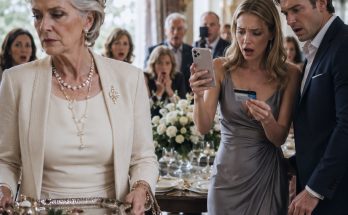
While I Was At The Bank Finalizing A Loan, My Neighbor Called, “Why Is There A Moving Truck Outside?
While I Was At The Bank Signing A Loan, My Neighbor Called, Her Voice Shaking. “Are You Moving?” “No, I’m Here With My Daughter.” She Hesitated Before Whispering, “Then Why Is Someone Loading Your Furniture Into A Moving Truck?” My Daughter Shot A Panicked Look At Her Husband.
### Part 1
The pen was already between my fingers when my phone started buzzing against the polished desk.
I remember the sound because everything else in that bank was too quiet. The soft hum of the air conditioner. The clicking of the loan officer’s keyboard. The faint smell of burnt coffee from the little waiting area by the glass doors. My daughter, Wren, sat on my left with her hands folded so tightly in her lap that her knuckles looked pale. Her husband, Callum Voss, sat on my right, leaning back like he had already won something.
The loan papers were spread in front of me.
My house was on the line.
Not because I was careless. Not because I wanted a bigger kitchen or a new car or some vacation I couldn’t afford. I was trying to refinance the last ugly knot of debt left behind after my husband, Owen, died three years earlier. Medical bills. Funeral expenses. A roof replacement I had put off too long. Life had not ruined me, but it had pressed its thumb hard against my throat.
The loan officer, a young man named Tyler with a wedding ring too shiny to have seen much trouble yet, smiled gently.
“Take your time, Mrs. Ellery,” he said.
I nodded, but I didn’t take my time. I was tired of surviving in small payments. I wanted one clean plan, one straight road, one month where I didn’t wake up at 3:16 in the morning doing math in my head.
Then my phone buzzed again.
Tessa Whitcomb.
My neighbor across the street.
I almost sent it to voicemail. Tessa called about small things. A package left on my porch. A strange raccoon near the trash cans. Whether I wanted extra tomatoes from her garden.
But something made me answer.
“Hey, Tessa,” I said softly, pressing the phone to my ear. “I’m at the bank. Can I call you back?”
For a second, there was nothing.
Only breathing.
Then Tessa whispered, “Maren, are you moving?”
I blinked at the loan papers.
“What?”
“Are you moving?” she asked again, and this time her voice shook. “Like today?”
I sat up straighter. Across from me, Tyler paused his typing. Wren’s head lifted fast. Callum’s coffee cup stopped halfway to his mouth.
“No,” I said slowly. “I’m at the bank with Wren and Callum. Why would you ask me that?”
Tessa was quiet again.
Then she said the sentence that split my life into before and after.
“Then why is there a moving truck outside your house?”
The bank seemed to shrink around me.
I looked at Wren.
She looked at Callum.
It was quick. Less than a second. A small, terrified flick of her eyes.
But I saw it.
Callum’s cup trembled. A dark line of coffee spilled over the rim and dotted his gray slacks. He didn’t wipe it away. He just stared at the carpet.
“Tessa,” I said, and my voice sounded like it belonged to someone else. “What exactly are you seeing?”
“Two movers,” she whispered. “Maybe three. Big white truck. No company name I can see. They’re carrying boxes out your front door.”
My fingers went numb around the phone.
“That’s impossible.”
“I thought maybe you hired them,” she said. “But Maren, they just took your blue wingback chair. The one Owen bought you.”
The room tilted.
That chair sat by the living room window. Owen had bought it for me at an estate sale the year before he got sick. It had one wooden leg that never sat right and a sun-faded patch on the arm where I always rested my elbow. I had read in that chair. Paid bills in that chair. Cried silently in that chair the first winter after he died.
Nobody would touch that chair unless they believed I would not stop them.
Tyler looked from my face to Wren’s.
“Mrs. Ellery?” he asked carefully. “Is everything okay?”
“No,” I said.
Wren whispered, “Mom—”
I turned to her.
She flinched before I said a word.
That flinch told me more than any confession could have.
“What did you do?” I asked.
Her lips parted, but no sound came out.
Callum stood too quickly, knocking his knee against the desk. “Maren, let’s not make a scene.”
“A scene?” I repeated.
He lowered his voice. “There’s probably a simple explanation.”
Tessa spoke again through the phone, her voice smaller now. “Maren, they’re going upstairs.”
My heart kicked hard.
“Upstairs where?”
“I can see through your front window. One of them is carrying something long. Maybe a mirror. Maybe from your bedroom.”
My bedroom.
The place where Owen’s watch still sat in the top drawer. The place where I kept the cedar chest with old letters, insurance documents, his folded Army jacket, and the tiny hospital bracelet from the day Wren was born.
No stranger belonged in there.
No mover.
No anyone.
I stood so fast the chair legs scraped the bank floor.
“I’m not signing,” I said.
Tyler froze with the pen still extended toward me. “Mrs. Ellery?”
“I’m not signing anything.”
Callum stepped into my path. “Maren, wait.”
I looked at him then. Really looked at him.
Callum had the kind of face people trusted too quickly. Clean haircut. Soft voice. Expensive watch he never explained. He always spoke like he was calming down a difficult customer. Even at family dinners, he made every conversation feel like a negotiation.
“Move,” I said.
Wren stood behind him, tears already bright in her eyes.
“Mom, please,” she whispered.
That was the moment my fear changed shape.
It became cold.
Because my daughter was not confused.
She was not surprised.
She was afraid I had found out too soon.
I walked past them, through the bank lobby, past the fake ficus tree and the bowl of free peppermints and the old man waiting to cash a check. Behind me, Callum kept saying my name. Wren kept saying nothing.
Outside, the July heat hit me like an open oven.
I got into my car with my hands shaking so badly it took two tries to start the engine.
As I pulled out of the parking lot, Tessa said, “Maren, should I call the police?”
I stared at Wren and Callum rushing toward their car in my rearview mirror.
“No,” I said. “Not yet.”
Because by then, I understood one thing with awful certainty.
The people robbing my house had not broken in.
Someone had given them a key.
### Part 2
The drive home should have taken twelve minutes.
It felt like an hour.
Every red light turned against me. Every slow car seemed planted there to keep me trapped inside my own thoughts. My hands gripped the steering wheel so tightly the leather creaked under my palms. The summer sun flashed across windshields and storefront windows, bright and cruel, while my mind dragged up every conversation I had ignored because loving your child makes you generous with excuses.
Six months earlier, Wren had asked, “Mom, do you still keep important papers in that old safe?”
We were in my kitchen. I was peeling potatoes. She was sitting at the counter, tapping her nails against a mug she hadn’t drunk from.
“I keep some things there,” I said.
“Like house stuff?”
“Some.”
She had smiled too fast. “I’m only asking because Callum says you should digitize everything. You know, in case of fire.”
At the time, I thought she was being helpful.
Two months after that, Callum had stood in my garage, studying the rafters like they offended him.
“You know, this place is worth more than you think,” he said. “With the market the way it is, you could cash out and be comfortable.”
“I am comfortable,” I told him.
He looked around at my old lawn mower, the stack of Christmas bins, Owen’s fishing rods hanging on hooks.
“With all due respect, Maren,” he said, “you’re attached to memories, not assets.”
I should have hated him then.
Instead, I told myself he was young. Ambitious. A little arrogant, maybe, but Wren loved him.
That was what I always came back to.
Wren loved him.
The Wren I raised had been a soft-hearted child who cried if someone stepped on a worm after rain. She used to sneak into my room during thunderstorms, dragging a stuffed rabbit by one ear. She wrote Father’s Day cards to Owen after he died and left them on the mantel because, as she once told me, “Maybe heaven has mail.”
That girl would never empty my house behind my back.
But the woman at the bank had looked at her husband before she looked at me.
My phone rang again.
Tessa.
“They’re moving faster,” she said the second I answered. “Maren, I don’t like this.”
“Are they still there?”
“Yes. One of them just carried out your cedar chest.”
The sound that left me wasn’t quite a gasp.
It was smaller. Worse.
That cedar chest had belonged to my grandmother. It smelled faintly of lavender, dust, and old wood. Owen had repaired the hinges the first year we were married. Inside were the pieces of my life nobody could replace.
“Tessa,” I said, forcing myself to breathe, “stay inside your house.”
“I’m filming from my window.”
“Good.”
“There’s something else.”
My foot eased off the gas.
“What?”
“One of them went into your study. The one with the safe.”
My eyes stung.
“Can you see the safe?”
“No. But he came out holding a black folder. Maybe two.”
Only three people knew where that safe was.
Me.
Wren.
And Owen, who had been dead for three years.
I turned onto Maple Hollow Drive going too fast.
My neighborhood looked painfully normal. Sprinklers ticking over green lawns. A boy riding a bike with a crooked helmet. Someone grilling hamburgers, the smell of charcoal drifting through the hot afternoon. And there, in my driveway, was a moving truck backed up to my front porch like a mouth waiting to swallow everything I had left.
The front door stood wide open.
A stranger in a navy T-shirt came down my porch steps carrying a box labeled with nothing but a red sticker. Behind him, another man wrestled with my floor lamp.
I slammed the car into park crooked across the curb.
“What are you doing?” I shouted before my feet even touched the driveway.
Both movers froze.
The man with the box blinked at me. “Ma’am?”
“That is my house. What are you doing inside my house?”
He set the box down carefully. “We were hired for a scheduled move.”
“By who?”
He looked toward the street.
I followed his gaze.
Wren and Callum’s car had pulled in behind mine.
Callum got out first. He adjusted his jacket like we were meeting for brunch.
“Maren,” he said, “please calm down.”
I walked toward him.
I was not screaming now.
Some kinds of rage become quiet because they know they need to last.
“Answer the question,” I said. “Who hired these men?”
Callum spread his hands. “We did.”
Wren stepped out of the passenger side, crying silently. Her hair was pinned back, but loose strands clung to her damp cheeks. She looked younger than thirty in that moment. Younger and guilty.
“You did,” I repeated.
Wren swallowed. “Mom, we thought—”
“No.” I pointed at the house. “You do not get to start with what you thought. You start with what you did.”
A curtain moved in the house across the street. Then another. Neighbors were watching, and for once I was grateful.
Callum lowered his voice. “This isn’t the way we wanted you to find out.”
“Find out what?”
He glanced at the movers, then at Wren. “The house sale is moving faster than expected.”
For a moment, the whole street went silent in my ears.
“The what?”
“The sale,” he said, as though repeating it gently would make it sane. “The buyer requested early possession. We arranged to have your belongings placed in storage.”
“My belongings.”
“Yes.”
“My house.”
His jaw tightened.
Wren whispered, “Mom, you were struggling.”
I turned to her.
“I was refinancing.”
“That loan wasn’t enough,” she said, her voice breaking. “Callum said—”
“Callum said,” I repeated.
She flinched again.
Callum stepped between us. “Don’t punish her for trying to help you.”
I stared at him.
“Help me?” I said. “You emptied my bedroom.”
His pleasant mask twitched.
“You were never going to leave this house willingly,” he said. “Someone had to make the hard choice.”
There it was.
Not an apology.
Not panic.
Authority.
Like he had already made himself the man of my house.
I walked past him.
He caught my arm.
Not hard. Not enough to hurt.
But enough.
I looked down at his hand, then back at his face.
“Let go of me,” I said.
He did.
Inside, my house looked violated.
The living room was half stripped. Pale rectangles marked the walls where family photos had hung. Dust floated in the sunlight from the open door. The rug was rolled halfway across the floor like a body being dragged. My blue chair was gone. Owen’s framed fishing photo was gone. The mantel was bare except for two forgotten nails and a line of dust.
I moved room by room, hearing Wren behind me, hearing Callum’s shoes on the hardwood.
In the kitchen, drawers hung open.
In the hallway, the linen closet had been emptied.
Then I reached my study.
The safe door was open.
The little brass lamp on my desk was still on, spilling warm light over a file I had never seen before.
My name was typed across the top.
Maren Elise Ellery.
Under it were words that made my skin go cold.
Residential Property Transfer Agreement.
I picked up the first page.
The signature at the bottom was supposed to be mine.
It wasn’t.
Behind me, Wren made a small sound.
I turned with the paper in my hand.
“Tell me,” I said, “this isn’t what it looks like.”
Tears spilled down her face.
She did not deny it.
And that silence did something no moving truck ever could.
It emptied the last safe room inside me.
### Part 3
I had always believed betrayal would arrive with noise.
A slammed door. A shouted insult. A confession in the middle of the night.
But betrayal, I learned, can sit quietly at your kitchen table. It can borrow your spare key. It can ask whether you want more coffee. It can call you “Mom” with a trembling voice while the ink on your forged signature is already dry.
I stood in my study with the fake property transfer in my hands, staring at Wren.
She looked ruined.
Callum looked annoyed.
That difference told me everything.
“You signed my name,” I said.
Wren covered her mouth with both hands. “Mom—”
“Say it.”
Her shoulders shook.
“Say what you did.”
Callum cut in. “This is not productive.”
I turned on him so sharply he stepped back.
“Do not speak for her in my house.”
His eyes hardened. The softness dropped for half a second, and I saw the man underneath. Not charming. Not reasonable. Not concerned.
Cornered.
He pointed at the papers. “The transfer was filed correctly.”
I laughed once, but there was no humor in it.
“Correctly?”
“Yes,” he said. “You authorized it.”
“I never saw this document before today.”
“You forget things when you’re under stress.”
The room seemed to sharpen around me.
The ticking wall clock. The smell of cardboard. The dust on the open safe shelf. The blue pen sitting beside the forged pages, as if someone had placed it there to make the lie feel casual.
“You’re calling me confused now?” I asked.
“I’m saying grief affects people.”
That landed harder than I expected.
Owen’s death had been sacred pain. Private pain. A wound I carried carefully so I could still be useful to everyone else. And Callum had reached into it like a drawer.
Wren whispered, “Callum, stop.”
He ignored her.
“Maren, you’ve been drowning in this place,” he said. “Wren and I made a decision before things got worse. The proceeds would have paid off your debt, helped us stabilize, and put you somewhere easier to manage.”
“Helped you stabilize,” I repeated.
His mouth closed.
There it was again. A slip. A clue.
Not my survival.
His.
Outside, voices rose near the driveway. I looked through the study window and saw Tessa marching across the lawn in yellow gardening gloves, her silver hair flying loose from its clip. She had her phone in one hand and a fierce look on her face. Beside her walked a woman I didn’t recognize.
The woman wore a navy suit despite the heat. Not flashy. Not expensive in the way Callum liked expensive things. Practical. Sharp. Her dark hair was pulled into a low knot, and she carried a leather folder against her ribs.
Tessa pointed toward my front door.
The woman nodded.
A moment later, they stepped into the study doorway.
“Maren,” Tessa said, breathless. “This woman has been trying to reach you all morning.”
The stranger looked past Tessa, past Wren, and directly at me.
“Mrs. Ellery?”
“Yes.”
She opened her folder and removed a card.
“My name is Noelle Hart. I’m an investigator with the district attorney’s office.”
Callum’s face changed.
It happened fast, but I saw it.
His chin lifted. His eyes narrowed. His breathing stopped for one beat too long.
Noelle handed me the card. “We need to talk about several property documents recently filed under your name.”
The fake papers suddenly felt heavier.
Wren sank into the chair by the bookshelves.
Callum said, “This is unnecessary.”
Noelle turned to him with the calm of a woman who had heard better lies from worse men.
“And you are?”
“Callum Voss. I’m Mrs. Ellery’s son-in-law.”
“Were you involved in preparing these documents?”
“I helped the family make arrangements,” he said.
Noelle’s pen hovered over her notepad. “What kind of arrangements?”
Callum smiled, but it was too thin. “Private financial ones.”
I held up the property transfer.
“He forged my signature.”
“Maren,” Callum snapped.
Noelle’s eyes moved to him.
That one snap cost him.
The room went very still.
Noelle stepped closer to my desk and examined the top page without touching it. “Mrs. Ellery, do you have identification on you?”
“Yes.”
“Good. I’ll need you to confirm whether this is your signature.”
“It isn’t.”
“Have you authorized anyone to sign documents on your behalf?”
“No.”
“Do you have a power of attorney filed for your daughter or Mr. Voss?”
“No.”
Wren began crying harder.
Callum said, “She’s emotional. This is all a misunderstanding.”
Tessa snorted from the doorway.
Noelle glanced at her. “Mrs. Whitcomb, you recorded the move from your property?”
“I did,” Tessa said. “Every minute since they opened that front door.”
The movers, who had gathered awkwardly in the hallway, looked like they wanted to disappear into the floor.
Noelle addressed them next. “Gentlemen, I need you to stop removing items from this residence immediately.”
The taller mover raised both hands. “We don’t want trouble. We were told the owner approved everything.”
“By whom?”
He looked at Callum.
Callum’s smile vanished.
Noelle noticed.
I noticed.
Wren noticed and folded in on herself like a paper bag in rain.
Within twenty minutes, a patrol officer arrived. Then another investigator. Photos were taken. Boxes were opened and inventoried. The movers produced an email chain, a payment receipt, a pickup schedule, and a signed authorization form that looked official until Noelle placed it beside my driver’s license signature and quietly said, “Not even close.”
Callum stopped talking after that.
Wren wouldn’t look at me.
The house filled with the sounds of strangers documenting my life. Camera shutters. Cabinet doors. The scratch of pens. The low murmur of official voices in my hallway.
I stood beside the empty mantel and stared at the dust outline where Owen’s photo had been.
Noelle came to me near sunset.
The white afternoon light had turned thin and tired across the hardwood.
“Mrs. Ellery,” she said gently, “there’s more.”
I looked at her.
“How much more?”
She hesitated just long enough for my stomach to tighten.
“These documents didn’t come out of nowhere. They were part of a sequence of filings. We flagged one this morning because your signature didn’t match prior records.”
“My prior records?”
“Your mortgage documents. Tax forms. A probate filing after your husband’s death.”
I wrapped my arms around myself.
“So this has been going on for a while.”
Noelle’s expression softened without becoming weak.
“I believe so.”
From the driveway came Wren’s voice, pleading with someone on the phone. Callum stood several feet away from her, speaking quietly to his attorney now, his back turned to all of us.
He looked less like a husband and more like a man checking exits.
Noelle lowered her voice.
“There’s a title office video we need you to see.”
I stared at my daughter through the window.
Wren wiped her face and looked toward the house, and for one second I saw my little girl again.
Then I remembered the open safe.
The missing papers.
My false name on a sale I never approved.
And I knew before Noelle showed me anything that whatever was on that video was going to break something that could not be repaired.
### Part 4
Noelle did not show me the video that night.
She said I had already absorbed enough shock for one day, which sounded almost kind until I realized she was giving me time to stand up before the next blow landed.
The moving truck left with nothing.
Not one chair. Not one box. Not one piece of Owen.
The movers unloaded everything back into my house under the watch of two officers and Tessa, who stood in my driveway with her arms crossed like a small-town sheriff. My blue chair came back last. One leg scraped the porch, and I almost cried at the sound.
Wren tried to approach me while the sun was dropping behind the oak trees.
“Mom,” she said.
I was standing by the front steps, holding Owen’s fishing photo against my chest.
“Not now.”
Her face crumpled. “Please.”
I looked at her then, and I hated how badly I still wanted to comfort her.
That is the cruelest part of being a mother. Your child can help set fire to your life, and some sick little instinct inside you still reaches for a blanket.
“Where is my safe folder?” I asked.
She swallowed.
Callum stood near their car, pretending not to listen.
“I don’t know everything,” she said.
“Then tell me what you do know.”
Her eyes moved toward him.
That same panic glance.
I felt it like a slap.
“Wren,” I said quietly, “look at me when you answer.”
She forced her gaze back to mine. “Callum said the documents were just to prepare. That nothing would happen until you agreed.”
“But you signed.”
Her lips trembled.
“I was scared.”
“Of me?”
“No.”
I waited.
She looked back at Callum.
He opened the car door with a sharp jerk. “Wren, we’re leaving.”
Noelle, standing near the porch, turned her head.
Wren didn’t move.
Callum’s voice dropped. “Now.”
Something in that single word made all the hair on my arms rise.
Not because it was loud.
Because it was practiced.
Wren walked to the car.
I let her go.
Not because I forgave her. Not because I understood. But because Noelle’s eyes had narrowed, and I realized there was another story underneath the one I had found. Another locked room. Another truth.
The next morning, I went to the district attorney’s office.
It was a square brick building downtown with flagpoles out front and a metal detector inside. The lobby smelled like floor polish and old paper. I sat in a plastic chair under a framed photograph of the county courthouse, holding a paper cup of water I never drank.
Noelle met me at 9:07.
She led me to a small conference room with no windows, just a table, three chairs, and a screen mounted on the wall.
“Before we begin,” she said, “I want you to understand something. You are not under investigation.”
I laughed weakly. “That’s comforting, considering my house was almost stolen yesterday.”
She didn’t smile.
“This may be bigger than your house.”
I stopped laughing.
Noelle opened a file. “The property transfer under your name was submitted through a title company called Marigold Settlement Services. We’ve been reviewing several suspicious filings tied to them. Your case triggered a stronger alert because the notary record had inconsistencies.”
“Notary record,” I said.
She nodded. “You’ll see.”
The screen came on.
The video had no sound at first. Just grainy color footage from a ceiling corner. A small office. Beige walls. A fake plant. A woman behind a desk. Two people seated across from her.
Wren and Callum.
My daughter wore the green blouse I had bought her for Easter.
Callum leaned forward, elbows on knees, speaking with confidence. Wren sat rigid beside him. Her purse was clutched against her stomach.
The notary slid papers across the desk.
Callum pointed to a line.
Wren picked up a pen.
I couldn’t breathe.
Noelle paused the footage.
“Do you want a minute?”
“No,” I said, though my voice shook. “Play it.”
The video continued.
The notary said something. Wren looked at Callum. Callum smiled and placed his hand over hers.
Then Wren signed.
My name.
Not hers.
Mine.
The room went blurry.
I pressed my palm to the edge of the table and focused on the cold laminate under my skin. It was the only solid thing in the world.
Noelle paused the video again.
“There are four recordings,” she said.
“Four?”
“Yes.”
“Four times she signed my name?”
“Three signatures. One identity verification attempt. We also have digital submissions from an account linked to Mr. Voss.”
I stared at the frozen screen.
Wren’s face was turned toward Callum in the paused image. The expression was not greed. It was fear.
I didn’t know whether that made it better or worse.
Noelle slid a printed page toward me. “This is an email sent to the moving company.”
I recognized Callum’s polished language immediately.
As discussed, all household items should be removed before 3:00 p.m. The owner will be unavailable during the relocation window.
Unavailable.
Because I was at the bank.
With them.
The loan meeting had not been a coincidence.
I looked up slowly. “They brought me there.”
Noelle said nothing.
“They insisted on coming with me. Wren said she wanted to support me. Callum offered to review the terms.”
My throat tightened.
“They needed me away from the house.”
Noelle’s silence confirmed it.
I sat back, feeling suddenly ancient.
For three years, I had told myself widowhood was the loneliest thing I would ever survive.
I was wrong.
Lonelier than losing a husband is realizing your own child had learned how to schedule your betrayal.
Noelle tapped the file. “We’re still building the timeline. I’ll need your permission to access certain bank and phone records.”
“You have it.”
“We’ll also need a complete list of what was kept in your safe.”
I thought of the missing folders.
“My deed documents. Owen’s insurance papers. Some old tax records. A copy of my will.”
Noelle’s pen stopped.
“Your will?”
“Yes.”
“When was it last updated?”
“After Owen died.”
“Who inherits the house?”
I stared at her.
Then I understood why she had asked.
“My daughter,” I said. “Wren inherits everything.”
Noelle wrote that down slowly.
I felt the next clue forming like storm clouds.
If Wren already stood to inherit the house one day, why risk stealing it now?
Unless one day was too far away for someone.
### Part 5
For the next two weeks, my house felt like a crime scene wearing familiar clothes.
The furniture was back, but nothing sat the same. Every drawer I opened reminded me someone else had touched it. Every creak of the floorboards made me look over my shoulder. At night, I locked the front door, the back door, the garage door, and then stood in the hallway wondering whether a key mattered when betrayal already knew the way in.
Tessa came over every morning with coffee in a travel mug and outrage in her voice.
“I never liked that man,” she said on Tuesday, setting banana bread on my counter like evidence. “He smiled with only his teeth.”
That was Tessa’s way. She turned fear into casseroles, suspicion into baked goods.
I was grateful for both.
Noelle called almost daily.
Sometimes she asked small things. Dates. Names. Whether Callum had ever borrowed my laptop. Whether Wren had access to my email. Whether I had noticed mail missing.
I had.
Not at first. Not in a way that mattered.
But now every small thing returned with teeth.
A bank statement that never arrived. A password reset email I thought was spam. A missing envelope from the county assessor. Wren asking to use my printer. Callum standing too close behind me while I typed my phone passcode one Sunday after dinner.
Clues had been everywhere.
I had stepped around them because I wanted peace.
On the fifteenth day, Noelle asked me to come back downtown.
This time, the conference room had two extra folders on the table.
One blue.
One red.
Noelle looked tired. Not uncertain. Tired in the way people get when the truth is uglier than the theory.
“We found the money trail,” she said.
I sat down.
“What money?”
“The attempted sale wasn’t completed, but there were advance payments connected to the transaction. There was also a bridge loan taken against projected proceeds.”
I stared at her.
“Against my house?”
“Against the fraudulent transfer.”
I closed my eyes.
“Callum.”
“Yes.”
Noelle opened the blue folder. “He routed funds through a business account under the name Voss Harbor Consulting.”
I had heard that name.
Callum had mentioned it at Thanksgiving while carving turkey with Owen’s old knife.
“Strategic advising,” he had said proudly. “Small firms need guidance scaling.”
When I asked what that meant, he gave me the patient smile men give women they think are too domestic to understand fraud.
Noelle continued. “The account received money from two private lenders, one real estate investor, and one individual we’re still looking at. Most of it disappeared within forty-eight hours.”
“Where did it go?”
“Debt payments. Cash withdrawals. A luxury lease. And transfers to a second account.”
The room hummed around me.
I thought about Wren’s old car with the cracked bumper. The coupons she still clipped. The way she once asked if I had any spare grocery store points.
“Did Wren get any of it?”
Noelle’s expression didn’t change, but her eyes softened.
“Not directly.”
That answer should have comforted me.
It didn’t.
“Show me the red folder,” I said.
Noelle paused.
Then she opened it.
Inside were printed text messages.
I recognized Wren’s name. Callum’s. Dates. Time stamps.
At first, I read too fast, desperate to find a version of my daughter I could still understand.
Wren: I can’t do this. She trusts me.
Callum: She trusts you because she has no one else. Use that.
I stopped.
My fingertips went cold.
Noelle said, “Take your time.”
I kept reading.
Wren: We should tell her the truth.
Callum: The truth is you married me, and your mother is sitting on the only asset that can save this family.
Wren: It’s her home.
Callum: It will be yours anyway.
There it was.
The will.
My stomach turned.
More messages followed. Some from late at night. Some early in the morning. Callum pushing. Wren resisting. Then weakening. Then helping.
Wren: She has a loan appointment Thursday.
Callum: Perfect. Keep her there until 2.
Wren: I hate this.
Callum: You’ll hate losing Milo more.
Milo.
My grandson.
The room shifted.
Milo was four. He smelled like apple shampoo and crayons. He called me “Mimi” because he couldn’t say Maren when he was two, and nobody corrected him because I loved it too much. He slept with a stuffed dinosaur named Mr. Pants.
I looked up.
“What does that mean?”
Noelle reached for another page but didn’t hand it to me immediately.
“We found indications that Mr. Voss used custody threats to pressure Wren.”
The anger I felt then was different.
It did not erase what Wren had done.
But it gave the betrayal another shadow.
“He threatened to take her son?”
“Yes.”
“Could he?”
“Legally, not the way he implied. But fear doesn’t always know the law.”
I looked back down at the messages.
Wren: Please don’t say that.
Callum: Then stop acting like a child and sign where you’re told.
I wanted to hate her cleanly.
It would have been easier.
I wanted her to be selfish, greedy, cruel. I wanted one simple shape for the pain.
But the truth was messier. My daughter had been manipulated. Pressured. Threatened. And still, she had picked up the pen. Still, she had copied my name. Still, she had sat beside me at the bank while strangers carried my life into a truck.
Both things were true.
Noelle closed the red folder halfway.
“There will likely be charges against Callum,” she said. “For Wren, the decision may depend on cooperation, intent, and the full extent of her involvement.”
I heard the carefulness in her voice.
“You’re asking what I want.”
“I’m asking whether you’re willing to make a victim impact statement when the time comes.”
I stared at the table.
“What I want,” I said slowly, “is my daughter back before the first lie. But that woman doesn’t exist anymore.”
Noelle said nothing.
I stood, then sat again because my knees weren’t steady.
“There’s something else,” Noelle said.
I almost laughed. “There always is.”
She slid one final sheet across the table.
It was a copy of an email from Callum to a real estate investor.
The line Noelle had highlighted was short.
Once the widow signs, the daughter won’t be a problem.
The widow.
Not Maren.
Not mother-in-law.
Not family.
The widow.
I read the sentence three times.
Then I asked the question I had been avoiding since the bank.
“Did Wren know he called me that?”
Noelle’s answer was quiet.
“Yes.”
That was the moment my heart stopped trying to defend her.
### Part 6
The first time Wren came to my house after the investigation began, I watched her through the doorbell camera for nearly a full minute before I opened the door.
She stood on the porch in a faded blue dress, holding Milo’s backpack in one hand and a white envelope in the other. Her hair was unwashed. Her eyes were swollen. She looked like grief had been living in her bones.
Milo stood beside her, small and confused, clutching Mr. Pants by one green felt foot.
“Mimi!” he shouted when he saw me through the glass.
That little voice nearly undid me.
I opened the door.
Milo launched himself into my legs. I bent and held him, breathing in apples, sunscreen, and little-boy sweat.
“Hey, bug,” I whispered.
“Mommy cried in the car,” he said into my shirt.
Wren made a broken sound.
I looked up at her over his head.
“Don’t do that,” I said.
She blinked.
“Don’t make him carry adult pain.”
Her face crumpled.
“You’re right.”
I stepped aside only for Milo.
Not for Wren.
She noticed.
Good.
Milo ran to the living room to check whether his basket of toys was still beside the fireplace. I heard plastic blocks crash onto the rug.
Wren remained on the porch.
“I need to talk to you,” she said.
“I know.”
“Can I come in?”
I looked at the hallway behind me. The empty place where my trust used to be.
“No.”
She absorbed that like a physical blow.
I didn’t apologize.
The old Maren would have. The old Maren apologized when someone else bumped into her cart at the grocery store. The old Maren softened every hard edge because she thought love meant making herself easy to return to.
That woman had nearly lost her house.
Wren held out the envelope.
“What is it?”
“A statement. Everything I remember. Everything he said. Passwords. Accounts. Names. I gave a copy to Investigator Hart.”
I took it but did not open it.
“Why bring it to me?”
“Because you deserve to know I’m not protecting him anymore.”
I studied her face.
“Were you protecting him when you signed my name?”
Her chin trembled. “I was afraid.”
“I believe you.”
Hope flickered in her eyes.
Then I finished.
“I also believe you knew it was wrong.”
The hope died.
She nodded slowly.
“I did.”
The honesty hurt more than another lie would have.
For a second, the screen door was the only thing between us, but it felt like a wall built over years. Every sacrifice I had made for her pressed against my ribs. The braces I paid for with overtime shifts. The college deposit I rebuilt after Owen’s diagnosis. The wedding flowers I bought because she cried over the cheaper ones. The check I wrote when Callum’s “temporary cash flow problem” became my emergency.
I had called it love.
Maybe some of it had been.
Maybe some of it had been training her to believe my life was always available for withdrawal.
Milo ran back holding a plastic dinosaur.
“Mimi, can I have juice?”
“In a minute, sweetheart.”
Wren wiped her cheek. “Callum moved out.”
I waited.
“He’s staying with someone from his old office. His attorney told him not to contact me, but he keeps using blocked numbers.”
“Have you reported it?”
“Yes.”
“Good.”
She looked surprised by the word.
I looked toward Milo, who was making dinosaur noises against the window.
“You and Milo can stay with Tessa for now if you need somewhere safe. I already asked her.”
Wren’s eyes filled again.
“You asked Tessa?”
“I asked for Milo.”
She flinched, but she didn’t argue.
“Mom,” she whispered, “I am so sorry.”
I held the envelope tighter.
I had imagined that apology for weeks. In my angriest moments, I thought I would throw it back in her face. In my weakest moments, I thought I would collapse into her arms and pretend pain could be erased if both people cried hard enough.
Instead, I felt tired.
“Sorry is a door,” I said. “It is not a house. You don’t get to live in it.”
She nodded through tears.
“I’ll do anything.”
“No,” I said. “You’ll do what the court asks. You’ll tell the truth. You’ll get help. You’ll protect your son. You’ll stop using me as the place you run when your choices burn down.”
Her mouth opened.
Then closed.
For the first time in a long time, she listened without asking me to rescue her.
Milo came to the door and pressed his sticky hand against the glass.
“Mommy, are we going?”
Wren looked at him, then at me.
“Can he stay with you this afternoon?” she asked. “I have a meeting with my attorney.”
I looked at Milo.
His world had already been cracked by adults who thought money was more urgent than mercy.
“Yes,” I said. “He can stay.”
Wren exhaled shakily. “Thank you.”
I knelt to Milo’s level as he came inside.
Wren stepped back from the threshold.
Before she left, she said, “Do you hate me?”
The question hung between us.
The mother in me wanted to lie.
The woman she had betrayed refused.
“I love you,” I said. “But I do not trust you.”
She closed her eyes.
“And I don’t know when that changes.”
Wren nodded once, then walked down the porch steps into the white afternoon light.
Milo waved from the hallway.
I closed the door gently.
Not slammed.
Not locked in anger.
Just closed.
And for the first time since the bank, I understood that a boundary could be quiet and still be final.
### Part 7
The hearing took place on a Thursday morning in September, under a sky so bright it made the courthouse steps look freshly washed.
I wore a navy dress Owen once said made me look like I could argue with God and win. Tessa drove me because she said no woman should have to face a snake in a suit alone. She parked crooked, cursed at the meter, and handed me a peppermint from her purse like I was eight years old.
“You don’t owe anyone softness today,” she said.
I nodded, but my stomach still twisted.
Inside, the courthouse smelled like paper, coffee, and nervous sweat. Shoes clicked against marble floors. Lawyers murmured near benches. A baby cried somewhere down the hall. Everything felt ordinary, which made it worse. My life had been torn open, and the building treated it like just another Thursday.
Callum arrived ten minutes before the hearing.
He wore an expensive charcoal suit, a blue tie, and the old confidence he used to carry into my kitchen. For a second, I saw the man Wren had introduced to me five years earlier. The one who brought flowers. The one who called me “Maren” instead of “Mrs. Ellery” because he said family shouldn’t be formal. The one who hugged me at Owen’s funeral and promised, “I’ll help take care of them.”
He looked at me now and gave the smallest nod.
Like we were still civilized.
I looked away.
Wren sat two rows behind me with her attorney. She looked thinner. Her hands were bare; her wedding ring was gone. She didn’t try to speak to me. That was the first respectful thing she had done in months.
Noelle sat at the prosecution table with two thick binders and a laptop.
When the hearing began, Callum’s attorney tried to turn the whole thing into confusion.
Family misunderstanding.
Financial stress.
Miscommunication.
A mother who had been grieving.
A daughter trying to help.
A son-in-law who believed he had consent.
I sat still through all of it, my hands folded in my lap.
Then Noelle stood.
She did not raise her voice.
She did not need to.
She began with the forged signatures. Mine beside the copies Wren had signed. Mine from real documents going back fifteen years. The difference was obvious to everyone except the people paid to pretend otherwise.
Then came the title office videos.
On the screen, Wren signed my name.
Once.
Twice.
Three times.
The courtroom was silent except for the faint buzz of the projector.
Wren cried without sound behind me.
Callum stared straight ahead.
Noelle moved next to the emails. The moving schedule. The instruction that I would be “unavailable.” The bank appointment Wren had helped arrange. The storage unit Callum had rented under a business alias.
His attorney stopped taking notes.
Then came the bank records.
Money flowing through Voss Harbor Consulting.
Private lender deposits.
Cash withdrawals.
Debt payments.
A lease on a black luxury SUV I had seen in Wren’s driveway and been told belonged to “a client.”
Noelle clicked to the next slide.
A secret account.
The account had been opened three weeks before the first forged document. The mailing address was not Wren and Callum’s apartment. It was a rented mailbox near the interstate.
Callum shifted in his seat.
The judge noticed.
Noelle played the audio last.
It had been recovered from Callum’s phone after a warrant. His voice filled the courtroom, smooth and familiar.
“Once the house sells, her money becomes our money. Wren will cry, Maren will fold, and by Christmas everyone will thank me.”
The silence after that sentence felt alive.
My body went cold, then hot.
Not because he had wanted the money.
I knew that already.
Because he had known exactly how I loved.
He had counted on it.
He had built his plan around my habit of forgiving too quickly.
Noelle paused, then played the next part.
A second voice asked, “What if the old lady fights it?”
Callum laughed.
Old lady.
I was thirty-four when Owen died.
Thirty-seven now.
But to Callum, I had never been a person. I had been an obstacle with a mailbox and a deed.
His recorded voice continued.
“She won’t. Widows like her just want the family back at the table.”
Tessa muttered something beside me that made the bailiff glance over.
I kept my eyes on Callum.
For the first time all morning, he would not look at me.
When Noelle finished, the judge removed his glasses and rubbed the bridge of his nose.
“Mr. Voss,” he said, “I strongly suggest you listen carefully to your counsel from this point forward.”
Callum’s jaw clenched.
The hearing ended with restrictions, pending charges, and enough legal language to make my head ache. Fraud. Forgery. Identity theft. Conspiracy. Attempted unlawful transfer of property.
Wren’s situation was separated because of her cooperation, but the judge made one thing clear: fear did not erase her actions.
I was glad.
I hated that I was glad.
As we filed out, Callum turned suddenly.
The bailiff stepped closer, but Callum only looked at me.
His face had changed completely. The polish was gone. The charm. The easy authority. What remained was a man who had lost control of the room and couldn’t understand why the room still existed.
“You think you know everything,” he said quietly.
I did not answer.
He leaned closer before the bailiff moved him back.
“There’s one thing you still don’t know.”
The words followed me into the hallway.
Tessa grabbed my arm. “Ignore him.”
But I couldn’t.
Because his face had not looked desperate when he said it.
It had looked satisfied.
Three days later, Noelle called.
Her voice was careful.
“Maren,” she said, “we found something in the rented mailbox records.”
I sat down before she finished.
Because suddenly I knew Callum had not been trying to scare me.
He had been leaving one last blade where he knew I would step.
### Part 8
Noelle asked me to come in alone.
That was how I knew the news was bad.
Not dangerous, exactly. Not the kind of bad that sends police cars racing down a street. This was quieter. The kind of bad that sits in a file folder and waits to rewrite your memories.
The rented mailbox records showed more than bank statements.
They showed letters.
Some from lenders.
Some from a private investigator Callum had hired.
And one thin envelope from a clinic in Oregon with Owen’s name misspelled on the outside.
I stared at it on Noelle’s conference table.
“What is that?”
Noelle folded her hands. “Before I show you, I need to ask whether your husband ever discussed changing your estate plan near the end of his life.”
I frowned.
“Owen could barely discuss lunch near the end. He was exhausted. He trusted me to handle everything.”
“Did he have any concerns about Wren’s marriage?”
A memory flashed.
Owen in his recliner, thinner than he should have been, watching Callum through the back window as Callum took a phone call by the fence.
“He doesn’t stand still when he lies,” Owen had said.
I had laughed softly. “You think everyone is suspicious.”
“No,” he said. “I think he is.”
I swallowed.
“He didn’t trust Callum.”
Noelle nodded and opened the envelope.
Inside was not a medical record.
It was a copy of an unsigned legal note. Owen’s handwriting filled half the page, shaky but unmistakable.
Maren keeps the house. Always. Wren gets money only in trust if Callum is involved.
My hand flew to my mouth.
Noelle slid another document toward me.
“This was recovered from the private investigator’s file. It looks like your husband asked questions about protecting assets before he passed, but he never completed the changes officially. Callum found out about this somehow.”
I couldn’t speak.
Owen had seen it.
Even sick, even dying, even with pain hollowing him out, he had seen the thing I refused to see.
Noelle continued gently. “We believe Callum’s urgency increased after he discovered your husband may have intended to limit his access to future inheritance.”
“How did he get this?”
“We’re still investigating. But one theory is that Wren mentioned it without understanding its importance.”
I closed my eyes.
Of course.
Wren, trying to explain family history.
Wren, trusting her husband with every private piece of us.
Wren, handing him the map.
The final blade was not that Callum had hated me.
It was that Owen had tried to protect me, and I had spent three years inviting the danger to Thanksgiving dinner.
I cried then.
Not politely.
Not quietly.
I cried until Noelle left the room and came back with tissues and water. I cried for the chair, the safe, the forged signatures, the daughter I loved, the husband I missed, and the woman I had been when I still thought endurance was the same as wisdom.
After that day, things moved slowly and then all at once.
Callum took a plea months later. The evidence was too heavy, the recordings too clear, the money trail too ugly. He stood in court in a wrinkled suit and said he accepted responsibility, but even then he sounded like a man reading a line he hoped would discount his punishment.
I gave my victim impact statement.
My voice shook at first.
Then it steadied.
“I did not lose furniture,” I told the court. “I lost the belief that love would keep my home safe. Mr. Voss studied my grief, my habits, and my daughter’s fear, and he turned them into tools. He did not make one mistake. He made a plan.”
Callum stared at the table.
I looked at the judge.
“And I want the court to know that I am done being the kind of woman people count on to fold.”
Wren testified too.
She admitted what she had done. She described the threats, the pressure, the custody fear, the shame. She did not ask the court to excuse her. That mattered. Not enough to erase the damage, but enough for me to believe she had finally stopped lying.
Her consequences were different from Callum’s, but they were still consequences. Probation. Restitution obligations. Mandatory counseling. Restrictions tied to financial documents and my property. Public humiliation she could not charm her way around.
When she left the courthouse that day, she walked toward me.
For a moment, I saw the little girl with the stuffed rabbit.
Then I saw the woman who had signed my name.
Both were real.
“Mom,” she said, “I know I don’t deserve anything from you.”
“You’re right,” I said.
She cried, but she didn’t argue.
“I’m going to spend the rest of my life trying to become someone you can trust again.”
I looked past her to Milo, who was sitting with Tessa on a bench, swinging his legs and eating crackers from a plastic bag.
“You should become someone he can trust,” I said. “Start there.”
Wren nodded.
“Can I call you sometimes?”
“For Milo, yes.”
Her face tightened, but she accepted it.
Not every ending is a hug.
Some endings are signed papers, changed locks, and a mother who finally understands that loving her daughter does not require handing her the keys again.
I updated my will.
The house went into a protected trust. Milo would be cared for, but no spouse, boyfriend, business partner, or desperate dreamer would ever be able to touch what Owen and I built. I changed every password. Replaced every lock. Installed cameras. Put copies of important records with an attorney who had no patience for charming men with smooth voices.
Then I did something I had not done since Owen died.
I made the house mine again.
I painted the study a deep green. I bought new curtains for the living room. I moved the blue chair away from the window and placed it beside the fireplace, not because Owen was gone, but because I was still here. Tessa helped me plant rosemary by the porch, saying it kept away mosquitoes and maybe idiots if we were lucky.
Winter came slowly.
By Christmas, Callum was gone from our daily lives, reduced to court updates and documents I let my attorney read first. Wren lived in a small apartment across town. She worked, went to counseling, raised Milo, and never came to my door without asking first.
That boundary stayed.
Some people thought I was cold.
They did not see me on the nights I sat in my car after dropping off Milo, crying quietly with both hands on the steering wheel.
They did not understand that not forgiving quickly was the only way I knew how to stop the cycle from swallowing me whole.
On Christmas Eve, Wren brought Milo over for dinner.
Not inside at first.
She stood on the porch holding a pie from the grocery store bakery, the cheap kind with a plastic lid that fogged from the cold. Milo wore a red sweater and carried a gift bag covered in glitter.
“Mimi!” he shouted. “I made you something!”
I opened the door.
The house smelled like cinnamon, roasted chicken, and rosemary from the porch brushing against the window screen. White winter light filled the hallway. For a second, everything looked almost like a memory.
Wren looked at me carefully.
“Thank you for letting us come.”
I stepped aside.
“For dinner,” I said. “Not forever.”
She nodded. “I understand.”
And I believed that maybe, this time, she did.
Milo ran in and placed his gift under the tree. Tessa shouted from the kitchen that somebody better come mash potatoes before she ruined Christmas on purpose. Wren laughed once through her tears.
I did not hug my daughter that night.
I did not tell her all was forgiven.
I did not pretend the empty place in me had magically filled.
But when she washed dishes after dinner without being asked, and when she put my house key back on the counter instead of slipping it into her purse out of old habit, I felt something loosen.
Not forgiveness.
Not yet.
Maybe not ever in the way she wanted.
But peace is not always a grand reunion.
Sometimes peace is watching the locks hold, hearing your grandson laugh in the next room, and knowing the woman you fought to become will never again be talked out of protecting herself.
Later, after they left, I sat in the blue chair by the fire.
Owen’s photo rested on the mantel again.
The house was quiet.
Not empty.
Quiet.
I thought about the bank, the pen, the phone call, Tessa’s trembling voice asking why a moving truck was outside. I thought about how close I had come to signing one more paper while my life was being carried out the front door.
Then I picked up my tea, looked around at the home they had tried to steal, and whispered the words I had earned the hard way.
“Welcome home, Maren.”
THE END!