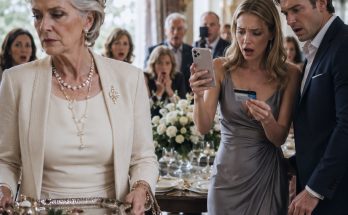
My Sister Shoved Me Out Of The Helicopter And Whispered, “You’ve Always Been In The Way.” My Husband? He Just Stood There. He Knew. They Planned It All—The Company And The “$5M Insurance.” As I Walked Into My Own Funeral, What Happened Next?
### Part 1
My name is Maren Vale, I’m thirty-two years old, and for seventeen days the world believed I was dead.
My sister had already cried on camera.
My husband had already accepted condolences.
My employees had already placed white lilies around a framed photograph of me in the chapel of a funeral home outside Seattle, the same photo I used on my company website because it made me look calm, successful, and harder to underestimate.
By the time I walked through the back doors of my own funeral, wearing a black coat over hospital bandages and leaning on a cane, my husband was standing beside my sister at the front of the room.
His hand was on the small of her back.
Not in grief.
In possession.
I noticed that before I noticed the flowers. Before I noticed the empty urn. Before I noticed my name printed on the memorial program.
Maren Vale.
Beloved wife. Devoted sister. Visionary founder.
1993–2026.
The funny thing about seeing your own death summarized on glossy cardstock is that your mind catches on the smallest insult. Not the dates. Not the lie. Not the absurdity of “beloved wife” when the man listed as my grieving widower had helped arrange my murder.
It was the photo.
They had chosen the one I hated.
The one where my smile looked too polite and my eyes looked tired.
I almost laughed.
I would have, if my ribs had not still ached every time I breathed too deeply.
Seventeen days earlier, my sister, Sloane, pushed me out of a helicopter over the Alaskan wilderness.
She didn’t scream when she did it. She didn’t cry. She didn’t tremble. Her hands hit my shoulders hard, and her face stayed smooth, almost bored, like she was closing a business deal she’d already rehearsed too many times.
My husband, Callum, was not in that helicopter.
He didn’t need to be.
His fingerprints were on everything else.
The insurance policy. The changed travel plans. The sudden interest in my company’s retreat schedule. The too-sweet goodbye before I left. The way he held me that final night and whispered, “I don’t know what I’d do without you,” as if testing the sound of future grief in his mouth.
The payout was five million dollars.
That was what my life had become to them.
Five million dollars, a dead wife, a tragic accident, and one devastated sister who could stand beside the grieving widower and help him spend it.
Before all of that, Sloane and I had been the kind of sisters people used as examples.
Three years apart. Same green eyes. Same stubborn chin. Same habit of eating cereal straight from the box at midnight when life got too heavy.
Our parents died when I was twenty and she was twenty-three, in a wreck on I-5 during a rainstorm that turned the highway silver and mean. After the funeral, we sat on the floor of their kitchen surrounded by unpaid bills, casserole dishes, and sympathy cards from people who would soon disappear.
Sloane held my hand so tightly my fingers went numb.
“It’s us now,” she said.
And I believed her.
For years, it was us.
I built my business from a desk in a rented apartment with bad heat and a view of a laundromat. Cybersecurity consulting sounded boring to most people, but companies paid well for boring when boring protected millions of dollars. I worked eighteen-hour days, drank burnt coffee, answered client calls from my car, and slept with spreadsheets open beside me.
By twenty-nine, ValeBridge Security had offices in Seattle and Austin, a client list that made investors call me “aggressive” in rooms where they called men “brilliant,” and a valuation north of fifteen million.
Sloane’s life moved differently.
She used her inheritance to buy into a boutique fitness franchise in Portland. The location was wrong, the rent was brutal, and the economy dipped just enough to turn every small mistake into a fatal one. Within two years, the franchise was gone, and so was most of her money.
I offered to help.
Not once. Not with pity. Not in a way that made her feel small.
“I can cover the debt and you can pay me back slowly,” I said over coffee one morning.
Sloane smiled into her cup.
“I’m not your charity case, Maren.”
“I didn’t say you were.”
“You didn’t have to.”
After that, I stopped offering directly. I paid for dinners before she saw the check. I sent her clients when I could. I invited her on trips and called them “sister weekends” instead of vacations she couldn’t afford.
I thought I was being careful with her pride.
I didn’t realize pride can rot into hatred when it has nowhere else to go.
Callum entered my life at a fundraiser I sponsored for a literacy nonprofit downtown. He wore a charcoal suit, had dark hair that curled slightly at the collar, and laughed like he’d never had to force anyone to like him.
He found me near the silent auction table, where I was pretending to care about a ski weekend I did not want.
“Your speech made half this room realize they don’t understand technology and the other half want to fund it anyway,” he said, handing me a glass of champagne. “That’s a dangerous talent.”
I should have heard the calculation under the charm.
Instead, I heard attention.
Within three months, he had a drawer in my house. Within six, he proposed with an antique sapphire ring because I had once said diamonds looked like expectations. A year after we met, I married him in a vineyard outside Walla Walla with Sloane standing beside me in a bronze satin dress, crying into a handkerchief.
In the photos, she looks radiant.
That bothers me more than it should.
Because now I know she wasn’t losing me that day.
She was gaining access.
### Part 2
The first time I caught Sloane and Callum whispering, I told myself I was lucky.
That sounds ridiculous now, but suspicion did not come naturally to me then.
I walked into my own kitchen on a Thursday afternoon after a client meeting ended early. Rain ticked against the windows. The house smelled like lemon cleaner and the expensive coffee Callum bought but never made correctly.
Their voices stopped before I reached the doorway.
Sloane stood by the island with one hand around a mug. Callum leaned against the counter too casually, his sleeves rolled up, his expression smooth but not fast enough.
“She’d never go for it,” Sloane said, just before she saw me.
Callum’s eyes flicked to mine.
“Go for what?” I asked.
A second too long passed.
Then Sloane laughed. “Your birthday.”
“My birthday is in five months.”
“Exactly,” Callum said, crossing the kitchen to kiss my cheek. “That’s how you know we’re planning something impressive.”
I wanted to believe that.
So I did.
That became the pattern. A strange detail. A reasonable explanation. A feeling in my stomach that I trained myself to ignore.
Financial folders disappeared from my office and reappeared in the wrong cabinets. My insurance documents were on Callum’s desk one afternoon, though he said he was “organizing household files.” Sloane asked unusually specific questions about my company structure, my estate plan, whether ValeBridge could operate without me if something happened.
“You sound like my attorney,” I teased her once.
She didn’t laugh.
“You never know,” she said. “People should be prepared.”
Callum’s debts came into focus after the wedding, though never all at once. A credit card balance here. A business loan there. A professional certification he claimed was “an investment.” He worked as a financial advisor, or at least that was the polished version. He had switched firms twice before I met him, always with explanations involving office politics and jealous managers.
I believed him because loving someone makes you generous with their contradictions.
My mistake was thinking generosity was the same thing as wisdom.
The Alaska trip was supposed to be simple.
Every summer, my executive team held a retreat at a lodge outside Denali. Strategy sessions in the mornings. Outdoor excursions in the afternoons. Good food, clean air, and enough forced bonding to make us all appreciate remote work again.
That year, the highlight was a helicopter tour over glaciers and backcountry valleys so untouched they looked invented.
I mentioned it at brunch two weeks before I left.
Sloane’s fork paused halfway to her mouth.
“A helicopter?” she asked.
“Company retreat thing,” I said. “Views, photos, everyone pretending not to be terrified.”
“I’ve always wanted to see Alaska.”
She said it lightly, but her eyes had sharpened.
“There’s a family day,” I told her. “You could come for the tour and dinner afterward.”
I expected her to decline. She usually avoided my work events, claiming she didn’t enjoy “watching rich people congratulate each other for breathing.”
Instead, she smiled.
“I’d love that.”
Callum looked pleased. Too pleased.
“You two need sister time,” he said, pouring more orange juice into my glass. “Seriously, Maren. Take her. You work too much.”
A few days later, he brought up life insurance.
We were in bed, blue television light flickering across the ceiling, when he said, “I’ve been thinking about risk exposure.”
I turned my head. “That is the least romantic sentence you’ve ever said to me.”
He smiled, but it didn’t reach his eyes.
“You’re the primary asset behind a growing company. If something happened to you, there would be lawsuits, buyout issues, tax consequences. We’re underinsured.”
“We already have coverage.”
“Not enough.”
Callum knew how to make concern sound responsible. He used words like liquidity, estate protection, continuity planning. I had a board meeting the next morning and a client crisis unfolding in Phoenix. I skimmed the paperwork, answered the medical questions, and signed.
Five million dollars.
Callum as primary beneficiary.
Sloane as secondary, “just in case,” because she was my only family.
When the agent asked why we needed that much coverage so quickly, Callum answered before I could.
“My wife built something extraordinary,” he said, squeezing my hand. “I’m just trying to protect it.”
He looked proud of me.
That is the part I still hate remembering.
The night before I left, Callum cooked dinner, which should have alerted me immediately because his idea of cooking usually involved taking something from a delivery bag and transferring it to plates.
He made salmon. Overcooked, but sweetly presented. He lit candles. He opened the wine we had been saving for our fifth anniversary, though we had only been married three years.
“You’re acting like I’m going to war,” I said.
He came around behind my chair and rested his hands on my shoulders.
“I just want you to know how much I love you.”
His thumbs pressed gently against the exact place Sloane’s hands would hit me two days later.
The next morning, Sloane gave me perfume at the airport.
It came in a heavy glass bottle with a gold cap. Expensive. Too floral. Not something I had ever worn.
“I saw it and thought of you,” she said.
“You thought of me as a French hotel lobby?”
She rolled her eyes. “Just wear it. For me.”
So I sprayed it on my wrists and throat.
The scent followed me onto the plane.
Sweet. Dense. Suffocating.
I did not know then that later, lying broken under pine branches with rainwater in my mouth, I would still smell it on my torn collar and understand that she had wanted me covered in a scent she chose.
One more detail she could control.
### Part 3
Alaska looked too beautiful for betrayal.
That was my first foolish thought when the lodge shuttle carried us past black spruce trees and wide blue distance. The mountains rose like teeth against the sky. Glaciers flashed between clouds. The air smelled of wet stone, pine resin, and cold water.
Sloane sat beside me, taking pictures through the window.
“You okay?” I asked.
She had been quiet since landing.
“Just tired.”
“You’re nervous about the helicopter.”
“I’m not nervous.”
Her voice came too fast.
At dinner that night, my team welcomed her warmly. Marco, my COO, raised a glass and said, “To the sister who got Maren to take an actual vacation day.”
Everyone laughed.
Sloane smiled, but I watched her eyes move over the table, over the executives, the spouses, the expensive watches, the easy confidence of people who had never lain awake calculating minimum payments.
For the first time, I wondered if bringing her had been cruel.
Not intentionally.
But maybe there are wounds that kindness keeps reopening.
The helicopter tour was scheduled for the next morning. The sky cleared after dawn, leaving everything washed in hard white light. The blades of the aircraft chopped the air into deep rhythmic thuds that I felt in my sternum before I climbed inside.
Our pilot was named Hank Calder, a thick-shouldered man with a silver beard and hands that looked carved from old wood.
“Seat belts stay on unless I say otherwise,” he told us. “Doors stay closed unless I say otherwise. This is not a movie.”
Sloane laughed too loudly.
“Got it.”
We were supposed to fly with a retired investor from my board, but he backed out at the last second, pale and embarrassed, claiming altitude sickness before we had even left the ground.
That left me, Sloane, and Hank.
At the time, it felt like luck.
The helicopter rose, and for twenty minutes, wonder overpowered everything else. Snowfields spread beneath us like torn white fabric. Rivers cut silver lines through green valleys. The world looked clean from up there, stripped of debt and resentment and human ugliness.
I pressed my forehead near the window.
“Can you believe this?” I said.
Sloane did not answer.
When I glanced over, she was staring at me, not the view.
“What?” I asked.
She blinked. “Nothing. You just look happy.”
“I am.”
Her mouth moved like she might say something else, but Hank’s voice crackled through the headset.
“Fuel gauge is giving me attitude. I’m setting down at a service pad. Five-minute check.”
The pad appeared below, a square of cleared ground near a small maintenance shed. The landing was smooth. Hank removed his headset and turned around.
“Stay buckled. Don’t touch anything. I mean that.”
He climbed out and walked toward the shed, shoulders hunched against the wind.
The moment the helicopter door closed behind him, the air changed.
Sloane unbuckled.
“What are you doing?” I asked.
“Relax. Let’s take a picture before he comes back.”
“He said stay buckled.”
“You always follow rules when strangers say them?”
It sounded like the old Sloane for half a second. The sister who dared me to jump off docks and sneak into late movies.
She opened the side door.
Cold air punched into the cabin. My hair whipped across my face. Below the pad, the land dropped toward thick forest. Pines packed the slope, dark and endless.
“Sloane, close it.”
“Come on,” she said. “One photo. You’ll use it in some inspirational post about perspective.”
I should have heard the contempt.
Instead, I unbuckled.
The floor vibrated under my shoes. I stepped closer to the open door, one hand gripping the frame, the other reaching for my phone.
“The light is perfect,” I said.
Behind me, Sloane whispered, “That’s why we picked it.”
I turned.
Her face had emptied.
No anger. No tears. No apology.
Just decision.
“Sloane?”
Her hands struck my shoulders.
Hard.
For one impossible second, my body refused to understand what was happening. My heels slid. My hand scraped the metal frame. I saw her green eyes, so much like mine, watching me with terrifying calm.
Then there was no floor.
There was only sky.
The helicopter shrank above me. Wind tore the scream from my throat. The world spun—white cloud, black trees, blue distance, white cloud again.
I remember thinking, absurdly, that Callum would be annoyed about the insurance delay if they couldn’t find my body.
Then the trees hit.
Branches cracked against me with sounds like gunshots. Each impact turned the world bright with pain. Something tore across my side. My left leg struck a trunk so violently that the shock seemed to split me in half.
The final fall ended in moss, roots, and darkness.
When I woke, I was not sure I was alive.
Pain arrived before memory. It came in layers—ribs, shoulder, face, leg. My breath scraped. My mouth tasted like metal and dirt. One shoe was gone. My blouse was ripped open at the sleeve. The perfume Sloane gave me clung to everything, sickly sweet beneath the smell of sap and blood.
Then memory returned.
Sloane’s hands.
Sloane’s eyes.
That one whispered sentence.
“That’s why we picked it.”
Not she.
We.
Callum.
A sound came out of me then that did not feel human. It tore through the trees and startled birds into the gray sky. I screamed until my chest spasmed and my vision spotted black.
Then I stopped.
Because screaming used energy.
And if I wanted to ruin their plan, I needed to live.
### Part 4
The first rule of survival is not hope.
Hope is too soft at the beginning.
The first rule is inventory.
What is broken? What is bleeding? What can move? What can kill you fastest?
My left leg was wrong. I knew that before I looked at it. The angle beneath the torn fabric made my stomach lurch, and when I tried to shift, pain exploded so violently I nearly passed out.
“Don’t look again,” I told myself.
My voice sounded small in the trees.
My ribs were damaged. Maybe broken. My right shoulder burned. Cuts covered my arms and face. Blood soaked one side of my blouse, but not fast enough to mean immediate death.
Immediate death, I decided, would come from cold.
Or shock.
Or an animal.
Or giving up.
I tore strips from my jacket lining with shaking hands. Every movement cost me. The forest smelled wet and ancient, moss under my cheek, pine needles in my hair, soil pressed into my palms. I found two fallen branches within reach and used them to brace my leg, tying them with fabric while biting down on my sleeve so hard my jaw cramped.
The pain became a white room inside my skull.
I went into it. Came back. Went in again.
When the splint was done, I lay still and cried without sound.
Not because of the leg.
Because Sloane used to braid my hair before school when Mom worked early shifts. Because Callum had kissed my forehead at the airport. Because I had mistaken proximity for love and attention for loyalty.
The sun moved behind the trees.
I needed shelter.
Dragging myself was worse than splinting the leg. I used my elbows and my good heel, inch by inch, toward a fallen tree that had created a hollow near its roots. The ground was cold enough to steal heat through my torn clothes. I pulled pine boughs over myself, stuffing leaves around my sides, building the ugliest shelter in Alaska with one functioning leg and pure spite.
By nightfall, rain began.
Thin at first. Then steady.
It tapped on leaves, slid down bark, collected in the depression near my hip. I tore more lining from my jacket and shaped it into a shallow cup against the ground. Water gathered slowly, tasting like dirt and fabric dye, but it was water.
I drank.
I whispered every detail I needed to remember.
“Sloane pushed me. Callum planned it. Insurance policy. Five million. Hank left the helicopter. Service pad. Wrong coordinates, maybe. Perfume. Sloane said we.”
Repeating facts kept my mind from floating away.
At some point in the night, I heard something move beyond the trees. A snap. A heavy breath. My whole body locked. I gripped a broken branch with my right hand and waited, heart battering my ribs.
The sound passed.
Maybe deer. Maybe bear. Maybe fear wearing feet.
By morning, fever had begun.
I could feel it behind my eyes, in the strange way the forest brightened and blurred. My throat was raw. My lips cracked. My body shook, though I was sweating.
I used one of my earrings to cut fabric into cleaner strips. Callum had given me those earrings on our second anniversary, leaning across a candlelit table and saying, “You deserve beautiful things.”
I used his beautiful thing to bind wounds.
That felt fair.
On the second day, helicopters passed twice.
Too far.
Wrong direction.
I screamed anyway. I waved my torn blouse from a branch. I angled the remaining earring on a rock, hoping sunlight would catch it, though sunlight came and went through the clouds like a promise afraid to commit.
No one saw me.
By the third day, I understood something that chilled me worse than the rain.
They were searching somewhere else.
A real accident would have meant accurate coordinates. Hank would know where I fell. Sloane would know. The helicopter’s path would exist.
If rescuers weren’t near me, it was because someone had moved the story.
“They told them the wrong place,” I whispered.
The words made everything sharper.
They didn’t just push me and panic.
They had planned what came after.
They had planned my not being found.
That afternoon, I hallucinated my mother.
She stood between two spruce trees wearing the yellow raincoat she had when I was little.
“Maren,” she said, “get up.”
“I can’t.”
“You always say that before you do.”
“I’m tired.”
“I know.”
The hallucination faded, but the command stayed.
Get up.
I couldn’t, not really. But I dragged myself three feet closer to a gap in the trees where my voice might travel better. Three feet took nearly an hour. I passed out twice.
When I woke the second time, voices floated through the forest.
At first, I thought my fever had dressed the wind in human sound.
Then I heard laughter.
Real laughter.
Young. Breathless. Close.
“Hikers,” I croaked.
I tried to shout. Nothing came but air.
I grabbed the branch beside me and struck it against the fallen log.
Once.
Twice.
Again.
The voices stopped.
“Did you hear that?” someone called.
I hit the log until my hand slipped, until pain burst through my shoulder.
“Help,” I tried.
A woman’s voice answered, closer now.
“Hello?”
“Help me.”
Leaves thrashed. Footsteps stumbled downhill. A man in a red jacket appeared first, then a woman with a braid and a satellite phone clipped to her pack.
The woman froze when she saw me.
“Oh my God.”
The man took one step back, then forward again.
“What happened to you?”
I forced my eyes open.
“My name is Maren Vale,” I said. “My sister pushed me out of a helicopter.”
The woman stared at me, horror spreading across her face.
Then I said the part that made both of them go silent.
“My husband helped her.”
### Part 5
The rescue helicopter arrived two hours later.
I hated the sound before I loved it.
The thudding blades rolled over the trees, and my body reacted before my mind could explain. My hands clawed at the moss. My breath broke. For one wild moment, I was falling again, Sloane’s eyes above me and open air under my feet.
The woman who found me, Tessa, knelt beside my head.
“You’re on the ground,” she said firmly. “You’re safe. Look at me. You are on the ground.”
Her husband, Reid, stood in a small clearing waving both arms at the approaching rescue team.
I focused on Tessa’s face. Freckles. Chapped lips. A tiny scar through one eyebrow.
Not Sloane.
Not sky.
Ground.
Safe.
The paramedics moved quickly. They asked questions I could barely answer. Pain blurred their faces into masks of color and motion. Someone cut away fabric. Someone checked my pupils. Someone said, “Femur fracture, possible internal injuries, severe dehydration.”
As they lifted me, I heard one medic mutter, “Isn’t this near that CEO fall?”
Another answered, “They searched west. She was supposed to have gone down west.”
I grabbed his sleeve with what little strength I had.
“Not west,” I whispered.
His eyes snapped to mine.
“What?”
“They lied.”
Then the medicine pulled me under.
The next days came in pieces.
White ceiling.
Machines beeping.
A nurse with warm hands.
A doctor saying surgery.
A detective’s badge.
Rain tapping hospital glass.
Pain, then darkness, then pain again.
I woke properly three days later in a private room in Anchorage with my leg wrapped and elevated, my ribs bandaged, and my throat so dry speech felt like swallowing gravel.
A woman sat beside the bed reading a file.
She looked mid-forties, with dark hair cut at her jaw and eyes that missed nothing. Her suit jacket hung over the chair. Her badge rested on the table beside a paper cup of coffee.
“Maren Vale,” she said when she noticed I was awake. “I’m Detective Nola Vance.”
I tried to sit up and failed.
“Callum?”
“Not here.”
“Sloane?”
“Also not here.”
Good.
The word floated through me like a prayer.
Detective Vance leaned forward.
“The hikers repeated what you told them. I need to hear it from you.”
So I told her.
Slowly. Badly. In fragments. The helicopter. Hank’s stop. Sloane opening the door. The sentence. The push. The fall. The days under the log.
Detective Vance did not interrupt.
When I finished, she looked down at her notes.
“Your sister reported that you leaned out for a photo and a gust caught you.”
“A gust.”
My laugh turned into a cough so painful tears filled my eyes.
“The pilot confirmed her version,” she said. “At first.”
“At first?”
“He changed details when pressed. Small ones. Timing. Exact location. Whether the aircraft door was open before he left. He says he was paid to give you and your sister a private moment.”
“Paid by who?”
“He claims he doesn’t know. Cash envelope.”
“Callum.”
“We’re looking.”
I closed my eyes.
“Do they know I’m alive?”
“No.”
I opened them again.
Detective Vance held my gaze.
“At the hospital, you were admitted as an unidentified trauma patient. Your face was badly bruised, you had no ID on you, and the rescue location didn’t match the missing-person report. By the time we connected you to the case, your husband and sister were already moving publicly as if you were presumed dead.”
“How publicly?”
Her mouth tightened.
“News statements. Search team thanks. Funeral planning.”
A coldness moved through me that no blanket could touch.
“My funeral?”
“Saturday.”
“What day is today?”
“Wednesday.”
I stared at the ceiling.
They had waited less than three weeks to bury an empty urn.
Detective Vance continued, voice careful.
“There’s more. Your husband contacted the insurance company yesterday about beginning the claim process.”
“Of course he did.”
“Five million dollars. New policy. Effective recently.”
My fingers curled against the sheet.
“What about Sloane?”
“She’s listed as secondary beneficiary.”
I turned my head toward the window. Outside, Anchorage looked ordinary. Cars moved through wet streets. A man in a blue jacket carried groceries. Somewhere, people were buying coffee, missing buses, complaining about emails.
My life had split in half, and the world had not even paused.
Detective Vance stood.
“Maren, I believe you. But belief isn’t enough. We need evidence strong enough to survive defense attorneys, media pressure, and two suspects who think they’ve already won.”
“What do you need from me?”
“For now? Stay dead.”
The words settled between us.
I should have refused. I should have demanded police kick down doors that instant. Instead, something in me went still and clear.
If they thought I was dead, they would be careless.
If they were careless, they would talk.
If they talked, I could bury the people who tried to bury me.
“Fine,” I said. “But I want to know everything.”
Over the next forty-eight hours, Detective Vance brought me pieces of my own murder.
Deleted texts recovered from Callum’s cloud account.
Sloane: Alaska works. Remote, believable.
Callum: Policy has to clear first.
Sloane: Then make it clear.
Bank withdrawals from Callum’s account matching the cash payment to Hank.
Search history on Sloane’s laptop about wilderness accident survival rates, helicopter tour doors, and presumed death insurance claims.
Security footage from my own kitchen the night after I fell.
That was the one that broke something final.
The video showed Callum and Sloane entering my house through the garage. Sloane still wore black leggings and boots from the trip. Callum opened champagne from the refrigerator, the bottle we saved for special occasions.
They did not cry.
They kissed.
Then Callum lifted his glass.
“To freedom,” he said.
Sloane smiled.
“To five million reasons to start over.”
I watched the clip once.
Then again.
On the third time, Detective Vance reached over and closed the laptop.
“That’s enough.”
“No,” I said.
My voice did not shake.
“Play it again.”
### Part 6
The funeral home smelled like lilies, furniture polish, and expensive lies.
Detective Vance drove me there in an unmarked car, parking two blocks away beneath a maple tree dripping rain onto the windshield. My disguise was simple because death is the best disguise of all. Nobody looks for a dead woman in the last row of her own memorial.
My hair had been dyed chestnut. Thick glasses changed the shape of my face. Bruising along my jaw, still visible beneath makeup, made me look like a distant cousin who had recently lost a fight with life.
My name for the day was Mara Ellery.
A family connection vague enough to discourage questions.
“You don’t have to do this,” Detective Vance said.
“Yes,” I said. “I do.”
Walking hurt. Every step sent a dull ache through my leg and a sharper warning through my ribs. My cane tapped against the sidewalk. Rain misted my coat. At the chapel doors, I paused.
Inside, people were mourning me.
That should have been the strangest part.
It wasn’t.
The strangest part was hearing my own laugh.
Someone had made a slideshow.
Photos moved across a screen near the front: me at twenty-two in a cheap blazer outside my first office, me at a company picnic, me with my parents, me with Sloane on a beach when we were kids, our arms around each other and our faces sunburned.
A recording played from some old event interview.
My voice filled the chapel.
“I believe security is about trust,” the recorded me said. “Trust is the infrastructure everything else depends on.”
I nearly turned around and left.
Detective Vance touched my elbow.
“Breathe.”
We slipped into the back row.
Callum sat in front beside Sloane.
He wore the black suit I bought him for investor dinners. His hair was perfectly styled, his shoulders bowed at the correct angle of grief. Sloane’s dress was new. I knew because I had never seen it, and because grief does not usually come with tags from a designer boutique unless grief expects reimbursement.
She held a tissue.
Her eyes were dry.
People approached them one by one.
“I’m so sorry.”
“She was remarkable.”
“You must be devastated.”
Callum nodded, voice low. “She was my whole world.”
Sloane leaned into him.
I gripped my cane until my hand cramped.
The service began.
The minister had clearly never met me. He called me “a woman of adventure,” which made several colleagues glance at one another because everyone knew I packed backup chargers for dinner reservations. He spoke warmly about fate, fragile life, and God’s mysterious plan.
I stared at the empty urn and thought, Not mysterious. Criminal.
Then Sloane stood.
She moved to the podium slowly, like sorrow had weight. When she unfolded her paper, her hand trembled. A nice touch.
“My sister Maren was my first home,” she began.
A sound moved through the chapel. Soft grief. Belief.
“She protected me after our parents died. She inspired me with her courage. She taught me that women could build lives bigger than the ones the world allowed them.”
Her voice broke.
Not enough to ruin the words.
Just enough to sell them.
I watched her perform sisterhood in front of people who had no idea she had used both hands to throw me into open air.
“Our final trip together was a gift,” she said. “I will never forget the way she looked at those mountains. She was so happy. So fearless. I keep telling myself that if Maren had to leave us, at least she left this world surrounded by beauty.”
My vision narrowed.
Detective Vance whispered, “Stay with me.”
Then Callum walked up.
He rested one hand on my urn.
My empty urn.
“Maren loved with her whole heart,” he said.
I almost stood then.
“She believed in me when I didn’t believe in myself. She made me better. Being her husband was the greatest honor of my life.”
A woman in the second row sobbed.
Callum looked down, letting silence gather.
“I keep expecting her to walk through the door,” he said softly. “I keep thinking this has to be some terrible mistake.”
Detective Vance’s hand tightened on her phone.
Recording.
Good.
After the service, mourners moved to a small reception hall. Coffee steamed in silver urns. Sandwiches sat untouched on white platters. My employees stood in clusters, stunned and red-eyed. Marco looked ten years older. My friend Liora cried so hard another friend held her upright.
Their grief was real.
That nearly undid me.
Sloane and Callum’s grief was theater, but everyone else had been injured by their performance.
When most guests had left, Callum and Sloane slipped out toward the side garden behind the chapel. There, under wet trees and a gray sky, they stood close beside a temporary memorial stone bearing my name.
Sloane exhaled.
“God, I thought Marco would never stop talking.”
Callum laughed softly. “He adored her.”
“He adored her company. There’s a difference.”
I stepped onto the gravel path.
My cane struck stone.
Once.
Twice.
Both of them turned.
Callum’s polite mourner face appeared first.
“Thank you for coming,” he said. “Were you a friend of Maren’s?”
I removed my glasses.
“In a way.”
Sloane stared.
Her lips parted.
No sound came out.
Callum’s face changed more slowly. Confusion first. Then irritation. Then something like terror pushing through the cracks.
“Surprise,” I said.
The rain picked up, tapping on leaves, on stone, on the empty grave they had prepared for me.
Sloane whispered, “No.”
I smiled.
It hurt my split lip.
“Yes.”
### Part 7
Callum took one step backward.
Sloane took none.
She simply stood there, frozen beneath the wet branches, staring at me as if I had crawled out of the ground instead of through the back of a chapel.
“You’re dead,” she said.
“That was the plan.”
Her face folded for half a second. Not grief. Not regret. Panic.
Callum recovered first because Callum always recovered when there was an audience.
“Maren,” he said, voice trembling beautifully. “My God. You’re alive. We thought—”
“Don’t.”
He stopped.
It was the first time in our marriage that one word from me actually shut him up.
Detective Vance stepped beside me and opened her coat enough for them to see her badge.
“Nola Vance, Alaska State Troopers. Callum Vale, Sloane Arden, you are both under arrest for conspiracy to commit murder, attempted murder, insurance fraud, and related charges.”
Sloane looked past us and finally noticed the officers moving in from either side of the garden path.
“No,” she said again, but differently now. Smaller.
Callum lifted both hands.
“Detective, this is a misunderstanding. There was an accident. My wife has clearly been through severe trauma. She may believe—”
“We have the texts,” I said.
His mouth closed.
“We have the money trail. We have Hank’s statement. We have the searches. We have the video from my kitchen.”
Sloane flinched.
Callum’s eyes darted to her.
There it was. The first crack.
“What video?” he asked.
I tilted my head.
“The one where you opened my champagne.”
His skin went gray.
Sloane covered her mouth, but not before a sound escaped her.
Detective Vance nodded to the officers.
Callum tried one more time.
“Maren, please. Listen to me. Sloane pushed you. I didn’t know she would actually do it.”
Sloane’s head snapped toward him.
“You coward.”
“Don’t,” he hissed.
“You planned the policy.”
“You said she’d survive if she landed in the trees.”
I stared at them.
There are moments so ugly they become clarifying.
No defense attorney. No polished statement. No grief suit. Just two predators turning on each other beside my fake grave.
Detective Vance let them talk for exactly six seconds before reading them their rights.
Sloane began crying when the handcuffs clicked around her wrists.
That was when she finally looked like my sister again.
Not enough.
Never enough.
“Maren,” she sobbed. “I’m sorry.”
I leaned on my cane, body aching, heart strangely quiet.
“You’re not sorry I was pushed,” I said. “You’re sorry I landed wrong for your plan.”
Her crying turned sharp.
Callum looked at me like I was a door closing.
“You loved me,” he said.
“I loved a person you invented.”
The officer guided him toward the waiting car.
At the edge of the path, he turned back.
“You’ll never trust anyone again.”
Maybe he meant it as a curse.
Maybe a final injury.
But I had survived four days under a fallen tree with a broken leg and my sister’s perfume rotting in my clothes. His words had no teeth left.
“I’ll trust myself,” I said. “That’s enough for today.”
The arrests became national news before nightfall.
CEO Walks Into Own Funeral, Exposes Murder Plot.
Husband And Sister Arrested In Helicopter Fall.
Five Million Dollar Insurance Scheme Ends At Memorial Service.
Reporters camped outside my house. News vans lined the curb. People I hadn’t spoken to in years sent messages full of shock, sympathy, and thinly disguised curiosity. True crime podcasts mispronounced my name within forty-eight hours.
I gave no interviews.
Not then.
My world shrank to courtrooms, doctors, physical therapy, and the quiet hours in my kitchen when I would stand with one hand on the counter and remember Callum kissing Sloane under my security camera.
The trial took nine months.
By then, my leg had healed enough for me to walk without a cane on good days, though rain made the bone ache in a deep, old way. The scars along my arms had faded from red to pale silver. My ribs no longer screamed when I laughed, though I did not laugh much.
Sloane and Callum hired separate attorneys.
That surprised no one.
Their love, if that was ever the right word, did not survive the possibility of prison.
Callum claimed Sloane was unstable, jealous, obsessed with replacing me. He said he thought they were only staging a disappearance long enough to scare me into giving Sloane money and restructuring assets.
Sloane claimed Callum manipulated her, seduced her, convinced her I had never really loved her. She said he promised I would survive the fall because there would be people waiting below.
Hank testified under a plea deal. He admitted taking cash to leave us alone on the pad. He said he thought it was for “a private emotional conversation,” though his eyes stayed on the table when he said it.
The prosecutor played the kitchen video.
The courtroom watched my husband and sister toast my death.
“To five million reasons to start over.”
A juror in the front row covered her mouth.
I did not look away.
When I testified, the defense attorneys tried to soften the truth by making it complicated.
Was it possible I slipped?
No.
Was I under extreme stress that could affect memory?
I remember her hands.
Did I resent my sister?
I loved her.
Had my marriage been troubled?
Not until my husband helped plan my death.
The jury deliberated for less than five hours.
Guilty.
Sloane received twenty-five years.
Callum received twenty-nine, with additional time tied to financial crimes uncovered during the investigation. His career had not merely been struggling. He had been stealing from clients, moving money between accounts, building a private disaster and looking for my life insurance to cover the crater.
At sentencing, Sloane turned toward me.
Her face was bare of makeup. Her hair looked dull. She seemed younger and older at once.
“I don’t expect forgiveness,” she said. “But I’m sorry.”
I stood because I wanted her to see me upright.
“You were my sister,” I said. “That used to mean something sacred to me. You destroyed that. I hope one day you understand the size of what you killed. But it wasn’t me.”
Callum did not apologize.
He only stared straight ahead, jaw tight, still loyal to the last version of himself where he had been smarter than everyone else.
When the bailiff led them away, I waited for relief to flood me.
It didn’t.
Justice is not the same as healing.
It is only the locked door that gives healing a safer room to begin.
### Part 8
A year after I walked into my own funeral, I returned to the cemetery.
Not for them.
For me.
The temporary memorial stone had been removed months earlier, but the grass still showed a faint rectangular patch where my name had rested. I stood over it in a gray coat, breathing air that smelled of wet earth and cut grass.
My leg ached. Rain was coming.
“You don’t get me,” I said quietly to the empty ground.
It felt strange, speaking to the place where people had gathered to mourn a woman who no longer existed.
Because the truth was, part of me had died.
The Maren who trusted without checking locks was gone. The Maren who thought love excused secrecy was gone. The Maren who believed shared childhood could protect someone from envy was gone.
But I was not only what they did to me.
That took longer to learn.
For months after the trial, I woke up falling. My body would jerk in bed, hands grabbing sheets, lungs empty of air. Helicopter sounds made me freeze. The smell of heavy floral perfume could send me into a bathroom stall shaking so badly I had to sit on the floor and count tiles.
My therapist, Dr. Selene Hart, called it compound trauma.
“Your body survived the fall,” she told me. “Your mind is surviving the betrayal.”
I hated therapy at first.
I wanted strategies, not feelings. I wanted assignments, not grief. I wanted to turn recovery into a project plan with milestones and clean deliverables.
Dr. Hart refused to let me manage my pain like a quarterly budget.
“You don’t heal by outperforming the wound,” she said.
So I learned slower things.
How to sit with anger without feeding it my whole life.
How to miss my sister without wanting her back.
How to accept that loving someone in the past does not obligate you to reopen the door they used to destroy you.
Sloane wrote once from prison.
Her letter arrived through my attorney in a plain envelope with her careful handwriting across the front. I left it on my kitchen counter for two days. Every time I passed it, my body reacted as if paper could push me from a helicopter.
When I finally read it, there were no excuses.
She wrote that jealousy had begun as a private embarrassment and grown into something she fed because it made her feel less powerless. She wrote that Callum had noticed it and used it, but that using her weakness did not erase her choice. She wrote, “I looked at my own sister and decided my life mattered more than yours. There is no apology large enough for that.”
I read that sentence until it blurred.
Then I folded the letter and put it in a box.
I did not reply.
Not because I felt nothing.
Because I felt too much, and none of it required action.
Callum wrote too.
His letter was three pages of self-pity dressed as accountability. He blamed pressure, debt, fear, Sloane, his upbringing, the financial industry, and my success. He wrote, “You have to understand what it was like being married to someone everyone admired.”
I stopped reading there.
Some men call your light warmth until it reveals their shadow.
Then they call it fire.
I burned his letter in the fireplace and slept better than I had in weeks.
My company survived.
Barely at first.
ValeBridge had wobbled during my presumed death, then again during the media circus. Some clients left quietly. Investors asked careful questions that were really doubts wearing suits.
At the first board meeting after the trial, one director said, “We need to consider whether your public association with the case creates reputational risk.”
I looked at him across the table.
“I survived an attempted murder conspiracy, exposed fraud, protected this company’s continuity, and returned to work with a titanium-reinforced leg,” I said. “If resilience is a reputational risk, we need better investors.”
Marco laughed first.
Then the room shifted.
We rebuilt the narrative because it was mine to rebuild.
I gave one interview to a business magazine, refusing every question that treated my trauma like entertainment. I spoke about preparation, decision-making under pressure, and how systems fail when trust is exploited without verification.
That interview brought in more clients than we lost.
A year later, ValeBridge launched a personal security division focused on protecting individuals from financial coercion, identity theft, and intimate betrayal schemes. It was not revenge.
It was architecture.
Pain turned into structure.
Fear turned into policy.
Survival turned into service.
I also started the Northline Foundation, funding wilderness emergency training and therapy grants for survivors of severe betrayal. Tessa and Reid, the hikers who found me, attended the launch. When Tessa hugged me, she smelled like wool and rain, and I cried into her shoulder without apologizing.
“You found me,” I said.
She squeezed harder.
“You kept yourself alive long enough to be found.”
Two years after the fall, I returned to Alaska.
Not to the exact place. Detective Vance offered to arrange it, but I said no. I did not need to stand under the tree that broke my body to prove anything to the sky.
Instead, I stood on a viewing platform outside the hospital trauma center I had helped fund. Mountains rose in the distance, blue-white and indifferent. Wind moved through my coat. Somewhere far off, a helicopter crossed the horizon.
My pulse jumped.
Then settled.
Beside me stood James Calder, a civil engineer who volunteered with Northline and had spent six months becoming my friend before asking me to dinner.
No rushing. No performance. No grand speeches.
The first time I told him I still checked exits in restaurants, he said, “Okay,” and chose a table where I could see the door.
That was the beginning.
Not fireworks.
Safety.
On the viewing platform, he did not touch me until I reached for his hand.
“You okay?” he asked.
I watched the helicopter shrink into cloud.
“Yes,” I said, and meant it.
Later, on the second anniversary of the funeral, I visited my parents’ graves.
I brought yellow tulips for my mother and black coffee for my father in a paper cup, because he used to joke that flowers were useless but caffeine proved love.
I sat between their stones and told them everything.
Not the public version. Not the courtroom version.
The daughter version.
“I miss who I thought she was,” I admitted. “I don’t forgive her. Maybe I never will. But I’m trying not to let what she became poison what we were before.”
The wind moved softly through the cemetery trees.
For once, I did not ask why I hadn’t seen it sooner.
That question had been a cage.
The better question was what I would build now that I was free.
I sold the house Callum had lived in.
Not because I was afraid of it.
Because I did not want my new life arranged around old ghosts.
I bought a smaller place on an island outside Seattle, with cedar walls, wide windows, and a kitchen that smelled like coffee every morning. No champagne in the refrigerator. No hidden documents. No perfume bottles I didn’t choose.
On the third anniversary of the fall, Northline held a fundraiser.
I stood onstage before hundreds of people—survivors, first responders, therapists, donors, hikers, executives, people who understood that disaster rarely asks permission before entering a life.
“My sister pushed me from a helicopter,” I said.
The room went silent.
“My husband helped her. They did it for money. That is the sentence people remember because it sounds impossible. But the more important sentence is this: I lived.”
I looked out and saw Tessa wiping her eyes. Marco standing near the back. Detective Vance with her arms crossed, pretending she wasn’t emotional. James watching me with quiet pride.
“I lived long enough to be found. I lived long enough to tell the truth. I lived long enough to learn that betrayal can change your shape without owning your future.”
My left leg ached under the stage lights.
I stood straighter.
“I did not forgive the people who tried to erase me. Forgiveness is not the price of healing. I did not return to the woman I was before. Returning is not the goal. I became someone else. Someone more careful, yes. Someone harder to fool. But also someone who knows the value of a real hand reaching through the trees when you have almost stopped calling for help.”
After the speech, people applauded for a long time.
I accepted it, not as praise, but as witness.
That night, James and I drove home under a clear sky. The road curved along dark water. The moon followed us in pieces.
“Do you ever think about the funeral?” he asked carefully.
“Sometimes.”
“What part?”
I watched the reflection of passing lights slide across the window.
“The moment they saw me,” I said. “I used to think that was the best part. Their faces. Their panic. The plan collapsing.”
“And now?”
“Now I think the best part was walking out afterward.”
He reached across the console, palm open.
I placed my hand in his.
Not because I trusted blindly.
Because I chose to.
And because the woman who fell from the sky, crawled through the wilderness, crashed her own funeral, and buried the life others tried to steal from her had earned the right to choose what came next.
I did not die in Alaska.
I did not end at that funeral.
I walked out of both.
And I kept walking.
THE END!