My Sister Laughed at My “Useless” Garage—Until I Passed Grandpa’s Final Test and She Came Begging
“The Poor Soldier Only Gets The Rusty Garage,” My Sister Laughed After Grandpa’s Will Reading. I Went To The Garage And Found A Note On The Door: “This Garage Is My Final Test. Only A True Soldier Will Know What To Do.” I Went Inside And Froze On The Spot At What I Saw… The Next Morning, I Had 52 Missed Calls From My Sister, Begging Me To Answer.
### Part 1
My name is Claire Lawson. I am thirty-five years old, and I serve as a logistics officer in the United States Army, which means I have spent most of my adult life noticing the things other people overlook.
A missing crate, a wrong serial number, a fuel estimate that looks almost right—small mistakes can become disasters once people start depending on them. My grandfather taught me the same lesson long before the Army gave it an official name.
“Never trust the shine,” Grandpa Howard used to say. “Clean paint can hide a cracked frame.”
That sentence was running through my mind when my family gathered in attorney Thomas Keane’s office to hear Grandpa’s will.
The room smelled of old paper, furniture polish, and the bitter coffee Thomas’s receptionist had left untouched on a side table. Heavy burgundy curtains blocked most of the afternoon sun, turning the office into something halfway between a library and a courtroom.
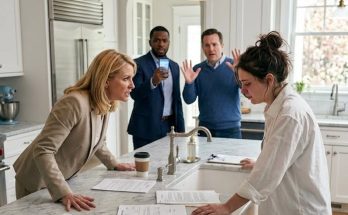
My older sister, Brooke, sat across from me with one ankle resting over her knee. Her cream-colored coat had probably cost more than my first car, and her manicured fingernails tapped a patient rhythm against the wooden armrest.
Brooke was three years older than me and had always possessed the kind of confidence that made people assume she belonged at the head of every table. She ran a successful real estate company, appeared in local business magazines, and had mastered a bright, polished smile that revealed almost nothing.
Thomas began reading.
Brooke received Grandpa’s lake house, two rental properties, several investment accounts, and partial ownership of a small vineyard. Each new item softened her expression until she looked almost generous.
Then Thomas adjusted his glasses.
“To my granddaughter Claire Lawson, I leave the detached garage located on the northern edge of my property, together with all tools, vehicles, records, fixtures, keys, and contents contained within it.”
Brooke stared at him for half a second before laughing.
“The garage?”
A few distant relatives shifted in their seats.
Brooke turned toward me, wearing the same amused smile she had used since we were children.
“The poor soldier gets Grandpa’s rusty garage.”
Two cousins chuckled. Someone near the window coughed into his hand, pretending not to.
My stomach tightened, but I kept my expression still. Silence is useful when someone is trying to provoke you, because people who perform for an audience usually reveal more when they are forced to fill the empty space themselves.
Brooke leaned closer.
“Maybe you can turn it into one of those little hobby workshops. You always liked getting grease under your nails.”
Thomas looked at me over the top of the will. His eyes rested on mine for one quiet second, and something in that look made me sit straighter.
He knew something.
I signed the necessary papers, accepted a small envelope containing a property key, and left without answering Brooke.
Outside, the October air felt sharp enough to clean my lungs. Dry leaves scraped across the gravel as I walked beyond Grandpa’s white farmhouse toward the northern end of the property.
The garage stood behind two cottonwood trees, exactly as it had throughout my childhood. Gray paint peeled from the siding, one window had been repaired with a square of cloudy glass, and the metal roof carried dark streaks from years of rain.
Nothing about it suggested wealth.
Nothing about it explained Thomas’s expression.
As I approached the main door, I noticed a sheet of paper taped beneath the handle. The corners fluttered in the wind.
Grandpa’s handwriting covered the center in careful block letters.
Claire,
This garage is my final test.
Do not sell anything.
Do not trust anyone who suddenly becomes kind.
Only the person who remembers what I taught will understand what to do.
My mouth went dry.
I unlocked the door.
The hinges groaned, and the familiar smell rolled toward me—motor oil, metal shavings, old soap, cold concrete, and the faint cedar scent of Grandpa’s work jacket.
A narrow beam of sunlight slipped through the cloudy window and landed on a steel box beneath the workbench.
Beside it stood a framed photograph of me at ten years old, swallowed by Grandpa’s Army jacket and holding a wrench almost as long as my arm.
I stepped closer, but before I could touch the box, my phone vibrated.
Brooke’s name appeared on the screen.
I declined the call.
It rang again before the display went dark.
Then again.
I turned the phone over and looked at the steel box. Its latch had been polished smooth by someone’s thumb, and a thin strip of blue tape across the lid carried one handwritten instruction.
Inventory before action.
I had heard Grandpa say those exact words hundreds of times.
I knelt on the concrete, reached toward the latch, and stopped when I heard tires crunching over the gravel outside.
Someone had followed me from the lawyer’s office.
### Part 2
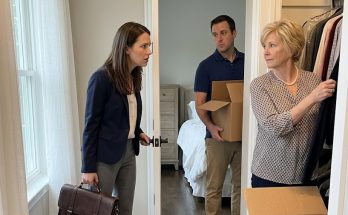
I moved away from the window and stood beside the workbench, where anyone entering would have to step fully into the garage before seeing me.
The engine outside idled for several seconds. A car door opened, then slammed.
I recognized Brooke’s heels before she reached the entrance. She always walked as if every floor had been built for her arrival.
The door shifted inward two inches before catching against the chain I had fastened.
“Claire?”
I remained silent.
“Come on. I know you’re in there.”
Through the narrow opening, I saw part of her face, one blue eye and a section of perfectly arranged hair.
“I only want to talk.”
“You had an entire office in which to talk.”
Her smile appeared in the gap.
“I was teasing. You know how our family is.”
“No, I know how you are.”
The smile tightened.
“Fine. I came to help. That building probably isn’t safe, and there could be hazardous materials inside. My company has contractors who can clear it out.”
“I just inherited it thirty minutes ago.”
“Exactly. You don’t need the burden.”
She placed her fingertips against the door.
“I could give you fifty thousand dollars today. No inspections, no paperwork. You transfer the garage and everything inside to me, and you walk away with cash.”
The offer came too quickly.
Brooke had laughed when she believed everyone was watching, but the moment she thought we were alone, she offered more money than the building appeared to be worth.
“What do you think is in here?” I asked.
Her eye flickered toward the darkness behind me.
“Nothing. That’s the point.”
“Then why offer fifty thousand dollars?”
Brooke stepped back.
“I’m trying to be generous.”
Grandpa’s note was still taped beneath the handle.
Do not trust anyone who suddenly becomes kind.
“I’m keeping the garage.”
Her pleasant expression vanished.
“You don’t even live here.”
“I do now, whenever I’m on leave.”
“You’re being emotional.”
“And you’re trespassing.”
She stared at me for several seconds. Then she looked toward the camera mounted above Grandpa’s side door. It had not worked in years, but Brooke did not know that.
“I hope you understand what you’re doing,” she said.
“I’m beginning to.”
She returned to her car, scattering gravel as she backed down the drive.
I waited until the sound disappeared before locking the main door and turning on every light. Half the bulbs flickered, but the room slowly emerged from the shadows.
Grandpa’s tools were arranged in straight rows. Each drawer bore a label written in black marker. A red shop rag lay folded beside the vise, and the wall calendar was still open to the month he died.
I began with the inventory.
The steel box contained six keys, a pocket flashlight, a photograph of Grandpa’s dark-blue muscle car, and a sealed envelope bearing my full name.
The keys were tagged Bench, North, Lift, Bay, Trunk, and Office. A seventh black key had no label.
I opened the envelope last.
Claire,
If you are reading this, you have passed the first step because you did not surrender the garage to avoid discomfort.
People will tell you that patience is fear. It is not. Patience is refusing to move before you can see the ground.
Begin where the late-morning light falls.
Use the map we drew together.
The right key will feel familiar.
I read the note three times.
On summer mornings during my childhood, Grandpa and I had played a game he called Field Mapping. He would hide a small metal object in the garage, then make me locate it using only measurements, shadows, and landmarks.
“Machines don’t lie,” he would say. “Rooms don’t either. People are the complicated part.”
I looked at the northern wall.
A pegboard covered most of it, holding wrenches, belts, clamps, and two dented hubcaps. Nothing seemed unusual until I turned off the overhead lights and allowed the late-morning sun to enter through the cloudy window.
The beam stretched across the concrete and touched the bottom corner of the pegboard.
There, almost hidden beneath the workbench, someone had drawn a small white triangle.
I crouched and aimed the pocket flashlight beneath the bench.
The beam caught a brass keyhole embedded in the wall.
The key marked North slid into it perfectly.
A section of pegboard released with a soft click.
Behind it was a shallow compartment containing an old notebook, a cassette recorder, and a hand-drawn diagram of the garage. Several sections were marked with letters, but one symbol caught my attention immediately.
A black circle had been drawn beneath the vehicle lift.
I opened the notebook.
Most pages contained ordinary repair records, but every seventh entry included a line of numbers that had nothing to do with engines.
Coordinates.
Dates.
Shipment weights.
At the bottom of the final page, Grandpa had written:
A good soldier finds the error.
A better soldier asks who benefits from it.
My phone began vibrating again. Brooke had called sixteen times.
This time she left a voicemail.
“Claire, listen to me. Grandpa was confused near the end. There may be documents in that garage that belong to the entire estate. Do not open anything until my attorney arrives.”
I replayed the message.
Brooke had not asked whether I had found documents.
She already knew they existed.
### Part 3
I spent that night at Grandpa’s farmhouse with the steel box locked beneath my bed and the notebook resting on the kitchen table.
The house sounded different without him. Pipes clicked behind the walls, the refrigerator hummed too loudly, and branches brushed the roof whenever the wind changed direction.
By sunrise, Brooke had called fifty-two times.
Her messages progressed through several personalities.
First came the concerned sister.
“Claire, I’m worried about you being alone in that old building.”
Then came the businesswoman.
“There are liability issues you don’t understand. Let me manage this properly.”
Then came the negotiator.
“I can increase my offer. One hundred thousand, and I’ll cover every tax.”
Finally, the mask slipped.
“If you damage or conceal estate property, I will take legal action. Being in the Army does not place you above the law.”
I created a folder on my laptop and saved every voicemail, text message, and screenshot. I recorded the times, summarized the tone, and made two backups.
Document before confrontation.
That lesson had protected me more than once.
Years earlier, after my first overseas deployment, I had needed a temporary apartment near a military medical clinic while recovering from a knee injury. Brooke had offered to arrange everything through her real estate company.
“Family rate,” she had promised, sliding a contract across a kitchen island decorated with fake lemons and an untouched bottle of sparkling water.
The agreement contained an application fee, administrative fee, cleaning retainer, parking deposit, and a “priority placement charge” Brooke claimed was standard.
I had been exhausted, in pain, and ashamed of needing help, so I signed.
Two weeks later, the property owner accepted a higher offer from a corporate renter. I received forty-eight hours to leave.
When I called Brooke, she told me business was business.
“You can’t expect special treatment because we’re related.”
Most of my money disappeared into nonrefundable fees. The so-called family discount turned out to be six percent below a price Brooke’s own company had artificially inflated.
I spent three nights sleeping on a folding cot in a friend’s garage, listening to a water heater cycle while my injured knee throbbed beneath a bag of melting ice.
Grandpa found out months later.
He never insulted Brooke. He simply took my contract, examined every page, and circled the fees with a red pencil.
“Kindness that keeps a ledger is not kindness,” he said.
Standing in his kitchen years later, listening to Brooke threaten me over the garage, I understood that her behavior had not changed. Only the numbers had grown larger.
At ten o’clock, I drove into town and purchased a new padlock, two security cameras, a motion sensor, numbered evidence bags, and a fireproof document case.
By noon, I had photographed every wall, tool, cabinet, vehicle, and stain on the floor. I recorded serial numbers and created a written inventory.
Then I called Thomas Keane.
He answered on the first ring.
“I was wondering how long you would wait.”
“Brooke knew there were documents in the garage.”
“I expected she might.”
“Why?”
Thomas was quiet for a moment.
“Come to my office. Bring nothing from the garage except your notes.”
When I arrived, rain had begun tapping against the front windows. Thomas closed his office door and placed a thick folder on his desk.
“Your grandfather revised his estate plan four years ago,” he said. “Brooke received copies of several preliminary inventories because she helped manage two of his rental properties.”
“So she saw something involving the garage.”
“She saw a reference to Lawson Field Systems.”
The name meant nothing to me.
Thomas watched my face.
“Your grandfather was more than a mechanic, Claire. After leaving the service, he designed modular repair kits for military transport vehicles. Portable diagnostic units, emergency fittings, field tools, things that could keep a damaged convoy moving.”
I remembered wooden crates stacked in the garage when I was young, each one marked with numbers Grandpa never explained.
“He licensed those designs to a private manufacturing company,” Thomas continued. “Most people believed he sold his interest decades ago. He did not.”
“How much does he still own?”
“I don’t know the current value.”
“But Brooke does.”
“She may know enough to be frightened.”
Thomas opened the folder and showed me a legal memorandum.
Ownership of Grandpa’s private company interest had been transferred to a trust. The person who completed the conditions of his final garage instructions would become the controlling beneficiary.
“If the conditions aren’t completed?” I asked.
“The interest is donated to a federal veterans’ foundation.”
“And Brooke receives nothing?”
“Not from that asset.”
I leaned back, hearing rain strike the metal window frame.
“Why did Grandpa make it complicated?”
“Because money reveals character, but delay reveals it more clearly.”
Thomas slid a sealed document across the desk.
“I am authorized to give you this only after you found the hidden notebook without damaging the northern wall.”
My hands remained still.
“What is it?”
“The second stage of the test.”
Inside was a single sentence.
Find the machine that appears to run perfectly, and discover why it should not.
### Part 4
Grandpa’s blue muscle car sat beneath a canvas cover in the rear bay of the garage.
I had seen the photograph in the steel box, but I had not lifted the cover because the inventory instructions told me to disturb nothing until each item had been documented.
Now I removed the fabric slowly.
The car’s paint was a deep midnight blue, broken by one pale stripe running from the hood to the trunk. Chrome trim reflected the garage lights, and the leather interior carried the dry, warm smell of old upholstery.
Grandpa had rebuilt the car when I was twelve. I remembered handing him sockets while he worked, though he never let me start the engine.
“One day,” he used to say.
I checked the fluids, inspected the belts, tested the battery, and examined every visible wire. Nothing appeared damaged.
The engine started on the second turn.
Its idle was smooth and steady. No knocking, no misfire, no rough vibration beneath the steering wheel.
It appeared to run perfectly.
That was the problem.
Grandpa never used careless wording. If he said a machine should not run, there had to be a reason beyond ordinary repair.
I shut off the engine and returned to the notebook.
Every seventh entry contained coordinates, dates, and shipment weights. I arranged the entries in chronological order, then compared them with the hand-drawn garage diagram.
The first letters of the locations formed a phrase.
CHECK THE RETURN LINE.
I slid beneath the car with a flashlight.
The fuel return line looked new, much newer than everything surrounding it. Its fitting had been tightened, cleaned, and marked with a thin stripe of white paint.
I touched the fitting.
It turned with almost no resistance.
“If it yields too easily, ask why,” Grandpa’s voice said in my memory.
I removed the fitting and found a narrow brass capsule hidden inside the hollow connector. The engine could run, but continued use would eventually block fuel flow and damage the pump.
Grandpa had created a flaw that only someone inspecting beyond appearances would notice.
Inside the capsule was a rolled strip of paper.
The black key opens what the lift conceals.
I raised the vehicle lift and examined the concrete beneath it. The black circle on Grandpa’s diagram matched a round steel plate covered by years of dust.
The unmarked key fit into a recessed lock.
When I turned it, a hidden floor compartment opened.
Inside sat three waterproof cases.
The first contained original engineering drawings for Grandpa’s field repair systems.
The second contained contracts, patent registrations, royalty statements, and voting certificates showing that Grandpa still controlled thirty-one percent of Lawson Field Systems.
The third contained a small video camera and a note instructing me to press Play.
Grandpa appeared on the screen, sitting at his workbench in the same red flannel shirt he had worn during our final Christmas together.
He looked thin, but his eyes were clear.
“Hello, Claire.”
Hearing his voice tightened something behind my ribs.
“If Brooke is standing beside you, stop this recording.”
I looked around the empty garage.
“If she is not, you have already learned more than she did.”
Grandpa folded his hands.
“Brooke found references to the company three years ago. She asked me to transfer my shares to her so she could package the business for investors. She talked about branding, expansion, and prestige. She did not ask what we built or whom it served.”
He glanced toward the car.
“I refused.”
My throat tightened.
“She later told investors she expected to control the company after my death. She may have borrowed money based on that claim. I cannot prove it, and it is not your task to punish her.”
The video paused briefly as Grandpa took a breath.
“Your task is to decide whether you want the responsibility. The shares are valuable, but they come with obligations. The company supports military supply contracts, emergency response programs, and pensions for workers who trusted my name.”
He leaned toward the camera.
“You may accept control, sell the interest under strict conditions, or walk away and allow the veterans’ foundation to receive it. Any choice made after honest inspection will satisfy the legal test.”
A small smile crossed his face.
“But there is one final condition. Before you decide, use this garage to help one person who can give you nothing in return.”
The screen went dark.
I sat on the concrete beside the open compartment while rain drummed on the roof.
Grandpa had not left me a treasure hunt designed to make me rich.
He had left me a choice designed to reveal who I had become.
At that moment, someone pounded on the garage door.
“Claire!” Brooke shouted. “I know you found the cases. Open this door before you destroy both of us.”
### Part 5
I activated the cameras before unlocking the side door.
Brooke stood beneath a black umbrella, her hair damp around her face and her expensive shoes sinking slightly into the mud. She looked different from the woman who had laughed in the lawyer’s office.
Her confidence had developed cracks.
“Let me in,” she said.
“No.”
“This is not a game.”
“I agree.”
Her gaze shifted toward the camera above the door.
“Turn that off.”
“No.”
Brooke lowered her voice.
“I made commitments based on information Grandpa gave me.”
“Grandpa said he refused to transfer his shares.”
Her face lost color.
“You watched the video.”
“Yes.”
“You don’t understand what he was doing. He was punishing me because I wanted to modernize the company.”
“He said you promised investors that you would control it.”
“I said I expected to.”
“Did you borrow money against that expectation?”
Brooke’s jaw tightened.
“My financial arrangements are not your concern.”
“They became my concern when you tried to buy the garage before I could inspect it.”
She looked past me toward the covered car and the raised lift.
“Claire, I have employees. Partners. Families whose incomes depend on deals I structured. If you take control of those shares, several agreements collapse.”
“Agreements you made without owning the asset.”
“You think everything is simple because the Army gives you orders and uniforms.”
I almost laughed.
Nothing about logistics was simple. That was why I recognized what Brooke had done.
She had promised the same supply line to too many people and assumed someone else would absorb the shortage.
“What do you want?” I asked.
“Transfer the voting rights to me. You can keep the garage, the car, even half the royalties.”
“No.”
“Sixty percent.”
“No.”
Her fingers tightened around the umbrella handle.
“You would throw away our relationship over money?”
“We lost our relationship when you left me without housing after taking nearly all my savings.”
“That was years ago.”
“Patterns do not expire simply because the person benefiting from them grows tired of being reminded.”
Brooke stepped closer.
“If you refuse, my company may fail.”
“That is not something I caused.”
For a moment, anger twisted her face.
Then, just as quickly, she began crying.
The tears looked real. That made them more dangerous, not less.
“I’m your sister,” she whispered.
“You remembered that only after I opened the garage.”
She stared at me, breathing unevenly.
“Grandpa always chose you.”
“No. He kept inviting you to stay. You kept leaving because there was nothing in here you could photograph.”
Brooke’s mouth opened, but no answer came.
I closed the door.
For the next three days, I considered Grandpa’s final condition.
Help one person who could give me nothing in return.
The opportunity arrived on Saturday morning.
A dented pickup stopped near the farmhouse. The driver was an elderly man named Martin Hale, a retired Army mechanic who had served with Grandpa decades earlier.
His truck had overheated on the county road. He had no roadside coverage, and the repair shop in town had quoted more than his monthly pension.
I towed the truck into the garage.
The cooling fan had failed, one hose was beginning to split, and the radiator cap no longer held pressure. None of the repairs were complicated, but each required time.
Martin sat on an overturned bucket, watching me work.
“Howard taught you well,” he said.
“He taught me to check the part behind the broken part.”
Martin smiled.
“He saved my life with that habit.”
He told me about a convoy accident during their service. A vehicle had caught fire, and Grandpa had crawled beneath it to release a trapped soldier before the ammunition boxes inside began exploding.
“That soldier was me,” Martin said.
The wrench stopped in my hand.
“He never told me.”
“Howard didn’t collect stories about himself. He collected people who made it home.”
When the truck was repaired, Martin reached for his wallet.
I shook my head.
“No charge.”
“I can pay something.”
“You already did.”
After he drove away, I returned to the hidden compartment.
I signed the acceptance papers.
I would keep the shares, protect the workers, and use a portion of the annual royalties to convert Grandpa’s garage into a free repair program for veterans and military families.
Thomas witnessed my signature the following morning.
“You completed the test,” he said.
Word of the transfer reached Brooke before sunset.
At 6:14 p.m., she sent one final message.
Please meet me tomorrow. If you don’t help me, investigators will discover everything.
This time, I answered.
Bring your attorney.
### Part 6
Brooke arrived at Thomas’s office wearing a gray suit and no jewelry.
Her attorney carried two leather folders and avoided looking at me as he sat down. Thomas had invited a forensic accountant and a representative from Lawson Field Systems, both of whom placed recorders on the table.
Brooke stared at them.
“I thought this was a family meeting.”
“It stopped being a family matter when you pledged someone else’s property as collateral,” Thomas said.
Her attorney leaned toward her and whispered something.
Brooke’s shoulders stiffened.
The accountant opened a spreadsheet.
Over the previous eighteen months, Brooke had represented to three investors that she would soon obtain controlling influence over Lawson Field Systems. She had used projected dividends as security for loans supporting several real estate developments.
Worse, some of the supporting documents contained Grandpa’s scanned signature.
Grandpa had never signed them.
“I did not create those files,” Brooke said.
Her attorney closed his eyes briefly.
The accountant continued.
Several property-management accounts under Brooke’s company also showed withheld tenant deposits, fabricated service fees, and transfers into development funds. The figures matched the pattern I had experienced years earlier, only on a much larger scale.
Brooke looked at me.
“You gave them records.”
“I gave them only your messages to me.”
Thomas folded his hands.
“The rest came from your investors after they learned Claire legally controlled the shares.”
Brooke’s face crumpled.
For the first time, there was no audience for her smile and nowhere for the numbers to hide.
“Claire, please.”
I remembered the fifty-two calls, the sudden offer, the threats, and the way she had laughed while our relatives watched.
“What are you asking me to do?”
“Tell them Grandpa promised me the shares.”
“He did not.”
“Say he was confused.”
“He was not.”
“Say the scanned signature could be legitimate.”
“It was not.”
Her voice sharpened.
“You don’t know that.”
“I have a video recorded less than two weeks before his death. He names the documents and states that he never authorized you to use his signature.”
Brooke became completely still.
Her attorney whispered again, but she pushed his hand away.
“You would send your own sister to prison?”
“No. Your decisions may send you there. I am refusing to lie about them.”
She stared at me with such raw hatred that I finally saw what Grandpa had recognized years earlier. Brooke did not regret harming people. She regretted losing control of the story.
The meeting ended after her attorney requested a private conference.
Within a month, Brooke’s company suspended operations. State regulators froze several accounts, investors filed civil claims, and former tenants came forward with records of deposits and fees that had never been returned.
I did not speak to reporters.
I did not post statements online.
I returned to the garage.
With approval from Lawson Field Systems, I created the Howard Lawson Service Bay, a nonprofit repair program operating two days each week. Retired mechanics volunteered. Local suppliers donated parts. A nearby technical school sent students who needed supervised experience.
The garage changed without losing itself.
Grandpa’s oil stain remained on the floor. His horseshoe stayed above the calendar. The chipped bar of red soap remained beside the sink.
The blue car stayed in the rear bay, not polished into a museum piece but maintained as Grandpa would have wanted—clean enough to protect it, imperfect enough to remember that it had been used.
On opening day, Martin returned carrying a coffee maker and a cardboard box filled with mismatched mugs.
“Every shop needs bad coffee,” he said.
By seven-thirty, three vehicles were waiting outside.
A young widow needed new brakes on the car she used to drive her children to school. A disabled veteran’s pickup needed a starter. A National Guard medic had been ignoring a grinding wheel bearing because rent had increased again.
We repaired all three.
That evening, after the volunteers left, I stood alone beneath the fluorescent lights and listened to metal cooling.
The garage no longer felt like an inheritance.
It felt like a living assignment.
Three months later, Brooke pleaded guilty to several financial offenses as part of an agreement requiring restitution and cooperation with investigators.
A week after she entered county custody, a letter arrived at my post-office box.
On the front, in Brooke’s handwriting, she had written:
For Claire—because I finally understand what the garage was worth.
### Part 7
I opened Brooke’s letter in my truck with the engine off.
The paper smelled faintly of institutional soap. A small photograph had been clipped to the first page.
It showed the two of us outside Grandpa’s garage when I was twelve and Brooke was fifteen. I wore a greasy baseball cap and held a socket wrench. Brooke stood in a white summer dress, one hand shielding her eyes from the sun.
On the back, she had written:
I thought you were wasting your time. I was the one wasting mine.
The letter began without a greeting.
I do not deserve your attention, and I know I have no right to ask for forgiveness.
For years, I called everything a transaction because transactions let me pretend nobody was being hurt. I told myself that tenants understood the forms, investors understood the risk, and you understood that family favors still had costs.
I understood nothing.
She admitted taking my money during the apartment arrangement. She had known the owner was considering another tenant before I signed, but she needed the placement fee to meet a quarterly target.
She admitted discovering the Lawson Field Systems reference in Grandpa’s estate records and telling investors she would control the company.
I believed he would choose me eventually, she wrote. I believed success should be rewarded, and I measured success by what other people could see.
When he refused, I decided he was confused.
When he left you the garage, I laughed because I needed everyone in the room to believe it was worthless. If they laughed with me, I could keep believing I had won.
Then came the sentence I had expected from the first line.
Please tell Grandpa I am sorry.
Brooke did not ask me to visit. She did not ask me to speak for her in court or reduce her restitution. She asked me to take her apology to his grave.
I folded the letter and sat in silence.
Part of me wanted to tear it in half.
Another part remembered Grandpa saying that anger was a useful alarm but a terrible mechanic. It could tell you something was wrong, but if you let it hold the tools, it usually damaged more than it repaired.
I drove to the garage and placed the letter inside the steel box.
I did not answer that day.
Instead, I changed the oil in a nurse’s car while she told me about raising two sons after her husband died overseas. I taught a technical-school student how to recognize uneven brake wear. I listened to Martin complain that every modern engine had been designed by someone afraid of open space.
The work steadied me.
Two weeks later, I wrote Brooke a short response.
I received your letter. I will take your words to Grandpa’s grave.
I will not testify falsely, request special treatment, transfer company rights, or restore our former relationship.
Your restitution and cooperation are your responsibility.
I hope you become someone who no longer needs an audience to do the right thing.
That was all.
Brooke replied once.
I understand.
During the following year, she sold the lake house, vineyard interest, and several properties to repay victims and investors. Her business license was revoked, and the court imposed a custodial sentence followed by supervised release.
Some relatives accused me of being cold.
My aunt called and said, “She is still your sister.”
I answered, “That describes our biology. It does not erase her choices.”
I did not hate Brooke.
Hatred would have required giving her more space inside my life than I was willing to surrender.
I simply stopped waiting for her to become the sister I had once needed.
The garage program expanded. Lawson Field Systems funded a mobile repair unit that traveled to rural communities where veterans often had to choose between vehicle repairs and groceries.
I remained in the Army, but when my active-duty service ended, I accepted a logistics leadership position with the company. My responsibility was to protect the supply systems Grandpa had helped create while keeping the veteran program independent from corporate advertising.
No banners carrying my photograph appeared above the garage.
No donors were allowed to turn repairs into publicity events.
Grandpa’s rules stayed on a laminated card beside the workbench.
No rush.
Clean tools.
Tell the truth.
Protect each other.
One cool morning, while I was preparing the blue car for a drive, Thomas arrived carrying a narrow envelope.
“This was the final item your grandfather left with me,” he said. “I was instructed to deliver it one year after you completed the test.”
Inside was a handwritten note.
Claire,
If you are reading this, you resisted the temptation to turn victory into revenge.
That was the real test.
Now take the car out on the county road.
It has been waiting for you.
### Part 8
I raised the garage door shortly after sunrise.
Morning light slid across the blue hood like water, revealing tiny scratches beneath the clear coat and a faint dent near the rear wheel where Grandpa had once dropped a wrench.
I left every imperfection untouched.
The engine started with a low, steady rumble. I checked the gauges, listened for irregular vibration, and waited until the idle settled.
“Inventory before action,” I said aloud.
Martin, standing near the coffee maker, shook his head.
“You planning to drive it or inspect it until winter?”
“I can do both.”
“That sounds like something Howard would say.”
I eased the car down the gravel drive and turned onto the county road.
The air entering through the vent smelled of cut grass, warm soil, and diesel from a tractor working beyond the fence line. The steering wheel felt heavy in the honest way older machines feel heavy, requiring attention instead of hiding every movement behind electronics.
I followed Grandpa’s old testing route.
Past the church with the crooked bell tower.
Past the white farmhouse where two dogs always raced the fence.
Past the service road lined with poplar trees.
As I shifted into third gear, I remembered being ten years old, sitting on a shop stool while Grandpa taught me how to seat a socket over a bolt.
“Don’t snap it into place,” he had said. “Press until you feel the metal agree.”
At the time, I thought he was talking about tools.
He had been teaching me how to live.
I stopped at the cemetery shortly before noon.
Grandpa’s grave stood beneath a cedar tree on the western rise, marked by a simple gray stone.
Howard Lawson
Soldier, Builder, Grandfather
Service Without Spectacle
I carried Brooke’s letter in a plain envelope.
For several minutes, I said nothing. Wind moved through the cedar branches, and somewhere near the road, a lawn mower coughed twice before starting.
Then I placed my hand against the cool stone.
“I passed your test.”
My voice sounded smaller outdoors.
“I found the notebook, the car, the contracts, and the flaw you hid in the fuel line. I kept the company interest. The workers are protected, and the garage is open to veterans twice a week.”
I told him about Martin’s truck, the young widow’s brakes, the mobile repair unit, and the students learning to work patiently.
I told him about Brooke.
“She admitted what she did. She is paying people back, although repayment does not restore the years she took from them. I did not forgive her, Grandpa. Not in the way people mean when they want everything to return to normal.”
I set the envelope at the base of the stone.
“But I did not use her collapse as entertainment either. I carried her apology here because she asked, and because refusing would have kept me tied to her.”
A gust lifted one corner of the envelope.
I placed a small stone on top of it.
“I finally understand what you meant about keeping myself whole.”
For years, I had believed strength meant enduring everything without reaction. The Army had taught me discipline, but Grandpa had taught me that discipline did not require accepting repeated harm.
Sometimes strength meant repairing a relationship.
Sometimes it meant closing the door and refusing to reopen it simply because the person outside had finally learned to knock politely.
I stayed until the shadow of the cedar crossed the path.
Then I returned to the car.
The drive back felt different, though the road had not changed. Sunlight flashed across the hood whenever I passed an opening in the trees, but I no longer mistook the shine for the value.
The value was in the engine beneath it, the hands that had maintained it, and the purpose waiting at the end of the road.
When I reached the garage, several vehicles were already lined up.
A volunteer waved from beneath the raised hood of a sedan.
Martin stood near the entrance, arguing with a coffee maker that refused to brew.
A young student held up a damaged belt and asked, “Ms. Lawson, does this need replacing?”
I walked over and examined the cracks along the rubber.
“What do you think?”
“It still looks good from the outside.”
I turned the belt so she could see the damaged inner surface.
“That’s why we don’t trust the shine.”
She nodded and carried the belt toward the parts shelf.
I parked Grandpa’s car in the rear bay, leaving its nose just short of the white line he had painted decades earlier.
The garage was louder now than it had been during my childhood. Air tools hissed, radios played softly, mugs struck against the coffee table, and people called to one another for sockets and measurements.
Yet beneath all that noise, I could still hear Grandpa’s voice.
Check every bolt.
Tell the truth.
Protect what matters.
Brooke eventually completed her sentence and moved to another state. She sent a brief letter once a year, usually describing her restitution payments and the ordinary job she had found in an accounting office.
I read the letters.
I did not answer them.
Forgiveness, for me, did not mean reconciliation. It meant I no longer carried the desire to punish her, but I also no longer offered her access to the life she had repeatedly tried to exploit.
She became part of my past instead of a problem in my present.
The garage remained mine, although ownership never felt like the right word.
I was its caretaker.
Grandpa had left Brooke the properties that looked impressive in photographs. He left me a weathered building filled with oil stains, old tools, hidden records, and one final lesson.
She had laughed because she thought I received nothing.
She began begging when she discovered I had inherited everything she could not manufacture—trust, purpose, responsibility, and a name that still meant something when nobody was watching.
On the wall above the workbench, I framed Grandpa’s final note.
Not everything worth keeping shines.
Beneath it, I added one sentence of my own.
And not everything broken deserves to be brought back into your life.
Then I rolled open the garage doors, picked up my wrench, and returned to work.
THE END!