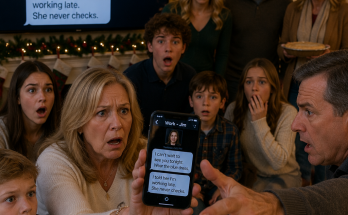
I Opened My Front Door To A Caseworker And Two Officers “Responding To A Report” That My Kids Weren’t Safe—Filed By My Sister, Who Had Already Petitioned For Their Guardianship. I Handed The Caseworker My Phone And Said, “Scroll To Last Tuesday.” Then I Watched Her Pen Stop Over The Page.
### Part 1
The knock came at 7:12 on a Thursday morning, three hard strikes that rattled the brass chain against my front door.
I was standing barefoot in the kitchen, waiting for the coffee maker to finish coughing out its first bitter drops. The house still carried the warm, buttery smell of the waffles I had packed into my son’s lunchbox. Upstairs, the pipes groaned as my daughter brushed her teeth, and the television murmured a weather report no one was watching.
When I opened the door, I found two uniformed police officers and a woman holding a leather folder against her chest.
The officers stood half a step behind her. They weren’t touching their holsters, but their posture was alert enough to make my stomach tighten.
“Ms. Bennett?” the woman asked.
“Yes.”
“My name is Allison Grant. I’m with County Child and Family Services. We’re responding to a report concerning the safety and supervision of your children.”
She said it gently, but the sentence landed with the weight of a brick dropped into still water.
For one second, all I could hear was the coffee machine hissing behind me.
“What kind of report?”
“I’d prefer to discuss the details inside, if that’s all right.”
One of the officers glanced past my shoulder into the hallway. My daughter’s pink sneakers sat beside the stairs, one upright and one tipped on its side. A navy backpack leaned against the coat rack. Nothing unusual. Nothing dangerous.
Still, I knew how ordinary things could be made to look suspicious when placed inside the right story.
Four years earlier, during my divorce, my ex-husband’s attorney had described my home as “unstable.” He had turned late work shifts into abandonment, a cluttered laundry room into neglect, and one missed dentist appointment into proof that I was incapable of raising two children.
Back then, I had walked into court believing the truth would defend itself.
It didn’t.
The truth needed dates, photographs, receipts, messages, names and witnesses. Without those things, it was only another version of events.
I stepped aside.
“You can come in.”
Allison entered first, carrying the faint scent of rain and peppermint gum. The officers followed, their boots leaving dark damp marks on the hardwood floor.
My son, Caleb, appeared at the top of the stairs wearing one sock and a wrinkled school shirt.
“Mom?”
“It’s okay,” I said quickly. “Finish getting dressed.”
His eyes moved from the officers to Allison’s folder.
“Did something happen?”
“No. Go help Sophie find her sweater.”
He hesitated before disappearing down the hall.
Allison watched him leave, then opened her folder at the dining table.
“I need to ask you several questions,” she said. “Some may feel personal. My job is to assess the children’s immediate safety.”
“I understand.”
The younger officer remained near the front door while the older one walked slowly through the living room, looking without appearing to look. His gaze passed over the family calendar, the basket of clean laundry on the couch and the framed school photographs on the mantel.
Allison clicked her pen.
“What time did your children eat dinner last night?”
“Six twenty.”
“What did they eat?”
“Chicken, rice, roasted carrots and apple slices.”
“Who prepared it?”
“I did.”
“When was the last time either child was seen by a physician?”
“Caleb had an appointment two days ago. Sophie had her annual physical last month.”
Her pen scratched steadily across the paper.
“Have the children ever been left alone overnight?”
“No.”
“Have they ever been left unsupervised for an extended period during the day?”
“No.”
She lifted her eyes.
“The report states that both children were left alone for most of last Tuesday. It alleges there was no adult supervision and no prepared food in the home.”
Last Tuesday.
Not last week. Not recently.
A specific day.
The cold pressure in my chest loosened, replaced by something sharper.
Recognition.
Someone had chosen a date. Someone believed they knew exactly where I had been and what my children had been doing.
At Thanksgiving two months earlier, my older sister, Vanessa, had leaned across our parents’ dining table and said, “What you call independence looks a lot like chronic neglect from the outside.”
The phrase had been so ugly and unnatural that I remembered it word for word.
Chronic neglect.
Allison used the same words when she summarized the complaint.
I looked toward the kitchen counter, where my phone sat beside the coffee maker.
The storm I had watched gathering for years had finally reached my front door.
And although I already suspected who had sent it, I didn’t yet know how much further she had gone.
### Part 2
I didn’t accuse Vanessa.
Not then.
An accusation without proof would make me sound defensive, and defensiveness was exactly what whoever filed the report wanted Allison to see.
Instead, I folded my hands on the dining table and asked, “What exactly was supposed to have happened on Tuesday?”
Allison paused before answering.
“The caller stated that the children were alone from early morning until after dark. According to the report, they had no breakfast or lunch, and your son was seen attempting to prepare food by himself.”
Caleb was ten. Sophie was seven.
The image of them hungry and frightened inside our house was so far removed from reality that it felt almost theatrical.
“Was the caller inside my home?”
“I can’t discuss the identity of the reporter.”
“That wasn’t my question.”
Her expression tightened slightly.
“No. The report does not indicate that the caller entered the residence.”
“So they claimed to know what food was available without coming inside.”
The older officer shifted his weight near the living room doorway.
Allison wrote something down.
“Can you describe Tuesday from the beginning?”
“I can show you.”
I stood slowly, making sure my movements couldn’t be mistaken for agitation, and picked up my phone from the counter.
The screen lit beneath my thumb.
My records weren’t part of some elaborate surveillance system. They were the ordinary remains of daily life: photos I took because Sophie liked seeing the tiny notes I tucked into her lunch, appointment reminders, school emails, grocery receipts and text messages with neighbors.
After the divorce, I had begun saving them into folders labeled by month. I also kept a simple calendar with pickup times, medical appointments and work shifts.
At first, it had felt ridiculous.
Then it became routine.
I unlocked the phone and placed it in front of Allison.
“Scroll to last Tuesday.”
She studied my face for a second, as though recalculating who she thought she was interviewing.
Then she looked down.
The first photograph was timestamped 7:38 a.m. It showed Sophie’s open lunchbox on the kitchen counter: a turkey sandwich cut into triangles, strawberries, crackers and a folded napkin covered in hand-drawn stars.
The next image showed Caleb making a disgusted face beside a bowl of oatmeal while Sophie laughed in the background. I had sent it to my mother with the caption, “He says cinnamon is a violation of his rights.”
At 8:11, I had photographed both children outside Brookfield Elementary after Sophie insisted I take a picture of the rainbow over the playground.
Allison’s pen moved again.
“Keep scrolling,” I said.
At 12:44 p.m., there was a parking receipt from Northside Children’s Clinic.
At 1:03, a photograph showed Caleb sitting on the paper-covered examination table with a blood-pressure cuff around his arm. His pediatrician, Dr. Patel, was visible in the background washing his hands.
At 1:19, I had typed notes into my phone about Caleb’s seasonal allergies and a follow-up appointment.
Allison stopped writing for half a second.
The younger officer stepped closer.
“That’s the boy?” he asked.
“Yes.”
“On Tuesday?”
“The timestamp is visible.”
Allison continued scrolling.
At 2:52, Brookfield Elementary had sent a message confirming Sophie would be released to me at the regular pickup location. At 3:16, I texted my neighbor, Laura Kim, saying we had made it home and she could stop by after five if she still wanted coffee.
At 5:27, Laura replied, “Walking over now. Tell Sophie I’m bringing the purple markers.”
At 5:31, my doorbell camera recorded Laura crossing the porch with a canvas bag over one shoulder.
At 6:14, there was a picture of both children sitting at the dining table doing homework while Laura held up Sophie’s drawing and pretended to inspect it like a museum curator.
At 7:42, I photographed Caleb’s science worksheet because he wanted to ask his teacher about one of the questions.
At 8:16, I sent my mother a message saying both kids were showered and reading in bed.
The claim hadn’t been exaggerated.
It hadn’t resulted from a misunderstanding.
It was false down to the hour.
Allison’s pen stopped above the page.
For the first time since entering my house, she looked unsettled.
“Do you keep records like this every day?” she asked.
“Most days.”
“Why?”
“Because four years ago, I learned that a lie becomes dangerous when the person telling the truth has nothing but their word.”
The older officer nodded almost imperceptibly.
Upstairs, Sophie called, “Mom, I can’t find my blue sweater!”
“In the dryer,” I called back.
Then I turned to Allison.
“There’s something else you should know.”
She closed her hand around her pen.
“I believe I know who made the report.”
Before I could say my sister’s name, the doorbell rang again.
Through the glass, I saw Vanessa standing on my porch.
And she was carrying a set of overnight bags for my children.
### Part 3
Vanessa smiled when I opened the door.
It was not the hesitant smile of someone surprised to see police cars outside her sister’s house. It was prepared, sympathetic and almost tender.
Behind her sat a silver SUV with its rear hatch open. Two small suitcases rested inside beside a stack of folded blankets and a box of children’s snacks.
“What are you doing here?” I asked.
Her eyes moved past me.
“Oh,” she breathed, pressing one hand to her chest. “They’re already here.”
The sentence told me everything.
She hadn’t come because she saw the officers.
She had expected them.
Allison stepped into the hallway behind me.
“Ma’am, who are you?”
“I’m Vanessa Holt. I’m Caleb and Sophie’s aunt.” Her voice softened. “I came in case the children needed somewhere safe to stay.”
The younger officer looked toward the luggage in her vehicle.
“You brought bags?”
“I wanted to be prepared.”
Vanessa reached for my arm, but I moved back before she could touch me.
“Prepared for what?”
Her expression flickered.
“For whatever they decide is best.”
My coffee sat cooling on the kitchen counter. A thin film had formed across the surface, and the ordinary sight of it made the scene feel even more unreal.
Allison glanced at me.
“Is this the person you were referring to?”
“Yes.”
Vanessa’s mouth tightened.
“Referring to me about what?”
“The report claims the children were alone all day Tuesday,” I said.
She tilted her head. “I don’t know the details.”
“You knew enough to bring luggage.”
“I knew someone had raised concerns.”
“Who told you?”
She looked at Allison instead of answering me.
“I’ve been worried about these children for a long time. Claire has been under tremendous pressure since the divorce. She works, she handles the house alone, and she doesn’t always realize how overwhelmed she is.”
There it was: concern sharpened into a blade.
Vanessa had perfected that tone over years. She never called me irresponsible directly. She described me as exhausted. She never said I was a bad mother. She said I deserved relief.
Every insult arrived wrapped like a gift.
Caleb came downstairs with his backpack over one shoulder. He froze when he saw her.
“Aunt Vanessa?”
Her face transformed.
“Hey, sweetheart.”
She stepped toward him, opening her arms.
He didn’t move.
“Why are there bags in your car?” he asked.
Vanessa glanced at me.
“I thought you and Sophie might have a sleepover.”
“No, you didn’t,” he said.
The blunt certainty in his voice seemed to embarrass her more than any accusation I could have made.
“Go upstairs,” I told him gently.
“But—”
“Please.”
He looked at the officers again, then climbed the stairs slowly.
Vanessa watched him until he disappeared.
“This is exactly what I mean,” she said quietly. “He shouldn’t have to understand adult problems.”
“You brought his suitcase to my house before breakfast.”
“I brought a suitcase because somebody had to think ahead.”
Allison opened her folder.
“Ms. Holt, did you file the report?”
“I understand reports are confidential.”
“That’s not an answer.”
Vanessa crossed her arms. The gold bracelet on her wrist caught the gray morning light.
“I shared concerns with the appropriate people. I’m not going to apologize for protecting my niece and nephew.”
“What you shared was a lie,” I said.
“You don’t know what I shared.”
“The complaint says they were abandoned last Tuesday. Caleb spent that afternoon at the pediatrician’s office with me. Sophie was at school until I picked her up. We have photos, messages, receipts and witnesses covering the entire day.”
Her face lost color, but only for a moment.
“Then perhaps someone was mistaken about the date.”
“The report included the date three separate times,” Allison said.
Vanessa turned toward her.
“I don’t know what the intake worker wrote.”
The officers exchanged a glance.
She had just revealed knowledge she should not have had unless she had spoken to the intake worker herself.
Vanessa realized it too late.
She adjusted the strap of her handbag and said, “This is becoming hostile. I came here to help.”
“No,” I said. “You came here to collect my children.”
Her gaze sharpened.
“You’re making this about sibling resentment when it’s about stability.”
“My children are stable.”
“They could be more stable.”
“With you?”
She didn’t answer.
But she didn’t have to.
Allison asked Vanessa to wait outside while she completed her assessment. Vanessa resisted, insisting that she was family, until the older officer stepped forward and repeated the request in a tone that left no room for argument.
As she turned toward the door, a thick white envelope slipped from beneath her handbag and landed on the floor.
I bent to pick it up.
Across the top, beneath the county courthouse seal, were the words Petition for Temporary Guardianship.
My sister had not merely hoped the caseworker would take my children.
She had already filed paperwork asking a judge to give them to her.
### Part 4
Vanessa reached for the envelope.
I held it away from her.
“What is this?”
Her face went still.
“Give it back.”
Allison moved closer. “Is that a court filing?”
“It’s private.”
“It has my children’s names on it,” I said. “It stopped being private when you brought it into my house.”
She tried to take the envelope again, but the older officer stepped between us.
“Let’s keep some distance.”
My fingers trembled as I opened the packet.
The first page listed Vanessa and her husband, Grant, as petitioners. I was named as the respondent. Beneath that, in cold printed language, my sister claimed I was unable to provide “consistent supervision, adequate nutrition and a safe domestic environment.”
The filing date was Monday.
The report to child welfare had been made Tuesday morning.
That meant she had petitioned for guardianship before the supposed day of neglect had even occurred.
I read the dates twice.
Then a third time.
A strange calm settled over me, colder than anger.
“You filed this before Tuesday.”
Vanessa pressed her lips together.
“I filed because the problems didn’t begin Tuesday.”
“But Tuesday is the incident you used to support the emergency request.”
“I didn’t write every word personally. My attorney prepared it.”
“The petition says you witnessed ongoing neglect.”
“I have witnessed your exhaustion.”
“That isn’t neglect.”
“You fall asleep on the couch.”
“At ten o’clock after the children are in bed.”
“You forget things.”
“I once forgot to send Sophie’s library book back on Monday.”
“You’re minimizing.”
“No. I’m being specific. You should try it.”
Allison held out her hand.
“May I see the petition?”
Vanessa laughed once, without humor.
“You don’t work for the court.”
“No, but the existence and timing of a guardianship petition may be relevant to determining whether this report was made in good faith.”
Vanessa looked toward the officers.
“Am I being accused of something?”
“No one has accused you of a crime,” the older officer said. “But you need to cooperate and remain calm.”
“I am calm.”
She wasn’t. A pulse beat rapidly in her neck, and she had begun rubbing her thumb over the edge of her bracelet.
I handed Allison the papers.
She read silently, pausing at several sections. Her expression became increasingly guarded.
One paragraph claimed that Vanessa had regularly purchased groceries because my refrigerator was often empty.
She had sent groceries twice in the past year.
The first time was after I caught the flu. The second was when she insisted on placing a large order for Caleb’s birthday party after I told her I had already bought everything.
Another paragraph said my children frequently arrived at family gatherings in “unclean or inappropriate clothing.”
Sophie had spilled chocolate milk on her dress at Easter.
Caleb had torn one knee of his jeans while climbing a fence at our parents’ house.
Vanessa had transformed childhood mess into evidence.
My mother had once joked that Vanessa could turn a grocery list into a legal brief. Until that morning, I hadn’t understood how literal the joke could become.
Allison reached the final page.
“There’s a request for immediate temporary placement pending investigation,” she said.
Vanessa lifted her chin.
“Because children shouldn’t remain in danger while adults debate technicalities.”
“Technicalities?” I repeated. “You invented an entire day.”
“I was given information.”
“By whom?”
She hesitated.
“A neighbor.”
“Which neighbor?”
“I’m not naming someone who trusted me.”
I thought of the houses around mine.
Laura had been inside my home Tuesday evening. Mr. Dawson across the street worked nights and slept during the day. The Franklin family had been visiting relatives out of state.
Then I remembered the gray sedan parked near the end of our block Tuesday morning.
At the time, I had assumed it belonged to a contractor working on the vacant house down the street. It remained there when I left for the school and was gone when I returned from Caleb’s appointment.
“Did you have someone watching my house?” I asked.
Vanessa’s eyes shifted toward the window.
It was a tiny movement, but Allison saw it.
“So you did.”
“I asked someone to verify concerns.”
“You paid someone to follow me?”
“I wanted an objective account.”
“Then why does the report say the children were alone when any objective person would have watched us leave together?”
Vanessa looked trapped for less than a second.
Then she said, “Maybe you arranged the doctor’s visit after you realized you were being observed.”
The accusation was so absurd that even the younger officer frowned.
The appointment had been booked three weeks earlier. I had the confirmation email.
But Vanessa wasn’t trying to persuade them anymore.
She was trying to discover how much evidence I had.
That frightened me more than the petition.
Because it suggested Tuesday’s lie was only one piece of a much larger plan.
### Part 5
Allison completed her inspection room by room.
I followed while Vanessa waited outside under the supervision of one officer.
The house suddenly looked different through a stranger’s eyes.
The crayons scattered beneath the coffee table. The cereal bowl soaking in the sink. A basket of unmatched socks beside the dryer. None of it felt harmless anymore. Every object seemed to stand trial.
Allison opened the refrigerator.
Inside were eggs, milk, yogurt, vegetables, chicken, sandwich meat and a plastic container of leftover rice. Caleb’s allergy schedule was attached to the door with a magnet shaped like a taco.
She checked the pantry, the children’s bedrooms, the smoke detectors and the medication cabinet.
Sophie’s room smelled faintly of strawberry shampoo. Stuffed animals crowded her bed, arranged according to a complicated system only she understood. Caleb’s desk was covered with model airplane pieces and three sharpened pencils lined up beside his homework folder.
“Your records are unusually thorough,” Allison said as we returned downstairs.
“I wish they didn’t need to be.”
“They may matter beyond today.”
I looked through the front window. Vanessa stood beside her SUV, speaking rapidly into her phone while the officer watched from several feet away.
“What happens now?”
“Based on what I’ve observed, there is no immediate safety concern. I’ll verify the school and medical information, speak privately with the children and contact the witnesses you identified.”
“Will you note that the report was false?”
“I will document every contradiction. The final classification comes after supervisory review.”
“And the guardianship petition?”
“That is a separate court matter. You need an attorney.”
The words tightened my throat.
Attorneys meant retainers, missed work and months of living with a knot beneath my ribs. I had survived one custody battle. The thought of beginning another made my knees feel weak.
Allison lowered her voice.
“The timing of this petition is significant. Keep the original records. Back up everything. Do not communicate with your sister unless necessary, and preferably do so in writing.”
I nodded.
Then she added, “You should also review older messages. People rarely begin planning something like this the week they file.”
After she interviewed Caleb and Sophie separately, she spoke briefly with the officers. No one gave Vanessa the confrontation she seemed prepared to perform. There were no raised voices, no handcuffs and no dramatic announcement.
Allison simply told me the children would remain in my care and that she would follow up.
Vanessa stared at her.
“You’re leaving them here?”
“I have not identified grounds for emergency removal.”
“You’ve been inside for less than an hour.”
“And during that hour, I reviewed time-stamped evidence directly contradicting the core allegation.”
“You’re letting paperwork blind you to what’s happening.”
“Ms. Holt,” Allison said, “you arrived with luggage before anyone had discussed removal. I suggest you speak with your attorney.”
Vanessa’s cheeks turned red.
She looked at me as though I had cheated.
“This isn’t over.”
The older officer straightened.
“Ma’am, don’t make statements that could be interpreted as threats.”
“I’m talking about the court process.”
“Then let the court process speak for itself.”
She slammed the rear hatch of her SUV. The sound cracked through the damp morning.
Before getting into the driver’s seat, she pointed toward my house.
“When this falls apart, don’t say I didn’t try to save them.”
Caleb watched from the upstairs window.
I saw the curtain move behind him.
Vanessa drove away, spraying water from the curb.
I closed the door and leaned against it.
For the first time that morning, my body began to shake.
Sophie came running down the stairs and wrapped both arms around my waist.
“Why did Aunt Vanessa want us to go with her?”
I rested my cheek against the top of her head.
“She thought she was helping.”
“Was she?”
“No.”
Caleb stayed several steps above us.
“Did she call the police?”
“Not exactly.”
“But she told someone we were alone.”
I didn’t ask how much he had overheard.
He looked older than he had at breakfast.
“I don’t want to go to her house,” he said.
“You’re not going anywhere.”
“Promise?”
“I promise.”
That afternoon, after the children were at school, I called an attorney named Evelyn Ross. She agreed to meet me the next morning.
Then I began reviewing old messages.
At 11:46 that night, I found a photograph Vanessa had sent six months earlier. It showed my children asleep in her guest room after a family barbecue.
At the time, I had thought it was sweet.
Now I noticed the caption beneath it.
“They already look like they belong here.”
### Part 6
Once I saw the pattern, I couldn’t stop seeing it.
Vanessa had been building a case in fragments for more than a year.
She texted after school events asking whether I was “managing the schedule.” She offered to keep the children for entire weekends when I only needed help for an hour. She sent articles about single-parent burnout and wrote, “No judgment. Just something to consider.”
Whenever I declined her offers, she responded with a heart emoji or a sentence about how I didn’t need to prove anything.
Then she saved my refusal as evidence that I rejected support.
I found a message from the previous summer.
“Caleb says you were too tired to cook last night.”
My reply read, “We had grilled cheese and tomato soup. He was complaining because I wouldn’t order pizza.”
Vanessa had answered, “Still, children notice when a parent is running on empty.”
Another message followed Sophie’s school concert.
“You arrived three minutes before it started. That kind of unpredictability is hard on kids.”
I had arrived three minutes before the performance because a delivery truck blocked the school entrance. Sophie hadn’t even noticed. Vanessa had.
By two in the morning, I had created a folder containing forty-seven messages.
I didn’t sleep.
The next morning, Evelyn Ross met me in an office above a bakery. The stairwell smelled like sugar and warm bread, a strangely comforting scent for a conversation about losing my children.
Evelyn was in her early fifties, with silver-streaked hair and the patient expression of someone who had learned not to react before hearing everything.
She read the petition without interrupting.
When she finished, she placed it flat on the desk.
“This was prepared before the incident used to justify emergency guardianship.”
“Yes.”
“That’s a serious credibility problem.”
“Can the judge still grant it?”
“Anyone can ask a court for almost anything. Granting it is another matter.”
She examined the screenshots on my phone.
“Your sister is financially comfortable?”
“She and her husband own a large house. She works in corporate accounting. He manages commercial properties.”
“Children?”
“No.”
“Has she ever discussed adoption?”
“Years ago. She said it wasn’t for them.”
Evelyn tapped one finger against the petition.
“This doesn’t read like someone offering temporary help. It reads like someone describing herself as the superior parent.”
“That’s what she believes.”
“Belief isn’t evidence.”
She explained that we would file an opposition, attach the child welfare findings when available, and request dismissal. She also recommended asking the court to preserve communications between Vanessa, her attorney and anyone hired to observe my house.
“Do you think she hired an investigator?”
“I think we should find out.”
Three days later, Allison called.
The report had been classified as unfounded.
The school confirmed both children were present Tuesday morning. The clinic confirmed Caleb’s appointment. Laura confirmed she spent the evening in my house. My doorbell footage showed all of us leaving together that morning and returning at documented times.
“There’s no support for the allegation,” Allison said.
“Will the false details be included?”
“Yes. I’m also noting that the guardianship petition predates the alleged incident.”
I closed my eyes.
“Thank you.”
“I haven’t done you a favor, Ms. Bennett. I documented what the evidence showed.”
That distinction mattered.
The truth hadn’t survived because someone liked me.
It survived because it could be verified.
The following week, Evelyn obtained an invoice through the court process.
Vanessa had hired a private investigator named Dale Mercer to watch my house.
His original report stated that I left home with both children at 7:56 Tuesday morning.
It also documented our arrival at the clinic and our return home that afternoon.
Vanessa had received his report before she contacted child welfare.
She knew her accusation was false before she made it.
But the invoice revealed something even worse.
She had hired Mercer three months earlier, and Tuesday had not been the first day he followed us.
### Part 7
The investigator had photographed my children at school, at the grocery store, at the park and outside their pediatrician’s office.
He had logged the times I left for work, the mornings my mother came over and the evenings Laura visited. He had even noted when I rolled the trash bins to the curb.
Vanessa had paid thousands of dollars to observe an ordinary life and then ignored everything that proved it was ordinary.
Evelyn spread the reports across her conference table.
“This is not evidence of neglect,” she said. “It is evidence of routine.”
One report described me taking Caleb to soccer practice, then shopping for groceries with Sophie. Another documented all three of us visiting the public library. A third noted that I spent two hours at an urgent care clinic after Sophie twisted her ankle.
The investigator had repeatedly concluded, “No concerning activity observed.”
Vanessa submitted none of those pages with her petition.
Instead, her filing included cropped photographs: Caleb carrying a grocery bag, Sophie waiting beside my car, me sleeping on a picnic blanket while the children played nearby.
The uncropped photograph showed my mother sitting six feet away, awake and watching them.
That afternoon, I received a text from Vanessa.
“We need to talk before lawyers make this uglier.”
I forwarded it to Evelyn.
“Do not respond yet,” she said.
Then my mother called.
“Your sister is beside herself.”
I stood at the kitchen sink, watching rain strike the backyard fence.
“She filed a false neglect report.”
“She was worried.”
“She hired someone to follow us for three months.”
“She thought she needed proof.”
“The proof showed my children were safe.”
My mother went quiet.
“She says you’re trying to ruin her career.”
“I haven’t contacted her employer.”
“Her attorney told her false reports could have consequences.”
“Those consequences belong to the person who filed the report.”
“She made a terrible mistake.”
“A mistake is entering the wrong date. She wrote a story she knew wasn’t true and tried to use it to take my children.”
“She loves them.”
“Love does not excuse possession.”
My mother began to cry softly.
I felt the old reflex to comfort her, to soften my language and make the situation easier for everyone except me.
I let the silence remain.
Finally, she said, “Vanessa has always wanted a family.”
“Then she should have built one without destroying mine.”
“She said she thought the children would eventually understand.”
“Understand what?”
“That she could give them more.”
The answer opened a hollow space inside me.
This had never been about a single false report. It had never even been about helping.
Vanessa had looked at my children, my house, my imperfect schedule and my exhaustion, and decided my family was an opportunity waiting to be transferred to her name.
The court hearing took place on a cold Monday morning.
Vanessa sat at the opposite table wearing a navy suit. Grant sat beside her, staring down at his clasped hands.
For the first time, I wondered how much he had known.
Evelyn presented the child welfare finding, the medical records, the school confirmation and the investigator’s full reports. Then she presented the dates.
Guardianship petition filed Monday.
Alleged neglect Tuesday.
Investigator’s report received Tuesday afternoon.
False child welfare complaint submitted Tuesday evening.
The judge removed his glasses.
“Mrs. Holt, your petition describes an incident that had not occurred when you signed this document.”
Vanessa’s attorney stood.
“The petition addressed an ongoing pattern, Your Honor.”
“Then why is this particular date used as the central basis for emergency intervention?”
Her attorney glanced toward Vanessa.
There was no good answer.
The judge dismissed the emergency petition and referred the false-report evidence for further review.
Vanessa’s shoulders dropped.
But as I walked out of the courtroom, Grant caught up with me near the elevators.
“There’s something you need to know,” he said.
He looked pale and exhausted.
“Vanessa wasn’t planning to keep the children temporarily.”
The elevator doors opened behind him.
“She had already contacted a school near our house and prepared bedrooms with their names on the walls.”
### Part 8
I stared at Grant.
People moved around us in the courthouse hallway, their shoes squeaking against the polished floor. Somewhere nearby, a printer hummed and a child began crying.
“What do you mean, their names were on the walls?”
Grant rubbed both hands over his face.
“She redid the guest rooms in September. One for Caleb, one for Sophie. She ordered furniture, clothes, school supplies—everything.”
September was seven months earlier.
Long before the petition.
Long before Tuesday.
“Why didn’t you stop her?”
“I thought it was a fantasy. Then she started talking to attorneys.”
“You knew about the investigator?”
“Not at first.”
“But you knew about the petition.”
He lowered his eyes.
“Yes.”
I stepped back from him.
“You let her file it.”
“She told me you were struggling. She showed me pictures.”
“Pictures she cropped.”
“I know that now.”
“You could have called me.”
“I should have.”
The courthouse elevator chimed again.
Grant looked toward the doors, then back at me.
“She said once the children stayed with us for a few weeks, they would see how much easier life could be. She believed they would ask to remain.”
My stomach turned.
“She planned to make them choose.”
“I’m sorry.”
“No. You’re afraid.”
He flinched.
It was true. Grant had not approached me because his conscience suddenly awakened. He had approached me because the plan had failed and he wanted distance from the fallout.
I left him standing beside the elevators.
Vanessa called that evening.
I didn’t answer.
She called six more times, then sent a message.
“Please let me explain without attorneys twisting everything.”
I saved it.
Two days later, she appeared at my mother’s house while I was dropping off groceries. I nearly turned around when I saw her car, but she came through the front door before I reached mine.
She looked smaller than she had in court. Her hair was pulled into a loose knot, and dark shadows sat beneath her eyes.
“Claire, please.”
My mother stood behind her, wringing a dish towel between her hands.
“I didn’t know she would be here,” Mom said.
I believed her, but that did not make the situation acceptable.
Vanessa stepped closer.
“I withdrew the remaining petition.”
“It was dismissed.”
“My attorney could have filed a revised one. I told him not to.”
“You want credit for stopping after you were caught?”
“I want you to understand why I did it.”
“I understand.”
“No, you don’t.” Her voice cracked. “You have Caleb and Sophie. You have no idea what it’s like to keep building a life that feels empty.”
“My children are not a cure for your emptiness.”
“I know that now.”
“You knew it before.”
She began crying.
“I thought I could give them more than you could.”
“You could give them a larger bedroom. That isn’t the same as a better mother.”
“I was scared for them.”
“You watched an investigator document that they were safe, and then you lied anyway.”
“I convinced myself the good days were performances.”
“That is not concern. That is delusion.”
My mother whispered, “Claire…”
I lifted one hand.
“No. Everyone has spent years translating Vanessa’s cruelty into concern because it sounds nicer. I’m done helping her do that.”
Vanessa wiped her face.
“I love them.”
“You loved the role you imagined them giving you.”
“That isn’t fair.”
“You prepared bedrooms with their names on the walls. You contacted a school. You brought suitcases before the caseworker arrived. You weren’t rescuing them. You were waiting for someone to hand them over.”
She covered her mouth.
For one moment, I saw my sister as she truly was—not a monster, not an evil stranger, but a deeply unhappy woman who had allowed envy to become entitlement and entitlement to become harm.
That made what she had done understandable.
It did not make it forgivable.
“You will not contact Caleb or Sophie,” I said. “You will not visit their school, send gifts, ask relatives for information or come to my home. Any necessary communication goes through my attorney.”
“Forever?”
“I don’t know. But you don’t get to ask me for a timetable.”
“I’m your sister.”
“You tried to use the government and the courts to take my children.”
She looked at Mom, perhaps expecting intervention.
Mom lowered her eyes.
I walked out without hugging either of them.
The county’s review concluded that Vanessa had knowingly provided false information. The consequences were quieter than television dramas make such things seem: legal fees, formal findings, mandated evaluations and a court order restricting contact. There was no spectacular public collapse.
There didn’t need to be.
Her guardianship request was gone. Her credibility was documented. My children were safe.
I changed the locks even though Vanessa had never had a key.
I installed additional cameras, notified the school and gave the front office copies of the court order. I backed up every record in two places.
For a while, the children asked about their aunt.
I gave them simple, age-appropriate answers.
“She made choices that were not safe for our family.”
“Does she still love us?” Sophie asked once.
“Probably,” I said. “But love doesn’t make every choice good.”
Months passed.
Our life became ordinary again.
Caleb complained about vegetables. Sophie covered the refrigerator in drawings. I missed one school email, burned a tray of garlic bread and arrived seven minutes late to soccer practice because I took the wrong exit.
Nothing terrible happened.
Ordinary mistakes were allowed to be ordinary again.
The following spring, I received a letter from Vanessa. It was six pages long. She apologized, explained her loneliness and described the counseling she had begun attending.
I read it once.
Then I placed it in the folder with the court records.
I didn’t respond.
Maybe she had changed. Maybe one day she would become someone capable of understanding what she had nearly destroyed. That journey belonged to her, not me.
Forgiveness was not the price I owed for surviving her betrayal.
On Tuesday mornings, I still packed lunches before sunrise. I still took unnecessary photographs—Sophie’s sandwich, Caleb’s ridiculous socks, the two of them arguing over the last strawberry.
But the pictures no longer felt like evidence.
They felt like what they had always been beneath the fear: small proof that our life belonged to us.
That Thursday morning, my sister arrived with suitcases because she believed my family could be taken through paperwork, performance and a carefully timed lie.
She was wrong.
Not because the system was perfect.
Not because the truth automatically won.
She was wrong because I had learned to give the truth a memory, a timestamp and a voice.
And when someone finally came to my door carrying her version of my life, I was ready to show them mine.
THE END!