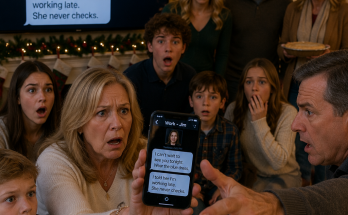
She Slapped Me For Serving Myself First. I Slapped Back And Walked Out With My Kids.
My Sister-In-Law Slapped Me At My Own Anniversary Dinner For Serving Myself Before Her. “You Forget Your Place In This Family,” She Snapped, While My Husband Just Looked Away. I Set Down My Fork And Slapped Her Back.
### Part 1
My sister-in-law slapped me across the face at my own anniversary dinner because I served myself before she had filled her plate.
The sound cracked through the dining room so sharply that my seven-year-old daughter dropped her fork. It struck the china, bounced once, and landed beside her water glass.
For one stunned second, nobody moved.
The roasted chicken I had spent all afternoon preparing still steamed beneath the chandelier. Rosemary and lemon hung in the air, mixed with the sweet scent of the candles I had placed between vases of fresh dahlias. Outside, dry leaves scratched across the porch in the early October wind.
Inside, my cheek burned.
“You forget your place in this family,” my sister-in-law, Vivian Mercer, said.
Her hand remained raised as though she expected applause.
My five-year-old son, Noah, stared at her with a piece of bread halfway to his mouth. My daughter, Lily, looked from Vivian to me, her eyes wide and frightened.
But I looked at my husband.
Daniel sat two seats away, wearing the charcoal shirt I had bought him for our eleventh wedding anniversary. His fork rested beside his plate. His shoulders were stiff. He had seen everything.
He looked down at the tablecloth.
That was all.
He did not tell his sister to leave. He did not ask whether I was hurt. He did not even say my name.
Something inside me, something that had bent and bent for eleven years, finally snapped.
I placed my fork beside my plate. Then I unfolded the linen napkin I had ironed that morning and wiped my fingers carefully. My movements felt strangely calm, as though my body had already made a decision before my mind caught up.
Vivian’s mouth curved into a satisfied smile.
She mistook my silence for surrender.
I stood, leaned across the table, and slapped her back.
Hard.
Her head jerked sideways. A wineglass trembled near her elbow. Daniel’s mother, Margaret, gasped as though I had fired a weapon in the dining room.
Vivian stared at me, one hand pressed to her cheek.
“How dare you?”
I barely heard her.
I was looking at Daniel.
“A husband who cannot defend his wife in front of a room full of people does not deserve to remain her husband.”
His face went pale.
“Claire, wait.”
It was the first thing he had said.
Not when his sister struck me.
Only when I threatened to leave.
I turned to Lily and held out my hand. She took it immediately. Noah slid down from his chair and grabbed my other hand, his small fingers sticky with butter.
“Where are you going?” Daniel asked, standing at last.
“Somewhere my children won’t learn that this is what love looks like.”
Margaret pushed back her chair. “You’re being hysterical. Vivian should not have touched you, but there is no reason to destroy a marriage over one emotional moment.”
One emotional moment.
That was how people like Margaret survived the consequences of their cruelty. They reduced years of humiliation to a misunderstanding, one insult to a joke, one act of violence to an unfortunate moment.
But the slap had not destroyed my marriage.
It had only revealed what had already died.
I walked my children through the foyer of the house I had helped pay for, past the framed wedding photograph hanging over the console table. In that picture, Daniel was laughing into my hair beneath a shower of flower petals.
I had once believed that photograph captured the truest version of us.
Now I wondered whether it had captured the last one.
I drove forty minutes to my parents’ house without turning on the radio. Lily stayed quiet in the back seat. Noah fell asleep with his forehead against the window.
My hands did not begin shaking until I pulled into the circular driveway of the home where I had grown up.
My mother opened the front door before I reached it. She wore slippers and an old blue sweater, and her silver-streaked hair was pinned loosely at the back of her neck.
She took one look at my face.
“Come inside, sweetheart,” she said. “You’re safe here.”
Those four words broke me more completely than the slap had.
I sank against her, still holding Lily’s hand, and began to cry.
That night, Daniel called seventeen times.
I answered none of them.
At 2:13 in the morning, while my children slept beside me in my parents’ guest room, one final message appeared on my phone.
Please come home. We can fix this.
I stared at the glowing screen until it went dark.
What Daniel did not know was that I was no longer wondering whether our marriage could be fixed.
I was beginning to wonder what else he had allowed his family to take from me while I was too busy trying to keep the peace.
### Part 2
I met Daniel Mercer when I was twenty-two in a coffee shop near my university apartment.
It had been raining since dawn, and every table was crowded with students hiding beneath wet coats. Daniel asked whether he could share mine. He had damp brown hair, an old canvas messenger bag, and a smile that made him look as though he had just remembered something wonderful.
We talked for four hours.
He was studying architecture and working nights for a small firm. His car had nearly two hundred thousand miles on it, and he joked that every warning light on the dashboard had become an old friend.
I came from a different world.
My father had built a successful commercial construction company from a borrowed truck, a small business loan, and a level of stubbornness that frightened bankers. By the time I was born, my parents lived comfortably. By the time I entered college, my mother had begun introducing me to polished young men whose families appeared in business magazines and charity photographs.
I wanted nothing to do with them.
Daniel felt honest. Unplanned. Entirely mine.
My father was cautious when I brought him home. My mother was kinder, though she once asked me a question I dismissed too quickly.
“Does he love the life around you,” she said, “or does he love you?”
“He loves me,” I replied without hesitation.
I believed it.
Daniel and I married two years later in the garden behind my grandmother’s church. His family attended with polite smiles and watchful eyes.
His widowed mother, Margaret, wore black even though Daniel had begged her not to. His older sister, Vivian, arrived late and spent most of the reception examining the flowers, the food, and the jewelry worn by my relatives.
At the time, I thought she felt uncomfortable around wealth.
Years later, I understood that she had been calculating what proximity to it might offer her.
The first insult came during our second Thanksgiving.
I had cooked from my grandmother’s handwritten recipes. The kitchen windows fogged while cinnamon, sage, and butter filled the house. I was proud of the meal until Vivian tasted the stuffing and placed her fork down with a deliberate clink.
“It’s sweet when some people try so hard to prove they belong somewhere they clearly weren’t born into.”
A few relatives laughed nervously.
Daniel reached for the gravy.
“Did anyone watch the game?” he asked.
That was the beginning of his silence.
At Noah’s christening, Margaret cornered me beside the coat closet while I held my sleeping infant against my chest.
“Money can buy a beautiful nursery,” she whispered, smiling as guests passed behind her, “but it cannot buy manners. I worry about what my grandchildren will absorb.”
Her perfume was heavy and floral. I can still remember the cold metal of Noah’s baptism bracelet against my wrist.
I said nothing.
Daniel later told me his mother had probably meant well.
At Margaret’s sixtieth birthday, Vivian’s catering company ran short on money two days before the event. I quietly covered the entire bill.
Nobody thanked me.
Instead, Vivian announced in front of the staff that it was nice I had finally found a use for my family’s money besides decorating rooms.
I laughed with everyone else.
By then, laughing had become a survival skill.
There were dozens of moments like that. Each one was small enough to dismiss but sharp enough to leave a mark. Vivian understood how to wound a person in public while making any response appear unreasonable.
Daniel never joined in.
For years, I told myself that mattered.
He was not cruel, I reasoned. He was conflict-averse. He had grown up under Margaret’s control. He did not know how to challenge Vivian.
But silence repeated often enough becomes a decision.
Eleven years into our marriage, we had two children and a beautiful colonial house with a wraparound porch. My father had provided the down payment as a wedding gift, and I had paid for every renovation with income from my interior design firm.
Daniel and I owned the house jointly on paper.
Yet Margaret and Vivian treated it as though I were a guest inside a Mercer family property.
Daniel had also assumed responsibility for most of our household banking because my work required frequent travel. At the time, it seemed practical. I trusted him completely.
After the anniversary dinner, that trust began to feel less like love and more like negligence.
Three days after I left, I finally answered his call.
I sat alone on my parents’ back porch while cold rain darkened the wooden railings.
“I should have defended you,” Daniel said. His voice cracked. “I know that now.”
“You knew it when she hit me.”
“I froze.”
“You have been freezing for eleven years.”
“My family will apologize. We can attend counseling. Please come home. The kids need their father.”
I closed my eyes.
“How many times have you watched your mother or sister humiliate me and said nothing?”
He was silent.
I waited.
Still nothing.
That silence answered me more clearly than words ever could.
“I’m filing for divorce,” I said.
He inhaled sharply. “Claire, don’t do this because you’re angry.”
“I’m not doing it because I’m angry. I’m doing it because I’m finally not afraid.”
Eleven days after the dinner, I sat across from my attorney, Julian Brooks, and told him I wanted primary custody, protection of my business, and a complete examination of our finances.
Julian removed his glasses and studied me.
“Is there a reason you suspect financial misconduct?”
“Not evidence,” I admitted. “Just a feeling.”
He nodded once.
“Feelings are not proof. But they often tell us where to begin looking.”
Two weeks later, he called me into his office.
Spread across his desk were four years of bank statements, each marked with yellow tabs.
More than sixty thousand dollars had disappeared from the account funded primarily by my income.
Every transfer led back to Vivian.
And that was only the first thing Julian had found.
### Part 3
The transfers were small enough to hide inside an ordinary life.
Eight hundred dollars one month. Twelve hundred the next. Sometimes nothing for several weeks, followed by two payments only days apart. Each one carried vague descriptions such as household services, vendor reimbursement, or family expense.
Daniel had approved all of them.
Together, they totaled more than sixty thousand dollars.
I sat in Julian’s office beneath the dry hum of the air conditioner, staring at the figures until they blurred.
“They were loans,” Daniel claimed during his first formal response. “Vivian’s business was struggling. I was helping my family.”
“With money you concealed from your wife,” Julian said.
“I intended to repay it.”
“You did not borrow it. You transferred it.”
Daniel’s attorney interrupted, but I barely heard the argument.
I kept thinking about the nights I had stayed awake reviewing payroll for my design firm, worried about whether a delayed client payment might affect my employees. I thought about business trips where I chose cheaper hotels because I believed our household expenses had increased. I remembered telling Lily we would postpone replacing her broken backyard playset until the following summer.
All that time, my money had been keeping Vivian’s failing catering company alive.
When Daniel called me privately that evening, I answered only because the children were with my parents.
“I was going to tell you,” he said.
“When?”
“I don’t know.”
“Before or after she slapped me in the house my money helped buy?”
“She was under stress.”
I laughed, but there was no humor in it.
“So was I. Somehow I managed not to steal sixty thousand dollars.”
“I didn’t steal it.”
“You hid it. You lied about it. You let me cut expenses for our children while financing your sister.”
“She is my family.”
“So were we.”
Daniel had no answer.
The missing money damaged what little remained of my trust, but Julian warned me there might be a larger problem.
During the mandatory review of property records, his paralegal had discovered an unusual filing attached to our house. Eighteen months earlier, someone had submitted a quitclaim deed attempting to transfer a ten-percent ownership interest to Margaret.
My signature appeared at the bottom.
I had never seen the document.
For several seconds, I could only hear the faint ticking of the clock on Julian’s wall.
“That isn’t my signature,” I said.
“It resembles yours.”
“It isn’t mine.”
Julian leaned back. “Fortunately, the county flagged the filing during verification. The transfer was placed on hold because supporting identification was never provided. Legally, Margaret does not own any portion of the property.”
Relief came first.
Then fear.
“But someone tried to give it to her.”
“Yes.”
“Who submitted it?”
“We are working on that.”
I stared at the photocopy. The forged signature was disturbingly convincing. Whoever created it had practiced.
A forensic document examiner compared it with genuine signatures from my mortgage documents, business contracts, and driver’s license. Her report identified differences in pressure, rhythm, and the way the pen lifted between letters.
“It is a simulation,” she explained. “A careful one, but not natural handwriting.”
The county recorder provided its internal records. The document had been delivered through a local filing service after being notarized at a small office across town.
The notary remembered a woman presenting the paperwork, but her records were incomplete. A financial-crimes detective would need to investigate whether she had been deceived or had failed to follow proper identification procedures.
Julian warned me not to expect quick answers.
“Property fraud cases move slowly,” he said. “The divorce may conclude long before any criminal investigation.”
“Do you think Daniel knew?”
“I think we need evidence before drawing conclusions.”
That was the lawyer’s answer.
My answer was simpler.
I no longer knew what Daniel was capable of ignoring.
When I confronted him through our attorneys, he denied knowledge of the forged deed.
“I knew my mother wanted security,” he admitted. “She worried that Claire would leave someday and cut us all off. But I never agreed to transfer ownership.”
Us all.
Even after everything, Daniel still spoke of himself, Margaret, and Vivian as one unit.
The children and I were somewhere outside it.
My father was furious when I told him. We sat in his study with the door closed so Lily and Noah would not hear. Late-afternoon sunlight fell across the shelves, and dust floated through it like ash.
“That house was meant to give you stability,” he said. “Not to become something those people could divide.”
“It never transferred.”
“They still tried.”
He walked to the window and stood with both hands in his pockets.
My father was rarely emotional. He believed anger should be used like a tool: only when it could build or protect something. That evening, I saw how hard he was working to control it.
“Nobody takes your home from you while I am alive,” he said.
I believed him.
Yet even my father could not protect me from what came next.
Julian’s review of older county records uncovered a property dispute involving Margaret from almost twenty-five years earlier. After her husband’s death, she had attempted to claim part ownership of a house belonging to her sister-in-law.
The matter had been settled privately.
The documents did not prove criminal conduct, but the similarity was impossible to ignore.
“This may be a pattern,” Julian said.
A week later, his office received a call from a woman named Jenna Price, a former employee of Vivian’s catering company.
She had heard about the financial investigation through a former coworker.
Jenna claimed she had documents we needed to see.
When she arrived at Julian’s office, she carried a worn cardboard box filled with invoices.
On top was the bill for my anniversary dinner.
The amount I paid did not match the services provided.
Vivian had inflated the invoice and redirected part of the payment.
The dinner where she slapped me had been another opportunity to steal from me.
But Jenna had brought something even more disturbing than the invoices.
She had saved a series of messages from Vivian mentioning “the house paperwork” and promising Margaret that Claire would never notice.
### Part 4
Jenna placed her phone on the conference table and slid it toward Julian.
The screen showed photographs of messages she had saved before leaving Vivian’s company. Most concerned unpaid wages, inflated invoices, or instructions to alter receipts.
Then Julian opened the thread that mentioned my house.
Margaret keeps asking whether the paperwork is finished.
A second message followed.
Daniel is useless when Claire is involved. We’ll handle it ourselves.
Another message, sent several weeks later, read:
Once the house is protected, she can’t throw us all away the next time she gets dramatic.
My skin turned cold.
The messages did not identify the exact document, and Julian cautioned that they were not conclusive proof of forgery. But their dates aligned closely with the attempted quitclaim filing.
“Why did Vivian send these to you?” I asked Jenna.
“She sent them to the wrong employee group,” Jenna explained. “She deleted them a few minutes later, but I had already taken screenshots.”
Jenna was in her late twenties, with tired eyes and a habit of twisting a silver ring around her thumb. She told us Vivian had stopped paying several employees regularly during the company’s final years. When questioned, she blamed wealthy clients for delaying payment.
“She always talked about you,” Jenna said quietly.
“What did she say?”
“That you thought you were better than everyone. That your husband’s family deserved part of what you had because you never would have married him without them.”
The words should have hurt.
Instead, they clarified something.
Vivian had never disliked me merely because I was wealthy. She resented that I controlled resources she believed Daniel’s marriage had entitled her to access.
“What happened at the anniversary dinner?” Julian asked.
Jenna lowered her eyes.
“Vivian told the kitchen staff that evening that Mrs. Mercer was finally going to teach you some respect.”
I felt as though the floor had shifted.
“The slap was planned?”
“I don’t know about the slap. But they were angry because you had started asking questions about expenses that month. Vivian said you needed to remember who the house really belonged to.”
I had asked Daniel about our rising household costs only once, almost casually, while packing for a client installation. He told me property taxes and insurance had increased.
I had believed him.
Margaret and Vivian must have feared I was beginning to notice the missing money.
The anniversary dinner had not simply been a celebration they ruined. It had been a confrontation waiting to happen.
The revelation changed the legal strategy.
Julian referred the evidence to the financial-crimes unit and requested stronger temporary protections over the house and marital accounts. The court restricted large transfers and ordered Daniel to provide a full accounting of every payment made to Vivian.
At home, however, my most difficult conversations had nothing to do with money.
Lily began waking from nightmares.
One night, I found her sitting on the floor beside my bed, hugging her knees beneath her nightgown.
“Mom?”
I switched on the lamp. “What happened?”
She climbed beside me, her hair tangled from sleep.
“Was the dinner my fault?”
The question struck harder than Vivian’s hand ever had.
“Why would you think that?”
“Because I served myself some rice before Aunt Vivian got hers. Maybe she got mad because both of us did it.”
I pulled Lily against me.
“Nothing that happened was because of you, and it was never really about food.”
“Then why did she hit you?”
I searched for words a seven-year-old could carry without becoming frightened by every adult in her life.
“Some people try to make others feel small because it makes them feel powerful. Aunt Vivian chose to do something cruel. Your father chose not to stop her. Those were their choices, not yours.”
Lily was quiet.
“Are we going back?”
“No.”
“Ever?”
“No.”
She nodded against my shoulder, and I felt her body relax.
Noah reacted differently. He asked when he would see Daniel, when he could collect his dinosaur lamp, and whether his room still belonged to him.
His questions were practical because practical things felt safer.
Daniel received temporary parenting time under a structured schedule. I never kept the children from him, though Margaret and Vivian were prohibited from being present during the visits while the investigation continued.
Daniel protested.
“My mother is their grandmother.”
“She tried to take part of their home.”
“You don’t know that.”
“I know enough.”
The first few exchanges took place in the parking lot of a family-services center. Daniel arrived looking exhausted, his shirt wrinkled and his beard untrimmed.
Each time, he tried to speak to me.
Each time, I directed him to our attorneys.
One afternoon, as the children climbed into his car, he caught my wrist gently.
“Claire, please.”
I looked down at his hand until he released me.
“I didn’t know about the deed,” he said. “I swear.”
“You knew about the money.”
“I thought I could solve it before you noticed.”
“That is what people say when they are sorry they were caught.”
His face tightened.
“I lost my wife over one bad decision.”
“No. You lost your wife through thousands of decisions. Most of them were moments when you chose to do nothing.”
I walked back to my car before he could answer.
The design firm became my refuge. My business partner, Rachel Kim, had built it with me from a two-desk office into a company employing eleven people. She absorbed meetings when I was overwhelmed and never treated my divorce like gossip.
One Friday evening, she stayed after everyone left and placed two takeout containers on my desk.
“You have carried everyone for too long,” she said. “Let us carry you for a while.”
I cried into cold noodles.
It was not elegant, but it was honest.
For the first time in years, I began accepting help without feeling that I owed anyone for it.
Then, six months after I left Daniel, Julian called with an update.
The investigation had identified who paid the notary fee attached to the forged deed.
The payment had come from an account belonging to Daniel.
### Part 5
Daniel claimed he had no memory of paying the notary.
During questioning, he said Margaret sometimes asked him to cover errands and household expenses. The charge had been less than fifty dollars, buried among ordinary transactions.
He insisted he had not known what it purchased.
The explanation was possible.
That was the problem.
Throughout our marriage, Daniel had specialized in making his ignorance believable. He did not ask where money went. He did not challenge his mother. He did not question Vivian. He allowed other people to act while protecting himself from the discomfort of knowing too much.
Whether he had participated in the forgery or merely paid for it without asking, the result was the same.
His silence had become useful to them.
The detective interviewed the notary, who admitted she had failed to verify identification properly. Margaret had presented the document and claimed I was unavailable because I was traveling for work. A woman accompanied her and signed part of the notary log in my name.
The office’s security footage had long since been erased.
Without it, proving who impersonated me would be difficult.
Margaret denied everything.
Vivian stopped answering investigators and hired an attorney.
The criminal case moved slowly, exactly as Julian had predicted. Months passed between updates. Subpoenas took time. Records arrived incomplete. Each answer produced three new questions.
The divorce moved faster.
Financial disclosures showed that Daniel had transferred even more money than we first discovered. Including payments made from a separate savings account, the total reached nearly seventy-four thousand dollars.
Some of it had paid rent on Vivian’s commercial kitchen. Some covered payroll. Several transfers went directly to Margaret.
Daniel continued describing them as family assistance.
Julian described them as dissipation of marital assets.
I described them as betrayal.
During mediation, Daniel sat across the table from me beneath fluorescent lights that made everyone look pale. Two pitchers of water stood untouched between our attorneys.
“I’ll repay the money,” he said. “I’ll give up my interest in the house. Just reconsider the custody arrangement.”
“You have parenting time.”
“I want my family back.”
“You should have thought about that while you were financing the people who were humiliating your wife.”
His attorney shifted uncomfortably.
Daniel leaned forward. “I made mistakes, Claire. But I love you.”
I studied his face.
For eleven years, those words had been enough to soften me. I had treated love as proof of goodness rather than a claim that needed to be supported by action.
“You loved having me,” I said. “That is not the same as loving me well.”
His eyes filled with tears.
A younger version of me would have reached across the table. She would have comforted him for the pain he caused her.
I kept my hands in my lap.
Outside the legal battle, the children and I began constructing a new life.
The family court restored exclusive possession of the house to me while the divorce continued. Margaret’s attempted ownership claim was formally declared invalid, and Daniel moved into a rented apartment across town.
Returning home for the first time was harder than leaving.
The dining room still smelled faintly of lemon polish. The anniversary flowers had dried in their vase. Someone had cleared the plates, but a pale mark remained on the wall where Vivian’s chair had struck it when she stood.
Lily refused to enter the room.
So I changed it.
With Rachel’s help, I turned the formal dining room into a bright family studio. We removed the long table and replaced it with shelves, art supplies, a reading chair, and a wide work surface where the children could paint.
Lily chose a soft green for the walls. Noah picked a rug covered with colorful roads and buildings.
The room where my marriage ended became the room where my children created things.
On the first Saturday after we finished, sunlight poured across the floor while Lily painted a purple horse and Noah built a cardboard city. Their laughter traveled through the house.
I stood in the doorway and realized I was breathing differently.
Freely.
My work changed too.
For years, my designs had been careful and elegant, always pleasing, never confrontational. After the separation, I began using stronger shapes and unexpected materials. I stopped apologizing when clients questioned my choices.
The response surprised me.
New referrals arrived. A regional magazine featured one of our projects. Within a year, the firm hired five additional employees and moved into a larger studio.
Rachel teased me about becoming fearless.
“I’m not fearless,” I told her.
I had simply learned that discomfort was survivable.
The children adjusted gradually. Lily joined a soccer team and formed a fierce friendship with a girl named Sophie. Noah stopped asking about his old room once his new one was filled with dinosaur posters, toy trucks, and glow-in-the-dark stars.
Daniel kept his scheduled visits. He was attentive with the children, though Lily remained guarded around him.
One evening after he returned them, she stood on the porch while Noah ran inside.
“Dad says Grandma Margaret misses us,” she said.
“What did you say?”
“I said missing someone doesn’t mean they have to let you back.”
I looked at my daughter, startled by the certainty in her voice.
“Where did you learn that?”
“From you.”
That night, I cried again.
But this time, I was not grieving the woman I had been.
I was proud of the woman my daughter was learning she could become.
At the beginning of the second year, Vivian’s catering company finally collapsed. Vendors sued for unpaid invoices. Employees filed wage complaints. Several clients discovered irregular billing.
Among the evidence was the inflated invoice from my anniversary dinner.
The business that my income had secretly sustained was gone.
Margaret called me the day the closure became public.
It was the first time she had contacted me directly since the separation.
“You have destroyed this family,” she said.
I listened without interrupting.
Then she revealed the one thing none of us had known.
Daniel had not merely paid the notary fee.
According to Margaret, he had been in the room when the deed was signed.
### Part 6
Margaret’s accusation arrived with no warning.
“You think my son is innocent?” she said. “He knew we were protecting the house.”
My hand tightened around the phone.
“Protecting it from whom?”
“From you. We all knew you would turn against us eventually.”
The bitterness in her voice was almost triumphant. Her daughter’s company had failed, her finances were under investigation, and yet Margaret still sounded certain that she was the victim.
“Was Daniel present when you notarized the deed?”
A pause followed.
Then she said, “Ask him.”
The line went dead.
I called Julian immediately.
He advised me not to contact Daniel and forwarded the information to the detective. Margaret’s statement alone did not prove Daniel’s participation, particularly because she might have been trying to implicate him out of anger.
But investigators questioned him again.
This time, his account changed.
Daniel admitted he had driven Margaret to the notary’s office. He claimed he waited in the car and believed she was updating estate documents.
Phone-location records placed him near the building for forty-three minutes.
He still denied entering.
When Julian told me, I felt surprisingly little.
By then, disappointment had become an old room inside me. I knew every corner of it.
Daniel requested an emergency meeting through our attorneys.
We gathered in Julian’s conference room on a gray Monday morning. Rain tapped softly against the windows.
Daniel looked thinner than he had during mediation. He kept rubbing his thumb over the pale band of skin where his wedding ring had been.
“My mother is lying about me,” he said.
“Which part?”
“I was not in that office.”
“But you drove her there.”
“Yes.”
“Why didn’t you disclose that earlier?”
“I panicked.”
“You always panic when the truth becomes inconvenient.”
He looked at Julian, then back at me.
“My mother said she needed help protecting something for the children. I thought she meant her own estate.”
“Did you ask?”
“No.”
“Did you read anything?”
“No.”
“Did you question why she needed you to pay a notary?”
“No.”
Each answer fell between us like a stone.
Daniel leaned forward.
“I know how it sounds.”
“It sounds exactly like our marriage.”
“What does that mean?”
“You saw enough to know something was wrong, but you made sure not to look closely enough to become responsible.”
His eyes reddened.
“I was weak.”
“Yes.”
The word came out calmly.
He flinched anyway.
“I never wanted to hurt you.”
“You kept choosing actions that protected the people hurting me. Your intentions stopped mattering years ago.”
Daniel covered his face with both hands.
I felt sadness, but not temptation. There is a point when grief stops pulling you backward and simply becomes part of the landscape behind you.
The custody evaluation continued. Records showed that I had handled nearly every medical appointment, school meeting, birthday plan, and emergency involving the children. Daniel loved Lily and Noah, but he had allowed Margaret’s opinions to influence decisions even when they conflicted with mine.
The court awarded me primary custody, with Daniel receiving a structured schedule that could expand if he complied with financial disclosure requirements and maintained appropriate boundaries with Margaret and Vivian.
He accepted the order without protest.
Margaret did not.
She sent relatives messages claiming I had used money and influence to steal her grandchildren. Several family members repeated her version until documents from Vivian’s lawsuits became public.
Then the calls changed.
People who had remained silent for years suddenly wanted to tell me they had always suspected something.
Daniel’s cousin, Ethan, sent a message late one night.
I’m sorry. I saw how they treated you. I should have said something.
I believed he meant it.
But apologies from witnesses do not erase what they witnessed without intervention.
I replied only, Thank you for acknowledging it.
My father’s older brother, a retired judge, called after learning about the forged deed.
“I never trusted Margaret,” he said. “She smiles like she is giving you something while calculating what she can take.”
“Why didn’t you tell me?”
“I thought you loved Daniel and would not listen.”
“Maybe I wouldn’t have.”
“That does not mean I should have stayed quiet.”
His honesty stayed with me.
Silence had surrounded my marriage from every direction. Daniel’s silence had been the most damaging, but others had seen enough to speak and chosen comfort instead.
I began teaching Lily and Noah something different.
At dinner, we talked about boundaries. When they argued, I did not force immediate apologies simply to restore quiet. We discussed what happened, who was hurt, and what needed to change.
Peace, I learned, was not the absence of noise.
Sometimes peace required making noise early enough that cruelty could not grow comfortable.
The second anniversary of the slap arrived on a Saturday.
Rachel invited us to dinner at her house. Her kitchen table was crowded with mismatched chairs, bowls of pasta, garlic bread, and a chocolate cake the children had decorated badly and enthusiastically.
No formal linens. No assigned seats. No one measuring my manners.
When Rachel placed the food down, I served Lily and Noah. Then, without thinking, I filled my own plate.
Nobody reacted.
Nobody watched.
Nobody believed my taking food meant someone else had lost status.
My mother, seated across from me, smiled.
“What?” I asked.
“I haven’t seen you laugh this easily in more than a decade.”
I looked around the table.
She was right.
Later that evening, after the children fell asleep in Rachel’s guest room, Julian called.
The civil portion of the property case had concluded. The house would remain entirely mine, and Daniel had agreed to relinquish his ownership interest as part of the financial settlement.
He would also repay every dollar diverted to Vivian through structured installments.
The house was safe.
But the criminal investigation had uncovered a second forged document.
This one was not connected to my property.
It involved a trust Margaret had established using Lily’s and Noah’s names.
### Part 7
The trust appeared legitimate at first.
Margaret had created it three years earlier, telling Daniel she wanted to leave money for the children’s education. Daniel signed several forms as their father.
No funds were ever deposited.
Instead, the trust had been used as supporting documentation in a failed attempt to secure a business loan for Vivian’s catering company. The application listed property connected to the children as collateral, including an interest in my house that neither the trust nor Margaret possessed.
My forged signature appeared again.
The loan had been rejected during verification, but the attempt expanded the investigation far beyond a single quitclaim deed.
Daniel claimed he had signed blank pages Margaret later attached to the application.
This time, even his attorney struggled to defend his carelessness.
The district attorney’s office still warned that criminal cases could take years. Forged documents, incomplete notary records, and conflicting statements made prosecution complicated.
I no longer needed the criminal system to deliver emotional closure.
The civil evidence had already protected my children and restored my property. Whether Margaret and Vivian eventually stood before a judge was no longer the center of my life.
That realization felt like freedom.
For months, I had measured progress through legal updates: a subpoena issued, a record obtained, an interview completed. Slowly, I began measuring it differently.
Lily scored her first soccer goal and ran toward me with both arms raised.
Noah learned to ride his bicycle without training wheels and crashed directly into the hydrangeas, emerging with leaves in his hair and a delighted grin.
My firm won the largest project in its history, the redesign of a group of independent hotels across three states.
Rachel and I stood in our new studio after signing the contract, surrounded by fabric samples and unopened boxes.
“To not making ourselves smaller,” she said, lifting a paper cup of coffee.
“To never doing it again,” I replied.
I did not begin a dramatic romance or discover that another man had been waiting patiently to rescue me.
I did not need rescue.
For the first time since I was twenty-two, my life belonged entirely to me.
I learned to enjoy quiet mornings when the children were with Daniel. At first, the empty house frightened me. Then I began reading on the porch, visiting galleries alone, and cooking meals no one else liked.
I bought a bright yellow chair for my bedroom simply because it made me happy.
No committee approved it.
No one criticized the cost.
No one told me it did not belong.
Daniel changed during those two years, though not enough to restore what he had broken. He attended counseling, complied with the repayment plan, and stopped bringing the children around Margaret and Vivian.
Lily gradually relaxed during visits. Noah never stopped loving him.
I was grateful for that.
A person can be a disappointing husband and still work to become a better father. Allowing Daniel that opportunity did not require me to become his wife again.
A month before the divorce hearing, he asked to meet privately.
I agreed only if we met at Julian’s office.
Daniel arrived early. He wore a navy jacket I remembered choosing for him years before. It hung loosely on his shoulders.
“I’m not here to ask you to stop the divorce,” he said.
I waited.
“I know I lost the right.”
The conference room smelled faintly of coffee and printer paper. Through the glass wall, employees moved between offices, carrying files and speaking in low voices.
Daniel looked down at his hands.
“I spent my whole life avoiding conflict with my mother and Vivian. I thought keeping them calm made me a good son. When they attacked you, I convinced myself staying neutral made me a good husband.”
“You were never neutral.”
“I know that now.”
He swallowed.
“I should have chosen you every time. I should have defended you before you ever needed to ask. I should have known where the money went. I should have read what I signed. I should have protected our home.”
Those were the words I had wanted for years.
Once, hearing them might have changed everything.
Now they arrived like a letter delivered to an address where I no longer lived.
“I believe you’re sorry,” I said.
Hope flickered across his face before I continued.
“But regret after consequences is not the same as courage before them.”
“I understand.”
“I don’t think you do. For eleven years, every apology bought you another chance. You learned that I would absorb the pain because I loved you. I taught you that my forgiveness had no limit.”
“I never meant to use you.”
“You did anyway.”
He wiped his eyes.
“Is there anything I can do?”
“For me? No.”
His shoulders fell.
“For the children, become someone who does not look away. When they need protection, speak before it becomes convenient. When they tell you something is wrong, believe them before someone else gives you permission.”
“I will.”
“I hope so.”
Daniel looked at me for a long moment.
“Do you hate me?”
“No.”
The answer surprised him.
“Hating you would require me to keep carrying you. I’m done carrying you.”
He nodded slowly.
When he left, he paused at the door as though waiting for me to call him back.
I did not.
The divorce hearing was scheduled for three weeks later.
Two days before it, Vivian appeared at my house.
She stood on the porch beneath a cold November rain, soaked through, her face pale and furious.
“I need you to stop the investigation,” she said.
Then she told me Margaret had blamed everything on her.
### Part 8
I did not invite Vivian inside.
Rainwater streamed from the edge of the porch roof and darkened the shoulders of her coat. She had lost weight since I last saw her. The polished confidence she once carried had been replaced by restless anger.
“My attorney says your statement could influence whether charges are filed,” she said.
“My statement will be truthful.”
“You don’t understand what Mother did.”
“I understand enough.”
“She planned the deed.”
“And you helped her.”
Vivian’s jaw tightened.
“She said the house belonged partly to Daniel. She said you would leave him eventually and take everything.”
“So you forged my name?”
“I did not sign it.”
“Who did?”
She looked away.
The porch light reflected against the rain beyond her like a sheet of silver.
“I won’t speak without my attorney.”
“Then why are you here?”
“Because you can make this stop.”
“No, Vivian. I can refuse to protect you from what you did.”
She stepped closer.
“You destroyed my business.”
“Your false invoices, unpaid employees, and stolen money destroyed your business.”
“You always thought you were better than us.”
“No. I spent eleven years trying to prove I wasn’t. That was my mistake.”
Her face twisted.
“We welcomed you.”
“You tolerated me because I paid for things.”
“That’s not true.”
“You inflated the invoice for the dinner where you hit me.”
For the first time, she looked ashamed.
The expression lasted only a second before anger returned.
“You hit me too.”
“Yes.”
“You could be charged.”
“I told the truth about that from the beginning. I’m not afraid of being accountable for my actions. That is the difference between us.”
Vivian stared at me.
Behind the front door, I heard Noah laughing at something on television. The sound reminded me exactly what I was protecting.
“This is your last chance,” Vivian said.
“No. My last chance was that dinner. I used it to leave.”
I closed the door.
The divorce was finalized on a gray Tuesday morning.
The hearing itself was less dramatic than the years leading to it. Documents were reviewed. Agreements were confirmed. The judge asked questions in a calm voice while rain streaked the courthouse windows.
I received primary custody. Daniel retained structured parenting time. The house became legally mine alone. He agreed to repay the diverted funds and assume responsibility for debts connected to transfers he had authorized.
When the judge declared the marriage dissolved, I expected to feel triumph.
Instead, I felt stillness.
Eleven years had ended in a sentence.
Outside the courtroom, Daniel stood near the elevators.
“I’m sorry,” he said one last time.
“I know.”
He looked toward Lily and Noah, who waited with my parents at the end of the corridor.
“I did love you.”
“I loved you too.”
The past tense settled between us.
Then I walked away.
I held Lily’s hand in one of mine and Noah’s in the other, just as I had the night we left the anniversary dinner. But this time, I was not fleeing a house filled with silence.
I was walking toward a life we had already begun building.
The criminal investigation against Margaret and Vivian remained unresolved. Julian explained that additional interviews and financial records could take months or years. The notary faced professional penalties for failing to verify identification. Former employees continued cooperating in the billing cases.
Margaret stopped contacting me.
I did not mistake her silence for remorse.
She had simply learned that proximity to me now carried consequences.
Several months after the divorce, Lily asked why Aunt Vivian and Grandma Margaret no longer attended her birthday parties.
We were frosting cupcakes in the kitchen. Pink icing covered her fingers, the countertop, and somehow the front of Noah’s shirt.
“Some people think love means they can keep hurting you and still be allowed into your life,” I said.
“Can they?”
“No.”
“What if they say sorry?”
“An apology matters when someone takes responsibility and changes. But you never have to reopen a door just because the person outside wants another chance.”
Lily considered this while adding far too many sprinkles to a cupcake.
“Dad said he’s trying to change.”
“He is.”
“Will you marry him again?”
“No.”
“Because you don’t forgive him?”
I thought carefully.
“I hope he becomes a better person, and I don’t spend my days feeling angry at him. But forgiving someone does not mean returning to the place where they hurt you.”
She nodded, satisfied, and returned to the cupcakes.
That evening, friends and family gathered around the long table in our redesigned studio. Rachel brought food. My parents arrived early. Lily’s soccer teammates filled the room with noise, while Noah and two friends built a fort beneath the worktable.
No one sat at the head.
No one needed to.
When dinner was served, I helped the children first. Then I filled my own plate and sat down.
Rachel noticed and smiled.
“What?” I asked.
“Nothing.”
But I knew.
Two years earlier, serving myself had been treated as rebellion. Now it was ordinary, which made it beautiful.
The house felt different because I felt different inside it. The wraparound porch was no longer a place where Margaret inspected my flowers and Vivian criticized my furniture. The dining room was no longer a stage where I performed gratitude for people who resented me.
It belonged to the children’s laughter, paint-stained tables, soccer cleats by the door, and quiet Sunday mornings.
It belonged to me.
My work continued growing. Clients said my designs had become braver. I knew the truth: I had stopped creating rooms where everyone else felt comfortable at my expense.
I began creating spaces that had boundaries.
Strong walls. Open doors chosen deliberately. Light allowed in without sacrificing privacy.
Perhaps every designer leaves part of herself in her work.
For years, I had designed beautiful places while living emotionally at the edge of my own home.
Now I stood at the center of it.
I sometimes think about the woman I was before that anniversary dinner. She believed endurance was loyalty. She mistook silence for patience and repeated forgiveness for strength.
I do not despise her.
She was surviving with the tools she had.
But I would never become her again.
I do not regret leaving. I do not regret refusing Daniel’s late apology. And I do not regret the moment I finally showed Vivian that my dignity was not hers to strike without consequence.
The slap did not make me strong.
I had always been strong.
It simply made continuing to pretend otherwise impossible.
The greatest lesson was not about revenge, money, property, or even marriage. It was about the danger of remaining at a table where people require you to become smaller before they will allow you to belong.
I had spent eleven years waiting for Daniel to defend my seat.
In the end, I stopped waiting.
I built my own table.
And in my home, my children will never have to earn their right to sit at it.
THE END!