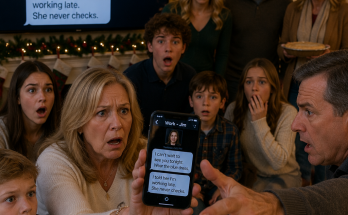
My Mom Screamed, “Your Husband Embarrassed Me!” My Mom Stole My Husband’s Bank Card And Went On A Shopping Spree, Then Called Furious When It Declined. I Rushed Home, Ready To Blame My Husband. He Said Nothing… He Called The Police Instead.
### Part 1
“Your husband embarrassed me in front of everyone!” My mother, Denise, was shouting so loudly through my phone that two cashiers at the grocery store turned toward me. My name is Emma Cole. I was thirty, managing the evening shift, standing under harsh white lights near customer service while a line of shoppers waited.
“He froze his card while I was at the register,” she snapped. “People looked at me like I was some kind of criminal.” I should have asked the obvious question: Why did my mother have my husband’s bank card?
Instead, the old reflex kicked in. Denise said my husband, Ryan, had let her buy “a few household necessities” and that she had two carts full when the card declined. Then her voice dropped. “You need to remind your husband who was helping you long before he came along.”
I left work early, furious on her behalf. During the drive home, I rehearsed everything I planned to say to Ryan. But when I stormed into our kitchen, he didn’t argue. He looked at his phone, set it beside the fruit bowl, and called the police.
I froze. “Yes,” he told the dispatcher. “The card belongs to me. No, I didn’t give anyone permission to take it.” After he hung up, I stared at him. “Mom said you gave it to her.”
“I didn’t.” He turned the screen toward me. Six transactions had hit his account in less than three hours: cosmetics, electronics, home décor, clothes, a luxury handbag store, then a declined purchase for more than $1,400. The approved charges were already close to $3,200.
Ryan tapped the first alert. “I was in a meeting when this came through. I checked my wallet afterward. The card was gone.” He paused. “So was the emergency cash behind it.”
My stomach tightened. “She has a key.” Ryan corrected me quietly. “She had a key.”
He pulled an envelope from his desk. Inside were printed images from our doorbell camera: Denise on our porch at 11:42 a.m., unlocking our front door a minute later, then leaving eighteen minutes after that with a tote bag that looked noticeably fuller. “She told me she hadn’t been here,” I whispered.
Ryan’s face didn’t change. “How many explanations are you going to invent before you let the evidence speak?” That hurt because he was right. Denise had used my credit card before and told me afterward. She had opened my mail because she was “concerned,” and entered our house without calling because she was “lonely.” Every boundary came wrapped in a reason that made me feel cruel for objecting.
My phone rang again. Denise. I answered on speaker. “What did he say?” she demanded. “Did he admit he froze it just to humiliate me?”
“Where did you get the card?”
A pause. “He gave it to me last week.”
“Ryan was traveling last week.”
Another pause, then anger. “Why are you interrogating your own mother?”
I stared at the transaction list. “Did you enter our house today? Did you take his card?”
“After everything I’ve done for you, you’re accusing me of stealing?”
Then she made one mistake she couldn’t take back.
“Tell him to cancel the police report before this gets out of control.”
I hadn’t told her we had called the police.
### Part 2
For several seconds, nobody spoke. “How do you know he called them?” I asked. Denise recovered fast. She always did. “I assumed he would. That’s the kind of dramatic thing he does.”
Ryan leaned toward the phone. “Bring the card and everything you bought back to our house.” Her fury instantly became wounded disbelief. “I cannot believe you would do this to me. I’m your wife’s mother.” Ryan replied, “That doesn’t give you permission to take my property.”
Then Denise shouted my name. “Are you seriously letting him threaten me?” I looked at the charges again. For years, she had trained me to prove my loyalty by rejecting whatever made her uncomfortable. This time I said, “Return what you took.”
She gasped. “So you’re choosing him.” I answered, “No. I’m choosing the truth.” She hung up.
Minutes later, two officers arrived. Ryan showed them the banking alerts, the doorbell footage, and his empty wallet. When one officer asked whether Denise had ever been authorized to use the card, Ryan said no. Then he looked at me. “Has your mother used your cards without asking?”
I swallowed. “Yes.” That single word felt like admitting something much larger.
After the officers left to contact her, Ryan opened a spreadsheet containing two years of unexplained expenses involving my mother. Six hundred dollars I thought was for a broken water heater; weeks later, Denise posted pictures of a new dining set. Nine hundred dollars she claimed was for overdue rent; soon afterward, she was smiling in beach-resort photos. Then there were dozens of smaller amounts—$40, $75, $120.
“Why didn’t you show me this?” I asked. “I tried three months ago.” I remembered immediately. I had called him controlling, then repeated our argument to Denise, who told me Ryan was trying to isolate me.
Before I could apologize, our security app chimed. Someone was entering the old front-door code. Denise stood on the porch with shopping bags hanging from both arms.
“Open this door!” she yelled into the camera. “You want your things back? Fine!”
Ryan spoke through the intercom. “Leave the card and purchases on the porch.” She began dumping items onto the concrete—shoes, cosmetics, candles, clothes, a boxed tablet. Then Ryan asked, “Where’s the handbag?”
“What handbag?”
“The eight-hundred-dollar purchase.”
“I returned it.”
“The refund isn’t showing.”
“The system is slow.”
“And the card?”
She pulled it from her purse and slapped it against the door.
A patrol car turned onto our street, and the change in my mother was instant. Her shoulders dropped. Her face crumpled. By the time the officers reached the porch, she was crying. “It’s a misunderstanding,” she said softly. “Ryan gave me the card.”
An officer asked, “Did anyone give you permission to enter this house today?”
“I’m family. I have a key.”
“That wasn’t the question.”
I opened the door but stayed beside Ryan. “No,” I said. “The key was for emergencies.” Denise stared at me. “Think carefully about what you’re saying.”
That sentence had controlled me since childhood. This time, I answered, “I am.”
Then Ryan showed the officers something I had never seen: footage from a small indoor camera. Denise walked into his office, opened his wallet, removed the card and cash, and slipped both into her purse.
There was no misunderstanding left.
Denise watched the video, turned toward me, and said quietly, “Tell them I was allowed to take it.”
### Part 3
If I refused, Denise would punish me with silence, relatives, guilt, and the same accusation she had used for years: “You chose your husband over your family.” But Ryan wasn’t asking me to defend him. He was waiting to see whether I would defend reality.
“You were not allowed to take it,” I said. My mother’s face went blank. The officers collected the card and recovered merchandise, then asked about the missing handbag and emergency cash. Denise insisted the bag had been returned and claimed she had spent the cash on transportation and lunch.
Then she screamed at Ryan. “Press charges against me after everything I did for your wife?” Ryan finally looked at her. “You didn’t steal from Emma because you knew she would forgive you. You stole from me because you believed she would defend you.” The porch went silent. He had been right.
Denise left with the officers while shouting that Ryan had planned everything to disgrace her. Our family group chat exploded. My aunt called Ryan abusive, my cousin said police were for “real criminals,” and my uncle demanded we withdraw everything before Denise’s reputation was ruined. Not one of them asked why she had taken the card.
I typed a long explanation, then deleted it. Instead, I wrote, “The police have the video, transaction records, and recovered merchandise. I will not debate facts in a family chat.” Then I left the group.
The next morning, an investigator called. Store cameras showed Denise using Ryan’s card at every location, and at the handbag boutique she had signed the receipt using his last name. The handbag had never been returned. An hour later, Denise’s friend sent me a photograph from the previous night.
Denise was sitting at a restaurant beneath warm pendant lights, smiling with the missing handbag displayed beside her plate. She had told everyone Ryan bought it for her. I sent the image to police, and investigators later recovered the bag from her house along with unopened cosmetics and most of the emergency cash.
That afternoon, Denise called. “You sent them that picture.” I said yes. “You could have protected me,” she replied. “You could have returned the bag.”
Her voice turned cold. “I needed people to believe I wasn’t humiliated.” Then I understood the shopping spree was never only about things. Denise wanted people to believe her daughter and son-in-law funded the life she displayed, and when the card declined, Ryan had broken that illusion in public.
“You raised me,” I said. “That doesn’t mean I owe you unlimited access to our money.” She laughed bitterly. “I paid for your food, your clothes, your education. Do you know how much you owe me?” My entire childhood had become an invoice.
Then she asked me to persuade Ryan to tell police he had simply forgotten giving her permission. I ended the call.
Over the next several weeks, Denise contacted Ryan’s employer, emailed friends, and told relatives he controlled my finances. But once people started comparing stories, cracks appeared. One friend said Denise had borrowed money and never repaid it. Another said she had used a store account and later denied making the purchases.
Then my aunt called, her voice unusually quiet. “Emma, your mother has been telling us something about you for years.” I gripped the phone. “What?” She hesitated. “She said Ryan controlled your phone and money—and that you asked her to keep watching him.”
I had never said any of it.
### Part 4
My aunt apologized, though she still suggested we settle privately “for the family.” I told her, “The embarrassment belongs to the person who caused it.” Months later, that sentence followed me into court.
At the preliminary hearing, Denise arrived in a conservative navy suit, looking as if she were attending a business meeting. Her attorney argued that the card use was a family misunderstanding. Then the evidence began: hallway footage, store recordings, bank transactions, family messages, the restaurant photograph, and the call where Denise asked me to tell police she had permission.
During a break, she approached me in the courthouse hallway. “You should be ashamed.” I asked, “For what?” Her jaw tightened. “For sitting beside him while strangers call me a criminal.”
“You asked me to lie.”
“I asked you to protect your mother.”
“No. You asked me to protect you from something you chose to do.”
She glanced at Ryan. “He wanted this. He wanted to separate us.” Ryan stayed silent until she snapped, “Say something!” He finally replied, “You entered my house, took my card, spent thousands, lied to Emma, lied to police, hid merchandise, and contacted my employer. What exactly would you like me to argue about?”
Then she turned to me and said, “If you let this continue, you are no longer my daughter.” Thirty years earlier, that threat would have shattered me. Instead, I asked, “What kind of mother requires her daughter to lie in order to remain her daughter?”
Denise accepted an agreement requiring her to admit she used Ryan’s card without permission, repay the remaining losses and fees, complete court-ordered requirements, and stay away from our home for a defined period. Some relatives stopped speaking to me, and I stopped chasing them.
Others returned after realizing how many stories Denise had told. Ryan and I started counseling, not because our marriage was ending, but because I understood how close my denial had brought us to the edge. I apologized for treating boundaries as cruelty and evidence as judgment. He accepted my apology, but trust returned through consistency, not one emotional conversation.
We changed the locks, separated access codes, enabled transaction alerts, and agreed that neither of us would lend significant money to relatives without discussing it first. Those rules weren’t control. They protected us from secrecy.
Months later, Denise sent a letter through her attorney. She blamed Ryan for her damaged reputation, blamed police for overreacting, and blamed me for misunderstanding her. Near the end was one sentence: “I hope someday you understand what your husband made me do.”
I read it twice, folded it, and placed it in the same drawer as the police report. Ryan asked, “Do you want to answer?” I said, “No.” She still believed consequences were things other people did to her.
That evening, Ryan and I sat at the kitchen table where everything had begun. The refrigerator hummed, rain tapped the window, and his wallet rested near his coffee exactly where he had left it. For years, I thought keeping peace meant preventing my mother from ever feeling uncomfortable.
I was wrong.
Peace built on lies is only fear with good manners. My mother screamed that Ryan embarrassed her, but he didn’t. He refused to argue with a lie, called the police, saved the evidence, and let her choices speak for themselves.
And when I finally stopped protecting the person who kept hurting us, I didn’t lose my family.
I learned which family had actually been protecting me all along.
THE END!