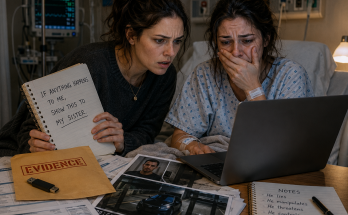
My Sister Stole The Cash I Saved And Blew It All On Shopping. She Waited For Me To Break Down, But I Just Grinned. Then Dad Stormed In Asking, “What Happened To The $15,950 For Her Tuition?” She Couldn’t Hold It Together.
### Part 1
The loose floorboard in my childhood bedroom used to hide things that mattered only when I was twelve—candy bars, folded notes, a silver bracelet I was sure Mom would confiscate. At thirty-one, it was hiding $15,950. Or at least it was supposed to be.
I knelt beside the bed on Monday morning, sunlight cutting through the blinds in narrow white stripes, and lifted the board with two fingers. Dust clung to my knuckles. The envelope was there, exactly where I had left it before flying to Seattle for work. It was also empty.
For a few seconds, I heard nothing except the refrigerator humming downstairs and the faint tick of the hallway clock. My jewelry box was untouched. My laptop was still on the desk. The emergency cash in my suitcase was there. Only the tuition money was gone.
I didn’t cry. That surprised even me.
The money was for my younger sister, Brooke. Four years younger, bright blue eyes, perfect smile, and a talent for making every room lean toward her. Growing up, I worked afternoons at a grocery store because Dad said, “If you want extras, earn them.” Brooke asked for a new phone and somehow had one by Friday.
I used to resent it. Then I got older and called it family dynamics because that sounded less painful. Our parents weren’t wealthy. Dad supervised a manufacturing plant outside Worcester, and Mom taught middle school English. They worked hard, paid the mortgage, and stretched every dollar. When Dad’s company cut overtime and Brooke’s tuition bill came due, the family started whispering around numbers.
I had numbers of my own. A good job in Boston. No kids. No expensive habits. Years of side projects, skipped vacations, reheated dinners, and saying no to things I wanted because being responsible had become my personality.
When Dad called, I heard exhaustion in his voice. “We’re short this semester.”
“I’ll cover it.”
Brooke hugged me so tightly that night I could smell her vanilla shampoo. “You’re seriously the best sister in the world.”
Three days before payment was due, I flew to Seattle for a conference. Before leaving, I tapped the old floorboard with my shoe and told her, “Monday morning, we go to campus together.”
She smiled over her coffee. “Everything’s handled.”
Now the envelope felt almost weightless in my hand. I searched the room anyway. Desk. Closet. Dresser. Under the mattress. Nothing.
Then I walked into the hall bathroom and noticed the trash can overflowing. A cream-colored receipt stuck out beneath a wad of tissue. I pulled it free. Neiman Marcus. Another: Nordstrom. Another: Saks. All dated while I was away. $895. $612. $1,347.
My pulse didn’t race. It slowed.
I opened Instagram on an old secondary account Brooke had forgotten about. Her page loaded. Shopping bags spread across her bed. A restaurant table covered in cocktails and small plates. A gold watch on her wrist. Caption: “Best weekend with my girls.”
Then my phone buzzed. My old roommate, Mason, had sent me a message. “Random question. Did Brooke win the lottery? Saw her Friday night. She was spending like crazy.”
I looked down at the receipts again. Then I noticed a folded bank slip jammed into the corner of the empty envelope.
Cash deposit: $15,950.
Account holder: Brooke Mercer.
Her signature sat at the bottom in looping blue ink.
That was when I smiled. Not because anything was funny. Because for the first time in my life, I knew exactly what I was not going to do.
And downstairs, the front door opened.
Shopping bags rustled against each other.
Brooke had come home.
### Part 2
I was sitting at the kitchen table when Brooke walked in. Four glossy shopping bags hung from her wrists. A gold watch flashed beneath the pendant light. Her hair had been blown out, her nails were freshly done, and she smelled like the expensive perfume I’d noticed in the hallway the night before.
She stopped when she saw me. “Oh. Hey.”
“Hey.”
“I thought you were still in Seattle.”
“Wrapped up early.”
Her smile twitched. “Nice. How was it?”
“Productive.”
She shifted the bags behind one leg as if that made them disappear. I glanced at them. “Looks like your weekend was productive too.”
“Sales.” She laughed too quickly. “End-of-season stuff.”
I picked up the Neiman Marcus receipt and flattened it against the table. “Great sales.”
Her face changed. Not guilt at first. Calculation.
“You went through my things?”
“Bathroom trash.”
“That’s basically the same thing.”
“No. One is snooping. The other is noticing what you left on top.”
Brooke dropped the bags. The paper handles slapped against the tile. “Okay, fine. I bought a few things.”
“With what money?”
She crossed her arms. “Why are you interrogating me?”
I slid the bank deposit slip across the table. Everything in her face emptied.
For a long second, neither of us spoke.
Then she whispered, “I was going to put it back.”
“By Monday?”
“I just needed some of it.”
“You deposited all $15,950.”
“I wasn’t going to spend all of it.”
“How much is left?”
Silence.
“Brooke.”
Her chin lifted. “You make good money, Claire.”
There it was. Not an apology. A defense.
“You won’t even miss it,” she continued. “You don’t have tuition. You don’t have kids. You don’t buy anything. I wanted one weekend where I didn’t feel like the broke girl.”
I stared at her. All those years, I had mistaken her neediness for innocence. I had watched Mom smooth over every mistake and Dad quietly replace every broken thing. I had done the same, only with bigger checks.
“You weren’t broke,” I said. “You had someone paying your tuition.”
Her eyes filled instantly. “Please don’t tell Mom and Dad.”
The tears arrived on command, but something about them looked different this time—less like fear of hurting me and more like fear of consequences.
“I’ll return everything,” she said. “I swear. Just don’t make this huge.”
I almost laughed at that. She had stolen nearly sixteen thousand dollars from my bedroom and wanted me to be careful not to make it huge.
“Monday is the payment deadline,” I said.
“I know.”
“Dad expects confirmation.”
“I know.”
“And you expect me to replace the money.”
She flinched. That was answer enough.
“Claire, please.”
I stood and carried my coffee mug to the sink. Behind me, her voice sharpened.
“You’re seriously going to ruin my semester over this?”
I turned. “No. You did that.”
Her mouth fell open. “I made a mistake.”
“You made about twenty-seven purchases.”
“I said I’ll fix it!”
“Good.”
I picked up the receipts and the deposit slip and tucked them into my work folder. She stared at it.
“What are you doing with those?”
“Keeping them.”
“For what?”
I didn’t answer.
Her panic rose another notch. “You can’t tell Dad. He’ll lose it. Mom will never look at me the same.”
“Then maybe you should have thought about them before you took the money.”
She followed me into the hallway. “Claire, wait. What do you want me to do?”
I paused at the stairs. For most of my life, that question had meant, How will you rescue me?
This time, it sounded different.
I looked at my sister and said, “I want you to figure out what happens when I don’t.”
Then I went upstairs and locked my bedroom door.
The next morning, our father answered a phone call at breakfast.
By the time he hung up, his coffee was untouched—and Brooke’s face had gone white.
### Part 3
Sunday breakfast had started like every other family breakfast. Mom made eggs. Dad scrolled through news on his tablet. The toaster popped twice. Brooke sat across from me in a gray sweatshirt, stirring coffee she wasn’t drinking. Nobody knew except us.
Then the landline rang.
Dad almost ignored it. Mom said, “It could be your sister,” and handed him the receiver. His expression changed within thirty seconds.
“Overdue?” he said.
Brooke stopped stirring.
“No, we were told Monday.”
Another pause.
“Today? A late fee?”
Mom lowered the spatula. Dad’s eyes moved from the wall to Brooke.
“Yes. I understand.”
He hung up slowly. The kitchen felt smaller.
“The college says your tuition hasn’t been paid,” he said. “They say your account is already overdue and you could be dropped from classes if payment isn’t made today.”
Brooke opened her mouth. Nothing came out.
Dad looked at me. “Claire, where’s the money?”
I set my fork down. “Gone.”
Mom blinked. “What do you mean, gone?”
“I left $15,950 in my room before Seattle. Yesterday morning, the envelope was empty.”
Dad’s head turned toward Brooke so slowly it frightened her more than yelling would have.
“Tell me you didn’t take it.”
Her eyes jumped to mine. The old plea was there.
Save me.
I didn’t move.
“I borrowed it,” she whispered.
Dad’s hand flattened against the table. “How much?”
Brooke swallowed. “All of it.”
Mom sat down hard.
I slid the receipts and bank slip across the table. Dad read them one by one. His face went from anger to disbelief to something colder.
“You stole the money your sister saved for your education,” he said, “and spent it on clothes, restaurants, and a watch?”
“I was going to return everything.”
“When?”
“I don’t know.”
“You posted pictures,” I said.
Brooke whipped toward me. “Why are you doing this?”
I almost couldn’t believe the question.
Dad answered for me. “Because you stole from her.”
Brooke started crying. “I hate being the poor one. Everyone at school has nice things. I was embarrassed.”
Mom’s voice was barely above a whisper. “So you made your sister pay for your embarrassment twice?”
That landed.
Brooke covered her face. For years, Mom had rushed toward her tears. This time, she didn’t.
Dad pushed the phone across the table. “Call the school.”
Brooke looked up. “What?”
“Tell them you can’t pay.”
Her eyes widened. “No.”
“Call.”
“Dad, please.”
“Your sister paid once. She is not paying twice.”
Brooke looked at me as if waiting for me to contradict him.
I said, “He’s right.”
Her breathing turned ragged. “You’re really going to let me lose the semester?”
I held her gaze. “I’m going to let the consequences belong to the person who caused them.”
She stared at me like I’d become someone else.
Maybe I had.
Her hand shook as she dialed. She gave her name, student number, and listened. Then she closed her eyes.
“Yes,” she whispered. “I understand.”
When the call ended, she set the receiver down. “They’ll remove me from my classes if it’s not paid by tonight.”
No one spoke.
Then Dad said, “Everything you bought gets returned today.”
Brooke wiped her cheeks. “And whatever can’t be returned?”
“You sell it.”
“And tuition?”
“You work.”
She looked at Mom. Mom nodded.
Then Brooke looked at me. “You planned this.”
“No.” I gathered the receipts. “I just stopped preventing it.”
That afternoon, we drove from store to store beneath a low gray sky. Some purchases were refunded. Some weren’t. One dress had been worn. The watch had been engraved and couldn’t be returned.
By sunset, less than half the money was back.
In the parking garage, Brooke held the gold watch in both hands. “I’ll sell it.”
“Good.”
Her face crumpled. “Aren’t you going to say it’s okay?”
I opened the car door.
“No.”
That night, she slid sixty dollars under my bedroom door.
No note. Just cash.
I left it on the dresser.
Because repayment had started.
But forgiveness hadn’t.
### Part 4
Four weeks later, my parents’ house sounded different at five in the morning. Instead of Brooke coming home late, I heard her leave early. The front door clicked shut before sunrise. Her old sedan coughed twice in the driveway. By six, she was behind the counter at a downtown café, tying on an apron that always came home smelling like espresso, burnt sugar, and steamed milk.
She had withdrawn from the semester.
For the first time in her life, nobody had rearranged reality to keep her comfortable.
Every Saturday, she handed me an envelope. Eighty dollars. One hundred twelve. Sixty-five. I kept a running total in a notebook, not on the refrigerator where everyone could admire her progress.
Paying back stolen money wasn’t a family achievement.
It was a debt.
Mom struggled with that more than Brooke did.
One evening, while we loaded dishes, she said quietly, “She’s trying.”
“I know.”
“Maybe you could tell her you’re proud.”
I shut the dishwasher. “Proud of what?”
Mom’s face tightened. “Claire.”
“No. I’m glad she’s working. I’m glad she’s paying it back. But I’m not going to turn basic accountability into a medal ceremony.”
Mom looked wounded. For a second, the old reflex woke up in me—the need to soften my words, reassure her, restore the room.
I let it pass.
A week later, my parents asked all four of us to attend family counseling.
The therapist, Dr. Reeves, had an office that smelled like peppermint tea and old carpet. A white-noise machine hissed near the door. For the first two sessions, Brooke barely spoke.
Mom spoke enough for everyone.
She explained how Brooke had been “sensitive” as a child. How I had always been “independent.” How she and Dad assumed I needed less because I asked for less.
Dr. Reeves turned to me. “What did that teach you?”
I stared at a crooked framed landscape on the wall.
“That being easy to love meant not needing anything.”
Mom started crying.
I didn’t comfort her.
Dad rubbed both palms over his knees. “I leaned on you,” he said. “More than I should have.”
“Yes.”
He looked surprised by the simplicity of my answer.
Brooke finally spoke during the fourth session. “I thought she’d always fix it.”
The room went quiet.
She twisted a tissue around one finger. “Claire always had money figured out. Jobs. Bills. Everything. I guess I started thinking if I messed up, she’d be angry, but she’d still make sure nothing really happened to me.”
Dr. Reeves asked, “And now?”
Brooke looked at me.
“Now I know that’s not true.”
There was no accusation in her voice. That almost made it harder.
By December, she had paid back a little over five thousand dollars after refunds and months of work. She applied for spring readmission with a payment plan and extra shifts.
One night, I found a note under my door.
“I know saying sorry doesn’t fix what I did. I’m not asking you to trust me. I just want you to know I finally understand why you stopped helping.”
I read it twice.
Then I folded it and placed it in my desk.
I didn’t go downstairs.
I didn’t hug her.
I didn’t tell her we were okay.
Because we weren’t.
The next morning, Dad found me packing a suitcase.
“Work trip?” he asked.
“No.”
I zipped it closed. “I’m moving back to Boston.”
His face fell. “You said you’d stay through spring.”
“I changed my mind.”
From the hallway, Brooke stood frozen in her café uniform.
And for the first time, the consequence she hadn’t expected wasn’t about money at all.
It was losing access to me.
### Part 5
I moved out two days before Christmas. Not dramatically. No slammed doors. No speech at the bottom of the stairs. I packed my clothes, my laptop, a few boxes from the attic, and the framed photo of Brooke and me as kids covered in mud after a summer storm.
I left the loose floorboard where it was.
Dad carried one box to my car and kept clearing his throat. “You know this is still your home.”
I looked at the white porch rail, the trimmed hedges, the wreath Mom had hung crooked.
“It was.”
He nodded like he understood the difference.
Brooke stood near the front door with her arms folded tightly around herself. “Can I talk to you?”
I waited.
She stepped onto the porch. Cold air turned her breath white.
“I know you don’t trust me.”
“I don’t.”
She flinched, but kept going. “I know I don’t get to ask you to stay.”
“No.”
“I just… I thought if I paid everything back, maybe we’d eventually go back to normal.”
I looked at her for a long moment.
“Normal is part of the problem.”
Her eyes filled. I didn’t look away.
“You stole from me because you were sure I would absorb the damage. Mom and Dad let you believe that. I helped teach you that too.”
“So what happens now?”
“You pay me back.”
“And us?”
I opened the passenger door and placed my bag inside.
“I don’t know.”
“Do you hate me?”
“No.”
That answer seemed to hurt her more.
“I just don’t want my life built around what you need anymore.”
She wiped her cheek with the heel of her hand. “I’m sorry, Claire.”
“I believe you.”
Her shoulders loosened slightly.
Then I added, “But believing you’re sorry isn’t the same as trusting you again.”
I drove back to Boston that afternoon.
My apartment had never seemed so quiet. For the first week, I kept expecting a family emergency. A call about Brooke’s tuition. A question about Mom’s car. Dad needing me to compare insurance plans. Something.
Nothing came.
Then I realized why.
I had stopped answering every problem before anyone else had to.
The silence wasn’t loneliness.
It was space.
I started using it.
I joined a Saturday climbing gym with a coworker named Hannah. I booked a long-delayed trip to Maine. I replaced the cracked dining chair I’d been meaning to fix for three years. Tiny things, but each one felt strangely rebellious.
Brooke kept paying. Sometimes the envelope came by certified mail. Sometimes she sent a transfer with only two words in the note: “Payment 12.”
No heart emojis.
No requests.
By March, she was back in school part-time, paying her own tuition through work, aid, and a payment plan. Mom told me she still woke before dawn three days a week for café shifts.
I said, “Good.”
Mom waited for more.
There wasn’t any.
Then one rainy Thursday, an envelope arrived with a cashier’s check.
The remaining balance.
$4,318.
Behind it was a short letter.
“I know the money is finished before the damage is. I won’t ask you to forgive me. I just wanted to keep the promise.”
I sat at my kitchen table while rain tapped against the window.
For months, I had imagined this moment. I thought repayment would feel like closure.
Instead, my phone rang.
It was Dad.
His first words were, “Brooke has a problem.”
I stared at the check in my hand.
And suddenly I understood the real test wasn’t whether she could repay me.
It was whether my family had learned to stop calling me when someone needed saving.
### Part 6
I let Dad’s call ring twice before answering.
“What happened?”
His voice was tense. “Brooke’s car died outside campus. Repair shop says the transmission is shot. She needs it for work.”
There it was.
The old script.
Problem. Panic. Claire.
For years, I would have been opening my banking app before he finished the sentence.
This time, I looked at the cashier’s check on my table.
“That sounds difficult.”
Dad paused. “She can’t afford another car.”
“I understand.”
Another pause.
Then he said, more carefully, “I’m not asking you to buy one.”
“But you called me.”
Silence.
Finally, he exhaled.
“You’re right.”
Those two words mattered more than an apology.
“What are you going to do?” I asked.
“Your mother and I can drive her some days. She can take the bus. Maybe pick up shifts closer to school.”
“Sounds like a plan.”
Dad laughed once, embarrassed. “I almost did it again.”
“Yeah.”
“I’m trying.”
“I know.”
When we hung up, I didn’t feel guilty.
That was new.
A month later, Mom invited me home for Easter. I almost declined, then decided I wanted to see what the house felt like now that I no longer belonged to its old machinery.
Brooke arrived late from work in black pants and worn sneakers. No designer bags. No gold watch. She brought a grocery-store pie and apologized because one side had collapsed in the box.
Nobody rushed to reassure her.
Dad just said, “Still tastes like pie.”
We ate in the same kitchen where everything had exploded months earlier.
After dinner, Brooke asked if I wanted to walk around the block.
Outside, the air smelled like wet grass and chimney smoke. She kept her hands in her jacket pockets.
“I bought another car,” she said.
“Yeah?”
“Old Honda. Ugly color. Runs.”
“Good.”
“I paid cash. Well, mostly. Dad loaned me eight hundred, and I’m paying him back too.”
I nodded.
She smiled faintly. “Look at me. Collecting debts everywhere.”
I almost smiled back.
Almost.
At the corner, she stopped.
“I know you said you didn’t hate me.”
“I don’t.”
“Do you think you’ll ever forgive me?”
There it was. The question everyone loves because it promises a clean ending.
I looked at my sister—the same face I had defended in school, the same eyes that had once filled with tears whenever the world said no.
“I don’t know,” I said. “Maybe parts of it. But forgiveness isn’t a door that puts us back where we were.”
She nodded slowly. “I understand.”
“And I won’t be your emergency fund. I won’t cover your mistakes. I won’t hide things from Mom and Dad for you. If you lie to me again, I’m done.”
Her eyes shone, but she didn’t argue.
“Okay.”
That was the closest thing to peace we had.
Not a hug.
Not a promise.
A boundary spoken out loud.
I went back to Boston that night.
Months passed. Brooke finished the semester without asking me for money. Mom stopped calling me every time someone in the family had a bad day. Dad began asking, “Do you have space for this?” before unloading a problem.
As for me, I finally learned to spend money on a life instead of using it as armor. I traveled. I made friends outside work. I stopped measuring my worth by how quickly I could rescue people.
The framed childhood photo stayed on my desk, but not as proof that Brooke and I were repaired.
We weren’t.
Maybe we never would be in the old way.
And that was fine.
The day I found the envelope empty, Brooke expected tears because tears would have meant I was still trapped in the same role—hurt, angry, and ready to fix everything anyway.
Instead, I smiled.
Because something had finally become clear.
She had stolen $15,950 from my room.
But I refused to let her steal another year of my life.
THE END!