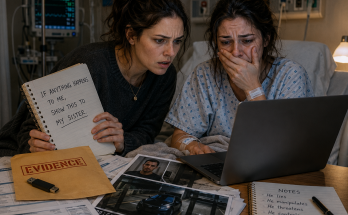
During A Weekend Family Dinner, My Stepmother Shouted, “Either Give Your Room To Your Younger Sister, Or Pack Your Bags And Get Out!” I Didn’t Cry. I Quietly Packed My Bags And Left. Then I Bought My Own House On A Hillside. Just Three Days Later… I Was Enjoying My New Home While They Were…
### Part 1
“Either give your master bedroom to your sister by tomorrow morning, or pack your bags and get out of this house forever.”
My stepmother, Cynthia, didn’t raise her voice gradually. She exploded across the dinner table so suddenly that the silverware seemed to jump.
For a second, the only sound in the room was the ceiling fan clicking above us and the faint hum of the refrigerator in the kitchen.
My father, Daniel, stared down at his plate.
My stepsister, Madison, leaned back in her chair with a tiny smile, like she had already won.
I was twenty-five years old, sitting in the same Austin house where I had spent most of my childhood. The dining room still had the walnut cabinet my mother had chosen before she died. The faded scratch near the doorway was from the year I tried to carry my bicycle inside during a thunderstorm.
Cynthia had lived there for nine years, but she had a talent for making me feel like the guest.
That night, Madison had decided she needed my bedroom.
Not a bedroom. My bedroom.
It was the largest room upstairs, with tall windows, a private balcony, and afternoon light that poured across the hardwood floor. My mother had helped design it when the house was renovated.
Madison, eighteen, wanted it for a social-media studio.
“You’re never home anyway,” she said, flicking her hair over one shoulder. “I need natural light. The basement room is fine for you.”
“The basement is my home office,” I said.
Cynthia gave me the same cold smile she used whenever she believed resistance was temporary.
“You can work from anywhere.”
“So can Madison.”
Her fork hit her plate.
My father finally cleared his throat. “Natalie, maybe just do it for a few months. Keep the peace.”
There it was.
Keep the peace.
He had been saying those three words since I was seventeen.
Keep the peace when Cynthia gave away my mother’s Christmas dishes without asking me.
Keep the peace when Madison borrowed my clothes and returned them stained.
Keep the peace when Cynthia told relatives I was “difficult” because I refused to pay for Madison’s spring-break trip.
I looked at my father and waited.
I wanted one thing from him. Just one.
“Tell her,” I said quietly.
His eyes lifted for half a second.
Then dropped again.
Something inside me went completely still.
Cynthia stood and planted both palms on the table. “I am finished with your attitude. This is my home too, and I will not be challenged at my own dinner table.”
Madison’s smile widened.
“Tomorrow morning,” Cynthia said. “Your room becomes Madison’s. If you don’t like it, leave.”
My father said nothing.
I folded my napkin beside my plate.
“All right.”
Cynthia blinked. “What?”
“All right.”
I stood, pushed in my chair, and walked upstairs.
I didn’t cry. I didn’t slam the door. I pulled two hard-shell suitcases from the closet and packed methodically: work clothes, laptop, documents, my mother’s jewelry, a framed photograph, and the small cedar box I had kept hidden behind winter blankets for years.
Twenty-five minutes later, I carried everything downstairs.
Cynthia and Madison were whispering in the living room. Madison actually laughed when she saw my luggage.
“Wow,” she said. “She’s really doing it.”
My father sat on the front porch in the dark.
As I passed him, he finally spoke.
“Natalie, don’t make this dramatic.”
I stopped with my hand on the suitcase handle.
“I’m not.”
I loaded my car and drove away.
No one followed me.
Forty minutes later, I turned onto a private road in Westlake Hills and pressed a remote clipped inside my car.
A steel gate opened.
Beyond it, lights came on across a modern hillside house with glass walls, limestone terraces, and a wide porch overlooking the Texas Hill Country.
My house.
And before I went to bed that night, I opened the cedar box and removed the document my father should have remembered existed.
### Part 2
My mother died when I was fifteen.
Her name was Elaine, and she was the kind of woman who labeled every kitchen drawer but could never remember where she left her coffee. She loved architecture, native Texas plants, and long Saturday mornings spent sketching renovation ideas at the breakfast table.
What she loved most, though, was security.
Especially mine.
After she became ill, she worked with an estate attorney to place our Austin property into a protected trust. I knew the basics as a teenager, but I didn’t understand the full structure until years later.
My father did.
At least, he had signed enough paperwork that he should have.
The house could be used as our family residence while I was young, but its beneficial interest belonged to me. When I turned twenty-five, control and title transferred fully into my name.
I had turned twenty-five six months earlier.
Cynthia either never knew or never bothered to ask. Madison certainly didn’t know. And my father had behaved for so long as though uncomfortable truths disappeared if he refused to discuss them that I honestly didn’t know what he remembered.
I never announced the transfer.
Why would I?
I had no desire to humiliate anyone.
By then I had graduated from the University of Texas and spent four brutal years working in commercial property development. I knew what leases cost in Austin. I knew how quickly taxes, insurance, maintenance, and utilities could swallow a household budget.
So I let my father, Cynthia, and Madison remain in the house.
They paid no rent.
I covered insurance and several major repairs. They were supposed to handle utilities, routine upkeep, and a portion of the property taxes, but more and more bills somehow drifted back to me.
I tolerated it because my father was my father.
That was my mistake.
Patience looks a lot like permission to people who benefit from it.
Two months before that dinner, I had quietly purchased the Westlake Hills house using my savings, investment income, and financing I could comfortably carry. I had planned to move gradually after finishing a major project at work.
Cynthia simply accelerated the schedule.
Sunday morning, sunlight filled my new kitchen while I made coffee in silence.
At 7:30, I called my attorney, Rachel Mercer.
She had reviewed the trust transition months earlier.
“I moved out,” I told her.
There was a pause.
“Voluntarily?”
“I was told to give up my bedroom or leave permanently.”
Another pause.
Then Rachel said, “Send me exactly what happened in writing.”
I did.
We discussed the house, the informal living arrangement, and the fact that there was no lease granting my family permanent occupancy. Rachel advised me not to improvise, threaten anyone, or shut off essential services as retaliation.
“Everything by the book,” she said.
“That’s what I want.”
She prepared formal notice terminating their permission to occupy the property and requiring them to vacate within the legally applicable period.
I also removed my payment methods from household accounts that I had been subsidizing. Any services they wanted to continue would have to be transferred into their own names according to provider rules.
Then I emailed the property manager who had once handled repairs for the trust and asked for a full ledger.
That ledger arrived before lunch.
I expected unpaid landscaping bills.
Maybe a late utility balance.
Instead, I found charges I had never authorized.
Contractor invoices. Furniture deliveries. A luxury appliance purchase. A line of credit application referencing the Oak Ridge property.
My stomach tightened.
I called Rachel again.
“Someone has been using the house as if Dad owns it.”
“Send me everything.”
Twenty minutes later, she called back.
Her voice had changed.
“Natalie, do not contact your father yet.”
“Why?”
“Because one of these documents appears to contain your signature.”
I was standing in my bright new kitchen, coffee cooling beside me.
I had never signed it.
### Part 3
By Monday morning, the family group chat had become a fire alarm.
At 8:12, Madison texted first.
“Did you cancel the internet???”
At 8:19, Cynthia sent six messages in a row.
“The account says it needs a new responsible party.”
“Fix this immediately.”
“Your father has work.”
“Madison has deadlines.”
“This is unbelievably childish.”
I didn’t respond.
I was already downtown in Rachel’s office, sitting across from a conference table covered with copies of financial records.
The problem was bigger than an internet account.
Someone had applied for a private loan using documents that suggested my father had authority over the Oak Ridge house. The loan itself had not been secured by the property because the title search exposed the true ownership, but fees, penalties, and other personal debts had accumulated around the failed transaction.
Worse, several home-improvement purchases had been opened under my father’s name based on the expectation that the house could later support refinancing.
Rachel tapped one page.
“This signature is supposed to be yours.”
It looked almost right.
Almost.
My first name leaned too far to the right. The loop in the N was wrong.
“I didn’t sign that.”
“I know.”
“How?”
“Because you signed the trust transfer in my office. I have the originals.”
I felt anger then, but it wasn’t loud anger.
It was cold.
Precise.
The kind that makes you notice tiny details.
The dusty smell of Rachel’s law books.
The air-conditioning vent rattling above the conference room.
The faint ink stain on my thumb where I had been gripping a pen.
“Did my father do this?”
“We don’t know yet.”
That answer hurt more than I expected.
At 10:40, a process server delivered the formal notice to Oak Ridge.
At 10:47, my father called.
At 10:49, he called again.
Then Cynthia.
Then Madison.
By noon, I had seventeen missed calls.
Rachel told me to preserve everything.
So I listened to the voicemails once and saved them.
Cynthia’s was furious.
“Natalie, whatever little tantrum you’re having has gone far enough. A man came to the house with legal papers. Call us now.”
Madison sounded offended rather than frightened.
“My lighting setup is useless without reliable internet. You seriously need therapy.”
Then I heard my father.
His voice was low.
“Natalie, please call me. I think there’s been a misunderstanding.”
A misunderstanding.
That word sat badly with me.
That afternoon, another email arrived from the accountant who had administered parts of my mother’s trust.
Attached was an old correspondence chain from three years earlier.
My father had asked whether he could borrow against the house.
The accountant had answered clearly: no. The beneficial owner was me, and the trust terms prohibited him from encumbering the property.
My father had replied: “Understood.”
I read that single word three times.
He remembered.
There was no confusion.
No forgotten paperwork.
No innocent mistake.
He had known exactly whose house it was while Cynthia ordered me out of it.
At 4:15, I finally answered one call.
My father spoke before I could say hello.
“Natalie, thank God. Cynthia is upset. We need to talk before this gets worse.”
“You knew.”
Silence.
“You knew the house became mine.”
Another silence.
Then he sighed.
“That’s more complicated than you think.”
“No. It’s one sentence.”
“Natalie—”
“Did you know?”
“Yes.”
The word landed softly.
That made it worse.
I looked through Rachel’s office window at traffic crawling along Congress Avenue.
“Did Cynthia know?”
He hesitated.
And in that hesitation, I got my answer.
Not all of it.
But enough.
Then my father said something that turned the entire situation from betrayal into something much uglier.
“She wasn’t supposed to find out this way.”
### Part 4
My father refused to explain over the phone.
He kept saying, “Come home and we’ll talk.”
Home.
The word almost made me laugh.
Instead, I ended the call and told Rachel I wanted every relevant record preserved.
Over the next two days, pieces fell into place.
My father had told Cynthia years earlier that the trust arrangement was “temporary” and that he expected the house to become effectively his once I was financially independent. He never promised her legal ownership in writing, but he allowed her to believe she had permanent control.
Then, as their spending increased, he began trying to turn that fantasy into money.
The false signature appeared on paperwork connected to a financing package that never closed. Rachel advised me that the signature issue needed to be handled through proper legal channels, separately from the occupancy dispute.
I agreed.
I wanted distance, not chaos.
On Wednesday afternoon, I was sitting on my porch with coffee when a dark SUV climbed the driveway.
My stomach dropped before I saw who stepped out.
My father.
Cynthia.
They had found my address.
Cynthia looked exhausted. My father carried a thick folder under one arm.
They stopped halfway up the steps and stared at the house behind me.
The glass façade reflected the pale Texas sky. Beyond the railing, green hills rolled toward the horizon.
Cynthia’s expression changed first.
Shock.
Then calculation.
“Natalie,” my father said. “You bought this?”
“Yes.”
“When?”
“Before dinner.”
Cynthia looked at the limestone terrace, the new landscaping, the wide windows.
“You had another house and said nothing?”
“You never asked whether I had somewhere to go before you told me to leave.”
Her mouth tightened.
My father climbed one step closer.
“Please. We need to fix this. The notice says we have to vacate. We can’t find anything comparable we can afford.”
“That sounds like something you should discuss with a leasing agent.”
Cynthia’s face reddened.
“You’re enjoying this.”
“No.”
And I meant it.
I wasn’t happy.
I was finished.
My father opened the folder and pulled out the notice.
“Your attorney is also demanding reimbursement for expenses tied to the unauthorized financing attempts.”
“She’s preserving my rights.”
“I’m your father.”
“You were my father at dinner too.”
That stopped him.
For once, Cynthia’s voice softened.
“Natalie, Madison can move back to her old room. You can have the master bedroom.”
I stared at her.
She had said it as if she were offering me a gift.
“My bedroom?”
“Yes.”
“In my house?”
Her eyes flicked toward my father.
I stood.
“I don’t want the room.”
Relief flashed across her face too quickly.
“I’m selling the property.”
The folder slipped slightly in my father’s hands.
“What?”
“I met with a broker Monday. There’s already serious interest from a redevelopment group.”
Cynthia went pale.
“You can’t sell our home.”
“You told the owner to get out.”
Her face crumpled.
For the first time in nine years, Cynthia didn’t look powerful. She looked frightened.
My father stepped toward me.
“Natalie, your mother loved that house.”
“She loved me more.”
His eyes filled.
That almost broke me.
Almost.
Then I remembered him sitting under that clicking ceiling fan while Cynthia pointed at me and told me to disappear.
I remembered his silence.
“I need you both to leave.”
Cynthia suddenly dropped to her knees.
“Please.”
I stepped back.
“No.”
My father whispered, “What happened to you?”
I looked at him for a long moment.
“You watched it happen.”
I called the security service for the neighborhood and asked them to escort my uninvited visitors to the gate.
As my father turned away, Cynthia grabbed his sleeve.
And that was when the folder opened.
A document slid onto the porch boards.
I recognized the header immediately.
It wasn’t about the eviction.
It was a notice from a creditor demanding payment on a debt I had never seen before.
### Part 5
I picked up the page before my father could.
The amount made my chest tighten.
Not because I owed it.
Because he did.
Years of credit-card balances, financing fees, personal loans, and purchases had been stacked together under a settlement demand. None of it was legally mine, Rachel later confirmed. But my father had built his finances around one assumption: eventually, he would gain access to the value in Oak Ridge.
He never did.
Now several creditors wanted payment at once.
Selling the house wouldn’t rescue him because the house wasn’t his to sell.
The next morning, he called Rachel instead of me.
Then he hired his own lawyer.
For a brief moment, Cynthia apparently convinced herself they could challenge my ownership. Their attorney reviewed the trust, the deed transfer, my mother’s will, and the county records.
The challenge disappeared within days.
There was nothing ambiguous.
My mother had protected the house for me deliberately.
The false-signature issue became a separate dispute. On Rachel’s advice, I cooperated with the appropriate investigation and refused to discuss details with my family.
Cynthia sent me one final message.
“You are destroying your father over a bedroom.”
I stared at it, then typed a reply.
“No. The bedroom was simply the moment I stopped protecting all of you from your own decisions.”
I never sent it.
I blocked her instead.
Thirty days after dinner, they moved out.
I did not go to watch.
Rachel’s office handled the final inspection with a property manager. I received photographs afterward.
The house looked strangely small without people in it.
Madison’s ring lights were gone.
Cynthia’s oversized sectional had left deep dents in the carpet.
My old bedroom was empty except for one thumbtack in the wall and a faint rectangle where my mother’s photograph had once hung.
I stared at that picture for a long time.
Then I closed the file.
My father, Cynthia, and Madison moved two hours outside Austin, where rent was cheaper. My father’s debt settlement consumed much of his income. Cynthia took steady retail work. Madison dropped most of her online ambitions and found a restaurant job while taking classes part-time.
I didn’t celebrate any of that.
Consequences are not the same thing as victory.
The Oak Ridge property sold several months later to a small residential developer. The price was strong enough that, after taxes and fees, I had a substantial amount to reinvest.
Before closing, I visited the house alone.
It smelled like dust and empty rooms.
I walked through the dining room, touched the back of the chair where I had been sitting that night, and then went upstairs.
Late afternoon light filled the master bedroom.
For years, I had thought keeping that room meant keeping a piece of my mother.
Standing there, I finally understood that I had been wrong.
My mother wasn’t in the windows.
She wasn’t in the balcony.
She wasn’t in the walnut cabinet downstairs.
What she had left me was not a building.
It was a way out.
At the closing table, I signed the final documents without shaking.
A week later, my father mailed me a handwritten letter.
No accusations.
No excuses.
Just four pages of apology.
He admitted he had known the truth about the house. He admitted he had let Cynthia dominate the family because conflict exhausted him. He admitted he had used my patience as a financial safety net.
At the end, he wrote:
“I hope someday you can forgive me enough to be my daughter again.”
I folded the letter and placed it in the cedar box beside my mother’s papers.
I did forgive him eventually.
But forgiveness did not mean restoration.
And he was about to learn the difference.
### Part 6
Two years later, I rarely thought about the dinner that changed my life.
That surprised me.
For months afterward, I had replayed Cynthia’s voice in my head.
“Give your room to your sister… or pack your bags and get out.”
At first, the memory made me angry.
Later, it sounded almost like accidental advice.
So I followed it.
I got out.
I built something better.
The money from the Oak Ridge sale became seed capital for several small residential projects around Central Texas. I had spent years learning how good development worked: not flashy renderings and empty promises, but drainage, zoning, financing, patient negotiation, and designs people could actually live in.
Eventually, I left my employer and opened my own firm.
I named it Hillstone Development Studio.
My first year was terrifying.
I worked from the long oak table in my Westlake house, surrounded by site plans, coffee cups, and contractor bids. Some nights I fell asleep on the sofa with my laptop open beside me.
But the work was mine.
So were the risks.
So were the rewards.
By the end of the second year, we had completed three profitable projects and hired a small team.
The thing I was proudest of had nothing to do with revenue.
I created the Elaine Harper Foundation in my mother’s name, offering scholarships and housing assistance to young women studying architecture, construction management, and real estate development.
On the morning we awarded our first scholarship, I stood in a university auditorium holding a folder with my mother’s photograph tucked inside.
For the first time in years, remembering her didn’t hurt.
It felt warm.
My father and I spoke occasionally.
Birthdays. Holidays. Short calls.
He never moved back into my life in the way he wanted.
When he apologized, I accepted the apology.
When he asked whether we could “go back to normal,” I told him the truth.
“Normal was the problem.”
He didn’t argue.
Cynthia never apologized directly. Once, she sent a Christmas card signed from all three of them. I put it in recycling after reading it.
Madison contacted me separately a few months later.
Her message was shorter.
“I was awful to you. Mom made everything feel like a competition, but I still chose how I treated you. I’m sorry.”
I believed she meant it.
I wished her well.
That was all.
I did not invite her into my company. I did not pay her bills. I did not rebuild a sisterhood that had never really existed.
Some doors can close without hatred.
That was the lesson I had struggled longest to learn.
One Saturday evening, I sat on my porch while the sun lowered behind the hills. The air smelled faintly of cedar and warm stone. Somewhere down the slope, a dog barked twice and stopped.
On the table beside me was the cedar box.
I opened it and took out the old trust document.
For years, I had thought that paper was my protection.
It wasn’t.
The real protection had been the moment I finally believed I was allowed to say no.
Cynthia had thought authority came from speaking the loudest.
My father had thought silence would protect him from consequences.
Madison had thought being favored meant being entitled.
They were all wrong.
A home is not a place where someone lets you stay as long as you obey.
Family is not a license to take what belongs to you.
And forgiveness is not an obligation to reopen a door that nearly destroyed you.
That night, I closed the cedar box and carried it inside.
The house was quiet, bright, and entirely mine.
I had not won because my family lost.
I had won because when they finally told me to leave, I stopped begging for a place at their table and built my own.
THE END!