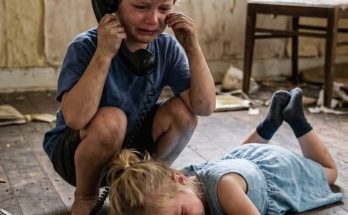
They are all seven and under. They are pressed into one another on a plastic bench across the sterile corridor, huddled together the way you would brace against a freezing wind. Each of them is holding some part of the next—a sleeve, a trembling hand, a fistful of denim jacket. It is a grip born of absolute terror, a physical manifestation of the belief that if they let go, the earth will simply open up and swallow them.
The oldest is holding the baby. The oldest is seven. His name is Leo.
In less than an hour, a judge is going to sign a piece of paper that sends them to different homes. Different families. Different counties. The child welfare system has a clinical phrase for it that manages to sound almost gentle: placement split. Two clean, administrative words for the brutal act of taking five children who have already lost everything in a house fire, and cutting the last thing they have left—each other—into jagged little pieces.
I have spent every dime I own to be sitting on this bench. I hired a lawyer I can barely afford, and I have brought a case that every sane person in my life told me I had no business bringing. My hands are shaking. They will not stay still because I know something the court paperwork doesn’t.
I know exactly what it does to a child to be driven away from the only family they have left. I know, because it was done to me.
But I am not the only one waiting in this hallway. Sitting twenty feet away, radiating an aura of expensive perfume and unearned confidence, are The Caldwells. Richard and Eleanor. They are the system’s dream: wealthy, impeccably dressed, childless, and armed with a sprawling estate in the hills. They are here to adopt.
But they don’t want all five. They only want the youngest two: three-year-old Chloe and six-month-old Baby Jack. They want the ones young enough to forget where they came from.
The doors to Courtroom 3B swing open. My lawyer, a tired public defender type named Marcus, steps out. He does not look at me right away. He looks at his shoes, then at his clipboard, and the cold dread in my gut suddenly turns to lead.
“Arthur,” Marcus says, his voice entirely devoid of hope. “They just filed an emergency motion. The Caldwells.”
They’re making a move. “What motion, Marcus?”
Marcus finally meets my eyes, and I can see the defeat already etched into his face. “They aren’t just petitioning for the babies anymore, Arthur. They’ve convinced the agency to expedite the split. The transport vans are already waiting in the loading dock.”
Three weeks ago, I didn’t know these children existed.
I found them the way you find a storm on the horizon—by accident, glancing at the wrong thing at the wrong time. I volunteer two evenings a week doing maintenance at the downtown community center, a place that frequently brushes up against the county’s emergency foster pipeline.
That was where I saw the photograph on a desk. Five small faces. Dark, confused eyes. It was taken the morning after a horrific electrical fire took both their parents in a single, suffocating night.
I’ve trained myself not to fall into every tragic photograph I see. You can’t. You’ll drown. But something in this one caught me by the throat. It was the way the children were holding each other’s coats. They weren’t posing. They were gripping handfuls of fabric, five kids who had already figured out in their marrow that the only thing standing between them and the abyss was the sibling next to them.
My hands remembered that grip. I had used that grip.
When I was small and my world ended, I held onto my sisters and my baby brother exactly like that. Knuckles white, desperately trying to keep our family from being subtracted a person at a time. And I remember the precise, agonizing moment my grip stopped being enough. I remember a grown-up’s kind, relentless hands peeling my fingers off my sister’s sleeve.
Everyone in that parking lot twenty-two years ago was being kind. That’s the part nobody believes. Kindness turned out to be no protection against the “practical” decision.
When I saw that photo, I knew I had to step in. I marched into the local Department of Child Services and demanded to file a petition for guardianship. That was when I met Evelyn Sterling.
Evelyn was the senior social worker assigned to the case. She wore tailored gray suits, kept her dark hair pulled back into a severe knot, and possessed a gaze that could freeze alcohol.
“Mr. Hayes,” Evelyn had said, laying my financial printouts on her desk like a bad diagnosis. “You are a single, twenty-nine-year-old woodworker. You make thirty-eight thousand dollars a year. You have zero parenting experience. Five traumatized children would break an experienced, wealthy couple. You are a statistical disaster waiting to happen.”
“I can keep them together,” I had pleaded, leaning over her desk.
“Keeping them together in poverty is not saving them,” she countered, her voice icy, impenetrable. “The Caldwells can offer Chloe and Jack the finest education, therapy, and security money can buy. The older three will be placed in specialized group homes. It is the only logical path.”
I had hated her in that moment. I hated her clinical detachment, her absolute faith in a system I knew was broken. I had spent the next three weeks emptying my savings. Seven years of unglamorous, careful saving, gone in an afternoon. I bought a battered minivan. I cleared out my woodworking shop, sealed the concrete floor, and built five custom oak beds, sanding them until they were smooth as river stones. I left the final paint undone so the kids could choose their own colors. Agency. When you lose your family, the first thing the system steals from you is your agency. I wanted to give it back.
But now, standing in the courthouse hallway with Marcus, all that oak and sawdust felt like a pathetic joke.
“They can’t expedite the split before I present my case,” I hissed at Marcus, my voice tight. “That’s illegal.”
“Evelyn Sterling signed off on it,” Marcus whispered, glancing nervously at the Caldwells. “She testified in chambers ten minutes ago that your living situation is critically unstable. The Judge signed the order, Arthur. The vans are here. If we don’t pull a miracle out of thin air in the next ten minutes, they’re gone.”
I didn’t wait for Marcus. I turned on my heel and marched straight toward the Caldwells.
Richard Caldwell stood up, buttoning his bespoke suit jacket. He flashed a smile that didn’t reach his eyes. “Mr. Hayes, isn’t it? The carpenter?”
“Woodworker,” I corrected, my jaw tight. “You’re taking the babies.”
Eleanor Caldwell placed a manicured hand on her husband’s arm. She looked at me with a mixture of pity and profound distaste. “We are giving them a future, Arthur. A chance at a real life. You must see that a single man in a… what is it, a converted garage? You can’t possibly provide for infants.”
“They have a brother,” I pointed at Leo, who was watching us with wide, terrified eyes. “They have sisters. You take those babies, you are amputating a limb from that family. They will spend the rest of their lives wondering why they weren’t enough to stay together.”
“They won’t remember,” Richard said smoothly. “That’s the beauty of it. They’re young enough to adapt. It’s a clean slate.”
A clean slate. The words made me physically sick. It was the exact lie they told me when they drove my baby sister away.
Before I could launch a response, the heavy wooden doors of Courtroom 3B opened again. Evelyn Sterling stepped out. Her face was an unreadable mask. She held a stack of manila folders tight against her chest.
“The bailiffs are coming up,” Evelyn announced, her voice echoing in the quiet corridor. She didn’t look at me. She looked at the children. “Mr. and Mrs. Caldwell, if you’ll follow me. We will do the transition in the private holding room.”
I watched in slow motion as Evelyn approached the plastic bench. Leo tightened his grip on baby Jack. The seven-year-old boy looked like a cornered animal, his chest heaving, his dark eyes darting between Evelyn, the Caldwells, and me.
I had promised him. When I was allowed a supervised visit two days ago, I had crouched down to his eye level and told him I was going to fix this.
I lied.
“Leo,” Evelyn said softly, reaching out. “It’s time to let Jack go to his new parents, sweetheart.”
“No,” Leo whispered. He scrambled backward on the bench, pushing his younger siblings behind him, forming a human shield. “He stays with me. He’s mine.”
“Leo, please,” Eleanor Caldwell stepped forward, her voice dripping with artificial sweetness. “We have a beautiful nursery for him. Lots of toys.”
“Don’t touch him!” Leo screamed. It wasn’t a child’s tantrum. It was a primal, gut-wrenching sound of pure survival.
The sound shattered the quiet of the courthouse. Two armed bailiffs immediately rounded the corner, their hands resting cautiously on their belts. Evelyn took a step back, gesturing for the guards to intervene.
I lunged forward. “Don’t you dare touch those kids!” I roared, stepping between the bailiffs and the bench.
“Mr. Hayes, step back!” Evelyn ordered, her composure cracking for a fraction of a second. “You are interfering with a court order!”
“I don’t care about the order!” I yelled, my heart hammering against my ribs like a trapped bird. I looked over my shoulder at Leo. The boy was crying silently now, tears tracking through the dirt on his cheeks. He looked at me, and the absolute betrayal in his eyes felt like a knife slipping between my ribs.
“Arthur, back off!” Marcus grabbed my shoulder and yanked me backward. “You assault a bailiff, you go to jail, and you lose any chance of an appeal!”
I fought against Marcus’s grip, but the bailiffs had already moved in. One of them gently but firmly pulled Leo’s arms back. The other scooped up baby Jack. Chloe began to wail, a high, piercing siren of terror, as Eleanor Caldwell reached down and scooped her up.
“Arthur!” Leo screamed, his voice cracking as the bailiff dragged him toward the opposite doors, toward the group home transport. “You promised! You promised!”
The heavy metal doors slammed shut, cutting off his screams. The hallway fell dead silent. The Caldwells were gone. The children were gone.
I collapsed onto the plastic bench, burying my face in my scarred hands. I had failed. Just like the adults who failed me.
But as I sat there in the deafening silence, my phone buzzed in my pocket. A text message from an unknown number.
They didn’t make it to the group home. The transport van broke down on I-95. The older three ran. They’re in the woods.
It was ten in the evening, and a freak, late-season blizzard was burying the county in white.
I was driving my battered minivan ninety miles an hour down the treacherous, unplowed shoulder of Interstate 95. The heater was blasting, but I couldn’t stop shivering.
The text had come from a burner phone. I didn’t care who sent it. All I knew was that Leo, Mia, and Sam—seven, five, and four years old—had kicked out the backdoor of a stalled transport van while the driver was waiting for a tow truck, and they had vanished into the freezing woods bordering the highway.
They were running. Leo was trying to find his way back to me, or maybe just away from the system. He was a seven-year-old boy carrying the weight of two younger siblings in sub-zero temperatures.
I slammed on the brakes as I saw the flashing lights of the abandoned transport van ahead. State troopers were setting up a perimeter, sweeping floodlights over the dense, snow-choked tree line.
I didn’t stop to talk to the cops. I knew this stretch of woods. Ten miles deep, it was a labyrinth of frozen ravines and abandoned logging trails. If the cops went in with dogs and sirens, they’d terrify the kids into running deeper.
I killed my headlights, rolled the van down a muddy embankment a mile past the police blockade, and plunged into the trees on foot.
The cold was an immediate, physical assault. It bit through my heavy canvas jacket, stinging my cheeks like shattered glass. The snow was already knee-deep, pulling at my boots with every step.
“Leo!” I shouted, the wind immediately snatching the name from my mouth and burying it. “Mia! Sam!”
Nothing. Just the howling wind and the cracking of frozen branches.
I pushed deeper, relying on a desperate, animal instinct. Where would a scared kid hide? Not out in the open. They’d look for shelter. A hollowed log, a cave, anything with a roof.
I trudged for what felt like hours. My lungs burned. My fingers were going numb inside my gloves. The flashlight beam cut through the swirling snow, revealing nothing but endless, mocking white.
Then, I saw it.
Half-buried at the edge of a frozen creek, slightly covered in fresh powder. A tiny, pink, light-up sneaker.
I dropped to my knees, digging the shoe out of the ice. It was Mia’s. She had lost it in the scramble. That meant a five-year-old girl was out here with only one shoe in a blizzard.
Panic, cold and sharp, coiled in my gut. I swept the flashlight up the creek bank. There, barely visible through the driving snow, was the skeletal frame of an old, rotted hunting blind.
I scrambled up the bank, slipping on the ice, tearing my fingernails on the frozen earth. I reached the wooden structure and shined my light inside.
They were there.
Leo was backed into the furthest corner. He had taken off his own jacket and wrapped it around Mia and Sam, who were curled into tight, shivering balls beneath him. Leo’s lips were blue. His teeth were chattering so violently I could hear it over the wind. But as my light hit him, he didn’t look relieved. He looked terrified. He reached into his pocket and pulled out a jagged, broken tree branch, holding it out like a spear.
“Get away!” Leo rasped, his voice barely a whisper.
“Leo, it’s me. It’s Arthur.” I dropped the flashlight and fell to my knees, crawling into the cramped, freezing space.
He didn’t lower the branch. “You lied. They took Jack. They took Chloe. You let them.”
“I know,” I choked out, tears instantly freezing on my face. I stripped off my heavy coat and threw it over all three of them. “I know I failed today, Leo. But I am not leaving you. I will fight them until I have no breath left in my body, but right now, you are freezing to death. You have to trust me one more time.”
Leo stared at me, his small body violently shaking. For a long second, he held the branch steady. Then, the fight drained out of him all at once. He dropped the wood, buried his face in my chest, and began to sob.
I wrapped my arms around the three of them, pulling them into a tight, desperate embrace, trying to transfer whatever heat I had left in my bones into theirs.
Suddenly, a blinding white light flooded the hunting blind.
“Police! Keep your hands where I can see them!” a voice boomed over a bullhorn.
Three state troopers trudged up the bank, weapons drawn, accompanied by a figure in a heavy winter coat. It was Evelyn Sterling.
“Get away from those children, Mr. Hayes,” the lead trooper barked.
“They’re freezing!” I yelled back, refusing to let go. “Let me carry them to the car!”
“You are under arrest for interference with a state custody order and child endangerment,” the trooper said, racking handcuffs.
They tore the kids from my arms. I fought, kicking and screaming as they dragged me into the snow, slamming my face into the ice. As they cuffed my hands behind my back, I looked up. Evelyn Sterling was holding a shivering Mia, watching me bleed into the snow.
Her face was utterly blank, but I swear, for a fraction of a second, I saw the ghost of a tear in her eye.
“You’re a monster,” I spat at her, tasting blood.
Evelyn turned away. “Take him to holding,” she told the cops.
Forty-eight hours later, I was back in Courtroom 3B.
I was wearing a borrowed suit that was too tight across the shoulders. There was a dark, ugly bruise spreading across my left cheekbone where the ice had cut me. Marcus had barely managed to get me out on bail, leveraging every favor he had in the DA’s office to downgrade the kidnapping charges.
But the damage was done. The emergency hearing was convened to finalize the permanent placement of all five children.
The Caldwells were sitting at the plaintiff’s table, looking appropriately horrified by my bruised face. Evelyn Sterling sat beside the State’s Attorney, a thick file open in front of her.
Judge Harmon, a man with a face like carved granite, peered over his reading glasses at me.
“Mr. Hayes,” the Judge began, his voice laced with absolute disdain. “You have demonstrated a shocking disregard for the law, the safety of these minors, and the authority of this court. You incited a flight risk, you tracked these children into a blizzard, and you aggressively resisted law enforcement.”
“I was trying to keep them alive, Your Honor,” I rasped, gripping the edge of the wooden podium so hard my knuckles popped.
“You are a danger to their stability,” the State’s Attorney interjected smoothly. “Your Honor, the State moves to permanently finalize the adoption of the youngest two to the Caldwell family, and immediately commit the older three to the state behavioral facility in Marion County. They need discipline and structure. Mr. Hayes has proven he can offer neither.”
I looked at the glass doors at the back of the courtroom. Through the small window, I could see Leo sitting on the bench outside. He was staring right at me. He had given up. I could see it in the slump of his shoulders. The fire was gone. The system had broken him.
“Ms. Sterling,” Judge Harmon turned to Evelyn. “As the senior caseworker, do you support the State’s motion?”
Evelyn stood up. She smoothed her skirt, her hands perfectly steady. She looked at the Caldwells, then at the State’s attorney, and finally, she looked at me. Her green eyes were completely hollow.
“Yes, Your Honor,” Evelyn said clearly. “I believe splitting the placement is the only viable option for the long-term survival of these children. Mr. Hayes is financially incapable and emotionally volatile.”
It was over. The executioner had swung the axe.
Judge Harmon nodded, reaching for his gavel. “Given the evidence, and the caseworker’s recommendation, I am denying Mr. Hayes’s petition for guardianship. Custody of the infants is transferred to…”
“Wait.”
The word tore out of my throat before I could stop it. It wasn’t a legal objection. It was a roar from a wounded animal.
“Mr. Hayes, sit down, or I will hold you in contempt,” Judge Harmon warned.
“I don’t care about contempt!” I shouted, stepping away from the podium and walking directly toward the center of the courtroom. I reached inside my suit jacket.
The bailiffs immediately stepped forward, their hands on their holsters.
“Stand down,” I snarled at them, pulling out a thick, faded manila envelope wrapped in twine. It was the only thing of value I owned.
I slammed the envelope onto the State’s table, right in front of Evelyn Sterling. The sound echoed like a gunshot.
“You want to talk about long-term survival?” I yelled, my voice cracking, pointing a shaking finger at Evelyn. “You want to talk about what happens when you split a family because it’s ‘viable’? Open the file, Ms. Sterling. Read it to the court.”
“Bailiff, remove him!” Richard Caldwell shouted, standing up in outrage.
“No!” I slammed my hand down on the file. “Twenty-two years ago, there was a car accident on Highway 9! A drunk driver crossed the median. A mother and father died instantly. No goodbyes. They left four children behind!”
The courtroom suddenly went deathly still. The Judge lowered his gavel. Evelyn was staring at the manila envelope, her breath catching in her throat.
“The oldest was seven,” I continued, pacing the floor, the memories tearing out of me like shrapnel. “The youngest was a year old. The county couldn’t find a single foster home for four grieving kids. So they made the ‘practical’ decision. The exact same decision you are making today. They split us up.”
I turned and glared at the Judge. “The oldest boy went north. The sister went east. The babies went south. And everyone in suits, people exactly like you, promised us we’d see each other. They promised it wasn’t goodbye.”
I looked at Evelyn. Her face had drained of all color. She was staring at my bruised face, her eyes wide, tracking the lines of my jaw, the shape of my nose.
“That seven-year-old boy,” I choked out, fighting the tears burning my eyes, “spent eleven years in nine different foster homes. He spent every Christmas praying his baby sister still remembered his face. He spent every birthday knowing she was forgetting him. By the time he aged out, the records were sealed. His family was gone. Erased.”
I pointed a trembling finger at my own chest. “I am that seven-year-old boy, Your Honor. I am the result of your ‘viable’ system. You don’t give them a fresh start. You teach them that love runs out. That they are disposable. That when they cry in the dark, nobody is coming. I will burn down everything I own, I will go to prison today, before I let you do to Leo what this system did to me!”
The silence in the room was absolute. Only the hum of the air conditioning broke the quiet.
Behind the State’s table, Evelyn Sterling slowly reached out a trembling hand and picked up the manila file I had slammed down. She didn’t open it. She just stared at the name stamped on the outside corner.
HAYES, ARTHUR.
Evelyn stood up. The chair screeched loudly against the hardwood floor. She was shaking so violently she had to grip the edge of the table to stay upright.
“Arthur?” she whispered. It wasn’t the voice of a senior caseworker. It was the terrified, fragile voice of a little girl.
She reached up and touched the underside of her own chin.
“Did you…” Evelyn swallowed hard, tears suddenly spilling over her eyelashes. “Did you carry her inside when she fell off the porch swing? Did she get a scar right here?”
My heart stopped beating. The air was sucked out of the room. I looked at her face. Past the severe hair, past the cold makeup, past the years of institutional armor. I looked at her green eyes.
“I carried her inside,” I whispered, stepping toward her, the courtroom blurring around me. “And we put a dinosaur band-aid on it so she wouldn’t cry.”
Evelyn let out a sound—a fractured, agonizing sob that seemed to tear its way out of her chest. She dropped the file, stumbled around the table, and collapsed against me.
“Arthur,” she wept, burying her face in my shoulder, her perfectly manicured hands gripping my cheap suit jacket like it was a lifeline. “Arthur, it’s me. It’s Ruby.”
The courtroom erupted.
Marcus leaped out of his chair. Richard Caldwell started shouting objections. The bailiffs didn’t know whether to arrest me or hand me a tissue.
Judge Harmon banged his gavel repeatedly, the sound cracking like thunder until the room fell into stunned, breathless silence.
I couldn’t move. I was holding my little sister. After twenty-two years of dead ends, sealed records, and a quiet, agonizing void in my chest, she was standing in my arms. Ruby. The sister who used to fall asleep on my arm. She had been swallowed by the system, just like me, and she had grown up, put on a suit, and become part of the machine that broke us.
Ruby pulled back, her face streaked with mascara. She looked at me, touching the bruise on my cheek, and then she turned to face the Judge.
She wiped her face with the back of her sleeve, stood up perfectly straight, and found her professional voice. But it wasn’t icy anymore. It was forged in steel.
“Your Honor,” Ruby said, her voice echoing in the cavernous room. “I need to formally withdraw my recommendation.”
“Ms. Sterling,” the State’s Attorney hissed, grabbing her arm. “You are compromising a state case. You are emotionally compromised.”
Ruby ripped her arm away, glaring at him with a ferocity that made him take a physical step back. “I am the senior caseworker on this file, and I am telling the court that my initial assessment was fundamentally flawed.”
She turned to the Caldwells. Eleanor Caldwell looked as if she had swallowed a lemon.
“The Caldwells,” Ruby continued, “can provide financial superiority. But they are demanding the severing of a sibling bond. As a ward of the state who endured exactly that severance…” she paused, her voice breaking slightly before she reinforced it, “…I can testify as an expert witness that the psychological trauma of a placement split vastly outweighs the benefits of financial wealth.”
She looked back at Judge Harmon. The older man had taken off his glasses. He wasn’t looking at the paperwork anymore. He was looking at us.
“Mr. Hayes,” Ruby said, looking at me, “risked his life, his freedom, and his last dime to protect those children in a blizzard. He built them beds. He showed up when the system failed them. That is not instability, Your Honor. That is the exact definition of a father.”
Richard Caldwell slammed his hand on the table. “This is absurd! He lives in a woodshop! He’s a criminal who assaulted police!”
“He is a man who kept a promise!” Ruby shouted back, silencing the wealthy man. She looked at the Judge, her green eyes blazing. “The State recommends immediate, temporary full custody of all five children be granted to Arthur Hayes.”
Judge Harmon sat in silence for a long, agonizing minute. He looked at the Caldwells, their perfect veneer cracking with rage. He looked at Ruby, a woman who had just jeopardized her entire career. And he looked at me, a bruised, broke woodworker standing in the middle of his court.
Slowly, the Judge picked up his pen. He crossed out a line on the paper in front of him.
“The court recognizes the extraordinary circumstances presented today,” Judge Harmon rumbled, his voice lacking its earlier hostility. “And frankly, the court is tired of signing papers that break people.”
He looked directly at me. “Mr. Hayes, you have an uphill battle. You have five children, a suspended sentence for resisting arrest, and no money. But you have an advocate today.”
He raised his gavel. “Temporary custody of all five minors is granted to Arthur Hayes. The Caldwell petition is denied.”
The gavel slammed down.
I didn’t hear the Caldwells storming out. I didn’t hear Marcus cheering. All I heard was the sound of the double doors at the back of the courtroom swinging open.
Leo stood there. He had heard the gavel. He had heard the verdict.
I dropped to my knees on the hardwood floor, right there in the middle of the court. I opened my arms.
Leo didn’t hesitate. He ran. He collided with me so hard he knocked the breath out of my lungs, wrapping his arms around my neck, burying his face in my collarbone. Seconds later, the bailiffs led Mia, Sam, Chloe, and baby Jack through the doors. They piled onto me, a tangle of small, crying, terrified, and relieved bodies.
I looked up through the tears. Ruby was kneeling right beside me. She reached out, her hand shaking, and gently touched Leo’s back.
Leo looked up at her, suspicious, remembering her as the woman who tried to take his brother.
“It’s okay, Leo,” I whispered, pulling my sister into the circle of our chaotic, broken, beautiful embrace. “She’s family. We found her.”
I would love to tell you that the next year was a fairy tale. It was not. It was the hardest, most exhausting, chaotic, and beautiful disaster of my life.
Five traumatized children do not heal overnight. There were night terrors that left us all awake at 3:00 AM. There were days when Leo would horde food in his pockets because he didn’t trust the pantry would stay full. There were days I sat in my sawdust-covered shop, staring at my empty bank account, wondering how I was going to buy winter coats.
But I wasn’t doing it alone anymore.
Ruby moved into the small apartment above my garage. She quit the state agency the week after the trial. She said she couldn’t work for the machine that had kept us apart for two decades. She took a job with a non-profit legal defense fund, advocating for family preservation.
And in the evenings, she was Aunt Ruby. She cooked terrible dinners, helped Leo with his math homework, and let little Chloe braid her hair into uneven, chaotic knots. We spent our nights sitting on the porch, piecing our childhoods back together, filling in the twenty-two years of blanks, forgiving ourselves for surviving.
The turning points with the kids were never cinematic. They were tiny, quiet victories. The morning Sam stopped flinching when I reached out to hand him a plate. The afternoon Mia picked out a violent shade of neon pink paint and demanded we paint her custom oak bed.
And the evening, six months in, when Leo walked into my workshop, picked up a piece of sandpaper, and stood next to me at the workbench without saying a word. Just existing in the same space, trusting that the space was permanent.
A year later, we were back in a courtroom. A different judge. A different atmosphere.
The adoption was final. Five kids, one last name. Hayes.
As we walked out of the courthouse and into the bright autumn sun, Leo grabbed my hand. He was eight now, taller, the shadows in his eyes replaced by a sharp, observant light.
He looked back at the heavy stone building, then up at me.
“They can’t ever take us now, right?” Leo asked, his grip tightening on my fingers.
I looked at him, then at Ruby holding baby Jack on her hip, then at Mia, Sam, and Chloe chasing pigeons across the concrete steps.
“No, buddy,” I said, squeezing his hand back. “They can’t ever take you. We are the kind of family that can’t be undone.”
I didn’t save them. I know that now. I was a drowning man, and they were a life raft, and we simply grabbed onto each other in the dark.
Every road that led me to this family ran through heartbreak. There is no version of this story that doesn’t start with fire and loss. But sitting in my shop now, listening to the tremendous, deafening noise of five children tearing through my house, I know the one true thing I fought a whole system to learn.
Love doesn’t just survive the storm. If you are stubborn enough, if you refuse to let go of the coat next to you, love goes back into the wreckage, picks up the broken pieces, and builds the house again.