I looked up at the digital clock on the wall of the attorney’s mahogany-paneled office. 10:21 in the morning. For twelve years, I had been Audrey Cortland. From that minute on, I was Audrey Vega again—the name I was born with, the name I should probably never have set down.
I had braced myself for this moment for weeks. I thought my hands would shake. I thought I might cry, or that looking at the man I’d built a life with while he casually discarded our history would make some essential thing inside me crack straight down the middle.
None of it happened.
What I felt, sitting there across the polished desk from Brad Cortland, was a deep, startling calm. It was the absolute stillness of a person who has already done her grieving in private, over a long time, and has arrived at the funeral with nothing left to weep.
“I’m keeping the penthouse, of course,” Brad said, his voice smooth, practically gliding over the syllables. He leaned back in his leather chair, adjusting his Rolex. “And the SUV stays with me. My new investors need to see stability.”
“Fine,” I said.
He frowned. A flicker of genuine disappointment crossed his handsome face. He had been looking forward to a fight, as if my resistance would validate his victory.
“And since you insisted on primary custody of Sophie and Lily, they’re your responsibility,” he added, his tone sharpening. “I’ll see them when my schedule allows.”
Even the divorce attorney, Mr. Sterling, looked up from his stacks of paper. “They’re your daughters, Mr. Cortland. Not appointments you slot in between board meetings.”
Brad only shrugged, his eyes already drifting to his phone. “I’m starting a new life. Chloe is having a boy. Things change.”
His sister, Sarah, who had insisted on coming along to support him, gave me a tight, pitying little smile from the corner of the room. “Maybe it’s for the best, Audrey. Brad can finally have the family he always wanted. The Cortland name needs an heir.”
I turned to face her, moving so slowly that the room seemed to hold its breath. “Brad already had a family.”
No one had anything to say to that.
I reached into my designer handbag, took out the heavy silver key fobs for the downtown penthouse and the luxury SUV, and set them down on the desk between us, side by side. They hit the wood with a dull, final thud.
“Keep both,” I said.
His whole face illuminated. He looked like a man who had just been handed a victory far grander than the one he’d come for. The wife wasn’t just leaving quietly; she was leaving the trophies behind.
I stood up, smoothed the front of my tailored coat, and walked toward the heavy oak door. With my hand on the brass frame, I paused and looked back at him over my shoulder.
“Just remember one thing, Brad.”
“What’s that?” he smirked, already dialing a number on his phone.
“Having the keys to something,” I said, letting the words hang in the sterile air, “doesn’t mean you own it.”
The smirk slid right off his face. “What the hell is that supposed to mean?”
But I didn’t answer him. I walked out of the office and down to the bustling Chicago street below, knowing something he didn’t. He had just signed a divorce settlement claiming assets he didn’t own, and in his blind arrogance, he had just laid the foundation for his own spectacular ruin.
To understand how we got to that lawyer’s office, you have to understand the slow, dripping poison of the Cortland family dynamic.
When my first daughter, Sophie, was born nine years ago, my mother-in-law, Thelma, held her in the hospital. She looked down at that perfect, breathing miracle and said warmly, “She’s beautiful. Let’s hope the next one’s a boy.” Everyone laughed. I laughed too, because I was new and wanted to be a good sport.
When Lily arrived four years later, my father-in-law, George, clapped Brad on the shoulder. “Poor Brad. Surrounded by women. Who’s going to take over the firm?” More laughter.
It took me years to understand that these weren’t jokes. They were confessions, dressed up in a laugh so that no one had to be accountable for them. My daughters were raised in a house that considered them a polite disappointment. A lovely first draft, while the family waited for the final, male version.
And then came Chloe.
Chloe was a “logistics consultant” Brad had hired for his commercial construction firm. Within six months, they were sleeping together. Within eight, she was pregnant. From the moment she announced she was carrying a boy, the whole Cortland family reorganized itself around her like iron filings to a magnet. Thelma bought her expensive maternity clothes; George set up a trust fund for the “heir.”
But Brad’s arrogance wasn’t just personal; it was financial.
Brad’s construction firm was heavily leveraged. He was desperate to land a massive, career-defining contract he called The Apex Project. To secure the necessary capital from a consortium of ruthless private investors, he needed to show immense personal liquidity.
A month before our divorce, I found a document left carelessly on his home office desk. It was a commercial loan application. Brad had used our sprawling, multi-million dollar penthouse as collateral to secure a high-risk, eight-figure bridge loan.
There was only one problem.
Brad knew, in the vague way he knew things about me, that my grandfather had founded a regional shipping company. What Brad never bothered to find out was that Vega Logistics had grown into a global supply-chain empire. When my grandfather passed, his shares were folded into a private family trust.
The penthouse Brad had just pledged to the bank? It was owned by a holding company answering to my family’s trust. The luxury SUV fleet? Corporate accounts under the same umbrella. I had never lied to him; I just stopped correcting him years ago when his favorite argument became, “Remember who pays for the roof over your head.”
I let him believe he held the power, because a marriage is a long test of character, and Brad failed it every single day.
Now, he had legally pledged an asset he did not own to a bank that did not forgive. And he was about to celebrate it in front of the entire city.
If there is one thing a narcissist cannot resist, it is an audience.
Brad didn’t just want to announce his son to the family; he wanted to leverage the pregnancy to secure his investors for The Apex Project. He rented out The Grand Atrium, a glass-domed architectural marvel in the heart of the city. He invited his bankers, his partners, his rivals, and his family.
I wasn’t there, of course. I was already packing my daughters’ bags for a flight to Madrid. But the story of that night was recorded on dozens of smartphones, and the details were gleefully recounted to me later by people who realized, far too late, which side of the war they should have been on.
Brad had spared no expense. Champagne towers, ice sculptures, and a massive digital screen dominating the center of the room. The piece de resistance? He had hired a high-profile private obstetrician, Dr. Aris, to perform a live, real-time ultrasound on the screen to “introduce the heir to his future empire.”
Chloe lay on a plush medical recliner on the raised stage, wearing a custom silk gown, holding Brad’s hand. The room was packed with men in tailored suits and women in cocktail dresses, holding their flutes of Dom Pérignon, waiting for the blue confetti.
“Ladies and gentlemen,” Brad’s voice echoed through the microphone, thick with smug satisfaction. “Tonight isn’t just about the future of Cortland Construction. It’s about the future of the Cortland legacy. Meet my son.”
The lights dimmed. The massive screen flickered to life. The rhythmic, rapid whoosh-whoosh of a fetal heartbeat filled the echoing atrium.
Thelma wiped a tear from her eye. George puffed his chest out. Investors nodded in approval at the sheer, undeniable display of virility and stability.
Dr. Aris smiled professionally as he moved the wand over Chloe’s stomach. “Alright, let’s get some basic measurements for the crowd,” he said through his own lapel mic.
On the screen, the grainy black and white image shifted. The doctor clicked his mouse, drawing a line across the baby’s femur, then the skull.
The doctor’s professional smile faltered.
He moved the wand again. He clicked. He measured. A heavy, uncomfortable silence began to spread outward from the stage, infecting the front rows first, then rippling to the back.
“Doctor?” Brad asked, his microphone picking up the sudden tightness in his throat. “Everything good with my champ?”
Dr. Aris looked at the screen, then at Chloe, who had suddenly gone as rigid as a board. “Mr. Cortland… the fetus is perfectly healthy. But…”
“But what?” Brad snapped, the facade cracking.
“But the gestational age is significantly advanced. Based on cranial development and femur length, this fetus isn’t fourteen weeks along.” The doctor’s voice echoed through the silent, cavernous room. “This fetus is at least twenty-one weeks.”
In the back of the room, a champagne glass shattered against the marble floor.
Brad froze. His brain, usually so adept at twisting reality, hit a brick wall of simple arithmetic. Twenty-one weeks.
Five months.
“That’s impossible,” Sarah’s voice carried clearly from the front row. “Twenty-one weeks ago was the first week of February. Brad, you were in Chicago that whole week negotiating the Apex bid. Chloe was… Chloe was still in New York.”
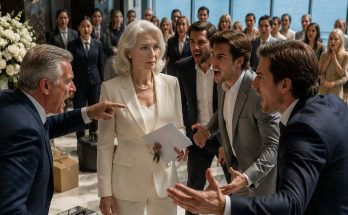
Every eye in the room—every banker, every rival, every whispering socialite—locked onto the stage. The silence was so profound it felt like a vacuum.
“There must be a mistake,” Brad stammered, dropping Chloe’s hand. He turned to the crowd, his face flushing a dangerous, dark red. “The machine is calibrated wrong. Tell them, doctor.”
“Ultrasounds at this stage have a margin of error of a few days, Mr. Cortland,” Dr. Aris said, his voice clipped, stepping back from the table. “Not two months.”
Brad turned to Chloe. “Chloe? Tell them.”
Chloe didn’t look at him. She was staring past the blinding stage lights, looking for someone in the crowd.
And then, the final, devastating piece of the puzzle clicked into place.
From the shadows near the catering entrance, a man stepped forward. It was Dylan, the handsome “architect” Chloe had introduced to Brad a few months prior as a potential consultant.
Chloe sat up on the medical table. The terrified, vulnerable act vanished instantly. Her posture shifted; the soft, doe-eyed expression hardened into something sharp and entirely predatory. She didn’t look like a mother-to-be caught in a lie; she looked like a shark that had just finished its meal.
She reached up, unclipped the lavalier microphone from her silk gown, and let it drop to the floor with a deafening screech of feedback.
“What are you doing?” Brad whispered, horrified.
Chloe swung her legs off the table, wiped the ultrasound gel off her stomach with a plush towel, and walked right past him. She descended the stairs and linked her arm through Dylan’s.
“Thanks for the deposit on the ‘nursery’ renovations, Brad,” Dylan said loudly, his voice carrying without a microphone. He patted his tailored jacket pocket. “We’ll send a postcard.”
The room erupted into chaos.
They weren’t secret lovers making a mistake. They were professional grifters. They had targeted Brad, recognized his monumental ego, and played him for hundreds of thousands in cash advances, luxury gifts, and phantom consulting fees. And the “heir” to the Cortland empire belonged to a con artist.
Thelma let out a breathless gasp and collapsed into a chair, the grandmotherly warmth leaving her eyes, replaced by cold, venomous shock. The love she had performed for months evaporated in a single second. It had never been for Chloe; it had only been for the boy.
Brad stood alone on the stage, the massive screen behind him still broadcasting the image of another man’s child to a room full of people who held his financial future in their hands.
He had wanted an audience. And he had gotten one.
Brad stumbled off the stage, pushing past the whispering investors. His chest heaved. He needed air. He needed to do damage control. He pulled out his phone, ready to call his PR team, ready to spin this into a story of him being a victim.
Before he could unlock the screen, it buzzed violently in his hand.
It was an urgent email from First Liberty Bank. The subject line was flagged in red: URGENT: Apex Project Bridge Loan – FRAUD ALERT.
Brad’s thumb shook as he opened it.
Mr. Cortland, our underwriters have completed the final title search on the collateral property (Penthouse 4A). Public records indicate the deed is held by Vega Holdings LLC, a subsidiary of the Vega Family Trust. Your signature pledging this asset constitutes federal bank fraud. The loan is terminated. Your corporate accounts are frozen pending a federal investigation. Legal counsel is advised.
The floor seemed to drop out from beneath him.
He stared at the screen, uncomprehending. The penthouse wasn’t his? How could it not be his? He lived there. He paid the maintenance fees. He had shouted at Audrey a hundred times that he put the roof over her head.
Having the keys to something doesn’t mean you own it.
Audrey’s parting words echoed in his skull, ringing like a death knell. She had known. She had sat in that office, let him demand a penthouse he didn’t own, let him walk straight into a federal fraud trap of his own making, and she hadn’t blinked.
His phone buzzed again. A text from his fleet manager. Brad, cops are at the lot. The holding company reported the SUV you’re driving as stolen/unauthorized use. They’re tracking the GPS. You need to dump the car.
In the space of ten minutes, the entire architecture of his life had collapsed. No son. No investors. No home. No car. And very soon, no freedom.
Panic, raw and metallic, flooded his veins. He had to stop Audrey. She had the girls. She was the only one who could fix this, who could call off the trust, who could tell the bank it was a misunderstanding.
He looked at his watch. 2:15 PM.
Her flight to Madrid was boarding at 4:00 PM.
The international terminal at O’Hare was a sanctuary of white noise and polished floors.
“Are we really getting on the big plane now, Mommy?” Lily asked, clutching her battered stuffed bear.
“We really are, sweetheart,” I said, handing our passports to the ticketing agent. Sophie was practically vibrating with excitement next to me.
We were thirty minutes from boarding. I felt the familiar, oceanic calm washing over me. We were leaving the wait behind.
Suddenly, a disturbance rippled through the security line behind us.
“There she is! Stop her! She’s kidnapping my children!”
I turned slowly. Brad was sprinting toward the security barricade, his expensive suit wrinkled, his face slick with sweat. He was flanked by two armed airport police officers and a TSA supervisor. He looked entirely unhinged.
“Ma’am, step away from the children,” one of the officers barked, resting a hand on his utility belt as they approached.
Sophie shrank behind my leg. I put a protective hand on her shoulder and looked the officer dead in the eye. “I am their mother, officer. We are catching a flight to our new home.”
“She doesn’t have permission!” Brad screamed, spit flying from his lips. He pointed a trembling finger at me. “I didn’t authorize international travel! It’s abduction! Arrest her!”
The officer looked at me sternly. “Ma’am, taking minors out of the country requires the documented consent of both legal guardians. Do you have that paperwork?”
“She doesn’t!” Brad yelled, a manic gleam of triumph in his eyes. He thought he had me. He thought he could exert control one last time, trap me here, and force me to bail him out of his financial grave.
I didn’t reach for my bag. I simply looked past Brad’s shoulder.
Hurrying down the concourse, clutching a leather briefcase to his chest and wheezing heavily, was Mr. Sterling, Brad’s own divorce attorney. I had texted him from the car two hours ago, anticipating exactly this move.
“Wait!” Mr. Sterling gasped, pushing through the crowd. “Officers, wait.”
Brad spun around. “Sterling! Good, tell them! Tell them she’s stealing my kids!”
Mr. Sterling stopped, catching his breath. He looked at Brad, not with solidarity, but with a profound, exhausting pity.
“Mr. Cortland,” the lawyer said, unzipping his briefcase. “I begged you to read the addendums. I begged you to sit down and review the paperwork before you signed.”
Mr. Sterling pulled out a thick stack of legal documents, stamped and notarized by the state of Illinois. He handed them directly to the police officer.
“What is that?” Brad demanded, his voice cracking.
“That,” the officer said, scanning the first page, “is a fully executed International Relocation Consent decree. Signed by you, Mr. Cortland. Granting full physical custody and permission to relocate the minors to Madrid, Spain.”
The officer handed the papers back to the lawyer and glared at Brad. “Sir, filing a false kidnapping report to ground an international flight is a federal offense. You need to step back. Now.”
Brad looked at the signature on the page. It was his. Bold, sweeping, arrogant. He had signed it three weeks ago while on speakerphone with Chloe, negotiating caterers for the gender reveal party. He hadn’t read a single line.
He was the victim of his own certainty that a woman wasn’t worth reading carefully. That certainty had been the load-bearing wall of his entire character, and I had simply stepped back and watched the roof cave in.
“You can’t do this,” Brad whispered, the manic energy draining out of him, leaving only a hollow shell. He looked at me, truly looking at me for the first time in years. “The bank… the fraud charges… Audrey, they’re going to put me in prison.”
“Then you should probably call a good criminal defense attorney,” I said softly. “Mr. Sterling only does family law.”
The overhead speaker chimed. Now boarding First Class, Flight 882 to Madrid.
“Come on, girls,” I said, taking their hands.
“Audrey, wait!” Brad begged, his voice dropping to a pathetic whine. “The money… the trust. How much… how much money do you actually have?”
I stopped. I turned my head, letting him see the absolute emptiness in my eyes when I looked at him.
“That stopped being any of your business,” I said, “the day you decided my worth was a matter of how much I needed from you.”
I turned my back on him. The police officers formed a barrier between us, and I walked my daughters through the gate, into the jet bridge, and out of his life forever.
Madrid was bathed in golden afternoon light. It had been a month since we left Chicago.
My daughters and I lived in a beautiful, sun-drenched villa on the edge of the city, surrounded by a garden of jasmine and bougainvillea. I had returned to work, stepping into my rightful place as the Director of Corporate Strategy for the European division of Vega Logistics.
I was sitting at my massive mahogany desk, reviewing a series of acquisition portfolios, when my private cell phone rang. It was an unknown international number.
I answered it.
“Audrey.”
Brad’s voice was unrecognizable. It was raspy, defeated, completely stripped of its old velvet arrogance.
“Hello, Brad.”
“I need your help,” he rasped. “Please. I’m begging you.”
I leaned back in my leather chair, looking out the floor-to-ceiling windows at the Spanish skyline. “I assume the bank didn’t drop the fraud charges?”
“No. They froze everything. Cortland Construction is in receivership. My dad had to mortgage his own house to post my bail.” He let out a dry, broken sob. “Chloe is gone. Everyone is gone.”
“Why are you calling me, Brad?”
“Because there’s one way out,” he said, a desperate, frantic spark igniting in his voice. “My firm’s only lifeline is a pending merger with Osprey Holdings. If the merger goes through, the capital injection covers the bridge loan. The bank drops the criminal charges. I can save my dad’s house. I can stay out of jail.”
“And?”
“Osprey paused the merger yesterday. They said they were being acquired by a larger European conglomerate. Audrey… you know people in logistics. You know European supply chains. Please, just make some calls. Find out who is buying Osprey. If I can just talk to them, pitch them on my value…”
I let the silence stretch across the Atlantic Ocean. I let it stretch until I could hear his ragged breathing on the other end.
“I don’t need to make any calls, Brad,” I said softly.
“What? Why? Please, Audrey, if this European company kills the merger, my life is over—”
“I know,” I interrupted, my voice as cold and clear as cut glass. “I know exactly what happens if the merger dies.”
“Then who is buying Osprey? Give me a name!”
“Vega Logistics,” I said.
The silence on the line was so absolute it felt like the call had dropped.
“I am the Director of Corporate Strategy, Brad,” I continued, savoring the taste of every syllable. “I oversaw the acquisition of Osprey Holdings this morning. And my very first executive action was to audit their pending contracts. I found a highly leveraged, toxic merger agreement with a failing Chicago firm called Cortland Construction.”
“Audrey… no. God, no.”
“I killed the deal twenty minutes ago, Brad. The paperwork is already filed.”
“You… you destroyed me,” he whispered, his voice cracking into pieces.
“No, Brad,” I replied, looking at a framed photo of my daughters on my desk. “You built a house out of lies, and you handed me the sledgehammer. I just finally took a swing.”
I ended the call. I didn’t block his number. I wanted it to ring, unanswered, into the void, a monument to the ghost he had become.
That Sunday, the Madrid sun poured into our massive kitchen.
I was standing at the stove, flipping pancakes, while Lily cut strawberries into aggressively uneven pieces and Sophie tried to keep our new Golden Retriever from stealing bacon off the counter.
“Mom, you’re different here,” Lily said suddenly, looking up at me with her bright, honest eyes.
“Different how, sweetheart?” I asked, smiling.
Sophie answered before her sister could. “You sing now.”
I stopped, the spatula suspended in the air. “What?”
“When you make breakfast, you sing,” Sophie said, scratching the dog behind the ears. “You never sang in Chicago.”
Something tight and heavy, a knot I didn’t even know I had been carrying for twelve years, finally dissolved in my chest.
Children don’t understand federal wire fraud, or trust funds, or corporate acquisitions. But they understand, perfectly and in their bones, what it feels like to live inside a sad, oppressive house. They had grown up in a house without music, assuming that was just the way the world sounded.
And now, they could hear the music returning.
I had uprooted them, fought a war in the shadows, and burned an arrogant man’s empire to the ground, all for this exact moment. To ensure my daughters would never, ever grow up believing they were a second-place prize in their own lives.
I set the spatula down, walked around the kitchen island, and pulled both of my bright, fierce, extraordinary girls into a tight hug.
A house can be lost. A fortune can be seized. A man can find himself locked in a cage of his own making.
But no child should ever have to grow up believing they needed to be born a boy to deserve the love of their own family. That much, at least, I had made certain of. That much was finally, entirely mine to give.