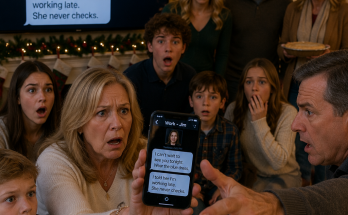
My Parents Kicked Me Out On Christmas Morning. My Sister Smiled: “Back To Your Place, Loser.” I Went To The Bank With The Cedar Box Grandpa Gave Me. The Manager Took One Look At It… And Locked The Office Door. “Miss Hale…” He Said: “You Need To Sit Down.”
### Part 1
My name is Mara Whitaker. I was twenty-six years old when my mother burned my Christmas stocking in front of me and told me I had never belonged in her family.
It was Christmas morning.
I woke to the smell of cinnamon coffee drifting upstairs, the same coffee my mother made every December twenty-fifth. For a few seconds, lying beneath an old patchwork quilt, I almost convinced myself it might be a normal Christmas.
Then I heard a suitcase wheel scrape across the hallway floor.
My bedroom door opened before I could sit up.
My mother, Elaine, walked in carrying a black garbage bag.
“Get dressed,” she said.
Behind her stood my father, Richard.
He wouldn’t look at me.
“What’s happening?”
Mom opened my dresser and began grabbing clothes by the handful.
Sweaters. Jeans. Underwear. Everything went into the bag.
“Mom.”
She ignored me.
My grandmother’s cream cardigan disappeared beneath a pair of sneakers.
“Stop.”
I grabbed her wrist.
She yanked away as if I had burned her.
“Don’t make this uglier than it needs to be.”
That sentence scared me more than shouting would have.
Dad finally stepped forward, took the bag from her, and shoved it against my chest.
I stumbled backward into the wall.
A framed photograph slipped from its hook and hit the floor.
Glass cracked across the smiling faces of my parents and my younger sister, Chloe.
I wasn’t in that photograph.
Of course I wasn’t.
Dad stared at the broken glass rather than me.
“Pack whatever else you need and get out of our house.”
Our house.
He said those two words with such confidence that, for a moment, I almost believed him.
Mom marched me downstairs.
The Christmas tree glowed beside the front window, covered in the old multicolored bulbs my grandfather had loved. Pine needles smelled sharp in the warm room. Wrapped gifts crowded the floor.
Every package had Chloe’s name on it.
Not mine.
Then I saw my stocking.
It was faded green wool, with MARA stitched crookedly across the top in red thread. My grandmother had made it when I was little.
Mom ripped it off the mantel.
“What are you doing?”
She opened the fireplace screen.
“Mom, don’t.”
She dropped it into the flames.
The wool curled almost immediately.
I stared as the red letters blackened.
Mom watched my name disappear.
Then she turned to me.
“You have ruined every Christmas since the day you were born.”
Her voice was frighteningly calm.
“We never wanted you here.”
I thought those words would destroy me.
Instead, something inside me went strangely still.
Because she had said versions of them my entire life.
This was simply the first time she had stopped pretending.
A laugh came from the staircase.
Chloe stood three steps from the bottom, holding her phone upright.
She was filming.
“Oh my God,” she whispered dramatically toward the screen. “This is actually happening.”
“Turn that off,” I said.
She grinned.
“No way.”
Dad opened the front door.
Cold air rushed inside.
Snow had covered the porch during the night.
Chloe swung the camera toward me.
“Good luck out there, loser. Nobody here is going to miss you.”
I looked at all three of them.
My mother beside the fireplace.
My sister filming.
My father holding open the door.
And I realized there was absolutely nothing I could say that would make any of them become people they had never been.
So I didn’t try.
I picked up the garbage bag.
Then I reached beneath the small table beside the stairs and took the cedar box I had placed there the night before.
My grandfather had given it to me nine years earlier.
He had made me promise never to open it unless I truly needed somewhere to go.
I stepped onto the porch in wool socks.
My shoes were still somewhere inside the garbage bag.
“Don’t come crawling back,” Chloe called.
I closed the door softly behind me.
All the way.
Just like Grandpa had taught me.
My car was freezing. My socks were soaked by the time I reached it.
I threw the garbage bag into the passenger seat and placed the cedar box on my lap.
For nine years, I had obeyed my grandfather.
That morning, I finally lifted the lid.
Inside was an old brass key, a photograph, a folded note, and a business card for Cascade Trust Bank.
On the back of the card, Grandpa had written one sentence.
“Tell Thomas you’re my granddaughter. He’ll know.”
Twenty minutes later, I was standing inside the bank while an older man locked his office door behind us.
He looked at the cedar box.
Then at me.
And his expression changed.
“Mara,” he said quietly, “your grandfather has been waiting nine years for you to walk through that door.”
### Part 2
My grandfather’s name was Arthur Bell.
He built furniture for more than forty years in a workshop behind an old brick feed store in Pine Hollow, Vermont.
The shop always smelled like sawdust, machine oil, and coffee he forgot to drink until it burned.
When I was eight, my mother started dropping me there after school because Chloe had dance lessons, tutoring, piano classes, and whatever else Mom had decided her “gifted child” required that month.
Grandpa would take my backpack and hang it beside his leather apron.
“We’ve got work to do, kiddo.”
Those afternoons became the safest part of my childhood.
He taught me how to measure twice before cutting once. How to tell maple from birch by smell. How to run my palm over a board and find rough patches my eyes missed.
“Always sand with the grain,” he’d say.
Once, when I asked why, he smiled.
“Because forcing something against its nature usually damages both of you.”
I didn’t understand then.
Years later, I did.
When I was fourteen, Grandma died and my parents moved us into Grandpa’s house.
That first night, I woke thirsty and heard voices in the hallway.
My mother was whispering.
“Just be patient. He’s old.”
Dad murmured something I couldn’t hear.
Mom answered, “Five years, maybe. Then we won’t have to worry about a mortgage again.”
I opened my bedroom door.
Grandpa was standing farther down the hallway holding a glass of water.
He had heard everything.
Our eyes met.
He said nothing.
Neither did I.
The next morning, he asked if I wanted to work with him every Sunday.
I never missed one.
Not until I was seventeen.
That summer, Mom accused me of stealing a bracelet at a backyard barbecue.
Fifteen relatives were there.
Chloe had actually borrowed it without asking, but when Mom found the empty jewelry box, Chloe pointed at me.
Mom slapped me before I could finish one sentence.
The entire yard went silent.
Dad stared at the grass.
Chloe covered a smile with her hand.
Grandpa walked me into the kitchen.
He wrapped ice in a dish towel and held it against my cheek.
“Don’t cry where she can use it,” he said.
I swallowed hard.
“That’s a terrible thing to tell somebody.”
“I know.”
His eyes looked tired.
Then he added, “So save it. And save everything else too.”
The following afternoon, he handed me the cedar box.
It was beautiful.
Dovetail joints. Cherrywood trim. My name burned carefully across the lid.
“For me?”
“For whenever you need it.”
“What’s inside?”
“Something useful.”
I started lifting the lid.
His hand came down gently on mine.
“Not yet.”
“When?”
“Anytime. Any reason. Any hour.”
I laughed.
“That doesn’t answer anything.”
“It will.”
For nine years, the box followed me from bedroom to bedroom, untouched.
Meanwhile, the difference between Chloe’s life and mine became impossible to ignore.
Chloe attended a private academy.
I attended public school.
When she wanted a car, Mom and Dad helped her buy one.
When mine broke, Dad gave me the number of a mechanic.
Chloe went to a private college for two semesters, quit, changed schools, quit again, and eventually started calling herself a lifestyle entrepreneur.
I worked evenings at a hardware store while earning an associate’s degree.
Whenever I struggled, Mom said, “You need to learn independence.”
Whenever Chloe struggled, Mom said, “She needs support.”
That was our family’s favorite equation.
Different numbers.
Same answer.
Then Grandpa got sick.
By the time doctors discovered how serious it was, there wasn’t much anyone could do.
He died that October.
At his funeral, my mother cried louder than anyone.
She held tissues to her face while repeatedly glancing toward the upstairs office where Grandpa kept his files.
I noticed.
I also noticed something stranger.
Three days later, she asked me whether Grandpa had ever given me “paperwork.”
I said no.
She asked whether he had ever mentioned a bank.
“No.”
“A lawyer?”
“No.”
Her shoulders relaxed.
I remember that now.
At the time, I thought grief had made her strange.
The truth was much worse.
After Grandpa died, Mom began behaving as though the house had become hers automatically.
She repainted his bedroom.
She donated half his clothes without asking me.
Chloe’s boyfriend, Mason, moved into Grandpa’s reading room and painted the walnut shelves gray.
“No offense,” he told me, “but old-man furniture doesn’t really fit the aesthetic.”
I wanted to scream.
Instead, I ran my fingertips along the one shelf they hadn’t painted yet.
Grandpa had made it.
I could still see faint pencil marks underneath.
The night before that final Christmas, I walked downstairs for water and heard my parents talking in the kitchen.
Mom said, “After tomorrow, it’ll finally just be our real family.”
Dad didn’t answer.
I went back upstairs.
Took the cedar box from the bottom of my closet.
Placed it beside my bed.
And stared at my name burned into the wood.
I still didn’t open it.
The next morning, they threw me out.
Now I sat across from Thomas Reed at Cascade Trust Bank while snow melted from my socks onto his carpet.
He opened a thick folder.
The first page contained Grandpa’s signature.
The second contained mine.
Except I had never signed it.
I looked up sharply.
“What is this?”
Thomas folded his hands.
“Proof that your grandfather started protecting you long before you knew you needed protection.”
### Part 3
I stared at the signature again.
“It looks like my name.”
“It is your name,” Thomas said. “But you didn’t sign it.”
That didn’t exactly make me feel better.
He turned the page.
“When you were seventeen, your grandfather established a trust. You were a minor, so certain documents were executed through a trustee structure. You became the sole beneficiary.”
I looked at him.
“Beneficiary of what?”
Thomas did not answer immediately.
Instead, he picked up the brass key from the cedar box.
It was heavy and dark with age.
A small leather tag hung from the ring.
FRONT DOOR.
Beneath that were four numbers—the year Grandpa had finished building his house.
Thomas rubbed his thumb across the metal.
“Your grandfather carried this key for decades.”
“I know.”
“He had one copy made.”
“For you?”
Thomas nodded.
“Mine is in the bank vault.”
Then he placed the key in my palm.
“This one opens the front door of 118 Willow Creek Road.”
My grandfather’s house.
I frowned.
“I already know that.”
“No, Mara.”
Thomas leaned forward.
“You don’t understand.”
He turned another document toward me.
At the top was the property address.
Below it were words I read three times before they made sense.
TRANSFER OF OWNERSHIP.
My mouth went dry.
“Your grandfather transferred the property into the Arthur Bell Family Trust nine years ago,” Thomas explained. “He retained a lifetime right of residence. Upon his death, ownership passed directly to the designated beneficiary.”
“Who?”
Thomas watched me carefully.
“You.”
I actually laughed.
Not because anything was funny.
Because my mind rejected the alternative.
“That’s impossible.”
“It’s recorded with the county.”
“My mother lives there.”
“Yes.”
“My father lives there.”
“Yes.”
“Chloe lives there.”
“At present.”
I pushed the document away.
“No. They think it’s theirs.”
Thomas’s expression told me something before he said it.
“They know it isn’t.”
The room became very quiet.
Outside his blinds, I could hear faint Christmas music playing in the lobby.
Something cheerful about sleigh bells.
I stared at him.
“What do you mean they know?”
Thomas opened a second folder.
Inside were three dated reports.
The first was written eight days after Grandpa’s funeral.
Elaine Whitaker had visited the bank requesting information about her father’s accounts.
She had been informed that she was not an authorized beneficiary.
The second report showed she returned several months later with identification and documents proving she was Grandpa’s daughter.
She demanded to know why “family assets” had been withheld from her.
She was again refused.
The third visit included my father.
According to the written notes, he raised his voice while Mom demanded that the bank “fix” Grandpa’s arrangements.
My hands started shaking.
Thomas pointed to the final paragraph.
“Read that.”
I did.
Before leaving the bank, Mrs. Whitaker stated: “Mara doesn’t even know. She doesn’t deserve to know.”
My stomach turned.
“She knew.”
Thomas nodded.
“The exact scope of her knowledge is difficult to determine. But yes. She knew your grandfather had excluded her from something significant. And she strongly suspected that something involved you.”
I remembered Mom asking me about paperwork after the funeral.
A bank.
A lawyer.
I had interpreted the questions as grief.
They had been an investigation.
“Why didn’t you call me?”
“Your grandfather prohibited it.”
I stared at him.
“What?”
“He believed that if we contacted you while you were still emotionally dependent on your family, your mother would pressure you into signing something away.”
“That sounds insane.”
Thomas’s eyes softened.
“Does it?”
I thought about the stocking burning.
The garbage bag.
My father opening the door.
Chloe laughing into her phone.
“No.”
Thomas slid another document forward.
A bank statement.
The balance was a little over ninety thousand dollars.
I blinked.
“What’s that?”
“An account your grandfather built from private furniture commissions over several years.”
“For what?”
Thomas turned over a handwritten note attached to the statement.
For the year she’ll need it.
My throat tightened.
“He knew?”
“I think he knew enough.”
Thomas reached beneath the folder and removed a cream-colored envelope.
My name was written across the front in Grandpa’s handwriting.
I could barely touch it.
Inside was a letter.
Sweetheart,
If you are reading this, then your mother probably did what I was afraid she would eventually do.
I saw more than you thought I saw.
I saw how differently they treated you.
I heard what was said when they thought nobody was listening.
I watched you learn to make yourself smaller because it made everyone else more comfortable.
I should have said more. That is one regret I will carry wherever old cabinetmakers go.
But I did what I knew how to do.
I built something.
The house is yours.
It cannot become your mother’s.
It cannot become your father’s.
Do not let anyone convince you that protecting yourself is cruelty.
You were never the burden.
You were the one who kept showing up.
Come home when you are ready.
Love,
Grandpa
I made it to the word home before I started crying.
Not politely.
Not quietly.
Nine years of swallowing everything came out at once.
Thomas moved a box of tissues toward me and looked away.
When I finally raised my head, my phone was vibrating across the desk.
MOM.
I watched it stop.
Then start again.
A voicemail appeared.
I played it.
Her voice had changed completely.
“Mara, honey, I think everyone got emotional this morning. Come back. We should talk about this like a family.”
A second voicemail came minutes later.
Her voice was colder.
“That house is family property. Whatever your grandfather told you, do not do anything stupid.”
I looked at Thomas.
“How could she know I’m here?”
He glanced toward my phone.
“She may not.”
Then another message appeared.
From Chloe.
My video is getting a lot of views. Mom says call immediately. This could become a problem.
I wiped my face.
For the first time that morning, I smiled.
Not because I knew exactly what I was going to do.
But because I finally knew something they didn’t.
They hadn’t thrown me into the street.
They had thrown themselves onto property that legally belonged to me.
### Part 4
I spent Christmas night in a roadside motel.
I could have gone back to the house immediately.
Thomas told me the key would still work.
Legally, nobody could stop me from entering my own property.
But Grandpa’s letter had said something else.
Come home when you are ready.
I wasn’t ready.
The motel smelled faintly of bleach and old carpet. A vending machine hummed outside my door. I ate crackers for dinner because every restaurant nearby had closed for Christmas.
It was one of the loneliest nights of my life.
And somehow, it was also the first night in years when I didn’t have to listen for my mother’s footsteps.
The next morning, I called Rebecca Sloan.
She had been Grandpa’s attorney.
When I gave my name, she didn’t hesitate.
“I’ve been expecting this call for years.”
Her office occupied the second floor of an old converted house above a bakery.
It smelled like coffee and warm butter.
Rebecca was in her early sixties, with silver hair cut to her chin and the calmest voice I had ever heard.
She asked me to tell her what happened.
I made it through most of Christmas morning without crying.
When I described Mom burning the stocking, Rebecca stopped taking notes.
“She burned it?”
“Yes.”
“Your grandmother’s?”
“Yes.”
Rebecca removed her glasses.
“Arthur would have been furious.”
For some reason, that nearly broke me.
She gave me a moment, then opened a file thicker than Thomas’s.
“Your grandfather planned carefully.”
That was an understatement.
The deed transfer was valid.
The trust was valid.
The title insurance was valid.
The house was unquestionably mine.
Grandpa had anticipated possible challenges and documented his mental competence when everything was signed.
Independent witnesses.
Medical records.
Attorney notes.
There was no loophole waiting for my mother.
“Can she contest it?”
“Anyone can file something.”
Rebecca shrugged.
“That doesn’t mean they can win.”
“What happens if she refuses to leave?”
Rebecca folded her hands.
“That depends on what you want.”
For years, people had asked me what I wanted only when they were already planning to tell me why I couldn’t have it.
The question felt strangely dangerous.
“I want my house back.”
“Good.”
Rebecca pulled two documents from the file.
“Then we do this cleanly.”
Under state law, my parents and sister had no ownership interest and no lease granting them permanent possession.
They were occupants without a valid ownership claim.
Rebecca recommended formal notice.
No screaming match.
No driveway confrontation.
No family meeting.
Paperwork.
“They’ll say I’m cruel.”
“They already threw you out on Christmas.”
“I know.”
“Then stop letting people who behave cruelly define cruelty for you.”
That sentence stayed with me.
I signed the notice.
My hand barely shook.
Three days later, a professional process server delivered it.
Mom answered the door while having her hair colored.
Chloe was filming again.
Rebecca later showed me the service report.
Mom read the first page.
Her face changed.
Then she tore it in half.
The process server calmly reached into his folder.
“That’s fine, ma’am. You have been served. I have additional copies.”
According to the report, Mom shouted, “This is my father’s house!”
The server replied, “The recorded owner is Mara Whitaker.”
Chloe stopped filming.
That might have been my favorite detail.
Within twenty-four hours, Rebecca received nine emails from Mom.
Then five more.
The messages shifted wildly.
First came outrage.
Mara is unstable.
Then bargaining.
We simply need more time to discuss what is fair.
Then guilt.
Parents should not be treated this way after everything we sacrificed.
Rebecca sent the same response every time.
“My client does not owe you a personal conversation regarding possession of her property.”
Dad never emailed.
Chloe did.
She sent me one message directly.
You’re seriously making us homeless over one bad morning?
I stared at it for several minutes.
One bad morning.
As if Christmas had created our family instead of exposing it.
I typed a response.
Then deleted it.
I blocked her instead.
A week later, Mom hired an attorney.
He contacted Rebecca, reviewed the deed and trust, then apparently advised my parents to leave voluntarily.
They fired him.
Mom began posting vague messages online.
“Some children forget who gave them life.”
“Greed destroys families.”
“Honor your parents while you still can.”
She never mentioned who owned the house.
That omission became important.
People started asking.
At first, Mom deleted the comments.
Then there were too many.
One woman wrote, “Elaine, if Mara owns the house, why did you kick her out of it?”
The post vanished within an hour.
By the end of the notice period, my family was still there.
Rebecca called me.
“They have made their choice.”
“So what happens?”
“We file.”
I looked at Grandpa’s brass key lying beside my coffee cup.
“How long?”
“Not long.”
Then she added, “Mara, this next part may feel ugly. Remember something. You did not create the situation by enforcing your rights. They created it by assuming you would never use them.”
The hearing was scheduled.
Mom posted that she was finally going to tell “the entire truth.”
But there was one problem with her version.
The truth was sitting in a county recorder’s office with my name on it.
### Part 5
I almost went to court.
The night before the hearing, I laid out a navy dress, black flats, and the small pearl earrings Grandpa had given me for graduation.
Then I sat on the edge of the motel bed staring at them.
I realized I was preparing myself to perform.
To look respectable enough.
Calm enough.
Hurt enough.
But not too hurt.
Exactly the kind of performance I had spent my whole childhood perfecting whenever Mom told relatives I was “difficult.”
I called Rebecca.
“Do I have to be there?”
“No.”
“Will it hurt the case if I’m not?”
“Not at all.”
“Then I’m not going.”
There was a pause.
Then Rebecca said, “Good.”
The next morning, I went to work.
I had started picking up extra hours at a local design-and-hardware store while figuring out what I wanted to do with the house.
Around lunchtime, Rebecca called.
“It’s over.”
I stepped into the stockroom.
“That fast?”
“The judge reviewed the deed. Your mother attempted to argue that the property was morally hers because she was Arthur’s daughter.”
I closed my eyes.
“And?”
“The judge informed her that morality was not the issue before the court.”
I laughed despite myself.
Rebecca continued.
“Your father admitted he had no ownership documents. Your sister apparently tried to speak from the gallery and was warned once.”
“That sounds like Chloe.”
“The court granted possession to you.”
My knees weakened.
I leaned against a shelf stacked with boxes of cabinet hinges.
“So they have to leave?”
“Yes.”
“And if they don’t?”
“The sheriff’s office will enforce the order.”
I looked down at my hands.
Grandpa’s workshop flashed into my memory.
His fingers guiding mine across sandpaper.
Slowly.
With the grain.
“Okay.”
Mom called me that evening from an unfamiliar number.
I almost hung up.
Then curiosity won.
“Mara?”
Her voice sounded different.
Smaller.
“Don’t call me from other people’s phones.”
“You won.”
I said nothing.
She laughed bitterly.
“Is that what you wanted to hear?”
“No.”
“Then what do you want?”
“My house.”
“That was my father’s home.”
“And he gave it to me.”
“He was manipulated.”
“By who?”
Silence.
I continued.
“You knew about the trust.”
“We knew something was wrong.”
“You went to the bank three times.”
Another silence.
Then she said, “You don’t understand what it was like being his daughter.”
That almost impressed me.
She had somehow turned Grandpa protecting me into another injury against her.
“Maybe not.”
“You were his favorite.”
“He was the only adult in that house who noticed what was happening.”
“That is not true.”
“You burned my stocking.”
“Oh, for God’s sake, Mara.”
There it was.
The old voice.
Sharp.
Impatient.
The version that appeared whenever pretending became inconvenient.
“It was a piece of fabric.”
“It had my name on it.”
“You’re going to throw your parents onto the street over a stocking?”
“No.”
My voice stayed surprisingly steady.
“I’m removing people who threw me out of my own house.”
“You wouldn’t even have that house if it weren’t for me.”
“I wouldn’t have needed protection from you if it weren’t for you either.”
She inhaled sharply.
Then she changed tactics.
“Your father is devastated.”
Dad.
The man who had watched her humiliate me for years.
The man who had opened the door on Christmas morning.
“Then he should talk to someone.”
“He’s your father.”
“I’m aware.”
“Mara, families forgive.”
“Families also protect.”
“You’ll regret this.”
Maybe.
I had spent most of my life afraid of regret.
Regretting making Mom angry.
Regretting upsetting Dad.
Regretting embarrassing Chloe.
That night, I realized regret had been another leash they used to keep me close.
“I’m done discussing it.”
“Mara—”
I hung up.
The lockout date arrived several days later.
I did not plan to watch.
Then Chloe announced online that she would livestream “the truth about what our psycho sister is doing to us.”
Rebecca sent me the link.
“For documentation only,” she wrote.
I opened it.
At first, twelve people were watching.
Mom sat in Grandpa’s living room wearing a white cardigan, crying into the camera.
Behind her, boxes were still unpacked.
They hadn’t prepared to leave.
Not really.
Mom kept calling the house “our forever home.”
Comments began appearing.
Does Mara own it?
Show the deed.
Why did you kick her out?
Mom ignored them.
Then someone knocked on the front door.
Mom’s entire expression brightened.
“Oh,” she whispered. “Maybe the local station finally came.”
She smoothed her hair.
Chloe carried the phone behind her.
Mom opened the door.
A uniformed deputy stood on the porch holding a court order.
“Mrs. Whitaker?”
Mom froze.
The viewer count jumped.
Hundreds.
Then thousands.
The deputy looked down at the paperwork.
“This property belongs to Mara Whitaker. The court has ordered possession returned to the owner.”
Behind Mom, Dad slowly stood from the kitchen table.
For the first time in my entire life, he looked directly into Chloe’s camera.
And then he said something I never expected to hear.
“She owns it.”
### Part 6
Chloe whispered, “Dad, stop.”
He didn’t.
Dad walked slowly from the kitchen toward the front door.
His face looked gray.
Older than I remembered.
Mom turned on him.
“Richard.”
He ignored her.
The deputy repeated that they needed to gather essential belongings and leave.
Mom began arguing.
“We are appealing.”
The deputy glanced at the order.
“No appeal has been filed that stays enforcement.”
“We have nowhere to go.”
“I’m sorry, ma’am. I’m here to enforce the court’s order.”
Chloe’s livestream chat moved so quickly I could barely read it.
Wait, Mara actually owns it?
They threw the OWNER out?
On CHRISTMAS?
Someone screen-record this.
Mom reached for Chloe’s phone.
“Turn that thing off.”
Chloe pulled away.
“No! People need to see this.”
Mom snapped, “You’re making it worse.”
That sentence almost made me laugh.
Because for once, she was right.
Dad sat down on the porch steps.
Snow from the previous week had mostly melted, leaving wet patches on the gravel.
He rubbed both hands over his face.
Then he spoke loudly enough for Chloe’s phone to catch it.
“Mara owns the house.”
Mom stared at him.
“Richard, shut up.”
“She always did.”
“No, she didn’t.”
“Yes.”
His voice cracked.
“We knew Arthur had done something. We knew.”
Chloe lowered the phone slightly.
“What do you mean, you knew?”
Mom stepped toward Dad.
“Not now.”
He looked at her.
“When, Elaine?”
I had never heard him challenge her before.
Not once.
Dad had built his entire adult life around disappearing whenever confrontation approached.
Apparently, even cowardice had a breaking point.
“We should’ve left when the attorney told us to,” he said.
Mom’s face twisted.
“You agreed she was bluffing.”
“I agreed because that’s what I always do.”
The comment section exploded.
Chloe turned the phone back toward herself.
“This is insane.”
Dad stared at the floorboards Grandpa had installed.
Then he said the sentence that traveled far beyond our town within twenty-four hours.
“We shouldn’t have done what we did to her.”
Mom slapped her palm against the doorframe.
“Enough!”
The deputy stepped calmly between them.
“Please gather your belongings.”
That ended the performance.
Boxes began moving.
Chloe cried when she realized she could not take Grandpa’s antique desk.
“It’s mine!”
The deputy asked, “Do you have documentation showing ownership?”
Mom said, “It’s family furniture.”
The deputy repeated the question.
Nobody answered.
The desk stayed.
So did Grandpa’s bookcases.
His tools.
His dining table.
The carved cedar chest in the upstairs hall.
They could take their clothes, electronics, personal possessions, and things they could prove belonged to them.
But the house itself did not follow.
Neither did the parts of Grandpa they had spent years treating as scenery.
The livestream eventually cut off.
Not before tens of thousands of people had watched Mom standing in the driveway beside a pile of suitcases while a locksmith changed the front lock.
I closed the video.
I didn’t celebrate.
That surprised me.
I thought I would feel victorious.
Instead, I felt tired.
Deeply, physically tired.
Like I had been carrying furniture upstairs for twenty-six years and had finally put it down.
The internet celebrated enough for everyone.
Clips of Dad saying, “She owns the house,” spread everywhere.
Chloe’s original Christmas video resurfaced too.
Someone edited the two clips together.
First Chloe laughing while I stood in the doorway with a garbage bag.
Then Chloe crying outside the same house while a locksmith worked behind her.
The contrast was brutal.
Several companies Chloe had worked with quietly removed her from promotional posts.
One sent a statement saying they did not support “humiliating private individuals for online engagement.”
Chloe blamed me.
Naturally.
She emailed.
You destroyed my career.
I didn’t respond.
Mason, her boyfriend, lasted four more days.
Then he texted her that the situation had become “toxic for his image.”
Apparently he had spent months talking about building a brand with Chloe.
When the brand became inconvenient, he disappeared.
He moved out before my parents even found a permanent apartment.
Chloe sent me another message.
Are you happy now?
I blocked the new address.
Mom’s social media page survived eleven days after the eviction.
Then she deleted it.
Not because people were cruel.
Because they kept asking one question she could not answer without destroying her entire public story.
Why did you throw your daughter out of a house that belonged to her?
My parents rented a two-bedroom apartment almost thirty miles away.
Chloe moved in with them.
For the first time in her life, she slept on a pullout couch.
I learned that through a cousin.
I did not ask for updates.
I didn’t need them.
Two months later, Dad mailed me a letter.
Not a text.
Not an email.
An actual letter.
I left it unopened on my kitchen table for three days.
When I finally read it, the first sentence made me stop.
Mara, I spent twenty-six years pretending that doing nothing meant I had not chosen a side.
### Part 7
Dad’s letter was six pages long.
His handwriting slanted harder toward the bottom of every page, as if the truth became heavier the longer he carried it.
He didn’t make excuses.
That was probably why I kept reading.
He admitted he knew Mom treated Chloe differently.
He knew about the bracelet.
He knew Mom blamed me for things Chloe had done.
He knew I paid for school while they spent money on Chloe.
He knew Grandpa had become my safe place because home wasn’t one.
And every time he could have stepped between us, he convinced himself silence was neutrality.
“It wasn’t,” he wrote. “Silence was the easiest way to help your mother without admitting I was helping her.”
I read that sentence several times.
Then came the part I hadn’t known.
After Grandpa died, Dad discovered Mom had already contacted the bank.
He went with her on the third visit because she believed a man demanding answers might be taken more seriously.
When the bank refused them again, they argued in the parking lot.
Dad said he wanted to tell me something was going on.
Mom threatened to leave him if he did.
So he chose his marriage.
Again.
“I chose keeping my life comfortable over making yours safe.”
That was the truest thing he had ever said to me.
Near the end, he wrote:
I am not asking you to forgive me. I don’t think I deserve to ask. I only want you to know that your grandfather saw you clearly, and I did too. The difference is he acted on what he saw.
I folded the letter.
Put it back in the envelope.
And placed it in the cedar box.
I did not reply.
People sometimes think refusing reconciliation means you are still angry.
I wasn’t.
Anger had burned hot for a while.
Then it cooled into something far more permanent.
Clarity.
My mother sent messages too.
Hers were different.
“We did our best.”
“You’ll understand when you have children.”
“We sacrificed more than you know.”
“Your grandfather poisoned you against us.”
Then, eventually:
“I forgive you.”
That one made me laugh out loud.
I blocked every number.
I didn’t need her apology anymore.
And I definitely didn’t need her forgiveness.
By early spring, I had learned where much of my parents’ money had actually gone.
Years of private tuition for Chloe.
Vacations I had been told were “too expensive” for all four of us, so somehow they took only three people.
A failed salon Mom had opened and closed within eighteen months.
Thousands poured into Mason and Chloe’s clothing project, which never sold anything beyond a handful of hoodies.
I used to believe my parents were unable to help me.
The truth was simpler.
They had resources.
They chose where to place them.
Once I understood that, something inside me stopped bargaining with the past.
Rebecca helped me sort out the remaining property issues.
Thomas helped transfer Grandpa’s account fully under my control.
I paid off my remaining student debt.
I did not buy a luxury car.
I did not take some dramatic revenge vacation.
I did something Grandpa would have understood.
I enrolled in a woodworking and interior restoration program.
On my first day, the instructor handed me a scrap of walnut and asked me what I knew.
I ran my thumb across the grain.
“More than people think.”
By May, I finally returned to 118 Willow Creek Road.
Not to visit.
To live.
A deputy met me there because the final lock change and property inventory had just been completed.
He handed me two new keys.
“Welcome home, Ms. Whitaker.”
I thanked him.
Then waited until his car disappeared before pulling Grandpa’s original brass key from my pocket.
The old lock on the workshop door had never been changed.
The key slid in perfectly.
The click echoed through the empty entryway.
Inside, the house felt enormous without my family’s voices.
No television.
No Chloe filming.
No Mom calling from room to room.
No Dad moving quietly through the background.
Just the hum of the refrigerator.
Birds outside.
My own breathing.
The living room smelled faintly of cedar, dust, and old fireplace ash.
I walked toward the mantel.
For a second, I saw the stocking burning again.
Then I set the cedar box exactly where it had hung.
I expected sadness.
Instead, I felt something quieter.
Ownership.
Not just of the house.
Of myself.
I spent weeks repairing what they had changed.
I stripped Mason’s gray paint from Grandpa’s walnut shelves.
The first pass with the scraper revealed warm wood underneath.
I actually laughed.
Some things weren’t ruined.
They were only covered.
I reopened the workshop.
The leather apron still hung from its peg.
That scorch mark was still near the bottom.
I pressed it between my fingers.
“You kept everything,” I whispered.
A month later, while cleaning the attic, I found a narrow crawlspace behind a stack of Christmas decorations.
There was a cardboard box inside.
My name was written across it.
MARA.
Grandpa’s handwriting.
I dragged it beneath the attic light.
Inside was another Christmas stocking.
Soft green wool.
My name stitched across the top in uneven red thread.
I sat down hard on the floor.
Grandma had died years before that stocking was made.
Which meant Grandpa had stitched it himself.
Underneath were four small cedar boxes.
Each one built almost exactly like the first.
On top rested a handwritten note.
Cabinetmakers make spares.
I covered my mouth.
Then I laughed and cried at the same time.
Because even after leaving me a house, money, legal protection, and a door out, Grandpa had apparently worried one cedar box might not be enough.
### Part 8
That first Christmas in the house, I woke before sunrise.
For several seconds, I forgot where I was.
Then I smelled coffee.
Not Mom’s cinnamon Christmas coffee.
Mine.
I had left the automatic brewer set the night before.
Outside, snow covered the orchard.
Inside, the house was warm.
I walked downstairs barefoot.
The restored walnut shelves glowed dark brown in the morning light. Grandpa’s leather apron hung beside the workshop door. The old colored Christmas bulbs circled the tree exactly the way he used to arrange them.
And on the mantel hung the stocking I found in the attic.
MARA.
The stitches were uneven.
One letter leaned sideways.
It was perfect.
I stood there holding my coffee while the sky slowly turned pale behind the windows.
No one yelled.
No one filmed.
No one told me I was ruining anything.
That silence felt more luxurious than anything money could buy.
Over the previous months, people had repeatedly asked whether I planned to reconcile with my parents.
Some said life was short.
Others said family was family.
A cousin even told me, “Your mother has suffered enough.”
Maybe she had.
But suffering consequences does not automatically transform someone into a safe person.
My mother had never truly apologized.
She apologized for “how things happened.”
For “everyone getting emotional.”
For “what the situation became.”
Never for burning my stocking.
Never for throwing me into the snow.
Never for spending decades teaching me that my sister deserved more.
Never for discovering Grandpa had protected me and choosing secrecy because she thought ignorance would keep me powerless.
So no, I did not reconcile with her.
I did not hate her either.
That surprised me most.
She simply stopped being someone whose approval mattered.
Dad was more complicated.
I kept his letter.
Months later, he sent one birthday card.
It contained no guilt.
No request.
Just one sentence.
I hope you built something good this year.
I placed it in the cedar box with his letter.
I still did not respond.
Maybe someday I will.
Maybe I won’t.
Forgiveness, if it ever comes, does not mean access.
That is something nobody taught me as a child.
I had to learn it myself.
Chloe tried contacting me one last time in late summer.
Her message began with:
I think we both made mistakes.
I stopped reading there.
We had not both made mistakes.
She filmed me being thrown out and laughed.
Then she posted it because humiliation was useful content until the audience turned against her.
I deleted the message.
Chloe eventually found work outside social media.
Mom restarted her life more quietly.
Dad remained with her.
I heard those things through relatives.
They no longer felt like updates about my life.
They felt like news about people I used to know.
My own life got bigger.
I completed my restoration program.
Then I converted Grandpa’s workshop into a small custom furniture business.
I called it Bell & Grain.
The first table I sold was made from reclaimed maple.
When the customer ran her palm across the surface, she smiled and said, “It feels like someone cared about making this.”
I had to look away for a second.
“That’s the idea.”
I kept Grandpa’s ninety-thousand-dollar account mostly untouched except for tuition, repairs, and business expenses.
The house itself became worth more over time, but I stopped thinking about its price.
Its value had nothing to do with numbers.
It was proof.
Proof that one person in my childhood had seen exactly what was happening.
Proof that being treated as unwanted did not mean I was worthless.
Proof that quiet love could outlast loud cruelty.
Sometimes I imagined Grandpa sitting at his workbench years earlier, preparing everything.
The deed.
The trust.
The account.
The cedar box.
The key.
Maybe he wondered whether I would ever need them.
Maybe part of him hoped I wouldn’t.
But he prepared anyway.
That was who he was.
He didn’t promise doors would always stay open.
He taught me how to build my own.
On Christmas evening, snow began falling again.
I lit the fireplace.
For a moment, I watched the flames and remembered the old stocking disappearing into them.
Then I looked at the one hanging above the mantel.
Grandpa’s uneven red thread caught the firelight.
My name was still there.
That mattered more than I can explain.
I took the original cedar box down.
Inside were Grandpa’s letter, Dad’s confession, the old bank card, and the photograph I had found the morning everything changed.
Grandpa stood in an orchard holding a newborn baby wrapped in white.
Me.
On the back, beside my birth date, I finally noticed faint writing I had somehow missed before.
Best thing this house ever held.
I cried.
But there was no shame in it anymore.
Nobody was listening from the hallway.
Nobody was waiting to use my sadness against me.
I let myself cry until I was done.
Then I put the photograph back.
Closed the box.
And walked to the front door.
The brass key still hung on a hook beside it.
Grandpa’s key.
My key.
Outside, snow covered the porch where I had once stood in wet socks holding a garbage bag while my sister laughed behind a phone.
I could almost see that younger version of myself at the bottom of the steps.
Terrified.
Humiliated.
Certain she had just lost everything.
She had no idea.
She had not been thrown out of her home that morning.
She had been pushed toward it.
My parents believed they were removing me from their lives.
Instead, they gave me the exact reason I needed to discover what Grandpa had quietly built beneath their feet.
They kicked me out of a house I owned.
Thirty days later, the law returned the favor.
But their eviction was never the part that saved me.
The house was not the part that saved me.
Even the money wasn’t.
What saved me was finally understanding that I did not have to keep begging people to love me simply because we shared blood.
I could shut a door.
I could lock it.
And I could decide who received a key.
My name is Mara Whitaker.
I am twenty-six years old.
I live in the house my grandfather built with his own hands and protected for me long before I understood why I might need protecting.
There is a fireplace in the living room.
There is a green stocking above it with my name stitched in red.
There is an old workshop behind the kitchen where sawdust still finds its way into every corner.
And there is a front door.
Tonight, I stepped onto the porch, breathed in the cold pine air, and looked once at the road disappearing beneath fresh snow.
Then I went back inside.
I closed the door gently behind me.
All the way.
Just like Grandpa taught me.
THE END!