Mom Humiliated Me At A Charity Gala By Announcing, “Starting Bid: One Dollar. Who Wants The Family Disappointment?” Everyone Laughed. Then A Man From The Back Calmly Said, “Five Million.” The Entire Ballroom Went Silent. Dad Choked On His Drink. Mom Froze, Whispered, “What?”
### Part 1
My mother sold me for one dollar in front of three hundred people.
At least, that was what it felt like.
I was nineteen years old, standing beneath a chandelier the size of a small car in the ballroom of one of Seattle’s most expensive hotels, when Victoria Hartwell lifted a microphone and pointed directly at me.
“Ladies and gentlemen,” she said, smiling that polished smile I had watched her practice in mirrors my entire childhood, “we’ve reached the most difficult item of tonight’s auction.”
A few people chuckled.
My stomach tightened.
Mom extended one manicured hand toward me.
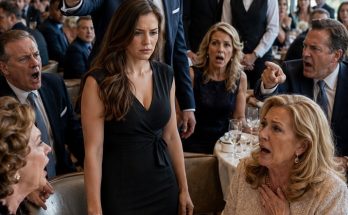
“Starting bid: one dollar. Who wants the family disappointment?”
For half a second, nobody reacted.
Then the ballroom erupted.
Laughter bounced off the high ceiling and glass walls. Men in tuxedos leaned toward one another. Women covered their mouths behind champagne glasses. Someone at a table near the dance floor actually slapped the table.
My father, Daniel Hartwell, inhaled his drink wrong and started coughing.
Mom laughed harder.
“There she is,” she continued. “Our very own rebel. Nineteen years old and already determined to reject every sensible opportunity handed to her.”
My face burned.
A man near the front lifted his auction paddle.
“I’ll give you two dollars!”
More laughter.
Mom pointed at him.
“Sold!”
I could hear my pulse in my ears.
The strangest thing was that I didn’t feel like crying.
I felt hollow.
Like every small humiliation I had swallowed over the years had finally accumulated into something too large for embarrassment.
Mom had criticized my clothes in front of waiters.
She had corrected my pronunciation at dinner parties.
She had once introduced me to a museum director by saying, “This is my daughter Lila. She’s going through her idealistic phase.”
She had spent years making insults sound affectionate.
But this was different.
There were cameras.
Foundation trustees.
Donors.
Artists.
Journalists.
People who had known me since I was a child.
And she had turned me into entertainment.
“Three dollars!” somebody shouted.
Mom laughed.
“Come on. Surely she’s worth four.”
That was when a calm male voice came from the back of the ballroom.
“Five million.”
The laughter died so abruptly I heard a spoon hit a plate.
Mom froze.
My father stopped coughing.
Every head turned.
A man stood near the rear doors wearing a dark suit without a bow tie. He looked somewhere in his early thirties, maybe a little older. Tall, composed, dark hair, nothing flashy about him except the fact that he had just bid five million dollars on a joke that had started at one.
Mom held the microphone halfway to her mouth.
“What?”
The stranger didn’t smile.
“Five million dollars.”
A restless whisper passed through the ballroom.
I had seen him before.
Six weeks earlier, at a museum reception.
Mom had been speaking with a young curator who wanted funding for a neighborhood exhibit. The curator had explained that the project would feature artists from low-income communities.
Mom had smiled politely and said, “It sounds very earnest. Unfortunately, earnest rarely fills a donor wall.”
The young woman’s face had fallen.
Across the room, this same man had been listening.
His expression then had been exactly what it was now.
Quiet.
Observant.
Unimpressed.
Mom recovered first.
“Well,” she said with a brittle laugh, “that is certainly generous, but I’m afraid you’ve misunderstood the joke.”
“No,” he replied.
He began walking forward.
“I understood it perfectly.”
My father stepped closer to Mom.
“Victoria,” he muttered, “end this.”
She ignored him.
The stranger stopped several yards from the stage and reached inside his jacket.
When he pulled out a thick cream envelope, something inside me shifted.
He had come prepared.
Whatever he was doing, it hadn’t begun with my mother’s joke.
Mom saw the envelope too.
Her expression changed so quickly most people probably missed it.
I didn’t.
For one heartbeat, she looked afraid.
“Perhaps,” she said, carefully choosing each word, “our guest would like to introduce himself.”
He nodded.
“Adrian Cole.”
That name meant nothing to me.
But apparently it meant something to everyone else.
Two trustees exchanged looks.
A donor behind me whispered, “Cole Impact.”
My mother’s fingers tightened around the microphone.
Adrian looked toward me, not her.
“I’m prepared to make a five-million-dollar commitment tonight.”
A few people began applauding.
He raised one hand.
The applause stopped.
“But not under the terms Mrs. Hartwell appears to imagine.”
Mom’s smile vanished.
“There are no terms. It was humor.”
Adrian looked at me.
“Was it?”
Suddenly, every person in the room was waiting for my answer.
That was Mom’s favorite trap.
She could insult me as publicly as she wanted, because she trusted me to save her afterward.
I was supposed to laugh.
Roll my eyes.
Say, “That’s just Mom.”
Protect her from the consequences of what she had done to me.
I stared at her.
And for the first time in nineteen years, I said absolutely nothing.
The silence became uncomfortable.
Mom’s eyes sharpened.
“Lila.”
It was only my name.
But I knew that tone.
Smile.
Fix this.
Do not embarrass me.
I took one step away from her.
Her face changed.
Then Adrian opened the envelope.
“For clarity,” he said, addressing the room, “I’m not offering five million dollars for a human being. No one here has the authority to sell one.”
Several guests lowered their eyes.
Mom’s cheeks flushed.
“Then what exactly are you offering?”
“A five-million-dollar fund for independent community arts programs.”
A few trustees leaned forward.
Adrian continued.
“The first grants would be selected from proposals already reviewed through the Hartwell Cultural Foundation’s blind application process.”
My mother went completely still.
“There is one condition.”
Nobody laughed now.
Adrian looked directly at her.
“The grants must be awarded according to the scores those proposals received before applicant names and family relationships became known.”
My heartbeat stumbled.
I didn’t understand why.
Not yet.
Then Adrian removed a single page from the envelope.
“Because proposal HS-17,” he said, “was ranked first.”
My breath caught.
HS-17.
That was my application number.
And three weeks earlier, the foundation had told me my proposal wasn’t good enough even to make the final round.
I looked at my mother.
She was no longer watching Adrian.
She was watching me.
And the expression on her face told me something I suddenly wished I didn’t understand.
She already knew exactly what HS-17 was.
### Part 2
Three months before the gala, my mother had announced my future over roasted salmon.
She didn’t ask what I wanted.
Victoria Hartwell rarely asked questions when she had already decided the answers.
We were sitting in the formal dining room at my parents’ house with two foundation trustees when she casually said, “Lila will spend next year in communications with us. It’s time she learned how real nonprofit work functions.”
One trustee smiled at me.
“What a wonderful opportunity.”
I put down my fork.
“I’m not doing that.”
The table went quiet.
Mom’s smile never moved.
“Excuse me?”
“I applied to an independent arts program. And I’m developing a community studio proposal.”
She laughed softly.
“How sweet.”
That was her preferred weapon.
Not yelling.
Not threats.
A tiny laugh that made anything I cared about sound childish.
I explained anyway.
I wanted to convert unused commercial space into low-cost studios where people could try painting, ceramics, photography, printmaking, and woodworking without having to buy expensive equipment first.
Working artists would teach evening classes.
Community centers could refer participants.
The program would track attendance, cost, repeat participation, and whether people continued creating after the workshops ended.
Mom listened as if I were describing a lemonade stand.
Then she asked, “And who exactly is paying for this?”
“That’s why I’m applying for grants.”
She dabbed her mouth with a napkin.
“You’re confusing hobbies with infrastructure.”
Two days later, a local society blog published a blurry photograph from dinner with a caption about “apparent tension inside Seattle’s most prominent philanthropic family.”
Mom blamed me.
Not the reporter.
Not whoever had taken the photograph.
Me.
“You made disagreement visible,” she said.
That sentence told me everything about her priorities.
She didn’t mind conflict.
She minded witnesses.
A week later, she announced that the annual Hartwell Cultural Foundation gala would “reset the narrative.”
I should have known I was part of the reset.
My program application, Hartwell system number HS-17, had been submitted through the foundation’s blind emerging-arts initiative.
I had nearly withdrawn when I realized the Hartwell Foundation was involved.
But the rules were supposed to protect applicants.
Names were hidden during preliminary scoring.
Reviewers saw budgets, goals, demographic research, staffing plans, sustainability metrics, and projected outcomes.
Not surnames.
Not family connections.
For once, I thought, Hartwell wouldn’t matter.
I spent five weeks building that application.
I interviewed twelve working artists about what they wished they had access to early in their careers.
I spoke with nineteen potential participants ranging from retirees to restaurant workers to community-college students.
I negotiated tentative use of an empty furniture warehouse whose owner was willing to discount rent for a pilot program.
I calculated insurance.
Utilities.
Equipment depreciation.
Instructor pay.
Emergency reserves.
I even included a section stating the pilot should close if attendance fell below a certain level for two consecutive quarters.
Mom found me at the kitchen island the morning the rejection arrived.
I had my laptop open.
The portal read:
NOT SELECTED.
She glanced at the screen.
“Maybe this is useful.”
I looked at her.
“How?”
“Perhaps now you’ll stop romanticizing hobbies and focus on something realistic.”
That sentence had lived in my head for weeks.
Every time I questioned whether my proposal had been naïve.
Every time I wondered whether I had overestimated myself.
Every time I considered accepting the communications job just to stop feeling foolish.
Now Adrian Cole was standing in a ballroom telling me HS-17 had ranked first.
I stepped toward him.
“How do you know that number?”
“I was one of the external reviewers.”
The room murmured.
Mom moved between us.
“Confidential review material has no place in a public event.”
Adrian nodded.
“I agree.”
His eyes moved toward the microphone in her hand.
“Neither does publicly assigning a dollar value to your nineteen-year-old daughter.”
Someone coughed.
Mom’s face hardened.
“Mr. Cole is exploiting a family joke to create a governance spectacle.”
I looked at Adrian.
“When you reviewed HS-17, did you know it was mine?”
“No.”
“When did you learn?”
“After the preliminary shortlist was changed.”
A cold feeling moved through my chest.
“Changed how?”
Mom interrupted.
“That’s enough.”
I looked at her.
“No.”
My voice came out quieter than I wanted.
Still, she stopped talking.
I swallowed.
“I want to hear him.”
Adrian unfolded another page.
“HS-17 received the highest composite score among emerging-program proposals.”
My knees felt strangely weak.
“Then why wasn’t it shortlisted?”
“It was.”
I blinked.
“For approximately two days.”
Mom took one sharp breath.
Adrian continued.
“Then the chair’s office requested that it be removed due to an alleged conflict.”
I looked at my mother.
“What conflict?”
She finally answered.
“You.”
I stared.
“What does that mean?”
“You are my daughter. Funding your project through a foundation I chair would create an obvious appearance problem.”
For half a second, relief almost entered me.
Because that explanation sounded reasonable.
Of course it did.
That was Mom’s specialty.
She could build a cage and make the bars sound responsible.
Adrian spoke.
“If that were the concern, the accepted remedy would have been disclosure and recusal.”
A silver-haired trustee near the front stood.
I recognized Thomas Reed, chair of the governance committee.
“That is correct.”
Mom looked toward him.
“Thomas, this is neither the time nor place.”
“You made it the place,” he said.
The room went quieter.
Thomas faced Adrian.
“Was the conflict disclosed to the committee?”
“No.”
“Was HS-17 sent to the committee for an eligibility determination?”
“No.”
Mom’s voice sharpened.
“I exercised chair discretion.”
Thomas frowned.
“That discretion allows you to flag a possible conflict. It does not allow you to remove the highest-scoring application without documenting the issue.”
Mom turned toward me.
“Lila, you have no idea what you’re allowing this man to do.”
There it was.
Not what she had done.
What I was allowing.
I felt my old instinct rise automatically.
Fix it.
Protect her.
Say everyone misunderstood.
Instead, I asked the question that had been burning in me since Adrian said HS-17.
“If you removed my application to protect the foundation, why didn’t you tell me?”
Mom hesitated.
Only for a second.
But everyone saw it.
I continued.
“Why did you let me think the reviewers rejected my work?”
Her expression tightened.
“Because you needed to learn that not every idea deserves validation.”
Something inside me went silent.
“You told me the rejection proved I was wasting my time.”
“I was trying to make you realistic.”
Adrian didn’t speak.
Thomas didn’t speak.
Nobody needed to.
My mother had just admitted the part that mattered.
The conflict explanation might have been legitimate.
The lie was not.
She had watched me believe strangers found my work worthless because she preferred that outcome.
And suddenly I knew tonight had never been just a tasteless joke.
The joke had a purpose.
Mom wanted everyone laughing at the version of me she had spent months constructing.
Ungrateful.
Aimless.
Naïve.
A disappointment.
If the room believed that version first, nobody would question why my work had disappeared.
I looked at her microphone.
Then at the stage.
Then at the ballroom full of people waiting to see whether I would save her.
I took another step away.
Mom whispered, “Lila, don’t.”
That was when I realized she was scared of something much bigger than my feelings.
And for the first time, I wanted to know exactly what it was.
### Part 3
I stepped off the stage.
It sounds insignificant now.
One step down.
Then another.
But I had spent nineteen years living inside invisible boundaries my mother drew around me.
Where to attend school.
Which events mattered.
Which dresses photographed well.
Which friends had useful parents.
Which ambitions were respectable.
Which disagreements were allowed to exist outside our house.
Stepping down from that platform felt like walking across a border.
“Lila.”
Mom’s voice followed me.
“Come back up here.”
I stopped on the ballroom floor.
“No.”
My voice cracked.
Her eyes immediately softened because she heard weakness.
That almost made me angry enough to laugh.
“You’re emotional,” she said gently. “We can discuss this privately.”
There it was again.
Her actions could be public.
My reaction had to be private.
“No.”
The second time sounded stronger.
“My voice is shaking because I’ve never done this before. I’m still saying no.”
Someone near the front exhaled audibly.
Mom’s mouth tightened.
“You are creating a scene.”
I looked around at the auction paddles, the champagne, the giant projection screen behind her displaying the foundation’s logo.
“You put me onstage and asked who wanted the family disappointment for a dollar.”
“A joke.”
“To you.”
“Oh, for heaven’s sake.”
Her patience finally cracked.
“You know perfectly well I would never actually sell my daughter.”
“I know. You just wanted everyone to laugh while you pretended I had no value.”
A few guests shifted in their chairs.
Mom glanced toward them.
That was what hurt her most.
Not my words.
Witnesses.
“Lila, stop.”
“No.”
The word felt almost intoxicating now.
“I’m not an auction item. I’m not your punchline. And I’m not going backstage so you can tell everyone tomorrow that I misunderstood what happened.”
Her jaw moved.
“Fine.”
She descended one step from the stage.
“If you want to perform adulthood in front of everyone, then let’s discuss adulthood.”
My stomach dropped before she said another word.
I knew that tone.
Money.
Mom had spent years making generosity feel like a contract whose terms only she could read.
“Your tuition,” she said. “Your apartment. Your cards. Your travel. Your introductions. Your internships. Every opportunity you’ve had came through this family.”
My father moved toward her.
“Victoria.”
She lifted a hand.
“No. She wants independence.”
Her eyes stayed on me.
“She can have it.”
The ballroom disappeared around me for a moment.
I had $2,684 in savings.
My part-time job at a campus gallery covered groceries and not much else.
My apartment cost more each month than I earned.
Tuition without family help was frightening enough that I had avoided calculating the full number.
Mom knew all of that.
Which was why she looked confident again.
She believed she had found the leash.
“If you walk away from this family tonight,” she said, “then you walk away from its support.”
My fingers went cold.
I could have backed down.
Nobody reasonable would have blamed me.
Principles sound clean until rent is due.
Freedom sounds romantic until tuition arrives.
For several seconds, I stared at her.
Then I opened my purse.
My black card holder caught against the zipper.
I pulled too hard and three cards slid onto the floor.
The sound seemed absurdly loud.
I crouched, picked them up, and placed them on the nearest empty table.
“Okay.”
Mom blinked.
“What?”
“If that’s the cost of disagreeing with you, keep them.”
My father stared at the cards.
“Lila, we don’t need to decide anything tonight.”
“She already decided,” I said.
Mom laughed once.
Not because anything was funny.
Because she didn’t know what else to do.
“You have absolutely no idea how difficult life is outside the bubble you pretend to despise.”
“I probably don’t.”
“That’s your answer?”
“I’ll learn.”
A chair scraped across the floor.
A woman rose from a table near the front.
Elaine Porter.
Her name was on a gallery wing, two scholarship programs, and enough donor plaques around Seattle that even I recognized her.
“Victoria,” she said, “I think this has gone far enough.”
Mom stared at her.
“This is a family matter.”
Elaine’s expression changed.
“It stopped being a family matter when Mr. Cole raised questions about the grant process.”
She looked at my cards on the table.
“And it became a donor matter when you threatened an applicant financially in the middle of a governance dispute.”
Color drained from Mom’s face.
“Elaine, sit down.”
Elaine raised one eyebrow.
I had never seen anyone refuse my mother so casually.
“No.”
The word sounded beautiful coming from somebody else.
Elaine turned toward Thomas Reed.
“You still chair governance?”
“I do.”
“Then I want HS-17 formally reviewed before the second half of my annual pledge is released.”
A ripple moved through the ballroom.
My mother stared at her.
“You cannot be serious.”
Another donor, a construction executive seated two tables away, lifted his hand.
“My matching commitment too.”
Mom’s head snapped toward him.
“What?”
“I’ll hold it pending the review.”
The room changed.
Ten minutes earlier, people had laughed because Victoria Hartwell gave them permission.
Now they were calculating whether trusting Victoria Hartwell might cost them something.
I didn’t feel victorious.
I felt nauseated.
This had become larger than I ever intended.
Mom looked at me.
“Are you satisfied?”
“No.”
She seemed surprised.
“I don’t want them punishing you because I’m angry.”
Her expression brightened as though she had found an escape.
“You see? Even Lila understands this has become ridiculous.”
“I didn’t say that.”
Her smile vanished.
“I said they should look at what you did and decide what it means for themselves. I don’t need revenge invented for me.”
I looked at her.
“The truth is enough.”
My father bent down and picked up the cards.
“I’ll hold these.”
Mom spun toward him.
“Daniel.”
“Not now.”
It was the first time all evening he had sounded like someone willing to disagree with her.
Maybe the first time in years.
A foundation employee hurried toward Thomas and whispered something.
Thomas checked his phone.
Then he looked at Adrian.
“Mr. Cole, you mentioned documentation.”
Adrian held up the cream envelope.
“That’s why I brought this.”
Mom went pale.
“Documentation of what?”
Adrian did not answer her.
He walked directly to Thomas and handed him the envelope.
Not to me.
Not to a journalist.
Not to another donor.
To the governance chair.
That detail mattered because I could already see my mother preparing a new story in her mind.
Adrian and I had conspired.
I had recruited him.
This was revenge.
Anything except what it actually was.
Thomas opened the envelope.
He read the first page.
Then the second.
His expression changed.
The executive director leaned beside him.
Mom took a step forward.
“What is in there?”
Thomas didn’t answer immediately.
Finally, he looked up.
“These are preliminary scores, the original shortlist, a revised shortlist, and an email requesting removal of HS-17.”
My mother’s mouth opened.
Thomas continued.
“The email came from your office.”
Everyone looked at her.
But what frightened me wasn’t the evidence.
It was the realization that Adrian had brought it before Mom ever picked up the microphone.
He had arrived at the gala expecting a confrontation.
Which meant somebody inside the foundation had already known something was wrong.
And if HS-17 wasn’t the only proposal affected, my mother’s problem was about to become much bigger than me.
### Part 4
The gala stopped feeling like a gala.
The jazz trio near the back lowered their instruments.
Servers slowed as they approached tables, suddenly unsure whether anyone still wanted champagne.
Guests who had spent thousands of dollars on tuxedos and gowns began checking their phones beneath the tablecloths.
Mom stood beneath the stage lights with the microphone still in her hand, but nobody was waiting for her to speak anymore.
Thomas Reed was reading documents.
That was worse.
After several minutes, Mom finally said, “There is a perfectly reasonable explanation.”
Thomas looked up.
“Then give it.”
Her shoulders straightened.
“HS-17 created an obvious conflict. The chair cannot appear to funnel foundation money to her own child.”
“For that reason,” Thomas said, “you should have disclosed the conflict and recused yourself.”
“I was protecting the foundation.”
Adrian spoke from beside him.
“The committee could have determined eligibility.”
Mom turned sharply.
“You are an outside investor, Mr. Cole. You do not dictate our procedures.”
“No.”
He nodded toward Thomas.
“He does.”
A few people looked away to hide smiles.
Mom’s eyes flashed.
“I will not apologize for protecting an institution I spent twelve years building.”
I finally understood why part of her explanation had almost worked on me.
Because it was not entirely false.
My family name could have created a problem.
If my proposal won, people might have questioned whether I deserved it.
But there was a simple question she still hadn’t answered.
“So why didn’t you tell me?”
Mom looked at me.
I walked closer.
“If this was about ethics, why let me believe the reviewers thought my project was bad?”
“Lila—”
“You watched me read the rejection.”
My throat tightened.
“You told me it proved I was wasting my time.”
“You were becoming obsessed with something unrealistic.”
“That isn’t an answer.”
“You needed perspective.”
“I needed the truth.”
Her eyes moved toward the crowd.
“This is exactly what I mean. Everything becomes emotional with you.”
I almost laughed.
“You started tonight by auctioning me.”
“That was humor.”
“And this is my response.”
Her lips pressed together.
For years, Mom had framed every conflict so only one interpretation survived.
She was practical.
I was emotional.
She was protecting.
I was rebelling.
She was experienced.
I was naïve.
But the people around us had heard enough to see the pattern.
Then Thomas pulled another sheet from the envelope.
“Victoria, what is proposal ER-09?”
Mom blinked.
“I don’t memorize application codes.”
Adrian answered.
“An after-school mural initiative. Preliminary rank: fourth.”
Thomas turned a page.
“Removed after chair review.”
My stomach tightened.
Another page.
“ML-22?”
“Mobile photography workshops,” Adrian said. “Ranked sixth.”
“Also removed.”
Mom’s expression changed.
“These were program-quality decisions.”
Thomas frowned.
“Made after the review panel?”
“The panel is advisory.”
A trustee behind him stood.
“Not under the guidelines we approved last year.”
For the first time, I saw panic enter Mom’s eyes.
Not because of HS-17.
Because there were more.
Thomas kept reading.
Three proposals had been removed.
Two replacements had been added.
One replacement was connected to a longtime donor.
Another had been proposed by an arts organization whose director served with Mom on a private civic committee.
Nothing yet proved corruption.
But the pattern was ugly.
Mom’s voice rose.
“This is absurd. Chairs make judgment calls constantly.”
“Then there will be no problem reviewing those calls,” Thomas said.
She stared at him.
“You’re suspending a gala because of paperwork?”
“No.”
He closed the folder.
“I’m suspending fundraising because we have governance questions involving how grant finalists were selected.”
The sentence landed like a dropped plate.
Mom looked around.
“My gala—”
“The foundation’s gala,” Thomas corrected.
Five words.
That was all it took.
For as long as I could remember, Mom had spoken about the foundation as if it were an extension of herself.
My donors.
My gala.
My board.
My programs.
Thomas had separated her identity from the institution in front of everyone.
She looked almost physically struck.
A woman from the city museum hurried toward the executive director and whispered to him.
He listened, frowned, then pulled Thomas aside.
Minutes later, Thomas returned.
“The museum is placing next year’s co-branded exhibition on administrative hold pending clarification.”
Mom’s mouth opened.
“That exhibition has been planned for fourteen months.”
“I’m aware.”
“You cannot let them do this based on one theatrical accusation.”
Adrian’s voice remained calm.
“I requested a governance review before tonight. Nothing theatrical was planned.”
I looked at him.
“You already contacted them?”
“The foundation’s governance office. Not donors. Not the museum.”
“Why?”
He glanced at my mother, then back at me.
“Because the scoring irregularities existed whether you were involved or not.”
That mattered more than I expected.
He hadn’t come to rescue Victoria Hartwell’s daughter.
He had come because something looked wrong.
My program happened to be where the evidence began.
My father stepped beside me.
“Lila.”
I didn’t turn.
“Not now.”
“I need to tell you something.”
His voice sounded different.
Smaller.
I faced him.
He rubbed the back of his neck.
“I knew there was an issue with your application.”
Everything around me seemed to slow.
“What?”
“I didn’t know about the scores.”
“Did you know Mom removed it?”
“She told me there was a conflict and that it would be cleaner if I stayed out of it.”
“And you did?”
His eyes dropped.
“Yes.”
That hurt differently.
Mom had acted.
Dad had chosen not to know.
“Did you ever ask why she told me I failed?”
“No.”
“Did you ask to see anything?”
“No.”
He began, “I thought—”
I raised my hand.
“Please don’t make me comfort you for admitting this.”
He stopped.
For several seconds, he just stood there.
Then he nodded.
“You’re right.”
Mom stared at him.
“Daniel, surely you aren’t going to participate in this performance too.”
He looked at her.
“I’m starting to think our daughter has been performing for us for years.”
The room went silent again.
I didn’t know whether I wanted to hug him or scream at him.
Probably both.
Thomas returned to the stage.
“Under the bylaws, I am formally requesting that Victoria Hartwell temporarily relinquish chair authority while an independent review is conducted.”
Mom stared at him.
“At my gala?”
“The foundation’s gala.”
She looked around the room.
No one came to her defense.
And standing there, I finally understood what real power looked like when people stopped agreeing to pretend it was permanent.
But the evening still had one surprise left.
Because as trustees began moving toward a private conference room, my mother approached me and whispered something only I could hear.
“You think this is about a grant?”
Her smile was gone.
“You have no idea what you just destroyed.”
### Part 5
I found Adrian near the coat check twenty minutes later.
The gala had effectively collapsed.
Some guests had left.
Others lingered in clusters, pretending they weren’t waiting for more drama.
Foundation staff had dimmed the stage lights. The auction displays remained glowing around the ballroom like decorations from a party everyone had suddenly forgotten how to enjoy.
I held a glass of water I hadn’t touched.
Adrian stopped several feet from me.
“May I explain the five million?”
I almost laughed.
“Strangely, that’s no longer the most confusing part of my night.”
His mouth twitched.
“That seems fair.”
I leaned against the wall.
“Go ahead.”
“I had already planned to recommend a five-million-dollar pooled community arts fund if the pilot proposals were strong enough.”
“So you didn’t invent the number because my mother decided to auction me.”
“No.”
“Good.”
He actually smiled then.
“That’s not the usual reaction when I tell someone five million dollars isn’t theirs.”
“Tonight has adjusted my standards.”
He explained that Cole Impact Partners funded projects with measurable community outcomes. The money would be spread across multiple programs, overseen independently, with each project subject to reporting requirements.
“If HS-17 survives a clean review,” he said, “you may receive funding.”
“May?”
“May.”
“I like that answer.”
“I thought you might.”
“Why?”
He considered that.
“Because your proposal had a section explaining when your own program should be shut down.”
I stared at him.
“You remember that?”
“Most applicants spend six pages explaining why they cannot fail.”
I folded my arms.
“You thought mine was pessimistic?”
“I thought it was honest.”
He remembered details.
The twelve artist interviews.
The nineteen participant interviews.
The equipment-sharing budget.
The fact that I had built transportation vouchers into evening classes because I noticed potential participants working late shifts might otherwise be unable to attend.
Nobody in my family had asked enough questions to know any of that.
That realization hurt more than I wanted it to.
“So why say five million in front of everyone?”
Adrian looked back toward the ballroom.
“Your mother turned your worth into a number.”
He paused.
“I wanted to give the room a number large enough to make them stop laughing.”
“And if they kept laughing?”
“I would have looked ridiculous.”
“You were willing to risk that?”
“I knew your work.”
He looked at me.
“I didn’t know you.”
Oddly, that made me trust him more.
He wasn’t pretending we had some instant connection.
I had already spent enough of my life around people who claimed to know what was best for me.
My father approached carrying the cards I had left on the table.
“I didn’t cancel these.”
I looked at him.
“I said I’d give them up.”
“I heard you.”
“Then why are you bringing them back?”
“Because Victoria called the family office and ordered everything frozen.”
My stomach dropped.
Dad continued.
“I reversed the instruction.”
I opened my mouth.
He shook his head.
“Decide tomorrow. Or next week. If you want to cut them up yourself, do it. But tonight I’m not turning money into another argument.”
For a second, neither of us spoke.
“Thank you.”
He looked exhausted.
“I should have asked about your application.”
“Yes.”
“I should have asked about a lot of things.”
“Yes.”
He nodded again.
No excuse.
No demand for forgiveness.
That was probably why I didn’t walk away.
Behind him, Mom appeared.
Without the microphone and the stage lights, she looked strangely ordinary.
She carried her own purse.
No assistant.
No board members following her.
No donors waiting for instructions.
“Lila.”
My shoulders tightened automatically.
“Can we talk?”
“Here.”
Her eyes flicked toward Adrian.
“Privately.”
“You had an audience when you started this.”
She inhaled slowly.
“I made a terrible joke.”
“You made a calculated joke.”
“You cannot seriously believe I intended any of this.”
“No. You intended me to smile.”
Her face tightened.
“You always interpret me in the cruelest possible way.”
“You called me the family disappointment in front of hundreds of people.”
“I was trying to show everyone we could laugh at ourselves.”
“Then why weren’t you the auction item?”
She didn’t answer.
Her phone buzzed.
She looked down.
Her face drained of color.
“What happened?” Dad asked.
Mom stared at the screen.
“One of our largest corporate sponsors has postponed renewal discussions.”
Dad closed his eyes.
Mom looked at me.
“This is because of tonight.”
“Yes.”
“You sound pleased.”
“I’m not.”
“Then stop this.”
I frowned.
“Stop what?”
“Talk to Thomas. Tell him this became exaggerated. Tell Elaine everyone was emotional. Tell Cole the review can happen quietly.”
Adrian said nothing.
Mom stepped closer.
“You can fix this.”
And there it was.
The real reason she wanted to talk.
Not an apology.
A request for labor.
She wanted the daughter she had humiliated to repair the consequences.
“I’m not fixing it.”
Her face hardened.
“You are destroying years of work because you’re angry about one joke.”
“No.”
I finally understood what she had whispered earlier.
“You think the foundation is yours.”
“I built it.”
“You chaired it.”
Her eyes flashed.
“What difference does that make?”
“A huge one, apparently.”
Dad looked away.
Mom lowered her voice.
“You’re enjoying this.”
“I’m terrified.”
That stopped her.
“I have no idea how I’m paying for school next year. I don’t know whether my program will exist. I don’t know what happens with us.”
I looked directly at her.
“But I know I’m done pretending something doesn’t hurt just because admitting it makes you uncomfortable.”
She stared at me.
For one moment, I saw something almost vulnerable in her face.
Then it disappeared.
“You’ll regret this when the excitement wears off.”
“Maybe.”
I picked up my coat.
“But at least the regret will belong to me.”
Three days later, the foundation announced an independent review.
Two weeks later, the city museum resumed its partnership under one condition.
My mother would no longer represent the Hartwell Cultural Foundation.
A month after that, the board scheduled a vote on whether to remove her permanently.
Victoria resigned the night before they could do it.
I thought that would be the end of the story.
Instead, that was when I discovered losing the foundation had only removed one of the ways my mother controlled our family.
And the next thing she tried almost worked.
### Part 6
Mom stopped calling me for twelve days.
That was unusual.
Victoria Hartwell believed silence was useful only when she controlled its duration.
I moved through those twelve days waiting for the next blow.
I picked up extra hours at the campus gallery.
I met with financial-aid counselors.
I researched cheaper apartments.
I created a spreadsheet showing how long my savings would last if I lost family support entirely.
The answer was not comforting.
Dad offered to cover my tuition personally.
I refused at first.
Then we had our first genuinely difficult conversation without Mom in the room.
“I understand why you don’t trust family money,” he said.
“I don’t want to replace one leash with another.”
“Then write the terms.”
I stared at him.
“What?”
“Put it in writing. Tuition support through graduation. No conditions involving where you work, who you date, where you live, whether you speak to us, or whether you embarrass me.”
“That sounds ridiculous.”
“It probably should have been unnecessary.”
He looked tired.
“But apparently our family has made unnecessary things necessary.”
I wrote the agreement.
He signed it.
No argument.
That did not erase the years he had stayed quiet.
But it gave us somewhere to begin.
Mom responded differently.
Her first message arrived on a Monday morning.
I hope you’re satisfied.
I didn’t answer.
Four days later:
I’m sorry things became so public.
Still not an apology for making them public.
I didn’t answer.
Then came the third.
I miss my daughter. Everyone who once praised me now treats me like I’m dangerous. I made mistakes, but someday I hope you understand how much I sacrificed for you.
I read the message twice.
Then I set my phone facedown.
Sacrifice.
There was another one of her words.
Like protection.
Like family.
Words she used as receipts.
I paid.
I provided.
I sacrificed.
Therefore you owe me access.
A week later, Thomas called about HS-17.
The independent review had completed its first stage.
My proposal was being restored.
“You can withdraw,” he said. “No one will interpret that as an admission of anything.”
I was silent.
He continued.
“Declining is also a valid exercise of independence.”
That sentence changed my decision.
For the first time, someone connected to the foundation was reminding me I had permission to leave.
Which made staying feel like an actual choice.
“Keep it in the process.”
The new review panel had no members who attended the gala.
Applicant identities remained hidden until final scoring.
Six weeks later, I received an email.
Open Door Studios had been selected for a one-year pilot grant.
$240,000.
I read the number five times.
Not five million.
Thank God.
Five million would have turned me into another spectacle.
Two hundred forty thousand dollars was real enough to build something and limited enough to fail honestly.
There would be contracts.
Audits.
Reporting deadlines.
Payroll.
Insurance.
Equipment orders.
Performance benchmarks.
Exactly the kind of difficulty I wanted.
Adrian’s five-million-dollar commitment eventually funded seven projects.
Mine was one.
Before signing, I added one condition.
No promotion connected to the gala.
No photographs of me standing beneath the auction lights.
No headlines about “the disappointment who proved everyone wrong.”
No videos turning humiliation into inspirational branding.
Open Door Studios would succeed or fail based on its work.
The foundation agreed.
Six months later, I stood inside a former furniture warehouse holding a broken tape measure in one hand and a contractor invoice in the other.
One wall still had faded rectangles where old inventory labels had been removed.
The concrete floor had paint stains.
Our cabinets came from three different salvage stores and matched absolutely nothing.
The industrial sink made a metallic groaning sound every time someone turned on the hot water.
I loved every inch of it.
We had twelve folding worktables.
Two kilns.
A photography area.
Lockable storage.
Printmaking equipment.
Basic woodworking tools.
An absurd number of extension cords.
And a tiny office whose door refused to close unless I kicked the bottom corner.
It was perfect.
Dad arrived on opening morning carrying coffee and pastries nobody had requested.
He had moved into an apartment downtown two months earlier.
He and Mom were “taking space,” which was their business.
I had finally learned that caring about someone did not make me responsible for managing their marriage.
“Do you need anything?” he asked.
“Approximately twenty things.”
“Name one.”
“Extension cords.”
He smiled.
“Finally. A Hartwell problem I’m qualified to solve.”
I laughed.
Then he became serious.
“Your mother asked if she could come today.”
My stomach tightened.
“What did you tell her?”
“That she needed to ask you.”
“Did she?”
“No.”
That mattered.
It shouldn’t have.
But it did.
Mom still wanted access without vulnerability.
She wanted someone else to negotiate the door.
I looked around at the studio.
“No.”
Dad nodded.
“No message?”
“No.”
He accepted that and left.
An hour later, Adrian arrived.
Empty-handed.
I had specifically warned him that donors were not allowed to bring ceremonial checks, plaques, photographers, oversized scissors, branded banners, or speeches.
He signed the guest sheet.
“Can I help?”
“You’re a donor.”
“I’ve been told donors occasionally possess hands.”
“Five-million-dollar hands?”
“Apparently useless ones.”
I pointed toward a stack of folding chairs.
“Prove yourself.”
We had become friends slowly.
Mostly through disagreements about budgets.
Sometimes dinner.
Occasionally coffee after meetings.
There was no dramatic romance born in the ballroom.
I was grateful for that.
I needed to build a life before I tried fitting another person into it.
At sunset, after our first workshop ended, I sat on the edge of a table surrounded by paint-stained cups and half-cleaned brushes.
My phone vibrated.
Mom.
One sentence.
They removed my name from the annual gala committee.
Months earlier, I would have responded immediately.
I would have softened the pain.
Explained that people still respected her.
Reminded her what she had accomplished.
Made her feel valuable again.
Instead, I stared at the message and realized something uncomfortable.
She still contacted me mostly when consequences hurt.
She never asked how opening day had gone.
She never asked how many people came.
She never asked whether the project she once called unrealistic was working.
She wanted comfort from the daughter she had mocked for needing approval.
I started typing.
Deleted it.
Started again.
Then I wrote the only answer I could live with.
“I’m sorry that hurts. I hope you use the time to decide who you want to be when nobody has to obey you.”
I sent it.
Her response came less than a minute later.
You’ve become cruel.
I looked around the studio.
At the paint.
The tools.
The messy tables.
The life I was building.
Then I turned my phone off.
For the first time, being called cruel by my mother did not make me wonder whether she was right.
### Part 7
Open Door Studios did not become an instant success.
I’m glad it didn’t.
The fantasy version would have been easy.
One humiliating gala.
One mysterious millionaire.
One giant check.
Then triumph.
Real life looked more like a kiln malfunctioning two hours before a ceramics workshop.
It looked like chasing late invoices.
A photography instructor quitting with eleven days’ notice.
A participant accidentally locking forty people’s supplies inside a storage room whose only key was in my apartment.
It looked like arguments over whether Saturday morning classes should begin at nine or ten.
It looked like discovering that nobody knows where scissors go after using them.
I loved it anyway.
By the fourth month, our attendance was slightly below projections.
By the sixth, referrals from two community centers pushed us above target.
By the ninth, several participants had begun teaching beginner sessions themselves.
The first time one of them received payment for leading a workshop, I went into my tiny office, shut the stubborn door with my foot, and cried for about thirty seconds.
Then someone knocked because the printer had jammed.
That felt right.
Mom remained outside my daily life.
She sent messages every few weeks.
Some were angry.
Some were nostalgic.
Some almost sounded like apologies.
Almost.
“I’m sorry you felt humiliated.”
“I’m sorry the joke was misunderstood.”
“I’m sorry events spiraled.”
Never:
I chose to humiliate you.
I lied to you about your application.
I used money to frighten you into obedience.
Those were the sentences I needed before I considered rebuilding anything.
They never came.
Dad and I made slower progress.
He attended therapy on his own.
I knew because he told me once and never used it as evidence that I owed him forgiveness.
He stopped saying, “Your mother means well.”
He stopped asking me to call her.
He stopped translating her actions into softer language.
One evening, nearly a year after the gala, we ate pizza in my studio office while rain rattled against the warehouse windows.
“I used to think staying neutral kept peace,” he said.
I folded my paper plate in half.
“It kept you comfortable.”
“Yes.”
I looked at him.
He nodded.
“You’re right.”
That became our strange little ritual.
He learned that admitting harm did not require me to reassure him afterward.
I learned that people sometimes changed slowly enough that you had to watch behavior instead of speeches.
Adrian remained in my life too.
He never asked me out during the first year.
I appreciated that more than he knew.
On the anniversary of the gala, he stopped by while I was replacing labels on storage bins.
“Do you know what today is?” he asked.
“Tuesday.”
He laughed.
“Also true.”
I checked the date.
Then groaned.
“Oh.”
“One year.”
I waited for some dramatic observation.
Instead, he held up a broken label maker.
“Any chance your quarter-million-dollar organization owns another one of these?”
“We do. It’s hidden from donors.”
Later, we walked to a small restaurant nearby.
No ballroom.
No photographers.
No foundation people.
Halfway through dinner, he said, “I’d like to ask you something, and you are allowed to say no without giving me a reason.”
I smiled.
“That introduction sounds suspicious.”
“Dinner. Again. But officially a date.”
I looked at him.
A year earlier, I would have wondered what answer someone expected.
Mom had trained me to calculate reactions before desires.
Would saying yes create obligation?
Would saying no create conflict?
Would someone be disappointed?
I sat with the question until I found the only answer that mattered.
What did I want?
“Yes.”
His shoulders relaxed.
“One condition.”
He laughed.
“Of course.”
“No five-million-dollar bids.”
“Financially devastating.”
We dated slowly.
There was no rescue.
No sweeping promise.
He had his work.
I had mine.
Sometimes we disagreed.
The first time we had a real argument, I went home expecting several days of cold silence because that was how conflict had worked in my childhood.
Instead, he called the next morning.
“I still disagree with you,” he said.
“Great opening.”
“But I don’t want you wondering whether disagreement means I’m leaving.”
I sat on the edge of my bed holding the phone.
That sentence taught me more about safety than a hundred grand gestures could have.
Meanwhile, Mom’s professional life settled into something smaller.
She started consulting independently.
Some former clients returned.
Others did not.
She joined two civic committees where she had no executive authority.
I heard from Dad that she hated that at first.
Then, apparently, she became quieter.
I didn’t rush toward the possibility that she was changing.
People had spent my whole childhood rewarding her intentions.
I had learned to evaluate actions.
The clearest test came when Open Door Studios prepared its second-year expansion.
A donor offered to fund a new media room.
The gift agreement arrived with one surprising note.
Victoria Hartwell had privately recommended us.
No publicity.
No condition.
No request that I be told.
I stared at the email for several minutes.
Then I called the donor directly.
“Did my mother ask for recognition?”
“No.”
“Did she ask you to mention her to me?”
“No.”
“Did she try to influence the grant?”
“No. She simply said our organization’s results were strong and I should look at the numbers.”
I hung up.
For the first time, Mom had helped without turning assistance into ownership.
It was something.
But something was not everything.
That night she texted me.
Dad says Open Door is expanding. Congratulations.
I typed:
Thank you.
Nothing else.
No invitation.
No sudden reunion.
No wiping away the past because she had finally done one decent thing correctly.
Forgiveness, I had learned, was not the same as reopening the door.
And change did not erase the person who had needed protection from the old version of her.
### Part 8
Two years after the gala, Open Door Studios held its first public showcase.
I refused to call it a gala.
There were no tuxedos.
No auction paddles.
No giant sponsor walls.
People wore whatever they wanted.
Paintings hung from temporary partitions.
Ceramic bowls sat on mismatched tables.
A group of teenagers displayed black-and-white photographs near the entrance.
One seventy-two-year-old participant had built a wooden cabinet after insisting for six months that she “wasn’t artistic.”
Another participant sold three prints before the doors officially opened.
The room smelled like coffee, sawdust, acrylic paint, and slightly overheated extension cords.
I stood near the entrance watching people move through something that had once existed only in a spreadsheet.
Dad arrived carrying flowers.
“Approved?” he asked.
“Flowers are permitted.”
“I checked the bylaws.”
“You’re learning.”
He smiled.
Our relationship was not repaired.
That word suggested something could be returned to its original condition.
I didn’t want the original condition.
We had built something new.
Smaller.
More honest.
Adrian arrived later and kissed my cheek before immediately being recruited to move tables.
That had become his unofficial role.
Multimillion-dollar investor.
Professional furniture mover.
About an hour before closing, Dad found me near the photography wall.
“There’s something I should tell you.”
I looked at him.
“Your mother is outside.”
My stomach tightened.
“Did you invite her?”
“No.”
“Did she ask you to get me?”
“No.”
That surprised me.
“What does she want?”
“She said she’d wait outside and leave if you didn’t want to see her.”
For a long moment, I watched people moving around the studio.
Two years earlier, those words would have thrown me into panic.
Now I felt something quieter.
Choice.
I walked outside.
Mom stood near the curb wearing a dark coat.
No photographers.
No assistant.
No expensive event dress.
Just Victoria.
She looked older.
Not dramatically.
Just enough that I noticed.
“Hi,” she said.
“Hi.”
“I won’t stay.”
I waited.
She looked through the warehouse windows.
“I saw the article about the showcase.”
“There wasn’t supposed to be an article.”
“It was in the neighborhood paper.”
“That explains it.”
Her mouth almost smiled.
Then she looked at me.
“I owe you something.”
I stiffened.
“If this is money—”
“It isn’t.”
She took a breath.
“An apology.”
I said nothing.
For once, she didn’t fill the silence.
“I humiliated you deliberately that night.”
The words hit me harder than I expected.
“I was angry that you had refused the foundation job. I was angry that you applied independently. I was angry that your project scored well because I knew, somewhere underneath all my explanations, that if you succeeded without following the path I chose, I would have less control over you.”
My throat tightened.
Mom continued.
“I removed your application because I told myself it protected the foundation. Maybe part of me believed that. But I also knew telling you the truth would let you challenge me.”
She looked down.
“So I let you think you failed.”
The street was quiet except for traffic several blocks away.
“I’m sorry.”
I had imagined that apology before.
For months after the gala, I thought hearing those words would unlock something dramatic in me.
Relief.
Forgiveness.
A rush into her arms.
Instead, I felt sad.
And strangely peaceful.
“I believe you’re sorry.”
She nodded.
“I understand if that isn’t enough.”
“It isn’t.”
Her eyes closed for half a second.
“I know.”
“I don’t hate you.”
“I’m grateful for that.”
“But I don’t want the relationship we had.”
“Neither do I.”
“And I’m not ready to give you access to my life because you finally understand why I took it away.”
Her eyes filled.
Years earlier, that would have destroyed me.
Seeing Mom cry would have automatically made her pain my responsibility.
Now I let her feel it.
She nodded.
“What would you be comfortable with?”
That question mattered more than any speech.
“An occasional message.”
“Okay.”
“No dropping by without asking.”
“Okay.”
“No using Dad to carry messages.”
She almost smiled.
“He already banned that.”
“Good.”
“And the studio?”
I looked through the windows.
People were laughing around one of the tables.
“Not yet.”
Pain crossed her face.
But she nodded.
“Not yet.”
She left ten minutes later.
No hug.
No miraculous reconciliation.
No promise that everything would become what it should have been.
I watched her walk toward her car and realized I had forgiven enough to stop carrying rage.
But forgiveness did not require access.
It did not erase consequences.
And it certainly did not mean returning to the daughter who existed before that night.
Inside, Adrian was stacking chairs badly.
Dad was arguing with a coffee machine.
Someone had left a sketchbook on the sink.
The industrial faucet still groaned whenever hot water ran.
I stood in the doorway and laughed.
This was my life.
Imperfect.
Expensive.
Busy.
Mine.
Sometimes people later described that gala as the night Adrian Cole offered five million dollars for me.
They always got it wrong.
Five million dollars didn’t save me.
Adrian didn’t save me.
The board didn’t save me.
The donors didn’t save me.
They created openings, yes.
They forced people to pay attention.
They exposed facts I deserved to know.
But none of that mattered until I did the one thing my mother had spent years teaching me not to do.
I disappointed her on purpose.
I said no.
I stepped off the stage while my hands were shaking.
I surrendered the cards she believed would bring me back.
I let people misunderstand me.
I accepted that independence could be frightening, inconvenient, and expensive.
And once I survived that first step, something changed permanently.
My mother began the gala believing she could define my value with a joke.
A stranger answered with five million dollars.
But the number that mattered most that night was still one.
One dollar.
One insult.
One step off a stage.
One word.
No.
That was all it took to begin separating my life from the people who believed loving me gave them the right to own my choices.
Two years later, I switched off the studio lights after everyone had gone home.
Adrian waited by the door while Dad carried leftover pastries to his car.
Outside, Seattle rain had polished the pavement until every streetlight reflected across it.
I locked the door.
For years, I had imagined freedom as something dramatic.
A giant check.
A perfect victory.
A room full of people finally admitting I was right.
It turned out freedom was much quieter.
It was choosing my own work.
Paying my own bills.
Making my own mistakes.
Loving people without surrendering to them.
Accepting apologies without pretending they erased history.
And understanding that late respect does not automatically earn back the access that disrespect once destroyed.
My mother once called me the family disappointment.
Maybe I was.
I disappointed every expectation she had built around me.
I disappointed her plan for my career.
Her plan for my public image.
Her belief that financial support guaranteed obedience.
Her certainty that I would always protect her from the consequences of hurting me.
And eventually, I became proud of that.
Because sometimes disappointing the people who want to control your life is the first sign that you have finally started living it.
THE END!