My mother died at eighty-nine, and for the first few weeks after the funeral, I moved through her house like someone walking underwater. Every room still held her shape. Her reading glasses sat beside the bed. Her slippers leaned against the radiator.

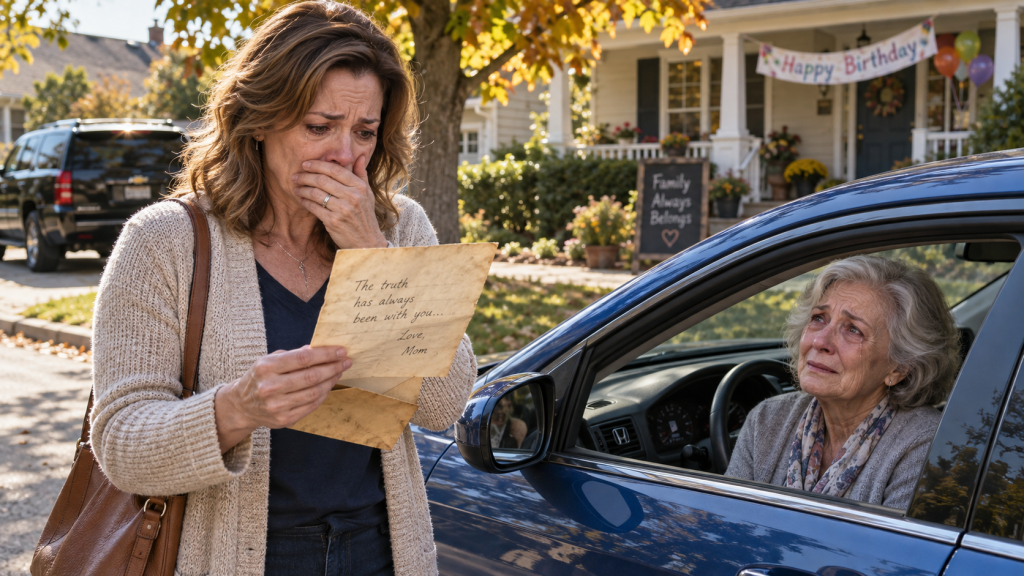
A half-finished crossword remained on the nightstand, three squares blank, as if she might come back annoyed that I had moved the newspaper. I decided to renovate her bedroom because I couldn’t bear the silence of it. Maybe changing the walls would make the grief easier to carry. Instead, I found the letter. It was hidden behind a strip of old wallpaper near the closet, sealed inside a yellowed envelope and addressed to me in Mom’s handwriting. My name. My birthday. And a date from forty-one years earlier. I sat on the floor before opening it because something about the way she had written my name frightened me. The first line made my heart stop. “If you’re reading this, I’m gone.” I kept going. “There is something I should have told you years ago. When you were six weeks old, a woman came to our door carrying you. She was crying so hard she could barely speak. She begged me to take you.” My hands began to tremble. I read the sentence again. And again. “Your father was dangerous,” the letter continued. “She said if he found out where she had gone, he would hurt both of you. She knew I had lost a baby the year before. She knew I had room in my heart. She asked me to raise you as mine.” I stopped breathing properly. Every memory I had suddenly felt unreliable. Christmas mornings. School photos. Mom brushing my hair before church. Dad teaching me to ride a bike. Had all of it been built on a lie? I forced myself to keep reading. “I loved you from the moment she placed you in my arms. That part was never a lie. But I promised her I would keep you safe, even if it meant you never knew her.” Then came the line that made the room tilt. “She visits every birthday. She never knocks. She sits in a car across the street for an hour or two, just to see you.” I stared at the page. My birthday had been three days earlier. My hands suddenly felt cold. We had installed a Ring camera two years ago after someone stole packages from the porch. I opened the app. The footage was still there. On my birthday, a blue Honda had parked across the street at 10:14 in the morning. It stayed until 12:09. I watched the clip twice. A woman sat behind the wheel. Gray hair. Thin face. Sunglasses. She never got out. I checked the year before. Same Honda. Same place. Different time. The year before that too. Then I remembered the bracelet. Last year, a small velvet box had appeared on the porch with no card. Inside was a gold bracelet worth around one hundred eighty dollars. I assumed one of my children had sent it anonymously as a joke. None had. My pulse started hammering. I stood up, grabbed the letter, and walked outside. The blue Honda was there. Across the street. Parked beneath the maple tree. The woman looked up the moment I stepped onto the porch. For a second, neither of us moved. Then she lifted one trembling hand to her mouth. I crossed the street slowly, every step feeling unreal. When I reached the driver’s window, she rolled it down. Up close, she looked older than I expected. Maybe mid-seventies. Her eyes were red. “You found the letter,” she whispered. I could barely speak. “Who are you?” Tears filled her eyes immediately. “My name is Evelyn.” She swallowed. “I’m your mother.” The word hit me like a physical blow. “No,” I said automatically. “My mother died three weeks ago.” Evelyn closed her eyes. “I know.” “Then don’t call yourself that.” “You’re right.” She nodded quickly. “I’m sorry.” I held up the letter. “She says you brought me to her.” “I did.” “And you’ve been watching me every birthday?” She nodded. “For forty-one years.” My throat tightened. “Why?” “Because leaving you was the only way I knew how to keep you alive.” I stared at her. “Who was my father?” Her face changed. Fear. Real fear, even after all these years. “His name was Thomas Vale.” I had never heard it before. “Is he alive?” She looked away. “Yes.” Something cold passed through me. “Does he know about me?” Evelyn’s hands tightened around the steering wheel. “He does now.” My stomach dropped. “What does that mean?” She looked at me then, and the terror in her eyes made every hair on my arms rise. “Your mother didn’t hide that letter from you because she was afraid of what you’d think of her.” Her voice broke. “She hid it because Thomas started looking for you again.” I stepped back from the car. “When?” Evelyn reached into her purse and pulled out an envelope. “Two months ago.” My name was written across the front in unfamiliar handwriting. “He sent this to me.” I took it with numb fingers. Inside was a single photograph. It showed me walking out of my office. Taken from across the street. On the back were six words: “You kept her from me long enough.” I looked up at Evelyn. “Why didn’t you tell me?” She was crying now. “Because your mother begged me not to. She thought she could protect you one last time.” I stared at the photo again. Then I noticed something in the background I hadn’t seen at first. A man stood beside a black SUV, looking directly toward the camera. I knew that face. I had seen him before. At Mom’s funeral. Standing quietly at the back of the chapel.
PART 2 — THE MAN AT THE BACK OF THE CHAPEL
I knew that face.
I had seen him at Mom’s funeral.
Standing quietly at the back of the chapel.
For several seconds, I could not look away from the photograph.
The man beside the black SUV was older than he had been in whatever memories Evelyn carried of him, but there was something unmistakable about him.
The narrow mouth.
The deep-set eyes.
The way he stood with his shoulders perfectly straight, as though the world was something he expected to make room for him.
At the funeral, I had assumed he was one of Mom’s old acquaintances.
She had lived eighty-nine years.
There were people at the chapel I had never met.
Former neighbors.
Church friends.
A pharmacist who remembered her for bringing homemade cookies every Christmas.
A retired teacher who had taught beside her decades ago.
The man in the back row had not seemed important.
He wore a black suit.
No tie.
He sat alone.
He did not approach the casket.
He did not sign the guest book.
I remembered noticing that only because Mom had been strangely particular about guest books.
“People deserve to know who came to say goodbye,” she once told me.
Thomas Vale had come.
But apparently he had not wanted anyone to know.
I looked at Evelyn.
“That was him.”
She nodded.
“You’re sure?”
“I would know him if I were blind.”
There was no hesitation.
Only fear sharpened by forty-one years of memory.
I looked toward the empty road.
The maple leaves shifted above us.
A dog barked somewhere behind one of the neighboring houses.
Everything around me was painfully ordinary.
My entire childhood home stood less than thirty feet away.
The blue porch.
Mom’s roses.
The mailbox Dad had replaced three times because snowplows kept hitting it.
And yet suddenly I felt as though I were standing somewhere completely unfamiliar.
“He came to the funeral.”
Evelyn’s hands tightened around the steering wheel.
“I know.”
“You saw him?”
“No.”
“How do you know?”
“Because he sent me another photograph.”
She reached into her purse.
I almost told her to stop.
I had already seen enough.
Instead, I held out my hand.
The second photograph showed the front of the chapel.
People were leaving after the service.
My children were gathered near me.
My oldest daughter had one arm around my shoulders.
My son was carrying the framed photograph of Mom we had placed near the casket.
I was staring at the ground.
Grieving.
Completely unaware that someone across the street had been photographing me.
On the back, Thomas had written:
She looks like you did at twenty.
My stomach turned.
I handed it back.
“You need to tell me everything.”
Evelyn looked toward Mom’s house.
“I’ve wanted to for forty-one years.”
“Then start now.”
She nodded.
But instead of speaking, she opened the car door.
“What are you doing?”
“I don’t want to tell you through a window.”
That answer was so unexpectedly human that it made me angrier.
I had spent ten minutes thinking of her as a mystery.
A woman in a blue Honda.
A secret.
A sentence in my dead mother’s letter.
Now she stepped onto the pavement slowly, one hand gripping the roof of the car because her knees seemed unsteady.
She was smaller than I had realized.
Maybe five-foot-three.
Thin.
A cream cardigan buttoned to her throat despite the warm afternoon.
Up close, I could see age spots on her hands.
A pale scar beneath her chin.
She looked nothing like Mom.
Then she removed her sunglasses.
And I saw myself.
Not perfectly.
But enough.
The shape of my eyes.
The slight downward tilt at the outer corners.
The tiny crease between the eyebrows that my children teased me about whenever I concentrated.
My heart hurt.
I looked away first.
“Not here.”
Evelyn nodded.
We crossed the street.
When we reached Mom’s porch, she stopped at the bottom step.
Her face changed.
“What?”
I asked.
“I’ve never been inside.”
That surprised me.
“Forty-one years?”
She shook her head.
“She never let me.”
Something defensive immediately rose in me.
“She was protecting me.”
“I know.”
“You sound angry.”
“I was.”
She swallowed.
“For years.”
Then she looked up at the bedroom window.
“But she kept her promise better than I kept mine.”
I did not know what to say to that.
I unlocked the front door.
Evelyn stepped inside as though entering a church.
Her eyes moved everywhere.
The hallway photographs.
Mom’s umbrella stand.
Dad’s old fishing hat still hanging on the coat hook even though he had been gone twelve years.
She stopped when she saw his picture.
“That was Robert?”
I turned.
“You knew his name?”
“Yes.”
I felt another shock.
“Did you know him too?”
“No.”
“Then how—”
“Margaret wrote to me.”
Mom.
Margaret.
Hearing Evelyn say her name felt strangely intimate.
“How often?”
“Once or twice a year at first.”
I stared at her.
Mom had corresponded with my biological mother.
For years.
While I lived in the same house.
“About me?”
“Yes.”
My chest tightened.
“What did she tell you?”
“That you were healthy.”
“That you hated peas.”
“That you broke your wrist falling out of a tree when you were nine.”
My mouth went dry.
“She told you that?”
Evelyn smiled through tears.
“She said you blamed the tree.”
Despite everything, I almost laughed.
I had.
For years.
“It had a weak branch.”
“That is exactly what she wrote.”
Something inside me gave way.
Not forgiveness.
Not acceptance.
Something smaller.
Recognition.
Mom had not erased Evelyn entirely.
She had kept a thin thread between them.
A secret thread.
I hated that.
I was grateful for it.
Both feelings occupied the same space.
“When did she stop writing?”
“About fifteen years ago.”
“Why?”
Evelyn looked at Dad’s photograph again.
“Robert found out.”
My heart stopped.
“My father knew?”
“Your father knew everything.”
I sat down.
Not gracefully.
I simply found the nearest chair before my knees stopped supporting me.
“No.”
Evelyn remained standing.
“No.”
I shook my head.
“Dad would have told me.”
“He wanted to.”
“How do you know?”
“Because he called me.”
I stared at her.
“When?”
“About a month after he learned.”
“How did he learn?”
“Margaret told him.”
“Why after all those years?”
Evelyn exhaled.
“Because Thomas had found me again.”
The room seemed to darken.
“When?”
“Fifteen years ago.”
I felt cold.
“So this isn’t the first time.”
“No.”
“Why did Mom’s letter make it sound recent?”
“Because this time is different.”
I looked at her.
“How?”
Evelyn sat across from me.
The house was so quiet I could hear the old kitchen clock ticking.
“Fifteen years ago, Thomas found me in Arizona.”
“What were you doing there?”
“Living.”
She almost smiled.
“I spent most of my life doing that very carefully.”
“What happened?”
“He called.”
“After thirty years?”
“Twenty-six.”
“What did he say?”
Her face hardened.
“Exactly what you’d expect.”
“I don’t know what to expect.”
“He said he forgave me.”
I stared at her.
“For taking me?”
“For embarrassing him.”
The distinction chilled me.
Not for running.
Not for hiding his child.
For embarrassing him.
Evelyn continued.
“Thomas always believed humiliation was a worse crime than cruelty.”
I thought of the man standing at the funeral.
Watching.
Photographing.
Not grieving.
Possessing the moment from a distance.
“What happened after he called?”
“I moved.”
“Again?”
“I’ve moved nineteen times because of him.”
My anger faltered.
Nineteen.
She said it without drama.
As if counting addresses rather than pieces of a life.
“Did you call police?”
“More than once.”
“And?”
“Thomas had never been convicted of hurting me.”
“Had he?”
Her eyes met mine.
“Yes.”
I did not ask for details.
Not yet.
“He had money,” she continued.
“Connections.”
“He knew how to sound reasonable.”
“And forty-one years ago, women who said their husbands frightened them were often told to go home and work things out.”
My throat tightened.
“Were you married?”
“Yes.”
“How old were you?”
“Thirty-one when I met him.”
“Thirty-four when I had you.”
For some reason, that made the story feel more real.
I had imagined her as a terrified teenager.
She had been a grown woman.
Educated.
Working.
Old enough to know better, people might say.
Yet she had still been trapped.
“What did Thomas do?”
Evelyn looked at her hands.
“At first?”
“He decided things.”
“Where we lived.”
“Who I spoke to.”
“What I wore to his company dinners.”
“He called it taking care of me.”
A familiar phrase.
Not from my life.
From books.
Stories.
Warnings I had always believed I would recognize immediately.
“Then?”
“The first time he hit me, he cried afterward.”
Her voice barely changed.
“I believed that meant it had frightened him too.”
I closed my eyes.
“The second time, he blamed alcohol.”
“The third time, me.”
“By the fourth, there was no explanation.”
She looked toward the window.
“Only expectation.”
I said nothing.
“When I became pregnant, he changed.”
“Better?”
“For about four months.”
A sad smile touched her face.
“He bought baby clothes.”
“Painted a room.”
“Talked about names.”
“Then he learned you were a girl.”
My stomach twisted.
“He wanted a son?”
“He wanted an heir.”
“To what?”
That was the first question that made Evelyn pause.
Not emotionally.
Strategically.
“What?”
I asked.
“Thomas owned part of a company.”
“What kind?”
“Industrial equipment.”
“Vale Precision.”
The name meant nothing to me.
“At the time, it was small.”
“Now?”
“It isn’t.”
She looked at me.
“Thomas is extremely wealthy.”
I laughed softly.
Not from humor.
“Of course he is.”
“What does that have to do with me?”
“More than I wanted it to.”
I stood and began pacing.
“My mother dies.”
“I find out she wasn’t my biological mother.”
“My biological father is apparently rich and dangerous.”
“And he’s been photographing me.”
I stopped.
“What exactly does he want?”
Evelyn’s expression became unreadable.
“That’s the question I hoped I would never have to answer.”
“Try.”
She stood.
“Do you still have the blanket?”
“What blanket?”
“The one I brought you in.”
I stared.
“How would I know?”
“It was white.”
“Crocheted edge.”
“One corner had a tiny blue flower.”
Something moved in my memory.
A cedar chest in Mom’s bedroom.
Old baby clothes.
A blanket I had once asked about.
Mom said Grandma made it.
I turned toward the stairs.
Evelyn grabbed my wrist.
“Wait.”
I looked down at her hand.
She released me immediately.
“I’m sorry.”
“What’s in the blanket?”
“Maybe nothing anymore.”
“That is not an answer.”
She swallowed.
“When I left Thomas, I took something.”
“What?”
“A key.”
My heart began pounding.
“To what?”
“A safe-deposit box.”
“Whose?”
“Thomas’s.”
“You stole his key?”
“I took my key.”
She corrected me sharply.
“The box had both our names.”
“What was inside?”
“Documents.”
“What documents?”
“Proof.”
My stomach tightened.
“Proof of what?”
Evelyn looked toward the front windows before answering.
“Thomas’s company did not grow honestly.”
I waited.
“He and his business partner were moving money through companies that didn’t exist.”
“False invoices.”
“Payments to officials.”
“Insurance claims.”
“I didn’t understand most of it at first.”
“But I was doing bookkeeping for him.”
“And eventually I understood enough.”
“You had evidence.”
“Yes.”
“Why not take it to police?”
“I tried.”
Her voice broke.
“I told one person.”
“A lawyer.”
“What happened?”
“He died.”
I stopped breathing.
“How?”
“Car accident.”
The silence became enormous.
“Was Thomas responsible?”
“I don’t know.”
She looked at me.
“And I have spent forty-one years refusing to turn suspicion into fact.”
That sentence reminded me of Mom.
She always hated gossip.
“Say what you know,” she would tell me.
“Not what makes the story better.”
Maybe some of that had come from Evelyn.
Maybe Mom learned it from protecting us.
“What happened after the lawyer died?”
“I panicked.”
“I emptied the safe-deposit box.”
“Where are the documents?”
“I gave them to Margaret.”
I stared.
“To Mom?”
“Yes.”
“When I brought you.”
My hands went cold.
“You gave her evidence of financial crimes with a newborn?”
“I gave her one envelope.”
“She did not know what was inside at first.”
“Where is it?”
“I don’t know.”
I almost shouted.
“You gave it to her!”
“Forty-one years ago!”
Her voice finally rose.
Then she stopped.
Closed her eyes.
“I’m sorry.”
I looked away.
“Margaret said she would hide it somewhere Thomas could never connect to me.”
“The house?”
“Maybe.”
“So he’s looking for the documents.”
“Maybe.”
“What else would he want?”
Evelyn looked at me.
“You.”
I laughed bitterly.
“He doesn’t know me.”
“That never mattered to Thomas.”
“What does that mean?”
“He believes blood creates ownership.”
Something in my skin crawled.
“He called you his daughter?”
“All his life.”
“You told him I was gone.”
“I told him you died.”
My breath stopped.
“What?”
Evelyn nodded.
“When I left, I told him you developed a fever.”
“That I took you to another hospital.”
“That you died.”
My stomach turned.
“That is horrible.”
“Yes.”
“But it worked.”
“For a while.”
“Did you fake a death certificate?”
“No.”
“He tried to find records.”
“He couldn’t.”
“But I disappeared before he could prove anything.”
“How did he eventually know I was alive?”
“That is part of what your mother never told me.”
I stared.
“What do you mean?”
“Fifteen years ago, when Thomas found me in Arizona, he knew I had lied about your death.”
“But he didn’t know where you were.”
“Then two months ago, he sent the photograph.”
“What changed?”
“I don’t know.”
“Someone told him.”
“Who?”
Evelyn’s face tightened.
“I think Margaret knew.”
My mother.
Dead three weeks.
Still holding answers.
I turned toward the stairs.
“This is insane.”
“Yes.”
“I’m going through her room.”
“You should.”
I stopped.
“You’re coming.”
Evelyn looked startled.
“If you knew her secrets, you can help me find them.”
She nodded.
We climbed the stairs together.
Halfway up, I realized how strange it was.
My biological mother walking through the house of the woman who raised me.
One knew the beginning.
The other had known everything after.
And I was standing between their secrets trying to understand my own life.
Mom’s bedroom still smelled faintly of lavender powder.
The wallpaper was partly removed where I had been working.
Her bed had been stripped.
The cedar chest sat beneath the window.
I crossed the room.
Opened it.
Baby clothes.
A yellow dress.
Tiny shoes.
My hospital bracelet.
I froze.
“What?”
Evelyn asked.
I held up the bracelet.
The name printed on it was faded.
Barely visible.
BABY GIRL EVANS.
Not my last name.
Not Vale.
Evans.
Evelyn saw it.
Her face changed.
“That was my maiden name.”
I sat on the floor.
Mom had kept it.
All these years.
Evidence that I had existed before becoming her daughter.
Underneath it was the blanket.
White.
Crocheted edging.
One blue flower.
Evelyn covered her mouth.
“That’s it.”
I lifted it carefully.
Nothing seemed unusual.
“What am I looking for?”
“The corner.”
She knelt beside me.
Her fingers trembled as she touched the blue flower.
“I sewed the key into the hem.”
I felt along the edge.
Nothing.
Again.
Nothing.
Evelyn’s face drained of color.
“It’s gone.”
“Maybe Mom removed it.”
“She must have.”
“Would Thomas know?”
“No.”
“Then why is he looking for me?”
“I don’t know.”
I hated that answer more every time she gave it.
I emptied the rest of the cedar chest.
Letters.
Photographs.
A lock of hair.
Report cards.
Birthday cards.
Then, beneath the wooden bottom, something knocked.
I stopped.
Evelyn heard it too.
“What was that?”
I pressed the base.
One side shifted.
A false bottom.
My pulse accelerated.
Mom had owned this cedar chest my entire life.
I had played dress-up beside it as a child.
Hidden Christmas gifts inside it as a teenager.
Never once did I know the bottom lifted.
I slid my fingers beneath the edge.
Pulled.
Underneath lay a metal cash box.
Gray.
Small.
Locked.
Evelyn went pale.
“Do you recognize it?”
“No.”
I lifted it out.
There was no key.
Then I remembered Mom’s sewing basket.
She kept everything there.
Buttons.
Old stamps.
Keys to things nobody remembered.
I searched.
At the bottom beneath a packet of needles, a tiny brass key had been taped to an index card.
On the card, Mom had written:
ONLY IF SHE KNOWS.
My throat closed.
She meant me.
Not when she died.
Not when I inherited the house.
Only if I knew.
I unlocked the box.
Inside were forty-one years of my life.
Not metaphorically.
Literally.
Photographs.
Letters.
Newspaper clippings.
Copies of school certificates.
A program from my high-school graduation.
My wedding announcement.
Birth announcements for my children.
Evelyn touched one photograph.
She was sitting in her blue Honda.
Mom had taken the picture from the upstairs window.
On the back:
Evelyn — her 16th birthday. Stayed 47 minutes.
My eyes filled.
Every birthday.
Mom had documented her.
Not like surveillance.
Like proof.
Proof that Evelyn kept coming.
At the bottom was a thick envelope.
THOMAS VALE
I stopped.
Evelyn whispered:
“Open it.”
Inside were newspaper articles.
Vale Precision expansion.
Charitable donations.
Thomas shaking hands with politicians.
A photograph of him receiving a civic award.
He looked respectable.
That frightened me more than if he had looked cruel.
Then came another envelope.
Copies of police reports.
Old.
Domestic disturbance.
No charges.
Another.
Evelyn’s name.
Another report.
A neighbor heard screaming.
No prosecution.
A restraining-order petition that apparently had never been completed.
Mom had kept everything.
Then came something newer.
A private investigator’s report.
Dated six months earlier.
My heart stopped.
“Mom hired someone.”
Evelyn leaned closer.
The investigator had followed Thomas.
Addresses.
Vehicles.
Business interests.
Recent travel.
Then one line.
Subject visited county records office on March 18 and requested archived adoption/guardianship files pertaining to infant female, approximate birth year 1984, surname Evans.
My skin prickled.
“He was searching records.”
Evelyn whispered:
“That’s how he found you.”
“Maybe.”
I turned the page.
Another entry.
Subject met with attorney Samuel Pike on April 2. Pike specializes in estate succession and contested inheritance.
Estate succession.
Inheritance.
I looked at Evelyn.
“What is this?”
Her face changed.
“I don’t know.”
Then I remembered what she had said.
Thomas wanted an heir.
“What family does he have now?”
I asked.
She hesitated.
“A wife.”
“Children?”
“One son.”
“Name?”
“Daniel.”
I searched the report.
Daniel Vale.
There.
Then another notation.
Daniel Vale — deceased, age 47. January 11.
I stared.
“His son died.”
Evelyn closed her eyes.
“When?”
“Eight months ago.”
That was before Thomas began looking for me again.
The room became very quiet.
“He lost his heir.”
I whispered.
Evelyn said nothing.
I turned another page.
Daniel had never married.
No children.
Thomas’s second wife had died years earlier.
I looked at Evelyn.
“I’m the only child he has left.”
She nodded slowly.
“Biologically, as far as I know.”
My stomach twisted.
“So this is about inheritance?”
“Maybe.”
“That doesn’t explain the threat.”
“No.”
I kept reading.
There were notes from the investigator indicating that Thomas had recently revised his estate plan.
Not details.
Only meetings.
Lawyers.
Trust companies.
He had also ordered genealogical searches.
Then came one handwritten note from Mom.
He does not want a daughter. He wants continuity. Do not confuse the two.
My eyes filled.
Even at eighty-nine, Mom had understood him.
I turned another page.
An envelope fell out.
It was addressed to me.
Not Mom’s handwriting.
Dad’s.
I stopped breathing.
My father had been dead twelve years.
I opened it carefully.
Sweetheart,
If you are reading this, then Margaret finally told you, or life forced the truth open before she was ready.
My vision blurred instantly.
Dad knew.
Really knew.
I was angry when I learned the truth. Not because you were not biologically ours. That thought never entered my heart. I was angry because your mother had carried fear alone for so long that she had forgotten marriage was supposed to help divide the weight.
I covered my mouth.
That sounded exactly like him.
I wanted to tell you. Margaret asked for time. I gave it because Thomas had resurfaced and we believed silence still protected you. Looking back, I am not sure that was our decision to make. If I failed you there, I am sorry.
Tears fell onto the page.
There is something else you need to know.
My hands tightened.
Of course.
There was always something else.
When Thomas appeared fifteen years ago, he was not only asking about you. He was asking about an item Evelyn took when she left him.
The key.
I kept reading.
Margaret had hidden the documents long before I learned of them. When she finally showed me, I understood why Thomas remained dangerous.
I looked at Evelyn.
“Dad saw the evidence.”
Her face went pale.
“Keep reading.”
We did not destroy it.
My heart pounded.
We gave the original documents to someone who could preserve them safely. Thomas never knew that. He still believes Margaret kept them.
I whispered:
“Who?”
The letter answered.
Attorney Samuel Pike.
I froze.
The same lawyer Thomas had met three months earlier.
Estate succession specialist.
Except apparently Pike had known our family for fifteen years.
I turned the page.
Samuel was an old friend from law school. If anything happened to Margaret or me, he was instructed to release copies to the appropriate authorities if Thomas threatened you, Evelyn, or your children.
My mouth went dry.
“Then why was Thomas meeting with him?”
Evelyn whispered.
“I don’t know.”
I kept reading.
The last paragraph had been underlined twice.
If Thomas ever comes near you, do not confront him. Call Samuel. He will know what to do.
I reached for my phone.
The investigator’s report listed Pike’s office.
I searched his name.
My stomach dropped.
Samuel Pike, 81, prominent estate attorney, dies unexpectedly after fall at home.
Date:
Six weeks ago.
I stared at the screen.
“No.”
Evelyn whispered:
“What?”
“He’s dead.”
Her face emptied.
“When?”
“Six weeks ago.”
Two weeks before Thomas sent her my photograph.
We looked at each other.
The timeline suddenly aligned.
Samuel Pike dies.
Thomas finds me.
Thomas begins appearing near my office.
Mom dies.
Thomas attends her funeral.
My skin went cold.
“Do you think he killed Pike?”
Evelyn immediately shook her head.
“We do not know that.”
Facts.
Again.
No matter how frightened she became, she returned to facts.
I nodded.
But another question remained.
“If Pike had the documents and he’s dead…”
“Where are they now?”
Neither of us knew.
I searched the cash box again.
At the very bottom lay a flash drive.
Taped to it:
SAMUEL — COPY
I stared.
Mom had kept a copy.
Of course she had.
I almost laughed through tears.
Eighty-nine years old.
Crossword puzzles.
Slippers beside the radiator.
And apparently a private evidence archive beneath her baby’s cedar chest.
“Do you have a computer?”
Evelyn asked.
“Downstairs.”
We took the flash drive to Mom’s desk.
I plugged it in.
Password protected.
A text file opened automatically.
One line.
What did she call you before you were ours?
My breath stopped.
I looked at Evelyn.
“What was my name?”
She began crying.
“I never told Margaret.”
“You must have.”
“No.”
“Think.”
Evelyn covered her mouth.
Then whispered:
“Hope.”
I stared.
“What?”
“I called you Hope.”
“Not legally.”
“Just when you were inside me.”
Her voice broke.
“Because I needed one thing Thomas could not ruin.”
I typed:
HOPE
Wrong.
Again.
HopeEvans
Wrong.
Then I looked at the question.
What did she call you before you were ours?
Dad wrote like that.
Maybe the answer was not a password.
Maybe it was a phrase.
I typed:
Little Hope
The drive opened.
Evelyn sobbed.
Folders appeared.
Financial records.
Scanned statements.
Audio files.
Photographs.
Then a folder named:
IF THOMAS RETURNS
Inside were three files.
One from Dad.
One from Mom.
And one labeled:
THOMAS_1984_AUDIO
I looked at Evelyn.
“What is this?”
Her face went completely white.
“I don’t know.”
I clicked.
Static.
Then a younger woman’s voice.
Evelyn.
Forty-one years younger.
Crying.
Then a man.
Thomas.
I knew his voice immediately despite never hearing him speak.
Some voices carry their shape through age.
His was low.
Controlled.
“You think you can leave me?”
Young Evelyn answered:
“I’m taking her.”
Thomas laughed.
“She is my child.”
“She is not your property.”
“Everything you have came through me.”
“No.”
Then a crash.
I flinched.
Evelyn beside me began shaking.
I reached toward the computer.
“I can stop it.”
“No.”
She grabbed my wrist.
“Please.”
The recording continued.
Thomas’s voice:
“If you walk out with that baby, I will find you.”
Evelyn crying.
“You’ll never see her.”
Then the sentence that made me stop breathing.
Thomas said:
“You take those papers, Evelyn, and I swear to God I will spend the rest of my life finding whatever you love.”
Silence.
Then:
“Your mother.”
“Your friends.”
“That baby.”
“I will wait if I have to.”
“I am very good at waiting.”
The file ended.
Neither Evelyn nor I moved.
Forty-one years.
He had not been exaggerating.
He had waited.
My phone rang.
Both of us jumped.
Unknown number.
I stared.
It stopped.
Then immediately rang again.
“Don’t answer.”
Evelyn whispered.
I let it go.
A voicemail arrived.
Then a text.
No words.
Only an image.
My stomach turned.
It was a photograph of Mom’s house.
Taken from across the street.
Not an old photograph.
Now.
I could see Evelyn’s blue Honda.
My car.
The curtains upstairs.
We were in the house.
Someone was outside.
I rushed to the window.
Evelyn grabbed me.
“Don’t.”
I moved sideways and looked through the narrow edge of the curtain.
No black SUV.
No obvious person.
Just parked cars.
Trees.
A delivery van farther down.
Then another text arrived.
This one had four words.
You opened the box.
My blood went cold.
How could he know?
I looked at the ceiling.
The room.
The windows.
The cash box upstairs.
“Did he put cameras in here?”
I whispered.
“No.”
Evelyn looked terrified.
“Then how does he know?”
My phone rang again.
This time I answered.
I should not have.
But grief, fear, and rage had finally collided into something stronger than caution.
I said nothing.
For several seconds, neither did the person on the other end.
Then a man spoke.
Older.
Calm.
“You sound like Evelyn when you’re frightened.”
My knees weakened.
Thomas.
Evelyn heard him through the phone.
Her entire face changed.
I gripped the desk.
“Stay away from my family.”
A soft laugh.
“I am your family.”
“No.”
“You may not like that fact.”
“It remains a fact.”
“You took pictures of me.”
“I wanted to see you.”
“You came to my mother’s funeral.”
A pause.
Then:
“Margaret was never your mother.”
Every part of me went still.
Evelyn inhaled sharply.
I answered:
“You never say her name again.”
Thomas was silent.
I continued.
“She raised me.”
“She sat beside me when I was sick.”
“She taught me to drive.”
“She held my children the day they were born.”
“She was my mother.”
My voice shook.
“You’re a stranger who takes photographs from across streets.”
For the first time, his calm cracked.
Only slightly.
“You have been told one side of a very old story.”
“I heard your voice.”
Silence.
“What?”
“The recording.”
Another silence.
Longer.
When he spoke again, the warmth was gone.
“Your mother should have destroyed that.”
I looked at Evelyn.
There.
Admission.
Not everything.
But enough.
“What do you want?”
I asked.
His voice softened again.
“You.”
“No.”
“I have no one left.”
“That is not my responsibility.”
“Daniel is dead.”
“I know.”
He stopped.
Apparently he had not expected that.
“You’ve been reading.”
“Yes.”
“Then you know I have spent my life building something.”
“A company?”
“A legacy.”
I laughed bitterly.
“You threatened a woman and a baby over accounting records.”
“That is not what happened.”
“I heard it.”
“You heard thirty seconds of a marriage you do not understand.”
Evelyn shut her eyes.
I felt fury rise.
“No.”
I said.
“I heard enough to understand why she ran.”
Thomas breathed slowly.
Then said:
“Ask Evelyn what else she took.”
I looked at her.
Her face changed.
“What?”
Thomas continued.
“Ask her why Margaret never told you the entire truth.”
My pulse accelerated.
“What entire truth?”
He laughed softly.
“Still protecting her.”
“Tell me.”
“No.”
His voice became almost gentle.
“Let her.”
Then he hung up.
I lowered the phone.
Evelyn would not look at me.
“What else did you take?”
She began crying.
“Evelyn.”
“I wanted to tell you.”
“What did you take?”
Her shoulders shook.
“I didn’t only take the documents.”
My stomach dropped.
“What else?”
She looked toward Mom’s photograph on the desk.
Then back at me.
“The money.”
“What money?”
“Thomas’s partner kept cash.”
“How much?”
“Evelyn.”
She whispered:
“Almost nine hundred thousand dollars.”
I stared.
“In 1984?”
She nodded.
That would be several million today.
“What did you do with it?”
“I never spent it.”
“Where is it?”
She looked at the flash drive.
“I gave Margaret the account information.”
I turned toward the screen.
Financial records.
Trust documents.
Then I saw a folder I had ignored.
H.E. TRUST
My initials were not H.E.
At least, not the name I had grown up with.
Hope Evans.
H.E.
My skin prickled.
I opened it.
Statements.
Old ones.
Then newer.
An investment account created forty-one years earlier.
Initial deposit:
$842,611.37
Current balance:
$11,486,204.19
I stopped breathing.
“No.”
Evelyn was sobbing now.
“I told Margaret to use it for you.”
“She refused.”
“She said stolen money did not become clean because the reason for stealing it was fear.”
That sounded exactly like Mom.
“What did she do?”
“She put it somewhere untouched.”
“Invested?”
“Eventually, through Samuel.”
My hands shook.
“Whose money is it?”
Evelyn closed her eyes.
“That is the problem.”
I stared at the screen.
Eleven million dollars.
Thomas’s money?
Criminal money?
Money connected to old fraud?
A secret account built around the name Evelyn had whispered to me before I was born.
Then I found the most recent document.
Dated one month before Mom died.
A letter from Samuel Pike.
Margaret,
Thomas has learned the Hope Evans Trust exists.
My mouth went dry.
I kept reading.
He believes the account contains property unlawfully taken from him and has indicated an intention to pursue recovery. More concerning, he appears to understand that the trust beneficiary is the child formerly known as Hope Evans.
I looked at Evelyn.
Thomas had not found me because his son died.
Not entirely.
He had found me because two secrets had finally collided.
His only surviving biological child.
And eleven million dollars he believed belonged to him.
I read the next paragraph.
Do not transfer anything. Do not contact Thomas. I am preparing a full evidentiary record showing the probable unlawful origin of the funds and Evelyn’s claim that they were removed to preserve evidence and prevent concealment. If anything happens to me, the duplicate file is with—
The sentence ended.
The next page was missing.
I searched.
Nothing.
“Where’s the rest?”
Evelyn shook her head.
“I don’t know.”
I felt panic rise.
Samuel dies.
Mom dies.
Thomas finds me.
And the one page telling us where the duplicate evidence had gone was missing.
Then a sound came from upstairs.
A floorboard creaked.
Evelyn and I froze.
Neither of us moved.
The house was old.
It creaked.
Settled.
Mom used to complain that the hallway sounded haunted when the weather changed.
Then came another sound.
Not a creak.
A drawer sliding open.
Upstairs.
My blood turned cold.
Someone was inside the house.
I grabbed my phone.
Evelyn whispered:
“Back door.”
We moved toward the kitchen.
Slowly.
Then footsteps crossed Mom’s bedroom above us.
Heavy.
Deliberate.
Not hiding anymore.
My hand shook as I dialed emergency services.
Before I pressed call, something landed on the stairwell.
A photograph.
It slid across the hardwood and stopped near my feet.
I stared.
It was a photograph of me as an infant.
Wrapped in the white blanket.
Evelyn holding me.
Behind us stood Mom.
Margaret.
Young.
Terrified.
On the back, in fresh black ink, were five words:
Ask her who took this.
I looked at Evelyn.
All the color disappeared from her face.
“What?”
I whispered.
She stared toward the staircase.
“No.”
“What?”
She shook her head.
“That picture shouldn’t exist.”
“Why?”
Her voice barely came.
“Because there were only three people in the room that night.”
“You.”
“Margaret.”
“And me.”
I looked at the photograph.
Someone had been standing behind the camera.
A fourth person.
Someone Evelyn had never mentioned.
Above us, the bedroom door slowly opened.
And then a man’s voice drifted down the stairs.
Not Thomas’s.
Older.
Weaker.
But terrifyingly familiar.
A voice I had heard thousands of times as a child.
A voice that could not possibly be inside that house.
He said my childhood nickname.
“Pumpkin.”
My heart stopped.
Because only one man had ever called me that.
Dad.
PART 3 — THE NAME MY MOTHER GAVE ME
“Pumpkin.”
My heart stopped.
For one impossible second, grief overruled reason.
Dad.
I actually thought it.
Not remembered.
Not imagined.
Thought.
Dad.
My father had been dead twelve years, and still some primitive part of me believed he had somehow climbed the stairs of his old house and spoken the name nobody else had used for me since the morning he died.
Then Evelyn grabbed my arm.
“Don’t move.”
The voice came again.
“Pumpkin.”
This time I heard something beneath it.
A faint hiss.
Static.
A mechanical click.
Not a man speaking.
A recording.
I looked toward the staircase.
A shadow crossed the wall.
Then an old handheld cassette recorder dropped onto the top step.
Dad’s cassette recorder.
I recognized the cracked gray casing immediately.
He used it when I was little to record family holidays because he claimed video cameras made everyone perform.
Somewhere on one of those tapes was my eight-year-old voice singing the wrong lyrics to “Silent Night.”
Somewhere else was Dad laughing and saying:
“Come here, Pumpkin.”
Thomas had found it.
And he had played my dead father’s voice just to make me freeze.
Something inside me went cold.
Not frightened.
Cold.
“Call the police,” Evelyn whispered.
I already had the emergency number on my screen.
I pressed call.
Then slipped the phone into my cardigan pocket without speaking.
A dispatcher answered.
I did not know whether she could hear me.
I only knew the line was open.
A shoe appeared at the top of the staircase.
Then another.
Thomas Vale stepped into view.
The man from the funeral.
The man from the photograph.
My biological father.
He wore dark trousers and a gray jacket.
No weapon that I could see.
Nothing dramatic.
That somehow made him more frightening.
He looked like a man coming downstairs to ask what we wanted for dinner.
He glanced toward the cassette recorder.
“Your father had a sentimental streak.”
I stared at him.
“Robert was my father.”
Thomas smiled.
“Biologically, no.”
“I didn’t say biologically.”
His smile faded.
Behind me, Evelyn’s breathing became shallow.
Thomas saw her.
For the first time, his expression changed completely.
“Evie.”
She flinched.
“Don’t call me that.”
Forty-one years of fear sat inside those four words.
Thomas walked down one step.
I moved in front of her.
He noticed.
Something almost amused passed through his face.
“You always did stand like her.”
I felt sick.
“You broke into my mother’s house.”
“Technically, it’s your house now.”
“That does not make you invited.”
“I wanted to talk.”
“You have a phone.”
“You weren’t answering.”
“You photographed me.”
“Yes.”
“You followed me.”
“I watched.”
“That isn’t better.”
Thomas tilted his head.
“You’ve inherited Margaret’s tone.”
That name in his mouth enraged me.
“You do not get to talk about her as if you knew her.”
“I knew enough.”
“You watched her funeral from the back of a chapel.”
His eyes hardened.
“She kept my daughter from me for forty-one years.”
Evelyn finally spoke.
“I kept her from you.”
Thomas looked at her.
“You started it.”
“Yes.”
“And Margaret continued.”
“Yes.”
“Robert too.”
“Yes.”
He smiled without warmth.
“An entire little committee decided I didn’t deserve my own child.”
I heard the dispatcher faintly from my pocket.
“Hello? Can you hear me?”
I moved my hand casually against the fabric, hoping the microphone remained clear.
Thomas descended another step.
I raised one hand.
“Stay there.”
He stopped.
Not because I had authority over him.
Because he wanted me to believe he was reasonable.
I understood that instantly.
This man had spent decades surviving on the difference between appearing calm and being safe.
“What do you want?”
I asked.
His eyes moved toward Mom’s bedroom.
“The box.”
“No.”
“The flash drive.”
“No.”
“And the trust documents.”
Evelyn whispered:
“So that’s it.”
Thomas looked at her.
“You stole from me.”
“I took evidence.”
“You took eight hundred thousand dollars.”
“Money you were hiding.”
“My money.”
“Money from fraudulent invoices.”
His expression sharpened.
“Careful.”
Evelyn’s voice shook, but she continued.
“I did bookkeeping for you.”
“I saw the checks.”
“The shell companies.”
“The payments.”
“I know what it was.”
Thomas smiled faintly.
“Forty years later, you’ve become very brave.”
“No.”
She glanced at me.
“I became tired.”
That sentence changed something in the room.
Thomas noticed too.
Fear had been his strongest relationship with Evelyn.
Now even that relationship was weakening.
He looked back at me.
“The account belongs to me.”
“The account may belong to people you stole from.”
His jaw tightened.
“You don’t know what you’re talking about.”
“You’re right.”
I held his gaze.
“That’s why lawyers and investigators can decide.”
The calm finally cracked.
“No.”
One word.
Sharper than everything before it.
“The authorities had their chance.”
“Then you won’t mind giving them another.”
He descended another stair.
I stepped backward.
“Don’t.”
Thomas stopped again.
“Do you know what Margaret did?”
“She raised me.”
“She concealed stolen assets.”
“She kept records.”
“She protected a fugitive.”
Evelyn laughed softly.
“Listen to yourself.”
Thomas turned.
“You stole my child.”
“I saved her.”
“She was mine.”
I felt something inside me snap into perfect clarity.
“No.”
He looked at me.
“I was never yours.”
His face changed.
“You are my daughter.”
“You contributed to my existence.”
“That is not the same thing.”
His expression became almost wounded.
“You’ve heard forty-one years of poison in less than one afternoon.”
“I heard your own voice.”
Silence.
“The recording.”
I continued.
“You threatened to spend your life finding whatever Evelyn loved.”
“That was a private argument.”
“You threatened a baby.”
“I was angry.”
“You promised to hunt people.”
“I had been betrayed.”
I stared at him.
And suddenly I understood something Evelyn had probably learned long before I was born.
Thomas could explain anything if the explanation kept him at the center.
Cruelty became reaction.
Control became love.
Threats became hurt.
Other people’s fear became proof they had misunderstood him.
“You think every feeling you have is permission.”
His eyes narrowed.
“What?”
“You were angry, so you threatened her.”
“You felt humiliated, so you hunted her.”
“You lost your son, so now you want me.”
“You learned about the money, so you broke into this house.”
I shook my head.
“Your emotions are not deeds to property.”
For the first time, Thomas had no quick answer.
Then he looked toward my pocket.
My phone.
His face changed.
“Who did you call?”
I did not answer.
He moved.
Fast.
Not toward me.
Toward the hallway.
The front door.
And that was when sirens sounded.
Close.
Thomas stopped.
Evelyn covered her mouth.
I nearly collapsed from relief.
The dispatcher had heard enough.
Thomas looked at me.
For the first time since he stepped onto the stairs, he looked old.
Not powerful.
Not wealthy.
Not mythical.
Just old.
A seventy-something man standing inside a house that did not belong to him because he believed history gave him permission.
He whispered:
“You have no idea what you’re throwing away.”
I thought of the eleven million dollars.
The company.
Inheritance.
The word daughter.
Then I thought of Mom’s slippers beside the radiator.
Dad’s cassette recorder on the staircase.
Evelyn sitting across the road for forty-one birthdays because staying away was the only way she knew how to keep a promise.
“I think I finally do.”
Police pounded on the front door.
Thomas did not run.
Men like him rarely believe the rules will apply until someone puts a hand on their shoulder.
When the officers entered, Thomas immediately became calm again.
“I’m her father.”
The sentence came out first.
Not:
There’s been a misunderstanding.
Not:
I was invited.
Just:
“I’m her father.”
As though biology were a warrant.
I answered before anyone else could.
“No.”
The officer looked at me.
“He is my biological father.”
I pointed upstairs.
“He entered without permission.”
“He has been stalking me.”
“He sent photographs.”
“And he just tried to take evidence connected to a financial investigation.”
Thomas laughed.
“She has had a very emotional day.”
There it was.
The oldest trick in the world.
Make a woman’s reaction more suspicious than the thing she is reacting to.
The officer did not engage.
“Sir, turn around.”
Thomas’s face changed.
Only slightly.
But I saw it.
So did Evelyn.
For forty-one years, Thomas had depended on other people hesitating.
That afternoon, somebody didn’t.
The photograph on the staircase turned out to matter.
Not for the reason Thomas intended.
When police secured the house, they found where he had entered: an old rear basement window whose latch had been damaged years earlier and never properly repaired.
He had been inside before Evelyn and I came upstairs.
He had heard us find the cash box.
He had heard us discuss Samuel.
He had texted me from inside the house.
That was how he knew the box had been opened.
The cassette recorder came from a shelf in Dad’s study.
Thomas had found a labeled tape.
RACHEL — AGE 6
My name is Rachel, by the way.
That felt important after an entire day of learning I had once been Hope.
Thomas rewound until he found Dad saying my childhood nickname.
Then he played it.
Cruelty does not need to be violent to reveal itself.
Sometimes all it needs is intimate knowledge used without love.
As for the old photograph of Evelyn holding me beside Margaret, the mystery of the unseen photographer turned out to be simpler.
And sadder.
Evelyn remembered after the police asked her to describe that night carefully.
“Samuel.”
She whispered his name.
“Samuel Pike.”
He had been there.
Not inside the bedroom during the moment she handed me over.
In the hallway.
Margaret had called him because she knew taking in a six-week-old infant could not remain only a promise between frightened women.
Samuel arrived before dawn with temporary guardianship papers.
He photographed Evelyn holding me so there would be a record of who had transferred the child voluntarily.
Evelyn had forgotten the photograph itself.
Trauma does strange things to memory.
It preserves a threat for forty-one years and erases the click of a camera ten feet away.
Samuel had taken the photograph.
That was why he knew the truth from the very beginning.
That was why Mom eventually trusted him with the original financial records.
And that was why his missing page mattered so much.
Thomas was not charged with every terrible possibility I imagined.
That is worth saying.
Samuel Pike had died from complications after an accidental fall.
There was no evidence Thomas caused it.
Mom’s death was natural.
Her heart had simply stopped after eighty-nine years of doing an extraordinary amount of work.
That mattered to me.
I had spent one terrifying afternoon wondering whether every loss in my life had somehow been arranged by Thomas.
It hadn’t.
Not every tragedy hides a villain.
Sometimes grief is simply grief.
I was almost grateful for that.
But Thomas had followed me.
Photographed me.
Entered Mom’s house without permission.
Attempted to interfere with records he believed were inside.
And the financial investigation that followed the flash drive uncovered something far larger than any of us had understood.
Samuel had not failed to protect the evidence.
He had anticipated his own death.
The missing final page of his letter had been removed by Mom intentionally.
Not lost.
We found it inside a sealed envelope at Samuel’s old law firm three days later.
On the front:
FOR RACHEL — ONLY AFTER MARGARET’S DEATH
Inside was one sentence that made me laugh and cry at the same time.
Your mother never trusted one hiding place when three were available.
Mom.
Of course.
The complete duplicate of the Vale records had already been transferred years earlier to a secure legal archive.
When Thomas resurfaced, Samuel had prepared disclosure packages.
After his death, his firm sent them according to his instructions.
State investigators.
Federal financial-crimes attorneys.
Tax authorities.
The people entitled to sort out what belonged to whom.
Thomas had broken into Mom’s house searching for evidence that was no longer there.
The flash drive was a copy.
Not the last copy.
Not even the most important one.
Mom had allowed him to spend forty-one years chasing something he could never truly put back into the dark.
Dad had been right.
Keep the truth somewhere fear cannot destroy it.
The Hope Evans Trust was frozen almost immediately.
I did not fight that.
I did not want eleven million dollars simply because an account listed a name Evelyn once whispered over her pregnant stomach.
The money had become too tangled with other people’s harm.
Investigators traced the original funds through old corporate records.
Some were linked to legitimate marital property Evelyn had been entitled to.
Some were connected to money Thomas and his former partner had concealed.
Some could no longer be traced cleanly after four decades.
It took years to settle.
Not months.
Years.
There were lawsuits.
Claims.
Tax questions.
Corporate successors.
Insurance disputes.
I stopped pretending I understood every piece.
Eventually, after restitution, settlements, taxes, and legal costs, part of the trust was legally confirmed as belonging to Evelyn’s share of marital and business property from the time.
Because she had named me beneficiary, a substantial amount ultimately came to me.
Not eleven million.
Much less.
Still more money than I expected to inherit from a secret name.
People asked whether it felt like justice.
No.
Money is terrible at justice.
It can repair roofs.
Pay attorneys.
Send children to college.
Buy time.
It cannot give Evelyn forty-one birthdays with her daughter.
It cannot give Mom back the years she spent looking out windows wondering whether a blue Honda would appear.
It cannot return Dad to the chair where he used to fall asleep reading.
I stopped asking money to do jobs it was never designed for.
I used some of it carefully.
And eventually, I used part of it for something Mom would have understood.
But that came later.
The hardest conversation happened two days after Thomas was arrested.
Evelyn and I sat at Mom’s kitchen table.
The same table where I had eaten cereal before school.
Done homework.
Signed permission slips.
Argued with Dad about curfew.
Now my biological mother sat across from me holding one of Mom’s chipped teacups.
She had not drunk anything.
“Why didn’t you come to me after I became an adult?”
I asked.
I had been holding the question since the blue Honda.
She stared at the tea.
“I promised Margaret.”
“You could have broken it.”
“Yes.”
“I was eighteen.”
“I know.”
“Twenty-five.”
“I know.”
“Thirty.”
“I know.”
“I had children.”
Her face crumpled.
“I know.”
Anger rose.
“Then why?”
She looked at me.
“Because every year made the next year harder.”
That was not enough.
She knew it.
“I would park across the street and tell myself I would knock.”
“Then I’d see you.”
“You looked happy.”
“Sometimes Robert was there.”
“Sometimes your children.”
“Sometimes Margaret.”
She cried.
“And I would think, what right do I have to walk across that road and detonate a life that is working?”
I shook my head.
“That should have been my decision.”
“Yes.”
The answer came immediately.
No defense.
“You’re right.”
That stopped some of my anger.
Not all.
“I told myself staying away was sacrifice.”
She wiped her cheek.
“Sometimes it was cowardice.”
I stared at her.
“I was afraid you would hate me.”
“I might have.”
“I know.”
“I’m angry now.”
“I know.”
“I don’t know what to call you.”
Her face broke.
“You don’t have to call me anything.”
That sentence gave me more room than the word mother ever could.
I looked toward the window.
“Mom was my mother.”
“Yes.”
“I need you to understand that.”
“I do.”
“No competition.”
“Never.”
“She lied to me.”
“Yes.”
“I’m angry at her too.”
“You’re allowed.”
“I still love her.”
“You should.”
That was when I cried.
Really cried.
Not because I had found a new mother.
Because I had lost one and discovered she had been carrying a story too heavy to tell.
For weeks after her funeral, I had thought the silence in her bedroom meant absence.
Now I understood it had also been full of withheld words.
I could love Margaret and still be furious with her.
I could understand why she kept the secret and still believe she should have told me.
Love did not require me to turn her into a saint just because she was dead.
That felt like another kind of honesty.
“What did you call me?” I asked.
Evelyn looked confused.
“When I was born.”
Her eyes filled.
“Hope.”
“Why?”
She smiled faintly.
“Because I had almost none left.”
My throat tightened.
“And then you came.”
I looked down.
“Rachel is my name.”
“I know.”
“Mom named me Rachel?”
“She and Robert did.”
I stared at her.
“I want to keep it.”
Evelyn reached across the table.
Stopped before touching my hand.
Waited.
I moved my hand the final inch.
She covered it with hers.
“I wouldn’t ask you to change a single thing they gave you.”
That was the first moment I allowed myself to think:
Maybe there was room.
Not replacement.
Room.
Thomas tried to contact me from jail through attorneys.
I refused.
Later, after release conditions and ongoing cases changed, he sent letters.
I kept one.
Not because I loved him.
Because I wanted to understand.
The first page was exactly what I expected.
His childhood.
His father.
His company.
His dead son Daniel.
His loneliness.
His belief that Evelyn had stolen the only daughter he had left.
Then came one line that made me stop.
I do not know how to distinguish wanting you from wanting what was taken from me.
For once, Thomas had accidentally written the truth.
He did not know the difference.
Daughter.
Legacy.
Money.
Ownership.
Continuity.
They had become the same thing inside him.
I never answered.
Not every truth requires a conversation.
Sometimes understanding someone is the last thing you need before walking away.
Evelyn did not become “Mom.”
Not quickly.
Maybe not ever in the same way.
At first, she was Evelyn.
Then sometimes Evie, though I knew Thomas had used that name and asked whether it bothered her.
She said:
“Only when he said it.”
We learned each other slowly.
She hated cinnamon.
I loved it.
She loved old western movies.
I could barely stay awake through them.
We both organized kitchen drawers exactly the same way.
That frightened me the first time I noticed.
Then made us laugh.
She met my children.
I did not introduce her with a dramatic announcement.
I told them the truth at ages appropriate to each of them.
“This is Evelyn. She gave birth to me.”
My youngest asked:
“Then who was Grandma Margaret?”
I smiled.
“My mother.”
He frowned.
“But Evelyn—”
“Families can have more than one true thing.”
He thought about it.
Then asked Evelyn whether she liked pancakes.
Children often solve identity faster than adults.
We found all forty-one birthday records in Mom’s cash box.
Photographs.
Notes.
Times.
Weather.
Sometimes just one sentence.
Evelyn came. Rachel never saw her.
Another:
Rain today. Blue Honda arrived at 11:03. She stayed anyway.
Another:
Rachel turned 21. Evelyn brought flowers and took them home again.
Then:
Rachel married today. E watched from church parking lot. I wish I knew whether I am protecting my daughter or stealing something from her.
That one destroyed me.
Mom had doubted herself.
For years, I had imagined her hiding the truth with certainty.
She hadn’t.
She had wrestled with it.
That did not erase her choice.
But it made her human again.
Dad left notes too.
One made me laugh.
Margaret says telling Rachel now may expose her to Thomas. I say Rachel could expose Thomas to Rachel, which may be worse for him. Discussion ongoing.
That was Dad.
Another:
If she ever learns all of this, she will be furious we waited. She will be correct.
I cried so hard I had to sit down.
Even in secrecy, Dad had left room for my anger.
That felt like love.
Not perfect love.
But love.
Thomas eventually faced financial charges connected not only to the old records but to later attempts to conceal assets and interfere with claims.
The old crimes were legally complicated by time and evidence.
Some could not be prosecuted.
Some could.
Again, real justice refused to become neat enough for storytelling.
He lost control of parts of the company he had spent his life calling a legacy.
He lost money.
Reputation.
Freedom for a period.
But none of that gave me childhood memories with Evelyn.
None of it brought Mom back.
I stopped measuring justice by how much Thomas suffered.
That scale never balanced.
Instead, I measured safety.
He stopped following me.
Stopped contacting my children.
Stopped appearing at funerals.
Evelyn no longer checked mirrors every time a dark SUV passed.
That was justice enough for ordinary days to begin.
Three years after Mom died, I finished renovating the bedroom.
It took me that long.
Not because renovations are difficult.
Because I kept stopping.
Every wall held something.
Behind the wallpaper, the letter.
Inside the cedar chest, my hospital bracelet.
Under the false bottom, the truth.
For a while, I considered turning the room into an office.
Instead, I made it a reading room.
Mom would have liked that.
Bookshelves.
A wide chair by the window.
Her old lamp.
Dad’s cassette recorder sat on one shelf.
I kept it.
Thomas had used it cruelly once.
I refused to let that become its final meaning.
The tapes were digitized.
My children listened to Dad telling jokes.
Mom singing off-key.
Me at six shouting because someone touched my birthday cake.
One evening, Evelyn sat in the chair beneath the window.
I played the tape where Dad called me Pumpkin.
She cried.
“So that’s what he sounded like.”
I looked at her.
“You never met him?”
“Not properly.”
“After everything?”
“No.”
I thought about the photograph.
Samuel.
Margaret.
A newborn.
Robert entering the story later and loving a child without needing to own how she began.
“You would have liked him.”
Evelyn smiled.
“I already do.”
On my forty-fifth birthday, I woke early.
For the first time in my life, I found myself watching the street.
At 10:14, no blue Honda appeared.
I laughed at myself.
Then felt strangely sad.
Evelyn had stopped the birthday vigil after meeting me.
Of course she had.
There was no reason to sit across the road anymore.
At ten-thirty, the doorbell rang.
I opened it.
Evelyn stood there holding the same style of small velvet jewelry box she had once left anonymously.
“Are you going to make me guess who this is from?”
She smiled.
“Apparently mystery gifts have been poorly received.”
I laughed.
Inside was not jewelry.
It was a tiny brass key.
The one she had sewn into my baby blanket.
Mom had removed it years earlier.
Samuel had kept it with the original safe-deposit records.
After the legal matters ended, his firm returned it to Evelyn.
She held it out.
“I thought you should have it.”
I stared at the key.
A piece of metal that had started so much fear.
“What does it open now?”
“Nothing.”
That made me smile.
“Perfect.”
I framed it beside a copy of Mom’s letter.
Not because I wanted to memorialize danger.
Because a key that opens nothing can no longer trap anyone.
Years later, when Evelyn became ill, I was the person she called.
Not because the universe had magically repaired forty-one lost years.
It hadn’t.
We never pretended.
There were gaps we could not fill.
Stories she did not know.
Childhood illnesses she did not witness.
The sound of my first cry she remembered; the person I became afterward she had watched only from across roads and through Margaret’s letters.
But we had the years we had.
That became enough because demanding the impossible would have ruined the possible.
Near the end, Evelyn asked me something.
“Do you think I was your mother?”
I sat beside her hospital bed.
“That’s not a fair question.”
She smiled weakly.
“I’m dying. I’m allowed one.”
I held her hand.
“Margaret was my mother.”
“I know.”
“You gave birth to me.”
“Yes.”
“You saved my life.”
Her eyes filled.
“And then you loved me from across a street for forty-one years.”
She started crying.
I continued.
“I don’t know one word big enough for all of that.”
She smiled.
“Good answer.”
I leaned closer.
“But yes.”
Her breath caught.
“In a way that belongs only to you.”
She closed her eyes.
That was enough.
She died two days later.
Quietly.
No secrets left hidden behind wallpaper.
I cannot describe what a gift that was.
Afterward, I used part of the money that legally remained from the Hope Evans Trust to start something small.
Not a foundation with my name.
Not a grand building.
A legal assistance fund for people trying to leave dangerous partners who needed help securing documents, emergency housing, identity records, and financial evidence.
We called it the Margaret & Evelyn Fund.
I considered putting Dad’s name on it too.
Then decided Robert would have objected to sharing a title with two women who had already outmaneuvered half the legal system.
So we placed a small line beneath the name:
In memory of Robert, who believed love should divide the weight.
That felt right.
I still think about Thomas sometimes.
Not with fear.
Mostly with sadness.
Imagine spending your whole life believing legacy means people carrying your blood, your surname, your money forward.
Then discovering the people who actually shaped your daughter were the ones who understood that love sometimes means letting go.
Evelyn let me go to save me.
Margaret held me without needing to erase where I came from, even though she waited too long to tell me.
Robert loved me after learning biology had nothing to do with the years he had already spent being my father.
Samuel preserved evidence because truth sometimes needs somewhere boring and secure to wait.
Thomas tried to possess everything.
And ended with the least.
That lesson mattered more than his punishment.
The old house is mine now.
I never sold it.
The maple tree across the street still stands.
Sometimes I sit on the porch on my birthday.
Not waiting anymore.
Just remembering.
I can see exactly where Evelyn parked.
For forty-one years, there had been a woman inside that blue Honda who knew my first name before I did.
A woman who called me Hope before anyone called me Rachel.
For forty-one years, inside the house behind me, another woman loved me enough to become simply Mom.
For twelve of those years, Dad moved through the rooms calling me Pumpkin and believing biology had nothing useful to add to the conversation.
I used to think learning the truth made my childhood unreliable.
It didn’t.
That was grief talking.
Christmas still happened.
Mom still brushed my hair before church.
Dad still taught me to ride a bike.
I still broke my wrist falling from that tree.
The birthday cakes were real.
The arguments were real.
The hugs were real.
The truth did not erase the life I had.
It widened it.
That is different.
There are things I wish Margaret had done differently.
I wish she had told me sooner.
I wish Robert had insisted.
I wish Evelyn had crossed the street when I turned eighteen.
I wish Samuel had not needed to hide documents in legal archives.
I wish Thomas had learned that a daughter was a person before he learned she was an heir.
But a life cannot be repaired by living forever inside the sentence:
I wish they had.
Eventually, you have to ask:
What do I do with what I know now?
I chose not to become anyone’s possession.
Not Thomas’s daughter in the way he wanted.
Not Evelyn’s lost years made flesh.
Not Margaret’s secret forever.
I chose to be Rachel.
A woman once called Hope.
A daughter with more than one beginning.
A mother who learned that secrecy and protection are not always the same thing.
A person who can love the dead without defending every decision they made.
And someone who finally understands that family is not decided by who can prove the strongest biological claim.
Family is revealed in the people who make room for your life to belong to you.
On my fiftieth birthday, my children came over.
They brought too much food.
My oldest daughter tried to finish Mom’s old crossword puzzle and insisted one of Mom’s answers was wrong.
My son found Dad’s cassette recorder and played the old birthday tape.
Static filled the room.
Then Dad’s voice.
Warm.
Laughing.
“Come here, Pumpkin.”
Everyone looked at me.
I smiled.
No fear.
No footsteps upstairs.
No man using memory as a weapon.
Just Dad.
Then another voice appeared faintly in the background.
Mom.
“Robert, stop recording and help me with the candles.”
My children laughed.
I closed my eyes for one second.
And I could see them.
Mom at eighty-nine.
Dad asleep in his chair.
Evelyn beneath the maple tree.
Samuel carrying a camera through a hallway before dawn.
Four imperfect people trying, in very different ways, to keep one small baby alive long enough to become herself.
My daughter touched my shoulder.
“You okay?”
I opened my eyes.
“Yes.”
This time, I meant it.
Outside, the street was empty.
No blue Honda.
No black SUV.
No one watching.
No one waiting to claim me.
And for the first time, the empty space across the road did not feel like abandonment.
It felt like peace.
I had spent my whole life believing my story began in this house.
Then I learned it began six weeks earlier, in the arms of a frightened woman running from a dangerous man.
For a while, that discovery made me feel as though the ground beneath my childhood had disappeared.
Now I understand something simpler.
A beginning is not a verdict.
Blood is not destiny.
Secrets do not cancel love.
And truth, even when it arrives forty-one years late, does not always destroy the family you thought you had.
Sometimes it shows you how many people it took to keep you alive long enough to understand what family really means.
My name is Rachel.
Once, before I knew anything about the world, someone called me Hope.
I think both women would be glad to know I became both.
THE END STORIES! THANK YOU FOR READING GOOD LUCK !