For twenty-two years, I believed I had the kind of marriage people quietly envied. My husband, David, and I had four children, a house full of noise, a kitchen table scarred by homework and birthday cakes, and a life that felt worn-in rather than worn-out.

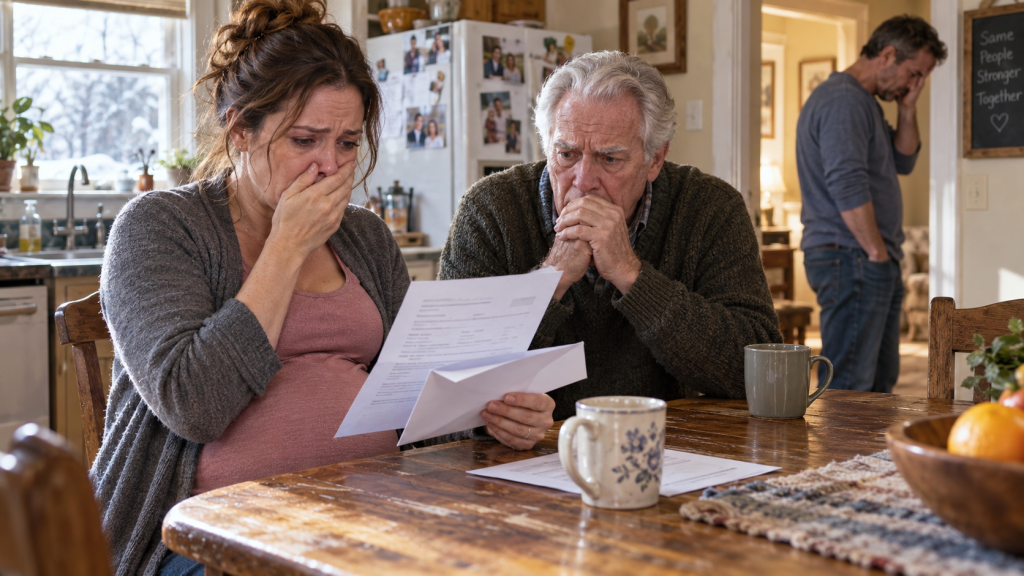
We still went on dates. We still held hands in parking lots. He still brought me flowers for no reason and kissed my forehead when he thought I was asleep. Even after two decades together, there were evenings when we would sit on the back porch with coffee and laugh like the young couple we had once been. So when I found out I was pregnant again at forty-three, I was terrified, but I was also happy. David cried when I showed him the test. He wrapped both arms around me and said, “Maybe this is our little miracle.” I believed him. I believed everything. New Year’s Eve was supposed to be simple. Our children were out with friends or sleeping over at relatives’ houses, and my parents had come by for dinner before heading to a neighborhood party. Around eleven-thirty, I went downstairs to find another bottle of sparkling cider. When I came back up, the living room was empty. Dad was outside taking a phone call. Mom was gone. David was gone too. I thought nothing of it until I heard a sound from our bedroom. Not loud. Just a muffled laugh, then silence. I pushed the door open. There are moments when the mind refuses to understand what the eyes are seeing. My mother stood beside my bed, her blouse half-buttoned. David was inches away from her. His face changed the second he saw me. Hers didn’t. That was what I remember most. She didn’t look shocked. She looked annoyed. “What is this?” I asked, though the answer was already everywhere. David stepped toward me. “Please, let me explain.” I backed away. “Don’t touch me.” Mom sighed. “You’re pregnant. Don’t make yourself hysterical.” Something inside me went cold. “Hysterical?” I looked at the woman who had held my hand while I gave birth to my first child, the woman who had helped me choose my wedding dress, the woman who had hugged David and called him the son she never had. “How long?” Neither answered. I screamed it then. “How long?” David sat on the edge of the bed and covered his face. Mom looked toward the window. Finally, he whispered, “Since before the wedding.” I thought I had misheard him. “What?” His shoulders shook. “It started a few months before we got married.” My knees nearly gave out. Twenty-two years. Every anniversary. Every Christmas. Every pregnancy. Every family vacation. Every Sunday dinner where David sat across from my father and passed the potatoes while secretly sleeping with his wife. “All this time?” I whispered. Mom folded her arms. “It wasn’t constant.” The cruelty of that sentence almost made me laugh. “Oh, well, that makes it better.” David started crying. “I love you.” “Don’t.” “I do.” “You don’t get to use that word.” I walked out before I did something I would regret and found Dad standing in the hallway. He had heard enough. His face looked twenty years older. “What happened?” he asked. I looked at him and realized I was about to break his life too. “Call me tomorrow,” I said. “And bring your marriage certificate, Mom’s old records, anything you have.” His brow furrowed. “Why?” I looked back toward the bedroom. “Because I don’t think this is only about my marriage.” The next morning, Dad came to my house alone. He hadn’t slept. Neither had I. We sat at the kitchen table while David stayed locked in the guest room and Mom refused to answer either of our calls. Dad kept saying, “Twenty-two years,” as if repetition might make the number less impossible. Then he told me something that made my stomach turn. My three youngest siblings had all been born after I started dating David. I had never thought about the timing. Why would I? They were my brother and sisters. Dad’s children. Mom’s children. Family. But now the dates lined up like accusations. Dad went pale when I said it aloud. “No,” he whispered. “She wouldn’t.” I looked at him. “Yesterday I would have said the same thing.” He scheduled DNA tests that afternoon. The waiting nearly destroyed us. David begged me not to involve the children. Mom finally called and accused me of “blowing up two families over an old mistake.” An old mistake. Twenty-two years of betrayal reduced to three words. I asked her directly whether David could be the father of Dad’s three youngest children. She went silent. That silence told me more than denial ever could. Dad heard it too. For the next five days, he barely spoke. Then, on a gray Thursday morning, his phone rang. The results were ready. He drove to my house with the envelope unopened because he said he couldn’t look at it alone. We sat at the same kitchen table where he had once helped my children carve pumpkins. His hands trembled so badly that I finally opened the packet for him. The first page listed my youngest brother. Probability of paternity for Dad: 0%. I stopped breathing. The second page was my sister. 0%. Dad made a sound I had never heard from another human being. Then I turned to the final page. My fingers went numb. Dad stared at my face. “What?” he whispered. “What does it say?” I looked up at him, unable to speak, because the third result was different—and beneath it was a second comparison that neither of us had requested.
PART 2 — THE FAMILY TREE THAT BROKE IN HALF
The third result was different.
That was the first thing my mind understood.
My father’s probability of paternity for my youngest sister, Nora, was 99.999 percent.
Dad was her father.
For one absurd second, relief moved through me.
It was tiny.
Almost shameful.
One child.
At least one of the three children he had raised was biologically his.
Then my eyes dropped to the paragraph beneath the result.
And whatever relief I felt disappeared.
ADDITIONAL PATERNAL COMPARISON COMPLETED.
I frowned.
Dad leaned closer.
“What does that mean?”
“I don’t know.”
There was a reference number beside it.
Then a name.
David Mercer.
My husband.
I read it once.
Then again.
The room seemed to tilt.
Dad reached for the paper.
“Why is David’s name on there?”
I couldn’t answer.
Because below his name was another line.
Then another.
The laboratory had received an additional sample connected to the case.
David had submitted it two days earlier.
Neither Dad nor I had known.
And according to the report, David was the biological father of my younger brother Michael.
Probability of paternity:
99.998 percent.
My eyes moved down.
Grace.
My eighteen-year-old sister.
Probability of paternity:
99.999 percent.
The paper slipped from my hands.
Dad caught it before it hit the floor.
For several seconds, neither of us spoke.
The refrigerator hummed.
Rain tapped softly against the kitchen window.
Somewhere upstairs, a pipe knocked inside the wall.
Ordinary sounds.
That was what made it unbearable.
The world had the nerve to remain ordinary.
Dad stared at David’s name.
Then he whispered, “He knew.”
I looked toward the hallway.
The guest room door was closed.
David was inside.
My father stood so abruptly that his chair crashed backward.
I grabbed his arm.
“Dad.”
He pulled away.
Not violently.
Desperately.
Like a drowning man refusing the hand trying to stop him from reaching shore.
“He knew.”
“I know.”
“He submitted his DNA.”
“I know.”
“He knew what they were testing.”
“Yes.”
“He knew.”
His voice cracked on the final word.
Twenty-two years of fatherhood seemed to collapse inside his chest all at once.
Michael’s first steps.
Grace’s dance recitals.
Nora asleep against his shoulder during family vacations.
School pictures.
Birthdays.
Christmas mornings.
Hospital visits.
Graduations.
Every memory still belonged to him.
But now someone had taken a blade and cut biology through the middle of it.
Dad walked toward the guest room.
I followed.
He didn’t knock.
He opened the door.
David was sitting on the edge of the bed with his phone in his hands.
He looked up.
And when he saw the papers in Dad’s fist, every trace of color left his face.
That was the confirmation before the confession.
Dad shut the door behind us.
“You sent your DNA.”
David stood.
“Robert—”
“Don’t call me that.”
David stopped.
Dad held the papers up.
“You submitted your DNA.”
David looked at me.
Not at Dad.
At me.
That made something inside me harden.
“Answer him,” I said.
David swallowed.
“Yes.”
Dad’s shoulders seemed to sink.
“Why?”
David rubbed both hands over his face.
“Because Marianne called me.”
My mother.
Of course she had.
“When?” I asked.
“The night after New Year’s.”
“So while Dad and I were sitting downstairs wondering whether three lives were about to be destroyed, you two were still talking.”
“It wasn’t like that.”
I laughed.
I couldn’t help it.
That sentence had apparently become the anthem of my marriage.
“It wasn’t like that.”
Nothing was ever like that.
Nothing meant what it looked like.
Nothing counted because there was always some explanation hiding behind it.
Dad stepped closer.
“Are Michael and Grace your children?”
David’s mouth opened.
Closed.
Dad shouted.
“Are they your children?”
“Yes.”
The word was barely audible.
But it was enough.
Dad sat down.
Not on the chair.
On the floor.
His knees simply stopped holding him.
I had never seen my father collapse before.
He was the man who carried refrigerators with neighbors.
The man who repaired roofs in July heat.
The man who stood beside my hospital bed when my first child was born and cried harder than anyone else in the room.
Now he sat on my guest-room carpet with his back against the wall and looked like an old man who had suddenly forgotten where he was.
David moved toward him.
I stepped between them.
“Don’t.”
David stopped.
Dad stared at the carpet.
“Michael called me Dad for twenty years.”
No one answered.
“I taught him to drive.”
His voice was almost conversational.
That made it worse.
“I stayed awake with Grace for three nights when she had pneumonia.”
David began to cry.
Dad looked up.
“Do not cry in front of me.”
David wiped his face.
“Robert, I never wanted to take them away from you.”
Dad stared at him.
“Take them away from me?”
Then something frighteningly calm entered his voice.
“You slept with my wife, fathered children with her, sat at my dinner table, let me raise them, and now you’re telling me you never wanted to take anything from me?”
David said nothing.
Dad pointed toward the hallway.
“Twenty-two years.”
David closed his eyes.
“Twenty-two years,” Dad repeated. “You hugged me at Christmas.”
“I know.”
“You called me when my brother died.”
“I know.”
“I gave you a speech at your wedding.”
That sentence nearly destroyed me.
Because I remembered it.
Dad standing beneath strings of white lights at the reception, champagne glass in his hand.
David beside me.
Mom smiling from the front table.
Dad had looked at my new husband and said, “I never had a son until tonight.”
And David had hugged him.
What kind of person could survive carrying a secret like that?
What kind of person could smile afterward?
I looked at my husband.
“I need to know everything.”
David shook his head.
“You don’t.”
“Yes.”
“It’ll only hurt you.”
“You lost the right to decide what hurts me.”
He looked at the floor.
I folded my arms across my stomach.
Our baby moved beneath my hand.
A tiny flutter.
Life continuing inside me while the life around me fell apart.
“How did it start?”
David sat down again.
He looked older than he had six days earlier.
“It was before the wedding.”
“I know that part.”
“Your mother was helping with everything. The venue. Invitations. Flowers. You were working late all the time.”
“Do not make this about me being busy.”
“I’m not.”
“Then choose your words carefully.”
He nodded.
“She started calling me.”
Dad stared at him.
“For what?”
“At first? Wedding things.”
“And then?”
David hesitated.
“She told me she was lonely.”
My father actually flinched.
David continued quietly.
“She said you barely noticed her anymore.”
Dad’s eyes filled.
“I worked two jobs.”
David looked away.
“Because she wanted that house,” Dad whispered. “Because she wanted you kids to have college money.”
David had no response.
I felt something twist inside my chest.
There are betrayals committed in bedrooms.
And then there are betrayals committed against history.
Mom had rewritten Dad’s sacrifices into neglect.
She had taken the very things he had done for our family and used them as evidence against him.
“How long before it became physical?” I asked.
David whispered, “About three months.”
“Before our wedding.”
“Yes.”
“And you still married me.”
He started crying again.
“I loved you.”
I shook my head.
“No.”
“I did.”
“No, David. You wanted me.”
He looked at me.
“There’s a difference.”
My voice trembled, but I forced myself to keep going.
“You wanted the house. The children. The photographs. The Christmas mornings. You wanted someone waiting for you when you came home. Maybe you even wanted to grow old beside me.”
I swallowed.
“But love requires protecting someone from the worst parts of yourself.”
His face crumpled.
“And you protected yourself instead.”
Silence filled the room.
Dad finally asked the question I was afraid to ask.
“Did you know those children were yours?”
David did not immediately answer.
That hesitation told us everything.
“Michael?” Dad asked.
“I suspected.”
“Grace?”
“I knew.”
Dad stood.
Slowly this time.
“You knew?”
David nodded.
“Marianne told me after Grace was born.”
Dad walked toward him.
I caught his arm.
“Dad.”
He stopped.
His whole body shook.
“She put that little girl in my arms.”
His eyes were somewhere else now.
Back eighteen years.
Back in a hospital room.
“She said she had my eyes.”
I closed my own.
Dad laughed once.
A broken sound.
“She said Grace had my eyes.”
Then he walked out.
I followed him downstairs.
He picked up his coat.
“Where are you going?”
“To see your mother.”
“I’m coming.”
“No.”
“Dad—”
He looked at me.
There was more pain in his face than anger.
“I spent forty-six years believing I knew that woman.”
His voice softened.
“I need five minutes where I’m not somebody’s husband, father, or grandfather.”
Then he left.
I stood in the doorway watching his car disappear through the rain.
Behind me, David said my name.
“Rebecca.”
I turned around.
He stood at the bottom of the stairs.
For twenty-two years, that face had meant home.
Now I studied it as if it belonged to someone I had met only days earlier.
“Why did you submit your DNA?” I asked.
“Your mother called after your dad scheduled the tests.”
“And?”
“She said if the truth was coming out, she needed to know exactly what the truth was.”
I almost smiled.
“She needed to know?”
“I did too.”
“You had twenty years to find out.”
“I was afraid.”
“So was Dad.”
David looked away.
“So was I.”
I stepped closer.
“And we didn’t get the luxury of choosing ignorance.”
He whispered, “I’m sorry.”
I shook my head.
“Stop saying that.”
“What do you want me to say?”
“The truth.”
“I’ve told you.”
“No.”
I looked directly into his eyes.
“You’ve told me the truth you think I already know.”
His expression changed.
Barely.
But enough.
My heartbeat quickened.
“There’s more.”
“No.”
“David.”
“There isn’t.”
“You always rub your wedding ring when you lie.”
His hand immediately dropped away from it.
For twenty-two years, I had known his habits.
Apparently I had simply misunderstood what they meant.
“What else?” I asked.
He stared at me.
Then his phone rang.
Mom.
Her name glowed on the screen between us.
David declined the call.
Thirty seconds later, she called again.
Then again.
I held out my hand.
“Give me the phone.”
“Rebecca.”
“Give it to me.”
He did.
On the fourth call, I answered.
Mom spoke before I could.
“David, listen to me. Do not tell her about the money until I get there.”
She stopped.
I said nothing.
The silence stretched.
Then she whispered, “Rebecca?”
I looked at David.
His eyes closed.
“What money, Mom?”
She hung up.
I slowly lowered the phone.
“What money?”
David sat down on the stairs.
And for the first time since New Year’s Eve, I understood that the affair was only the first layer.
It was the ugliest layer.
But it was not the deepest.
“David.”
He covered his face.
“What money?”
He whispered, “I helped with Michael and Grace.”
I felt cold.
“How?”
“Expenses.”
“What expenses?”
“School.”
My mind moved backward through twenty years.
Braces.
Summer camps.
A used car for Michael when he turned sixteen.
Grace’s private dance lessons.
A class trip to France.
Mom always said she and Dad had carefully saved.
Dad always complained that money disappeared faster than he could earn it.
“How much?”
David didn’t answer.
I asked again.
“How much money did you take out of our family?”
“I didn’t take it.”
“That is not an answer.”
“I moved money from my personal accounts.”
“We were married. There were no secret personal accounts.”
He stared at the floor.
Apparently there were.
I walked into the kitchen and pulled open the cabinet where we kept household records.
Bank statements.
Tax folders.
Mortgage papers.
Everything seemed suddenly contaminated.
For years I had trusted David with most of our long-term finances.
Not because I was incapable.
Because marriage had taught me that trust was supposed to make life lighter.
Now I realized trust could also make theft easier.
“How much?”
David came into the kitchen.
“Over the years?”
“Yes.”
He hesitated.
“Maybe one hundred and eighty thousand.”
My knees weakened.
I gripped the counter.
“One hundred and eighty thousand dollars?”
“It wasn’t all at once.”
I turned around.
“Stop saying things like that.”
He flinched.
“Do you hear yourself?”
“I know.”
“No. You don’t.”
My voice rose.
“You talk about twenty-two years like spreading the damage across time somehow makes it smaller.”
Our oldest daughter, Hannah, had wanted to attend an expensive private university four years earlier.
We told her we couldn’t afford it without enormous loans.
She had cried for one night, then accepted a scholarship to a state school and never complained again.
Our son Caleb had needed braces we delayed for almost a year.
I had driven the same minivan for eleven years because we agreed another car payment wasn’t responsible.
There were vacations we never took.
Repairs we postponed.
Dreams we called unnecessary.
Meanwhile David had quietly financed children he had secretly fathered with my mother.
I pressed a hand against my mouth.
“Hannah.”
David looked confused.
“What?”
“She gave up Northwestern.”
“Rebecca—”
“She gave up her dream school because we said we couldn’t justify the money.”
“That wasn’t because of this.”
“How do you know?”
“We still would’ve had to—”
“How do you know?”
I screamed it.
He stopped talking.
I began crying then.
Not the stunned tears from New Year’s Eve.
Not the silent tears that came during sleepless nights.
These tears were angry.
They seemed to come from twenty-two years of small sacrifices I had once made gladly because I believed they belonged to a shared life.
“You let our children go without things.”
“They never went without.”
“You don’t get to decide what counts.”
“I was trying to do the right thing for Michael and Grace.”
I stared at him.
“The right thing?”
“Yes.”
“Then you should have told the truth.”
He said nothing.
“That would have been the right thing.”
My voice dropped.
“You wanted to be their father in secret while letting Dad do the difficult parts in public.”
David’s face collapsed.
“You didn’t stay up with Michael when he had night terrors.”
Dad had.
“You didn’t teach Grace to ride a bicycle.”
Dad had.
“You didn’t sit outside the principal’s office when Michael got suspended.”
Dad had.
“You didn’t walk around the house at two in the morning holding Grace while she cried over her first heartbreak.”
Dad had.
“But you gave them money sometimes, so you could tell yourself you hadn’t abandoned them.”
David wiped his eyes.
“That’s not fair.”
I stared at him.
And then I laughed.
Fair.
That word.
How strange that he still believed it belonged in the room.
“You’re right,” I whispered.
He looked at me.
“None of this is fair.”
My phone rang.
Dad.
I answered immediately.
“Dad?”
His breathing was uneven.
“Your mother’s gone.”
“What?”
“She packed.”
My heart dropped.
“Where?”
“I don’t know.”
“Are you at the house?”
“Yes.”
“I’m coming.”
I grabbed my keys.
David followed.
“Rebecca, you shouldn’t drive upset.”
I turned around so sharply that he froze.
“Do not pretend to worry about me now.”
He stopped.
I drove alone.
Dad was sitting on the front steps when I arrived.
Rain dotted his gray hair.
He hadn’t even put on a jacket.
I pulled into the driveway and ran toward him.
“Dad.”
“She knew.”
He stared at the lawn.
“She knew those test results would come back.”
I sat beside him.
“She left?”
He nodded.
“Suitcase is gone. Jewelry too.”
He handed me an envelope.
“She left this on the kitchen table.”
My name was written across the front.
Rebecca.
Mom’s handwriting.
I opened it.
There were only four sentences.
I know you hate me.
Someday you will understand that life is more complicated than the version children have of their parents.
I loved you, even when I made choices you will never forgive.
Please do not destroy your brothers and sisters just because you need someone to punish.
I read it twice.
Then folded it carefully.
Dad looked at me.
“What did she say?”
I handed him the note.
He read it.
His jaw tightened.
Then, without a word, he tore it in half.
Dad was not a dramatic man.
He had never thrown plates.
Never punched walls.
Never screamed during arguments.
Watching him tear those four sentences felt more final than violence would have.
“She still thinks this is about punishment,” he said.
I took his hand.
“No.”
“She thinks we’re doing this to her.”
“I know.”
He looked toward the house where he had raised five children.
“I don’t know how to tell them.”
Neither did I.
But secrets had already taken enough years from us.
I would not give them another day.
Michael came first.
Twenty years old.
Tall.
Funny.
The sibling who could walk into any room and somehow leave with three new friends.
Grace arrived from college an hour later.
Nora came home from a friend’s house that evening.
Dad asked me to stay.
So I did.
They sat together on the living-room couch.
I looked at them and suddenly remembered holding each of them as babies.
There had never been an asterisk beside the word family.
There had never been categories.
They were simply mine.
My brother.
My sisters.
Dad sat across from them.
His hands were clasped between his knees.
“Your mother and I are separating.”
Grace immediately started crying.
Nora whispered, “Why?”
Dad looked at me.
I hated that I had become the person who knew how to say impossible things.
“There’s something else.”
Michael leaned forward.
“What?”
I told them.
Not every detail.
Not the bedroom.
Not the history.
Not yet.
I told them the DNA results.
I told them David was Michael and Grace’s biological father.
I told Nora that Dad was biologically hers.
Then I watched three young people lose the shape of their family.
Michael stood.
“No.”
“Michael—”
“No.”
He paced toward the fireplace.
“This is insane.”
Grace covered her face.
Nora stared at Dad.
“You’re still my dad?”
Dad moved beside her immediately.
“Oh, sweetheart.”
She fell into him.
“You’re still my dad?”
He held her tightly.
“Yes.”
His voice broke.
“Yes. Always.”
Michael turned.
“And us?”
Dad looked at him.
There are moments when biology matters.
There are also moments when a human being chooses something larger than biology.
Dad stood.
He crossed the room.
He put one hand on Michael’s shoulder and the other around Grace.
“You are my children.”
Michael’s face crumpled.
“But he’s our father.”
“No.”
Dad shook his head.
“He is your biological father.”
He looked at all three of them.
“I am the man who raised you.”
Michael began crying.
I had not seen him cry since he was a little boy.
Dad pulled him close.
And my brother—my twenty-year-old, six-foot-two brother—buried his face against the shoulder of the only father he had ever known.
Grace joined them.
Nora wrapped both arms around Dad’s waist.
I watched from the other side of the room with tears running down my face.
For the first time since New Year’s Eve, something true existed in front of me.
Broken.
Complicated.
Devastated.
But true.
Dad did not need DNA to love them.
That was the difference between him and everyone who had betrayed us.
His love did not disappear when truth became inconvenient.
That night, I had to tell my own children.
Hannah came first.
Twenty-one.
Caleb was nineteen.
Eli was sixteen.
Sophie was thirteen.
We sat around the same kitchen table where I had opened the DNA results.
David was not there.
I had asked him to leave.
He was staying at a hotel.
Hannah looked at me for a long time after I finished.
“So Uncle Michael…”
She stopped.
Her face tightened.
“He’s not my uncle?”
I swallowed.
“Biologically, he’s your half-brother.”
Caleb stood up.
“What the hell?”
“Caleb.”
“No, Mom.”
He paced away.
“What the actual hell?”
Sophie began crying.
Eli looked completely numb.
Hannah stared at the table.
Then she asked a question that nearly broke me.
“Did Dad ever choose us first?”
I opened my mouth.
No words came.
She looked up.
“All those years.”
Tears filled her eyes.
“Did he ever choose us first?”
I reached across the table.
She let me take her hand.
“I don’t know.”
It was the hardest truth I had spoken yet.
“I wish I could give you a better answer.”
Hannah nodded.
And cried silently.
“I keep thinking about Grandpa.”
“So do I.”
“He loved them like they were his.”
“Yes.”
“And Dad knew.”
“Yes.”
She shook her head.
“That’s evil.”
I didn’t defend him.
There are times when children need adults to soften the world for them.
And there are times when softening the truth only teaches them to distrust their own pain.
The following morning, I called an attorney.
By afternoon, I had copies of every bank statement I could access.
By evening, I had changed passwords.
Within two days, I learned that the one hundred and eighty thousand dollars David admitted to was not the entire amount.
There were transfers.
Cash withdrawals.
A college savings account I had never seen.
An investment account bearing Michael’s initials.
Another for Grace.
And a small limited-liability company registered twelve years earlier.
Its owners were listed as David Mercer and Marianne Collins.
My husband.
My mother.
That company owned a lake cabin three hours north of us.
I stared at the address.
I knew that cabin.
Of course I did.
Mom had told us one of her friends owned it.
She and Dad had vacationed there twice.
Our family had spent a Fourth of July there when Sophie was six.
There was a photograph from that weekend sitting in our hallway.
Mom smiling beside Dad.
David standing behind me with his arm around my waist.
All of us together.
At a house my mother and husband secretly owned.
When my attorney showed me the purchase date, I stopped breathing.
They had bought it seventeen years earlier.
Six months after Grace was born.
I went home and removed the photograph from the wall.
I thought I might smash it.
Instead, I sat on the floor and stared at it.
My children were smiling.
Dad was smiling.
I was smiling.
Only two people in that photograph knew the truth.
Sometimes the cruelest part of betrayal is not discovering the lie.
It is discovering how many happy memories the liar was able to stand inside without flinching.
That evening, Dad called.
He had been going through Mom’s things.
Not snooping, he said.
Trying to understand what bills needed to be paid.
What accounts existed.
What belonged to whom.
Then his voice changed.
“Rebecca.”
“What?”
“I found something.”
My stomach tightened.
“What kind of something?”
“A box.”
I closed my eyes.
“Dad.”
“There are letters.”
“From David?”
“No.”
I sat straighter.
“Then from who?”
He was silent for several seconds.
“Your mother.”
“To who?”
“You.”
My heart stopped.
“What?”
“They’re addressed to you.”
I stood.
“How many?”
“A lot.”
“Did she write them recently?”
“No.”
His voice sounded strange.
“They go back twenty-three years.”
Before my wedding.
Before my marriage.
Before everything I thought I understood.
“I’m coming over.”
Dad hesitated.
“There’s something else.”
I gripped the phone.
“What?”
“The first one isn’t in your mother’s handwriting.”
I didn’t speak.
“It’s from David.”
My entire body went cold.
“What does it say?”
Dad breathed in.
Then slowly exhaled.
“I only read the first line.”
“What does it say?”
Another pause.
Then my father spoke the sentence that would keep me awake for the next three nights.
“It says, ‘Marianne, Rebecca can never know why I really agreed to marry her.’”
I stopped breathing.
Dad continued.
“There’s a date on it.”
“How long before the wedding?”
“Four months.”
The room seemed to disappear around me.
I had spent the last week mourning twenty-two years of marriage.
Now, for the first time, I wondered whether the marriage I was mourning had ever existed at all.
Because apparently David had lied before the vows.
Before the house.
Before our children.
Before my mother became his secret lover.
And whatever was inside that box had frightened both of them enough to keep it hidden for more than two decades.
I looked toward the staircase where our wedding photograph still hung.
David and I were standing beneath an arch of white roses.
His hands were around mine.
I was looking at him like the future had finally arrived.
He was smiling directly at me.
For twenty-two years, I had believed I knew what that smile meant.
Now there was only one question left.
If David had not married me simply because he loved me…
why had he married me at all?
PART 3 — THE TRUTH BENEATH THE VOWS
I drove to Dad’s house after midnight.
The roads were nearly empty.
Streetlights passed over my windshield in slow intervals, appearing and disappearing like brief pieces of memory.
At every red light, I saw David’s face on our wedding day.
Young.
Nervous.
Beautiful to me.
I remembered the way his fingers had trembled when he slid the ring onto mine.
I remembered whispering, “You okay?”
And the way he smiled.
“Never better.”
For twenty-two years, I had carried that moment like proof.
Proof that I had been chosen.
Proof that whatever else life became, it had begun honestly.
Now a letter written four months before that day had reduced the memory to ash.
Rebecca can never know why I really agreed to marry her.
By the time I reached Dad’s house, my hands were shaking so badly I missed the driveway the first time.
Dad was waiting at the kitchen table.
The wooden box sat between us.
I recognized it.
Mom had kept it in the back of her bedroom closet for years.
Whenever we asked what was inside, she said it held old insurance papers, family photographs, things nobody would care about.
Apparently that had been one more lie.
Dad looked exhausted.
He had stopped shaving.
His shirt was wrinkled.
His wedding ring was gone.
That startled me more than I expected.
For my entire life, I had never seen his left hand without it.
I sat across from him.
Neither of us touched the box.
“How many letters?” I asked.
“Twenty-seven.”
“From David?”
“Some.”
“And Mom?”
“Most.”
“To me?”
Dad nodded.
“Some are addressed to you. Some are addressed to him. A few were never addressed to anyone.”
I stared at the box.
“Did you read them?”
“Not all.”
“Why not?”
His eyes met mine.
“Because some of them belong to you.”
That nearly made me cry.
Even now.
Even after everything that had been stolen from him, Dad still understood the difference between having access to someone’s private life and believing you were entitled to it.
The people who had hurt us most had never understood that distinction.
I reached for the first letter.
The paper had yellowed slightly around the edges.
David’s handwriting was unmistakable.
I knew that handwriting.
I had seen it on grocery lists, anniversary cards, school forms, sticky notes on the refrigerator.
Marianne,
Rebecca can never know why I really agreed to marry her. If she finds out before the wedding, she’ll leave, and everything we’ve done will be for nothing.
I stopped.
Dad looked down.
I continued.
I know you think I should feel worse about this. I do. But your plan makes sense. She trusts both of us. Once we’re married, the property situation becomes easier. You said your father’s trust only passes through Rebecca unless she’s married. I still don’t understand why he structured it that way, but you’ve assured me the legal side will work.
I stopped reading.
The words blurred.
“Property?”
Dad’s jaw tightened.
“I didn’t know about any trust.”
I turned the page.
I love Rebecca. Maybe not in the way she believes yet, but I care about her. I think I could be good to her. Maybe eventually that will be enough. You said yourself she wants a family more than anything. I can give her that.
My stomach turned.
I pressed the paper against the table.
Dad whispered, “Keep going.”
I didn’t want to.
But truth had already shown me what happened when people stopped reading because they were afraid of the next line.
So I continued.
As for us, we need rules. Once the wedding happens, we cannot be careless. Robert suspects nothing, and Rebecca suspects even less. If we keep our heads, everyone gets what they want.
The letter ended there.
No apology.
No guilt.
No confusion.
Just strategy.
Rules.
A plan.
I looked up at Dad.
“What trust?”
He shook his head.
“I called your Aunt Linda after I found the box.”
My mother’s older sister.
They had barely spoken in years.
“She knew.”
“Knew what?”
“That your grandfather left something behind.”
My mother’s father had died when I was nineteen.
He had owned farmland, warehouses, and several rental properties in another state.
I remembered adults arguing after the funeral.
I remembered Mom saying her father had been controlling and had left behind “a legal mess.”
Then life moved on.
Or I thought it had.
Dad pushed a folder toward me.
“Your grandfather didn’t leave the bulk of his estate to your mother.”
I opened it.
“He left it to me?”
“Not directly.”
Dad rubbed his forehead.
“He created a trust. You were the primary beneficiary because you were his first grandchild.”
I stared at him.
“Why?”
“Linda said he didn’t trust your mother with money.”
A bitter laugh escaped me.
“He had excellent instincts.”
Dad almost smiled.
Almost.
“The trust was supposed to transfer certain properties to you when you turned twenty-five, or earlier under a marital provision if you married and established a household.”
I looked at him.
“I married at twenty-one.”
“Yes.”
“And Mom knew.”
“Yes.”
I looked back at David’s letter.
“She needed me married.”
Dad nodded.
“Apparently.”
“Why?”
He slid another document across the table.
The copy was old.
Faxed.
Hard to read.
But the language was clear enough.
My mother had been listed as temporary administrator over several trust assets until the triggering condition.
Marriage.
My marriage.
I felt something inside me go still.
“She was using the properties.”
Dad’s silence answered.
“She had borrowed against them?”
“Yes.”
“How much?”
He swallowed.
“Hundreds of thousands.”
I laughed again.
A hollow sound.
“So if I didn’t marry…”
“The accounts would eventually have been reviewed when you turned twenty-five.”
“And she would have been exposed.”
“Yes.”
My eyes returned to David’s letter.
“She needed me to marry before then.”
Dad nodded.
“And David helped her.”
I stood and walked away from the table.
For a moment, I could not breathe.
My wedding had not merely hidden an affair.
It had completed a financial scheme.
The white dress.
The flowers.
The vows.
My father giving me away.
The reception.
The photographs.
All of it had been built over a trapdoor.
I turned toward Dad.
“And what did David get?”
Dad looked at the box.
“That’s in the next letter.”
I sat.
This one was from Mom.
Written to David.
You keep asking what happens after the transfer. I told you. Once Rebecca is married, the trust stops being monitored the same way. We refinance, move the debt, and no one knows. You will receive the money we agreed on.
My throat tightened.
Below that, another paragraph.
You said you want your own business. This gives you your start. Think of it as compensation for helping me protect what should have been mine in the first place.
I stared at the paper for a very long time.
David had started his business six months after our wedding.
I remembered those early years.
How proud I had been.
How hard he worked.
How I brought him dinner when he stayed late.
How I bragged about him to everyone.
“He built that company from nothing,” I used to say.
Except he hadn’t.
Part of it had been built with stolen money from a trust I never knew existed.
I suddenly remembered a conversation from our second anniversary.
David had taken my hands and said, “Everything I have is because of you.”
I thought it was romantic.
Now I realized it had been literal.
Dad looked at me.
“You okay?”
“No.”
It was the first answer that came.
Then I added, “But keep going.”
The next letters told the story in pieces.
Mom had been taking money from the trust before my grandfather even died, using power-of-attorney privileges while he was sick.
After his death, she shifted debt among properties.
She believed the estate belonged to her.
She resented that my grandfather had bypassed her.
When I became old enough to inherit control, she panicked.
David entered the picture at exactly the right time.
Or the wrong one.
He was twenty-four.
Ambitious.
In debt.
Dating me.
Mom began spending time with him while I worked evenings at a medical billing office.
At first, the letters were about money.
Then they became personal.
Flirtatious.
Then explicit.
I stopped reading those.
I didn’t need them.
Pain does not become more truthful simply because you examine every detail.
At some point, knowing enough is an act of survival.
Then I found a letter written by Mom to me.
Never sent.
The date was three days before my wedding.
Rebecca,
There may come a day when you hate me. If that happens, remember that I did what I did because I spent my entire life watching men decide what women deserved. My father decided I was irresponsible. Your father decided work mattered more than attention. David understands me in a way neither of them ever did.
I stopped.
Dad’s face hardened.
I kept reading.
You have always been softer than I am. You believe people should do the right thing because it is right. I learned early that people take what they are strong enough to take.
My hands trembled.
I am sorry you are part of the arrangement. But you will have a husband, children, a beautiful home, and a life most women would envy. Someday perhaps you will realize that happiness does not need to know how it was created.
I dropped the letter.
Dad stared at it.
Then whispered, “She planned your happiness for you.”
“No.”
I shook my head.
“She planned my ignorance.”
That was the difference.
And somehow, saying it aloud loosened something inside me.
For days, I had asked myself whether any part of my marriage had been real.
Now I understood the question was too simple.
Some of it had been real.
My children were real.
The nights David held me when I miscarried between Caleb and Eli were real.
The laughter on the porch had been real.
The way he knew I hated the crust on sandwiches and cut it off when I was sick had been real.
But real tenderness does not erase deliberate betrayal.
A person can love you and still destroy you if their love is weaker than their selfishness.
That was the truth I had resisted.
David may have come to love me.
But he had entered my life through deception.
And every year he stayed silent, he chose the deception again.
I opened another letter.
This one was written almost ten years after our wedding.
David to Mom.
We have to stop.
I read faster.
This has gone too far. Rebecca is not the girl she was. She trusts me completely, and every year I hate myself more for what we did to her. I’m not leaving her. I love her. I mean that. Whatever this started as, my marriage is real to me now.
My eyes filled.
Dad noticed.
“Rebecca…”
I raised a hand.
I needed to finish.
You keep saying we deserve this, but we don’t. Robert doesn’t deserve it either. Michael is getting old enough to notice things. Grace will eventually ask questions. I want out.
Below it, in Mom’s handwriting, she had written:
You don’t get out.
Three words.
That was all.
I sat back.
For the first time, I saw David not only as a betrayer but also as a coward who had spent years trapped inside the consequences of his own choices.
That did not absolve him.
It made the tragedy more complete.
He had opportunities to tell me.
He did not.
He had chances to tell Dad.
He did not.
He could have walked into the fire while it was small.
Instead, he waited until it burned down both families.
Dad stared at the letter.
“So he wanted to stop.”
“Apparently.”
Dad’s voice was flat.
“And then continued for another twelve years.”
“Yes.”
“Then it doesn’t matter much.”
I looked at him.
“No.”
It didn’t.
Regret is not repentance when it changes nothing.
We sat quietly for a long time.
Then Dad reached into the bottom of the box.
“There’s one more thing.”
He handed me a small envelope.
My name was written on it.
Mom’s handwriting.
The date was from nine years earlier.
Inside was a single page.
Rebecca,
David told me tonight that he is going to confess everything. He says he cannot keep lying to you. I told him if he does, I will tell you he seduced me before your wedding and planned the entire trust arrangement himself. He does not know I kept the early letters. Perhaps that makes me cruel. Perhaps it makes me prepared.
I closed my eyes.
Nine years ago.
I remembered that year.
David had been strange for several weeks.
Quiet.
Restless.
One night he took me to dinner and barely touched his food.
On the drive home, he said, “There’s something I need to tell you.”
I had laughed.
“Are you secretly married?”
He almost drove off the road.
I remembered teasing him for weeks.
Then he never told me.
Until now, I had forgotten the moment entirely.
There had been a doorway.
He stood in it.
And he turned away.
I folded the letter.
Something inside me shifted.
I no longer felt desperate to ask whether he had loved me.
That question had kept me awake because I believed the answer could somehow change what I should do.
Now I understood it couldn’t.
Maybe he loved me.
Maybe he loved me deeply.
Maybe he had spent the last decade waking beside me and wishing he had been a different man.
But love is not a legal defense against betrayal.
And forgiveness is not the same thing as permission to remain.
I looked at Dad.
“I’m filing for divorce.”
He nodded.
“I know.”
“How?”
He gave me the faintest smile.
“Because you’re my daughter.”
For the first time in days, I smiled back.
Then Dad’s face softened.
“What about the baby?”
My hand moved instinctively to my stomach.
“I don’t know yet.”
“You don’t have to decide everything tonight.”
“No.”
I exhaled.
“But I know one thing.”
“What?”
“This child will never grow up inside a lie.”
The next morning, I called David.
I asked him to meet me at the house.
He arrived within twenty minutes.
He looked terrified.
I had placed the letters across the dining-room table.
When he walked in and saw them, he stopped.
His eyes closed.
“You found them.”
“Yes.”
He sat down slowly.
I remained standing.
“Tell me the truth once.”
He looked at me.
“All of it?”
“All of it.”
So he did.
At least, I believe he did.
There are some things I will never be able to verify.
But his story matched the letters.
He had known Mom was mishandling money from my trust.
She promised him fifty thousand dollars to marry me before the trust underwent its next review.
He had already planned to propose eventually.
That was the excuse he used on himself.
“It wasn’t like I married a stranger,” he said.
I stared at him.
“You really thought that made it better?”
“No.”
He lowered his head.
“Not anymore.”
He admitted the affair began weeks after the financial arrangement.
He claimed he tried to end it multiple times.
Mom threatened to expose him.
Then Michael was born.
Then Grace.
And with each new secret, leaving became harder.
“You could have told me.”
“I know.”
“You could have told Dad.”
“I know.”
“You could have stopped sleeping with her.”
His face tightened.
“Yes.”
I waited.
He whispered, “I know.”
“Then why didn’t you?”
He looked at me for a long time.
Finally, he said something I did not expect.
“Because part of me liked being wanted by both of you.”
The honesty struck harder than another excuse would have.
He began crying.
“I hated myself for it. But that’s the truth.”
I sat down.
For once, there was no polished explanation.
No claim that circumstances carried him helplessly along.
He had wanted it.
At least sometimes.
Wanted the secrecy.
Wanted the attention.
Wanted the money.
Wanted the family.
Wanted everything.
And he had convinced himself that because he did not intend to lose me, he was not risking me.
I wiped my eyes.
“Did you ever love her?”
He looked toward the window.
“I thought I did.”
“And me?”
He looked at me immediately.
“Yes.”
I almost laughed.
“How convenient.”
“I know how it sounds.”
“No, David. I don’t think you do.”
I leaned closer.
“You have spent your entire adult life wanting two opposite things to be true at once.”
His face crumpled.
“You wanted to be a loyal husband and an unfaithful one.”
“You wanted to be Dad’s friend and betray him.”
“You wanted Michael and Grace to be yours and also wanted Dad to raise them.”
“You wanted money you didn’t earn and still wanted to believe you were a good provider.”
“You wanted my trust and your secrets.”
I shook my head.
“And every time reality demanded you choose, you chose both and forced the rest of us to pay for it.”
He covered his face.
“I’m sorry.”
This time, I didn’t tell him to stop saying it.
I simply answered.
“I know.”
He looked up.
“And I believe you.”
Hope flashed in his eyes.
Only for a second.
I hated that I had to take it away.
“But believing you’re sorry doesn’t mean I can stay.”
He went still.
“Rebecca.”
“I filed this morning.”
He stared at me.
Then he began crying so hard he could barely breathe.
For twenty-two years, seeing David cry would have pulled me toward him automatically.
I would have sat beside him.
Held him.
Told him we would figure it out.
That instinct rose in me.
Then stopped.
Because there are moments when compassion must learn boundaries.
His pain was real.
But I was no longer responsible for rescuing him from the consequences of what he had done.
He whispered, “Please don’t end our family.”
I looked at him.
“You ended the version of our family that depended on lies.”
“We can rebuild.”
“Maybe.”
His head lifted.
“But not as husband and wife.”
He looked away.
I continued.
“You are still the father of our children.”
My voice softened.
“And you are the biological father of Michael and Grace.”
He began shaking his head.
“They don’t want me.”
“Maybe they never will.”
He closed his eyes.
“You don’t get to demand that relationship.”
“I know.”
“But if they ever choose to ask you questions, you answer honestly.”
He nodded.
“And you do not manipulate them with guilt.”
“I won’t.”
“You do not tell them you suffered too.”
His face tightened.
“Rebecca—”
“No.”
I held his gaze.
“The people you lied to are not responsible for making you feel forgiven.”
That sentence stayed between us.
Then I took off my wedding ring.
For several days, I had not been able to do it.
My finger felt strangely bare when I slid it free.
I placed the ring on the table.
David stared at it.
And twenty-two years of marriage became something small enough to fit in the center of my palm.
He whispered, “Was none of it worth saving?”
I looked at him.
“That’s not what divorce means.”
He frowned.
“There are things worth saving.”
I thought of our children.
Birthday videos.
Trips.
Christmas mornings.
Sick days.
The porch.
All those pieces of life.
“I’m saving the truth.”
Then I stood.
“And whatever was real can survive without pretending the rest was acceptable.”
David left quietly.
My mother stayed gone for twelve days.
Then the attorney found her.
She had gone to stay with a friend two states away.
When she learned we had discovered the trust records, she called me.
Not Dad.
Me.
I almost didn’t answer.
Then I decided I wanted to hear her voice one last time without fear.
“Rebecca.”
She sounded tired.
“Hi, Mom.”
“I assume Robert showed you everything.”
“Yes.”
“He had no right to go through my private things.”
I nearly laughed.
Even then, she could find a door marked victim and walk through it.
“You stole from my trust.”
Silence.
“You arranged my marriage around it.”
Silence.
“You slept with my husband for twenty-two years.”
“That is between David and me.”
“No.”
My voice remained calm.
“That is exactly what you never understood.”
She began crying.
“You think I wanted this?”
“Yes.”
She stopped.
The answer surprised her.
“I think you wanted many things,” I continued. “And like David, you believed wanting them gave you permission to take them.”
“You don’t know what my father did to me.”
“You’re right.”
“He controlled everything. Money. Property. Every decision.”
“I believe you.”
She was quiet.
“But you don’t get to heal what someone did to you by doing it to someone else.”
Her breathing changed.
“I gave you a good life.”
“No.”
“You had a house. Children. A husband who loved you.”
“You gave me a stage set.”
“That’s cruel.”
“So was the script.”
She began sobbing.
A younger version of me would have folded.
That was the power my mother had always held.
Her tears could make everyone else reconsider their pain.
Not anymore.
She whispered, “Can you forgive me?”
I looked through the kitchen window.
Dad had come over to help Sophie with a school project.
He sat at the table with glue on his fingers, patiently attaching tiny cardboard trees to a model.
A man whose whole life had been overturned was still showing up for the people he loved.
That was forgiveness to me.
Not words.
Not demands.
Presence.
“I don’t know,” I said.
Mom cried harder.
“But I do know forgiveness, if it comes, will not restore access.”
“What does that mean?”
“It means you are not coming back into my home like nothing happened.”
“I’m your mother.”
“Yes.”
“And I’m your daughter.”
I swallowed.
“You should have remembered that.”
We ended the call without saying goodbye.
Dad filed for divorce.
The financial investigation took months.
Mom and David were both questioned over trust assets and transfers.
Some of the claims were too old to prosecute easily.
Others became part of civil proceedings.
The lake cabin was sold.
Several investment accounts were frozen.
Eventually, part of the money was restored.
But by then, money felt almost irrelevant.
You cannot reimburse a childhood.
You cannot refund twenty-two Christmases.
There is no financial instrument that pays back trust.
The hardest part was the children.
Michael wanted nothing to do with David.
For months, he refused even to say his name.
Grace was different.
She needed answers.
She met David once at a coffee shop with Dad nearby.
She asked why he never claimed her.
David told the truth.
“I was a coward.”
Grace came home and cried for three hours.
Then she asked Dad to sit beside her until she fell asleep.
He did.
Nora struggled with survivor’s guilt.
Because Dad was biologically hers.
She kept apologizing to Michael and Grace as if DNA were something she had won.
One night, Michael finally told her, “You didn’t steal Dad from us.”
That helped.
Hannah remained furious with David longer than any of my children.
Caleb barely spoke to him for six months.
Eli asked questions slowly.
Sophie wanted everything to go back to normal.
That was the most heartbreaking wish of all.
There is no going back after truth.
Only forward.
And forward is rarely graceful.
Some days, it looked like family therapy.
Some days, it looked like slammed doors.
Some days, it looked like Dad making pancakes for seven young people who were related to each other in ways no genealogy website could display properly.
And some days, it looked like laughter returning by accident.
Those were my favorite days.
Eight months after New Year’s Eve, I gave birth to a little girl.
I named her Hope.
Not because I felt hopeful every day.
I didn’t.
I named her Hope because I finally understood hope is not a feeling.
It is a decision to believe that the future does not owe the past a repetition.
David was at the hospital.
Not beside me.
But nearby.
When the nurse placed Hope in his arms, he cried.
I watched him carefully.
For the first time in our lives, there was nothing romantic between us.
Only grief.
History.
And a child.
He looked at me.
“Thank you.”
I nodded.
He knew better than to say more.
Dad came in afterward.
He held Hope against his chest and whispered, “Hello, little miracle.”
That word.
Miracle.
The same word David had used when I showed him the pregnancy test.
For a moment, pain moved through me.
Then it passed.
Words do not belong forever to the people who hurt us.
We are allowed to reclaim them.
My divorce was finalized eleven months after I found David and my mother in my bedroom.
On the morning I signed the last paper, I expected to feel victorious.
I didn’t.
I felt sad.
Then relieved.
Then sad again.
Healing did not arrive like a sunrise.
It came like weather.
Changing.
Unpredictable.
Sometimes warm.
Sometimes brutal.
But always moving.
Two years later, Dad bought a small house near us.
Michael helped him renovate the basement.
Grace chose the curtains.
Nora painted the kitchen.
Every Sunday, whoever was available came for dinner.
Sometimes there were six of us.
Sometimes fourteen.
Sometimes David dropped the kids off and stayed on the porch talking to Dad for five uncomfortable minutes.
Dad never forgave him in the way David wanted.
But eventually, he stopped hating him.
“That’s enough for me,” Dad said once.
I understood.
Mom lived alone for a while.
Then she moved closer to her sister.
We spoke occasionally.
Birthdays.
Christmas.
Once, when she became ill, I took Hope to visit.
I did not hug her when I arrived.
I did when I left.
That surprised both of us.
Forgiveness, I learned, does not always rebuild the bridge.
Sometimes it only means you stop standing on your side hoping the other person falls.
David never remarried.
At least not during those first few years.
He sold part of his company and paid back money connected to the trust.
He became more present with our children.
Not perfect.
But honest.
Michael eventually agreed to meet him.
Not as father and son.
Not at first.
Just two men sitting across from each other in a diner.
I never asked what they discussed.
Some truths belong to the people who need them.
As for me, I stayed single for a long time.
Not because I stopped believing in love.
Because I stopped believing love should be rushed simply because loneliness feels uncomfortable.
I learned my own finances.
I learned how to fix the leaking kitchen sink.
I took Hope camping by myself.
I traveled with Hannah.
I danced at Caleb’s wedding.
I watched Eli graduate.
I watched Sophie grow into a young woman who understood more about boundaries at nineteen than I had at forty-three.
And I sat on the back porch again.
The same porch where David and I once drank coffee and laughed.
For months, I avoided it.
Then one morning, I carried my mug outside.
The sun was coming through the trees.
Hope was drawing with chalk on the patio.
Dad was in the yard arguing with Michael about tomato plants.
Grace was asleep inside after driving home late from college.
The house was noisy again.
Different noise.
Different family.
Still mine.
I thought about the woman I had been on New Year’s Eve.
The woman walking upstairs with sparkling cider.
She believed betrayal would be the worst thing that ever happened to her.
She was wrong.
The worst thing would have been never discovering it.
Because lies had made my life look whole while quietly hollowing out the foundation.
Truth broke everything open.
But once the breaking stopped, we finally had something solid to rebuild on.
I looked at my bare left hand.
For years, the missing ring had felt like evidence of failure.
Now it felt like space.
Hope ran toward me.
“Mommy, look!”
She held up her hands, covered in blue chalk.
“What did you make?”
“A family.”
She pulled me toward the patio.
There were stick figures everywhere.
Too many legs.
Giant heads.
A purple dog we did not own.
Dad had been given orange hair even though he was almost completely bald.
Michael was taller than a tree.
Grace had a crown.
David was there too.
So was Mom.
Far apart.
But there.
I looked at the chaotic drawing and felt tears fill my eyes.
Hope pointed proudly.
“Everybody fits.”
I knelt beside her.
“Yes.”
My voice broke slightly.
“Yes, sweetheart.”
Everyone fit.
Not neatly.
Not the way I once thought family had to fit.
But truth had taught us something lies never could.
Family is not the absence of fracture.
It is what people choose to do after something breaks.
Dad chose to remain a father.
Michael and Grace chose him back.
My children chose honesty over pretending.
I chose myself.
And eventually, in imperfect and unequal ways, we chose to stop letting two people’s betrayal define every relationship that survived it.
I looked at Hope’s chalk family under the morning sun.
Then at the house behind me.
The kitchen table was still scarred.
The porch still creaked.
There were photographs on the walls again.
Some old.
Some new.
I had not thrown away every picture of my marriage.
That surprised people.
But I did not need to erase my past in order to stop living inside its lies.
I had been happy in some of those pictures.
That happiness belonged to me.
Even if other people had been dishonest while I felt it.
That was another thing I had learned.
Betrayal can corrupt the truth around a memory.
But it cannot travel backward in time and steal every genuine laugh you ever had.
I was still the woman who loved deeply.
The woman who built a home.
The woman who raised children.
The woman who trusted.
For a while, I thought trusting had made me foolish.
Now I knew better.
Their deception was not proof that trust was weakness.
It was proof that they had been given something precious and failed to honor it.
That shame belonged to them.
Not me.
Dad called from the garden.
“Rebecca! Tell your brother tomatoes need full sun.”
Michael shouted back, “Tell him it’s six hours, not all day!”
I laughed.
A real laugh.
Easy.
Unplanned.
Hope laughed because I did.
I looked around at the pieces of my life.
Some repaired.
Some still cracked.
Some gone forever.
And for the first time since New Year’s Eve, I did not wish for the old life back.
I would never again be the woman who believed she had a perfect marriage.
But I had become something stronger than that.
A woman who could recognize an imperfect truth and still build a beautiful life around it.
I picked up a piece of chalk.
“What color am I?” I asked Hope.
She considered this with enormous seriousness.
Then handed me yellow.
“Why yellow?”
“Because yellow is happy.”
I smiled.
“Okay.”
I drew myself beside her.
Not beside David.
Not beside Mom.
Not in the place someone else had chosen for me.
Just where I wanted to stand.
Hope leaned against my shoulder.
And beneath us, on the warm concrete, was a family tree with branches going in impossible directions.
A grandfather who was still Dad even where blood said otherwise.
Siblings who had become half-siblings and somehow remained completely family.
An ex-husband who was both father and warning.
A mother I loved from a safer distance.
Children who knew the truth.
A baby born from the final year of a marriage but raised in the first year of my freedom.
And me.
Still here.
That was the part nobody told you about endings.
Sometimes the end of the story you wanted is the beginning of the life you actually needed.
For twenty-two years, I believed love meant never letting go.
Now I knew love sometimes meant releasing what could no longer be held without hurting you.
I looked up at the bright morning sky.
I thought of vows.
Of letters.
Of blood tests.
Of wedding rings.
Of all the things people use to prove who belongs to whom.
In the end, none of them mattered as much as choice.
Dad chose his children.
My children chose truth.
I chose peace.
And after a lifetime built around other people’s secrets, I finally chose a life that did not require me to close my eyes in order to keep it.
Hope squeezed my hand.
“Mommy?”
“Yes?”
“Are you happy?”
The question was so simple that it almost broke my heart.
I looked at my daughter.
At my father.
At my brother arguing over tomatoes.
At the chalk family spreading across the patio.
Then I looked at the open door of my home.
I thought carefully before answering.
Because I no longer wanted easy answers.
I wanted true ones.
“Yes.”
I kissed the top of her head.
“I really am.”
And this time, when I said it, there were no secrets hiding behind the words.
THE END STORIES! THANK YOU FOR READING GOOD LUCK !