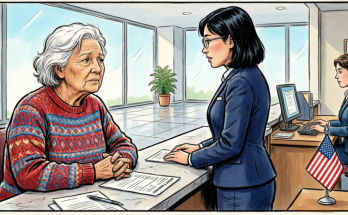
They Mistook My Grief for Weakness and My Silence for Permission — Until a Uniformed Officer Saluted Me at My Own Door
Chapter 1 — The Morning They Decided
Three days after we laid my husband to rest, my younger sister decided that my primary bedroom would make a perfect home office for her husband.
She did not ask me.
Neither did my parenTS.
At six-forty on a freezing Thanksgiving morning, I stood barefoot in the kitchen of my home in the foothills outside Colorado Springs, one arm wrapped around my seven-months-pregnant belly, while my mother carried cardboard boxes of my personal belongings toward the attached garage.
My husband, Tristan Larsen, had bought that house with me six years earlier, saving every spare dollar of his military pay.
He had replaced the old kitchen cabinets with his own hands, planted the young sugar maple beside the driveway, spent two summers turning the unfinished basement into a family room.
Now he was gone, and less than a week after his honor guard folded the flag, everyone around me had begun behaving as though I had vanished alongside him.
My sister, Priscilla, leaned against the granite island while her husband, Gregory, measured the doorway to my bedroom with his eyes.
“The natural light in there is perfect,” Gregory said.
“I could put my desk near the south windows and use that back wall for my video client meetings.” I stared at him, clutching my cardigan.
“That is my bedroom.” Priscilla sighed and adjusted her scarf as if I had interrupted a board meeting.
“Charlotte, you barely use that room.” “I sleep in it every night.” “You hardly sleep anyway,” she said, waving a hand.
And my father, Wayne, looked up from his black coffee at the table.
“Your sister is only trying to make the house useful again.” Useful again.
As though grief had rendered my home useless, and my husband’s boots by the closet and his half-read book on the nightstand were clutter waiting to be cleared.
I did not know it yet, standing barefoot on that cold tile, but before the sun was fully up, every person in that kitchen would understand exactly whose house it was, and exactly who I was, and would spend the rest of their lives reckoning with both.
Chapter 2 — The Garage
I turned to my mother, Beverly, hoping for some shred of maternal support.
She avoided my eyes, smoothing her apron as she picked up another tote.
“We moved some of your extra things to the garage,” she said softly.
“Just temporary, until we get everything sorted.”
For a moment I was certain I had misheard.
“You moved my belongings where?”
“The garage has plenty of space.”
“It’s twenty-eight degrees outside,” I said, watching frost creep across the edges of the kitchen windows.
Priscilla rolled her eyes.
“Nobody’s asking you to go live in the driveway forever, Charlotte.” And then Gregory laughed — not loud, just a small, condescending exhale, enough to tell the whole room that he found my protest amusing.
That quiet chuckle did something to me.
It closed a door somewhere deep in my chest that had been standing open, out of grief and exhaustion, for seven long monThS.
Because here is the thing they could not see, all four of them, standing in my kitchen dividing up my house three days after my husband’s funeral: they had mistaken my grief for weakness, and my silence for surrender, and my exhaustion for consent.
They had built an entire understanding of me — of who I was, and what I could be made to give up — on the evidence of a woman too shattered by loss to fight them over dishes and closeTS.
And they had no idea, none of them, that the woman they were casually banishing to a freezing garage had spent twelve years doing something none of them could have imagined, and that the reckoning for their mistake was, at that very moment, already on the road, three miles out and closing.
But I want to be honest, before I tell the rest, about what the reckoning actually was and what it was not, because it would be easy to tell this story as a tale of sweet revenge — the secret major, the convoy, the family’s faces when the colonel saluted — and that is not quite the story, and telling it that way would miss the only part that mattered.
I did not summon the convoy to humiliate my family.
I could not have; I did not know it was coming in that form, and its arrival had nothing to do with them.
The reckoning that mattered was not the vehicles in the driveway.
It was something quieter that the vehicles only happened to reveal: the simple, devastating exposure of what my family had always believed about me, and been wrong about.
For twelve years they had constructed a small and manageable Charlotte — a clerk, a pushover, a grief-softened woman whose bedroom was theirs for the taking — and they had built that construction not out of malice, exactly, but out of a failure to ever actually look at me, to ever ask a real question, to ever wonder whether the quiet woman at the end of the table might be someone other than the one their assumptions required.
The convoy did not defeat them.
It made it impossible, for one morning, to keep not-seeing me.
And the deepest reckoning was not their humiliation but their sudden, forced comprehension that they had been living beside a stranger for years — a stranger they had felt entitled to diminish precisely because they had never bothered to know her.
That is what the woman three days a widow understood, standing barefoot on the cold tile as the diesel engines grew louder down the road: that she was about to be seen, at last, by people who had never once tried to see her, and that being finally seen was going to cost every one of them something they did not yet know they were about to lose.
Chapter 3 — Seven Months of Silence
My parents had been under my roof for nearly seven monThS.
When Tristan’s unit first notified me that he was missing after a classified deployment in Eastern Europe, I had been unable to function.
I was newly pregnant, terrified, and carrying a grief I could not even fully explain to my friends, because so much of my husband’s work was classified by the federal government.
My mother had offered to stay two weeks to help me cook.
Then my father arrived with his luggage.
Then Priscilla began visiting every weekend with Gregory.
And by degrees, without any single moment I could point to, all four of them had come to treat my private home as a shared family estate.
At first I let it go, because I lacked the energy to do anything else.
When my mother reorganized my pantry and moved all my dishes, I said nothing.
When my father moved Tristan’s tools out of the workshop, I said nothing.
When Priscilla filled my guest closet with her wardrobe, I swallowed it and stayed quiet.
I told myself they were only trying to help me survive the worst thing that had ever happened to me, and that fighting over small things would only make a season of tragedy worse.
What I did not understand then — what I would only understand fully on Thanksgiving morning — is that every single time I chose silence, my family recorded it as permission.
Not as grief.
Not as generosity.
Not as a woman too devastated to argue.
As a yes.
Each swallowed objection, each thing I let slide to keep the peace, was filed away in their minds as evidence that I did not really mind, that I was fine with it, that the space and the things and the decisions were theirs to take.
My silence, offered as the white flag of a grieving woman, had been read the whole time as a signature.
And by Thanksgiving, they had stopped asking me anything at all.
They had simply begun announcing decisions already made.
I have thought a great deal since about how that translation error happens — how a person can say nothing, and have it heard as yes — because it is the mechanism that traps so many people in their own homes and their own families, and it trapped me for the better part of a year.
The problem is that silence has no fixed meaning.
It is a blank that other people fill in according to their own needs.
When I stayed quiet as my mother rearranged my kitchen, I meant something specific and, I thought, obvious: I am too devastated to have this conversation right now, please be gentle with me.
That is what my silence meant to me.
But my family did not receive the meaning I intended; they received the meaning that served them, which was: she doesn’t mind.
And because I never corrected the translation — because correcting it would have required exactly the confrontational energy that grief had drained out of me — the wrong meaning hardened, over months, into settled fact.
Each additional silence confirmed it.
By the time they were dividing up my bedroom, they were not being cruel in their own minds, or not only cruel; they genuinely believed, on the accumulated evidence of a hundred unopposed intrusions, that I was a person who did not defend her space, and that taking it was therefore not a violation but simply the way our family worked.
I had, through nothing but exhausted silence, taught them that lesson myself.
This is the cruel bind of the grieving and the depleted: the very state that makes you unable to defend your boundaries is read, by the people crossing them, as consent to their crossing.
Your weakness does not summon their protection.
It rewrites, in their minds, the terms of what you are owed.
And the only way out, I learned, is the one thing grief makes hardest — to break the silence, once, unmistakably, and say the true thing out loud, so that it can no longer be translated into its convenient opposite.
Chapter 4 — Whose Name Is on the Deed
My father set his coffee mug down with a dull thud.
“Gregory needs a proper workspace.
His consulting business is expanding fast.”
“Then Gregory can rent an office downtown,” I said, standing my ground by the counter.
Priscilla’s face tightened.
“Why would he waste thousands a month on rent when you have a whole master suite sitting mostly empty?”
“Because that room belongs to me.
It’s my sanctuary.”
My father shook his head.
“Don’t start making this about petty legal ownership, Charlotte.” I almost laughed aloud.
What was a conversation about grown adults clearing out my bedroom supposed to be about, if not ownership?
“Whose name do you think is on the property deed?” I asked him.
He stared, then waved a hand.
“That’s not the point.” “It is precisely the point.” My mother stepped between us, hands raised.
“Everyone’s getting too emotional.
Let’s not ruin Thanksgiving.” And I looked her dead in the eye and refused to let her dodge it.
“You carried your pregnant daughter’s clothes and keepsakes into a freezing garage three days after her husband’s funeral.
And you want to accuse me of ruining Thanksgiving?” She opened her mouth, and nothing came out, and she turned her face away.
I want to note that I had, in that exchange, finally said the true thing out loud — whose name is on the deed — and that it had changed nothing in their faces, because ownership had never been the operative fact in my family.
The operative fact had always been power: who could be worn down, and who could do the wearing.
The deed was mine.
But they had spent seven months proving that in our family, the law of the house was not property.
It was persistence.
And they had every reason to believe, that morning, that persistence would win again.
Chapter 5 — What They Never Knew
For my entire adult life, my family had believed I worked a dull administrative job for the Department of Defense.
That belief had been entirely deliberate, built over years of operational security.
For twelve years I had served on active duty in the United States Army, rising to the rank of major, specializing in intelligence coordination and tactical planning.
My work involved assignments I was legally and ethically forbidden to discuss with anyone lacking clearance — including my own family.
Tristan had served in a parallel capacity within a joint task force, and so we had both learned early that keeping our work from relatives was not a personal slight but a basic requirement of the job.
When curious relatives asked what I did on base, I would smile and say I managed digital logistics records.
My family filled in the rest with their own assumptions.
Priscilla believed I had briefly played soldier in my early twenties before settling into a desk job.
My father thought of me as a low-level civil servant who took the occasional routine business trip.
None of them knew that I was still an active major with top-secret clearance.
None of them knew that Tristan’s final mission had triggered security reviews that were, even then, underway.
And absolutely none of them knew that late the previous night, an encrypted emergency message had reached a secure terminal in my study, instructing me to remain inside my residence and wait for military transport at first light.
I had spent the night expecting something routine — an unmarked sedan, two junior officers, some clearance paperwork.
I had not expected what was about to turn onto my quiet street.
Chapter 6 — The Vehicles in the Driveway
At exactly seven-eighteen, the deep rumble of diesel engines vibrated up through the floorboards.
Gregory pulled back the window curtain.
“Are you expecting a delivery, Charlotte?”
I said nothing, arms crossed over my cardigan, watching.
Three massive blacked-out military utility vehicles turned slowly into my driveway, blocking the path to the garage, followed by two dark support sedans with low-profile antennas on their roofs.
My mother went pale, her hand pressed to her mouth.
My father dropped his newspaper.
Priscilla rushed to the window, her voice climbing.
“What is happening in our driveway?”
Our driveway. I pulled my cardigan tight around my shoulders and took a steadying breath.
“They’re here for me,” I said.
The room fell into a heavy, total silence as my family stared.
I walked past all of them, unlocked the heavy oak door, and stepped out onto the cold porch, and the crisp mountain air hit my face and cleared away the last of the kitchen’s tension.
A senior officer in full dress uniform stepped from the lead vehicle, flanked by two members of a security detail who fanned out to hold a professional perimeter.
He marched up the walkway, halted at the foot of the porch steps, and rendered a crisp salute.
“Major Ellison.” Behind me I heard a clatter as my father, following me out, dropped his coffee mug onto the deck.
I raised my hand and returned the salute with perfect form.
“Colonel.”
Chapter 7 — Major
“Ma’am,” the colonel continued, “your emergency transport order has been cleared by headquarters.
We need to verify the primary secured case and relocate you to the secure facility immediately.”
“Understood, Colonel,” I said.
Gregory had come out behind my parents, car keys motionless in his hand.
Priscilla looked between the soldiers and me, her jaw slack.
“Major?”
I glanced at her over my shoulder.
“Yes, Priscilla.”
My father stumbled down the porch steps, his voice shaking.
“You’re an active major in the United States Army?” “I have been for quite some time, Dad.” He looked at me as if at a stranger.
“You told us for years you worked in an administrative supply office.” “I told you the operational narrative I was legally authorized to share with civilians,” I corrected him gently.
Priscilla folded her arms, her shock curdling into anger.
“So you’ve been lying to your own family for over a decade?” “Protecting classified national security information is not the same as lying for personal advantage,” I said.
And I felt, standing on my own porch in the cold, the strange vertigo of watching my family meet, for the first time, a version of me that had been standing in front of them their whole lives, fully formed, entirely unseen.
They had constructed a small, manageable Charlotte — the clerk, the desk worker, the one who could be badgered out of her own bedroom — and reality was now dismantling that construction in front of them, salute by salute, and they could not look away, and they could not make it stop.