I Convinced Myself She Left Me — Then I Found the Voicemails My Assistant Had Deleted
Chapter 1 — The Interrupted Signature
Six months after my divorce became final, I was sitting at the head of a massive mahogany table in a sleek Atlanta boardroom, about to sign the most lucrative contract of my career.
My construction company was on the verge of a landmark commercial deal worth nearly a billion dollars.
I never answered unknown numbers during critical meetings.
But that morning, on the third ring, some impulse I have never been able to explain made me pick up the phone.
“Mr.
Callahan, my name is Dr.
Ingrid Lindqvist, and I’m calling from Saint Thomas Memorial Hospital in Nashville,” a woman said with quiet urgency.
“Your son was delivered prematurely this morning.”
For several seconds I was certain she had the wrong number, and I just sat there staring at the polished wood while nine nervous investors, two corporate attorneys, and my business partner waited across the table, and a signature line worth nine hundred and forty million dollars waited in front of me.
“I’m sorry,” I said, my voice barely above a whisper.
“My what?” The doctor paused.
“Your son, sir.
His mother is Rosalie Holt.” And the entire boardroom, the contract, the nine figures, the whole architecture of the life I had built, faded into total insignificance.
Rosalie was my ex-wife.
The woman I had not spoken a single word to in half a year, and had convinced myself wanted a life entirely separate from mine.
“Is Rosalie okay?” I asked, forgetting the contract beneath my hands completely.
“She developed serious complications and we delivered at thirty-two weeks,” Dr.
Lindqvist said carefully.
“She’s stable.
But she and the baby both need close observation.” I stood so fast my heavy chair rolled back and struck the glass wall.
“Why are you calling me?” And after another pause, the doctor said the words that reshaped my entire existence.
“Because Ms.
Holt listed you as the biological father.”
Chapter 2 — The Man I Was Proud to Be
My name is Alexander Callahan, and at forty-three I had built Callahan Enterprise into one of the largest privately owned construction firms in Georgia.
People in my industry described me as disciplined, hyper-focused, and impossible to distract.
For years I had taken enormous pride in exactly those words.
That morning, holding a phone to my ear in a boardroom, they sounded cold and empty, and I began, for the first time, to understand them as a kind of accusation.
Because a man impossible to distract is also a man impossible to reach.
A man hyper-focused on a contract is a man not focused on a wife who feels invisible, or a phone call from a frightened woman, or the possibility that his own life contained something more important than a signature line.
The traits I had spent a career sharpening into a competitive advantage were, I would spend the next several weeks discovering, the exact traits that had nearly cost me my son.
And standing there, I suddenly remembered a night I had spent six months forcing myself to forget.
It had happened shortly before Rosalie and I finalized the divorce, when a massive ice storm grounded every flight across the South.
Rosalie had come by our old penthouse to collect a few last boxes, and neither of us had meant to stay more than ten minutes.
But the storm trapped us inside, and so we ordered food, and opened a bottle of wine, and for the first time in over two years we stopped arguing and talked, honestly, about the early years, about why we had fallen in love in the first place.
For one night, the enormous distance between us simply vanished.
And by morning, reality returned.
My work phone rang before sunrise with a structural emergency on a job site, and I rushed out to handle it without waking her, leaving no note, no explanation, nothing.
I had thought of that morning, in the months since, only as an awkward loose end.
I did the math now, standing in the boardroom, and my stomach dropped straight through the floor.
Chapter 3 — Four Pounds, Three Ounces
“How much does he weigh?” I asked the doctor, my voice trembling.
“Four pounds, three ounces.
He’s on respiratory support in our neonatal intensive care unit,” Dr.
Lindqvist said.
“He’s very small.
But he’s fighting hard.”
I capped my pen and closed the heavy blue folder that held the development contract.
Across the table, my business partner, Damian Ellery, stared at me in shock.
“Alexander, what on earth are you doing?” Damian demanded, gripping the edge of the table.
“We have twenty investors waiting downstairs right now.”
I took my wool coat off the rack and looked him in the eye.
“My son was just born,” I said.
And nobody in that room dared to say another word as I walked out the door.
I want to mark that moment, because it was the first genuine choice I had made in years that was not about the business — the first time in longer than I could remember that I had heard the words money and son in the same minute and not had to think, even for a second, about which one I would stand up for.
A better man would not have needed the contrast to know himself.
But I was not yet a better man.
I was only, that morning, beginning to become one, and it had taken a phone call about a four-pound stranger to start.
And I have wondered, in the time since, how many men never get that phone call, or get it and let it ring, and go on to the ends of their lives never learning what I learned that morning in a boardroom with a pen in my hand: that when the choice between everything you have built and someone you are meant to love finally arrives, undisguised, in a single ringing moment, the whole of your character is nothing more or less than which one you stand up for.
I nearly stood up for the contract.
I will be grateful to the end of my days that, for once, I did not.
Chapter 4 — Room Four-Seventeen
I barely remember the drive up to Tennessee; my mind was a single unbroken loop of racing thought and deepening regret.
When I finally reached Saint Thomas Memorial, Dr.
Lindqvist was waiting outside the maternity unit.
“Before you go into room four-seventeen to see Ms.
Holt,” she said, with a direct and solemn gaze, “I need you to understand something.
She went through almost this entire high-risk pregnancy completely alone, without a partner beside her.
So whatever grievances exist between you two stay outside that door.”
Her tone stung, but I had no right to be defensive.
“I honestly had no idea she was pregnant,” I said quietly.
Dr.
Lindqvist studied my face for a long moment.
“According to Rosalie,” she said, “she tried extraordinarily hard to tell you.
Many times.” And that single sentence was the first crack in the comfortable story I had been telling myself for half a year.
I took a breath, and opened the heavy door, and stepped inside.
Rosalie looked smaller and more fragile than I had ever seen her, her dark hair tied back in a messy knot, no makeup, none of the vibrant energy she carried into every room.
When she opened her eyes and saw me at the foot of her bed, her weary sadness turned to disbelief.
“You actually came,” she whispered.
“The hospital called my direct line,” I said, stepping closer.
“You listed me as his father.” Tears welled in her hazel eyes.
“Because you are his father, Alexander.”
Chapter 5 — How Many Closed Doors
I pulled a small wooden chair to her bedside and sat, a heavy weight settling in my chest.
“Why didn’t you tell me sooner?” I asked, and it was the wrong question, and I knew it the moment it left my mouth.
Rosalie looked at me for a long moment, and wiped a tear from her cheek.
“Alexander.
I tried to tell you dozens of times.”
I shook my head, genuinely confused, because I truly had no memory of her reaching me.
“What do you mean, you tried?”
She took a slow, painful breath and began to list them.
“I called your office line, over and over.
I sent emails.
I tried your private cell.
And when none of it worked, I drove to your headquarters.
Twice.” “You came to the office?” “The first time, I had taken three positive tests that morning,” she said, her voice fragile.
“The second time I was almost twelve weeks along and had the first ultrasound photo in my purse.
Your security guard wouldn’t let me past the lobby elevator.
The front desk told me you’d given strict instructions that no personal visitors were allowed upstairs, under any circumstances.” And a sick wave of guilt went through me, because that part was true.
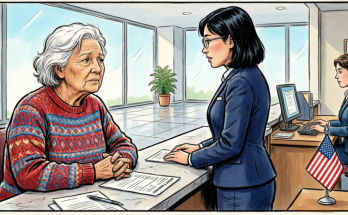
After the separation, I had told my executive assistant, Theresa, to shield me from any personal distraction connected to the divorce.
“I called your divorce attorney too,” Rosalie added.
“He said all communication had to go through your office, and promised he’d pass the message along.” “He never said a word to me,” I confessed, my voice cracking.
“Nobody told me anything.” “Nobody let me through,” Rosalie corrected softly, looking straight into my eyes.
“How many closed doors was I supposed to stand in front of before I finally accepted that you just didn’t want me in your life anymore?” I had no answer.
The walls I had built to keep my grief out had, it turned out, been perfectly designed to keep my own child out too.