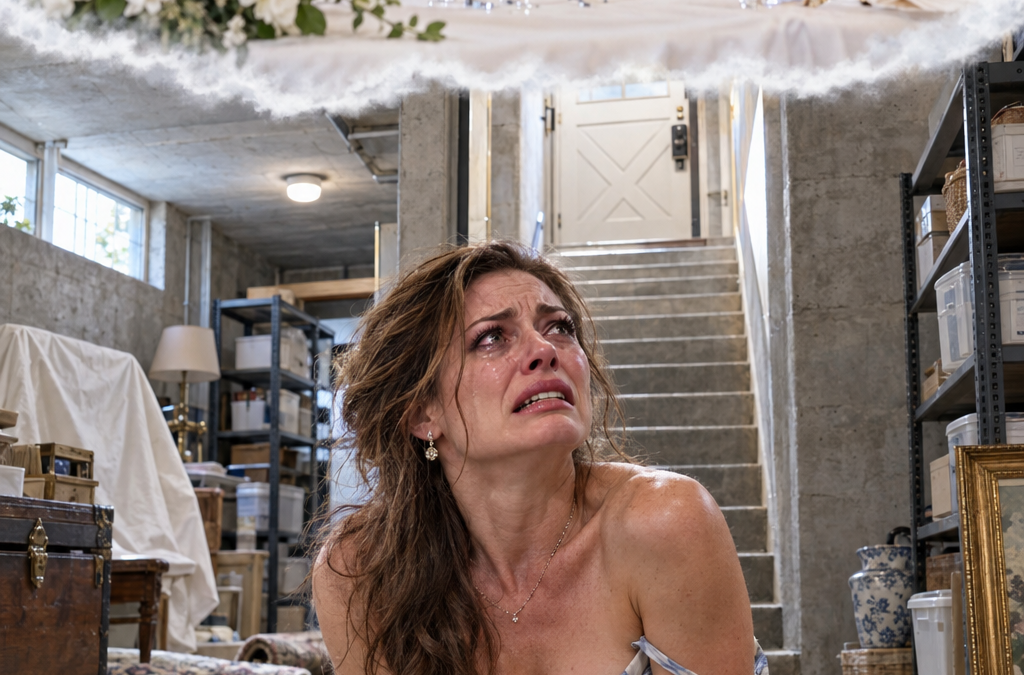
The Mistress Locked Me In The Basement, Taking My Place At My Husband’s Celebration. The Partner Smashed A Glass, Halting The Contract. “Didn’t Your Wife Say I’m Her Brother? Who Gave You The Guts To Impersonate My Sister?”
My husband locked me in our basement, dressed his mistress in the gown I had designed, fastened my late mother’s emerald necklace around her throat, and took her to the biggest business gala of his life as “Mrs. Cole.” He believed no one there had ever met me, so the lie would be perfect. What Adrian didn’t know was that the investor he was desperate to impress was my older brother—and by the time I escaped that basement, I was done protecting the man who had quietly built his entire empire from my money, my code, and my name.
### Part 1: The Woman Wearing My Life
The click of the basement lock was so soft that, for one stupid second, I wondered whether I had imagined it. Then I heard Sienna Blake’s heels crossing the hardwood floor above me—sharp, measured taps that moved from my bedroom toward the staircase—and I knew exactly what Adrian had done. I sat on an old leather couch under the weak emergency light, still wearing the cream cotton nightgown I had slept in, and twisted the fabric between my fingers until my knuckles turned white. The basement smelled of concrete, dust, and the cardboard boxes Adrian had insisted we store instead of throw away.
“Adrian, are you sure this dress looks right on me?” Sienna called from upstairs, her voice floating through the vents with practiced sweetness. “I don’t want to look like I’m trying too hard.” My husband answered in the gentle voice he used whenever he wanted to sound patient and generous. “You look perfect. Tonight, you’re Mrs. Cole, so act like it.”
I stood so quickly the couch springs complained beneath me. For several seconds, I stared at the steel door as though I could see straight through it to the woman wearing the ivory silk gown I had commissioned three months earlier. The magnolia embroidery along the skirt came from sketches I had drawn myself at our kitchen island, correcting petal shapes until two in the morning because my mother had loved magnolias. That gown had not been made merely for a party; it carried pieces of my history stitched into every inch.
Then Sienna asked the question that changed something permanent inside me. “What about the green necklace?” Adrian didn’t hesitate. “Wear the whole set. The investors tonight are old money. We need to look the part.”
I crossed the basement and pressed both palms against the door. The emerald necklace had belonged to my mother, Margaret Mercer, and before that to her mother. Mom fastened it around my neck on my wedding morning and told me that Mercer women were supposed to remember who they were, especially after they took someone else’s last name. She died two years later, and the necklace became one of the few objects in my house I still treated as sacred.
“Open the door,” I said.
The voices upstairs stopped. Adrian finally approached, his shoes moving slowly toward the basement hallway, and when he spoke through the door his tone held the same patronizing calm he had perfected over three years of marriage. “Evelyn, we’ve already discussed this. You haven’t been sleeping. You’re overwhelmed. Tonight is too important for another emotional episode.”
Another emotional episode. That was what he called exhaustion after I spent a month rebuilding the financial projections for Cole Dynamics’ international expansion while he slept beside me. I had recently spoken with a doctor because I was averaging three hours of sleep, and Adrian had turned that ordinary appointment into evidence that I was unstable. “I’m exhausted because I’ve been doing your work,” I said. “Now open the door.”
“See?” he replied. “You’re angry. That’s exactly why you shouldn’t be there.”
I closed my eyes. Three years earlier, I would have argued until my throat hurt, then cried, then apologized for raising my voice. That was the rhythm Adrian had trained into our marriage: he crossed a line, I protested, he questioned my reaction, and somehow we ended with me explaining why I was sorry. That night, standing barefoot on cold concrete, I finally heard how absurd the entire pattern sounded.
“The dress is mine,” I said. “The necklace is mine.”
“We’re married, Evelyn. Stop dividing everything into yours and mine.” His irritation finally surfaced. “Tonight determines the future of this company. If you actually care about what we’ve built, stay downstairs, calm down, and let me handle this.”
What we had built. I almost laughed.
Cole Dynamics had started with three million dollars from my personal investment account. Its predictive financial engine came from research I had completed during graduate school at Stanford. Its first enterprise clients came from people I had known since college, people Adrian had never met until I introduced him. He was charismatic, tireless, and brilliant at making a room believe he was the smartest person inside it, but the structure underneath the performance—the money, models, forecasts, relationships—had come from me.
For years, I had called that partnership.
Standing behind that locked door, I finally understood that Adrian called it ownership.
Sienna murmured something I couldn’t hear, and he laughed. “Come on. The car’s waiting.”
Their footsteps moved away. A front door closed. An engine started outside, then faded down the gravel drive until our enormous Woodside house became silent enough for me to hear the emergency light humming above my head.
I pressed my forehead against the steel door and felt nothing close to heartbreak. What I felt was clarity.
Adrian believed he had hidden me because hardly anyone in his business world had seen his wife. He had spent years telling people I hated networking, hated publicity, hated being photographed, while telling me corporate dinners bored him and there was no reason for me to attend. He had separated two versions of his life so carefully that Sienna could apparently step into mine with a different face and no one would question it.
But there was one person at that gala who would question it.
Nathan Mercer.
My older brother.
Adrian knew that the lead investor in tonight’s expansion round was Mercer Ventures. What he did not know was that Nathan Mercer, the firm’s founder and managing partner, was my brother. I had deliberately kept the connection quiet because I wanted Adrian’s company evaluated on its merits instead of my last name.
Now my husband was heading toward a ballroom full of cameras with another woman wearing my mother’s necklace, preparing to introduce her to my own blood.
I turned away from the door and scanned the storage shelves. Years earlier, before Adrian renovated the security system, the estate had been wired with an old internal intercom. He hated the ugly wall panels and covered most of them, but I remembered one behind a shelving unit in the basement because our family security director had tested it after I moved in.
I dragged two boxes aside and found the faded plastic panel beneath a layer of dust.
My finger hovered over the call button.
Then I pressed it.
Static hissed for three seconds before a familiar voice answered. “Security.”
“Victor,” I said.
There was a pause.
“Ms. Mercer?”
“It’s me. I’m locked in the lower basement.”
His tone changed instantly. “Are you injured?”
“No.”
“I’m coming.”
The line went dead.
I sat back on the couch and looked at my bare hands. My wedding ring caught the weak light.
Adrian thought he had bought himself an evening without me.
What he had actually bought was the first three minutes of the end of our marriage.
### Part 2: The Brother Adrian Never Asked About
Victor Ruiz opened the basement door with a speed that told me he had not wasted time searching for Adrian’s missing key. He had worked security for my family for almost twenty years, first for my father and later for Nathan, and when I married Adrian, Nathan quietly assigned Victor to oversee the Woodside property under the harmless title of estate manager. Adrian barely noticed him. To Adrian, anyone who opened gates, checked cameras, or managed contractors existed somewhere below the level of people worth remembering.
Victor looked at my nightgown, my bare feet, and the dark room behind me. His jaw tightened. “Where’s your phone?”
“Adrian took it.”
“I know.” He pulled a backup phone from his jacket. “Your brother had me keep this active in case you ever needed a private line.”
That annoyed me almost as much as it comforted me. Nathan had never liked Adrian, and for years I had dismissed his distrust as older-brother arrogance. Now, holding the phone Nathan had apparently prepared for an emergency I insisted would never happen, I had to admit he had understood my marriage better from the outside than I had from inside it.
Before calling him, I went upstairs to change. My walk-in closet looked as if someone had raided a luxury department store during an earthquake. Empty hangers covered the carpet, drawers had been left open, and one of Sienna’s lipstick-stained coffee cups sat on the vanity beside a velvet jewelry tray she had emptied.
Most of my evening clothes were gone.
She had not touched the ivory business suit buried behind two winter coats.
I pulled it out slowly. I had bought it before my wedding, back when I still wore structured jackets to investor meetings and technical presentations. Adrian used to tease me about dressing like I was preparing to acquire somebody’s company, and after we married he gradually convinced me that I had no reason to dress that way anymore. “You’re not interviewing,” he would say. “You don’t have to impress anyone.”
I changed into the suit.
Looking in the mirror, I almost failed to recognize myself. My hair was messy, I had no makeup, and exhaustion had left shadows beneath my eyes, but the woman staring back at me looked more familiar than the carefully softened version Adrian preferred. I pulled my hair into a low ponytail, slipped into a pair of black heels I had not worn in years, and turned on the backup phone.
Victor stood by the doorway. “Should I call your brother?”
“I will.”
Before I did, I searched for the gala livestream.
Adrian had arranged extensive press coverage because he wanted the evening to announce Cole Dynamics as the next major Silicon Valley infrastructure company. The screen filled with chandeliers, champagne, dark suits, evening gowns, and a stage displaying his company’s logo. More than two hundred investors, executives, reporters, and potential partners circulated through the ballroom.
Then the camera found Sienna.
My breath stopped.
She wore the magnolia gown. My mother’s emerald necklace rested against her collarbone. On her wrist was my Cartier watch, and her hair had been styled in the same low swept-back shape I often wore for formal dinners.
It wasn’t only theft.
It was imitation.
A reporter leaned toward her with a microphone. “Mrs. Cole, people are saying you played an important role in the international expansion strategy. How involved were you?”
Sienna smiled modestly.
“I just helped my husband here and there. Adrian is the visionary.”
I almost laughed at the word.
The reporter asked how the expansion architecture had been developed.
“Honestly, a lot of it started around our dinner table,” Sienna said. “Adrian would throw out ideas and I would help organize them.”
I remembered the actual dinner table. Adrian eating takeout while I ran revenue simulations on two laptops, explaining for the third time why his assumptions would create a catastrophic cash-flow gap in Europe. He had barely looked up from his phone.
What disturbed me most was not that Sienna lied.
It was how naturally she lied as me.
For three years she had served as Adrian’s executive assistant. She had been inside our house often enough to observe the way I spoke, the clothes I wore, even the small tilt of my head when someone complimented me. She had not merely been sleeping with my husband.
She had been studying his wife.
I closed the livestream and called Nathan.
He answered after one ring.
“Evelyn?”
His voice was instantly alert. That phone number told him something was wrong before I spoke.
“Where are you?”
“St. Regis. I just arrived. Where are you? Adrian said you’d be—”
“He locked me in the basement.”
Silence.
Not confused silence.
Dangerous silence.
“What did you say?”
“He locked me in the basement, took my phone, and brought Sienna Blake to the gala wearing my dress and Mom’s emeralds.”
Another pause followed.
Nathan never shouted when he was furious. Our father used to say the quieter Nathan became, the more expensive somebody’s next hour was about to become.
“Are you safe?”
“Yes. Victor got me out.”
“Good. Come here.”
“I’m already changing.”
“No. Listen carefully.” His voice became sharp and controlled. “Use the VIP entrance. Go to the thirty-sixth-floor lounge. Don’t enter the ballroom until I tell you.”
“What are you planning?”
“I’m going to let Adrian introduce his wife to me.”
I closed my eyes.
“Nathan.”
“What?”
“Don’t do anything reckless.”
He gave a humorless laugh. “He locked my sister in a basement and put our mother’s necklace on his mistress. I think my definition of reckless has adjusted.”
The line disconnected.
Victor drove while I watched the livestream from the back seat. Adrian moved through the ballroom with Sienna’s hand resting lightly on his arm. Every photograph made them look polished, wealthy, established, and perfectly married.
They looked like a magazine version of the life Adrian had decided he deserved.
When we reached the hotel, Victor took me through a private garage and up to the lounge. Floor-to-ceiling windows showed San Francisco glittering below, indifferent to the small disaster unfolding thirty-eight stories above the street. On my phone, the master of ceremonies announced that the formal investment presentation was beginning.
Then Nathan entered the ballroom.
Adrian practically hurried across the room to greet him.
Nathan did not take the hand Adrian extended.
Even through a phone screen, I could see the first crack appear in my husband’s confidence.
Then Nathan looked past him.
Straight at Sienna.
“Who is this?” my brother asked.
Adrian smiled.
“My wife.”
Sienna stepped forward wearing my face without my face.
“Mr. Mercer,” she said warmly. “I’ve heard wonderful things about you.”
Nathan stared at her.
At the emeralds.
At the gown.
At the woman pretending to be his sister.
My phone buzzed.
A message appeared.
Signing starts in five minutes.
Then another.
Wait until you hear glass break.
I read it twice.
For the first time that night, my heartbeat accelerated.
### Part 3: The Glass That Ended Everything
The ballroom quieted when Nathan took his seat at the signing table. Adrian sat across from him with two copies of the proposed agreement between them, smiling for the cameras as though the most important moment of his professional life had finally arrived. Mercer Ventures was expected to lead a financing package large enough to turn Cole Dynamics from an ambitious American company into a global platform, and Adrian had spent months telling everyone the deal would prove he belonged among Silicon Valley’s elite.
Nathan opened the agreement.
He turned each page slowly.
Adrian had already signed his copy. Now he waited with his pen resting between his fingers, tapping once against the table, then again. Nathan continued reading long after any ordinary ceremonial review would have ended.
Finally, he closed the folder.
“Mr. Cole.”
Adrian’s smile tightened. “Yes?”
Nathan picked up a wineglass.
“Did your wife ever mention that she has an older brother?”
Every muscle in Adrian’s face seemed to stop working.
Nathan looked toward Sienna.
The wineglass slipped from his hand.
Crystal exploded against the signing table.
I locked my phone and stood.
The elevator ride from the thirty-sixth to the thirty-eighth floor lasted only seconds. When the doors opened, the hallway outside the ballroom was unnaturally quiet, as though the building itself was listening. Victor followed half a step behind me while I walked toward the mahogany doors.
I pushed them open.
More than two hundred heads turned.
Nathan stood beside the signing table. Adrian sat frozen across from him, his face drained of color. Sienna remained in the front row with both hands gripping my gown.
Nathan’s eyes found mine.
He looked back at Adrian.
“Let me ask again,” he said. “The woman you introduced as Evelyn Cole. You’re certain she’s your wife?”
Adrian finally turned.
He saw me.
I watched recognition become disbelief, then panic.
“Evelyn?”
His voice sounded smaller than I had ever heard it.
I walked into the ballroom without answering. Each click of my heels echoed farther than it should have, and the crowd seemed to part automatically as I approached the stage.
Sienna’s face changed when I passed her.
For an instant, she looked less like a mistress and more like an employee who had just realized the real owner had entered the room.
Adrian stood so abruptly that his chair struck the backdrop behind him.
“How did you—”
“Get out?” I finished. “Of the basement you locked me inside?”
A collective gasp moved across the room.
There are moments when a lie collapses so completely that trying to repair it only makes the destruction more visible. Adrian understood that. I saw it in the way his eyes moved from me to Nathan to the journalists standing near the stage.
“Evelyn, please. This is not—”
“Ladies and gentlemen,” I said, turning toward the room, “my name is Evelyn Mercer Cole. Nathan Mercer is my brother. Adrian Cole is my husband.”
I looked at Sienna.
“And that woman is not me.”
The ballroom erupted.
Questions flew from reporters. Guests leaned toward one another. Phones appeared everywhere as people realized they were watching something much bigger than a failed investment signing.
Sienna stood.
Her confidence disappeared so quickly it was almost painful to watch.
“Evelyn, there’s been a misunderstanding.”
“No.”
“I can explain.”
“No.”
I walked toward her.
She instinctively stepped backward.
My mother’s emerald necklace glowed against her skin.
“Take it off.”
Her hands rose to the clasp but shook so badly she couldn’t open it.
“Evelyn,” Adrian said. “Don’t do this here.”
I looked at him. “You decided where to do this.”
Sienna finally managed to unfasten the necklace and dropped it into my palm. I closed my fingers around the cool stones, then waited while she removed the matching earrings.
Nathan came down from the stage and stood beside me.
Adrian stared at him. “Mr. Mercer, I understand how this looks.”
Nathan’s expression barely changed. “Do you?”
“This is a marital matter.”
Nathan gave one quiet laugh.
“The Woodside property is my sister’s. The seed capital came through my sister. Your company’s original financial architecture was built by my sister. Your earliest clients were introduced by my sister.” He looked Adrian up and down. “I’m trying to identify which portion of your success you consider separate from this marital matter.”
Adrian’s jaw tightened.
For years, he had been able to control every room because he was usually the most confident person in it. Nathan did not need to perform confidence. He had grown up with it.
Sienna suddenly stepped forward, tears already gathering in her eyes.
“Mr. Mercer, Adrian told me to do this.”
My husband’s head snapped toward her.
She continued quickly. “He said Evelyn wasn’t coming and investors expected him to appear with his wife. He told me nobody would know.”
“Sienna,” Adrian warned.
“I didn’t plan this.”
I looked at her.
“You wore my mother’s jewelry.”
She stopped.
“You wore my clothes.”
Her mouth opened.
“You answered questions using my work.”
Her eyes dropped.
“Whatever Adrian promised you, you chose to participate.”
She began crying.
I felt nothing.
Nathan returned to the signing table. The agreement was stained where the wineglass had shattered. He lifted the papers, examined them once, and tore them down the middle.
Every phone in the room seemed to rise higher.
“Mercer Ventures is withdrawing from this transaction,” he said. “Our attorneys will issue formal notice.”
Adrian moved toward him. “Nathan, wait.”
Nathan did not.
The second tear divided the agreement again.
Paper fell across the table.
“This is insane,” Adrian said. “You cannot jeopardize a company employing thousands of people because of a family dispute.”
Nathan looked at me.
I understood what he was doing.
He was giving the decision back to me.
I faced Adrian.
“For years, every time you hurt me, you found something larger to hide behind. The company. Investors. Employees. Deadlines. Reputation.” My voice remained steady. “Tonight you locked your wife in a basement so your mistress could impersonate her, and you’re still talking about the company.”
His expression hardened.
That was when I knew the apology I might have expected was never coming.
He did not see what he had done to me.
He saw what I might do to him.
“Evelyn,” he whispered. “You’re destroying everything.”
I slipped my mother’s necklace into my jacket pocket.
“No, Adrian. I’m just not holding it together for you anymore.”
Nathan and I walked toward the exit.
Adrian followed two steps.
“Evelyn.”
I stopped but didn’t turn.
“We need to talk privately.”
“Have your lawyer contact mine.”
“You don’t have a lawyer.”
I finally looked back.
“I will by morning.”
The doors closed behind us.
Inside the elevator, my hands began shaking.
Nathan noticed.
“Let me see.”
“I’m fine.”
“Your hand.”
I opened my fist. My nails had left deep crescent marks in my palm.
Nathan handed me a folded handkerchief and leaned against the elevator wall.
“I’m sorry,” I said.
“For what?”
“The investment.”
His face tightened in irritation.
“Money is replaceable.”
“It was a huge deal.”
“You’re my sister.”
I looked down at the emerald stones visible inside my pocket.
Nathan continued. “And for what it’s worth, our due diligence team had already found problems. Related-party transactions. Unexplained vendor payments. Revenue that didn’t reconcile.”
I looked up.
“What kind of problems?”
“The kind that make me grateful I never signed.”
The elevator doors opened.
Nathan stepped out, then glanced back at me.
“What are you going to do about Adrian?”
I followed him into the garage.
“Divorce him.”
The answer came without hesitation.
For three years I had been afraid that leaving my marriage would mean admitting I had failed.
That night, I understood staying would be the failure.
### Part 4: I Audited My Own Marriage
I did not sleep that night. By one in the morning I was sitting in the study of Nathan’s penthouse with my laptop open, a legal pad beside me, and enough coffee to make my hands tremble even without adrenaline. Once I stopped thinking of Adrian as my husband and started examining our marriage like a failed investment, the numbers became easier to look at.
The first problem appeared in the seed funding.
Three years earlier, I had moved three million dollars from my investment account into Cole Dynamics during its earliest financing round. Adrian told me the money would be used to hire engineers, lease cloud infrastructure, and build the first sales team. Instead, a portion had traveled through several consulting entities before landing in a company called Blake Strategic Media.
Sienna Blake.
I stared at the name.
Then I kept digging.
More payments followed.
Brand strategy.
Executive advisory.
Market development.
Services Cole Dynamics already employed full-time teams to perform.
Over three years, millions of dollars had moved through companies associated with Sienna.
The affair was ugly.
The financial trail was worse.
At nine the next morning, I emailed my old college roommate, Claire Donovan, now a partner at one of San Francisco’s most respected family-law firms. My message contained only three sentences.
I’m filing for divorce.
It involves a tech company, hidden assets, and intellectual property.
I need you today.
Her response arrived in less than five minutes.
Two o’clock.
By then, reporters were calling the backup phone. I rejected requests from business networks, newspapers, technology sites, and one television producer who apparently believed I wanted to discuss my humiliation live before dinner. I said nothing publicly.
At Claire’s office, I told her everything.
She listened without interrupting until I placed a flash drive on her desk.
“What’s that?”
“Financial records.”
She inserted it into her computer.
For ten minutes, only the sound of her keyboard filled the office.
Then she leaned back.
“Evelyn, this is not just an affair.”
“I know.”
“If these records are accurate, your husband may have diverted company funds through entities connected to his mistress.”
“I know.”
Claire looked at me carefully. “What do you want?”
There had been a time when that question would have frightened me.
Now it didn’t.
“The Woodside house is separate property. I keep it.”
She nodded.
“I want a full forensic accounting of every marital and corporate asset he moved.”
Another note.
“My investment position needs to be addressed.”
“Absolutely.”
“And I want my intellectual property back.”
Claire’s pen stopped.
“What intellectual property?”
I explained the predictive architecture Adrian had used as Cole Dynamics’ technical foundation. The original work predated our marriage. I had developed it at Stanford, published portions academically, and later adapted parts for Adrian when he founded his company.
“Did you sign an assignment?” she asked.
“No.”
“A license?”
“No.”
“Any document transferring ownership?”
“No.”
Claire slowly lowered her pen.
“Does Adrian know that?”
“I doubt it.”
For the first time since I entered her office, she smiled.
“That may be your strongest leverage.”
Three days passed.
Adrian called seventeen times.
His first message sounded apologetic.
Evelyn, I know I made a terrible mistake. Please let me explain.
The second sounded desperate.
Don’t let Nathan make decisions for you.
The third sounded offended.
We are married. You owe me one conversation.
I answered none of them.
Then Sienna arrived at Nathan’s building.
Victor called from downstairs.
“She says Adrian fired her.”
I almost laughed.
Of course he had.
Five minutes later, Sienna sat across from me wearing sweatpants and an oversized sweatshirt. Without the formal makeup and borrowed jewelry, she looked younger than I remembered and far less powerful.
“Adrian blamed everything on me,” she said.
I said nothing.
“He told the board I impersonated you without permission.”
“Did you?”
She looked down.
“No.”
“Then tell them that.”
“He threatened me.”
Still nothing.
Sienna reached into her bag and placed a flash drive on the table.
“I have messages. Recordings. Documents.”
I did not touch it.
“What documents?”
“A shareholder agreement.”
That caught my attention.
She swallowed.
“Adrian arranged for fifteen percent of Cole Dynamics to be held under my name.”
“Why?”
Her face flushed.
“He said it was temporary.”
“That isn’t an answer.”
She stared at her hands.
“If he divorced you, the shares were supposed to remain outside the marital estate.”
There it was.
Not impulsive cheating.
Planning.
“Since when?”
“Eight months.”
I felt something inside me go completely still.
Eight months earlier, Adrian had taken me to Napa for our anniversary. He booked the suite where we spent our honeymoon, ordered my favorite dinner, and told me he could not imagine his life without me.
At the same time, he had apparently been creating a plan to move tens of millions of dollars beyond my reach.
“Why give this to me?” I asked.
Sienna’s eyes hardened.
“Because now he says the agreement never existed. He says I forged it. He fired me, cut off the condo payments, and told me I’d be blamed for stealing from you.”
“You’re angry because he abandoned you.”
“Yes.”
At least she was honest.
“I’m not going to rescue you.”
“I know.”
“I’m not giving you money.”
“I know.”
“I’m not helping you claim those shares.”
Her mouth tightened.
“I understand.”
“If Claire determines this evidence is useful, you cooperate completely. Sworn statements. Dates. Messages. Everything.”
She nodded.
“And after that, you disappear from my life.”
Tears appeared again.
“All right.”
I picked up the drive.
Sienna stood to leave, then stopped at the doorway.
“Evelyn?”
“What?”
“You probably think I stole your husband.”
I looked at her.
She shook her head.
“I think he was already gone before I ever realized what kind of man he was.”
After she left, I called Claire.
The contents of the drive were worse than I expected.
Adrian had discussed hiding equity. He had referred to me as “financially dangerous if she ever wakes up.” He had told Sienna that keeping me isolated from business events would make it easier to control the company narrative if our marriage ended.
One message made Claire go silent.
If Evelyn stays invisible long enough, eventually people will accept whatever version of her I give them.
I read it three times.
That sentence explained the gala.
The clothes.
The impersonation.
The basement.
Adrian had not simply cheated on me.
He had spent years preparing to erase me.
My phone rang while Claire and I were still reviewing the evidence.
Adrian.
For the first time, I answered.
“Evelyn.”
He exhaled as if he had been drowning.
“Thank God.”
“You wanted to talk.”
“Yes. Please. Face-to-face.”
I looked at Claire.
She shook her head.
I ignored her.
“Tomorrow,” I said. “Public place. One hour.”
“Where?”
“Blue Bottle on Howard.”
“I’ll be there.”
I ended the call.
Claire stared at me.
“Why are you seeing him?”
“Because I want to ask him one question.”
“What question?”
I looked down at the message on the screen.
If Evelyn stays invisible long enough…
“I want to know what he planned to do after he replaced me.”
### Part 5: The Last Conversation With My Husband
Adrian looked ten years older when I entered the coffee shop.
His hair was uncombed, dark stubble covered his jaw, and the confident founder who once lectured employees about projecting strength had been replaced by a man wearing a gray fleece and staring at untouched coffee. When he saw me, he stood so quickly his chair scraped across the floor.
“Evelyn.”
I sat down.
He remained standing another second, perhaps waiting for a hug that was never coming, then slowly returned to his chair.
“I know I was wrong.”
“That’s vague.”
He rubbed his hands together.
“I shouldn’t have locked the basement.”
“Correct.”
“I shouldn’t have let Sienna go to the gala.”
“Also correct.”
“I panicked. The investment was everything. You were exhausted, and we’d been arguing, and I thought—”
“No.”
He stopped.
“You don’t get to rewrite this while I’m sitting here.”
His mouth tightened.
I leaned forward.
“I have one question. Suppose Nathan wasn’t my brother. Suppose nobody discovered Sienna. Suppose you signed the financing, went home, and the press spent the next week publishing photographs of your beautiful wife.”
Adrian looked away.
“When were you going to let me out?”
“That’s ridiculous.”
“When?”
“Obviously that night.”
“And then?”
He said nothing.
“Would Sienna stop being Mrs. Cole?”
Silence.
“Would you correct the articles?”
He looked toward the window.
“Would you tell investors the woman they met had been pretending to be me?”
“Evelyn, business situations are complicated.”
I almost smiled.
“Marriage apparently is, too.”
He reached across the table.
I moved my hand.
His fingers stopped against the wood.
“I love you.”
The words should have hurt.
They didn’t.
“What exactly do you love?”
His expression shifted.
“You.”
“No. Be specific.”
“What kind of question is that?”
“The kind your wife asks after discovering you created shell companies with your mistress.”
His face changed instantly.
He knew.
“Sienna talked to you.”
“I’ve seen the shareholder agreement.”
“That document means nothing.”
“I’ve seen the financial transfers.”
His shoulders stiffened.
“How?”
“I built the financial architecture.”
His eyes narrowed.
“That doesn’t give you the right to spy on company systems.”
There it was again.
Not shame.
Anger that I knew.
I leaned back.
“I found your messages from January.”
His face became completely still.
“You knew?”
“I saw enough.”
“Then why didn’t you confront me?”
“Because I still hoped I was wrong.”
For the first time, something like genuine emotion moved through his expression.
I continued.
“Last spring, I saw messages between you and Sienna. You told me they were work-related. I believed you.”
He lowered his eyes.
“In August, I found a jewelry receipt. You lied again.”
“Evelyn—”
“In January, I saw language about transferring equity before a divorce. I waited five months to see whether you would stop.”
He stared at me.
“You knew for five months?”
“Yes.”
“And you said nothing?”
“I gave you a chance to make a different choice without being forced into it.”
His face twisted.
“That’s manipulative.”
For several seconds, I could only stare.
Then I laughed.
Not loudly.
Not dramatically.
Just one short, disbelieving laugh.
“You locked me in a basement while your mistress wore my dead mother’s jewelry, and you’ve decided I’m manipulative because I waited for you to tell the truth.”
He looked embarrassed.
That embarrassment quickly became desperation.
“I fired her.”
“That doesn’t matter.”
“I ended everything.”
“It doesn’t matter.”
“I’ll restructure the company.”
“It doesn’t matter.”
“You can have shares. A board seat. Whatever you want.”
“It doesn’t matter.”
His voice cracked.
“Then what matters?”
I looked directly at him.
“That I don’t want to be married to you.”
Adrian stared at me as though I had spoken another language.
“We can fix this.”
“No.”
“Counseling.”
“No.”
“I’ll step away from the company.”
“No.”
“Evelyn, stop saying no and listen.”
The command came out automatically.
We both heard it.
For three years, I had been trained to listen until his version replaced mine.
This time I stood.
“Claire will serve you this week.”
His panic became anger.
“You think because Nathan has money you can crush me?”
“This has nothing to do with Nathan.”
“Everything in your life has to do with Nathan and that family.”
I picked up my bag.
“You wouldn’t survive six months without them.”
I stopped.
He was breathing hard now, his face flushed.
Then he said the sentence I would remember long after I forgot almost everything else about our marriage.
“Without me, Evelyn, you’re nothing.”
The coffee shop seemed to become strangely quiet.
I turned around.
Adrian realized what he had said, but pride prevented him from taking it back.
I walked toward him again.
“My money started Cole Dynamics.”
He looked away.
“My model became your core technology.”
His jaw tightened.
“My introductions gave you your first clients.”
Nothing.
“My forecasting kept you alive through your second year when you were three months from running out of cash.”
He stared at the table.
“You didn’t support me, Adrian.”
I lowered my voice.
“I supported you.”
Then I left.
Outside, sunlight hit my face so brightly I had to squint.
Victor waited by the curb, but I told him I did not want to return to Nathan’s penthouse.
“Take me home.”
He hesitated.
“Woodside?”
“Not Adrian’s house.”
Victor understood.
The Mercer family estate was quiet beneath old oak trees. Nathan sat on the veranda with coffee when I arrived, as though he had somehow predicted where I would go.
“He said I was nothing without him,” I told him.
Nathan’s expression barely moved.
“What did you say?”
“The truth.”
For the next half hour, I admitted something I had not said aloud before. Adrian had not taken my career from me in one dramatic act. He had taken it through compliments, comfort, and tiny suggestions. Why work so hard? Why attend that conference? Why take that meeting? Why deal with corporate politics when you can build things privately and let me handle the pressure?
Eventually, I believed withdrawing was my choice.
“I’m angry at myself,” I said.
Nathan shook his head.
“Wrong target.”
“I let it happen.”
“You trusted your husband.”
“I stopped trusting myself.”
“That part you can fix.”
He went inside and returned carrying a thick envelope.
Inside was my Stanford thesis, official publication records, correspondence from my adviser, and dated technical documentation.
I stared at him.
“You kept all this?”
“I keep everything important.”
My throat tightened.
Nathan tapped the papers.
“Cole Dynamics’ core technology came from this.”
“I know.”
“No, you’re missing the important part.” He leaned closer. “Your work predates the marriage. You never assigned ownership. Adrian commercialized technology he never legally acquired.”
I looked down at the papers.
Claire had already suggested the same possibility.
Now I held the proof.
Nathan sat back.
“Your husband thinks your value comes from being attached to him.”
I closed the envelope.
“Then maybe it’s time to detach everything.”
Two days later, Claire served Adrian with divorce papers.
That evening, his attorneys responded.
They wanted the house.
They wanted part of my premarital investments.
They claimed my intellectual property belonged to the marriage.
And, unbelievably, Adrian demanded spousal support.
I finished reading the filing and called Claire.
“He wants to fight?”
“Yes.”
I looked at the Stanford documents beside my laptop.
“Good.”
There was a pause.
“Evelyn, what are you thinking?”
I touched the first page of the work Adrian had spent years calling his.
“I’m thinking he just gave me permission to stop being gentle.”
### Part 6: I Took Back the One Thing He Couldn’t Replace
Claire filed the ownership documents forty-eight hours later.
My legal team sent Cole Dynamics a formal notice stating that its core predictive architecture incorporated intellectual property I had created before marriage and never assigned to the company. We did not shut anything down immediately. Instead, we offered Adrian something he had never offered me: a choice.
Settle the divorce honestly.
Return disputed assets.
Drop the absurd claims against my property.
Negotiate a temporary technology license so employees and clients could transition safely.
Or fight me.
Adrian called within an hour.
“What the hell are you doing?”
I had expected rage.
What surprised me was fear.
“Protecting my property.”
“You’ll destroy the company.”
“Then settle.”
“You think you can hold three thousand employees hostage?”
“No. I think you’ve been using three thousand employees as hostages every time someone questions you.”
“You know what happens if our platform loses access to that technology.”
“Yes.”
“Customers leave. People get fired.”
“Then perhaps you should have secured legal rights before building a company around someone else’s work.”
He breathed heavily into the phone.
“You gave it to me.”
“I helped my husband.”
“That means it was ours.”
“No, Adrian. You just spent three years teaching me the difference between ours and yours.”
He went quiet.
I gave him a deadline.
He refused.
So I held a technical press conference.
Claire begged me not to discuss the marriage, and I agreed. I did not mention Sienna, the basement, the affair, or the divorce. I stood beneath white conference lights in my old ivory suit and presented timestamps, academic publications, source architecture, version history, and expert verification.
Facts.
Only facts.
A reporter asked whether the dispute was revenge against my husband.
“No,” I said. “Ownership is not revenge.”
Another asked whether I intended to bankrupt Cole Dynamics.
“No. I offered a transition license. The company declined the proposed settlement terms.”
Then I demonstrated something Adrian did not know existed.
Version three.
I had never stopped coding.
Even during the years when Adrian told everyone his wife had retired from professional life, I worked late at night because solving technical problems was the one part of myself I could not completely surrender. My newer architecture was faster, cleaner, and independent of Cole Dynamics.
For fifteen minutes, I ran live benchmarks.
The room became completely silent.
When the demonstration ended, one analyst raised his hand.
“Ms. Mercer, is this system currently owned by Cole Dynamics?”
“No.”
“Licensed to Cole Dynamics?”
“No.”
“Who owns it?”
“I do.”
By evening, Claire’s inbox contained messages from investors.
Not Nathan’s contacts.
Mine.
People wanted meetings.
Technical partnerships.
Licensing discussions.
Seed proposals.
The part of the day that mattered most to me had nothing to do with Adrian.
For the first time in years, strangers looked at my work and saw me.
Nathan took me to dinner that night.
Halfway through, Claire called.
“Sienna went to federal investigators.”
I put down my fork.
“What did she give them?”
“Everything.”
Sienna apparently had internal board documents, bank transfers, fake vendor agreements, and communications showing Adrian had concealed revenue problems while moving company money through related entities. The parking-garage confrontation between them had pushed her past whatever loyalty remained.
“She wants cooperation credit,” Claire said.
“Of course she does.”
“She may get it.”
“That’s not my concern.”
Claire paused.
“No. But Adrian’s problems are about to become much bigger than divorce.”
The next week moved like a storm.
Cole Dynamics’ board placed Adrian on administrative leave.
Major clients demanded audits.
Lenders froze new credit.
Several executives resigned.
Adrian posted a long public statement admitting “mistakes” while describing himself as a burned-out founder under extraordinary pressure. He wrote about insecurity, therapy, work addiction, and the difficulty of marrying into a wealthier family.
He also wrote that he still loved me.
Commentators debated whether I should forgive him.
I did not respond.
Then he made one mistake.
He claimed publicly that I had never been involved in Cole Dynamics’ technical work.
That was when I announced a second demonstration.
No lawyers.
No divorce documents.
No accusations.
I walked onto a stage with my own software and built something live.
Not Adrian’s company.
Mine.
By the time I finished, the technology press was no longer asking whether I had contributed to Cole Dynamics.
They were asking when I planned to launch my own company.
That question made me smile for the first time in weeks.
Adrian’s public-relations campaign collapsed under the weight of something stronger than gossip: demonstrable competence.
Three days later, federal investigators formally opened inquiries into Cole Dynamics’ financial practices.
I learned through Claire, not the press.
“Do you feel guilty?” she asked carefully.
“No.”
“Not even about the employees?”
“I feel terrible for them.”
“That isn’t the same thing.”
“No. It isn’t.”
I looked around Nathan’s study.
“The difference is that I finally understand I didn’t create Adrian’s choices.”
That night, an unknown number texted me.
Evelyn, please stop.
Another message followed.
I will sign anything.
Then:
Just talk to me.
I deleted all three.
The following morning, Claire called before seven.
“He signed.”
“What?”
“The divorce settlement. Everything we demanded.”
I sat upright.
“The house?”
“Yours.”
“My investments?”
“Returned according to the negotiated valuation.”
“The IP claims?”
“Withdrawn.”
“Spousal support?”
“Gone.”
I exhaled slowly.
Claire continued.
“There’s one more thing. Federal agents executed search warrants at Cole Dynamics this morning.”
I closed my eyes.
Outside Nathan’s windows, San Francisco was waking beneath a pale blue sky.
For weeks, Adrian had insisted I was destroying him.
Now, standing at the edge of consequences I had not created and could no longer stop, I understood something far simpler.
I had only removed the woman who used to save him.
### Part 7: I Did Not Go Back
The divorce was finalized faster than Claire initially expected because Adrian’s priorities changed the moment federal investigators entered his office. His civil lawyers stopped making grand threats. His aggressive claims against me disappeared. Suddenly, he needed money, time, and attention for problems that no settlement conference could solve.
I signed the final decree in Claire’s office.
She watched me closely.
“No tears?”
“I think I used them up years ago.”
“No celebration?”
“I don’t want one.”
I touched the edge of the document.
“I just want quiet.”
The Woodside estate belonged to me, but I never moved back.
The first time I entered after the divorce, the house felt staged, as though someone had built a museum around a woman I no longer recognized. My old dresses remained in the closet. Adrian’s home office still held shelves of awards. The basement door had been repaired.
I stood in front of it for several seconds.
Then I called a realtor.
“Sell everything.”
“The furniture too?”
“Yes.”
“What about personal items?”
“I’ll mark what stays.”
I kept my mother’s jewelry.
A few photographs.
My academic records.
Nothing else.
I rented a bright apartment in SoMa with enormous windows and far less space than the Woodside house. On my first morning there, I made coffee barefoot in a kitchen where every object had been chosen by me. No staff. No rooms designed for entertaining investors.
Just sunlight.
Silence.
Mine.
Then I incorporated a company.
Dawn Systems.
The name sounded almost embarrassingly hopeful, which was exactly why I chose it.
I funded the earliest work myself and accepted outside investment only after hiring independent counsel to review every clause. Nathan offered to lead the round.
I refused.
He looked offended.
“Why?”
“Because I need to know whether people invest in the product when my brother isn’t standing beside it.”
He stared at me for a second.
Then smiled.
“Good answer.”
The first outside term sheet came three days later.
The second arrived that afternoon.
I chose neither immediately.
For the first time in my professional life, I enjoyed saying, “I’ll review it.”
We hired twelve people during our first two months.
Engineers.
A product lead.
A security architect.
Two operations staff.
Nobody called me Mrs. Cole.
Most employees called me Evelyn.
One particularly nervous engineer kept calling me Ms. Mercer until I told him that every time he did it I felt like someone’s school principal.
The office laughed.
It felt good.
Not revenge-good.
Alive-good.
Sienna contacted Claire once.
She was leaving California.
I did not ask where.
Her cooperation had reduced her own legal exposure, but her career in Silicon Valley was finished. She apparently wanted Claire to pass along an apology.
I declined to receive it.
Forgiveness is often presented as the final stage of healing, as though a wound remains unfinished until you bless the person who caused it.
I did not hate Sienna.
I also did not forgive her.
I simply stopped making room for her in my life.
The same was true of Adrian.
His case moved forward over the next several months. Some allegations were dismissed, others remained, and eventually he reached resolutions that included prison time for financial offenses connected to the company. I never attended the hearings.
Claire called after sentencing.
“Do you want the details?”
“No.”
“Are you sure?”
“Yes.”
She laughed softly.
“You really are done.”
“I told you I was.”
That evening I stayed late at the Dawn Systems office.
We were preparing a major beta release, and one of our API modules kept failing under heavy load. Three engineers sat with me around a conference table littered with takeout containers, laptops, and empty coffee cups.
At eleven thirty, we thought we fixed it.
It failed again.
At twelve fifteen, we found a memory problem.
At twelve forty, we pushed another build.
The terminal turned green.
One engineer threw both hands into the air.
“Yes!”
I laughed so hard my eyes watered.
Nothing about the moment would have impressed the people Adrian once tried so desperately to impress.
No ballroom.
No journalists.
No crystal chandeliers.
No billion-dollar promises.
Just four exhausted people looking at a successful test result.
It was one of the happiest nights I could remember.
After everyone left, I remained in the darkened office and looked across the city.
Years earlier, I had spent nights just like this building models for Adrian while he slept. In the morning, he would walk into meetings and present my work as evidence of his genius. I had convinced myself that marriage meant not caring whose name appeared on the slide.
Maybe healthy marriages sometimes worked that way.
Mine had not.
Mine had depended on my disappearance.
My phone buzzed.
Nathan.
Lunch tomorrow. Family estate. Noon.
I replied:
Only if Maria makes the short ribs.
His answer came immediately.
Already requested.
I smiled.
Before leaving the office, I opened my laptop one last time.
A draft document sat on the desktop.
Quarterly hiring plan.
Product roadmap.
Patent strategy.
Three years earlier, my files were named after Adrian’s company.
Now every folder belonged to a future that did not include him.
I closed the computer.
For the first time since the basement, I realized I had gone an entire day without thinking about Adrian Cole.
Then I realized something even better.
I did not care.
### Part 8: My Name Was Never His to Keep
A year after the gala, Dawn Systems held its first major customer conference.
I almost laughed when my operations director suggested a ballroom.
“No.”
She blinked.
“No ballroom?”
“Absolutely not.”
We rented an industrial event space near the waterfront instead, with exposed beams, huge windows, simple seating, and enough technical infrastructure for live demonstrations. There were no champagne towers, no dramatic entrances, and no carefully positioned spouses standing beside executives for photographs.
I wore navy trousers, a white blouse, and flat shoes.
My mother’s emerald necklace stayed at home.
It no longer needed to prove anything.
When I walked onto the stage, three hundred people applauded.
Not because I was Nathan Mercer’s sister.
Not because I had once been Adrian Cole’s wife.
Because our software had become genuinely useful.
Dawn Systems had grown from twelve people to forty-six. We had enterprise customers in finance, logistics, and cloud infrastructure, and our latest funding round came from investors who had competed against one another for allocation. Nathan participated only after two independent firms had already committed.
He complained that I made him overpay.
I told him that was capitalism.
The audience laughed when I repeated the story onstage.
After the presentation, I stepped outside to breathe.
The bay wind was colder than expected, and I wrapped my arms around myself while watching ferries cross the water. Nathan joined me carrying two paper cups.
“You did well.”
“That almost sounded like praise.”
“Don’t get used to it.”
He handed me coffee.
For a while, neither of us spoke.
Then he said, “Do you ever think about that night?”
“The gala?”
“The basement.”
I looked across the water.
“Sometimes.”
“Does it still make you angry?”
I considered the question.
“No.”
“Really?”
“Really.”
That surprised me too.
For months, I thought anger was what kept me moving. Anger helped me hire lawyers, examine records, rebuild my career, and say no when Adrian begged for one more chance. But anger was heavy, and eventually I stopped needing it.
“What do you feel?” Nathan asked.
“Embarrassed.”
He frowned.
“Why?”
“Because I spent so long thinking being loved meant becoming useful enough that someone would never leave.”
Nathan said nothing.
“I gave Adrian money, code, contacts, time, patience, excuses. Every time he took more, I thought giving more would make the marriage safer.”
“That wasn’t love.”
“I know that now.”
He nodded toward the building.
“And this?”
I watched employees moving through the windows, laughing and carrying laptops between tables.
“This is work.”
Nathan smiled slightly.
“Good distinction.”
Several months earlier, one of Adrian’s former attorneys had mailed Claire a box of personal items recovered after his legal troubles. Inside were two framed photographs, an old anniversary card, and a handwritten letter Adrian had apparently asked someone to forward to me.
I never opened the letter.
Claire asked whether I wanted her to destroy it.
“No.”
“Then what?”
“Return it.”
“To him?”
“Yes.”
“No message?”
“No message.”
That was the last communication between us.
People occasionally asked whether I believed Adrian had loved me.
I stopped trying to answer.
Maybe he did in whatever way he understood love. Maybe the cheesecake slices, late-night tea, anniversary trips, and quiet kisses had all been genuine in the moment. Human beings were complicated enough to be affectionate and selfish, tender and cruel, generous and exploitative without one side canceling out the other.
The good memories did not prove the bad ones were misunderstandings.
The bad ones did not mean every good day had been fake.
Both could be true.
What mattered was that none of it obligated me to return.
After the conference, our team went out for dinner.
At the restaurant, someone raised a glass.
“To Evelyn.”
I groaned.
“No speeches.”
“Too late,” my product director said. “To the founder who still reviews pull requests at midnight.”
“That is not admirable behavior.”
“And who makes us redo benchmarks when she knows the first result is too pretty.”
“That is admirable behavior.”
Everyone laughed.
The glass in my hand caught the restaurant light.
For one instant, I remembered Nathan dropping that crystal glass at the gala.
The sound.
The silence.
The ballroom doors.
Adrian’s face when he saw me walking toward him.
For a long time, I thought that was the moment my life collapsed.
I was wrong.
That was the moment the version of my life built around Adrian collapsed.
My actual life had been waiting underneath it.
Later that night, I drove home alone.
I had purchased a smaller house south of the city after Dawn Systems closed its latest round. It had three bedrooms, a modest backyard, and a home office facing west so afternoon sunlight spread across my desk. No basement.
That had been intentional.
I walked inside, kicked off my shoes, and set my bag on the kitchen counter.
On a shelf near the living room stood one framed photograph of Mom.
She was laughing, her head tilted back, wearing the emerald necklace.
I opened the small safe beneath the bookshelf and took the necklace out.
For years, whenever I touched it, I remembered Sienna wearing it.
That night, I remembered something else.
My wedding morning.
Mom standing behind me.
Her fingers fastening the clasp.
Her voice in my ear.
“Your name may change,” she had said, “but never let anyone convince you that you belong to them.”
At twenty-nine, I thought she was being sentimental.
At thirty-five, I finally understood.
I placed the emeralds back inside the safe.
Then I went to my office.
My laptop woke automatically.
The Dawn Systems dashboard showed strong numbers from the conference registrations, and several new enterprise inquiries waited in my inbox. A year earlier, those numbers would have kept me awake all night.
Now I closed the browser.
Work would still exist tomorrow.
That was another lesson I had learned.
A company was not a marriage.
Success was not love.
Sacrifice was not proof of devotion.
And no deadline was worth disappearing from my own life again.
I opened the notes app instead.
There was an old file near the bottom.
Divorce Strategy.
I had forgotten to delete it.
I opened it.
Property.
Investment.
Intellectual property.
Evidence.
Settlement.
Five words from the most frightening weeks of my life.
I selected the file and deleted it.
Then I created a new note.
2027 Goals.
Underneath, I typed:
Build something I’m proud of.
Travel somewhere alone.
Take weekends off.
Call Nathan before he complains.
I smiled and added one more.
Never make myself smaller to make someone else feel bigger.
I saved it.
Outside, rain had started tapping lightly against the windows.
I turned off the office lamp and walked toward the bedroom.
As I passed the hallway mirror, I caught my reflection and stopped.
No gown.
No diamonds.
No three-inch heels.
No husband’s last name.
Just Evelyn Mercer.
For years, Adrian had convinced me he was giving me a life.
The house.
The company.
The status.
The marriage.
Only after leaving did I understand the truth.
Almost everything valuable in that life had come from me.
He had simply put his name on it.
That was why I never went back when he apologized.
Why I never answered his final letter.
Why I did not need revenge after the consequences arrived.
There was nothing left to recover from him.
I had already recovered myself.
The night Adrian locked me in the basement, he believed he was shutting away the inconvenient woman who might interfere with his future.
He was wrong.
He locked away the last version of me willing to protect him.
The woman who walked out was someone he had spent three years making sure everyone forgot existed.
Including me.
And once I remembered her, there was no door in the world strong enough to lock her away again.
THE END!